
my mother’s voice, my father’s eye, and my other body: the sound of deaf photographs

Editor’s Note: This post is the second in a three-part Sounding Out! series on deafness, Sound Studies, and Deaf Studies during February 2012. Read last week’s post by Liana Silva here–JSA
dizzy snapshots
Lately, I’ve been halted by a particular photograph of my mother. Like Roland Barthes’ wonderland photo of his mother in Camera Lucida,
this picture “corresponded to a discomfort I had always suffered from: the uneasiness of being a subject torn between two languages, one expressive, the other critical” (8).
It began when my father reorganized his photographs. Since retirement, he’s taken on archival projects with renewed fervor. He began with 1974 (the year I was born), made it all the way to 1984 and from there slipped back. My mother, a freckled farm girl in South Dakota, standing in front of a box house and snow, lots of snow. The year, 1957 or so. My father in a high chair in Sepulveda, California. Perhaps 1948. By then my grandparents knew he was deaf.
And every couple of weeks or so my dad calls me. I finished another year, come see the pictures, he tells me via the Iphone, his slow, thoughtful typing shaped by many years of TTY-use (TTYs, or “Text Telephones,” are increasingly receding from every day use, replaced by chatting and text messaging). I imagine him at home in my old room, surrounded by generations of Waldners, Cardinales, Jensons and Ewings. Eagerly, he fills an old stereoscope viewer with 3d slides. His favorite is of my brother and me at the Buschart Gardens in Victoria, Canada. My brother is six and I am eight; our young faces are carefully tilted towards the pale cabbage roses. My father fits more years into fewer albums, filing the stray photos in new Costco cardboard photo boxes. And yet, as he reduces by putting old pictures into new boxes, he continually finds older pictures, older boxes.
The last time he called me, he was in 1984. These pictures depress my dad; he won’t spend much time here. In the photos I’m always on the phone or covering my face. Perhaps he remembers, as I do, the times he would attempt to enter my teenage world of sound. He’d follow the knotted coil of the cord, pick up the phone and say “huh-lllll-ooo,” exaggerating his lips in a comical lip-synch, emitting a low, guttural voice while I danced for the phone. We’d both laugh as if we secretly agreed: hearing language is silly, ugly; my father rarely uses his voice.
But within 1984 was a stack of black and white 5×6 matte photographs bound by a rubber band. They were a series of still television shots of my mother. We lived in Berkeley then, and my mother would drive to San Francisco to record the DeafNews; I remember being sleepy, confused, and excited when my mother’s face appeared on the TV. These photographs frame my mother the way I saw her: her face elongated by the distorting concave screen surrounded by blackness; in the picture she seems still to be floating in TV space. I wonder, who stood in front of the television, through several barriers and captured these stills of language?

In high school, I went to a dance at the Fremont School for the Deaf where my parents were chaperones. It was easy to find the dance; you could hear the throbbing bass from across campus. It was so loud, it hurt. When I walked in, I wasn’t surprised to see a wall full of uncomfortably dressed teenagers holding balloons to feel the sound and bobbing their heads in tempo. “Careless Whispers” played as it did at all high school dances and embraced couples locked bodies in a slow sway on the dance floor. The music, the discomfort of boys in pressed shirts and Drakkar Noir, it was no different than the stiff dances at Ramona High school down the street. But it was Deaf more than any silence could be. When my friends found out my parents were deaf they nearly almost always gasped: “I bet your house must be so quiet!”; they nearly always got it wrong. Here, in this cafeteria-turned “sea of love,” Deafness announced itself. Deafness was not mute.
sound does not just enter the gateway of hearing; it can also be perceived through the sense of force” (77).
The song changed to M.C. Hammer, and the dancers on the floor continued slowly rocking. A nervous looking redhead held his palm out with one hand and with the other shaped his hands to form legs; he put the two signs together and asked me to dance.
I was flattered, and acutely aware that I was the foreigner there. As I took his hand, I was filled with adolescent shame forever demanding: “be quiet! People can hear.”
sonnet xvii
así te amo porque no sé amar de otra manera,/sino así de este modo en que no soy ni eres/tan cerca que tu mano sobre mi pecho es mía,/tan cerca que se cierran tus ojos con mi sueño–Pablo Neruda, 100 Love Sonnets Cien Sonetos de Amor
I am six, and eight, and thirteen. The door is open, so I crawl into my parents’ bed, and the pull of the sheets awakens my mother. She grasps my hand. I whisper in sign language so my father won’t be disturbed by the light. Then, I take her hand and listen, tracing the terrain of her fingers, following the curves to read her words. I fall asleep talking to my mother, her hand in mine, my father’s snoring vibrating the bed.
I am twenty-nine and I am watching her hands, her signing, and seeing my own. Her name, signed with a sweep from a handshape “L” to a curved “C” down the shoulder to the wrist (my name, the same “C”)— “now I know your mother, you sign just like her.” And my punctum—sting, speck, prick—the kind of subtle beyond—as if the image launched desire beyond what it permits us to see: not only toward ‘the rest’ of nakedness, not only toward the fantasy of a praxis, but toward the absolute excellence of a being, body and soul together. Barthes again.
Her hands—her hands and my hands, let me see your hands she tells me. She too sees herself on my body; we are both always looking at the blurrr of her hands.
And looking, I return always to a short story by Julio Cortázar, “Axototl” from Blow-Up and Other Stories about a boy who spends hours at the aquarium watching the axolotls; he is transfixed, haunted, obsessed, and keeps returning to watch these fish, no not fish. The boy consults a dictionary and discovers that they are the larval stage of a kind of Mexican salamander. I find the boy and his axolotls among my books, and discover highlighted in purple:
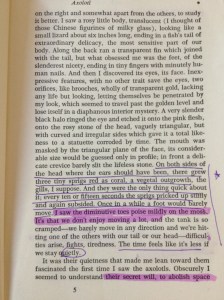
I was, I am, struck by this passage. These atavistic creatures capture, compress space and being. Identity breaks down—I, we, they are no longer discrete. What side are you on? Mother, Father Deaf.
non-negotiable photos
When I was eleven our family bought a deluxe conversion Dodge Caravan complete with metallic bronze customized paint job, rust colored velour captain’s chairs, and a boomerang-shaped television antenna. I went with my parents to the car dealer on a sticky August afternoon. “We want a minivan,” my mother signed to me, I voiced to the short man with greasy black hair and uncomfortably freckled arms. He immediately took us past rows of suburb-like cutouts of vans and led us to the Las Vegas model of minivans—all the deluxe features and without a deluxe price. A special deal. I signed this eagerly—I wanted my parents to understand as I did—we were lucky to see this car. It’s a familiar scene: father adjusting the seats and falling in love with cruise control; mother insisting it was more than they budgeted; the dealer crawling in the back and hollering out through the nifty sliding third door all of the fantastic features.
Inside the car. Tell them the back seat can be removed for more room. Tell them there’s an acoustical equalizer for the stereo. Tell them there’s air conditioning. Tell them there’s a threeyearthirtythousandmilewarranty. Tell them we do financing right here in the lot. Tell them.
Outside the car. Is this the best price? Does he have anything less expensive? Does it come with a warranty? Do you have special discounts? Are you telling us everything?
“Yes, they like all the extras.” No—best price.
We left the dealer and got back into our happy orange VW van. My bare legs stuck to the vinyl seats and I cried. My mother was upset: “What’s wrong? Did you want that car?”.
 The salesman knew my parents didn’t care about the equalizer or the TV monitor in the back seat; but he didn’t know they understood. “How nice of you to help your mother go to the store and do the groceries” while my mother writes a check, looking at the cash register screen for the correct amount. I am the mute one. “What did the lady say?” my mother asks; “nothing,” is my silent reply. Nothing. Nothing. Nothing.
Yes, my mother has a college degree. Table 7 shows that the proportion of persons 18 years of age and over with under 12 years of education increases monotonically as the level of their hearing ability decreases. A bachelor of library sciences. No, she does not work in a library. They were afraid of what would happen if she answered the phone. They were afraid of hearing a deaf woman speak. We moved several times when the rent for one reason or another had to go up; even being six you become familiar with friendly discomfort. Interpreting for my mother when she caught my landlord in a contradictory lie—the distrust on both sides boomeranged off my nine-year old body.
In that parking lot, the traffic of misunderstanding and mistrust, all I wanted to do was to hide my lips, shield my transparent body so that neither side would see they were being betrayed.
talking pictures
The stage is dark, but the theatre is vibrating. “Red hots . . .” lingers in the air. My dad taps me on the shoulder. What does the music sound like?
My father is sitting to my left, my husband to my right. It is between scenes at the DEAFWEST performance of Tennessee Williams’s A Streetcar Named Desire. I’m thrilled to watch the interpreters peering from the balcony above; their voices float above the Deaf actors who take center stage. Sign language takes center stage. The interpreters are for the hearing. The dividing line of the stage is several feet ahead of us. Blanche Dubois begins signing to Stella on the stage. But unlike the other Deaf actors, Blanche speaks with her own voice; the interpreters above are silent. Her signs are stiff, they struggle to keep up with her vocal cadence. I nod as I watch, transfixed: everything has been reversed.
I quickly sign to my father: She is speaking. She’s hearing! Then I lean over and whisper to my husband: her signing. It’s not Deaf. She’s hearing.
I am signing Deaf. I am whispering Hearing.
Cara Cardinale gives sound to her narrative with her mother’s voice–“sounding out” against audist notions of sound that keep Deaf voices silent and perpetuate the idea that deafness is interchangeable with muteness. She would like to thank her mother for sharing her beautiful voice, which to a CODA is a distinctive and comforting sound but often carries a stigma outside the home. Cara uses her own signing body here, not as interpreter, but as primary narration of this intimate photograph.
From his jacket pocket, my father pulls out his hearing aid still marked with red dormitory tape from his years at the residential state school for the Deaf; the opaque embossed letters have slowly curled back on themselves. He adjusts the petrified, squealing earmold then smiles at me.
photo emulsion
Her hands are strapped to the hospital bed. More violent than the search for willing veins to take the sedatives, is the silencing. I cover my mouth to keep from gagging. In the darkness, I watch the television screen as it shows the tour of my mother’s internal body: my face looking back at me against the glass.
The doctor freezes the image and points out the polyps clinging to the intestinal walls. But I see gestation, birth—I am looking from the inside out:
If there exists a border-line surface between such an inside and outside, this surface is painful on both sides. When we experience this passage . . . intimate space loses its clarity, while exterior space loses its void–Gaston Bachelard, The Poetics of Space (218).
It was my body in her body and I found myself looking for the lost baby from years ago; perhaps it was there, inside of her body, my body.
The intimacy, the motion still in the blurrr of the photograph. I am fascinated with a delightful dread, horror. Her name in captions, my name. Her body, my body. That picture says everything about my body. Everything about sitting between my father and my husband: lines drawn between us in the newly reupholstered seats, steel blue like everything new, between the actors and the audience, close enough to see the eyeliner drawn in for emphasis, between the Deaf actors on the stage and the hearing interpreters peering over them on the balcony.
I am transfixed. No transition and no surprise, I saw my face against the glass, I saw it on the outside of the tank, I saw it on the other side of the glass. Then my face drew back and I understood.
Florescent lights saturate the room. I lean forward; take a breath; faint.
center of vision
Sometime within the last six months, my father’s left eye has had an aneurysm. This led to a detached retina and a burst blood vessel. The blood has been slowly moving towards the center of vision. During the day, my father sees shadows. And my mother has been hearing things. Last week she was startled by a high pitched noise; moments later the light in the kitchen flashed indicating that the phone was ringing. Lines are bleeding. The darkness is terrifying for my father in the same way that sound has become disorienting for my mother. And lately I’ve been on the verge of vertigo. It seems as if it were the moving forwards and looking backwards at the same time that’s been disorienting me.
I go with my father to see a retinal specialist. Once in the examining room, I am in the dark again. I am signing in the dark, but my father cannot hold my hand. He is across the room, peering at me with one eye, seeing my signs with the shadow of the pinlight. It must be dark, they explain, his eye needs time to dilate, to open so we can see inside. He will be injected with a kind of serum so that the shadow can be seen.
While we wait for the dizzy eye to dilate, I describe my vertigo to my father. He notes with interest and nods, yes, mother took me to doctors in Washington D.C. He looks at me. Your age. Even the emergency room. Nothing wrong. Gone—he signs with a shrug. Maybe gone—he points at me—soon.
The doctor returns and looks into my father’s eye. The serum has worked, and the image is transparent.
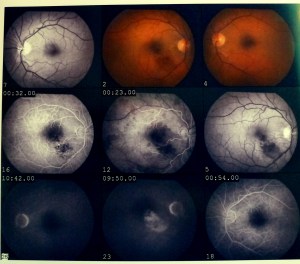
I see his eye, enlarged, disembodied, projected on the screen behind him. It is beautiful and dark, a moonscape clouded over by an eclipse. Everything is transparent, and I think of the axolotls.
—
C.L. Cardinale has a PhD in English Literature from University of California, Riverside. Currently she is editing her manuscript on what she calls “look-listening”—deafened gestures—in twentieth century narratives. She also publicly reads Proust, edits for Lettered Press, and sings with her one and six year old in California’s east bay.
Share this:

On Donuts, Sandwiches and Beattapes: Listening for J Dilla Six Years On

"J Dilla aka Jay Dee R.I.P." by Flickr user Ohm 17 under Creative Commons License
It has been six years this week since the passing of James “J Dilla” Yancey, considered by many in hip-hop as the quintessential producer’s producer. Over the course of his career the Detroit-born beatmaker garnered production credits with artists ranging from The Pharcyde to Janet Jackson. Since his passing there has been a substantial amount of posthumous output, including a Yancey Boys album with his brother Illa J, Ruff Draft, The Shining and Jay Stay Paid. There have also been the tons of unofficial releases by artists using material from his beattapes without prior permission. An unofficial discography of projects ‘featuring’ Dilla’s work could eclipse his official one.
Dilla’s beattapes, which he shared amongst friends and associates via CDs, eventually traveled the globe via message boards years prior to his passing. His legacy became what it is, at least in part, due to the reach of these CDs, but unfortunately it has also made monetizing the work after his passing a difficult task. There were early issues between Dilla’s family and the legal estate, but for the last couple of years there has been a process established which allows for the use of tracks from his vaults. They are currently set to release The Rebirth of Detroit, which boasts unheard Dilla beats featuring the Detroit artists he came up with:
In addition to posthumous releases under Dilla’s name the estate also licenses tracks for projects by other artists. With over 4000 tracks in their possession, it stands to reason there will be plenty more Dilla in the future. Yet still there is a sense that ‘new Dilla’ will never be new again, as in the future we will only be able to look at Dilla’s past. How would his process as an artist have grown? Surely whatever he was doing before he passed sounds nothing like what he would be doing in 2012.
Fortunately, the creativity of Dilla lives on through his influence on others. In the years since his passing, that influence has gone beyond hip-hop into jazz, indie rock, classical, and electronic music; some might argue Dilla’s influence has spawned new styles or even genres of music . The LA beat scene was seemingly born in homage to him; with its off kilter drums and wild sample chops, it extends beyond the initial influence, projecting into the future a lineage which will forever trace back to Dilla. Another of those lineages takes Dilla to perhaps the least likely place for a hip-hop producer: late-night television, through the figure of Ahmir “?uestlove” Thompson of The Roots.
At the end of the 90s until around 2001, Dilla was a member of The Soulquarians creative team that produced albums for Erykah Badu, D’Angelo, Common, and Bilal:
During this time Dilla worked closely with drummer, producer, and founding member of The Roots ?uestlove. There was a musical bond established over countless studio hours which allowed for a fusion of styles between them that carried Yancey from his Jay Dee period into his J Dilla period, and which ?uestlove continues to carry to this day.
Since Dilla’s passing, ?uest has been an instrumental voice in keeping Dilla’s legacy alive. He regularly DJ’s events celebrating Dilla’s work. On all of The Roots albums except for the most recent one, there have been musical dedications to Dilla. It is when ?uest goes into the studio with The Roots, however, that the living continuation of their musical fusion can be found.
The studio is where ?uest spends a lot of his time, rehearsing The Roots for their role as the house band on the Late Night with Jimmy Fallon show; ?uest records the sessions to listen back before and after the show. On Late Night The Roots play new songs in front of a live audience five nights a week. These songs only air for ten to twenty seconds going in and out of commercials. If you run to grab something from the refrigerator you might miss them. Or, coming back you might find your head nodding to them. Not only are they original works (other than walk on music for show guests, and musical performances), they are an insight into the creative process which shaped both ?uest and Dilla.
?uest names the tracks Sandwiches, a nod to his former collaborator’s Donuts. Donuts was the last official project that Dilla worked on, quite literally on his death bed, and is considered his instrumental opus. It opened up the notion of the short-form instrumental hip-hop work, which traces its own lineage to the history of beattapes. Today, a beattape is a collection of hip-hop instrumentals released as a product through distribution channels (free or paid). In the beginning however, beattapes were physical cassette tapes (and later CD-Rs) passed around from hand to hand. Tracks from beattapes were snippets of beats often recorded right after they were made so the producer could listen to them again outside of the studio setting. They were passed amongst friends and eventually within the industry as a means of selling the producer’s beats.
Early beattapes were not meant for public consumption or as cohesive projects. It’s important to remember that at the time you didn’t finish productions in a home or project studio. Artists, labels, producers etc. would listen to a beattape and select tracks to be purchased for a project. If a beat was bought, the producer would meet the artist in a large studio with an engineer, which is where the beat went into production. The beattape at the time was not considered a final anything, but a sketch of what could become a production.
In addition, beattapes had a secondary purpose as a measure of skill and technique. They became a format for rehearsal and practice. Where a traditional instrumentalist may practice chord changes on their instrument, a beat maker makes beats and records them for easy playback later. For example, a producer could decide to sample the same record as another producer to show how they would use the sample differently. There would be no intent to turn such a track into a full fledged song (though it could happen), instead it would be recorded so they could play it back to a friend or even the producer who originally used the sample for bragging rights.
Dilla was an active participant in this trade. His beat CDs became his calling card particularly for the techniques displayed on them. Donuts was his expansion of that beattape format. Rather than a display of short rough sketches that serve as indications of productions to come, Dilla produced intricate and layered flaunts of technique compacted into short sketches.
The most recognized technique from Donuts is the chop. The chop comes out of the stab line of techniques. A stab is a single instrumental hit played on a sampler. On the MPC line of samplers (which Dilla was famous for using), stabs could be spread across trigger pads pitch shifted chromatically allowing melodic sequences to be played using a single stab. The chop takes that a step further by using multiple samples from the same source (chops) to replace the chromatic stabs, and play melodically. What Dilla displayed on Donuts however, is not merely the chop but the variety of techniques available by which a producer can chop. Working outside the limitations of loops and stabs, new techniques like drum and instrument isolation, de-quantization, vocal stabs and more come at you, one layered technique after the other.
Many of these techniques have been canonized today, but some quality has been lost with that normalization. With de-quantization by example, overuse has practically rendered the technique cliché because its depth was reduced by its definition. De-quantization translates to simply turning off the preference in software programs or hardware beat machines that align all sound triggers to the grid of the tempo and time signature. That definition speaks nothing to what Dilla actually did with that preference off, which was impose his own humanized sense of timing onto the de-quantized patterns of the machine.
Of those that followed Dilla, most got the de-quantization part but missed his sense of time. While de-quantization has shown influence, outside of the ‘stock Dilla’ pattern, his sense of timing has been continued by only a few. At the top of that list is ?uestlove, as he is as responsible for the development of that sense of timing as Dilla is his own. The root of that development can be found in the The Soulquarians period, which can be marked as the time both artists came into their own by working together. That they would come together at all was quite serendipitous, as no player has a better sense of timing than a drummer. It was the mutual sense of timing between Dilla and ?uest that worked to produce the amazing material that resulted.
In The Soulquarians studio sessions ?uest and Dilla created a feedback loop between the drum machine and the drums. This pushed their sense of time as they fused a sonic texture for their drums, which can be heard between their productions. There is a shuffling urgency with a tick of hats between pulses that lead one into the other; the snare or clap crisp, never aggressively cracking, the kick big but not over dominant. It is sequence-based music turned into grooves that maintain the variable constraints of the sequence. They each took these elements with them in their post Soulquarians work, and after Dilla’s passing, you can frequently hear ?uest calling back to those days through his music.
Take a Sandwich like “Gross Understatement.” At the onset a drum loop with a prominent clap is layered into the snare on alternate hits, while a keyboard moves through presets until an organ sound is found. The bass noodles patiently until, with a chord, they meet. When ?uest comes in it takes a couple of bars of him pushing the drums to get everyone else to fall in on his time, but once it hits he can’t control himself, letting out a holler, “something flew out the gate.” What follows is three minutes of magic as the band jams to a grove that is the perfect cross between Dilla and ?uest.
Gross Understatement (G minor) #Sandwich 1397
Up until November 2011, by ?uest’s count, The Roots had created almost 1800 Sandwiches. He has released a stream of Sandwiches through his Swift FM account (the page is currently down until the site relaunches). By his own admission though, all of the Sandwiches aren’t as good as “Gross Understatement.” Out of the 2 to 23 they record each day, he says only about 1 in 19 are bangers. At 94 out of 1800 it isn’t a bad count, enough for nine albums. The only format in these tracks exist however, is as they appear on Late Night, on ?uest’s harddrive and whatever Sandwiches he decides to share. What would a studio project of this material sound like? As big of an audience as they receive on Late Nite, Sandwiches are buried in the mix of television things where it’s not easy to give them the musical attention they deserve. Perhaps in the future an official release of a project from this line will emerge. In the meantime catch them on NBC when you can and stay tuned to ?uest’s social stream.
—
Primus Luta is a husband and father of two (maybe three by the time this goes up). He is a writer and an artist exploring the intersection of technology and art, and their philosophical implications. He is a regular guest contributor to the Create Digital Music website, and maintains his own AvantUrb site. Luta is a regular presenter for the Rhythm Incursions Podcast series with his monthly show RIPL. As an artist he is a founding member of the live electronic music collective Concrète Sound System, which spins off into a record label for the exploratory realms of sound in 2012. Luta is currently working on completing his first book, BeatGenealogy: A History of the Electronic Beat From WWII to Now.
Share this:


Current Top Posts





April 2021

January 2020

November 2019

October 2019

August 2019

April 2014

November 2017

March 2015

December 2017

October 2015
 Sounding Out!
Recent Comments