
Sonic Brownface: Representations of Mexicanness in an Era of Discontent

Image by Flickr User Thomas Hawk
In the current anti-immigrant climate, the visual, sonic, and textual modes of representation are becoming battlegrounds we must consider. Arizona, Georgia, and Alabama’s takes on immigration policy and eliminations of ethnic study course offerings from college and high school curricula, are signs of a climate fraught with discontent. However, these fights are not limited solely to the political sphere; in fact, the arena of cultural production—music, literature, theater, and film—facilitates a generalized outlook on Latinidad in the United States by representing Dreamers (the generations of children who were raised in the U.S. from a young age but are not citizens), and/or the thousands of undocumented immigrants who sustain an infrastructure of cheap labor. Within these often stereotypical representations, it is frequently sound that produces the strongest sense of social, cultural, and political difference for Latino subjects.
In this post, I analyze the 2006 film Nacho Libre, a comedy starring Jack Black as a friar who becomes a Lucha Libre fighter, as symptomatic of what I term “sonic brownface,” an aural performativity of Mexicanness. My interest on Nacho Libre is to elucidate how sonic brownface manifests on the big screen, and what is at stake through these seemingly innocent (re)presentations of Mexicanness. I characterize “sonic brownface” as a “speedification” of a Mexican accent, named after Speedy Gonzalez’ infamous call “¡Ándale! ¡Ándale! ¡Arriba! ¡Arriba! ¡Epa! ¡Epa! ¡Epa!” Although comedian Jack Black intends to present a respectful portrayal of a Mexican, his speech enables my analysis of “sonic brownface” within popular culture, a sound that reproduces ideologies about an invisible majority that is also perceived as non-American: Latinos, undocumented immigrants, and dreamers.

The May 1, 2006 protest in Los Angeles, Image by Flickr user The Korean Resource Center 민족학교
Voicing the Other…

Popular silent-era leading man Ramon Novarro (née José Ramón Gil Samaniego) as photographed by Carl Van Vechten in 1935
The last scene of the Academy Award winning film The Artist (2011), presents why the silent film Artist was against the industry’s move toward the “talkie.” His voice collided with the visual representation of the suave debonair cosmopolitan man—and audience expectations of what such privilege sounds like. Though French actor Jean Dujardin plays the lead character in the film The Artist, it must be noted that several Mexican and Latin American actors did quite well in those early years of Hollywood cinema. Their exotic looks made them desirable and allowed audiences to fantasize about the man or woman on the screen because they could not hear them speak. Moreover, their physicality allowed some actors to “pass” as white. When talkies became the norm, Latino actors began performing now familiar stereotypical characters because in the U.S., their voices were indelibly associated with their “foreignness.”
In the realm of popular culture, both Disney and Warner Brothers created their own “Mexican” characters. In 1944, Disney introduced a Mexican and a Brazilian in the animated film Three Caballeros. Joaquin Garay was a Mexican voice actor featured in the voice of Panchito Pistoles in the Three Caballeros.
.
His accent and his singing sounded like someone who is Mexican speaking English, as oppose to an exaggerated Mexican accent heard later in the cartoon character of Speedy Gonzalez. Panchito Pistolas showcases a pride in being Mexican as heard in the singing of a ranchera and wearing his gun like the Mexican Revolutionaries of the 1910s. In the 1950s, Warner Brothers introduced Speedy Gonzales to their pantheon of animated characters, coinciding with the next wave of anti-Mexican sentiment during the campaign of Operation Wetback.
In his essay “Autopsy of a Rat,” William Nericcio posits that viewers come to recognize a series of stereotypes about Mexicans through the animated character of Speedy Gonzales. Nericcio incorporates historical references that influenced the design and creation of Gonzalez. He stipulates that this animation creates visual cues which American audiences connect as qualities of Mexicanness, “how this popular animated star comes to function in a way that reinforces politically charged, visions/versions of the ‘Mexican’ on ‘American’ soil” (212). Nericcio emphasizes the “visuo-ethnic clues” to deconstruct the Speedy Gonzales cartoon, and his definition of the stereotype helps corroborates my interest in how “sonic brownface” manifests as a “Speedification” of a Mexican accent. “Strapped for existential input as to the dynamic of Mexican subjects, we turn to stereotypes to provide us with visuo-ethnic ‘clues’ that fill in for empirical data and satisfy the lazy desire of our collective curiosity (219). Whereas Nericcio emphasizes the visual, however, I argue that sound has also held a strong purchase on the American racial imaginary in the case of Latinos. When audiences see and hear Jack Black as Nacho Libre, for example, they already recognize the accent.
Nacho Libre, sonic brownface personified
I propose the concept of “sonic brownface,” which pairs auditory with visual signs of Mexicanness as mediated in popular culture, to characterize the Mexican as a perpetual foreigner within the national imaginary. My interest in a film like Nacho Libre is to elucidate how audiences already recognize “Speedification,” a voicing of Mexicanness that manifests as a performance of “sonic brownface.” This conceptualization of “sonic brownface” is informed by Jennifer Stoever-Ackerman’s work on the “sonic color-line.” In “Splicing the Sonic Color-Line: Tony Schwartz Remixes Postwar Nueva York,” she posits that “sound is not merely a scientific phenomenon—vibrations passing through matter at particular frequencies—it is also a set of social relations … the “sonic color-line” begins to theorize the mutually constitutive relationship between sound, listening, and race.” She elaborates how “aural signifiers of race are thoroughly enmeshed with the visuality of race [because] they never really lose their ultimate referent to different types of bodies” (65). In the case of “sonic brownface,” Jack Black does not need to be a Mexican actor, he just needs to sound “Mexican” to conjure a physical referent.
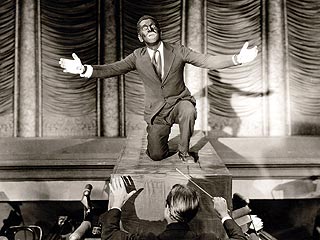
Still from The Jazz Singer
In utilizing the term “brownface,” I also reference minstrel entertainment in which blackness fetishized and simultaneously disavowed African American entertainers consequently framing racial codes onto a spectrum of racialized bodies. In his analysis of the first talkie The Jazz Singer (1927) “Blackface, White Noise,” Michael Rogin proposes that the “protagonist adopts a black mask and ventriloquiz[es]the black, sings through his mouth” (419). Through this masking, the Jazz Singer becomes Americanized through “appropriat[ing] an imaginary blackness” (421). Even as our contemporary sensibility would call out any form of contemporary blackface performance, we have yet to identify a similar masking when it occurs with Mexican or Latino characters. I contend that the models seen in blackface entertainment have already placed familiar scenarios of seeing White or Jewish actors performing an ethnic Other. When American audiences see Jack Black as “Nacho Libre,” they do not need to see him brown his skin; it is enough to hear a “speedification” of Spanish to have us entertain his believability. When “sonic brownface” occurs, it does not Americanize the performer, rather it perpetuates the Mexican and by extension Chicanos and Latinos as always already foreigners.
In order to recognize how “sonic brownface” is performed in the comedy Nacho Libre, it is also necessary to understand how its sound echoes a political climate that conflates “Mexican” with “Immigrant,” thereby representing Mexicans as undocumented people who have no right to be on this side of the U.S./Mexico border, and lumps all Latinos together as “Mexican.” The film was released a month after the nation’s largest immigrant rallies on May 1, 2006, occurring throughout many cities. The timing of the film also coincided with the first series of policy measures on immigration reform proposed by Congress. Whereas before the May Day marches, some members of congress discussed immigrants as criminals, after the big turnout Congress changed their tune, beginning to consider amnesty or easier paths to citizenship for undocumented immigrants, including generation Dreamers, already raised and finishing their schooling in the States. Cue Jack Black.

Image by Flickr User Thommy Browne
Speedification del Celluloid: “sonic brownface” in Nacho Libre
Nacho Libre, directed by Jared Hess (of Napoleon Dynamite fame) presents a comedic fictionalization of the story of Fray Tormenta, a career Lucha Libre fighter who was actually Reverend Sergio Gutiérrez Benitez. The film highlights Black’s strengths as a singer and presents him in a character that is the classic underdog trying to achieve his wrestling dream. As Nacho, the cook for the orphanage, he also wishes to provide the children a better meal, at least once in a while. I will highlight a few scenes in which Black’s sonic brownface performance stands in contrast to the other Mexican cinema actors who speak English. I will conclude with a proposition as to why sonic brownface is already so familiar to us.
From the opening sequence, we see the quaint orphanage located in a small Mexican pueblo. “Sonic brownface” is introduced in the film from Black’s first words “Be grateful Juan Pablo today is especially delicious.” In the next sequence, Hess films the Father saying mass in Spanish with no translation, or subtitles. I point this out because it sets up a type of authenticity with the Mexican orphanage, and that the film brings together both American actors speaking “Es-Pan-ish” and Mexican actors speaking in English. Ana de la Reguera, “Sister Encarnación,”–a nun who arrives to teach the children–also does not perform sonic brownface. She sounds like a Mexican actress speaking English, very much like other Mexican actors preceding her in Hollywood, adding a third later of sonic representation that actually works to heighten sonic brownface’s effects.
However, the sequence that most prominently presents the visual and auditory cues of sonic brownface appear in a twenty-minute segment when Nacho recruits his partner, Esquelito, and they transform into luchadores. In the midst of Nacho’s transformation, he must also contend with his carnal feelings for Sister Encarnación and to instruct the boys that wrestling is not good. Black goes from Italian in “taste of glory” (19:114-16); to Cuban “take it easy” (24:03); to urban Mexican American “my life is good, really good. It’s fantastic” (35:50). The sequence ends as Nacho cannot defend Sister Encarnación and blames Esqueleto for the mishap. Here sonic blackface culminates this performativity of Other with “get that corn outta my face. I looked like a fool last night. What took you so long?!” (39:54-40:29).
One could read this performativity of Otherness in the remix of accents as Black’s self-awareness that he is voicing something not of his experience. However, that he is Jewish and a comedian implies a privileged position already granted to him through blackface performances: the permission to co-opt ethnic and racial identities. When he inflects a Cubanesque accent, audiences can recall Al Pacino in Scarface, an earlier articulation of “sonic brownface.” Or the urban Chicano accent as seen in Born in East L.A. when Cheech Marin teaches the Mexicans waiting to cross the border how to blend in with Chicanos. By the time Black performs sonic blackface, as audiences we have been cued to these auditory references, thus we do not need him to alter his physicality to match the accent. It is enough to hear it to understand the referent. The sequence reaffirms Nacho as the luchador, since we also see his persona of the fighter come to life.
Rogin’s analysis can help us understand these slippages, as well as the role of “sonic brownface” in representations of Latinos by white actors. Rogin posits how Jolson’s performance in the first talkie simultaneously killed Vaudeville entertainment and reintroduced blackface into popular media (429). It is Rogin’s conclusion that it is with the appearance of “Jack Robin” in blackface, that the Jewish individual “Jakie Robinowitz” becomes white and thereby successful, mediating this success through visual codes of blackness. Similarly, in Nacho Libre, sonic brownface operates as both the visual and sonic cues of Mexicanness that enable Jack Black to become the luchador who doesn’t need to live behind a mask. As the film ends, Nacho is content, becoming a hero to the orphans who no longer bemoans his lot in life. This ending is contrary to the plight of immigrants from Latin America who must leave their home in search of better economic opportunities.
By identifying sonic brownface, we can see how American audiences fetishize the sounds of the Mexican/Latin Other yet simultaneously disavow their presence by placing non-Latino actors in these roles. Through the performativity of sonic brownface, popular media and film reify codes of Mexicanness as always foreign, silencing their accents because español is still an unwelcomed sound. Sonic brownface can also be a useful tool by which to investigate similar auditory articulations of Latino sounds. I’m thinking here of Rita Moreno in West Side Story (1961)—see Priscilla Peña Ovalle‘s Sounding Out! post “Aurally Other: Rita Moreno and the Articulation of ‘Latina-ness’” (January 2011)–George Lopez in Beverly Hills Chihuahua (2008), Wilmer Valderrama “Fez” in the television series That 70s Show, and the panoply of Latino actors in Machete (2010) by Richard Rodriguez. Given that media tends to recycle tropes and stereotypes, as audience members we have developed a keen awareness of these sonic markings of Otherness.
Most importantly, my intent in identifying sonic brownface concerns its re-appearance during another surge of anti-immigrant rhetoric. The rallies that occurred on May Day 2006 became synomous with immigrant rights. The release of Nacho Libre shortly after these rallies unknowingly silenced immigrant Spanish speaking voices in the popular imaginary until the film A Better Life (2011) staring Demián Bichir, connected undocumented immigrants with an empathetic experience. The strongest counteractions, however, have not been channeled through Hollywood. With the 2012 election, another surge of immigrant rallies happened at the Democratic National Convention with UndocuBus riders arriving in time to call attention to immigrant rights (start at 8:10-11:24).
As seen in this video clip, undocumented immigrants, Dreamers, Latina/s, and Chicana/os committed acts of civil disobedience because their voices will not be silenced.
—
reina alejandra prado saldivar is an art historian, curator, and an adjunct lecturer in the Social Science Division of Glendale Community College in Glendale, California.As a cultural activist, she focused her earlier research on Chicano cultural production and the visual arts. Prado is also a poet and performance artist known for her interactive durational work Take a Piece of my Heart as the character Santa Perversa (www.santaperversa.com) and is currently working on her first solo performance entitled Whipped!
—
 REWIND! . . .If you liked this post, you may also dig:
Sound and Curation; or, Cruisin’ through the galleries, posing as an audiophiliac-–reina alejandra prado saldivar
Chicana Radio Activists and the Sounds of Chicana Feminisms–Monica De La Torre
Listening to Modern Family’s Accent–Juan Sebastian Ferrada and Dolores Inés Casillas
Share this:

Regulating the Carceral Soundscape: Media Policy in Prison

In Alcatraz, prisoners were allowed to listen to radio via this two-channel device; Image by Flickr user adrian8_8
The first thing I noticed about 4-block was the silence. It was so quiet that every time I sat on my bunk I fell asleep. The Reformatory was always one continuous roar, musicfrom radios and televisions, noise from guys shouting to one another up and down the block, it seemed to never end. But in Jackson it was very, very different. The daytime hours you could hear typewriters and the closing of cell doors, the phone at the guards desk ringing but that was it. And after 9:00 PM you heard absolutely nothing …” –“Chet” (qtd. in Music Behind Bars: Liberatory Musicology in Two Michigan Prisons, 66-67)
Film and television usually portray prison as the loudest place on earth, filled with nonstop clanking and shouting and slamming, the noise reverberating sharply off its hard, flat surfaces. Actually, prison is much more likely to be a binary soundscape: either too loud or, at times, inhumanly quiet.
In fact, the manipulation of the sonic environment behind bars is part of the punishment mechanism itself, imposing or withholding different kinds of sound from different kinds of prisoners. There is a long history of prison music and prison radio, often within the context of education and activities aimed at recreation and rehabilitation, but here I’m talking about the mundane sounds of closing gates, locking doors, intrusive PA announcements, whirring fans, banging buckets, clattering garbage cans, and of course the human voice at any and all hours and volume levels: the inescapable sounds of quotidian prison life. The denial of the inmates’ ability to control that soundscape for themselves—or the compulsion that they do—thus becomes an issue not just of penal policy, but, interestingly, of media policy as well.
Indeed, the most fascinating questions in media policy these days are arising not at the FCC or OFCOM, but in places where policy scholars don’t usually look: schools, cinemas, and prisons. The state may have a lock on binding legislation, spectrum allocation, and international trade agreements, but it is the everyday policymakers on the school board or in the guard tower who directly affect more lives. With their pronouncements on which media forms may be used by whom, in what ways, and for what purposes, such accidental policymakers seek to regulate behavior through culture. Therefore, it is crucial to consider: which behaviors? which culture? and with which understandings of the relationship between the two?
One such instance of vernacular policymaking came last year when the Bureau of Prisons began testing the use of mp3 players in federal prisons, a technological update on rules that already allowed radios, televisions, and portable cassette or CD players. The move opens up new vistas of choice and control for the prisoners, who are no longer limited to the 20-30 cassette tapes or CDs for their Walkmen that cell space allows, nor dependent on the spotty radio reception in the rural areas where many prisons are located (a spatial impact which itself is an effect of multiple layers of ideology, policy, and control). Unsurprisingly, the players have become many prisoners’ most prized commodity, though the control they may exercise is far from absolute. The song selection is vetted by authorities (no “Cop Killer” in the Penitential Jukebox, don’t you know) and a remote kill switch allows the warden to brick the player should an inmate’s privileges be revoked, or in the case of theft or barter (trading goods and services is almost always a no-no in prison, a prohibition only slightly more effective, one guesses, than the ban on masturbation).

JPay’s JP4, The most common Mp3 device in U.S. Prisons
The introduction of mp3 players reveals not just the power and problems of local policymaking but the ways in which sound functions within a carceral system. For authorities, sound is “noise” when it interferes with security and a disciplinary tool when it doesn’t. As Robert Powitz’s article, “A Simple Primer on Jail Noise Control” reminds readers of American Jails, the trade publication for the prison industry, “Good security practices dictate that we want to hear certain sounds, particularly those associated with malfunctioning mechanical systems such as ventilation and plumbing, and more importantly, we need to hear a correctional officer’s call for help, an inmate in distress, and even seditious conversation” (Sep./Oct. 2007, 104). While it is surprisingly nice that Powitz threw “an inmate in distress” in the article, he otherwise presents an exclusively top-down rationale for separating sound from noise; Michel Foucault’s emphasis on the visual panopticon notwithstanding, which several scholars have critiqued, aural surveillance is equally important to the well functioning disciplinary institution and the production of docile bodies.

The Visitation Area at the former Moundsville State Penitentiary in West Virginia; Image by Flickr user IndyDina
Sound that American Jails would not classify as “noise”— i.e. sound that doesn’t interfere with security operations—is not merely incidental ambience, however, as the well-regulated soundscape produces its own disciplinary effects. The tortuous sensory deprivation of solitary confinement commonly includes the removal of sonic stimulation: silence as punishment. Already in the 1830s Alexis de Tocqueville critiqued the cruel silence imposed on prisoners in the U.S., and contemporary research repeatedly confirms the mentally destabilizing effects of sonic deprivation (see e.g. here and here). Total sonic deprivation is merely an extreme, however; there is an array of situations involving sound management. For example, conversations with visitors often occur through soundproof glass; obviously the surveillance function of this setup is paramount, but the distanciating filtration of the telephone adds further punishment through physical denial of the unmediated sound of a loved one’s voice. The raucous cacophony of the daytime cell block, meanwhile, acts efficiently as population control of another kind: as an incentive to self-regulate so as to enjoy the perks that enable one to escape the noise. The routines of prison policy intersect with the technologies of media policy to turn the chaotic soundscape into good behavior, through the mechanism of a prisoner’s desire for a pair of earbuds and some familiar tunes. (Media policies also turn that soundscape into a profit center: tracks on the prison’s version of iTunes cost between $1.29 and $1.99, obviously more than the going rate on the outside.)
Via the regulation of the aural environment, the authorities’ “sound”—the elements of the sonic environment that they impose or, at least, see no need to reduce or eliminate—thus becomes the prisoners’ “noise,” while prisoners’ “sound” can be either provided or withheld as part of the disciplinary and economic logic of the carceral system as a whole. As one prisoner, “Marcos,” summarized the system:
They pacify us with these so-called liberties, such as personal TVs, personal radios, personal guitars, tapes, cable TV, a complete store like the free world. And plenty of sports! Why–they call this our rights. In actuality it’s a break down in our system” (qtd. in Elsila, 56).
Such are the effects of so-called “personal” media for such an impersonal environment, for individuals who have been turned into social non-persons: media policy disguised as personal liberty rather than mass prisoner control. This disguise often fools the “throw away the key” law-and-order types who object to coddling criminals with the current Kenny Chesney track; for them, it is worth mentioning that the computers where prisoners download songs for their mp3 players are appropriately called—no joke—“Music Wardens.”
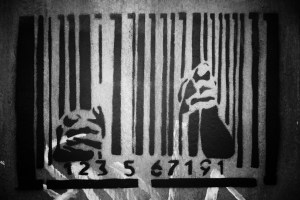
Image by Flickr User lanier67
Foucault’s great metaphor for the disciplinary society—the prison as a template of surveillance and control that has been adapted to all spheres of modern life—becomes punishingly literal behind bars, but that is merely where it is most visible or, often, audible. As I explain to my students, media policymakers claim merely to regulate gadgets, physics, and economic relations, but in fact they are always and inevitably also regulating bodies and ideas. The production of the prison soundscape reveals the relation of policy to conduct, a relation that in everyday life often remains cloaked behind scientific and legal discourses.
A final point: equally punishingly literal is the notion of media effects held by those policymakers in the prisons. Inveterate behaviorists, they imagine–and then attempt to manipulate–a direct causal relationship between media consumption and action, between sound and deeds. Those manipulations, however, are a broken media policy for a broken system. As Marcos put it, speaking of the many entertainment options available to the docile inmate: “Even before I ever could imagine I was going to end up in prison, never in my wild imagination could I expect it to be this easy. Yes I said easy. We have no serious form of rehabilitation. . .Why does the state spend more on activities than education?”
—
Thanks to Genevieve Spinner for invaluable research assistance on this project.
—
Bill Kirkpatrick is Assistant Professor of Media and Cultural Studies in the Communication Department at Denison University. His ongoing research and teaching interests include media history and cultural policy; impacts of popular culture on American public life; theories, practices, and future of citizen-produced media; and media and disability. He is also co-producer of Aca-Media, a monthly podcast that presents an academic perspective on media. You can find out more at www.billkirkpatrick.net.
—
REWIND! . . .If you liked this post, you may also dig:
Prison Music: Containment, Escape, and the Sound of America—Jeb Middlebrook
SO! Reads: Jonathan Sterne’s MP3: The Meaning of a Format–Aaron Trammell
Pushing Play: What Makes the Portable Cassette Recorder Interesting?-Gus Stadler
Share this:


Current Top Posts





April 2021

January 2020

November 2019

October 2019

August 2019

April 2014

November 2017

March 2015

December 2017

October 2015
 Sounding Out!
Recent Comments