
SO! Reads: Isaac Weiner’s Religion Out Loud: Religious Sound, Public Space, and American Pluralism

 Calling devotees to prayer, preaching on the subway, broadcasted pre-recorded sermons from a moving car, organizing drum circles in the park, resounding church bells through the city – expressions of faith to some, a nuisance, or even a personal offense (or outright danger), to others. Must religion be so noisy? Must it also be so publicly noisy?
 Religious studies scholar Isaac Weiner portrays public loudness as but one of many exigencies of the religious worldview in his recent publication, Religion Out Loud: Religious Sound, Public Space, and American Pluralism (New York: New York University Press: 2014). Weiner argues that the substantive content of religious doctrine – moral claims, theological arguments, etc. – both constitutes and is constituted by how its ideas are given expression. This might seem unremarkable. However, the claim allows Weiner to re-frame religious pluralism as not only a “matter of competing values, truth claims, or moral doctrines, but of different styles of public practice, of fundamentally different ways of using body and space.” (200)
So, according to Weiner, yes: Some religious groups must be so noisy, and must be noisy publicly. If they weren’t, their religious beliefs and doctrines would be deprived of the expressive forms that imbue them with significance.

“Street Preacher” by Flickr user Tabitha Kaylee Hawk, CC BY-NC-ND 2.0
Weiner is Assistant Professor of Religious Studies in the Department of Comparative Studies at The Ohio State University. Weiner is not a card-carrying sound studies specialist. Nonetheless, his output is representative of a quickly accelerating interest about religion and spirituality within studies of sound and culture. Religion Out Loud is his first book, and builds from themes explored in his previous publications, including articles such as “Sound” (Material Religion 7, no. 1 [2011]: 108-115), “Sound and American Religions” (Religion Compass 3, no. 5 [September 2009]: 897-908), and “Displacement and Re-placement: The International Friendship Bell as a Translocative Technology of Memory” (Material Religion 5, no. 2 [July 2009]: 180-205). Forthcoming are several chapters and articles that closely relate to topics investigated in Religion Out Loud.
The text ranges from America’s colonial period through the early 2000s. It largely attends to legislative efforts seeking to circumscribe the practicing of what Weiner calls “religion out loud” – public, and perceivably exorbitant displays of sonic religiosity. On the other hand, Weiner also details the various ways in which religious practitioners have resisted legal containment. Weiner thus adds to an already copious literature about how contestations over sonic space reflect broader contestations over meaning and power, that includes texts such as Brandon Labelle’s Acoustic Territories: Sound Culture and Everyday Life (New York: Continuum, 2010), Karen Bijsterveld’s Mechanical Sound: Technology, Culture, and Public Problems of Noise in the Twentieth Century (Cambridge, MA: MIT Press, 2008), and other religion-related work like Philip V. Bohlman’s “Music Inside Out: Sounding Public Religion in a Post-Secular Europe” (in Music, Sound and Space, ed. Georgina Born, Cambridge: Cambridge University Press, 2013). This tension between the embodied practice and legal-discursive regulation of sonic spaces throws into relief what Weiner calls a “politics of religious sensation.” However, readers with an interest in the experiential dimensions of the “religious sensorium” should look elsewhere, perhaps the recent volume, Senses and Citizenship: Embodying Political Life, edited by Susanna Trnka (New York: Routledge, 2013). Religion Out Loud appeals more to readers with an interest in the political histories of religious rights and noise abatement policy, and the ways in which “religious sensation” has been regulated according to unstable conceptions of liberalism and pluralism in American jurisprudence.

“Preaching” by Flickr user Boston Public Library, CC BY 2.0
In order to span such a long temporal trajectory (essentially the history of the United States!), Weiner anchors Religion Out Loud in three historically disparate case studies. Each is preceded by a chapter of historical and theoretical contextualization. This forces Weiner to rapidly chronicle decades of developments in noise abatement policy. Yet he does so with both scrupulousness and concision, leaving remarkably few holes left unfilled. This gives the reader the benefit of charting the long-term effects of the policy changes that Weiner more focusedly interrogates. His approach thus differs quite markedly from some other important sound/religious studies literature, such as Leigh Schmidt’s Hearing Things: Religion, Illusion, and the American Enlightenment (Cambridge, MA: Harvard University Press, 2002), which investigates a single historical period in more concentrated fashion.
From chapter one’s onset, I was struck by the impressive depth of archival research Weiner has infused into his arguments. As a result, Weiner’s more speculative conclusions – generally modest in scope – have no shortage of evidence, and are altogether convincing. In chapter one, for instance, Weiner details shifting perceptions of church bells in colonial and postbellum America, an area well tilled in sound studies by the likes of Alain Corbin (Village Bells: Sound and Meaning in the Nineteenth-Century French Countryside, trans. Martin Thom, New York: Columbia University Press, 1998) and Richard Cullen Rath (How Early America Sounded, Ithaca and London: Cornell University Press, 2003). Weiner furthers this conversation by revealing how religious sounds such as church bells – what had receded to the background of what R. Murray Schafer called the “historical soundscape” – faced unprecedented scrutiny as the symbolic status of noise began to change. Likewise, city governments challenged congregants’ rights to occupy acoustic territory. In the burgeoning clamor of the modern city, noise meant progress and prosperity, for some listeners, but, for others, the stylized noise of religion practiced “out loud” signified a kind of regressive primitivism. Noise thus occupied both sides of the evolutionist coin that Weiner suggests ideologically underpinned religious self-understandings of the time.

“St. Mark’s Church Philadelphia” by Flickr user Library Company of Philadelphia
Weiner further explores the progressive/primitive duality in his first case study – Harrison v. St. Marks of 1877– in which Weiner quite brilliantly unravels how both perspectives were articulated in legal discourse. According to Weiner, complainants challenged the long-presumed public-acoustic prerogatives of Philadelphia’s fashionable St. Mark’s Protestant Episcopal Church. The main takeaway from the chapter is that St. Marks’s complainants voiced a formulation of suitable, modern, and thus normative religious practice as “properly disentangled from various forms of materiality and mediation, carefully circumscribed and respectful of its bounds, interiorized and intellectualized, invisible and inaudible.” (60) From the complainants’ perspective, noisy religion signified backward, immature religion. The court sided with this position, treating church bells as it would any other “extraneous” public noise. Yet in so doing, it ironically reinforced the cultural dominance of Protestantism. That is to say, by silencing St. Mark’s bells, the ostensibly secularized legal system set a precedent that legitimated the “subjugation” of all forms of religious practice to “proper modes of acceptable piety” – including “religious ‘others’” who lacked the pervasive influence that Protestantism could exercise in the public and political spheres, including the courts. (74)
In the second section, Weiner shifts his focus from acoustic territorialization to noisy religiosity as a form of dissent. He details how noise abatement legislation in the early twentieth century harkened a “new regulatory regime” that suppressed the activities of religious practitioners for whom “making noise was not merely incidental to their work; it was their work” (80). The Salvation and Army and the Jehovah’s Witnesses, Weiner shows, aggressively challenged norms of community outreach through provocative exhibitions of religious devotion in public spaces. However, while exercising freedoms of speech, religion, and public assembly, such groups turned unsuspecting citizens into “captive audiences,” and thus infringed upon rights to privacy. The style of practicing some liberties, as many scholars and critics have suggested, has throughout history limited the enjoyment of liberties by other parties.

“The Watchtower” by Flickr user Scott Kellum, CC BY-NC 2.0
Moreover, as Weiner rightly suggests in his second case study, Saia v. New York of 1946, civil liberties have always been carefully regulated by the state. Samuel Saia, a Jehovah’s Witness, drove around the city of Lockhart, NY, and used loudspeakers to broadcast inflammatory sermons from his car. He loudly exercised his first amendment rights through what Weiner calls “sound car religion.” Yet the city managed to treat the sermons’ noisiness as extraneous to Saia’s religion, rather than acknowledging the practice as partially constitutive of it. Lockhart’s noise abatement ordinance thus infringed upon his right to religious free exercise. To that end, Weiner repositions McLuhan’s famous “the medium is the message,” framing religion as media, as opposed to religion and media as separable concepts. Saia spread God’s word, and in doing so loudly fulfilled a core tenet of the Witness creed.
Throughout the case study, Weiner critiques the “liberal inclusionary ideology” that has come to characterize the Judeo-Christian tradition of American jurisprudence. But he curiously softens his otherwise pointed critique at the end of the chapter. Saia ultimately won the case, yet the Witnesses’ devotional style gradually became unmarked in the ensuing years, as they seemed to assimilate voluntarily to normative expectations of religious devotion. As such, Weiner suggests that dissenters in general often find that they can “afford to quiet down once they feel that their voices have been heard.” (135) While it is “important not to exaggerate the coercive effects of American law,” I would have nonetheless appreciated a more critical take on how the legal system had its cake and ate it too – that is, how it satisfied the demands of the Witnesses and also managed to keep them quiet. Indeed, Weiner’s mild conclusion may unsettle those readers who enjoyed the previous three chapters of incisive and nuanced analysis.

“Carillon of Peter And Paul Cathedral in Saint-Petersburg” by Wikimedia user RuED, CC BY-SA 3.0
In the last section, Weiner shows how a controversial 1990 Supreme Court decision – Employment Division v. Smith, spearheaded by Justice Antonin Scalia – enacted into law a conception of religiosity as interiorized, intellectualized, and privatized. It favored majoritarian notions of religious free exercise such that dissenting – or noisy – religious practice by minority religious subjects risked criminalization. As a result, the granting of religious exemption from preclusive noise ordinances was left not to the courts to decide, but rather to the political arena. Potentially disruptive religious free exercise was no longer constitutionally protected. It now required approval from a political body. The last case study, then, does not deal with legal proceedings. Rather, it examines the public debates and media spectacles that surrounded al-Islāh Islamic Center’s petition to broadcast the call to prayer in Hamtramck, MI, in 2004. Al-Islāh was ultimately granted exemption from the local noise ordinance. But over the course of an exasperating six months of debate, Weiner demonstrates, formerly unvoiced identity politics that residents invested into the city’s sonic territories were brought to light in highly contentious ways.
Weiner identifies three rhetorical-discursive tropes that various parties used to debate changing the city’s noise ordinance to accommodate the call to prayer. One of them, pluralism, will likely be of most interest to readers (the others are exclusivism and privatism). The pluralist debaters envisioned the public sphere as a neutral space in which the particularities of religious difference were accommodated, but only according to an ideal of “agonistic respect.” Against this idealistic backdrop, pluralists interpreted the call to prayer not as broadcasters intended it to be heard, but rather as a symbol for the “potential for interfaith harmony.” (186) Weiner argues that the hearings refigured – effaced, even – the call’s meaning, since the Muslim community’s political recognition was achievable only by way of the discourse of pluralist forms of tolerance. In other words, if pluralist discourse takes the form by which Muslim faith can express itself, then Muslim faith itself risks effacement as a result of such “accommodation.”

“Muezzin” by Flickr user colin, CC BY-NC-SA 2.0
Surprisingly, Weiner largely omits Muslim perspectives from the chapter. How did pluralist assimilation change the meanings of religious practice as the Muslim community saw it? How did the Muslims feel they had to modify their rhetoric of self-representation? Moreover, how did Muslims perceive – or perhaps even challenge – displays of Judeo-Christian devotion? Perhaps pursuing such questions exceeds the scope of Weiner’s project, as could the inclusion of many other issues that readers might think warrant consideration. For instance, Weiner gestures toward the sonic interpellation of Muslim and Christian subjectivity, but does not pursue the topic. Further analysis could productively complement recent work on religious acoustemology such as Charles Hirschkind’s The Ethical Soundscape: Cassette Sermons and Islamic Counterpublics (New York: Columbia University Press, 2006), Andrew J. Eisenberg’s, “Islam, Sound and Space: Acoustemology and Muslim Citizenship on the Kenyan Coast” (in Music, Sound and Space, ed. Georgina Born, Cambridge: Cambridge University Press, 2013), Jeanette S. Jouli’s “Beat-ification: British Muslim Hip Hop and Ethical Listening Practices,” and Ashon Crawley’s “Pentecostal Song, Sound, and Authentic Voices.” Additionally, Weiner glosses over counterculture in the 1960s. How might a treatment of the Nation of Islam, for but one example, complicate his conclusions about the accommodation of religion practiced “out loud” in the period?
That notwithstanding, Weiner accomplishes his proposed task with great nuance, insight, and lucidity. Religion Out Loud skillfully unites archival research with ethnographic methods, a history of sound with a history of ideas. It will appeal to those with an interest in the “politics of sensation,” as Weiner suggests, and even more so to readers with interests in the contradictions of noise abatement policy, the legal history of religious rights, and ways in which they have contributed to religious soundscapes in the United States. And of course, it provides an emphatic—and important—affirmative to that longstanding question “must religion be so noisy?”
—
Jordan Musser is a graduate student in the musicology program at Cornell University. He has a primary interest in the social practice of musical aesthetics, with a focus on roles of the avant-garde in popular culture. Using theoretical frameworks from media, performance, and cultural studies, his recent projects have investigated virtuosity in 19th-century Europe, musical reenactment, the sonic imaginary, and politics of musical mythologization. In 2012, Jordan earned the M.A. in the Humanities from the University of Chicago. Before arriving at Cornell, he was an editorial assistant with Grove Music Online, and held teaching positions from the early childhood to high school levels.
—
Featured image: “Microphone inside Al-Azhar Mosque” by Flickr user John Kannenberg, CC BY-NC-ND 2.0
—
 REWIND!…If you liked this post, you may also dig:
“Listen to the Word: Deafness and Participation in Spiritual Community”-Liana Silva-Ford
“I Love to Praise His Name: Shouting as Feminine Disruption, Public Ecstasy, and Audio-Visual Pleasure”-Shakira Holt
“Sounding Out! Podcast Episode #5: Sound and Spirit on the Highway”-David B. Greenberg
Share this:

Sound at SCMS 2014

 With a wide array of departmental affiliations and disciplinary backgrounds represented among its society membership, as well as an active and creative leadership, the annual meeting of the Society for Cinema and Media Studies is an excellent place to get a sense of where sound studies is and might be heading in the academy. To help read those tea leaves at this year’s upcoming conference in Seattle, we are thrilled to welcome one of the key figures working at the intersection of sound and media today, Denison University Communications Professor Bill Kirkpatrick.
Bill is not only a first-rate scholar — he’s at the forefront of emerging work on sound media and disability — but he’s also a producer, one of the people behind Cinema Journal‘s podcast Aca-Media, which is helping to show how sound can be not only a media studies topic, but a way of doing media studies. As one of the co-chairs of the Radio Studies Scholarly Interest Group at SCMS, Bill has also taken a leadership role in promoting the work of many other scholars, and we’re excited to hear from him on the state of the field. Here are his thoughts and a curated guide for how to make the most of the conference in the Emerald City this year.
– SCMS/ASA Editor Neil Verma
—
The Society for Cinema and Media Studies is clearly in a boom period for sound studies. In interviews for the March episode of Aca-Media, SCMS programmers Angelo Restivo and Bruce Brasell each noted the extraordinary rise in papers on sound as one of the key trends in the field, and the 2014 schedule bears this out with nearly 150 papers related to sound, music, and radio—an average of thirty each day of the conference, which will take place in Seattle from March 19-23.
Last year, in his 2013 SCMS preview for SO!, Neil Verma sounded a little nervous that this rise in sound-related papers was somehow too good to be true: “This year may mark the point at which sound studies became – likely temporarily, and perhaps distressingly – normal.” It might be temporary, but the quantity and variety of papers on sound again this year is definitely not distressing. Even more than last year, this year’s conference goes well beyond radio, music, and soundtracks to offer papers on sound in airplanes, in museums, in video games, and on phones, as well as governmental policies connected to sound and more.
Here are some trends and highlights I noticed while going through the schedule:
- In my first read-through, I was alarmed by what appeared to be a decline in the number of radio-themed papers and panels. We know that SCMS is still establishing itself as a good place for radio studies, which the still-nascent Radio Studies Scholarly Interest Group is beginning to help, but it would have been nice to see a few more panels in this area. After my second reading of the schedule, however, it’s fairer to say that radio is holding steady, especially if we count podcasting. I hope to catch a lot of these papers, and you can’t go wrong with any of the Radio Studies SIG-sponsored panels (marked by * below). In the “something different” category, I’m particularly interested in Matt Sienkiewicz’s paper on “Radio Islam” in Afghanistan and Lana Lin’s “Psychoanalytic Reading of Upton Sinclair’s Mental Radio,” which will look at the intersections between radio and telepathy in the early social imaginary.
- Last year Neil urged sound studies to “keep it weird,” and there are definitely some papers this year that fit that bill. One of my favorites is Stephen Groening’s study of how the airplane environment affects issues of immersion and distraction, which is one of those topics I wish I’d thought of first. I also hope to catch a paper by Dimitrios Pavlounis on how silent films before 1920 used the detective dictograph as a plot device, constructing the idea of sound recording in a silent medium. Sarah Street’s “Synthetic Dreams: Color-Film-Music in the 1920s” will examine some notable sound-image experiments (including Eisenstein’s) during the 1920s. And though I don’t know anything about it but the title, Todd Decker’s presentation on “Helicopter Music” has got to be good, right?
- For a town with as storied a musical history as Seattle, the music offerings this year do little to take advantage of place (something that Neil also noted regarding last year’s conference in the even more storied city of Chicago). Nonetheless there are all kinds of cool papers on music and musicals. Given the Beatles nostalgia this year, William Gombash’s paper on the promotional films for “Penny Lane” and “Strawberry Fields Forever” seems apropos; pair it with Jessica Fowler on “The Monkees and the Birth of New Hollywood” and a talk on Elvis Presley’s musicals by Amanda McQueen for a DIY ’60s pop-musical mini-conference. Or you could go the other direction with a panel on Wagner (H13) and several intriguing papers on opera (look for the papers by Sabine Hake, Ling Zhang, and Jennifer Fleeger).
- This is a good year for technologies of sound, from the cinematic apparatus to the architecture of listening spaces. See, for example, Meredith Ward’s paper on “Architecting Listening in the Cinema House” or Rafael Freire on “The Conversion to Sound in Brazil,” to give just two interesting examples.
- The Scholarly Interest Groups for Sound Studies and Radio Studies will each be holding business meetings with special programming. The Sound Studies SIG will meet over lunch on Friday (3/21, 12:15-2:00 in Ballard). The Radio Studies SIG will meet the next morning (3/22, 9:00-10:45 in Ballard) and will feature a talk by folks from Seattle indie rock station KEXP about radio in a streaming age.

“Tower Records Seattle Music Mural” by Flickr user Zoomar, CC BY-NC-SA 2.0
To help you navigate these and the other offerings, I’ve provided not one but two conference guides. The first is arranged chronologically for all the sound-related panels. The second is arranged topically in four categories (Sound & Soundtracks, Music & Musicals, Radio and Podcasting, and Other: Museums, Airplanes, Phones, Video Games, and Policy). I’ve also added content notes on just a few papers where I’ve been in contact with the author and learned a bit more about the talk. I apologize in advance for the inevitable errors and omissions! [please report any flubs to SO! ASA/SCMS Special Editor Neil Verma, nkhv@soundingoutblog.com, we’ll make corrections as needed]
—
In closing, what should we look for—or at least hope for—from SCMS in 2015? I’ll list my three biggies:
Music: The quantity of papers this year on opera and classical music in film and media, while still small, suggests that SCMS might finally be emerging as a conference for music scholars beyond pop music, and I hope this trend will continue. I can’t get into the methodological and theoretical rifts within the discipline of musicology here, but for years Norma Coates, Tim Anderson, and many others have been working to make SCMS a viable alternative to the dominant musicology conferences that, in large and small ways, are hostile to (or simply wrong for) critical-cultural music scholars, especially if their topic has a TV/film component. So let the word go out that they are welcome here! As a side note, can someone please take better advantage of the amazing history of music in Montreal next year?
Sound: Nothing to complain about here—sound is alive and well. I would like to see a few more papers on television and sound, and one could argue that the aesthetic and economic analyses of sound could be supplemented with more papers on political and social dimensions of sound. But overall sound studies seems to be in excellent shape at SCMS.
Radio: I’m not pessimistic about radio studies at SCMS, but it is also not where I had expected it to be at this point. We need to encourage more international scholars to participate, and we can hope that the Montreal venue will make it easier and more attractive for European radio scholars—of whom there are many—to apply. Thematically, there remains a troubling “donut hole” in radio scholarship that I hope more scholars will address: we have lots of work on early radio (into the 1950s), and lots of work on contemporary radio and podcasting, but that leaves a half-century gap that doesn’t receive nearly enough scholarly attention. In other words, radio studies is far from exhausted, so I hope that radio scholars and the RS SIG can make 2015 a year of growth and diversification for radio at SCMS.
* = Sponsored by the Radio Studies Scholarly Interest Group
** = Sponsored by the Sound Studies Scholarly Interest Group
—
Featured Image: “KEXP, Seattle” by Flickr user Curtis Cronn, CC BY-ND-ND 2.0
—
Bill Kirkpatrick is Assistant Professor of Media Studies in the Communication Department at Denison University in Ohio. His research interests include broadcast history, media and disability, and media policy. He is currently working on an anthology on media and disability and a monograph on the intersections of radio and disability in the 1920s and ‘30s. He is also a co-producer of the film and media studies podcast Aca-Media (www.aca-media.org).
—
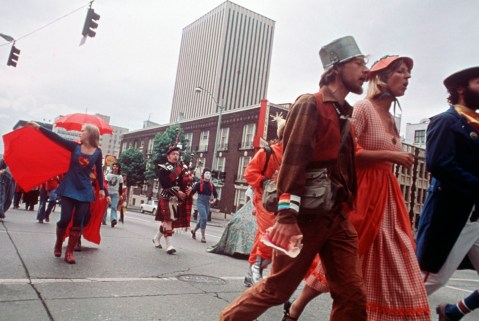
“Bumbershoot procession, 1974” by Flickr user Seattle Municipal Archives, CC BY 2.0
I. Chronological Index
Jump to WEDNESDAY, MARCH 19, 2014
Jump to THURSDAY, MARCH 20, 2014
Jump to FRIDAY, MARCH 21, 2014
Jump to SATURDAY, MARCH 22, 2014
Jump to SUNDAY, MARCH 23, 2014
II. Topic Index
Jump to SOUND & SOUNDTRACKS
Jump to MUSIC & MUSICALS
Jump to RADIO/PODCASTING
Jump to OTHER
.
I. CHRONOLOGICAL LIST
WEDNESDAY, MARCH 19
Session A 10:00 – 11:45 a.m.
A4: French Auteurs: Becker, Demy, Bresson, Bunuel
Tracy Cox-Stanton, SAVANNA COLLEGE OF ART AND DESIGN, “Film Sound, Footsteps, and Unvoiced Desire in Bresson’s “Pickpocket” (1959) and Bunuel’s “Belle du Jour” (1967)”
.
A10: Knowing the Score
Kevin Donnelly, UNIVERSITY OF SOUTHAMPTON, “Phantom Power: Electrifying an Old Silent Film”
Ariane Lebot, NEW YORK UNIVERSITY, “Composing the Narrative: Bernard Herrmann’s Contribution to De Palma’s ‘Obsession’ (1976)”
Megan Alvarado Saggese, UNIVERSITY OF CALIFORNIA BERKELEY, “From Sound to Cinema: Dissonance and Disruption between Adorno’s Theory of Film and Kagel’s “Antithese””
Christine Sprengler, UNIVERSITY OF WESTERN ONTARIO, “‘The Broom That Sweeps the Cobwebs Away’: Vertigo’s Soundtrack as Sound Art”
.
A16: Re-viewing Feminisms
Elizabeth Watkins, UNIVERSITY OF LEEDS, “Gesture and the Female Voice”
Alexander Russo, CATHOLIC UNIVERSITY OF AMERICA, “Androids as the New ‘Other’: Janelle Monae’s Feminist Afrofuturism in The Metropolis Suite” (focuses on the sonic attributes of race and gender, as well as her engagement with the sounds of masculine black music of the second half of the 20th century)
.
Session B 12:00 – 1:45 p.m.
B6: Policy: The Law and other Gatekeepers
Birk Weiberg, ZURICH UNIVERSITY OF THE ARTS, “Roy J. Pomeroy, Dunning Process Co., Inc., and Paramount Publix Corporation vs. Warner Bros. Pictures, Inc., Vitaphone Corporation, and Frederick Jackman: How the Movie Industry Learned about Patents.”
.
B15: Promotional Culture
William Gombash, VALENCIA COLLEGE, “The Evolution of Media Convergence and Popular Music: The Promotional Films for “Penny Lane” and “Strawberry Fields Forever”” (will include discussion of how the Beatles recorded the songs and how the evolving nature of the complexities of the production of their music mitigated against live performances)
.
B19: Avant-garde Aesthetic Strategies
Dustin Zemel, LOUISIANA STATE UNIVERSITY, “Polyphony and Documentary Presentness” (explores the idea of Bakhtinian literary polyphony and it’s relationship/relevance to film, using Jonas Mekas’s The Brig as an example of how overlapping voices in the soundtrack can effectively facilitate the presentation of multiple, autonomous presences.)
.
Session C 2:00 – 3:45 p.m.
C6: Narrative Forms of/and American Authorship
Paul Cote, UNIVERSITY OF MARYLAND, “Encountering Sonic Memories: Sound, Childhood, and Escapism in Steven Spielberg’s “Close Encounters of the Third Kind.””
.
C8: The Spaces of Media Production and Consumption
Meredith Ward, NORTHWESTERN UNIVERSITY, “Black Boxes and Rich, Repressed Sounds: Architecting Listening in the Cinema House”
.
C10: Listening to Films: Cinematic Sound and Media Culture in East Asia
Nicole Huang, UNIVERSITY OF WISCONSIN, MADISON, “Listening to Films: Radio and Communal Film Culture in 1970s China”
Kerim Yasar, UNIVERSITY OF NOTRE DAME, “Otozukuri: Affect, Ontology, and Techne in Early Japanese Radio Drama and Talkie Sound Effects”
Giorgio Biancorosso, UNIVERSITY OF HONG KONG, “Double Agents and The Poor Man’s Orchestra: Music and the Aesthetic of the Self in *Chunking Express* (1994)”
Ling Zhang, UNIVERSITY OF CHICAGO, “The Flowing Ambiguity of Soundscape: Female Voice-over in Spring in a Small Town and Fei Mu’s Chinese Operatic Sound Aesthetic”
.
Session D 4:00 – 5:45 p.m.
D4: The Globalization of Post-Millenial Persian Media
Matt Sienkiewicz, BOSTON COLLEGE, “Uncle Sam’s Koran: American Broadcasting, Koranic Values and Hybrid “Radio Islam” in Afghanistan”
.
D6: Objects: The Medium Is the Material
Paul Jasen, CARLETON UNIVERSITY, “Infrasound: Spectres of the Manmade Unknown”
.
D10: Physician, Heal Thy Selfie
Stephanie Brown, UNIVERSITY OF ILLINOIS, URBANA-CHAMPAIGN, “‘A Waiting Room That Doesn’t Suck’: Negotiations of Agency, Authenticity, and Community in the “Mental Illness Happy Hour Podcast””
.
D13: New Histories of Animation
Lora Mjolsness, UNIVERSITY OF CALIFORNIA, IRVINE, “Sound, Synchronization, and Subversion: The Early Animation of the Brumberg Sisters”
.
D15: Distribution in the Digital Age
Tim Anderson, OLD DOMINION UNIVERSITY, “Why Don’t We Give it Away?: Value and “Free” for an Emerging Music Industry”
Jeremy Morris, UNIVERSITY OF WISCONSIN, MADISON, “‘App’etite for Digitization: App-based Albums and the Virtual Commodification of Music”
.

“Sub Pop 20th Anniversary!” by Flickr user Rakka, CC BY-NC-ND 2.0
THURSDAY, MARCH 20
Session E 9:00 – 10:45 a.m.
E1: Gender and Contemporary Technologies
Jacqueline Vickery, UNIVERSITY OF NORTH TEXAS, “Mobile Phones, a Girl’s Best Friend?: How the Mobile Phone Industry Legitimizes Surveillance, Commodifies Talk, and Genders Technology”
.
*E10: Sound: Aesthetics and Ideology
Justin Morris, UNIVERSITY OF TORONTO, “Radio Ranch: Emergent Seriality in 1930s Film and Radio”
Paula Musegades, BRANDEIS UNIVERSITY, “Silence is Golden: Aaron Copland’s Film Score for “The Heiress””
Yuki Takinami, UNIVERSITY OF TOKYO, “The Issue of Sound-Cinema Aesthetics in Early-1930s Japan: Theory and Practice”
Alejandra Bronfman, UNIVERSITY OF BRITISH COLUMBIA, “Screeches, Static, and Silence: The Fragmented Terrain of Caribbean Radio”
.
E13: Deleuzian Aesthetics
Justin Horton, GEORGIA STATE UNIVERSITY, “Vibration, Resonance, Deformation: Deleuze’s Soundful Aesthetics”
.
E19: New/Media/Art/Objects
Alison Wielgus, UNIVERSITY OF IOWA, “Watch Out! The World’s Behind You: Warhol’s Exploding Plastic Inevitable and the Promises of Expanded Cinema” (discusses the influence of La Monte Young and drone music on the Exploding Plastic Inevitable, and how the live performance of such music creates a new context for interpreting the Warhol films screened during the events; unfortunately Alison will not be able to attend the conference, but you can contact her for more information)
.
Session F 11:00 – 12:45 p.m.
F1: Reconsidering Psychoanalysis and Media Studies: Towards a Productive Intersection
Lana Lin, NEW YORK UNIVERSITY, “Are These Thoughts My Own?: A Psychoanalytic Reading of Upton Sinclair’s “Mental Radio””
.
F5: Margins of the New Wave: Japanese Cinemas of the 1960s
Michael Raine, UNIVERSITY OF WESTERN ONTARIO, “Music, Musicals, and the Margins of the Japanese New Wave”
.
F16: Feminist Approaches to War Media
Debra White-Stanley, KEENE STATE COLLEGE, “Combat Medicine, Gendered Trauma, and Audio-Vision” (an interdisciplinary integration of sound studies with the idea of “women at war”)
.
F17: Negotiating Race in Digital Spaces
Sarah Florini, UNIVERSITY OF WISCONSIN, MADISON, “Networked Enclaves: Black Podcasters’ Responses to the George Zimmerman Verdict”
.
**F18: Documentary Sound and the Global City
Rita Safariants, VASSAR COLLEGE, “The Gig is in the Boiler Room: Filming Leningrad’s Rock-n-Roll Counterculture”
Josh Glick, YALE UNIVERSITY, “The Renegade in the Network: Joe Saltzman, CBS, and Soundtrack Innovations”
Ashish Chadha, UNIVERSITY OF RHODE ISLAND, “Sound in the City: Experimental Documentaries of Films Division in India”
Noelle Griffis, INDIANA UNIVERSITY, “Telling it Like it Is: The Camera as Voice in AFI Supported Minority Youth Films of the 1960s”
.
Session G 1:00 – 2:45 p.m.
**G18: Between Speech, Music, and Noise: The Voice in Recent Film and Television
John Richardson, UNIVERSITY OF TURKU, “Between Dialogue and Sound: The Voice, Audiovisual Flow, and the Aestheticizing Impulse”
Robynn Stilwell, GEORGETOWN UNIVERSITY, “Walking and Talking and Singing and Dancing: Axes and Boundaries in the Television Soundscape”
Claudia Gorbman, UNIVERSITY OF WASHINGTON, TACOMA, “The Master’s Voice”
Mitchell Morris, UNIVERSITY OF CALIFORNIA, LOS ANGELES, “Fictions of the Facture: Vocal Realities in “Velvet Goldmine”
.
Session H 3:00 – 4:45 p.m.
H3: Negotiating Identity, Belonging, and Citizenship in Transnational Latino Communities in the US
Veronica Zavala, UNIVERSITY OF CALIFORNIA, SANTA BARBARA, “Alivianadas: Spanish-Language Radio Incentives”
.
H4: French Film Archives: New Findings, New Forms
Charlie Michael, EMORY UNIVERSITY, “The Lescure Report and the Future of French Audiovisual Policy” (an analysis of the participatory blog that the French Ministry of Culture launched to have a public discussion about audiovisual reform)
.
*H9: Regionalism, Accent, and Dialect at the BBC, 1930-1955
Debra Rae Cohen, UNIVERSITY OF SOUTH CAROLINA, ““There’s No Such Thing as Reet”: Reclaiming Region in Burbleton””
Ian Whittington, UNIVERSITY OF MISSISSIPPI, “Regional Voice, National Crisis: J.B. Priestley as Second World War Radio Celebrity”
Emily Bloom, GEORGIA STATE UNIVERSITY, “Speaking Oirish: The BBC Third Programme and Irish Drama”
Damien Keane, UNIVERSITY AT BUFFALO, “A Back-Window on Belfast: W.R. Rodgers’ The Return Room”
.
H13: Cinema & Wagner
Amy Stebbins, UNIVERSITY OF CHICAGO, “Being Richard: History, Myth, and the Biopic”
Rebekah Rutkoff, CUNY, “Towards a Complete Order: Markopoulos and Wagner”
Ken Eisenstein, UNIVERSITY OF CHICAGO / BUCKNELL UNIVERSITY, “‘All Things Pass Into the Night’: Music, Montage, and Wagner in Billy Wilder’s “Love in the Afternoon” (1957)”
.
*H15: Branded Entertainment of the Past
Kathryn Fuller-Seeley, GEORGIA STATE UNIVERSITY, ““The Dean of Radio Salesmen” vs. “The Huckster”: Jack Benny’s Struggle with Sponsor Lucky Strike, 1944-1948”
Cynthia Meyers, COLLEGE OF MOUNT SAINT VINCENT, “The Problems of Branded Entertainment: BBDO, Sponsors, and Blacklists on Radio and Early Television”
Lauren Bratslavsky, UNIVERSITY OF OREGON, “Soft Hands and Soft Westerns: The True Stories of Death Valley Days, 1930-72”
Andrew deWaard, UNIVERSITY OF CALIFORNIA, LOS ANGELES, “Marty Weiser, Exploitation Agent: Product Placement, Publicity, and the Tie-Up Business in Hollywood, 1940-1980”
.
H19: Intermedial Modernisms: Cinema’s Expanded Horizons in the 1920s
Sarah Street, UNIVERSITY OF BRISTOL, “Synthetic Dreams: Color-Film-Music in the 1920s”
.
H25: Once More with Feeling: Audiences, Origins, and Affect in the Hollywood Musical
Desiree Garcia, ARIZONA STATE UNIVERSITY, “Life Upon the Wicked Stage: The Origins of the Hollywood Show Musical”
Sean Griffin, SOUTHERN METHODIST UNIVERSITY, “Don’t Fence Me In: B Studio Musicals’ Appeal to Marginalized Audiences”
Caryl Flinn, UNIVERSITY OF MICHIGAN, “The Kitschy Feelings of Kitschy Musicals”
Kelly Kessler, DEPAUL UNIVERSITY, “I Dreamed a Dream of Close-Ups Gone By: “Les Misérables” and the Visual Excess of Stage-to-Screen Transfers in the FX Era”
.
Session I 5:00 – 6:45 p.m.
I4: Museum as Medium: Technology, Spectatorship, Space
Karine Bouchard, UNIVERSITY DE MONTREAL, “(Im)mobilized Sound: Towards Listening Experiences in the Museum Exhibition.”
.
**I10: Sounds of Labor: Musicians’ Employment in Hollywood’s Transition to Sound
Jennifer Fleeger, URSINUS COLLEGE, “Putting Opera to Work: Song, Stardom, and Labor in the Vitaphone Opera Shorts”
Rob King, COLUMBIA UNIVERSITY, ““I Want Music Everywhere”: Underscoring in the Hal Roach Studios’ Early Sound Films”
Daniel Goldmark, CASE WESTERN RESERVE UNIVERSITY, “The Musical Roots of “The Jazz Singer””
.
I11: Rethinking Wong Kar-wei: New Approaches to an Established International Auteur
Angelo Restivo, GEORGIA STATE UNIVERSITY, “Wong Kar-wai: Sound + Image”
.
I19: Makes Me Feel Some Kinda Way: Television and Black Women’s Affect
Racquel Gates, COLLEGE OF STATEN ISLAND, CUNY, “The Ratchet Public Sphere: Love and Hip Hop Atlanta and Black Women’s Culture”
.
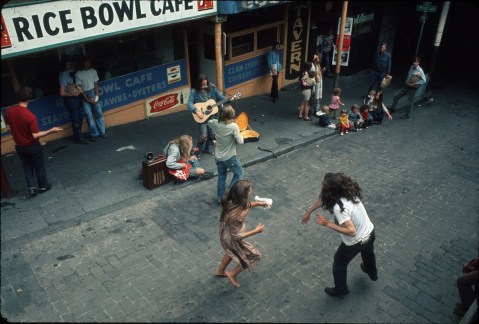
“Musicians and dancers at Pike Place Market, circa 1972” by Flickr user Seattle Municipal Archives, CC BY 2.0
FRIDAY, MARCH 21
Session J 9:00 -10:45 a.m.
J1: What Is “The Symbolist Temptation?” The Aesthetics of Symbolism in Transnational Cinema
Tami Williams, UNIVERSITY OF WISCONSIN-MILWAUKEE, “A Music of Silence: Abstraction and Sensation in Belle Époque Symbolist Theater and 1920s French Art Cinema”
.
J3: Brazilian Cinema Revisited: Technologies, Exhibition, Reception
Rafael Freire, UNIVERSIDADE FEDERAL FLUMINENSE, “The Conversion to Sound in Brazil”
..
*J10: Radio and Other Sounds
Hannah Spaulding, NORTHWESTERN UNIVERSITY, “Eavesdropping as Entertainment: The Enormous Radio and Shut Up Little Man!”
Jack Curtis Dubowsky, ACADEMY OF ART UNIVERSITY, “The Music of Brokeback Mountain”
Ming-Yuen Ma, PITZER COLLEGE, “Noises of Protest: Sound, Race, and Violence in Christian Marclay’s Guitar Drag and Paul D. Miller’s Rebirth of a Nation”
.
J19: Race, Gender, and the Body in Found Footage Film
Jaimie Baron, UNIVERSITY OF ALBERTA, “Unintentional Singers and Racial Ventriloquism in Contemporary Found Footage Videos” (Explores how found footage (remix) videomakers are literally making their (speaking) subjects sing and how this constitutes a form of ventriloquism)
.
Session K 12:15-2:00 p.m.
*Meeting of the Sound Studies Scholarly Interest Group
.
K9: Medium and Method in “Early Television” History
Kate Newbold, NORTHWESTERN UNIVERSITY, “Television Ontology and Media Methodology: Exploring Televisual Fragmentation in Phonograph, Broadcast, and Print Industries, 1926-1940”
Luke Stadel, NORTHWESTERN UNIVERSITY, “Radio/Television/Sound, 1922-1941”
.
K18: Revisiting Kurosawa
Michael Bourdaghs, UNIVERSITY OF CHICAGO, “Hearing the Cold War: Kurosawa Akira’s Soundtracks and Soviet Film Theory”
.
Session L 2:15-4:00 p.m.
**L10: Sound Waves: Technology and Practice in Film Sound
Charles O’Brien, CARLETON UNIVERSITY, “Multi-Track Sound and the Battle of Paris: American and German Films for French Distribution”
Eric Dienstfrey, UNIVERSITY OF WISCONSIN, MADISON, “Splits, Quad, and the Psychedelic: Dolby’s Rear Channels Examined”
Katherine Quanz, WILFRID LAURIER UNIVERSITY, “The Industrial Impact of Toronto’s Transition to Digidesign Technology in the Mid-2000s”
Benjamin Wright, UNIVERSITY OF SOUTHERN CALIFORNIA, “Atmos Now: How Dolby is Transforming the Art and Craft of Sound Mixing”
.

“Sound Garden” by Flickr user The Kozy Shack, CC BY-NC-ND 2.0
SATURDAY, MARCH 22
Session M 9:00-10:45 a.m.
*Meeting of the Radio Studies Scholarly Interest Group (featuring guests from KEXP to talk about radio in a streaming age)
.
M4: What is Socialist Realism? Reexamining Soviet Post-montage Cinema
Vincent Bohlinger, RHODE ISLAND COLLEGE, “Soundtrack Design in Soviet Early Sound Film”
.
M7: Playing with Avatars
Lyn Goeringer, OBERLIN CONSERVATORY OF MUSIC, “No Avatar Required: Audio-reactive Games and Physical Connectivity”
.
**M10: Global Approaches to Film Sound
Pavitra Sundar, KETTERING UNIVERSITY, “Thinking Sound, Rethinking History in Hindi Cinema”
James Lastra, UNIVERSITY OF CHICAGO, “From Mickey Mouse to Peter Kubelka”
Esra-Gokce Sahin, HARVARD UNIVERSITY, “Soundscape and Humor in Acharaka Comedy in Prewar Japan”
.
M16: Hispanic Musicals: Nationalisms and Transnational Stars
Valeria Camporesi, AUTONOMOUS UNIVERSITY OF MADRID,, “Latin Stars, Spanish Women: Lola Flores in the 1950s”
Ana Lopez, TULANE UNIVERSITY, “La Vecindad: A Musical Space for the Mexican Cinema”
Dolores Tierney, SUSSEX UNIVERSITY, and Sergio de la Mora, UNIVERSITY OF CALIFORNIA, DAVIS, “Re-mapping Mexican Cinema of the 1970s: Music and Female Sexuality in Zona Roja”
Enrique Garcia, MIDDLEBURY COLLEGE, “From Brechtian to Hollywood Approach: The Hispanic Community and Salsa Music in the Documentary Our Latin Thing (Nuestra Cosa) and the Biopic/Musical El Cantante”
.
M17: Forms of Non-Fiction: Voices, Realisms, Disciplines, Shadows
James V. Catano, LOUISIANA STATE UNIVERSITY, “Voiceover and the Essay Film”
.
Session N 11:00-12:45 p.m.
N2: The Precarious Aesthetic in Contemporary Moving Images
Arild Fetveit, UNIVERSITY OF COPENHAGEN, “Death, Love, and Cinematic Nostalgia: The Precarious Aesthetic of Lana Del Ray” (linking the aesthetics of her videos to her music, in particular to the ways in which she uses her voice)
.
*N6: Locating Radio: The Symbolic, Cultural, and Political Dimensions of ‘Place’ in North American Radio Broadcasting
Brian Fauteux, UNIVERSITY OF WISCONSIN, MADISON, “Localities and Independent Music in Satellite Radio Programming”
Catherine Martin, BOSTON UNIVERSITY, “‘I’ve Got My Eyes Open and I Can’t be Crooked’: Female Virtue and National Identity in “Terry and the Pirates””
Eleanor Patterson, UNIVERSITY OF WISCONSIN, MADISON, “This American Franchise: Negotiating the Production of Local Public Radio for a Global Audience”
Jennifer Wang, INDEPENDENT SCHOLAR, “Some ‘Homemakers’ are More Than Housekeepers: Negotiating Modern Living, Gendered Spheres, and the Rural Lifestyle in Wisconsin Radio”
.
N11: The Little Flashlight of the Usher: Objects in Exhibition Between Spectator and Screen
Stephen Groening, GEORGE MASON UNIVERSITY, “‘If You Don’t Want to Look at It, No One Can Force You’: Spectatorship, Agency, and Headphones”
.
**N16: Teaching Post-Production Sound From a Sound Studies Perspective
Mark Berger, UNIVERSITY OF CALIFORNIA, BERKELEY
Jay Beck, CARLETON COLLEGE
George Larkin, UNIVERSITY OF CALIFORNIA, BERKELEY
.
Session O 1:00-2:45 p.m.
O4: Expanding the Meanings of Film: Cinema and the Nation in East Germany
Sabine Hake, UNIVERSITY OF TEXAS, AUSTIN, “The Popularity of High Culture: On the DEFA Opera Film”
.
O8: Sinophone Cinemas
Alison Groppe, UNIVERSITY OF OREGON, “Multilingualism in Singaporean Film Dialogue: Authenticity or Argument?”
O14: Breath and the Body of the Voice in Cinema
Ian Garwood, UNIVERSITY OF GLASGOW, “Lost in Non-Translation: Analysing Film Voices from a Position of Linguistic Incompetence”
Liz Greene, QUEEN’S UNIVERSITY BELFAST, “The Gasping Breath: Controlling the Female Voice in Hollywood Cinema”
Nessa Johnston, GLASGOW SCHOOL OF ART, “The Embodied Aural Encounters of Drama-Documentary”
Philippa Lovatt, UNIVERSITY OF STIRLING, “Breathing Bodies: Sound and Subjectivity in the War Film”
.
Session P 3:00-4:45 p.m.
P7: “Women Contained”: Figuring Feminism in the Films of Todd Haynes
Respondent: Maria San Filippo, INDIANA UNIVERSITY, BLOOMINGTON
Matthew Von Vogt, INDIANA UNIVERSITY, BLOOMINGTON, “Structural Anorexia in “Superstar””
Jess Issacharoff, UNIVERSITY OF IOWA, ““Poison’s” Oath in Another Language: Todd Haynes’ Feminist Promise”
Michael Hetra, UNIVERSITY OF IOWA, “Music and the Vicissitudes of Desire in Todd Haynes’s “Mildred Pierce””
.
P18: Beyond Bond: Alternative Perspectives on the James Bond Franchise
Meenasarani Murugan, NORTHWESTERN UNIVERSITY, “‘Unlike Men, the Diamonds Linger’: Bassey and Bond beyond the Theme Song”
.
*P22: Musics and Medias
Shawn VanCour, NEW YORK UNIVERSITY, “In Search of Spectacular Sound: Aesthetic Innovation in Classical Music Programming on Early U.S. Television”
Lindsay Affleck, UNIVERSITY OF CALIFORNIA, LOS ANGELES, “The Young Man with a Horn: Harry James and the Intersection of the Big Band Era and Classical Hollywood”
Christopher Cwynar, UNIVERSITY OF WISCONSIN, MADISON, “Unbuttoning National Public Radio: Assessing the Place of Popular Music in NPR’s Current Affairs Programming”
Norma Coates, UNIVERSITY OF WESTERN ONTARIO, “5% of It is Good:” Leonard Bernstein, CBS Reports, and the Cultural Accreditation of Rock Music”
.
Session Q 5:00-6:45 p.m.
Q4: Staging Spain: Performance and Acting in Spanish Cinema
Tom Whittaker, UNIVERSITY OF LIVERPOOL, ““Sounding Authentic: Direct Sound and Spanish Vocal Performance in the 1970s””
.
Q5: Indian Cinema in the 1930s: Scripts, Parsi Theater, and Melodrama in the Early Sound Film
Anupama Kapse, CUNY, QUEENS COLLEGE, “At Home in One’s Voice: Melodrama and Aural Performance in the Early Sound Film”
.
Q8: New Media History
Andrew Bottomley, UNIVERSITY OF WISCONSIN, MADISON, “What is Internet Radio? A Historical Genealogy of the Discourses of Radio in the Digital Era”
.
Q15: Roadshows to Revisionism: Mapping Shifts in Distribution and Exhibition from the 1950s to the Present
Dennis Bingham, INDIANA UNIVERSITY – PURDUE UNIVERSITY INDIANAPOLIS, “‘Hey, Big Spender’: How Bob Fosse Ran Afoul of Roadshows and Discovered the Revisionist Musical”
.
Q18: Sound, Vision, and Experience in Lucien Castaing-Taylor and Véréna Paravel’s “Leviathan (2012)”
Respondent: Catherine Russell, CONCORDIA UNIVERSITY
Christopher Pavsek, SIMON FRASER UNIVERSITY, “Where’s the Sense in Sensory Ethnography?”
Ohad Landesman, TEL AVIV UNIVERSITY, “Faraway, So Close: “Leviathan” and the Digital Future of Observational Ethnography”
Eirik Frisvold Hanssen, NORWEGIAN UNIVERSITY OF SCIENCE & TECHNOLOGY, “‘His Eyes Are Like the Rays of Dawn’: Color Vision and Embodiment in “Leviathan””
.
Q22: Cinematic Spaces in the Urban Global South
Paulina Suarez-Hesketh, NEW YORK UNIVERSITY, “Dancing Pictures, Mobile Publics (Mexico City, 1930s -1950s)”
.
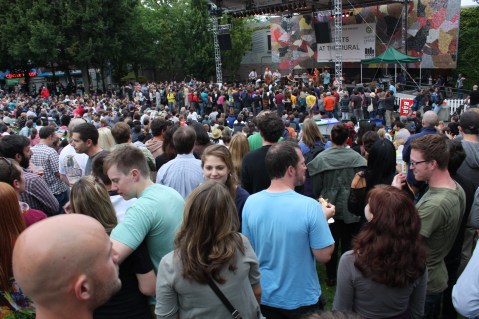
“KEXP Concerts at the Mural” by Flickr user Chelsea Nesvig, CC BY 2.0
SUNDAY, MARCH 23
Session R 9:00-10:45 a.m.
R2: War/Film
Todd Decker, WASHINGTON UNIVERSITY ST. LOUIS, “Helicopter Music”
.
R7: Labor Practice and Labors Lost
Josh Heuman, TEXAS A&M UNIVERSITY, “All of This Sometimes Tends to Look Like a Closed-Shop Operation: Organizing and Professionalizing Labor Markets and Relations in Early Broadcast Writing”
Michael Slowik, SAN DIEGO STATE UNIVERSITY, “Losing the Human Element: The Shift from Live to Recorded Music in Hollywood’s Early Sound Era”
.
**R10: Sound Effects and Sound Affects
Karly-Lynne Scott, NORTHWESTERN UNIVERSITY, “‘The Voice of Shouts and Moans’: Haptic Aurality, Resonance, and Affect in Pornography”
Ian Kennedy, WAYNE STATE UNIVERSITY, “Damion Romero’s I Know! I Know! and the Sonic Translation of Nonhuman Affect”
Dong Liang, UNIVERSITY OF CHICAGO, “Is There a Sound Effect in this Score?: SFX in Transition”
Kelly Kirshtner, UNIVERSITY OF WISCONSIN, MILWAUKEE, “Bodies of Proof: Sound and the Aesthetics of Discovery in Televisual Space”
.
R20: Beyond Sight and Sound: Film and the Multisensory Experience
Respondent: Carl Plantinga, CALVIN COLLEGE
Joseph Kickasola, BAYLOR UNIVERSITY, “The Senses Know: Wong Kar‐Wai’s Multisensory Aesthetic”
William Brown, ROEHAMPTON UNIVERSITY, “A Touch of Nostalgia, or Time and Cinematic Synaesthesia”
Luis Antunes, UNIVERSITY OF KENT & NORWEGIAN UNIVERSITY OF SCIENCE & TECHNOLOGY, “Multimodal Segmentation in Terrence Malick’s “The Thin Red Line”: Insight into the Time Window of Multisensory Integration”
.
R24: About Time
Jeff Heinzl, UNIVERSITY OF PITTSBURGH, “MTV Meets Slow Cinema: Feedback Loops and the Long Take in G.O.O.D. Music’s Mercy (2012)”
.
Session S 11:00-12:45 p.m.
S3: Nontheatrical Film Communities
Pamela Krayenbuhl, NORTHWESTERN UNIVERSITY, “Raising the Barre in Screendance Scholarship: An Archival Analysis of the Dance Company Film”
.
S8: New Hollywood and the Archive
Jessica Fowler, UNIVERSITY OF CALIFORNIA, LOS ANGELES, “We’re the Young Generation and We’ve Got Something to Say: The Monkees and the Birth of New Hollywood”
.
S9: A Global Pre-History of Reality TV
Aniko Imre, UNIVERSITY OF SOUTHERN CALIFORNIA, “Socialist Idols: Reality Music Competition Programs in the Soviet Bloc”
.
**S10: Audible Cinema: Explorations in Sound
Kartik Nair, NEW YORK UNIVERSITY, “‘The Body in the Voice’: Labor, Sound, and the Cinematic Scream”
Chunfeng Lin, UNIVERSITY OF ILLINOIS, URBANA-CHAMPAGNE, “The Sound Identity of the Early Chinese Sound Films: Symbolism as Skin, Realism as Body, and Politics as Soul”
James Osborne, UNIVERSITY OF ARIZONA, “Weaving a Sonic Dream: Voice, Sound, Music, and Meaning in Paul Thomas Anderson’s “Magnolia””
Neil Lerner, DAVIDSON COLLEGE, “Investigating the Origins of Video Game Music Style, 1977-1983: The Early Cinema Hypothesis”
.
S11: Historicising Stars
Kyle Barnett, BELLARMINE UNIVERSITY, “Stars on the Stereo: Variations on Phonographic Celebrity”
Amanda McQueen, UNIVERSITY OF WISCONSIN, MADISON, “”All They’re Good for Is to Make Money”: The Industrial Significance of Elvis Presley Musicals in 1960s Hollywood”
.
S14: Agency in Media Pedagogy: Critical Approaches to Empowerment
This is a workshop in which Elisabeth Soep of Youth Radio will be participating
.
S15: Playing with the Interface
Lauren Cramer, GEORGIA STATE UNIVERSITY, “Race at the Interface: Rendering Blackness on WorldStarHipHop.com”
Kiri Miller, BROWN UNIVERSITY, “Gaming Gender in “Dance Central””
.
S16: Questions of Realism
Antonio Iannotta, UNIVERSITY OF SALERNO, “A Sound Laboratory for the Modern: Sound in Italian Cinema from Neorealism to the 60s”
.
Session T 1:00-2:45 p.m.
T5: Translation-Adaptation-Nation
Gerald Sim, FLORIDA ATLANTIC UNIVERSITY, “Cacophonies of Affection: Postcolonial Soundscapes”
.
T7: Histories of Technologies
Dimitrios Pavlounis, UNIVERSITY OF MICHIGAN, “Audio Surveillance Goes to the Movies : William J. Burns, the Detective Dictograph, and the Idea of Sound Recording, 1910-1920”
.
T17: Revisoning Black Time and Space through the Afrofuturist Moving Image
Kevin Ball, WAYNE STATE UNIVERSITY, “The Incendiary Intergalactic: Sun Ra in Space Is the Place”
—

“Bumbershoot ad, 1974” by Flickr user Seattle Municipal Archives, CC BY 2.0
Read More…
Share this:


Current Top Posts





April 2021

January 2020

November 2019

October 2019

August 2019

April 2014

November 2017

March 2015

December 2017

October 2015
 Sounding Out!
Recent Comments