
Shoo bop shoo bop, my baby, ooooo: W.E.B. Du Bois, Sigmund Freud & Barry Jenkins’ Moonlight
 Inspired by the recent Black Perspectives “W.E.B. Du Bois @ 150” Online Forum, SO!’s “W.E.B. Du Bois at 150” amplifies the commemoration of the occasion of the 150th anniversary of Du Bois’s birth in 2018 by examining his all-too-often and all-too-long unacknowledged role in developing, furthering, challenging, and shaping what we now know as “sound studies.”
It has been an abundant decade-plus (!!!) since Alexander Weheliye’s Phonographies “link[ed] the formal structure of W.E.B. Du Bois’s The Souls of Black Folk to the contemporary mixing practices of DJs” (13) and we want to know how folks have thought about and listened with Du Bois in their work in the intervening years. How does Du Bois as DJ remix both the historiography and the contemporary praxis of sound studies? How does attention to Du Bois’s theories of race and sound encourage us to challenge the ways in which white supremacy has historically shaped American institutions, sensory orientations, and fields of study? What new futures emerge when we listen to Du Bois as a thinker and agent of sound?
Over the next two months, we will be sharing work that reimagines sound studies with Du Bois at the center. Pieces by Phillip Luke Sinitiere, Kristin Moriah, Aaron Carter-Ényì, Austin Richey, Julie Beth Napolin, and Vanessa Valdés, move us toward a decolonized understanding and history of sound studies, showing us how has Du Bois been urging us to attune ourselves to it. To start the series from the beginning, click here.
Readers, today’s post by Julie Beth Napolin brings her trilogy to a close, exploring the echoes of black maternal sounding and listening she has amplified in Du Bois in Barry Jenkins’s Oscar-winning film Moonlight (2016).
Essay One: Listening to and as Contemporaries: W.E.B. Du Bois & Sigmund Freud
Essay Two: (T)racing Mother Listening: W.E.B. Du Bois & Sigmund Freud
–Jennifer Lynn Stoever and Liana Silva, Eds.
The theory of the acousmatic—the idea of a sound whose source is unseen, as it comes to us from Barthes, Chion, and Dolar—rests upon the mother tongue and the Oedipal scene, the dyad of mother and father. There is in “Do ba – na co – ba”–his great- great- grandmother’s song Du Bois remembers hearing passed down through his family–a transmission from the mother, but what kind of transmission? “There is no one extant autobiographical narrative of a female captive who survived the Middle Passage,” Hartman writes in “Venus in Two Acts” (3). History becomes, she continues, a project of “listening for the unsaid, translating misconstrued words” (3-4). The word-sounds “Do ba-na co-ba” are not the translation of a misconstrued word and they bolster a song of survival, of living on. But there is a silence there. “Do ba-na co-ba,” in a manner of speaking, survives the Middle Passage, and re-opens it as a primary channel of listening and receiving.
The Bantu woman was Du Bois’ grandfather’s grandmother, so many generations removed.
Returning to the vestiges of black motherhood in recent black cinema (including Jordan Peele’s Get Out and Barry Jenkin’s Moonlight), Rizvana Bradley argues that the loss of the mother “in black life more generally, as it repeats through cycles of material loss, … encapsulates racial slavery’s gendered social afterlife” (51). Bradley’s essay is crucial in retrieving the figure of the lost mother even in moments when the mother is absolutely elided as a character, not to appear visually. Horror more generally owes its immersive quality to the womb (enclosed spaces), but Bradley turns to black film form in particular to find in its mise-en-scène (such as in the gravitational field of the “sunken place”) maternal flesh and form.
In the compositional and formal strategies of The Souls of Black Folk, in the punctuated silences that open each chapter, there is a trace of the elided black maternal. The Bantu woman is lost not because Du Bois did not know her (he could not have), but because something of her song transmits a loss and theft that were not symbolic, but literal—a stolen and kidnapped maternal, rather than simply destroyed, as in the Oedipal mandate. It is crucial that the song that is at the core of Du Bois’ memory is transmitted along the maternal line. This maternal voicing is the unspoken wound of Du Bois’ text.

Spillers begins “Mama’s Baby, Papa’s Maybe” from the premise of non-Oedipal psycho-biographies, and these include not only the single mother, but the kidnapped mother. The quotation marks that surround the figure of the “black woman” for Spillers are “so loaded with mythical prepossession” that the agents it conceals cannot be clarified. Spillers takes particular aim at the infamous conclusions of the Moynihan report of 1965 that trace the roots of African American poverty to the figure of the single mother, the underachievement of lower class black males being linked in the report to black women.
In this way, black culture is thought to operate in a matriarchal pattern essentially out of step with a majority culture where a child’s identity and name, by definition, cannot be determined by the maternal line (66). As Lacan insists, it is the Father who gives a child both the Name and the symbolic Law (language). According to this configuration, Spillers argues, the child of the black mother can only be left in a haunting dis-identity. The implications for psychoanalysis are radical: Spillers begins the essay with a “stunning reversal of the castration thematic,” one that displaces its structure “to the territory of the Mother and Daughter, [and] becomes an aspect of the African-American female’s misnaming” (66). Among these misnamings is that black women are often not seen as “women,” omitted from the category and its political inflections. She is left castrated, politically impotent. For in this displacement, the subject positions of “male” and “female” lose—or fail to adhere to—their traditionally conceived symbolic integrity, and this loss begins with the historical experience aboard ship.

“waves and shadows,” image by Flickr User Albatrail
For Spillers, then, it is essential to trace this misnaming and undifferentiation of black women to the physical and psychic conditions of the Middle Passage. When Freud begins Civilization and Its Discontents, he notes an “oceanic feeling” engendered by religion. The oceanic is the longing for return to a pre-subjective state where one is united with all that is, before the cut that is birth and then language (indeed, the oceanic feeling is often attributed to song). Spillers’ move is to read the oceanic literally and structurally at once: there is the Atlantic Ocean and its Middle Passage. The oceanic, in this way, is de-subjectivating; it casts the subject out of itself in a terror of undifferentiation that does not cease with landfall.
But Spillers also implies that, in that (sexual) undifferentiation, a radical political potential can be retrieved. It is not that black feminism retrieves for her a sexual differentiation after becoming an ambiguous thing. It would not be “woman” in any traditional sense, for that New World category rests upon the violence Spillers seeks to describe. Above all, it would not be easy to name.
Du Bois certainly takes up the Father in his poetic epigraphs. But in ending with the Bantu woman’s song—as it seems to anatomize all of the other songs he describes—Du Bois upholds himself as being named by the maternal line. He is unable or perhaps unwilling to make a clarified place for a black female political agent. If we listen with ear’s pricked, we find that she is the submerged, oceanic condition for his speech.

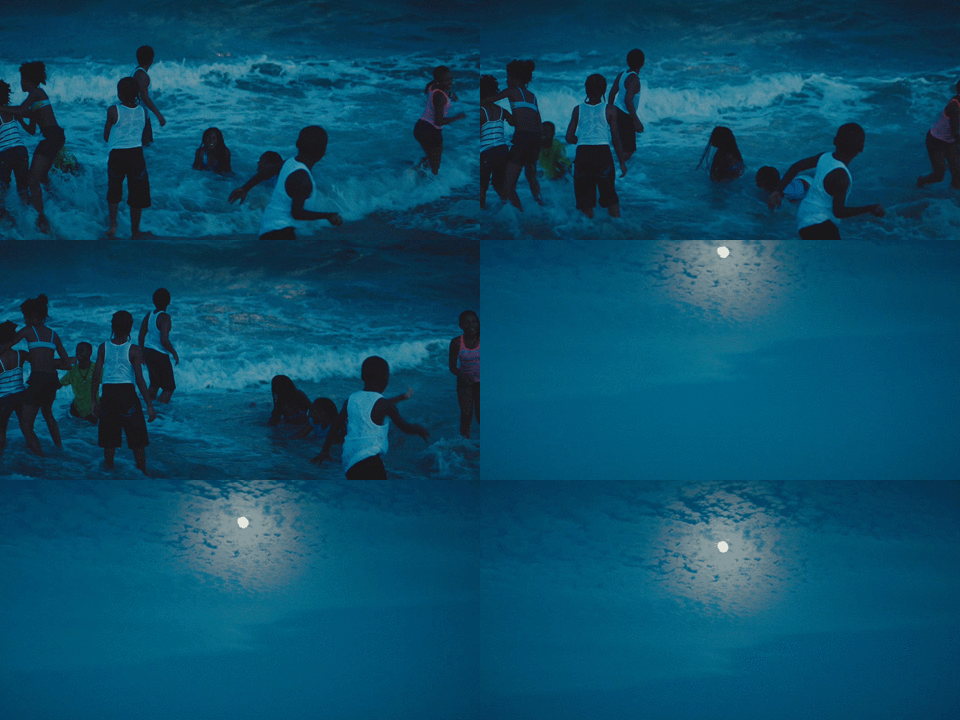
By way of an open-ended conclusion, we can recall the sound of the ocean that punctuates Jenkin’s stunningly lyrical and psychologically complex coming-of-age film, Moonlight. The ocean provides the anchoring location for the psychological action, but also its aesthetic locus, the beginnings of its cinematic language. The sound of the ocean continually marks a desire for “return” to maternal undifferentiation and oneness, and yet, it provides the space for two embodied memories that cannot be compassed by traumatic separation. In the first, a father-like figure, Juan, embraces a young boy, Little, to allow him to float in a nearly baptismal scene of second birth, and in a second scene at the shore, Little experiences with his friend, Kevin, sexual gratification, a coming into his body as a site of pleasure.
The conclusion of the film posits these moments as being in the past. We had experienced them as contemporary, but only later realize they are a well of memory for a now-adult subject who does not know himself. I want to focus, then, on the film’s conclusion, after Kevin and Little (now named Black, his adult re-renaming), meet again after many years. Kevin calls Little/Black on the phone, a defining gesture of reaching out erotically and acousmatically with voices. We later learn that he calls because Kevin has heard an old song that reminded of him of his lost friend. By this voice or call, Black is brought somewhere back to his moment of break to become Little again, as if something in the past must be recuperated for the present. As he drives down the open road to find Kevin, the music of Caetano Veloso soars.
We can’t be sure if this is extra-diegetic or diegetic music. To be sure, Black would never listen to such a song on his stereo. And yet, the song seems to emanate directly from its affective space. In the language of literature, it is a “free-indirect style,” part character and part author; the film is hearing Black/Little feel. He’s in a space of haunting melody, drenched in personal memory, whose principle scene had been the Florida shore, the ocean lapping providing a (maternal) containing motif for the film, now transmuted into song.
The oceanic, Spillers might remind us, is violent, echoing the passages that made it possible for these two black boys to be there. But the sound is also amniotic, a space of maternal longing, particularly for a character who, in Bradley’s estimation, is positioned as pathological, injured by the missing mother who is, in turn, indicted by the film’s imaginary. To some extent, Moonlight participates in the mother’s misnaming: it cannot see the structures that ensure her lostness. But the film does also push towards some mode of melancholia that, as Michael B. Gillespie argues of Jenkins’ earlier work, would cease to be depressive. Jenkins’ aesthetic practice is transformative, Gillespie suggesting that we use Flatley’s term, “antidepressive melancholia,” as it’s with a stake in the personal past but turned towards the collective future (106).

When the two boys, now men, meet again, several sounds punctuate the scene. They are not words or even phonemes, yet “speak” to provide a sonic geography of feeling that includes or “holds” the viewer, as Ashon Crawley might suggest. Among them is the sound of the bell on the door, which marks hello and goodbye, entry and exit, coming and going (or “fort-da” in Freud’s lexicon). When Black enters the diner, he is still “Black.” It is only when remembering what happened at the shore, then to say that no man has touched him since, that he becomes Little. He discloses this truth on behalf of a potential in present and a still-nascent future. Kevin cooks for Black, and Jenkins’ is careful to amplify the sound of the spoon stirring. He provides for Black, the film locating Kevin, a male, within the coordinates of maternal care. The sonic crux of the scene—no longer primal, no longer traumatic—is when Kevin plays the song on the jukebox that had drawn him to call to Little/Black in the first place. “Hello, stranger,” Barbara Lewis croons, “it seems like a mighty long time. Shoo bop shoo bop, my baby, ooooo.”
In listening to a song that is from our past, Newtonian time collapses, a shock running from past to present. The film never discloses whether these two had once heard this song together before. It is more likely that its affective map impacts Kevin, that he hears in its melancholic sound a nascence, and with it, a longing to retrieve his own past and repair. Lewis herself, singing in the sixties, is a recalling an already eclipsed fifties doo-wop. The phonemes circle back to their beginnings in “Do ba- na co-ba.” Such sounds are to be opposed to the shot of Little’s mother yelling at him (presumably a slur). There, the sound had cut out of the scene, which recurs for Little in a traumatic nightmare.
In contrast to that violent naming, the boys’ intimacy was defined by, to use Kevin Quashie’s term, “quiet,” a sense of interiority Michael Gillespie explores in his analysis of Jenkins’ first feature film, Medicine for Melancholy. Shakira Holt and Chris Chien called this dynamic in Chiron and Juan’s relationship “silence as a form of intimate conversance” in their 2017 post about Moonlight. There is a queer intimacy revived apart from trauma, triangulated by a black woman’s voice, paired with male harmonies, that resonate acousmatically from the jukebox to hold and contain the scene. For psychoanalytic theories of voice, containment is the essential maternal gesture of song.
We begin to wonder what might be possible for the feminine were it to be separated from the maternal dimension, a potential that Jenkins does not explore in this particular film in his oeuvre (as he does in Medicine for Melancholy, for example); each of the women in Moonlight “mother” to some extent. Nonetheless, he disperses the maternal function across male and female subjects, particularly in moments when the film resists depression. In listening with ears pricked, as with Du Bois’ epigraphs, the voices cease to belong to an individual, to be male voices or female voices, but become plural and pluralistic. It becomes possible to ground a politics of listening to the past for remaking in the present in that sound.

—
I would like to thank Michael B. Gillespie, Amanda Holmes, and Jennifer Stoever for their incredible scholarly assistance and comments in writing this essay trilogy.
—
Julie Beth Napolin is Assistant Professor of Literary Studies at The New School, a musician, and radio producer. She received a PhD in Rhetoric from the University of California, Berkeley. Her work participates in the fields of sound studies, literary modernism and aesthetic philosophy, asking what practices and philosophies of listening can tell us about the novel as form. She served as Associate Editor of Digital Yoknapatawpha and is writing a book manuscript on listening, race, and memory in the works of Conrad, Du Bois, and Faulkner titled The Fact of Resonance. Her work has appeared in qui parle, Fifty Years After Faulkner (ed. Jay Watson and Ann Abadie), and Vibratory Modernism (ed. Shelley Trower and Anthony Enns).
—
 REWIND! . . .If you liked this post, you may also dig:
Moonlight’s Orchestral Manoeuvers: A duet by Shakira Holt and Christopher Chien
“A Sinister Resonance”: Joseph Conrad’s Malay Ear and Auditory Cultural Studies–Julie Beth Napolin
“Scenes of Subjection: Women’s Voices Narrating Black Death“–Julie Beth Napolin
Share this:

(T)racing Mother Listening: W.E.B. Du Bois & Sigmund Freud

Inspired by the recent Black Perspectives “W.E.B. Du Bois @ 150” Online Forum, SO!’s “W.E.B. Du Bois at 150” amplifies the commemoration of the occasion of the 150th anniversary of Du Bois’s birth in 2018 by examining his all-too-often and all-too-long unacknowledged role in developing, furthering, challenging, and shaping what we now know as “sound studies.”
It has been an abundant decade-plus (!!!) since Alexander Weheliye’s Phonographies “link[ed] the formal structure of W.E.B. Du Bois’s The Souls of Black Folk to the contemporary mixing practices of DJs” (13) and we want to know how folks have thought about and listened with Du Bois in their work in the intervening years. How does Du Bois as DJ remix both the historiography and the contemporary praxis of sound studies? How does attention to Du Bois’s theories of race and sound encourage us to challenge the ways in which white supremacy has historically shaped American institutions, sensory orientations, and fields of study? What new futures emerge when we listen to Du Bois as a thinker and agent of sound?
Over the next two months, we will be sharing work that reimagines sound studies with Du Bois at the center. Pieces by Phillip Luke Sinitiere, Kristin Moriah, Aaron Carter-Ényì, Austin Richey, Julie Beth Napolin, and Vanessa Valdés, move us toward a decolonized understanding and history of sound studies, showing us how has Du Bois been urging us to attune ourselves to it. To start the series from the beginning, click here.
Readers, today’s post (the second of an interlocking trilogy of essays) by Julie Beth Napolin continues to echolocate Du Bois and Freud as lived contemporaries, exploring entangled notions of melancholic listening across the Veil.
–Jennifer Lynn Stoever and Liana Silva, Eds.
In “Intimacy and Affliction,” Peter Coviello writes of W.E.B. Du Bois’ abiding, proto-psychoanalytic preoccupation with race’s “entanglements with virtually every aspect of intimate life” (4). Such entanglement demands, he suggests, a method both historical and psychoanalytic. Coviello recalls, for example, the work of Hortense Spillers who writes that Du Bois finds in the color line “radically different historical reasons” for such key psychoanalytic themes as the “look” than those to be discovered in the pages of Lacan (726).
While there’s much to say on this topic, I want to focus in particular on the contribution of Du Bois to a psychoanalytic theory of listening, showing how that contribution demands a renewed return of psychoanalysis, sexuality, and race to sound studies. Beginning to touch upon these questions, literary critic Joseph Flatley describes the intersection of politics and melancholia in Du Bois to argue for what he calls “affective mapping” in listening. For Du Bois, songs disclose the historicity of his feelings, bound to other people who feel and have felt like he does before (146), creating a transpersonal map. This disclosure, Flatley writes, “always beckons towards a potentially political effect,” an effect that is often “nascent and unrealized” (106). Such nascence, or what Sara Marcus calls “untimely feedback,” begins to explain why we listen to old songs in the present: old feelings are waiting for us to take them up in politically transformative ways. I will unfold this claim in this week’s post to conclude with an analysis of the politics of sound, gender, and sexuality in Barry Jenkins’ 2016 film, Moonlight.
Du Bois’ mode of presentation of word, sound, and melody in The Souls of Black Folk has been theorized by Alexander Weheilye as being akin to DJ samples cutting and mixing history and by Eric Sundquist as the elevation of a uniquely African American culture. In an earlier post in this series, “More Ancient Than Words,” Aaron Carter-Ényì argues that, in including melodies, Du Bois “entered the songs into a new literary and scholarly canon,” changing the concept of “the book.”

vinyl loves water, image by Flickr User Georgios Kaleadis
Beyond this work of canonization, which turns upon the existence of what Gilroy names the “Black Atlantic,” the materiality of Du Bois’ text discloses much concerning the suppressed contours of both race and the feminine in psychoanalytic theories of listening. It is difficult to separate these theories (particularly Chion’s, as Kaja Silverman makes plain in The Acoustic Mirror: The Female Voice in Psychoanalysis and Cinema) from Freud’s premise of a universal, male subject. In Freud’s theory of the Oedipal phase, the male child desires to supplant the father, and the mother—who is culturally forbidden from being seen in any way as being akin to or “like” the boy—emerges as the model of the proper object for heterosexual desire. But the pre-Oedipal phase is the opposite, defined by a closeness with the mother, often revealed in the language of cooing sounds they share. In other words, masculinity is culturally founded on the rejection of the feminine. Despite Silverman’s major contribution, this structure still remains essential for sound studies to deconstruct, particularly as it obscures other kinds of historical determinations that give shape to listening and the psychic life of sound in Du Bois’ text.
Psychoanalysis had been largely abandoned by the various “historical turns” in media studies. But it can only be recuperated in a Du Boisian fashion, that is, by the modes of listening made available by his text. Above all, the psychobiography indicated by Du Boisian listening is neither “universal” nor Oedipally determined—shaped by the destruction of the maternal— but rather historically and politically wrought by the specificity and ubiquity of the Middle Passage, or what Christina Sharpe names “being in the wake.”

“In the Wake,” image by Flickr User Sharonius Maximus
Unfolding the gendered afterlife of the Middle Passage has proved crucial for black feminism. Saidiya Hartman’s lyrical memoir of her experience as an African American woman traveling along the former routes of the Atlantic slave trade, for example, is defined by the feeling of what it is to “lose your mother.” This phrase contains many melancholic resonances, including the ideal of Africa (as a place of imaginary “return”), its phantasmatic, lost mother tongues, and fantasies of reunited kin in the midst of longing for “a new naming of things” (39). At the same time, Hartman suggests, the African American subject—whose name is derived from the slave owner—is “born with a blank space where a father’s name should be.” This blank space, its attendant forms of de-gendering, makes an imputed maternal inheritance of the black subject in the American cultural imaginary nothing less than a “monstrosity” (81).
In tension with these revelations, Sundquist’s magisterial To Wake the Nations argues that Du Bois’ textual presentation and formal strategies of pairing word and melody indicate racial amalgamation. Such a notion, however, is largely fraternal in its connotation. Indeed, the poetic epigraphs Du Bois calls upon are from white men, as many have critiqued. Flatley has shown how the “echo of haunting melody” is both historically and melancholically charged in Du Bois. We in sound studies can go further to describe how it is an acousmatic sound object. Such a claim involves intervening in the racially neutral terrain of the sound object to insist that it emanates in Du Bois’ memory from a black maternal position. This position makes the epigraphic space not so much an otherworldly union, but a violently charged, historical space that listens for the traces of miscegenation. It desires a place for the black maternal that could be articulated without also being repressed.
Where there is amalgamation, there is sexuality. Du Bois’ formal strategies, both conscious and unconscious, are radical because they indicate potential for a theory for a listening derived from or animated by a black feminine position.
***
To listen for the black maternal in Du Bois, then, involves returning to its most traumatic memory of song, one carried by his unnamed grandfather’s grandmother in the book’s final chapter, “The Sorrow Songs.” Whereas the opening epigraphs of Du Bois’s text provide us with bars of melody offered without comment, his final chapter is a sustained and nearly musicological analysis of song. The one amplifies silence, heightening the gap between reading, hearing, and understanding, the other produces cultural knowledge. At the core of “The Sorrow Songs” is the autobiographical memory of a song first heard in childhood. It is perhaps his earliest memory of song, though we can’t be sure.
Do ba – na co – ba, ge – ne me, ge – ne me!
Do ba – na co – ba, ge – ne me, ge – ne me!Ben d’ nu – li, nu – li, nu – li, nu – li, ben d’ le.
He recalls this melody, as sung by a Bantu woman seized by Dutch traders: “The child sang it to his children and they to their children’s children, and so two hundred years it has travelled down to us and we sing it to our children, knowing as little as our fathers what its words may mean, but knowing well the meaning of its music.” For Du Bois, the song remains a transmission that necessarily involves both a partial memory and a mode of overhearing, as if hearing from a distance. Du Bois “overhears” not because, like Freud’s Wolf Man, he stands at the threshold of a secret and clandestine threshold. Du Bois overhears because to receive the song in the New World is already to be traumatized, on the outside of some possibility of full transmission. Carter-Ényì describes how rhythms and “melodies may last longer than lyrics as cultural transmissions.” Melody in Du Bois provides “an alternate theory” of orality and literacy, one that privileges not a spoken oral tradition, but rather a survival of music, an aural tradition, as Carter-Ényì calls it, where melodies hold fast when language is “violently submerged.”
I want to fasten upon a different but related aural affect, not the one of immediate recognition (through which the song is passed down), but rather its attendant ambivalence and gaps. This gap—hearing without understanding— returns us to Souls as a displaced beginning of psychoanalytic modes of listening.

“Bubbles, Streams, and Waves.” Image by Flickr User Wolfgang Widener
According to Theodor Reik, Freud’s musically attuned student, Freud experienced an extreme distaste for music because an analytic trait bristled against something he couldn’t clearly theorize. When he did attend to the songs remembered by his patients, Freud suggested that only the words mattered. Bucking his master, Reik instead privileged the sound of a song, a tune and its affective valences, noting that “haunting melodies”—the same phrase used by Du Bois to describe sorrow songs as they echo on the other side of the Middle Passage—must be listened to with what Reik called a “third ear.” Insisting that two ears already too many, Jacques Lacan resists Reik’s emphasis upon listening for meaning to suggest that an analyst instead “listen for sounds and phonemes, words, locutions, and…not forgetting pauses, scansions, cuts” (394). Even transcriptions of patient speech, Lacan says, must include these as the basis of “analytic intuition.”
The way the analyst listens beyond meaning resonates with Du Bois who was already listening to, repeating, and writing down the Bantu song without knowing what the words mean, nevertheless “knowing,” as it were, the meaning, ascribing to it great psychological importance. In the language of sound studies, “Do ba – na co – ba” is a sound object. Something of it is acousmatic, arriving as a sound separated from source. But the acousmatic is largely apolitical in its orthodox, Schaefferian conception. Schaeffer deems the sound object to be separable from its ecology, which would include not only ideology and the social, but race and history. In contrast, we learn from Du Bois that an acousmatic situation can rest upon historically determined partial memory. “Do ba – na co – ba” is sung in a so-called “mother tongue,” but this tongue is unknowable, unretrievable by Du Bois (the words he remembers as sounds have yet to be translated by historians).
We can’t forget that, like Du Bois, Freud died in exile (the one in Ghana, American citizenship revoked, the other in London, escaping persecution). When Reik describes the haunting melody, he begins with the experience of mourning. What he doesn’t say is that he himself, writing in English in America, was in émigré from war. The émigré is not the captive, and immigration is not forced migration of the Middle Passage. My point is that the position of racialized listening that is submerged in Freud is the avowed place of beginning in Du Bois, allowing him to address head on the historical and political conditions of listening, even though he can’t totally compass their sexual charge. He is listening for a new kind of political subject whose dictum is “lose your mother.”

Coast off Accra, Ghana, Image by Flickr User Fellfromatree
Importantly, “Do ba – na co – ba” is not part of the pre-Oedipal maternal effluence of sound and rhythm that Julia Kristeva famously calls the “semiotic chora.” Part of the content of the song is defined by being missing, seized, and surviving (rather than simply coming and going). Nor is it structured by the Oedipal desire to supplant the father and have the desire mother. Above all, Du Bois turns to this intensely personal memory of song to posit an individual coming into formation through a memory of song that is collective. These songs are both his and belong to others. Hearing the song involves affective mapping, or understanding oneself as being more than oneself (which we will find in part three of this essay) is the crux of sound and music in Moonlight.
Du Bois doesn’t begin the book with this memory of a Bantu woman’s crooning, but rather ends with it. By relocating the (personal) primal scene to the end, he redefines the political possibility for its epistemological rupture. This beginning releases the reader back into the world as a listener whose ears are now pricked, that is, alert to the historical injuries that sustain subject formation. In this way, the formal elision of the song animates the autobiographical locus of the book, its subject and its self. In other words, it is a locus that has to be displaced in order to be represented. This displacement is not merely symbolic, owing to the structure of language as such, but to or the real displacement of exile, the forcible entry into an imperial or colonizing language while one’s mother tongue is extracted, stolen, or erased.

Door of No Return, Cape Coast Castle, Ghana, Image by Flickr User Greg Neate
Here, I point to black feminism and its transformative use of psychoanalysis. Spillers begins her intensely psychoanalytic essay, “Mama’s Baby, Papa’s Maybe: An American Grammar Book,” with Du Bois’ prediction for a 20th century that will be defined by “the problem of the color line.” But she argues the color line is a “spatiotemporal configuration” to which must be added another and weightier thematic: the revelation of the figure of the “black woman,” i.e. a “particular figuration of the split subject that psychoanalytic theory posits” (65). This split—between the “I” and the “me”—is defined for Lacan by the entry into language. The Freudian primal scene is triangulated by the threat of castration that underwrites the boy’s entry into language. Though imaginary, it was nonetheless literal, localized in genital fantasies. For Lacan, castration is instead a more a generalized cut between the signifier and signified, the conscious and the unconscious. No one, male or female, escapes this cut, and the formation of the “I,” the subject, is contingent upon the separations and losses that language first negotiates. The infant first learns words to articulate pleasure and pain, its separation from things. We forever have the word because we don’t have the thing.
When Spillers takes up psychoanalysis it is to make the radical claim that the New World is “written in blood.” There is not the fantasy of castration, but rather a history of “actual mutilation, dismemberment, and exile,” a “theft of the body” that severs it from its motive, will, and desire (67). Spillers insists not on crimes against the body (a more traditional category in psychoanalysis), but what she calls the “flesh” in its capacity to be harmed. Flesh forms the basis of a central distinction between captive and liberated subject-positions. By the primary narrative of flesh, she continues, “we mean its seared, divided, ripped-apartness, riveted to the ship’s hole, fallen, or ‘escaped’ overboard.”
Lacan’s move is de-literalize castration in favor of structure; Spillers (poststructuralist) move is to re-literalize it, but without losing the insight that the cut is language itself, the separation between word and thing. Spillers’ point, however, is that psychoanalysis is incomplete until it can think these transhistorical questions. By this same token, I would argue, sound studies remains incomplete if it cannot transform what we think we are listening for in language. Lacan insists that the word is an irremediable cut or severance from a thing that it nonetheless brings into being through naming. Sound studies misrecognizes itself if it thinks that sound isn’t precisely what is to be located and listened for through the cut between word and thing.
The memory of “Do ba – na co – ba” is both sung and heard from within that cut. These words (that are also not words) are the coming into being of a thing that cannot be named, or is sounded out rather than named. We are suddenly placed into a terrain—and mode of listening—not totally familiar to the origins of psychoanalysis, unless we include Du Bois. We enter into real implications for the primal scene. At the beginning of Souls, Du Bois elliptically notes “the red stain of bastardy,” which designates the rape of black women by white men. Is not the trauma of this stain indirectly registered by Du Bois when listening to “Do ba – na co – ba,” as the crooning of a kidnapped woman? The meaning of its sound is “well understood”—but never put into words. This unnamed Bantu woman’s crooning is a song of becoming violently undifferentiated, a thing, alienated, and forced out of language: it is a song of the flesh. In this way, Du Bois’ political subject position cannot be fully separated from the flesh of the past whose searing and ripping “transfers,” Spillers suggests, across generations. With Du Bois, then, we encounter a subject and bodily ego with memories that are not entirely personal, but rather transpersonal.
For Du Bois, the memory of listening is animated by the fantasy of belonging to a lost language out of which his authorial “voice” and with it, the sorrow songs, emerge. The place of the mother’s voice in psychoanalysis is often one that sweetly echoes back and repeats the self to itself. That is why we are drawn to lullabies; they sonically contain and affirm us. Barthes famously writes of the “grain of the voice.” “That is what the “grain” would be: the materiality of the body speaking its mother tongue . . . [Emphasis mine]” (270). But this body is not the flesh. The grain is the voluptuousness of a voice speaking its “mother tongue.”

“Foam” by Flickr User Melissa Emmons
It is not that Du Bois is without voluptuous memories of a mother’s voice, but rather that he elevates a different kind of auditory heritage of the self. He writes of the sorrow songs as “some echo of haunting melody.” There are two orders of remove in what is presupposed by Barthes to be a perfectly reflexive scene. It is not that Du Bois did not as an infant experience this conjectured scene, but that it is doubled by another that does not enter into psychoanalytic discourse without its completion by black feminism, postcolonialism, and other discourses that begin from the premise of historical trauma and stolen mother tongues.
Du Bois was able to listen for what Freud repressed. Du Bois writes down not only the melody as he remembers it, as it has been passed down to him, but also the sounds of her words in Romanized letters that approximate her phonemes. The melody has persisted in spite of the mystery of the words. But what becomes apparent in their approximation, as phonemes, is both retention and loss. The Bantu woman sings in a lost mother tongue; singing, she is in the midst of being forcibly taken away from language, and the song acts as a trace.
Next week, Napolin’s third essay will further explore the psychoanalytic listening Du Bois enacts via The Souls of Black Folk through a reading of Barry Jenkins’ “stunningly lyrical and psychologically complex coming-of-age film, Moonlight,” and its use of wave-sound aural imagery that “continually marks a desire for “return” to maternal undifferentiation and oneness, and yet. . .provides the space for two embodied memories that cannot be compassed by traumatic separation.”
—
Julie Beth Napolin is Assistant Professor of Literary Studies at The New School, a musician, and radio producer. She received a PhD in Rhetoric from the University of California, Berkeley. Her work participates in the fields of sound studies, literary modernism and aesthetic philosophy, asking what practices and philosophies of listening can tell us about the novel as form. She served as Associate Editor of Digital Yoknapatawpha and is writing a book manuscript on listening, race, and memory in the works of Conrad, Du Bois, and Faulkner titled The Fact of Resonance. Her work has appeared in qui parle, Fifty Years After Faulkner (ed. Jay Watson and Ann Abadie), and Vibratory Modernism (ed. Shelley Trower and Anthony Enns).
—
 REWIND! . . .If you liked this post, you may also dig:
“A Sinister Resonance”: Joseph Conrad’s Malay Ear and Auditory Cultural Studies–Julie Beth Napolin
“Scenes of Subjection: Women’s Voices Narrating Black Death“–Julie Beth Napolin
Listening to and as Contemporaries: W.E.B. Du Bois & Sigmund Freud–Julie Beth Napolin
Share this:


Current Top Posts





April 2021

January 2020

November 2019

October 2019

August 2019

April 2014

November 2017

March 2015

December 2017

October 2015
 Sounding Out!
Recent Comments