
Slow, Loud, and Bangin’: Paul Wall talks “slab god” sonics

slab god, Paul Wall’s latest project, surpasses many recent rap releases via its stripped down sound, minimalistic in a non-trendy, monastic sort of way. Sonically, slab god is solemn, thoughtful and surprisingly provocative, especially in the context of Wall’s entire discography (his early material with the Color Changin’ Click, for example, was much more lighthearted and playful). Wall professed, “it’s just something that I wanted to do differently. All the music in Hip Hop right now sounds the same and I wanted to do something that didn’t sound like what was coming out right now, so that’s why I came with this.” Unlike many of Wall’s projects based mostly on freestyles, Slab god took several years to produce.
 As soon as Wall recorded “Swangin’ in the Rain,” the first song arranged for slab god back in 2010, he wanted to make the whole album sonically in line with the single: “music to put in the car and bump and ride to.”
SLAB= Slow, Loud, AND BANGIN’, see: Houston Car Culture
In 2012, Wall embarked on his second beginning by releasing No Sleep ‘Til Houston, his first mixtape as an independent artist again, after departing from his eight year relationship with Atlantic Records. For Wall, that was his opportunity to get back to his roots. Committed to this conviction, he disregarded his mainstream momentum in order to “make music not tainted with outside influence from the music industry.” So, pursuant to the title No Sleep ‘Til Houston, Wall followed this self-prescribed antidote until he reintroduced himself to the city where he started, Houston, Texas.
After Wall felt reconnected, he dropped #Checkseason in 2013. Like many of Wall’s projects, it was about getting money; Wall said, “it was meant to be like a motivation mixtape. When you are on your hustle you pop it in.” And in 2014, Wall dropped Po Up Poet, which was according to Wall, titled after “a nickname one of my boys gave me because I’m always talkin’ ‘bout drankin’, po-in’ up, and leanin’.” To Wall, “the lean culture has taken over globally. There’s Brazilian rappers talking about lean. There’s German rappers talking about lean.” [ed.’s note to Paul Wall: Sounding Out! has talked about lean. See Kemi Adeyemi’s “Straight Leanin’: Sounding Black Life at the Intersection of Hip-hop and Big Pharma” (Sept. 2015)]. As a response, Wall released Po Up Poet, “to claim something for Houston.”
I met up with the enterprising Paul Wall while he was in New York City promoting slab god and had the opportunity to “grill” Wall about his new slab sonics for Sounding Out!. In what follows, Wall explains the oral transmission of slab culture, the sonic tension between regionalism and globalism, and Houston Hip Hop. Wall explored some fascinating concepts, namely, how the stimuli for slab god consisted of a jambalaya of subtropical weather and hyper-local Houston folklore along with the pursuit of fun, money, and aesthetics. He also explains how his new sound makes clear that he is a full-on “slabagogue.”
Douglas Doneson: This album took you several years to make. You recorded “Swangin’ in the Rain” in 2010.
Paul Wall: When we did the song “Swangin’ in the Rain,” immediately, it was special to me. It is my favorite song that I have ever personally made.
Another thing is that there has never been a song about rain and slabs or anything screwed up related with rain. Sometimes when it rains the radio plays the rain mix, where all the songs have a rain theme. In L.A., I recorded “Swangin’ in the Rain,” [and] it rained, and of course it never rains in L.A. I just remember thinking, man it’s a blessing these artists don’t even realize because they get free radio play every time it rains. You know what I am saying? So I was like it would be dope if there was a rap song, especially like a Houston type of themed rap song having to do with rain because it rains all the time in Houston. So shit, you get lucky with a jamming song about rain in Houston, there is going to be a lot of radio play.
After I made the song, I was like man I am going to make a whole album like this. So I went to the studio and [it] went to a folder. I have a few different types of folders. I have one where it is songs about money, another folder where it is mostly songs about drank and syrup, and another where it is mostly songs about cars, because that is what I rap about the most, getting money, driving cars, jewelry, and lean. So those are my different folders.
When “Swangin’ in the Rain” came out, I wanted to make a whole album like that: music for the car, music to put in the car and bump and ride to. If you have a journey or you have to ride across town or ride home from work or wherever, this is something I’ll want to put in. It is riding music.

Paul Wall and the Houston Skyline, Photo by Mike Frost
DD: Who are some of the featured artists?
PW: On slab god some of the features I got are definitely a lot of H-Town collaboration on there, starting off with my boy Dead End Red, Sosa Man, Le$, Devin the Dude, Curren$y, Burner, and Snoop Dogg.
DD: I was surprised to see DJ Chose on there. Tell me more about that collaboration.
PW: I met him a while back and I did a song with him before for one of his projects. You see the passion in him; he really looks at what he is doing as art. I ain’t going to lie; we all looked at it like it was a hustle. We didn’t look at it from an artistic aspect of music; we all looked at it like this is something we do for fun and we are going to go hustle it and make some money off of what we do for fun. But with DJ Chose, you could see the way he records; his style is artistic and a little different. I had wanted to work with him for a while. This is one of those things where you’ve got to get him on the right song. You get him on the right song and he’s going to kill it. That’s what he did.
DD: As far back as I can remember, even back in the Color Changin’ Click days, your rhymes have generally been lighthearted and playful, but slab god, especially your verse on “Crumble the Satellite” is confrontational. A line that stuck out to me the most is, “and just because your shirt say it, that don’t make you trill.” What’s going on here?
PW: Well, number one, I wanted to drop some bars, some quotables, where you’ve got to rewind it, [and ask] “what he say,” “he said what?” You know, some of them type of quotables. It took a little time because that’s not stuff you freestyle, that’s something you think about because it’s got to be said right and wording has to be right. It’s more work and I’m not scared of hard work. It’s more time in the studio perfecting things and getting it right.
I ain’t going to lie, I did my verse first, and I didn’t know where to take the song. I just knew the beat was jamming. When I heard the beat it kind of reminded me of “Still Tippin’” with the bass, the drums, and I always remember my boy T Farris telling me when we did “Still Tippin,’” “go in there and freestyle.” So I heard that in the back of my head and it sounded like “Still Tippin,’” so I went in there and did a little freestyle and I was talking about a bunch of random shit. My verse wasn’t a 12 or a 16 bar verse. It was like a 24 bar verse. Originally, it was going to be just me and I wasn’t even going to put a hook on it. I was going to leave it like a freestyle. But at the end when I said, “crumble the satellite,” I said you know what I’m going to call it that and then I sent it to Curren$y and Devin to jump on and both of them boys came right on with it.
DD: The title of your newest album is slab god. What is a slab god?
PW: I was going to call it Slab Life. I wanted to call it something slab related and I didn’t want to call it Slab King, because Lil’ Keke and Corey Blount are Slab Kings, so I didn’t want to say that like I was trying to take their throne. Someone gave me the nickname, they said, “you are the slab god.” I was like, you ain’t lying, I am. I done had over 20 slabs, so shit. I kept [god] with a lower case “g” because I didn’t want to be blasphemous. People are still like, “you are going to hell for that.” I’m like man, shit. I didn’t make nothing difficult. I’m not saying I’m the almighty God. I am also not saying I am the slab god. I am one of several slab gods. There are lots of other people in Houston who are slab gods. We are carrying on the culture, carrying on the torch for the slab. We are just trying to hold it down.
DD: You mentioned Lil’ Keke is a Slab King. On the song “Checklist” with Lil’ Keke off of slab god, you break down the elements of a slab. What are some of the features of a slab?
PW: It is a fluid list. It is always changing. New technologies come, [now] there are new Halo Oracle headlights you can get installed, but three years ago you couldn’t get that. Same with the Ghost Lights on the door; when you open the door up and the lights shine on the ground. They weren’t available two years ago. The checklist keeps getting bigger.
You’ve got to make it your own. That’s the other thing about a slab, is it’s your personal upgrade. There are definitely a few must haves like, you’ve got to have the Texan Wire Wheels Swangas, the ‘84s; there are several different sizes and variations. But you’ve got to have Swangas and you’ve got to have Vogue tires. If you don’t have Vogue tires and you just have regular black tires or something than nah, it’s no deal. You’ve got to have candy paint on it, music in the trunk, some people put tint on it, some people leave it without tint, and a front grill in the front—that’s a must.
On the older cars you put a hood ornament on it like a woman in the front or something. But on the newer cars you don’t really do that too much. We also put a fifth wheel on the back, which is just a spare tire or rim on the back, but you can’t use it, it’s not for practical purposes, it’s for decoration. We put hydraulic pumps on the fifth wheel and on the trunk, so when you hit the switch, the trunk opens up and you got neon lights showing in there with a word or phrase. You’ve [also] got [to have] speakers in there, and that’s pretty much it. Some slabs have convertible, some have a sun roof, and maybe the other thing about slabs is you’ve got to bang Screw. You’ve got to jam Screw in the slab.
DD: It seems like a lot of slab culture is passed down by oral tradition through the O.G.s and Slab Kings such as Corey Blount. In your song “Top Diine” off of slab god, you say, “Texas Ed taught me how to drive extra patient.” Who is Texas Ed?
PW: Man! He going to LOVE that you said that! [Laughs]. That’s my boy [who] I went to elementary, junior high, and high school with. “Top Diine,” I did with Happy Perez. He produced that track and we did that song four years ago or maybe five years ago, so that’s a nice one that we’ve been sitting on for a while [that] we’ve been waiting to put out. But, Texas Ed is my homeboy. We grew up together. He lived in a neighborhood next to mine. When I was in high school, he was one of the ones riding slab, so he was one of the forefathers before me who showed me how to do it.
DD: On your song “Forever Hustle” off of slab god, each line in your verse is like a new phrase ripe for Houston Hip Hop adoption. Drop a few of your favorite lines and talk to me about them.
PW: With that song I wanted to do a flip on word play. First of all, I thought that beat was just jamming so hard and I was like whatever I do to this, I better not fuck up this jamming beat. That’s really what I was thinking. But other than that it, the hook kept coming to me. I don’t know what I was going through at the time, but I heard Slim Thug say one time in a rap, “man I’m going to do this for 10 more years, I ain’t never falling off.” So, shit, that made me realize that as long as there are things I want, [and] as long as I want these things, then I’m going to have to hustle for them. There is no lottery ticket, where you never have to work again. As long as Cadillac makes cars, I’m going to want one. That’s my dream car. My dream car is whatever the newest Cadillac is. As long as they got Swangas and Vogues to put on them I’m going to be putting them on. You know what I’m saying? [Laughs].
I really wanted to do a word play- “I’ma sip mud, ‘til I’m in the mud,” “I’ma sip syrup, until I’m in the dirt.” The rhyme scheme wasn’t a normal bar for bar rhyme; I broke it up in halves and did different shit. “I’ma let the trunk wave, ‘til I’m in the grave,” and “I’ma bang Screw, ‘til I join him,” all that man, shit. It was just something different I wanted to do.
DD: Tell me about your special connection to Slab culture.
PW: For one, it is something that is ours in Houston. There are other places like Austin [and] we generally say Texas, but there’s a lot of places in Texas where they don’t ride slab. There’s not too many people in Dallas that ride slabs, maybe outside Austin, maybe San Antonio, and maybe a few other places; a couple of people in Madisonville, and some of the smaller towns, but as a whole, we try to say Texas, but it is really more of a Houston thing.
The greatest things to me in the world are the most local things. You know when you go to certain areas of the world and they got that cuisine? There is nothing like eating a cheese steak in Philly, there is nothing like going to Louisiana and eating some creole food or Cajun food, and there is nothing like going to Texas and eating some Tex-Mex. With these types of things the localized aspects of it are always the best. It’s something that we got that’s our own and the fact that the rest of the world don’t ride makes it even more special to me because if everyone else did I wouldn’t want to because it was just be something everybody else is doing. That sense of Texas pride is instilled in you when you come from Texas. Texas history from when you were in school, to “everything is bigger in Texas,” to all the companies that come from Texas that are so Texas proud like Blue Bell, and stuff like that. Everybody is so Texas proud. They just teach you that sense of pride in Texas, so our car culture is no different.
The Screw music is another thing that’s ours that came from Texas so, it’s part of that culture and goes right along with the slab culture, so it’s like something I take a lot of pride in because its comes from where we are from, so I want to represent it that much more, you know what I am saying?
Sometimes I might be riding somewhere and there might be somebody, like an old person who don’t like my car and they might give me a dirty look or something and that makes me smile because it reminds me that this is not for everybody and this is something that is just ours. Like my album, I know this album is jamming, so if somebody says they don’t like it then hey it might not be their type of music, or maybe they hate it, or maybe they listened to the wrong album, but I know it’s not because I ain’t do my thing right. Same thing with my car, I know my car looks good. I’m not saying that it’s the best. There are definitely things I should improve, but I know my shit is clean. So if someone else don’t like it then that just means it’s not for them, or they are just a hater, or whatever, but that’s cool because it’s for me, you know what I’m saying?

“Paul Wall Texas Longhorns,” photo by Mike Frost
DD: In an interview you recently did with Devi Dev on KHOU Houston, Texas, you state, “the best artists ever in the world have always been true to their local culture, local style, and local sound.” However, a lot of music critics claim that one reason Houston artists have a hard time popping off is because they won’t let go of their close connection to their culture, isolating themselves from audiences outside of Texas. How has this so-called language barrier affected you?
PW: What the critics have said has been one of the main obstacles of Texas artists achieving super main stream success. We’ve achieved mainstream success but not to a level of a Jay-Z or where Lil’ Wayne is now. We got to where Lil’ Wayne was 10 years ago, you know what I’m saying? We all made it to that level. But none of us made it to the level where Lil’ Wayne is at now! Partially, they are right because [of] Texas culture, a lot of people don’t have any clue what we are talking about. Therefore, when they hear us talking about it, its gibberish or it’s another language, so people are ignorant to what we are saying, when really we might be dropping some hella-fied metaphors, and similes, and bars that are real lyrical. People don’t take it like that because they hear the accent; they hear the slang references, or the culture references that are different than their culture so they just look at it as being bullshit. For instances, if Tupac came out right now and was rapping Russian, I don’t think he’d be looked at as the greatest rapper ever because most people wouldn’t understand what he was saying. But since he spoke in English, we understood what he was saying. So our culture is like speaking Russian.
DD: I love how you brought that up. You transport the Houston sound to other regions. I’m fascinated with your trip to Poland to work with Kazcor. How’d that come about?
That’s dope you asked me about that. Kazcor will be excited about that. This is my dream job. Growing up in Houston, a lot of us never left the neighborhood. I have friends who still, have never left the North Side of town or the South Side of town. You don’t drive past the Galleria, the Galleria is as far as you go. [DD note: Gu raised his hand and indicated he rarely leaves his neighborhood. Everyone laughs] The first time he left the South Side is probably when we went out of town somewhere. There’s a lot of people like that so, that’s how we are brought up in Houston. We just stick to our own area and that’s it and the only reason we’d travel to the other side of town is to go to AstroWorld or something.
The Polish flag and the Texas flag are a lot similar. The only difference I think is the star. So I always wondered if my fan base in Poland was big because the flag is kind of similar. We find excuses or reasons to associate with people for whatever reason. So anyway, a guy I know grew up in Russia, but he moved to Chicago, then he moved to Milwaukee, and then when the recession hit, he and his family moved back to Poland. They went to their family business, which was the slaughter house business and he was just homesick one year for Christmas and was like man, “I am homesick and you were my favorite rapper, so I am going to bring you to Poland and do a concert.” He wasn’t a concert promoter or nothing like that. He wanted to have a dope concert and he was homesick. So I went out there and for me being able to travel around the world to different places like that is a once in a lifetime opportunity, especially when I’m going to these places and literally, I know people who haven’t crossed I-10 in their life; the only time they crossed I-10 was to go downtown to court.
Poland is dope. Some parts of Europe, they speak English, but in Poland, nobody spoke English. It was not an English speaking country; English wasn’t their first language, English wasn’t their second language, [and] English wasn’t their third language. But man, I was inspired by their Hip Hop scene over there. The first time I went, Kazcor, had beef at the time with another rapper, and he performed right before me, and his whole performance was like 50 Cent at Summer Jam, bringing out a blow up doll, doing skits, all related to his beef with another Polish rapper. I was like damn; the beef history of Hip Hop is traveling. I was inspired by that.
They had their own producers out there; rappers, rap scene, rap culture, and DJs and none of them were at all familiar with what was going on in America. It’s not like you know, when Texas is popping now its popping out there, if Atlanta music is popping, its popping out there. It’s not even like if it’s popping, a few months later it’ll be popping there. No man, whatever was going on in America, they didn’t even know who they were. When I would talk to people, I’d be like [have you] heard of this person or that person? They’d say, “nope.” I was inspired that they were completely out of touch with what was going on in Hip Hop in America but, yet and still Hip Hop in Poland was thriving, healthy, and they had their own award shows.
DD: Another example of you bringing the Houston sound to another region is you Screwed and Chopped the album Haunted Cities, by California based rock-rap group The Transplants. Whose idea was that?
PW: I met Skinhead Rob and Travis Barker in the Atlantic offices right when I signed to Atlantic. Of course I knew who Blink 182 was, but I met both of them and they were both cool as a fan. After that, I started researching more of their music and got familiar with it and it was dope.
Skinhead Rob was the one who was like, “man, why don’t you do a Screwed and Chopped version of this? There never been anything like this done before.” First of all, if something has never been done, I’m already like “yep, I’ll do it.” And it was also jamming, so we were on the same level. It was easy to do. So when Skinhead Rob put that play in motion, I was like, hell yes. I am proud of that one, man.
DD: On slab god you mention Jacka. I was wondering who that is and if you feel comfortable talking about him.
PW: For sure. He’s a rap artist from the Bay. He was in a group called the Mob Figaz. My boy Husalah is on the album too, he’s in the group Mob Figaz. Jacka got killed a few months ago, this year. He was a real close friend of mine. Before I had even met him, I was a big fan of him. Matter of fact, my boy Skinhead Rob turned me onto him. Skinhead Rob turned me on to a lot of underground music. He turned me on to Mac Dre, Andre Nikatina, the Mob Figaz, Jacka, Husalah, Mitchy Slick, and to a lot of West Coast artists.
But, Jacka, I still remember meeting him, when the All Star Game was in Houston, 2006 Super Bowl. I remember meeting Jacka; somebody in the club saying in the microphone, “shout out to the Jacka, Mob Figaz in the house.” I was like, “what? Where is he at? I got to meet him.” I just asked somebody who I knew from the Bay, I was like, “bro, is Jacka in here? Where he at?” He said that’s him over there. So I went up to him and was like, “bruh, I fuck with your shit.” Because I really did jam his music like that. I think he was taken back like, “man are you for real or are you just like saying this?” And I said, “nah, bruh.” I was quoting lyrics and quoting lines, dropping bars, like I really fuck with you. He was literally one of my favorite rappers, especially at the time and still now.
I get stuck in my personal zone where I only listen to a few artists, and he was one of them for sure. He just was a good person and that’s how we met [and] over the years we did other things, shows, songs, we got an album together, it hasn’t come out yet, but we’ve been working on that. We really have two albums together.
Something I always admired about him was how he preached gems in his music. In his music, he’ll drop a spiritual gem that will make you reevaluate your relationship with God and in his raps he would inspire people to be better. And one thing that I always loved about him, anytime I ever would be with Jacka he would always have me feeling like I could conquer the world. He was a hell of a pep talker and a lot of people I know who knew him say the same thing. That was my boy. He got killed [and] I just wanted to do a song for him, dedicate it for him, let the whole world know, and more specifically, put people in Texas on to him because he reminds me of a Z- Ro type of artist. Z- Ro will say God related things or spiritual things to help better yourself sometimes [and] you’ll be like damn this boy Z- Ro is deep. And that’s just kind of how the Jacka is.
DD: Is there anything else you want to share with us?
PW: slab god is in stores now. Houston Oiler is on the way.
—
Featured Image: Paul Wall, his slab, and the white cup, Photo by Mike Frost
—
Douglas Doneson writes about Houston rap music. He has written for The T.R.O.Y. Blog, Complex, Noisey, and God is in the TV.
—
 REWIND!…If you liked this post, check out:
“This is Your Body on the Velvet Underground“–Jacob Smith
“The (Magic) Upper Room: Sonic Pleasure Politics in Southern Hip Hop“–Regina Bradley
Culture Jamming and Game Sound: An Interview with foci + loci–Skot Deeming and Martin Zeilinger
Share this:

The Sweet Sounds of Havana: Space, Listening, and the Making of Sonic Citizenship

 Welcome to the third and final installment of Unsettling the World Soundscape Project, a series in which we critically investigate the output of early acoustic ecology and assess its continuing value for today’s sound studies. In our first post, Mitchell Akiyama addressed the WSP’s ten-hour Soundscapes of Canada radio series from 1974 to situate the broadcast’s innovative work historically and explore how it attempted to represent a diverse nation by way of sound. In my follow-up post, I focused on the WSP’s Vancouver research, their only output since returning from Europe in 1975, assessing shifts in the ideologies and practices over its two official releases and arguing for the best path that future iterations of the project might follow.
In this final entry, Vincent Andrisani puts the “world” back into the World Soundscape Project by carrying his experience as the recordist for the WSP’s last archiving mission in Vancouver out into his solo doctoral research in Havana, Cuba. Andrisani lends an unsettled ear to one of the city’s most beloved sounds, the tune of the ice cream vendor, unpacking its social and historical significance to make an argument about the role that sound plays in local self-definitions of citizenship. Inspired by the WSP’s continuing quest to discover how people’s relationship to places can be defined through sound, Andrisani’s work offers an example of what contemporary soundscape research can be while demonstrating how to deal with many of the concerns raised about the WSP’s output over the course of this series.
It has been a great pleasure acting as editor for this series over the past few weeks and it is our hope that these posts will provide further fuel for celebrating, expanding, critiquing and rethinking the work of acoustic ecology in the broader context of contemporary sonic research.
— Guest Editor Randolph Jordan
—
To conceive of Havana in sound is to think not of the material spaces of the city, but rather, across them. From inside the home, residents participate in conversations taking place in the streets, while those in the streets often call for the attention of their friends or family indoors. Through windows, open doors, and porticoes, residents engage in interpersonal exchanges that bring neighbourhood communities to life. To listen across these spaces is to listen trans-liminally from the threshold through which sounds must pass as they animate the vibrant social life of the city. Such an act is made most apparent by the voices of vendedores ambulantes, or, mobile street vendors. “¡El buen paquete de galleta!” (“The good packs of cookies!”), “¡Se compran y se vendan libros!” (“I’m buying and selling books!”), and most famously, “¡Mani! ¡Mani!” (“Peanuts! Peanuts!”) are some of the pregones—the musical cries—heard through the streets and into the home.
But not all vendors are pregoneros. El heladero, the ice cream vendor, uses the jangly melodies of the electronic music box to make ears perk up, mouths water, and children’s shoes hit the ground running. The sound signals a respite from the sweltering Caribbean heat and is symbolic of a novelty food item for which Cubans have a strong cultural affinity. But most of all, the ice cream vendor’s melodic tunes bring people out of their homes and into the street, giving life to a moment that is as social, participatory, and convivial as it is savory.
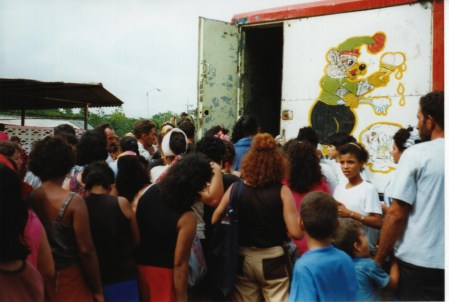
Ice Cream Vendor in Cuba, 2008, Courtesy of Flickr User berg_chabot
For over a century, ice cream vendors have been heard on the streets of Havana. Throughout this time, the city’s spaces have been contested by external regimes of power that include the Spanish Crown, U.S. business interests, Cuba’s own socialist government, the Soviet Union, and since the 1990s, Cuba’s resurgent tourist economy. Yet, in spite of the exclusionary logic imposed by each of these systems of power, the sound of the ice cream vendor still remains. To listen to it is to listen to Havana according not to the agenda of outside interests, but rather, according to the collective interests of residents themselves.
Borrowing from the work of Saskia Sassen (2006) who maintains that “citizenship practices have to do with the production of ‘presence’ of those without power and a politics that claims rights to the city” (315), I regard the tacit, communicative, trans-liminal act of listening as a means through which residents assert their embodied presence amidst both the spatial and political landscapes of the city. Listening to the sound of the ice cream vendor, I argue, constitutes an act of citizenship—an act of sonic citizenship—that momentarily claims Havana’s spaces according to the aims, aspirations, and desires of those who live there.
Citizenship, in this sense, is conceived of not as an institution bound to the political-juridical architecture of the nation-state, but rather, as a place-based “practice and project” (Sassen, p281) that, over time, has the potential to condition changes in the formalized institution itself. It emerges in the everyday, rather ordinary moments during which the city’s spaces are produced and given meaning by those with unequal access to political power. Just as Jennifer Stoever (2011) and Michael Francis O’Toole (2014) have discussed elsewhere, I too contend that citizenship is articulated in sound, but in order to hear it, we must listen historically to—and through—the spaces of Havana’s built environment.
The above clip, which I captured while conducting fieldwork in Havana, represents a moment of everyday life in the municipality of Centro Habana. While speaking about it with friends, colleagues, and acquaintances, I came to realize that only recently had the ice cream vendor’s heralding music become part of the local soundscapes. “Where was it before that?”, I asked. “Before that,” they all said, “it was gone.” In 1990, the Soviet Union collapsed and brought Cuba’s economy along with it. Shortages of food, petrol, and material resources were so severe that satisfying basic needs took precedence over the delivery of frozen novelties. The result was the loss of the ice cream vendor—and its corresponding sound—which, for decades, was part of the ongoing, everyday life of the city.
Fittingly, the collective sentiment surrounding that loss is captured in song. “Helado Sobre Ruedas,” or “Ice Cream on Wheels” by Gema y Pavel was released in 1994, during the height of Cuba’s economic crisis. In it, the duo lament the disappearance of the ice cream vendor from the streets of Havana and reflect on what it meant not only to them, but to all residents of the city. They speak about the presence of the ice cream vendor as a ‘refreshing’ event on hot days; as a source of joy, pleasure, and happiness that offered much more than a simple respite from the heat, but as one that “made family problems disappear.” The “sweet melody” of the vendor was the cause for celebration in neighbourhoods across the city, and is a sound that the duo recalls with both warmth and affection.
Throughout most of the twentieth century, ice cream sales in Havana looked and sounded much like it did in the United States. Minnesota-based Nichols Electronics developed the technology of the electronic music box in the mid-1950s, and within a few years, its chime-y sounds were heard on the streets of Havana. The frozen novelty itself can be traced back to 1920 in Youngstown, Ohio. Harry Burt, the eventual founder of the Good Humor brand paired, first, the lollipop’s wooden stick with chocolate covered vanilla ice cream, and subsequently, ice cream sales and automobility. In Havana, brands such as Hatuey, Guarina, and El Gallito borrowed Burt’s developments, and by the time the city underwent its westward suburbanization in the 1940s and ’50s, mobile ice cream sales were booming.
But if we listen further still into Havana’s past, we can discern the ways in which the ice cream vendor’s music echoes the complex history of the city. During Cuba’s struggle for independence in the late 1800s, American traditions and customs such as baseball, Protestantism, and new habits of hygiene began emerging in Havana. At once a rejection of the perceived backwardness of Spanish culture and an appeal to modernizing the island, this cultural appropriation was, as both Louis A. Pérez Jr. (1999) and Marial Iglesias-Utset (2011) have carefully observed, a way for residents to perform acts of citizenship with the intent of defining the customs of the impending nation.
It is perhaps no coincidence, then, that the practice of street side ice cream vending arrived in Havana at this very moment following its proliferation in cities such as Barcelona, London, and notably New York. These vendors performed a series of decisive functions amidst the city’s political geography, the most discernible of which was that they offered an opportunity for the working class to indulge in what historically was a bourgeois delight. Of equal importance however, was that ice cream vendors were also participants in Havana’s project of cultural modernization, and their street side presence enabled locals to inhabit the acoustic spaces of the city on their own terms and not those of the Spanish Crown.

Ice cream vendor on the streets of Havana between 1890 and 1910. Courtesy of the Library of Congress Archives.
This photograph, taken in Havana some time between 1890 and 1910, can be read not only as a silent image, but as an audiovisual text. Without any visible technology with which to herald his presence, it’s likely that this vendor relied on his own voice in the form of a pregón. We might imagine the slow rumble of the cart’s wooden wheels as they rolled over the unpaved road, glass cups jangling as the cart bounced along, and enthusiastic voices congregating in the street to buy what was known as a “penny lick.” Each of these sounds moved across the liminal spaces of the built environment, each marking a moment of savory indulgence and neighborly dialogue in the life of the city—as they do again today.
Listening to, documenting, and as historian Bruce R. Smith (2004) terms it, “un-airing” the history of Havana’s ice cream vendors offers a means through which to cultivate unexplored encounters with the city. It animates a narrative grounded not in political rupture, but in historical continuity; it locates a geography characterized not by unequivocal exclusion, but one that, quite simply, belongs to those who live there; and in so doing, it develops an account of the city not from the top-down, but rather, from the bottom-up. Such an approach renders audible the enactment of citizenship by listening for the sounds that firmly ground citizens in the very spaces that, time and again, have been destabilized by forces imposed from above.
To hear the ways in which citizens inhabit the city of Havana, we must simultaneously listen trans-liminally, across the open spaces of the built environment, and into the city’s history, which resonates through the sounds of neighbourhood communities, interpersonal dialogue, and social interaction. The heralding music of the ice cream vendor is one sound that does precisely that: for some, it offers a sense of childhood nostalgia, for others, it conjures the taste of a delicious frozen snack. But in every case, to listen to it is to enact a form of civic memory that orients residents according to both the spaces they inhabit, and the social and cultural history to which they belong. It comprises a moment, liminal as it may be, during which the city is lived, experienced, and imagined according to the interests of no one other than citizens themselves.
Acknowledgements: A sincere thanks to my extended family in Havana, to the academic community at Fundación Fernando Ortiz, and in particular, to Dr. Aurelio Francos Lauredo for his time, guidance, and for his attentive and compassionate ear.
—
Vincent Andrisani is a PhD Candidate and an instructor in the School of Communication at Simon Fraser University. He has written and lectured on the topics of popular music, broadcast media, and the politics of audio documentation in the context of Soundscape Studies, and has presented his research in a number of artistic and academic venues; the most recent of which was at the Pan-American Mobilities Conference in Santiago, Chile in 2014. Intersecting the areas of Sound Studies, Urban Geography, and Cuban Studies, Vincent’s doctoral research explores the relationship between sound, space, and citizenship in the city of Havana. In addition to the ice cream vendor, the sounds of water pipes, international travelers, and street musicians performing “Guantanamera” and other likely tunes form the basis of the study. http://www.vincentandrisani.com.
—
Featured image:Ice cream vendor in Havana, courtesy of University of Miami Libraries, Cuban Heritage Collection.
—
 REWIND! . . .If you liked this post, you may also dig:
Radio de Acción: Violent Circuits, Contentious Voices: Caribbean Radio Histories — Alejandra Bronfman
Snap, Crackle, Pop: The Sonic Pleasures of Food — Steph Ceraso
Listening (Loudly) to Spanish-Language Radio — Doloris Inés Casillas
Share this:


Current Top Posts





April 2021

January 2020

November 2019

October 2019

August 2019

April 2014

November 2017

March 2015

December 2017

October 2015
 Sounding Out!
Recent Comments