
Speaking “Mexican” and the use of “Mock Spanish” in Children’s Books (or Do Not Read Skippyjon Jones)

Cinco de Mayo. ‘Tis the season when many Americans don sombreros, order their frozen margaritas, and, God help us, speak “Spanish.” We are well used to hyper Anglicized renditions of “amigo,” “adios,” and happy hour specials brought on by the commercialization of Cinco de Mayo. The holiday celebrates a significant event in Mexico’s history – the battle of Puebla and victory over France in 1862 – through narrowing ideas about language, culture, and tequila. That said, let’s not just blame Cinco de Mayo for the disconcerting use of Spanish. Unfortunately, the incessant use of phrases such as “ay caramba” and “no problemo” are heard much, much earlier in contemporary children’s books.
The New York Times recently published the startling figure that just 93 of the 3,200 children’s books published in 2013 were about African American children. Within these few 93 texts, African American children all-too-often read about themselves within the past tense, in reference to slavery and civil rights legacies. Children of color are left to identify with the adventures and imaginative stories of white characters amid white settings. Aptly characterized as an, “apartheid of children’s literature,” two moving first-person accounts from Walter Dean Myers and Christopher Myers detail the significance of incorporating more characters of color for all readers. One major effect of this dearth of representation, according to Christopher Myers,
…is a gap in the much-written-about sense of self-love that comes from recognizing oneself in a text, from the understanding that your life and lives of people like you are worthy of being told, thought about, discussed and even celebrated.
Just as significant, is the number of children’s books about Latino children from the 2013’s trove of 3,200 books: 53. That’s 5-3. As a reminder, the United States Census tallied 53 million Latinos in the United States, representing the nation’s youngest demographic (children!).
However, perhaps worse than the actual lack is the rise of stereotypic in-your-face representations of race within children’s books – award-winning ones, actually – and their role in teaching children troubling ideas about race, language, and “difference.”
My name is Skippito Friskito. (clap-clap)
I fear not a single bandito. (clap-clap)
My manners are mellow,
I’m sweet like the Jell-O,
I get the job done, yes indeed-o.
Case in point: Skippyjon Jones, a Siamese cat that pretends to be a Chihuahua superhero. Skippyjon speaks English, but his super hero alter ego speaks in Mock Spanish in his recurring and imaginative quests. Speaking “Spanish” in hyperanglized fashion recasts Skippyjon from an English-speaking (white) cat to a Spanish-accented (brown) dog. His auditory performance of Mexicanness, what Reina Prado considers “sonic brownface,” reeks of white privilege as he code-switches from cat/white/English to dog/brown/”Spanish.” What’s worse, as a children’s book, directed at those between the impressionable ages of 4-8, Skippyjon encourages both adult readers and young readers to read out loud and perform sonic brownface. Listening to the book’s trite word choice (amigos, adios, frijoles), fake Spanish (indeed-o, mask-ito) and embellished accents (“ees” for is) trains the ear on how to speak “Mexican,” presumably, of course, for the listening amusement of non-Mexicans.

Image by Flickr user Howard Lewis Ship
“I am El Skippito, the great sword fighter,” said Skippyjon Jones.
Apparently, these tried and true tactics sell quite well. This award-winning children’s book character, by Judy Schachner, has spawned into a lucrative empire that includes fourteen books, a coordinating plush toy figure, online webisodes of the books’ stories, CDs of Schachner reading out loud, the obligatory Ipad app, a starring role in the department store Kohl’s “We Care” charity campaign in 2012, and get this, a children’s musical. Of course, Skippyjon is not really recognized as a book series about Latinos (like fellow television darlings, Dora the Explorer, Handy Manny, or Dragon Tales) yet it taps into every flinching stereotype we know of, and should avoid, about Mexicans. Equating Mexicans and Mexican tales to the canine of a Chihuahua is hardly new but it does not make it less problematic.
For instance, in the inaugural self-titled Skippyjon Jones book, the cat’s adventures take place “far, far away in old Mexico.” Much like the perpetual placement of African Americans in the past tense within children’s books, situating Mexico in the imaginative past reinforces perceptions of all-things-Mexican as distant, foreign, and old. Skippyjon and his chimichangos – his sidekicks (good guys) –set out to save their rice and beans from Alfredo Buzzito and Bumblebeeto Bandito (bad guys). Zorro-esque masks, swords, fiestas followed by siestas, fellow Chihuahuas, piñatas, plenty of cacti, and lots of clap-clap cues frame the rice-and-bean rescue. His adventures, book after book, via a Skippito brown identity sends a disquieting message about power and privilege. Skippito, even when masked, still plays the role of Great White Hero to the masses of “Mexican” dogs.
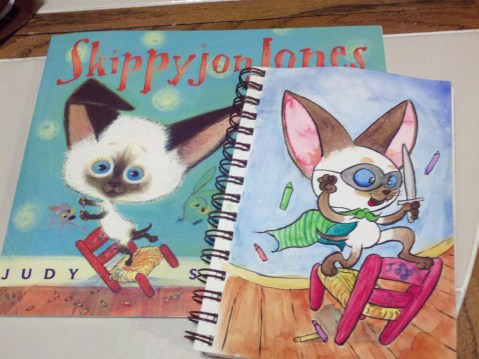
Image by Flickr user Tomas Quinones
Then all of the Chimichangos went crazy loco.
Several of Schachner’s Skippyjon books have received notable accolades including, for instance, the 2004 E.B. White Read Aloud Award and a spot on the coveted “Teachers’ Top 100 Books for Children” by the National Education Association in 2007. The former comes with an adorning gold seal on future editions of honored books. A sampling of the series’ laudatory press, from the E.B White Read Aloud press release, “Peppered with Spanish expressions and full of energized fun, SkippyJon Jones is not only entertaining for the listener, it’s also enjoyable for the reader.” And from the author’s webpage: “Each of my adventures are ay caramba, mucho fun but they’re educational too!” The insinuation that the Skippyjon Empire teaches Spanish not only ignores the richness of Spanish but it also feeds popular ideals that Spanish is an “easy” and “fun” language to learn.
Schachner’s recurrent use of “Spanish,” in particular, not only structures the silly narrative adventures of Skippyjon as he imagines himself to be Skippito but the racialized language play has also become the hallmark element of Skippyjon. Written and read out loud by parents and teachers, some of Skippyjon’s signature phrases include “Holy Guacamole!” and “Holy Frijoles!” – textbook examples of Jane Hill’s renowned writings on Mock Spanish (or fake, incoherent Spanish uttered and deemed “funny” by non-native Spanish speakers). Because we already hold native Spanish-speakers (U.S. Latinos) with such little regard in the first place, Mock Spanish done for laughs, as argued by Hill, comes quite easily. Carmen Martínez-Roldán takes the Skippyjon Jones series to task in necessary detail; see her analysis of Mock Spanish in the equally troubling, Skippyjon Jones in the Doghouse. Her emphasis on the cultural representations of Mexicans vis-a-vis language in children’s books supports my tirade against this cat/dog. Martínez-Roldán found that several teachers, particularly those from the Southwest, expressed a sense of inexplicable uneasiness to these books. Amazon ratings are (painfully) positive for Skippyjon, yet, according to Martínez-Roldán, those who expressed low ratings were “accompanied by lengthy explanations, mostly related to misrepresentations of Mexicans and the poor use of Spanish.” Her research calls for more diversity within children’s literature but, central to this essay, reminds us that U.S. Latinos hold both a personal and political relationship to Spanish.
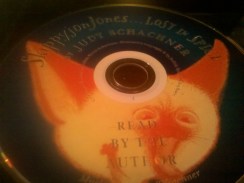
Image by Flickr User John Graham
Anthropologist Bonnie Urciuoli explains how Spanish, when overheard in designated public spaces (think: Cinco de Mayo or Mexican restaurants) is safely “ethnified,” yet Spanish is regarded as out of place or “racialized” when heard as bilingual announcements at local grocery stores or school sites. When heard by monolingual English speakers outside of its designated spaces in the U.S., Spanish carries “racialized” connotations such as “impoliteness” and “danger.” The insistence many American employers place on speaking English and prohibiting non-English language conversations at workplaces, for instance, speaks to the public boundaries imposed on Spanish and Spanish-speakers. (Yes, Whole Foods. I am looking at you.)
Jane Hill’s provocative argument, built from Uricuolli’s writings, examines Whites’ use of Spanish (Mock Spanish). Unlike Latinos, who learn early on to self-monitor where and how they speak English and Spanish, non-native speakers of Spanish do not carry this same burden, according to Hill. In fact, they have the privilege of speaking grammatically incorrect Spanish, in hyper Anglicized Spanish, or mockingly (by adding a stupid “o” or prefacing a phrasing with “el”) without surveillance.
Then, using his very best Spanish accent, he said, “My ears are too beeg for my head.
My head ees too beeg for my body. I am not a Siamese cat… I AM A CHIHUAHUA!”
In addition to overplayed colloquial expressions, Schachner demarcates a racial line with “visual accents” (“beeg” for big) (see Jennifer Stoever-Ackerman, Priscilla Peña Ovalle and Sara V. Hinojos). In line with Uricuolli’s ideas, even Skippito’s English is accented and marked while in “Mexican” character. Readers stammer through “ees” and “beeg” in an effort, as prepped, to use their “very best Spanish accent.” The practice teaches children that accents are performative and easy to take on and off rather than hear accents as indicative of someone’s larger family histories of migration and culture.

The Frito Bandito, Image by Flickr user Bill Futreal
For children unfamiliar with Mexicans and Latinos, these books cast Spanish with archaic imageries of Mexican bandits and modern-day Frito Banditos. Spanish is not used as a language to communicate given its incoherence. Instead, Schachner uses Spanish to laugh at Skippito and by extension, Mexicans and Latinos in the U.S.; its runaway success is indicative of how “funny” Spanish and Mexicans continue to be to White and/or monolingual English speakers.
For Latinos, these books plant early attitudes about their own language differences. For children positioned as the family translator or struggling to maintain a bilingual, bicultural existence, these books teach children to shun their accent and those of their families. These books are clearly not for my two kids, whose young ears are already familiar with their grandmother’s Spanish-accented English and their own mother’s English-accented Spanish.
“Vamos, Skippito- or it is you the Bandito will eato!”
Reading children’s books out loud and listening to race through scripted accents sends troubling messages about “difference” at an early age. Educators have long argued that children’s books serve as both mirrors and maps to affirm and inspire readers’ identities, experiences, and future motivations. True. But I would also argue that the woeful absence of more diverse children’s tales mirrors a number of campaigns directed at working-class, communities of color; namely, our nation’s shaky commitment to universal preschool, lack of public support for Women Infant and Children (WIC) and Food Stamp programs, and outdated approaches to parental leaves (six measly weeks). In particular, Skippyjon Jones is a kid’s rendition of grownup racial and language politics, a pint-size version of NAFTA and English-only propositions presented for five-year old audiences. These policies, like the woeful crop of contemporary books, do little to provide a map for the livelihoods of children of color. Instead, Skippyjon’s use of language, a reincarnation of Speedy Gonzalez normalizes English, white characters (even in brown drag), and helps keep Cinco de Mayo antics alive.
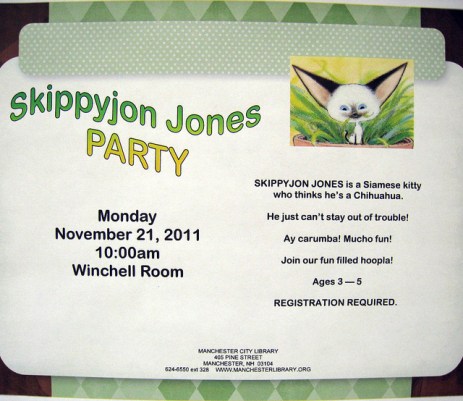
Image by Flickr user Manchester City Library
—
NOTE: On 5-8-14, the author added a passage to this article to reflect the relationship of her work to Carmen M. Martínez-Roldán’s “The Representation of Latinos and the Use of Spanish: A Critical Content Analysis of Skippyjon Jones” published in The Journal of Children’s Literature (2013).
Featured Image by Flickr user The Long Beach Public Library, CC BY-NC-ND 2.0
—
Dolores Inés Casillas is an assistant professor in the Department of Chicana and Chicano Studies and a faculty affiliate of Film & Media Studies at the University of California, Santa Barbara. She writes and teaches courses on Latina/o sound practices, popular culture, and the politics of language. Her book, Sounds of Belonging: U.S. Spanish-language Radio and Public Advocacy will be published this fall by New York University Press as part of their Critical Cultural Communication series.
—
 REWIND!…If you liked this post, you may also dig:
This Is How You Listen: Reading Critically Junot Díaz’s Audiobook-Liana Silva
Óyeme Voz: U.S. Latin@ & Immigrant Communities Re-Sound Citizenship and Belonging -Nancy Morales
Sonic Brownface: Representations of Mexicanness in an Era of Discontent–reina alejandra prado saldivar
Share this:

Radio and the Voice of the Aymara People

 Welcome back to our continuing series on radio in the Caribbean and Latin America: Radio de Acción. A consideration of the multilingual history of radio from Cuba, Jamaica, and Haiti to the Southern Cone and beyond, Radio de Acción turns this week to the Aymara in Peru, Chile, and especially Bolivia in a fascinating piece from anthropologist Karl Swinehart.
If you missed our first post, Alejandra Bronfman’s stunning history of radio and violence in the Caribbean, you can find it here. In the meantime, keep your dials tuned to Karl Swinehart’s study of the micropolitics of language and power on Aymaran radio.
– Guest Editor Tom McEnaney
—
“What do you like most about working at this radio station?” was a simple question I had asked Celia Colque Quispe, an Aymara language radio broadcaster on Radio San Gabriel in El Alto, Bolivia during an interview I conducted in 2007 as part of my dissertation research on Aymara-language media. Her response was simple, but profound.
“Clearly, here, being Aymara. I like to be Aymara.”
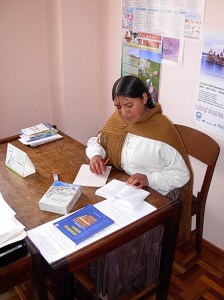
Celia Colque Quispe; photo by the author, all rights reserved
Quispe came to Radio San Gabriel from a small, rural community on the shores of Lake Titicaca. One day, she had heard an announcement on the radio that Radio San Gabriel would be hiring personnel through an open selection process involving an Aymara language fluency assessment. Competing against university-trained linguists and graduates of communications programs, Quispe stood out for her eloquent Aymara speech and was hired, beginning a career in radio where she came to not only to work as an announcer, but as a member of the Aymara Language Department where she wrote and approved scripts for the station’s programs. Stories like this are not unusual at Radio San Gabriel, but are otherwise rare in this multilingual Andean republic, still profoundly marked by anti-Indian racism. What “being Aymara” means in Bolivia remains highly contested. One thing was clear from my conversation with Quispe, however—her work at the radio allows her “to be Aymara.”
The presence of the Aymara language on Bolivian airwaves contrasts sharply with its general absence within other Bolivian media. There are some notable exceptions: Bolivian state television occasionally runs Aymara language programming on programs like Entre Culturas (‘Between Cultures’), and, famously, the neorealist director Jorge Sanjinés’ work has dramatized the struggles of highland Aymara and Quechua Indians in films like Yawar Mallku (Blood of the condor) and Nación Clandestina (Clandestine Nation).
These are exceptions, however, that prove the rule of Spanish language dominance within Bolivian television and film, leaving radio to stand out as the medium that most reflects the country’s multilingualism. In this post we will tune in to Radio San Gabriel, Bolivia’s oldest and most prominent Aymara language radio station, to ask how Aymara language radio might not just reflect Bolivia’s multilingualism, but also actively intervene in it, shaping how Aymaras hear their own language.
Aymaras and Bolivia

Geographic distribution of the Aymara language, public domain
The Aymaras are one of the the largest ethnolinguistic groups within Bolivia, a nation that is now officially a “Plurinational State” in which 36 indigenous languages are recognized as co-official with Spanish. Aymara is among the most widely spoken of these and Aymaras constitute a majority of the population in a contiguous territory surrounding the nation’s capital of La Paz, and crossing national borders into neighboring Chile and Peru. With approximately two and a half million people (and many more than this if speaking Aymara is removed as a criterion of ethnicity), Bolivia has the largest concentration of Aymaras in the region. Perhaps because Bolivia’s political capital sits within Aymara territory or because of their sheer numbers with respect to other indigenous populations, the Aymara have long played a significant role in Bolivian politics. Increasing the presence of the Aymara language in public space, on the airwaves or otherwise, is thus a prominent component of a multifaceted politics of indigenous resurgence in contemporary Bolivia.
Aymar Markan Arupa – “The Voice of the Aymara People” – Radio San Gabriel
As Bolivia’s first and longest running Aymara language radio station, Radio San Gabriel (RSG) calls itself “Aymar markan arupa” (the voice of the Aymara people). In the wake of the 1952 Bolivian revolution, a major social upheaval in which miners’ militias played a crucial role, Maryknoll Jesuit priests founded RSG in 1955 with aims of Christian evangelization within a broader effort at rural uplift. RSG’s mission was also in line with the new government’s hopes of integrating indigenous rural communities into national political life. Jesuits had experience with radio in mining communities, a broadcasting milieu dominated by radical syndicalist and communist political currents, where Jesuits had also founded radio stations of their own. Although miners are remembered as the central protagonists in the 1952 revolution, also crucial to its victory were the highland indigenous communities who overturned nearly feudal relations of the haciendas through insurrectionary land expropriations.

The offices and studios of Radio San Gabriel in El Alto, Bolivia; photo by the author, all rights reserved
In its early days, RSG approached the Aymara language as a bridge to Spanish language literacy and integration into the mainstream of the Catholic faith, an approach consistent with a mid-twentieth century view which formulated the “the Indian problem” as one of national integration. Yet these early assimilationist efforts would quickly change due to both developments in the Catholic Church, such as the Second Vatican Council (1962-1965) and the rise of “liberation theology,” and also political ferment in Bolivia in opposition to military rule. During the 1970s radical Aymara nationalism, or katarismo, was on the rise, finding institutional expression through organizations like the Movimiento Revolucionario Tupak Katari (MRTK, ‘Revolutionary Movement Tupak Katari’), and the founding of the Confederación Sindical Única de Trabajadores Campesinos Bolivianos (CSUTSB, ‘Trade Union Confederation of Rural Workers of Bolivia’) under katarista leadership in 1979.

“Tawa Chakana” by Wikimedia user Huhsunq, CC BY-SA 2.5
Influenced by Aymara nationalism, RSG made a dramatic shift in its orientation towards Aymara language and culture. Their adoption of an Aymara-centric idiom resonated with other nationalist currents, while maintaining Maryknoll Jesuit aims of social justice and service to the poor by reformulating “liberation theology” as a “theology of inculturation.” Practices earlier demonized by the Catholic Church as pagan were now celebrated as being essentially Christian—with the spilled blood of a sacrificed llama, for example, recast as analogous to the wine of the sacrament. This remains in many ways the orientation of RSG today, and the station positions itself as an authority on questions of Aymara linguistic and cultural authenticity.
Broadcast language – dehispanicized “pure” Aymara
One of the ways that RSG’s authority becomes audible to its Aymara audience is through the language used on the air. On RSG, radio announcers speak without using Spanish loan words, using what radio announcers and other Aymaras refer to as “Aymara puro” (pure Aymara). This is ensured through the radio’s Aymara Language Department, which intervenes prior to each broadcast by either writing or editing scripts, and is responsible, along with the radio’s director, for these scripts’ ultimate approval. However, its responsibilities do not end with broadcasts’ content. The department is also responsible for a protocol extending through and beyond the actual broadcasts called seguimiento, or “following.”
Seguimiento involves two procedures: the real-time monitoring of broadcasts for “aberrations,” and a follow-up interaction with those who utter them on air.The department finds alternatives or invents neologisms for the many loan words in Aymara from Spanish. These loan words include words as common as the verb “to speak”—parlaña from the sixteenth-century Spanish parlar—and are testament to 500 years of contact with Spanish. Contact, of course, is a euphemism for what was first colonial and later republican subjugation, making the aberración serve as a linguistic reminder of this painful history. This is why, rather than simply “Aymara puro,” a more apt term might be deshispanized Aymara. While Spanish loan words are purged from the broadcasts, many words shared between Quechua and Aymara escape the protocols of seguimiento, even though these also likely entered the language as the result of earlier subjugation of the Aymara under the Inca Empire. It was not the Inca period, however, but the domination of all Indians, whether Quechua, Aymara, or otherwise, by the Spanish under the colony, then by their descendants during the Republican period and into the 21st century that has most profoundly shaped Bolivia’s dynamics of race and class and, it turns out, the linguistic phenomena that accompanying them, leaving the loan word, the aberración, to be understood as the residue of this history.

Outside the studios of Radio San Gabriel in El Alto, Bolivia; photo by the author, all rights reserved
Decolonization over the Airwaves
Is the linguistic purism of the RSG any different from that of, say, the Academie Française? In terms of aims and procedures, much remains the same—both groups identify loan words and push for consensus to implement neologisms. Such a comparison, however, would obscure the starkly different social context in which this process unfolds in Bolivia. If “protecting” the language is commensurate with protecting the people, at RSG, this means targeting loanwords that serve as reminders of the painful processes of colonialism. In this light, many at RSG understand their work as fitting within a larger project of decolonization, a project not without its contradictions or ironies, particularly considering the role of the Catholic Church in both the past and the present. I explore these ironies more in a longer ethnographic account of the process of seguimiento at RSG.
Whatever the ironies, RSG’s cultivation of a model of refinement in Aymara speech has created opportunities for people who are otherwise profoundly marginalized in Bolivian society, particularly rural women, to advance professionally in a labor market that too often shuts them out. Where Celia Colque Quispe’s wearing of long braids, broached shawl, and full pollera skirt of rural Aymara women, for example, would have her barred from other employment whose job descriptions might demand of employees a euphemistically racist and sexist requirement of buena presencia, at RSG her traditional dress and status as a rural Aymara woman was valued and bolstered her authority within the institution. In a society still steeped in legacies of colonialism, it is no wonder, then, that what Quispe likes most about her work is simply that she can be Aymara.
In the broader media landscape, stations like RSG surely fill a gaping hole of Aymara language programming. Yet as “the voice of the Aymara people” extends across the high plain, radio introduces new absences: the absence of speech deemed too marked by colonialism to appear on air. Linguistically, then, the static on the frequencies of Aymara language airwaves are many. Both the neologisms of the voices cultivated for the airwaves and the incursion of Spanish into the speech of those whose tongues are less trained complicate any notion that the voice of the radio resonates free of the static of history.
—
Featured image: Aymaras marching to commemorate the uprising and massacre of 1921 in Jesús de Machaca, La Paz.
—
Karl Swinehart is Collegiate Assistant Professor and Harper-Fellow at the University of Chicago. He is currently working on a manuscript on hip-hop in Bolivia, Clear, Hidden Voices: Language, Indigeneity and Hip-Hop in Bolivia. He is a linguistic anthropologist with interests in media, popular music, social movements, racialization and multilingualism. He is co-editor of Languages and Publics in Stateless Nations, a special issue of Language and Communication. His work can also be found in the Journal of Linguistic Anthropology, Language in Society, and Social Text.
—
REWIND!…If you liked this post, you may also dig:
“Violent Circuits, Contentious Voices: Caribbean Radio Histories”-Alejandra Bronfman
“Chicana Radio Activists and the Sounds of Chicana Feminisms”-Monica De La Torre
“On the Lower Frequencies: Norman Corwin, Colorblindness, and the ‘Golden Age’ of U.S. Radio”-Jennifer Stoever
Share this:


Current Top Posts





April 2021

January 2020

November 2019

October 2019

August 2019

April 2014

November 2017

March 2015

December 2017

October 2015
 Sounding Out!
Recent Comments