
“I’m on my New York s**t”: Jean Grae’s Sonic Claims on the City
 Hellooooooo, Cyberspace! Are you ready to rock??? Welcome to our February Forum on “Sonic Borders,” a collaboration with the IASPM-US blog in connection with this year’s IASPM-US conference on Liminality and Borderlands, held in Austin, Texas from February 28 to March 3, 2013. Expertly organized by Sounding Out!’s Managing Editor Liana Silva and IASPM’s Web Editor/Webmaster Justin Burton (and curated for SO! by yours truly), the “Sonic Borders” forum is a Virtual Roundtable cross-blog entity that will feature six Sounding Out! writers posting on Mondays beginning today and running through February 25, and four writers from IASPM-US, posting on Wednesdays starting February 6th and ending February 27th. We envision plenty of excitement and cross blog commenting from authors, audiences, and IASPM-US conference attendees. Consider this your ticket to the show, so please come on in and mix it up!
And what will we be talking about across our platforms? The “sonic borders” between sound studies and popular music studies. . .where their methods, objects of study, and approaches overlap, where they rub raw, where they challenge the people on either side to do do better, and where they meet to generate some of the finest scholarship in the contemporary humanities.
And who will you be hearing from over here at Sounding Out!?: Liana Silva, SO! regular Regina Bradley, Marcus Boon (York University, The Wire), Daphne Brooks (Princeton), Tavia Nyong’o (NYU), and Art Jones (film-maker, photographer, artist, mixer, raconteur, School of the Museum of Fine Arts, Boston).
And what topics do you have a front row ticket for? Some real New York shit. Django. Body-regenerating vibrations on the dance floor. Cabaret, jazz, and funk/soul, plus musical memory, dance, performance art, race, gender, sexuality, and politics. Sound gatherings in Pakistan.
Feel free to camp out and shine your cell phone lights at each day of our Forum, because we’re turning it up to 11 over here at Sounding Out! and IASPM-US!—Jennifer Stoever-Ackerman, Editor-in-Chief
***
If you had to guess whether the singers of the following lyrics were male or female, how would you fare? Click on the lyrics to hear the song and find out who’s the rap artist.
“We gon’ hold it down for Illadel for life
Came through made a name, nigga nailed it tight
An’ now we shine, been knew, shit, it was about time
Switched from streets, the beats, platinum lines
Used to struggle in the hood just to brodie the mic
Took the fame ’cause they ain’t give it us, now we excite
The biggest crowds an’ they screamin’ loud, “Philly the shit”
“They hear Brooklyn, and we up to no good
Well, here we come, so there goes your neighborhood
Timbos scuffed up, sess bein’ puffed up
Mess with the wrong one, kid, you get ruffed up”
“My city do it best, whether it’s East or West
We feelin’ good fine, love it when it’s summertime
Detroit in summertime, summer time in Detroit,
Detroit in summertime, summertime in Detroit”
Although it is somewhat unfair to judge the gender of a rapper by the lyrics of a song, it is commonly thought that if a rapper is talking about the city, they are more than likely a man. Are there borders in hip hop around the content that men or women can address?
Case in point: several years ago I wrote a paper on representations of the city in hip hop songs. It gave me the opportunity to look closely and write extensively about some of my favorite hip hop artists and songs. However, most of the songs I tackled in the paper, actually most of the songs that occurred to me, were written and sung by male rappers. When I realized this, I couldn’t believe my oversight. Surely there had to be female rappers invoking the city in their songs. Men couldn’t be the only ones claiming the city. So, over the years I have been on the hunt for songs by female emcees that talk about the city. (I recently started a Spotify playlist, but several of the songs I have come across are on mix tapes that don’t show up on Spotify. If you have any suggestions you’d like to add to this collaborative playlist, please add them or mention them in the comments!)
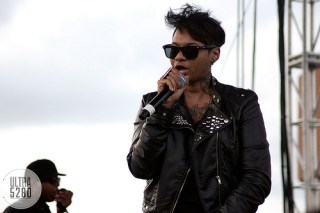
“Jean Grae” by Flickr user ultra5280 under Creative Commons 2.0 License
One of the female emcees that stands out most is Brooklyn-based Jean Grae. Born in South Africa in 1976, she moved to the United States with her parents shortly after she was born and grew up in New York City. In a 2006 interview with Robert Walsh for the academic journal Callaloo, Jean Grae reminisces about how hip hop culture was inescapable for a teen in New York City in the early nineties:
It was a thing when kids finally realized that you could put out your music yourself and you didn’t have to wait around and get signed. It was possible to learn for yourself and be able to put out music on your own or on an underground level. It was kind of unavoidable to be a part of it, I guess. (216)
After a brief stint as a DJ, she opted for rapping, as she was already writing (even if not necessarily rhyming). She took a hiatus from the hip hop scene in 2008 but later that year returned to performing and finally released a new mixtape named Cookies or Comas in 2011.
In hip hop, cities are often represented as masculine–what with the number of male rappers dropping stories about how things go down on the street–and Jean Grae complicates that representation. In Jean Grae’s version of Busta Rhymes’ “New York Shit,” she opens a door to thinking about female rappers and urban space, and her sonic intervention into Busta Rhymes’ narrative in his version of “New York Shit” illustrates how female rappers claim the city as well. I read her track as an act of urban homemaking: rapping about the city (and subverting the male voice that initially sung on the track, Busta) becomes a practice to claim the city as her home. In fact, it is not just through her lyrics but also through her voice that Jean Grae makes her presence felt.
Jean Grae’s version of “New York Shit,” a collaboration with rapper Talib Kweli, is an alternate version of Busta Rhymes’ hit track “New York Shit” from his 2006 album The Big Bang, although both songs use the same sampled loop and constantly repeat the phrase “New York Shit.”
The track that “New York Shit” samples is from the opening of a 1976 song titled “Faded Lady” from The Soul Sensation Orchestra (featuring Douglas Lucas and The Sugar Sisters, who sing together throughout the whole song). The song itself tells the story of a “faded lady” who seems to have lost her hopes, dreams, and connection to the world around her. “New York Shit,” both the Busta Rhymes and the Jean Grae/Talib Kweli version, samples approximately the first 13 seconds of the song, so that in their version the voices are erased; all that is left is the even thump thump of a drum, a bass, and a guitar, with the clash of a top hat and the bass in between, finally rising up to a climax with what sounds like a flute or clarinet until it drops back into the thump thump. The loop invokes the soundtracks of blaxploitation films, several of which were set in urban locations. The sample choice then places “New York Shit” in an urban soundscape.
Busta’s original song weaves images of New York as the birthplace of hip hop, as the location of great sports teams, and expensive taste around this soulful, smooth loop. The chorus of the song (“If you’re from New York, stand up right now, If you’re from New York, hands up right now”) calling forth New Yorkers. In the song, Busta also pays homage to some of the big names in hip hop who come from New York: Ol’ Dirty Bastard, Notorious BIG, Big Pun, Jam Master Jay, while the video includes cameos from people like Q-Tip, RZA, Slick Rick, and Big Daddy Kane. In this way, the song celebrates their contributions to hip hop, but also recreates a narrow, gendered view of who is part of that musical history.
However, the sonic picture Busta Rhymes paints is one that is devoid of women. Before the loop starts, Busta Rhymes’ voice emerges from the quiet: “DJ Scratch you’re sick for this one,” which acts as the signal for a chorus of male voices. Some of them whoop, some of them whistle, and some of them sing. Eventually they make way for Busta Rhymes to serenade listeners with his tales of New York life. His voice sounds gruff and aggressive, a contrast with the smooth vibe of “Faded Lady.” In fact, it seems as if the “faded lady” of the title is not just faded but erased–the women in the city become the faded ladies whose erasure makes possible for this problematic representation of urban space.
Enter Jean Grae.
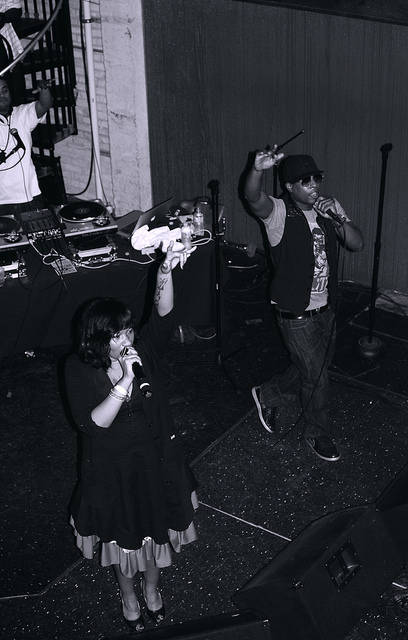
“talibjeangrae” by Flickr user HDShootsPhotos under Creative Commons License 2.0
In 2006, she and Talib Kweli released their version of “New York Shit” in a mixtape titled Hip Hop Docktrine: The Official Boondocks Mixtape which responds to Busta Rhymes’ sonic tribute to New York. (It also appeared on the mixtape Talib Kweli Presents Blacksmith the Movement.) Busta Rhymes’ song comes immediately to mind when listening to Jean Grae’s sixteen bars, especially when she starts with “Some of y’all forgot what New York is,” and in that vein it is hard not to hear Jean Grae’s track as a response to Busta Rhymes’.
Whereas Busta Rhymes’ song is ushered in by a chorus of disparate men’s voices, Talib Kweli and Jean Grae’s version starts with Talib Kweli’s introduction, followed by Jean Grae’s rapping. Talib Kweli’s introduction tricks the listener into thinking this version is just an echo of the original by Busta Rhymes (especially since the loop is virtually unchanged) until Jean Grae pops up by responding to Talib Kweli’s “I went for mine” with her “Go for yours, man.” The back-and-forth of the male and female voices, laid upon the same loop, acts as a subversion of Busta Rhymes’ male New York chorus.
But Jean Grae’s rapping is the most subversive element of the song. Jean Grae’s first line, “I’m on my New York shit,” calls forth Busta Rhymes’ song, even in her tempo. However, her verses take a swift turn from what Busta Rhymes puts forth in his song; at first listen, Busta Rhymes’ snappy, aggressive repetition of the phrase “New York [plus noun]” at the end of each verse is absent from Jean Grae’s rapping. Her voice seems to float on top of The S.S.O. loop, picking up speed when the loop reaches a climax, and dropping an octave or two (and slowing down a tad, too) when the climax of the track drops and loops back to the beginning. The resulting effect is that Jean Grae’s voice merges with the soulful flow of the song whereas Busta Rhymes’s voice is at war with it. Through her voice, Jean Grae disrupts Busta Rhymes’ sonic portrayal of a men’s-only New York. In fact, by subverting the vocal pattern Busta Rhymes sets up in the original version, Jean Grae creates a space in this New York hip hop narrative for female rappers to claim New York City as their own.
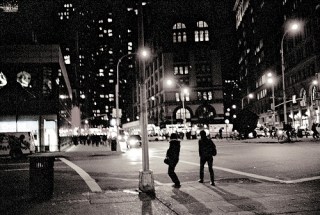
“New York City at Night” by Flickr user Alyssa L. Miller under Creative Commons License 2.0
In her verses, Jean Grae depicts a New York that is not glamorous or glitzy, like the one in Busta Rhymes’ song. Instead she talks about a “cement jungle,” and men who “struggle to their feet”; she also invokes the perils of gentrification when she talks about the Starbucks that pop up around the block (an indication of the white middle class coming to the neighborhood). But what catches my ear from this song is that Jean Grae mentions toward the end of her bars, “I just want to write and give back to the city that I’m a factor of.” Writing and rapping become a way for Jean Grae to practice her New York citizenship, an act of urban homemaking.
Even though Jean Grae busts her way into this narrative of urban masculinity, she is still a lonely female voice in the “New York Shit” repertoire. According to Wikipedia, there are several versions of the song, but Jean Grae is one of only two women to take on “New York Shit.” (Brooke Valentine has a version titled “H-Town Shit,” but I am limiting myself to the versions that look at New York City.) In that sense, Jean Grae’s female voice doesn’t necessarily fill a void in hip hop but rather points to it. On the other hand, her voice can be read/heard as highlighting a tradition of women rapping about the city. Whereas many rap songs invoke cities and urban locations, oftentimes these are portrayed as the sites of male dominance, normalizing a sonic cityscape that consists solely of men However, Jean Grae’s vocal track resists to that sonic cityscape, and that resistance too is an act of urban homemaking by virtue of claiming her space.
I continue to look for more tracks by female rappers and MCs that talk about U.S. cities, and this post has brought to mind more questions that I need to address. For example, what does it mean for a woman to rap about the city? Are there certain themes that echo throughout the songs (or throughout certain periods or subgenres)? Are there certain samples that are repeated? Do the sounds vary from city to city? These are questions that can be addressed by looking at a broader sample, but a close reading of one track can go a long way into thinking through these issues. Female rap artists like Jean Grae remind listeners that, to signify on Jay-Z, there is love in the heart of the city.
—
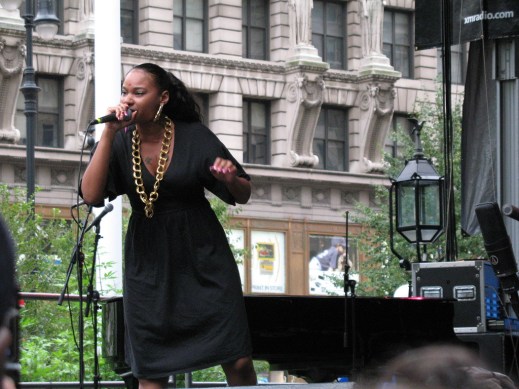
Featured Image of Jean Grae performing in New York City on August 26, 2006, Courtesy of Flickr User MrMoneda
—
Liana M. Silva is co-founder and Managing Editor of Sounding Out!
Share this:

Sound at MLA 2013


“Northeastern University, Boston, MA” by Flickr user ksparrow11 under Creative Commons 2.0 License
Lastly, Jennifer, regular contributor Osvaldo Oyola, and I will be presenting at this year’s MLA. Jennifer is participating in a roundtable Saturday at 3:30; look out for session #588, “Race and Poetics: On Aesthetic Practice in Ethnic Studies,” which considers cultural difference as seen in different genres and media. Osvaldo is presenting on Junot Diaz’s The Brief Wondrous Life of Oscar Wao in session #97, “American Linguistic Plurality.” I will be presenting at a non-sound-studies panel on Friday at noon titled “How Did I Get Here? Our ‘Altac’ Jobs” (s#270). My topic will be how I moved from an adjuncting job to an alternative academic position and how this moved changed my ideas of a career in academia.
If you are not present at MLA, please follow along via Twitter! You can check out the #MLA13 hashtag, but if you’re interested in a particular session from the ones below, you can also search on Twitter for the session number during its scheduled time. You can also check out the conference action by following the official Sounding Out! twitter account (commandeered by our Editor-in-Chief) or following my personal account, @literarychica, for our live-tweets from MLA 2013.
Please comment to let us know what you think–both before and after MLA 2012. If I somehow missed you or your panel in this round up, please let me know!: lms@soundingoutblog.com
–
Liana M. Silva is co-founder and Managing Editor of Sounding Out!.
Jump to THURSDAY, January 3
Jump to FRIDAY, January 4
Jump to SATURDAY, January 5
Jump to SUNDAY, January 6.

“A Chilly Night in Boston” by Flickr user Stuck in Customs under a Creative Commons 2.0 License
Back to menu
THURSDAY, January 3
Thursday, January 3
8:30–11:30 a.m.
.3. Evaluating Digital Work for Tenure and Promotion: A Workshop for Evaluators and Candidates
Republic A, Sheraton
Program arranged by the MLA Office of Programs. Presiding: Alison Byerly, Middlebury Coll.; Kathleen Fitzpatrick, MLA; Katherine A. Rowe, Bryn Mawr Coll.
Facilitated discussion about evaluating work in digital media (e.g., scholarly
editions, databases, digital mapping projects, born- digital creative or scholarly
work). Designed for both creators of digital materials and administrators
or colleagues who evaluate those materials, the workshop will propose
strategies for documenting, presenting, and evaluating such work.
Preregistration required.
12:00-1:15
22. Expanding Access: Building Bridges within Digital Humanities
205, Hynes
A special session.
Presiding: Trent M. Kays, Univ. of Minnesota, Twin Cities; Lee Skallerup Bessette, Morehead State Univ.
Marc Fortin, Queen’s Univ.
Alexander Gil, Univ. of Virginia
Brian Larson, Univ. of Minnesota, Twin Cities
Sophie Marcotte, Concordia Univ.
Ernesto Priego, London, England
36. Languages of the Occupy Movement
307, Hynes
Program arranged by the Division on Language and Society. Presiding: Frank Farmer, Univ. of Kansas
Corinne Seals, Georgetown Univ., “Examining the Linguistic Landscape of Occupy”
Corey J. Frost, New Jersey City Univ., “Occupy and Rhetorics of Amplification”
Keith Spencer, Carnegie Mellon Univ., “Class, Race, and the ‘Common Man’: Interviews with Occupy Pittsburgh”
Respondent: Frank Farmer
40. Hearing and Seeing Anew: Ralph Ellison’s Aural and Visual ;8Registers
Beacon A, Sheraton
A special session. Presiding: Horace Porter, Univ. of Iowa
Shanna Greene Benjamin, Grinnell Coll. “Listening inside a Glass Box: Mary Rambo’s Lessons for Invisible Man”
Herman Beavers, Univ. of Pennsylvania, “The Noisy Lostness: Oppositionality and Acousmatic Subjectivity in Invisible Man”
Lena Michelle Hill, Univ. of Iowa, “Silent Sights of Fatherhood in Three Days before the Shooting…”
Respondent: Kenneth W. Warren, Univ. of Chicago
3:30–4:45 p.m
94. Modernism and the Senses
Beacon D, Sheraton
A special session. Presiding: Alex Niven, Univ. of Oxford; Stephen Ross, Univ. of Oxford, Saint John’s Coll.
Jonathan Day, Univ. of Oxford, Saint John’s Coll. “Cognitive Realism and the Problem of Qualia”
Matt Langione, Univ. of California, Berkeley, “Modernizing Modernism: Intentionality, Neuroscience, and the Sense of Modernist Poetry”
97. American Linguistic Plurality
203, Hynes
Program arranged by the Discussion Group on Literature of the United States in Languages Other Than English. Presiding: Heidi Kathleen Kim,Univ. of North Carolina, Chapel Hill
Audrey Wu Clark,United States Naval Acad., “Dialects of Regionalist Modernism in Sui Sin Far’s Mrs. Spring Fragrance”
Benjamin A. Railton, Fitchburg State Univ., “Vocal Color: Recovering an Alternative, Multilingual American Literary Realism”
Osvaldo Oyola, Binghamton Univ., State Univ. of New York, “Traduciendo de el Dork: Cultural and Lingual Syncretism in Junot Díaz’s The Brief Wondrous Life of Oscar Wao,”
Melissa Dennihy, Graduate Center, City Univ. of New York “Hybrid Tongues: Linguistic Innovations and Inventions in Contemporary Multiethnic United States Literature”
102. Digital Diasporas
Public Garden, Sheraton
Program arranged by the Division on Black American Literature and Culture. Presiding: Shelley Fisher Fishkin, Stanford Univ.
Corrie Claiborne, Morehouse Coll., “Living Word”
Adam Banks, Univ. of Kentucky, “Digital Griots”
Marcyliena Morgan, Harvard Univ., “Hip- Hop Archives”
107. The Linguistic Construction of Narrative Space
313, Hynes
Program arranged by the Division on Linguistic Approaches to Literature. Presiding: Monika Fludernik, Univ. of Freiburg
Robert Troyer, Western Oregon Univ., “Locating Action in the Postapocalyptic Text World of Cormac McCarthy’s The Road”
Birgitta Svensson, Stockholm Univ., “Acting, Being, Sensing, and Saying: Analyzing Characters with a Functional Language Approach,”
Pauline Bleuse, Grand Valley State Univ., “Burgess’s A Clockwork Orange; or, The Use of an Unfamiliar Language to Relate Controversy”
5:15–6:30 p.m.
125. Translating for (and from) the Italian Screen: Dubbing and Subtitles
201, Hynes
Program arranged by the American Association for Italian Studies. Presiding: Philip Balma, Univ. of Connecticut, Storrs
Anna Belladelli, Univ. of Verona, “Misrepresentations and Re- representations of Otherness in the Italian Dubbing of United States TV Series,”
Giulia Centineo, Univ. of California, Santa Cruz “Dubbing Hollywood and Difference,”
Daniele Fioretti, Miami Univ., Oxford, “Qualunquista Equals Socialist? Political Issues in the Subtitling of Pier Paolo Pasolini’s La ricotta,”
129. Teaching in the Shallows: Reading, Writing, and Teaching in the Digital Age
Berkeley, Sheraton
A special session. Presiding: Robert R. Bleil, Coll. of Coastal Georgia; Jennifer Gray, Coll. of Coastal Georgia.
Speakers: Susan Cook, Southern New Hampshire Univ.; Christopher Dickman, Saint Louis Univ.; T. Geiger, Syracuse Univ.; Jennifer Gray; Matthew Parfitt, Boston Univ.; James Sanchez, Texas Christian Univ.
Respondent: Robert R. Bleil
Nicholas Carr’s 2008 article “Is Google Making Us Stupid?” and his 2010 book The Shallows: What the Internet Is Doing to Our Brains argue that the paradigms of our digital lives have shifted significantly in two decades of living life online. This roundtable unites teachers of composition and literature to explore cultural, psychological, and developmental changes for students and teachers.
140. Illness and Disability in Asian American Literature
Hampton, Sheraton
Program arranged by the Division on Asian American Literature. Presiding: Anita Mannur, Miami Univ., Oxford
Cynthia Wu, Univ. at Buffalo, State Univ. of New York, “Daniel K. Inouye’s Journey to Washington: Disability and the Hidden Privileges of Local Japanese Ascendancy in Hawai‘i,”
Ellen Samuels, Univ. of Wisconsin, Madison, “Multilinguality and ‘Deaf Speech’ in Betty Quan’s Mother Tongue,”
Rick H. Lee, Rutgers Univ., New Brunswick, “SIN, HIV, SFO: AIDS, the Body, and Justin Chin’s Corpus,”
James Kyung-Jin Lee, Univ. of California, Irvine, “Against Asian American Health: Vibrant Secularities and Medical Narratives of Illness”
142. What’s Place Got to Do with It? Voices and Vision in Midwestern Literature
Beacon G, Sheraton
Program arranged by the Society for the Study of Midwestern Literature. Presiding: Marilyn Judith Atlas, Ohio Univ., Athens
Andy Oler, Indiana Univ., Bloomington, “‘High and Fervently They Were Singing’: Voice, Space, and Midwestern Modernity in Langston Hughes’s 1930 Novel Not without Laughter”
Alexander Engebretson, Graduate Center, City Univ. of New York, “The Midwest Seen New Englandly: Regional Tensions in Marilynne Robinson’s Gilead”
James Alfred Lewin, Shepherd Univ., “Sara Paretsky’s ‘Other’ Chicago”
7:00–8:15 p.m.
152. Political Trauma and Literary Alchemy: Testimonios and the Regenerative Power of Language
202, Hynes
A special session. Presiding: Jennifer Browdy De Hernandez, Bard Coll. at Simon’s Rock
Speakers: Nicole Caso, Bard Coll.; Martha Helena Montoya Velez, Universidad Autónoma de la Ciudad de México; Alicia Partnoy, Loyola Marymount Univ.; Maria del Carmen Sillato, Univ. of Waterloo; Y. L. Mariela Wong, Coll. of Mount Saint Vincent
To mark the fortieth anniversary of the Pinochet coup in Chile and nearly forty years since the military takeover in Argentina, this session features three Southern Cone testimonialists, who will read passages from their works, and three respondents, who will lead a discussion on the power of narrative to resist a legacy of violence and fear. For excerpts from the three testimonials, visit bethechange2012.wordpress.com/mla-2013-testimonios.
155. Movements, Incantations, and Parables of Queer Performance
201, Hynes
A special session. Presiding: Ann Pellegrini, New York Univ.
Sean Edgecomb, Univ. of Queensland, “Queer Movement: The Mystique of Alexander Guerra’s Traveling Rabbit”
Eng- Beng Lim, Brown Univ., “Incantatory Pinkness from Singapore to Utah”
Carrie J. Preston, Boston Univ., “Queer Christian Submission in Drag: Benjamin Britten and William Plomer’s Curlew River”
165. Beyond the PDF: Experiments in Open-Access Scholarly Publishing
Hampton, Sheraton
A special session
Speakers: Douglas M. Armato, Univ. of Minnesota Press; Jamie Skye Bianco, Univ. of Pittsburgh; Matthew K. Gold, New York City Coll. of Tech., City Univ. of New York; Jennifer Laherty, Indiana Univ., Bloomington; Monica McCormick, New York Univ.; Katie Rawson, Emory Univ.
As open- access scholarly publishing matures and movements such as the Elsevier boycott continue to grow, open- access publications have begun to move beyond the simple (but crucial) principle of openness toward an ideal of interactivity. This session will explore innovative examples of open-access scholarly publishing that showcase new types of social, interactive, mixed- media texts.
For abstracts and discussion, visit beyondthepdf.wordpress.com/ after 1 Nov.
167. Digital Humanities and Theory
Riverway, Sheraton
A special session. Presiding: Stefano Franchi, Texas A&M Univ., College Station
Geoffrey Rockwell, Univ. of Alberta, “Theoretical Things for the Humanities”
Stefano Franchi, “From Artificial Intelligence to Artistic Practices: A New Theoretical Model for the Digital Humanities,”
David Washington, Loyola Univ., New Orleans, “Object- Oriented Ontology: Escaping the Title of the Book”
For abstracts, visit dhcommons.tamu.edu.
177. Hybridity and Multilingualism in Yiddish
308, Hynes
Program arranged by the Discussion Group on Yiddish Literature. Presiding: Sarah Ponichtera, Columbia Univ.
Ken Frieden, Syracuse Univ., “Mysticism and Its Discontents: Hasidic and Anti- Hasidic Narratives between Hebrew and Yiddish”
Nikki Halpern, Université Paris Diderot 7, “Memory Palace, Yiddish Ghetto (Isaac Bashevis Singer and That Vexatious Yiddish Identity)”
Saul Zaritt, Jewish Theological Seminary, “The Master from Krochmalna Street: Isaac Bashevis Singer and World Literature,”

“Boston Custom House Tower at Night” by Flickr user Manu_H under Creative Commons 2.0 License
Friday, January 4
8:30–9:45 a.m.
204. Theorizing Indigenous Literatures in Latin America
303, Hynes
A special session. Presiding: Kelly S. McDonough, Univ. of Texas, Austin
Ulises Juan Zevallos-Aguilar, Ohio State Univ., Columbus, “Diglossia and Linguistic Registers: Toward a Sociolinguistic Reading of Peruvian Quechua Literature/ Hacia una lectura sociolingüística de la literatura quechua peruana”
Susan Foote, Univ. of Concepción, Chile, “Mapuche Testimony and Poetry in Chile: Poetic and Prose Discourse over Time”
Adam Coon, Univ. of Texas, Austin, “Icnotlahtolli / Migrant Words: Indigenous Theoretical Approaches to Migration in Contemporary Nahua Literature”
Ramsey Tracy, Trinity Coll., CT, “Indigenous Narrative from Oral Performance to Text: Semantic and Structural Aesthetic Concerns as Applied to the Work of Literary Translation”
209. Humanities in the Twenty- First Century: Innovation in Research and Practice
Commonwealth, Sheraton
Program arranged by the Division on Teaching as a Profession. Presiding: Christine Henseler, Union Coll., NY
Lynn Pasquerella, Mount Holyoke Coll., “The Promise of Humanities Practice”
David Theo Goldberg, Univ. of California, Irvine, “Making the Humanities ‘Count’”
Jane Aikin, National Endowment for the Humanities, “The National Endowment for the Humanities”
Christine Henseler, “The Humanities in the Digital Age”
220. Image, Voice, Text: Canadian Literature
Beacon D, Sheraton
Program arranged by the Discussion Group on Canadian Literature in English. Presiding: Sophie McCall, Simon Fraser Univ., Burnaby
Sunny Chan, Univ. of British Columbia, “AvantGarde.ca: Toward a Canadian Alienethnic Poetics of the Internet”
Hannah McGregor, Univ. of Guelph, “Intermedial Witnessing in Karen Connelly’s Burmese Lessons”
Sarah Henzi, Univ. of Montreal, “Aboriginal New Media: Alternative Forms of Storytelling”
For abstracts, write to smccall@sfu.ca after 15 Nov.
10:15–11:30 a.m.
223. “Spanglish” and Identity within and outside the Classroom
206, Hynes
Program arranged by the American Association of Teachers of Spanish and Portuguese. Presiding: Domnita Dumitrescu, California State Univ., Los Angeles
Robert Train, Sonoma State Univ., “Becoming Bilingual, Becoming Ourselves: Archival Memories of Spanglish in Early Californian Epistolary Texts”
Jorgelina Fidia Corbatta, Wayne State Univ., “Gloria Anzaldúa’s Discourse as a Mestiza and Queer Writer”
Ana Sánchez-Muñoz, California State Univ., Northridge, “‘Who soy yo?’: The Creative Use of Spanglish to Express a Hybrid Identity in Chicano/a Heritage Language Learners of Spanish”
Regan Postma, Albertson Coll. of Idaho, “‘¿Por qué leemos esto en la clase de español?’: The Politics of Teaching Literature in Spanglish”
236. Representations of Cultural Resistance: Deafness and Power
Hampton, Sheraton
A special session. Presiding: Rebecca Garden, Upstate Medical Univ., State Univ. of New York
Christopher Becker Krentz, Univ. of Virginia, “Deaf Literature, Medicine, and the Paradoxes of Identity”
Rebecca Garden, “Reproducing Deafness: Visual Culture and Pathology”
Lennard J. Davis, Univ. of Illinois, Chicago, “Cochlear Wars: Deaf Culture against Science?”
237. Access to What? A Roundtable on Public Scholarship, Community Engagement, and Diversity
Fairfax A, Sheraton
A special session. Presiding: Bruce Burgett, Univ. of Washington, Bothell
Speakers: Jodi Melamed, Marquette Univ.; Ifeoma C. K. Nwankwo, Vanderbilt Univ.; Imani Perry, Princeton Univ.; Chandan Reddy, Univ. of Washington, Seattle; Doris Sommer, Harvard Univ.
Respondent: Gregory S. Jay, Univ. of Wisconsin, Milwaukee
Questions of access in higher education most often focus on who gets in, who is left out, and how the sorting of life chances plays out across the larger institutional landscape. (is roundtable shifts that conversation by linking the question of “Access for whom?” to the equally pressing issue of “Access to what?”
239. Representing Race: Silence in the Digital Humanities
Gardner, Sheraton
A special session. Presiding: Adeline Koh, Richard Stockton Coll. of New Jersey
Speakers: Moya Bailey, Emory Univ.; Anne Cong-Huyen, Univ. of California, Santa Barbara; Hussein Keshani, Univ. of British Columbia; Maria Velazquez, Univ. of Maryland, College Park
Respondent: Alondra Nelson, Columbia Univ.
This panel examines the politics of race, ethnicity, and silence in the digital humanities. How has the digital humanities remained silent on issues of race and ethnicity? How does this silence reinforce unspoken assumptions and doxa? What is the function of racialized silences in digital archival projects?
For links and participant biographies, visit www.adelinekoh .org/ blog/2012/04/02/racend/.
12:00-1:15 pm
270. How Did I Get Here? Our “Altac” Jobs
Back Bay B, Sheraton
A special session. Presiding: Brenda Bethman, Univ. of Missouri, Kansas City
Speakers: Donna M. Bickford, Univ. of North Carolina, Chapel Hill; Brian Croxall, Emory Univ.; Kathryn Linder, Suffolk Univ.; Liana Silva, Univ. of Kansas; Sarah Werner, Folger Shakespeare Library
Respondent: C. Shaun Longstreet, Marquette Univ.
This roundtable features “alternative academics” who will discuss the paths to their “altac” job, including opportunities and challenges that come with altac positions, strategies universities might employ to maximize and leverage PhD- prepared administrators, preparing graduate students for altac jobs, the role of mentoring, and differences between altac, adjunct, and tenure- track jobs.
For a longer description of the panel and panelists’ bios, see bit.ly/JqjHdj
1:30–3:30 p.m.
295. Getting Funded in the Humanities: An NEH Workshop
210, Hynes
Program arranged by the Office of the Executive Director. Presiding: Jason+C. Rhody, National Endowment for the Humanities
This workshop will highlight recent awards and outline current funding opportunities. In addition to emphasizing grant programs that support individual and collaborative research and education, the workshop will include information on the NEH’s Office of Digital Humanities. A question-and-answer period will follow.
1:45–3:30 p.m.
296. Tuning In to the Phoneme: Phonetic and Phonological Nuances in Second Language Acquisition
306, Hynes
A forum arranged by the Linguistic Society of America and the MLA. Presiding: Bryan Kirschen, Univ. of California, Los Angeles
Christine Shea, Univ. of Iowa, “Orthography Modulates Phonological Activation in a Second Language”
Jane Hacking, Univ. of Utah; Rachel Hayes- Harb, Univ. of Utah, “Orthographic and Auditory Contributions to Second- Language Word Learning: Native English Speakers Learning Russian Lexical Stress”
Polina Vasiliev, Univ. of California, Los Angeles, “Native English Speakers’ Perception of Spanish and Portuguese Vowels: The Initial State of L2 Acquisition”
Viola Miglio, Univ. of California, Santa Barbara; Eva Wheeler, Univ. of California, Santa Barbara, “Pronunciation of Basque as L2 by American English Native Speakers: Problems and L1 Interference”
The difficulties L2 learners have in perceiving and producing target- language sounds accurately manifest themselves in the perception and production of vowels, consonants, and suprasegmental features like intonation and stress, as well as in word recognition. Each presentation brings a different perspective on these issues, demonstrating a variety of means and methodologies available in exploring such themes.
For further details, visit www .linguisticsociety .org/meetings-institutes/ annual-meetings/2013.
3:30–4:45 p.m.
343. All Ears: Listening as a Way of Understanding Literature
Independence East, Sheraton
A special session. Presiding: Chiara Alfano, Univ. of Sussex
Speakers: David Ben- Merre, State Univ. of New York, Buffalo State Coll.; Paul Gordon, Univ. of Colorado, Boulder; May Peckham, Washington Univ. in St. Louis; Jessica Teague, Columbia Univ.
This roundtable seeks to start a discussion on the interface between accounts of listening to literature and listening as reading literature. Although the specific focus will be on literature and theory of the twentieth century, the roundtable will resonate with all who are interested in learning to read with their ears.
350. Puerto Rican Print Cultures
208, Hynes
Program arranged by the Discussion Group on Puerto Rican Literature and Culture. Presiding: Tomás Urayoán Noel, Univ. at Albany, State Univ. of New York
Kahlil Chaar-Pérez, Harvard Univ., “Letters of Bondage: Blackface and the Merengue Craze in El Ponceño, 1852– 54”
Anne Garland Mahler, Emory Univ., “The Linguistic Politics of Piri Thomas: African American Vernacular English and Racial Discourse in Down These Mean Streets”
Juan Rodriguez, Georgia Inst. of Tech., “Poesía, imagen y tecnología en Rizoma de Áurea María Sotomayor”
Respondent: Rubén Ríos Ávila, Univ. of Puerto Rico, Río Piedras
353. Avenues of Access: Digital Humanities and the Future of Scholarly Communication
Republic Ballroom, Sheraton
A linked session arranged in conjunction with The Presidential Forum: Avenues of Access (112).
Presiding: Michael Bérubé, Penn State Univ., University Park
Matthew Kirschenbaum, Univ. of Maryland, College Park, “The Mirror and the LAMP”
Cathy N. Davidson, Duke Univ., “Access Demands a Paradigm Shift”
Bethany Nowviskie, Univ. of Virginia, “Resistance in the Materials”
The news that digital humanities are the next big thing must come as a pleasant surprise to people who have been working in the field for decades. Yet only recently has the scholarly community at large realized that developments in new media have implications not only for the form but also for the content of scholarly communication. This session will explore some of those implications—for scholars, for libraries, for journals, and for the idea of intellectual property.
363. African Testimonial Literature
209, Hynes
Program arranged by the Division on African Literatures. Presiding: Joya F. Uraizee, Saint Louis Univ.
Kimberly Nance, Illinois State Univ., “‘Use Beginning, Middle, and End’: Testimonial Narrative as Reintegrative Therapy in Delia Jarrett- Macauley’s Moses, Citizen and Me”
Tamara Moellenberg, Univ. of Oxford, Brasenose Coll., “New Lacunae: Silence and the Child Soldier”
James D. B. McCorkle, Hobart and William Smith Colls., “In the Shadow of Rwanda: Boubacar Boris Diop, Tierno Monénembo, and Véronique Tadjo and the Literature of Testimony”
Jessica Roberts, Queen’s Univ., “Contested Testimonials: Child Soldier Memoirs”
5:15–6:30 p.m.
399. Term Limits: The Language of the Presidential Campaign
Commonwealth, Sheraton
Program arranged by the Division on Language and Society. Presiding: Bruce W. Robbins, Columbia Univ.
Speakers: David Bromwich, Yale Univ.; Donald E. Pease, Dartmouth Coll.; Hortense Jeanette Spillers, Vanderbilt Univ.
Three perspectives by distinguished scholars on the language used by the candidates in the 2012 presidential campaign.

“Boston Sunset” by Flickr user bettlebrox under Creative Commons 2.0 License
Back to menu
SATURDAY, January 5
SATURDAY, January 5
8:30–9:45 a.m.
432. Aural Literature and Close Listening
Beacon H, Sheraton
A special session. Presiding: Michelle Nancy Levy, Simon Fraser Univ., Burnaby
Matthew Rubery, Univ. of London, Queen Mary Coll. “The Case against Audiobooks”
Cornelius Collins, Fordham Univ., Bronx, “Aural Literacy in a Visual Era: Is Anyone Listening?”
Justin St. Clair, Univ. of South Alabama, “Novel Sound Tracks and the Future of Hybridized Reading”
Lisa A. Hollenbach, Univ. of Wisconsin, Madison, “Poetry as MP3: PennSound, Poetry Recording, and the New Digital Archive”
For abstracts, write to mnl@sfu.ca
442. Reading Aloud to Revise: Exploring the Role of Intonation in Silent Written Language
Fairfax B, Sheraton
A special session. Presiding: Peter Elbow, Univ. of Massachusetts, Amherst
Reading aloud to revise is a celebrated practice, but it is too little taught as a concrete skill and too little analyzed from a linguistic point of view. In this workshop, participants will explore this valuable teaching technique. We will work on sample passages by reading them aloud with attention to rhythm and sound and will analyze the linguistics of intonation to show why the tongue is a reliable guide to strong clear prose.
For two chapters from Elbow’s recent book, write to elbow@english.umass.edu.
12:00 noon–1:15 p.m.
497. Redefining the “Fossilized” Language of the Twenty- First Century
201, Hynes
Program arranged by the Discussion Group on General Linguistics. Presiding: Marnie Jo Petray, California Polytechnic State Univ., San Luis Obispo
Bryan Kirschen, Univ. of California, Los Angeles, “Contemporary Linguistic Features of ‘Cervantine’ Judeo- Spanish”
Nassima Neggaz, Georgetown Univ., “Syria’s Arab Spring: Language Enrichment in the Midst of Revolution”
Covadonga Lamar Prieto, Univ. of California, Riverside, “Fossilized Features in 1:45–3:00 p.m.Contemporary California Spanish and Their Relation with Historical California Spanish”
1:45–3:00 p.m.
539. Gendered Blues Subjectivities and Racial Politics across Southern History
Beacon F, Sheraton
A special session. Presiding: Adam Gussow, Univ. of Mississippi
Adam Gussow, “Thee Devil’s Son-in- Law: Blues Masculinity, Interracial Sexuality, and the Infrapolitics of Jim Crow”
Courtney George, Columbus State Univ., “‘What Would the Music Be Like?’: Revolutionary Music in Alice Walker’s Meridian”
Nicholas Gorrell, Univ. of Mississippi, “‘If Your Heart Been Broken, Call on the Handy Man’: Female Sexuality and Revisionist Masculinities in Contemporary Southern Soul-Blues”
Respondent: R. A. Lawson, Dean Coll.
For abstracts, write to ngorrell@olemiss.edu after 15 Nov.
546. Taste, Touch, Hear: Race, Science, and the Senses in the Nineteenth Century
Beacon A, Sheraton
A special session. Presiding: Kyla Wazana Tompkins, Pomona Coll.
Uri McMillan, Univ. of California, Los Angeles, “An Echo across Centuries: Joice Heth’s Sonic of Dissent”
Kyla Schuller, Rutgers Univ., New Brunswick, “Touching Time: Frances E.W. Harper’s Evolutionary Aesthetics”
Kyla Wazana Tompkins, “Lifestyle Eugenics: Joel Chandler Harris and the Birth of Victim Citizenship”
550. The Classroom as Interface
Hampton, Sheraton
A special session. Presiding: Kathi Inman Berens, Univ. of Southern California
Elizabeth Mathews Losh, Univ. of California, San Diego, “The Campus as Interface: Screening the University”
Jason Farman, Univ. of Maryland, College Park, “Being Distracted in the Digital Age”
Kathi Inman Berens, “Virtual Classroom Software: A Medium-Specific Analysis”
Leeann Hunter, Georgia Inst. of Tech., “The Multisensory Classroom”
566. Wonder and Marvel in Cross- Cultural Encounter
207, Hynes
Program arranged by the Discussion Group on Romance Literary Relations. Presiding: Lynn Ramey, Vanderbilt Univ.
Paula Park, Univ. of Texas, Austin, “The Utopian Impulse to Archive New Sounds in Alejo Carpentier’s The Lost Steps”
Laure M. Marcellesi, Dartmouth Coll., “Sexual Misunderstandings: First European Encounters with Tahiti”
Danielle Carlotti-Smith, Univ. of Virginia, “Le choc avec le réel: Intertextual Encounters in the French West Indies”
For abstracts, visit my.vanderbilt .edu/lynnramey/mla2013/.
569. One Hundred Years of The Rite of Spring
305, Hynes
Program arranged by the American Association of Teachers of Slavic and East European Languages. Presiding: Rebecca Jane Stanton, Barnard Coll.
Francoise Rosset, Wheaton Coll., MA, “The Rite of Spring: Roerich’s Pagan Past”
Marilyn Sizer, Seattle, WA, “The Rite of Spring: Stravinsky’s Mysterium”
Carol Rowntree Jones, Nottingham, England, “The Rite of Spring: Pina Bausch; Danger; and a Woman, Writing”
Respondent: Harlow L. Robinson, Northeastern Univ.
For abstracts, visit http://mlaslavic2013.blogspot.com/.
3:30–4:45 p.m.
577. Science and Technology in Afro-Modern Literature
Beacon D, Sheraton
A special session. Presiding: Marques Redd, Marquette Univ.
Marques Redd, “The Technology of the Ancient Egyptian Future: The Cosmic Poetry of Sun Ra”
Zakiyyah Jackson, Univ. of Virginia, “The Future Is a Parasite: Octavia Butler and Posthumanism”
Beth M. Coleman, Harvard Univ., “Race as Technology: Ideologies and Literatures of ‘ Post- Race’ Identity”
583. Intellectual and Cognitive Disability Studies
Beacon F, Sheraton
A special session. Presiding: John N. Allen, Milwaukee Area Technical Coll.
Sarah Pett, Univ. of York, “‘Aphasia’s Fingerprints’: Language Impairment, Autobiography, and Fiction in Paul West’s The Shadow Factory”
Michelle Jarman, Univ. of Wyoming, “The Savant and the Silent Subject: Challenging the Hierarchy of the Autism Spectrum”
John N. Allen, “The Reception of The Memory Keeper’s Daughter and the Discourse of Down Syndrome”
588. Race and Poetics: On Aesthetic Practice in Ethnic Studies
Beacon A, Sheraton
A special session. Presiding: Nathan Grant, Saint Louis Univ.
Speakers: John Alba Cutler, Northwestern Univ.; Samantha Pinto, Georgetown Univ.; Libbie Ri-in, Georgetown Univ.; Jennifer Stoever- Ackerman, Binghamton Univ., State Univ. of New York
Respondent: Kandice Chuh, Graduate Center, City Univ. of New York
This roundtable will consider cultural forms of difference across a range of genres, including the lyric, collaborative authorship, and radio. We will focus on how aesthetics shifts some of the major tenants of ethnic studies, looking at major as well as neglected authors across African American, Latino/a, Asian American, and anglophone postcolonial studies.
5:15-6:30 pm
616. Poetic Occupations: From the Great Depression to the “Great Recession”
Independence East, Sheraton
A special session. Presiding: Sarah Ehlers, Univ. of South Dakota
John Marsh, Penn State Univ., University Park, “Percentile Poetics and Distributive Justice”
Sarah Ehlers, “‘The Left Needs Rhythm’: Poetry Speaks the Depression”
Paula Rabinowitz, Univ. of Minnesota, Twin Cities, “Class Ventriloquism: Women’s Letters, Lectures, Lyrics”
621. Reading, Reading Machines, and Machine Reading
Gardner, Sheraton
Program arranged by the Discussion Group on Media and Literature. Presiding: Jessica Pressman, American Council of Learned Socs.
Matthew Rubery, Univ. of London, Queen Mary Coll., “Phonographic Reading Machines”
Katherine Wilson, Alelphi Univ., “Mechanical Mediations of Miniature Text: Reading Microform”
Mara Mills, New York Univ., “Between Human and Machine, a Printed Sheet: (e Early History of OCR (Optical Character Recognition)”
631. Literary Theory and American Sign Language Literature
Hampton, Sheraton
Program arranged by the MLA Committee on Disability Issues in the Profession. Presiding: Jill Marie Bradbury, Gallaudet Univ.
Rebecca Terese Sanchez, Fordham Univ., Bronx, “‘Human Bodies Are Words’: The Poetics of Deaf Voice”
“The Gaze: Film Studies and the Flying Words Project,” Pamela Kincheloe, Rochester Inst. of Tech.
“ASL Protest Poetry and Refashioning the Traditional Oral Epic,” Kristen%C. Harmon, Gallaudet Univ.
639. Two Tools for Student- Generated Digital Projects: WordPress and Omeka in the Classroom
Back Bay B, Sheraton
A special session. Presiding: Gabrielle Dean, Johns Hopkins Univ., MD
Speakers: Amanda L. French, George Mason Univ.; George Williams, Univ. of South Carolina, Spartanburg
This “master class” will focus on integrating two digital tools into the classroom to facilitate studentgenerated projects: Omeka, for the creation of archives and exhibits, and WordPress, for the creation of blogs and Web sites. We will discuss what kinds of assignments work with each tool, how to get started, and how to evaluate assignments. Bring a laptop (not a tablet) for hands- on work.

“060701boylston1” by Flickr user Dan4th under Creative Commons 2.0 License. In the background is the Hynes Convention Center
Back to menu
SUNDAY, January 6
Sunday, January 6
8:30–9:45 a.m.
692. Baroque Forces
303, Hynes
Program arranged by the Division on Colonial Latin American Literatures. Presiding: Anna H. More, Univ. of California, Los Angeles
Ivonne del Valle, Univ. of California, Berkeley, “Colonial Baroque: Violence as History”
Lisa Voigt, Ohio State Univ., Columbus, “Festive Forces in Potosí”
José Francisco Robles, El Colegio de México, “Sigüenza y Vico”
Rachel Spaulding, Univ. of New Mexico, Albuquerque, “The Baroque Voice: Syncretic Afro- Catholic Performance and Power in the Visions of Early Modern Brazil’s Rosa Maria Egipçiaca”
693. Theorizing Digital Practice, Practicing Digital Theory
Liberty A, Sheraton
Program arranged by the MLA Committee on Information Technology. Presiding: Victoria E. Szabo, Duke Univ.
Tanya E. Clement, Univ. of Texas, Austin, “What Text Mining and Visualizations Have to Do with Feminist Scholarly Inquiries”
Dana Solomon, Univ. of California, Santa Barbara, “Building the Infrastructural Layer: Reading Data Visualization in the Digital Humanities”
Stephanie Boluk, Vassar Coll., “What Should We Do with Our Games?”
Respondent: Victoria E. Szabo
For abstracts, visit people.duke.edu/~ves4/mla13/.
10:15–11:30 a.m.
698. Intonation and Poetic Convention
Dalton, Sheraton
A special session. Presiding: Natalie E. Gerber, State Univ. of New York, Fredonia; Benjamin Glaser, Skidmore Coll.
Benjamin Glaser, “Libraries of Rhythm”
Thomas Cable, Univ. of Texas, Austin, “When Free Verse Is Not Free Enough”
Steve Willard, Univ. of California, San Diego “Suffused Selves: Intertextual Poetics, Intonation, and Prosody,”
Respondent: Natalie E. Gerber
For abstracts, write to gerber@ fredonia.edu.
700. May 4 Voices: Teaching about the 1970 Kent State Shootings through Oral History and Drama
Back Bay A, Sheraton
A special session. Presiding: Robert Balla, Univ. of Akron
Speakers: Robert Balla; Kenneth Bindas, Kent State Univ., Kent; Katherine Burke, Theatre of the Oppressed, Inc.; David Hassler, Kent State Univ., Kent
Roundtable discussion of May 4 Voices, an oral history play about the Kent State student shootings of 1970. The session will explore the play’s usefulness in multiple pedagogical settings. Panelists will describe their experiences with May 4 Voices in diverse disciplines and elicit audience responses, along with ideas for incorporating the play into humanities curricula.
701. Trauma, Affect, and Genre in African American Culture
Riverway, Sheraton
A special session. Presiding: Cherise Smith, Univ. of Texas, Austin
Speakers: Stephanie Batiste, Univ. of California, Santa Barbara; Sonnet Retman, Univ. of Washington, Seattle; Christina Sharpe, Tufts Univ.; Cherise Smith; Lisa Thompson, Univ. of Austin
In this roundtable, we turn to a range of cultural media, from plays and photographs to novels and musicals, to explore the ways that various African American artists historicize and politicize racial trauma through the innovative use of genre and its affective possibilities.
702. South Asian- izing the Digital Humanities
209, Hynes
A special session. Presiding: Rahul Gairola, Univ. of Washington, Seattle
Suchismita Banerjee, Univ. of Wisconsin, Milwaukee, “Creating Alternate Voices: Exploring South Asian Cyberfeminism”
Waseem Anwar, Forman Christian Coll., “Digitizing Pakistani Literary Forms; or, E/Merging the Transcultural”
Rashmi Bhatnagar, Univ. of Pittsburgh“Reimagining Aesthetic Education: Digital Humanities in the Global South”
Respondent: Amritjit Singh, Ohio Univ., Athens
For abstracts, write to rgairola@uw.edu after 1 Dec 2012.
708. Victorian Oral Culture, circa 1861–1901
Public Garden, Sheraton
A special session. Presiding: Anne Zwierlein, Univ. of Regensburg
John Plunkett, Univ. of Exeter, “Ways with Words: Peepshows, Panoramas, and the Showman- Lecturer”
Janice Schroeder, Carleton Univ., “The Schooled Voice: Sound and Sense in the Reports of the School Inspectorate”
John M. Picker, Massachusetts Inst. of Tech., “Siri Love, circa 1900: Voice Engine Fictions in the Age of Synergy”
For abstracts, visit www.uni-regensburg.de/sprache-literatur-kultur/anglistik/staff/zwierlein/index.html
715. Philip Roth’s Music
Liberty B, Sheraton
A special session. Presiding: Aimee Lynn Pozorski, Central Connecticut State Univ.
Ira Nadel, Univ. of British Columbia, “Philip Roth and the Music of Seduction”
Aimee Lynn Pozorski, “Nationalism, Lyricism, and Self- Loathing in I Married a Communist and Indignation”
Matthew Shipe, Washington Univ. in St. Louis, “Dream a Little Dream: Music as Counternarrative in Philip Roth’s Late Fiction”
Respondent: B. Jane Statlander- Slote, Miami International Univ. of Art and Design
For abstracts, visit rothsociety.org after 15 Dec.
1:45–3:00 p.m.
793. Anthropomorphism
206, Hynes
Program arranged by the Division on Comparative Studies in Romanticism and the Nineteenth Century. Presiding: Sara Guyer, Univ. of Wisconsin, Madison
Helmut Heinz Müller- Sievers, Univ. of Colorado, Boulder, “Making the Gestell Sing: Romantic Music Theory, Virtuoso Performance, and the Aesthetics of Machines”
Jessica Kuskey, Syracuse Univ., “Industrial Anthropomorphism and the Victorian Factory Question”
Monique Allewaert, Univ. of Wisconsin, Madison, “Antimorphism”
795. Literature and Digital Pedagogies
Fairfax A, Sheraton
A special session. Presiding: Anaïs Saint- Jude, Stanford Univ.
“Teaching Modernism Traditionally and Digitally: What We May Learn from New Digital Tutoring Models by Khan Academy and Udacity,” Petra Dierkes- Thrun, Stanford Univ.
“Digital Resources and the Medieval- Literature Classroom,” Robin Wharton, Georgia Inst. of Tech.
“Toward a New Hybrid Pedagogy: Embodiment and Learning in the Classroom 2.0,” Pete Rorabaugh, Georgia State Univ.; Jesse Stommel, Marylhurst Univ.
For abstracts, visit litilluminations.wordpress.com/ after 1 Dec.

“after hours” by Flickr user haydnseek under Creative Commons License 2.0
Share this:


Current Top Posts





April 2021

January 2020

November 2019

October 2019

August 2019

April 2014

November 2017

March 2015

December 2017

October 2015
 Sounding Out!
Recent Comments