
The Specialty Record Shop

Harold Kelley holds "Blue Danube," a 78 record. Single 78s are visible on the rack below. Behind him is the store's soundproof listening booth. Circa 1949.
In 1947, my grandparents converted a room connected to their small home in downtown Richmond, Indiana, into a record shop. According to my grandmother, my grandfather—perhaps enamored with the family’s new “Airline” table model automatic phonograph (purchased from Montgomery Ward the year before)—somehow managed to persuade her, my great aunt Ina, and my great uncle Henry to embark on the venture. On May 12, 1947, the Monday after Mother’s Day, the Specialty Record Shop opened its doors. It would become the first black owned and operated retail establishment in the area to serve both black and white customers. (The store closed in 1980.)
Many years later, so many things strike me about this ambitious undertaking. Mostly, I realize that their actions were, particularly at that time, a very bold step across a profoundly demarcated color line in American life and music, even in Richmond, which was, with its Quaker history, somewhat more tolerant of African Americans. While Richmond’s public schools had been integrated by 1947, official segregation in the City of Richmond didn’t end until 1965. Long after my mother graduated from high school (1957), blacks and whites lived mostly separate lives—and listened to different music.

The shop's second location on Main Street in Richmond, Indiana, circa 1955.
This seems especially true in the early days of the shop, although among the nearly 100 78 rpm, ten-inch breakable shellac records that comprised the store’s first inventory were records by Nat King Cole, who by 1947 had himself made it across the color line into popular music. For the week ending January 3, 1947, King Cole’s “I Love You (For Sentimental Reasons)” was among Billboard’s top ten “Honor Roll of Hits,” a tabulation of the most popular tunes in the nation. Other popular songs carried by the shop on opening day were Alvino Rey’s “Near You” and Tex Williams’s “Smoke! Smoke! Smoke! (That Cigarette).”
.
Specialty would come to distinguish itself from its five Richmond competitors by carrying all kinds of music and special ordering any sound a customer wanted: classical, country and western, bluegrass, jazz, R&B, spiritual, folk. Music that other stores didn’t stock, Specialty carried, and its inventory eventually included more than 400 different labels. White customers who listened to sounds outside of mainstream popular music of the day found a home at Specialty, but on occasion would still feel the need to discreetly whisper their requests for the latest country and western or bluegrass hit, as if embarrassed by their own musical tastes. Such was the climate in those early days.
.In the 1950s, the Specialty Record Shop, which had from its inception boasted the “Greatest Variety in Recordings,” was in its advertisements not only marketing all genres of music but also both white and black musicians. A November 24, 1954, advertisement, for example, promotes Specialty’s wide variety of “albums and single records of popular, children’s, classical, religious, western, rhythm and blues, and jazz.” And an earlier advertisement from May 19, 1954, for example, promotes Tommy Dorsey (“Little White Lies”), Artie Shaw (“Special Delivery Stomp”), Fats Waller (“Honeysuckle Rose”), Duke Ellington (“Solitude”), Jimmie Lunceford (“Jazznocracy”), and Coleman Hawkins (“Body and Soul”).

A "Tips on Tops" Specialty advertisement promoting music by Perez Prado, Sarah Vaughn and Dinah Shore, Johnny Desmond, Les Baxter and Roy Hamilton, and Sauter-Finegan. This ad also features Specialty's outlet store in Connersville, Indiana. Richmond Palladium-Item, May 11, 1955.
Still, what’s painfully clear from the majority of advertising during that time is that mainstream music of the day reflected “popular” (that is, white) tastes. While black teenagers like my mother listened to “Ain’t That a Shame” by Fats Domino, her white counterparts listened to “Ain’t That a Shame” by Pat Boone. On and on, two versions of records—black and white—and two audiences: Among black songs covered by white artists that my mother remembers from her youth (most certainly carried in my grandparents’ store in both incarnations) are “Fever” by Little Willie John and “Fever” by Peggy Lee, “Long Tall Sally” by Little Richard and “Long Tall Sally” by Pat Boone, “Good Night, Irene” by Leadbelly and “Good Night, Irene” by the Weavers, and “Hound Dog” by Big Mama Thornton and “Hound Dog” by Elvis Presley.
.
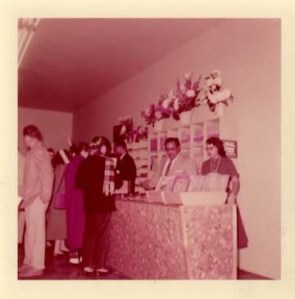
Marilyn Kelley, fifteen, helping customers with Henry Bass and Harold Kelley at the Main Street shop, 1955.
The R & B sounds that my mother, Marilyn Kelley, favored in musical artists in the 1950s were the familiar sounds of (or “sepia” as it was called early on), gutbucket, and melisma—black musical sounds and pronunciation not acceptable to the parents of white teenagers (although white youth were of course becoming familiar with these sounds). Covers changed that sound and made popular rhythm and dance music acceptable to white parents while satisfying white teens and keeping them “inside the fold.” White people (and black people) regularly heard and saw Dinah Shore, Peggy Lee, Pat Boone, Elvis Presley, and other white performers on radio and television, as the record companies heavily promoted these artists and their versions of popular songs. Black performers, on the other hand, were much harder for black people (or everybody else, for that matter) to discover. In the Midwest you had to catch Randy, a white disc jockey out of Nashville, who played black performers’ records and sold them through mail order (see WLAC—Radio). My mother listened to Randy’s show from her bedroom nearly every Saturday night.
.
I had never heard of Little Willie John or his version of “Fever” until my mother mentioned it, but when I listened to his voice for the first time I immediately understood what compelled my parents as teenagers to desire this song, even without lots of radio play or the benefit of television. When I sent my mother a link to Gayle Wald‘s review of a book about the musician (Fever: Little Willie John: A Fast Life, Mysterious Death and the Birth of Soul), she remarked that as a young girl in the rural Midwest she knew not a single thing about him except for the sound of his voice on that one song, which has stuck in her memory all these years. Few people in rural America knew what budding black artists looked like in those days. For listeners like my mother it was all about sound because there was practically nothing else. Pure sound drove her to enjoy these artists and made her want to hear their music again and again.
Into this world jumped two ordinary black couples, moved by their own phonograph player and records to turn a space they had leased to a succession of black beauty parlor operators into a small storefront: Harold Kelley, my grandfather, a carpenter by training who tended as carefully to the foundations of the store as to its customers; my grandmother, Elizabeth, who handled the register and advertising; my great aunt Ina, who mostly worked behind the scenes as the bookkeeper; and my great uncle, Henry Bass, known among the family as “the promoter,” likely as much for his knowledge of music, particularly jazz, as for a habit of walking up and down the street talking to people (a young African-American man named John would join the four after first lingering in the shop as a customer, then helping as a volunteer, until finally becoming an invaluable employee in 1955.)

Kelleys and Basses: Left to right: Henry Bass, Mary Ina Bass, Elizabeth Kelley, and Harold Kelley, co-owners of the Specialty Record Shop, circa 1963.
Benefiting first from their proximity to downtown at 611 South A Street, beneath a rose-colored neon sign, and later in the more spacious Main Street shop—with its “high fidelity” room in the basement—that I remember, the Kelleys and Basses managed to put several other record stores out of business, but more significantly they forged a small community—white and black—around music at the heyday of a vast industry and at one of the peaks of cultural segregation, which even now, so many decades later, seems like no small accomplishment.
Last year, my mother and I traveled to Richmond to visit both Specialty locations, maybe thinking that in all their metaphorical glory they would inspire us to write down what we remember. We went first to the storefront on Main Street, the place that I knew, and then to the small frame house on South A Street, the early shop and my mother’s childhood home. The drabness of the place knocked any hint of nostalgia out of both of us: The bushes and flowerbeds were gone, and the building looked cold and empty, slightly seedy, and a little miserable—these days no doubt valued more for the land it sits on than for the property itself. Thinking now of how my mother must have felt to see her childhood home diminished so mercilessly by time and progress still pains me.
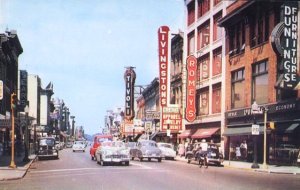
Main Street, Richmond, Indiana in the 1950s
She said then and I write with certainty now that it was more than it looked, which brings me back to what Specialty was, which must be something larger than what stands in our memories or I would not be writing this. It is difficult to attach particular significance to the place in a simple essay about music except to say that as with sound with Specialty meaning was everywhere, and as with music, Specialty reached everyone, at least in Richmond. Its soundproof booth, five-by-five feet square, drew high-fidelity enthusiasts to listen longer than perhaps should have been allowed. A single door connecting the store to my grandparents’ home, sometimes left open by chance, invited curiosity and even boldness from some customers who, stumbling upon the family’s dining room table with its treasure trove of uncataloged records may well have lingered too long in a private space but were never scolded or turned away. The record company representatives who, swept up in the excitement of Specialty’s open house in 1955, began helping customers buy any record, regardless of its label. Taken together, these shared experiences become a narrative of human experience as intricate and complicated as music itself, not so unlike the tapestry of sound that compelled my mother to listen to the magnetic voice of Little Willie John.
In the musical amalgam of today, it is at times difficult to imagine an America so rural, isolated, and segregated, at least in these particular ways. These days “black” music—that is, music by African-American performers—is likely more accepted by and certainly more fully integrated into mainstream America than is the black population itself. Virtual musical communities like turntable, Spotify, Grooveshark, and Pandora are as much growing purveyors of music as are iTunes and Amazon, the new corner record stores, and as such hold much promise for unprecedented global musical cross-pollination and exchange.
 As we may rightly celebrate the cultural integration of more sounds into a larger and perhaps more democratic musical landscape, it is also appropriate to mourn the passing of brick and mortar record stores (and bookstores and libraries, too, I might add) like Specialty, as much for their fidelity as for the ephemeral things these spaces once contained: qualities that bring kinship and serendipity to human experience—sound, yes, but also light, smell, touch, and color, with all its complications.
—
Jacqueline Dowdell received a B.A. from the University of Michigan and an M.F.A. from Cornell University. She is a communications coordinator at Cornell Law School. Thanks to her mother’s memories, her grandmother’s meticulous archive of Specialty history, and a newfound enthusiasm for sound, she is working on a memoir about the Specialty Record Shop.
.
Share this:

Sound at MLA 2012
 Unlike MLA 2011 in Los Angeles, which overflowed with audio-themed research delights–see our last year’s round up here —MLA 2012 in Seattle seems, well, a lot less sonic. I have a few theories as to why this may be (and of course, I would love to hear your thoughts as to MLA’s relative silence in the comment section. Drop us a line!). First off, even in our networked universe, conferences always seem to take on some local flavor, so last year’s event in L.A., whose main industry continues to be entertainment, may have been a magnet for panels about music, sound, and other audio-visual inquiries. Without implying that sound studies is mutually exclusive with Digital Humanities–quite the opposite–perhaps the move to Seattle, long a technology hub thanks to Amazon.com and Microsoft, helps account for the veritable explosion of DH panels in the PMLA this year. Being the Editor-in-Chief of a blog, I have included some of the many excellent DH panels in this round up that I think are of interest to fellow research bloggers and sound studies peeps; see Professor (and ProfHacker) Mark Sample’s comprehensive Digital MLA listing on his blog Sample Reality for the full line up (and a great discussion of the growth of digital humanities as a field).
While the sharp decline in overtly labeled “sound studies” panels at MLA seems a bit troubling for a fledgling field, it could also be a backhanded marker of its growing success. As sound studies grows and expands into more academic venues, this extremely interdisciplinary field is becoming more diffuse and multivalent. 2011 marked the year that the American Studies Association hosted its first official meeting of the sound studies caucus, for example, and published a sound studies special issue of American Quarterly. Three years strong, the Sound Studies Special Interest Group of the Society for Cinema and Media Studies hosted a full slate of events and sound studies panels in New Orleans this past March. And the Sound Studies Special Interest Group at the Society for Ethnomusicology meeting this year in Philadelphia, two years old, did the same. Perhaps the time has come for us to coalesce at MLA in a similar way, forming a society with standing meetings and panels to ensure that the nexus of sound studies and literary inquiry continues to break new ground and thrive instead of waxing and waning along with the market and successive conference themes. Far from being antithetical or ancillary to studies of soundscapes, recordings, and other audible forms, language constructs and shapes our sensory experience of and the meanings we make from “actual” sound; we are only beginning to understand how.
Or perhaps not. Perhaps the way in which sound studies research has been absorbed into studies of literature and language is not so much a muting but rather a healthy sign of what audio engineers refer to as “bleed.” This year’s slate of panels shows how Sound Studies has proven undeniably useful to some of the core issues of the discipline: identity, translation, poetics, affect, tone, and especially voice. With the advent of sound studies, “voice” in literary study has ceased to be a solely a metaphor or an abstract symbol of agency, but panels like “Pinter’s Voice,” “Dissenting Voices,” and “Dickinson’s Fictions of Voice” suggest that the field now hears “voice” as a living, breathing, and sounding entity in its own right, a sensory element of literary craft bearing material traces (and social consequences–see “Gender and Voice: Orality, Dissent, and Community in the Late Middle Ages” and “Arabic Language and Identity: Transregional Texts and Transnational Discourse”).
Finally, I must mention that the MLA’s strength continues to be its international range; sound studies is frequently critiqued for a largely U.S. and British-based focus, so it is refreshing to see sound studies work from (and on) Germany, France, Australia, Morocco, Jordan, Lebanon, Ireland, and Iraq (among others) as well as inquiries that question the idea of borders and nation-states altogether. Whether revivifying the concept of voice or questioning the rhetorical construction of bodies and spaces across the globe, sound studies emerges as a critical mediator between sound and language at MLA 2012, a rich conversation that has really only just begun.
Please comment to let us know what you think–both before and after MLA 2012. If I somehow missed you or your panel in this round up, please let me know!: jsa@soundingoutblog.com
—
Jennifer Stoever-Ackerman is co-founder, Editor-in-Chief and Guest Posts Editor for Sounding Out! She is also Assistant Professor of English at Binghamton University and a Fellow at the Society for the Humanities at Cornell University.
Jump to THURSDAY, January 5
Jump to FRIDAY, January 6
Jump to SATURDAY, January 7
Jump to SUNDAY, January 8
.
Back to menu
THURSDAY, January 5
Thursday, 5 January
.
8:30–11:30 a.m.
.1. Evaluating Digital Work for Tenure and Promotion: A Workshop for Evaluators and Candidates
Willow A, Sheraton
Presiding: Alison Byerly, Middlebury Coll.; Katherine A. Rowe, Bryn Mawr Coll.; Susan Schreibman, Trinity Coll. Dublin
The workshop will provide materials and facilitated discussion about evaluating work in digital media (e.g., scholarly editions, databases, digital mapping projects, born- digital creative or scholarly work). Designed for both creators of digital materials (candidates for tenure and promotion) and administrators or colleagues who evaluate those materials, the workshop will propose strategies for documenting, presenting, and evaluating such work.
Preregistration required.
.
1:45–3:00 p.m.
.44. Pinter’s Voice
303, WSCC
Program arranged by the Harold Pinter Society. Presiding: Judith A. Roof, Rice Univ.
Saumya Rajan, Univ. of Allahabad, “Ruth: Harold Pinter’s Voice of Postmodernist Politics”
William Crooke, East Tennessee State Univ., “What Dyou Mean? The Cockney Voice in Harold Pinter’s The Dumb Waiter,”
Susan Hollis Merritt, Pinter Review, “Pinter’s Voices”
.
1:45–3:00 p.m.
67. Race and Digital Humanities
611, WSCC
Program arranged by the Division on Black American Literature and Culture. Presiding: Howard Rambsy, Southern Illinois Univ.
Kimberly D. Blockett, Penn State Univ., Brandywine, “Digitizing the Past: The Technologies of Recovering Black Lives”
Bryan Carter, Univ. of Central Missouri, “Digital Africana Studies 3.0: Singularity, Performativity, and Technologizing the Field”
Maryemma Graham, Univ. of Kansas, “The Project on the History of Black Writing and Digital Possibilities”
For abstracts, write to hrambsy@siue.edu.
.
3:30–4:45 p.m.
.70. Multimediated Brecht
Cedar, Sheraton
Program arranged by the International Brecht Society. Presiding: Kristopher Imbrigotta, Univ. of Wisconsin, Madison
Michael Shane Boyle, Univ. of California, Berkeley, “‘Literarization’ and the Radical Potential of Media”
Julia Draganovic, Modena, Italy, “Brecht’s Radio and Its Italian Legacy”
Michael Ryan, Duke Univ., “Brecht’s Media Theory: A Popular Reassessment”
Respondent: Henning Wrage, Haverford College
.
82. Arabic Language and Identity: Transregional Texts and Transnational Discourses
Columbia, Sheraton
A special session. Presiding: Karin C. Ryding, Georgetown Univ.
Elizabeth M. Bergman, Miami Univ., Oxford, “Animating Linguistic Nationalism in Jordan”
Clara Shea, Georgetown Univ., “The Sound of the People: Popular Music and Identity in Lebanon”
Georgette Jabbour, Defense Language Inst., “The Way Forward to Teaching Arabic: Incorporating Dialect with Modern Standard Arabic (MSA)”
Emily J. Selove, Univ. of California, Los Angeles, “A Baghdadi Party Crasher in Isfahan”
For abstracts, write to rydingk@georgetown.edu
.
97. Voicing Documentary
307, WSCC
Program arranged by the Division on Language and Society. Presiding: James V. Catano, Louisiana State Univ., Baton Rouge
Jose Capino, Univ. of Illinois, Urbana, “Voice- Over Narration in the Cold War Documentary”
Rebecca Sheehan, Harvard Univ., “The Essay Film and the Ontology of the Epistolary Image: Akerman, Marker, Godard”
James V. Catano, Louisiana State Univ., Baton Rouge, “Voicing Authority: Confessing before God and Errol Morris”
.
5:15–6:30 p.m.
115. Gender and Voice: Orality, Dissent, and Community in the Late Middle Ages
Virginia, Sheraton
Program arranged by the Society for Medieval Feminist Scholarship. Presiding: Dorothy Kim, Vassar Coll.
Katherine G. Zieman, Univ. of Notre Dame, “Performing Ourselves: Gendering and Voicing in Pater Noster Commentaries”
Nicole Nolan Sidhu, East Carolina Univ., “Gender and the Unruly Female Voice in Piers Plowman”
Dorian Lugo- Bertrán, Univ. of Puerto Rico, “The Inscription of the Voice and Medieval Materiality in Teresa of Ávila’s Camino de perfección”
Anthony J. Cárdenas- Rotunno, Univ. of New Mexico, Albuquerque, “The Gendered Voices of Leonor López de Córdoba and Teresa de Cartagena”
For abstracts, visit hosted .lib.uiowa .edu/smfs/mff/
.
7:00–8:15 p.m.
142. Affect, Distance, Confession: Emotion and Popular Music
620, WSC
Program arranged by the Division on Popular Culture. Presiding: Sonnet Retman, Univ. of Washington, Seattle
John W. Mowitt, Univ. of Minnesota, Twin Cities, “(I Can’t Get No) Affect”
Barry Shank, Ohio State Univ., Columbus, “Approaching Odd Future (OFWGKTA) from a Distant Place”
David R. Shumway, Carnegie Mellon Univ., “‘A Compulsion to Be Honest with My Audience’: Joni Mitchell and Confession”
Respondent: Sonnet Retman
.
150. Digital Humanities and Internet Research
613, WSCC
A special session. Presiding: John Jones, Univ. of Texas, Dallas
Robin A. Reid, Texas A&M Univ., Commerce, “Creating a Conceptual Search Engine and Multimodal Corpus for Humanities Research”
John Jones, Univ. of Texas, Dallas, “What the Digital Can’t Remember”
Jennifer Sano Franchini, Michigan State Univ., “Toward a Rhetoric of Collaboration: An Online Resource for Teaching and Learning Research”
For abstracts, visit http://robin-anne-reid.dreamwidth.org/
Thursday Individual Papers of Interest
Mark Deggan, Univ. of British Columbia, “‘Not Bleeding, Singing’:The Operatic Legacy of ’Twixt Land and Sea,” 12:00 noon–1:15 p.m., 616, WSCC
Emilie Brancato, Univ. of Toronto, “Exploring Marguerite’s Voice in the Middle English Translation of the Mirouer des simples âmes,” 3:30–4:45 p.m., Virginia, Sheraton
Eric J.Hyman, Fayetteville State Univ., “The Filtered Voices of Margery Kempe,” 3:30–4:45 p.m., Virginia, Sheraton
John Melillo, Univ. of Arizona, “Empathic Noise,” 3:30–4:45 p.m., 608, WSCC2.
Benjamin Conisbee Baer, Princeton Univ, “Césaire’s Voice Lessons,” 5:15–6:30 p.m., 618, WSCC
Robert J. Patterson, Georgetown Univ., “She Heard Nothing: Traumatized Cat and the Unsympathetic Listener in Gayl Jones’s Corregidora,” 5:15–6:30 p.m., 615, WSCC
Yonsoo Kim, Purdue Univ., West Lafayette, “Women’s Voiced Desire and Muted Passions: Teresa de Cartagena and Santa Teresa,” 7:00–8:15 p.m., 620, WSC
.
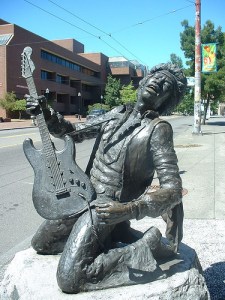
Statue of Jimi Hendrix at the Corner of Pike and Broadway, Seattle, WA by Flickruser bleachers
Friday, 6 January
8:30–9:45 a.m.
166. Tone in Narrative
617, WSCC
Program arranged by the International Society for the Study of Narrative. Presiding: Molly Hite, Cornell Univ.
James Phelan, Ohio State Univ., Columbus, “Dialogue, Voice, and Tone; or, Exploring a Neglected Channel of Narrative Communication”
Debra Fried, Cornell Univ., “Taking a Wrong Tone”
Chris Rideout, Seattle Univ. School of Law, “Voice, Self, and Tonal Cues in Legal Discourse”
.
174. The Opera Libretto
620, WSCC
Program arranged by the Lyrica Society for Word-Music Relations. Presiding: Jeff Dailey, Five Towns Coll.
Edward Anderson, Rice Univ. “Staging Authority—Ariosto, Early Opera, and the Society of Dead Poets”
Matthew Paul Carlson, Univ. of North Carolina, Chapel Hill, “English Verse Translations of Die Zauberlöte: Auden and Kallman versus McClatchy”
Ryan Kangas, Univ. of Houston, “Encountering the Mirror in ‘The Birthday of the Infanta’ and Der Zwerg”
Douglas Fisher, Florida State Univ., “Willie Stark: Carlisle Floyd’s Libretto Based on William Penn Warren’s All the King’s Men”
For abstracts, visit http://www.lyricasociety.org/
.
188. Jimi Hendrix and the Poetics of Song
611, WSCC
A special session. Presiding: Jacob Wilkenfeld, Univ. of North Carolina, Chapel Hill
Jeffrey Carroll, Univ. of Hawai‘i, Mānoa, “Dancing in Dylan’s Head: Jimi Hendrix and the Folk Tradition”
Daniel Barlow, Univ. of Pittsburgh, “Jimi Hendrix and the Politics of Blackness”
Michael New, Penn State Univ., University Park, “Voodoo Child: Jimi Hendrix and the African American Experimental Tradition”
Jacob Wilkenfeld, Univ. of North Carolina, Chapel Hill, “Are You Experienced? Jimi Hendrix and the Poetics of Black Experience”
.
10:15–11:30 a.m.
236. Remixing Present-Day English
306, WSCC
Program arranged by the Discussion Group on Present-Day English Language. Presiding: Dulce M. Estevez, Arizona State Univ.
Nils Olov Fors, Indiana Univ. of Pennsylvania, “A Critical Analysis of Language Use Constructs in Discourses Related to Language Education in South Texas, 2000–10”
Jennifer M. Santos, Virginia Military Inst., “Agog or a Gag? Lady Gaga’s Remixes Remixed”
Dulce M. Estevez, Arizona State Univ., “Mixteando Languages in the United States”
Sarah Catherine Dean, Arizona State Univ., “Remixing English to Represent Trauma and Identity”
.
12:00 noon–1:15 p.m.
244. Dickinson’s Fictions of Voice
303, WSCC
Program arranged by the Emily Dickinson International Society. Presiding: Elizabeth Petrino, Fairield Univ.
Vivian R. Pollak, Washington Univ. in St. Louis, “Dickinson and Sincerity: The Nineteenth-Century Context”
Margaret Rennix, Harvard Univ., “The Speaking Dead: Animated Corpses and National Crisis in the Poetry of Emily Dickinson and Alfred Tennyson”
Ai’fe Murray, San Francisco, CA, “The Influence of Her Servants’ Ethnic Vernaculars on Emily Dickinson’s Language”
For abstracts, write to epetrino@ fairfield.edu
.
245. Narrativity and Musicality: The Confluence of Language, Literature, and Culture
305, WSCC
Program arranged by the College Language Association. Presiding: Warren Carson, Univ. of South Carolina, Spartanburg
Kameelah Martin Samuel, Georgia State Univ., “Of Blues Narrative and Conjure Magic: A Symbiotic Dialectic in the Fiction of Arthur Flowers and J. J. Phillips”
Dolan Hubbard, Morgan State Univ., “DuBois, Hansberry, and a Knock at Midnight”
Thabiti Lewis, Washington State Univ., Vancouver, “Teaching Hip-Hop and Black Vernacular Tradition While Tackling the Boogie Man”
.
249. Building Digital Humanities in the Undergraduate Classroom
Grand A, Sheraton
A special session. Presiding: Kathi Inman Berens, Univ. of Southern California
Speakers: Kathryn E. Crowther, Georgia Inst. of Tech.; Brian Croxall, Emory Univ.; Maureen Engel, Univ. of Alberta; Paul Fyfe, Florida State Univ.; Kathi Inman Berens; Janelle A. Jenstad, Univ. of Victoria; Charlotte Nunes, Univ. of Texas, Austin; Heather Zwicker, Univ. of Alberta
This electronic roundtable assumes that “building stuff” is foundational to the digital humanities and that the technical barriers to participation can be low. When teaching undergraduates digital humanities, simple tools allow students to focus on the simultaneous practices of building and interpreting. This show-and-tell presents projects of variable technical complexity that foster robust interpretation.
For abstracts, visit briancroxall.net/buildingDH
.
259. Representation in the Shadow of New Media Technologies
304, WSCC
Program arranged by the MLA Committee on the Literatures of People of Color in the United States and Canada. Presiding: Lan Dong, Univ. of Illinois, Springield
Aymar Jean Christian, Univ. of Pennsylvania, “Web Video and Ethnic Media: Linking Representation and Distribution”
Daniel Greene, Univ. of Maryland, College Park, “Among Friends: Comparing Social Networking Functions in the Baltimore Sun and Baltimore Afro-American in 1904 and 1933″
Lisa Nakamura, Univ. of Illinois, Urbana, “Digital Trash Talk: The Rhetoric of Instrumental Racism as Procedural Strategy”
.
273. Queer Performance: Space, Bodies, and Movement(s)
620, WSCC
Program arranged by the GL/Q Caucus for the Modern Languages. Presiding: Francesca Therese Royster, DePaul Univ.
Aimee Carrillo Rowe, Univ. of Iowa“Race-ing Time through Queer Xicana Performance”
Robert McRuer, George Washington Univ., “Crip Out: Freakish Performance and the Rogue Queer History”
Sharon Bridgforth, DePaul Univ., “Ring or Shout”
For abstracts, write to ltorres@ depaul.edu.
.
1:45–3:00 p.m.
283. What Makes Language Literary?
Metropolitan A, Sheraton
A linked session arranged in conjunction with The Presidential Forum: Language, Literature, Learning (202). Presiding: Sabine Wilke, Univ. of Washington, Seattle
Speakers: Charles Francis Altieri, Univ. of California, Berkeley; Daniel Dooghan, Univ. of Tampa; Frances Ferguson, Johns Hopkins Univ., MD; Alexander C. Y. Huang, George Washington Univ.
This roundtable asks whether the familiar pairing “language and literature” is more than just an academic convention. Is literature a necessary function of language, or is language merely the vehicle with which literature pursues its own ends? At stake are questions of rhetoric and criticism, poetic language, the standing of translation, and the tensions between historical experience and aesthetic autonomy.
.
294. Humor and Subversion: Approaches to Pacific Literature and Orature at the Universities of Hawai‘i and Guam
608, WSCC
A special session. Presiding: Caroline Sinavaiana, Univ. of Hawai‘i, Mānoa
Caroline Sinavaiana, Univ. of Hawai‘i, Mānoa, “bro’Town and he Naked Samoans: Ritual Clowning Goes Prime Time”
Ku‘ualoha Ho‘omanawanui, Univ. of Hawai‘i, Manoa, “Mokes with Jokes: Nah Nah Nah Nah—‘Bussing Laugh’ as Colonial Resistance”
Nicholas J. Goetzfridt, Univ. of Guam, “The Illusions of Betrayal: Mudrooroo, Indigenousness, and the Stage I Make”
Brandy Nalani McDougall, Univ. of Hawai‘i, Mānoa, “Anticolonial Humor and Poetic Resistance in the American Colonies of the Pacific”
Respondent: Craig Perez, Univ. of California, Berkeley
For abstracts, write to sinavaia@hawaii.edu
.
298. Reading across Media
Aspen, Sheraton
Program arranged by the Division on Twentieth-Century German Literature. Presiding: Deniz Göktürk, Univ. of California, Berkeley
Lutz Koepnick, Washington Univ. in St. Louis, “Reading on the Move”
Heather Love, Indiana Univ., Bloomington, “Fighting Stupidity and Playing Music: Musil, Adorno, and the Performativity of Interpretation”
Daniel Gilillan, Arizona State Univ., “Literature on the Radio: Sound and the Intermedial Modulation of Knowledge”
.
307. Theorizing Hip- Hop: New Approaches to Hip-Hop as Intellectual Production
618, WSCC
A special session. Presiding: Jill Richardson, Borough of Manhattan Community Coll., City Univ. of New York
Shante Paradigm Smalls, Davidson Coll., “Queer Hip-Hop Diasporas: A History”
James Ford, Occidental Coll., “The Shadows of Tomorrow: Hip- Hop, Madlib, and the Archive”
Michael Ralph, New York Univ., “Hip- Hop Is Not What You Think It Is”
Jill Richardson, Borough of Manhattan Community Coll., City Univ. of New York, “Performing Male Desire: The Intersection of Hip- Hop and Drug Culture”
For abstracts, write to jilltrichardson@msn.com
.
3:30–4:45 p.m.
325. Ireland and the Politics of Language
304, WSCC
Program arranged by the American Conference for Irish Studies. Presiding: Richard Russell, Baylor Univ.
Laura B. O’Connor, Univ. of California, Irvine, “Muse Energy: Releasing and Reinscribing the Spéirbhean”
Spurgeon W. Thompson, Kaplan International Colls., “‘English Is Dead’: Assassinating English in Finnegans Wake”
Kelly Matthews, Framingham State Univ., “‘Johnny, I Hardly Knew You!’: Sean O’Faolain, the Gaelic League, and Debates over Language and Literature in the Mid- Twentieth Century”
.
332. Digital Narratives and Gaming for Teaching Language and Literature
Aspen, Sheraton
Program arranged by the MLA Committee on Information Technology and the American Council on the Teaching of Foreign Languages. Presiding: Barbara Laford, Arizona State Univ.
Steven Thorne, Portland State Univ., “Narrative Expression and Scientific Method in Online Gaming Worlds”
Jonathon Reinhardt, Univ. of Arizona; Julie Sykes, Univ. of New Mexico, Albuquerque, “Designing Narratives: A Framework for Digital Game- Mediated L2 Literacies Development”
Edmond Chang, Univ. of Washington, Seattle; Timothy Welsh, Loyola Univ., New Orleans, “Close Playing, Paired Playing: A Practicum”
Respondent: Dave McAlpine, Univ. of Arkansas, Little Rock
.
5:15–6:30 p.m.
.349. Digital Pedagogy
Grand A, Sheraton
A special session. Presiding: Katherine D. Harris, San José State Univ.
Speakers: Sheila T. Cavanagh, Emory Univ.; Elizabeth Chang, Univ. of Missouri, Columbia; Lori A. Emerson, Univ. of Colorado, Boulder; Adeline Koh, Richard Stockton Coll. of New Jersey; John Lennon, Univ. of South Florida Polytechnic; Kevin Quarmby, Shakespeare’s Globe Trust; Katherine Singer, Mount Holyoke Coll.; Roger Whitson, Georgia Inst. of Tech.
.
Friday Individual Papers of Interest
Kimberly Wedeven Segall, Seattle Pacific Univ., “Heteroglossic Iraq: Voices of Women and War,” 8:30–9:45 a.m., 303, WSCC
Imani Perry, Princeton Univ., “Of Degraded Tongues and Digital Talk: Race and the Politics of Language,” 10:15 a.m.–12:00 noon, Metropolitan A, Sheraton
Emily M. Harrington, Penn State Univ., University Park, “Lyric and Music at the Fin de Siècle: The Cultural Place of Song,” 3:30–4:45 p.m., 611, WSCC
James D. B. McCorkle, Hobart and William Smith Colls., “Of Moan and Stutter: M. Nourbese Philips’s Hauntological Zong!” 5:15–6:30 p.m., 614, WSCC
.
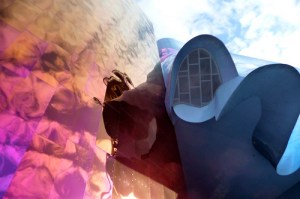
The Experience Music Project, Seattle photo by Flickr user Brad Coy
.
Back to menu
Saturday, January 7
Saturday, 7 January
.
10:15–11:30 a.m.
450. Digital Faulkner: William Faulkner and Digital Humanities
615, WSCC
Program arranged by the William Faulkner Society. Presiding: Steven Knepper, Univ. of Virginia
Speakers: Keith Goldsmith, Vintage Books; John B. Padgett, Brevard Coll.; Noel Earl Polk, Mississippi State Univ.; Stephen Railton, Univ. of Virginia; Peter Stoichef, Univ. of Saskatchewan
A roundtable on digital humanities and its implications for teaching and scholarship on the work of William Faulkner.
For abstracts, visit faulknersociety .com/ panels.htm
Discussions about digital projects and digital tools often focus on research goals. For this electronic roundtable, we will instead demonstrate how these digital resources, tools, and projects have been integrated into undergraduate and graduate curricula.
.
12:00 noon–1:15 p.m.
468. Networks, Maps, and Words: Digital-Humanities Approaches to the Archive of American Slavery
615, WSCC
A special session. Presiding: Lauren Klein, Georgia Inst. of Tech.
Lauren Klein, Georgia Inst. of Tech.,“‘A Report Has Come Here’: Social-Network Analysis in the Papers of Thomas Jefferson”
Cameron Blevins, Stanford Univ., “Slave Narratives in Space: Mapping the World of Venture Smith”
Aditi Muralidharan, Univ. of California, Berkeley, “Using Digital Tools to Explore Narrative Conventions in the North American Antebellum Slave Narratives”
Respondent: Amy Earhart, Texas A&M Univ., College Station
.
477. Postnational Readings of the Audiovisual
Aspen, Sheraton
Program arranged by the Division on Twentieth-Century German Literature and the Division on Film. Presiding: Nora M. Alter, Temple Univ.,Philadelphia; Deniz Göktürk, Univ. of California, Berkeley
Kalani Michell, Univ. of Minnesota, Twin Cities,“Sounds of the Berlin School”
Ian Thomas Fleishman, Harvard Univ., “International ‘Auditorism’: The Postnational Politics of Reading of von Donnersmarck’s The Lives of Others”
Jaimey Fisher, Univ. of California, Davis, “Surveying the Border Crossing: Terrorist Films and the Postnational Imaginary”
.
479. Digital Humanities in the Italian Context
Cedar, Sheraton
A special session. Presiding: Manuela Marchesini, Texas A&M Univ., College Station
Stefano Franchi, Texas A&M Univ., College Station, “Digital Humanities in the Italian Culture Landscape”
Alberto Moreiras, Texas A&M Univ., College Station, “Life and the Digital: On Esposito and Tarizzo’s Inventions of Life”
Massimo Lollini, Univ. of Oregon “Humanist Studies and the Digital Age”
Silvia Stoyanova, Princeton Univ., “Giacomo Leopardi’s Zibaldone: From Card Index to Hypertext”
For abstracts, write to mmarchesini@tamu.edu
.
484. Dissenting Voices
Columbia, Sheraton
Program arranged by the Division on ArabicLiterature and Culture. Presiding: Anouar Majid, Univ. of New England
Ibtissam Bouachrine, Smith Coll., “Why Moroccan Women Rebel”
Nouri Gana, Univ. of California, Los Angeles, “Hip- Hop Insurgency”
Olivier Bourderionnet, Univ. of New Orleans, “Building Bridges with Songs: Amazigh Kateb and Abd al-Malik”
.
499. Literary Multilingualism and Exile in Twentieth-Century Fiction
Ravenna C, Sheraton
A special session. Presiding: Salvatore Pappalardo, Rutgers Univ., New Brunswick
Celine Piser, Univ. of California, Berkeley, “Multilingualism and the Construction of a Hybrid Identity in Twentieth Century Judeo French Literature”
Hassan Melehy, Univ. of North Carolina, Chapel Hill, “Jack Kerouac’s Translingual Exile”
Maria Kager, Rutgers Univ., New Brunswick, “Ahksent on Last Syllable: Mispronunciation in Nabokov’s American Novels”
.
1:45–3:00 p.m.
506. Voice and Identity in Australian Literature
616, WSCC
Program arranged by the American Association of Australian Literary Studies. Presiding: Nathanael O’Reilly, Texas Christian Univ.
Jennifer McGovern, Univ. of Iowa, “Death by Torture in the Country of the Mind: Metaphors of Captivity and Freedom in Patrick White’s Voss (1957)”
Sarah Chihaya, Univ. of California, Berkeley, “The Un-death of Maggs: The Returned Convict as Revenant in Jack Maggs”
Nicholas Dunlop, Univ. of Birmingham, “Suburban Space and Multicultural Identities in Christos Tsiolkas’s The Slap”
Nathanael O’Reilly, Texas Christian Univ., “Rejecting Suburban Identity in George Johnston’s My Brother Jack”
..
522. The Seattle Sound
618, WSCC
Program arranged by the Division on Popular Culture. Presiding: Hillary L. Chute, Univ. of Chicago
Lindsay E. Waters, Harvard Univ. Press, “Theory Alone Nothing; Theory plus Dancing Change the World: The Seattle Sound of Sleater-Kinney and Hendrix”
John Melillo, New York Univ., “Nirvana: Noise and Empathy”
John McCombe, Univ. of Dayton, “Virginia Woolf in the Trailer Park: Isaac Brock; Nowhere, WA; and the Lonesome, Crowded West”
.
3:30–4:45 p.m.
539. # alt- ac: Alternative Paths, Pitfalls, and Jobs in the Digital Humanities
3B, WSCC
Program arranged by the Discussion Group on Computer Studies in Language and Literature. Presiding: Sara Steger, Univ. of Georgia
Speakers: Brian Croxall, Emory Univ.; Julia H. Flanders, Brown Univ.; Jennifer Howard, Chronicle of Higher Education; Matthew Jockers, Stanford Univ.; Shana Kimball, Univ. of Michigan, Ann Arbor; Bethany Nowviskie, Univ. of Virginia; Lisa Spiro, National Inst. for Tech. in Liberal Education
This roundtable brings together various perspectives on alternative academic careers from professionals in digital humanities centers, libraries, publishing, and humanities labs. Speakers will discuss how and whether digital humanities is especially suited to fostering non-tenure- track positions and how that translates to the role of alt-ac in digital humanities and the academy. Related session: “# alt- ac: he Future of ‘Alternative Academic’ Careers” (595).
.
5:15–6:30 p.m.
581. Digital Humanities versus New Media
611, WSCC
Alison Byerly, Middlebury Coll., “Everything Old Is New Again: The Digital Past and the Humanistic Future”
Andrew Pilsch, Penn State Univ., University Park, “As Study or as Paradigm? Humanities and the Uptake of Emerging Technologies”
David Robert Gruber, North Carolina State Univ., “Digital Tunnel Vision: Deining a Rhetorical Situation”
Victoria E. Szabo, Duke Univ., “Digital Humanities Authorship as the Object of New Media Studies”
For abstracts, visit www .duke .edu/ ~ves4/mla201
Saturday Individual Papers of Interest
Erich Nunn, Auburn Univ., Auburn, “Music, Race, and Nation in Johnson’s Autobiography,” 1:45–3:00 p.m., 307, WSCC
Leslie Petty, Rhodes Coll., “‘Every Woman . . . Should Raise Her Voice’: Rethinking White Women’s Activism in William Wells Brown’s Clotel,” 5:15–6:30 p.m., 307, WSCC
.

Flyer for a Seattle Phonographers Union Performance, For information on the artists' collective see http://www.seapho.org/
.
Back to menu
SUNDAY, January 8
Sunday, 8 January
.
8:30–9:45 a.m.
638. Gettin’ Around: Transnational Jazz Literature
618, WSCC
A special session. Presiding: Jürgen E. Grandt, Gainesville State Coll., GA
Rashida Braggs, Williams Coll., “From Harlem to Paris: A Transatlantic Interpretation of James Baldwin’s ‘Sonny’s Blues’”
Marc-Oliver Schuster, Univ. of Vienna, “Swinging Variety: Jazz in the Literature of the German Democratic Republic”
Aldon Lynn Nielsen, Penn State Univ., University Park, “The Transplanetary Nation Blues and the Abstract Truth”
Respondent: DoVeanna Sherie Fulton Minor, Univ. of Alabama, Tuscaloosa
For abstracts, write to jgrandt@gsc.edu.
.
10:15–11:30 a.m.
664. Sound and Voice in the Creative Writing Classroom: Practice-Based Pedagogies
614, WSCC
A special session. Presiding: Christopher Drew, Univ. of Wisconsin, Milwaukee
David Bartone, Univ. of Massachusetts, Amherst, “Avoiding Meaning: A Classroom Exercise to Improve Students’ Homophonic Sensibilities”
David Yost, Univ. of Wisconsin, Milwaukee“Into the Trenches: Breaking the Student-Author Binary with ‘Dulce et Decorum Est’”
Liane LeMaster, Georgia Perimeter Coll., North Campus, “Speciicity of Dialogue: A Coke Is a Soda Is a Pop Is a Cola”
.
665. Debates in the Digital Humanities
615, WSCC
A special session. Presiding: Alexander Reid, Univ. at Buffalo, State Univ. of New York
Matthew K. Gold, New York City Coll. of Tech., City Univ. of New York, “Whose Revolution? Toward a More Equitable Digital Humanities”
Elizabeth Mathews Losh, Univ. of California, San Diego, “Hacktivism and the Humanities: Programming Protest in the Era of the Digital University”
Jeff Rice, Univ. of Missouri, Columbia, “Twenty-First- Century Literacy: Searching the Story of Billy the Kid”
Jentery Sayers, Univ. of Victoria, “Why the Digital Humanities Needs Theory”
For abstracts and discussion, visit dhdebatesmla12.wordpress.com.
.
12:00 noon–1:15 p.m.
691. Gertrude Stein and Music
Cedar, Sheraton
Program arranged by the Lyrica Society for Word-Music Relations and the Association for the Study of Dada and Surrealism. Presiding: Jeff Dailey, Five Towns Coll.
Tanya E. Clement, Univ. of Maryland, College Park, “Sounding Stein’s Texts by Using Digital Tools for Distant Listening”
Judith A. Roof, Rice Univ., “Gertrude’s Glee and Jazz Mislaid Jazz”
Brandon Masterman,Univ. of Pittsburgh, “‘This Is How hey Do Not Like It’: Queer Abjection in Gertrude Stein and Virgil Thomson’s Four Saints in Three Acts”
.
716. Digital Material
613, WSCC
A special session. Presiding: Charles M. Tung, Seattle Univ.; Benjamin Widiss, Princeton Univ.
Speakers: Paul Benzon, Temple Univ., Philadelphia; Cara Elisabeth Ogburn, Univ. of Wisconsin, Milwaukee; Charles M. Tung; Benjamin Widiss; Zachary Zimmer, Virginia Polytechnic Inst. and State Univ.
Is there gravity in digital worlds? Moving beyond both lamentations and celebrations of the putatively free- loating informatic empyrean, this roundtable will explore the ways in which representations in myriad digital platforms—verbal, visual, musical, cinematic—might bear the weight of materiality, presence, and history and the ways in which bodies—both human and hardware—might be recruited for or implicated in the efort.
For abstracts, write to bwidiss@princeton.edu
.
1:45–3:00 p.m
736. Close Playing: Literary Methods and Video Game Studies
University, Sheraton
A special session. Presiding: Mark L. Sample, George Mason Univ.
Speakers: Edmond Chang, Univ. of Washington, Seattle; Steven E. Jones, Loyola Univ., Chicago; Jason C. Rhody, National Endowment for the Humanities; Anastasia Salter, Univ. of Baltimore; Timothy Welsh, Loyola Univ., New Orleans; Zach Whalen, Univ. of Mary Washington
This roundtable moves beyond the games-versus-stories dichotomy to explore the full range of possible literary approaches to video games. These approaches include the theoretical and methodological contributions of reception studies, reader-response theory, narrative theory, critical race and gender theory, disability studies, and textual scholarship.
For abstracts, visit www .samplereality .com/ mla12.
745. Affecting Affect
615, WSCC
A special session, Presiding: Lauren Berlant, Univ. of Chicago
Speakers: Ann L. Cvetkovich, Univ. of Texas, Austin; Neville W. Hoad, Univ. of Texas, Austin;Heather K. Love, Univ. of Pennsylvania; Tavia Nyong’o, New York Univ.
For a list of questions for roundtable participants (and the potential interlocutors from the audience), visit www.supervalentthought.com.
.
Sunday Individual Papers of Interest
Toni Wall Jaudon, Ithaca Coll., “Sound and Separateness: The Hindu Widow’s Cries in Early-Nineteenth-Century United States Print Culture,” 1:45–3:00 p.m., 304, WSCC

Grunge: One of Seattle's Signature Sounds, Photo by Flickr User Sands
Share this:


Current Top Posts





April 2021

January 2020

November 2019

October 2019

August 2019

April 2014

November 2017

March 2015

December 2017

October 2015
 Sounding Out!
Recent Comments