
The Eldritch Voice: H. P. Lovecraft’s Weird Phonography

 Welcome to the last installment of Sonic Shadows, Sounding Out!’s limited series pursuing the question of what it means to have a voice. In the most recent post, Dominic Pettman encountered several traumatized birds who acoustically and uncannily mirror the human, a feedback loop that composes what he called “the creaturely voice.” This week, James Steintrager investigates the strange meaning of a “metallic” voice in the stories of H.P. Lovecraft, showing how early sound recording technology exposed an alien potential lingering within the human voice. This alien voice – between human and machine – was fodder for techniques of defamiliarizing the world of the reader.
— Guest Editor Julie Beth Napolin
—
A decade after finding itself downsized to a dwarf planet, Pluto has managed to spark wonder in the summer of 2015 as pictures of its remarkable surface features and those of its moon are delivered to us by NASA’s New Horizons space probe. As scientists begin to tentatively name these features, they have drawn from speculative fiction for what they see on the moon Charon, giving craters names including Spock, Sulu, Uhuru, and—mixing franchises—Skywalker . From Doctor Who there will be a Tardis Chasma and a Gallifrey Macula. Pluto’s features stretch back a bit further, where there will also be a Cthulhu Regio, named after the unspeakable interstellar monster-cum-god invented by H. P. Lovecraft.
We can imagine that Lovecraft would have been thrilled, since back when Pluto was first discovered in early 1930 and was the evocative edge of the solar system, he had turned the planet into the putative home of secretive alien visitors to Earth in his short story “The Whisperer in Darkness.” First published in the pulp magazine Weird Tales in 1931, “The Whisperer in Darkness” features various media of communication—telegraphs, telephones, photographs, and newspapers—as well as the possibilities of their manipulation and misconstruing. The phonograph, however, plays the starring role in this tale about gathering and interpreting the eerie and otherworldly—the eldritch, in a word—signs of possible alien presence in backwoods Vermont.
In the story, Akeley, a farmer with a degree of erudition and curiosity, captures something strange on a record. This something, when played back by the protagonist Wilmarth, a folklorist at Lovecraft’s fictional Miskatonic University, goes like this:
Iä! Shub-Niggurath! The Black Goat of the Woods with a Thousand Young! (219)
The sinister resonance of a racial epithet in what appears to be a foreign or truly alien tongue notwithstanding, this story features none of the more obvious and problematic invocations of race and ethnicity—the primitive rituals in the swamps of Louisiana of “The Call of Cthulhu” or the anti-Catholic immigrant panic of “The Horror at Red Hook”—for which Lovecraft has achieved a degree of infamy. Moreover, the understandable concern with Lovecraft’s social Darwinism and bad biology in some ways tends to miss how for the author—and for us as well—power and otherness are bound up with technology.
 The transcription of these exclamations, recorded on a “blasphemous waxen cylinder,” is prefaced with an emphatic remark about their sonic character: “A BUZZING IMITATION OF HUMAN SPEECH” (219-220). The captured voice is further described as an “accursed buzzing which had no likeness to humanity despite the human words which it uttered in good English grammar and a scholarly accent” (218). It is glossed yet again as a “fiendish buzzing… like the drone of some loathsome, gigantic insect ponderously shaped into the articulate speech of an alien species” (220). If such a creature tried to utter our tongue and to do so in our manner—both of which would be alien to it—surely we might expect an indication of the difference in vocal apparatuses: a revelatory buzzing. Lovecraft’s story figures this “eldritch sound” as it is transduced through the corporeal: as the timbral indication of something off when the human voice is embodied in a fundamentally different sort of being. It is the sound that happens when a fungoid creature from Yuggoth—the supposedly native term for Pluto—speaks our tongue with its insectile mouthparts.
Yet, reading historically, we might understand this transduction as the sound of technical mediation itself: the brazen buzz of phonography, overlaying and, in a sense, inhabiting the human voice.
For listeners to early phonographic recordings, metallic sounds—inevitable given the materials used for styluses, tone arms, diaphragms, amplifying horns—were simply part of the experience. Far from capturing “the unimaginable real” or registering “acoustic events as such,” as media theorist Friedrich Kittler once put the case about Edison’s invention, which debuted in 1877, phonography was not only technically incapable of recording anything like an ambient soundscape but also drew attention to the very noise of itself (23).
For the first several decades of the medium’s existence, patent registers and admen’s pitches show that clean capture and reproduction were elusive rather than given. An account in the Literary Digest Advertiser of Valdemar Poulsen’s Telegraphone, explains the problem:
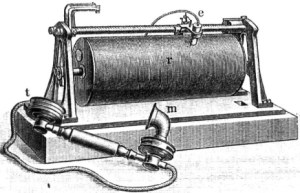 The talking-machine records sound by the action of a steel point upon some yielding substance like wax, and reproduces it by practically reversing the operation. The making of the record itself is accompanied by a necessary but disagreeably mechanical noise—that dominating drone—that ‘b-r-r-r-r’ that is never in the human voice, and always in its mechanical imitations. One hears metallic sounds from a brazen throat—uncanny and inhuman. The brittle cylinder drops on the floor, breaks—and the neighbors rejoice!
The Telegraphone, which recorded sounds “upon imperishable steel through the intangible but potent force of electromagnetism” such that no “foreign or mechanical noise is heard or is possible,” of course promised to make the neighbors happy not by breaking the cylinder but rather by taking the inhuman ‘b-r-r-r-r’ out of the phonographically reproduced voice. Nonetheless, etching sound on steel, the Telegraphone was still a metal machine and unlikely to overcome the buzz entirely.
In his account of “weird stories” and why the genre suited him best, Lovecraft explained that one of his “strongest and most persistent wishes” was “to achieve, momentarily, the illusion of some strange suspension or violation of the galling limitations of time, space, and natural law which forever imprison us and frustrate our curiosity about the infinite cosmic spaces beyond the radius of our sight and analysis.” In “The Whisperer in Darkness,” Lovecraft put to work a technology that was rapidly becoming commonplace to introduce a buzz into the fabric of the everyday. This is the eldritch effect of Lovecraft’s evocation of phonography. While we might wonder whether a photograph has been tampered with, who really sent a telegram, or with whom we are actually speaking over a telephone line—all examples from Lovecraft’s tale—the central, repeated conundrums for the scholar Wilmarth remain not only whose voice is captured on the recorded cylinder but also why it sounds that way.
 The phonograph transforms the human voice, engineers a cosmic transduction, suggesting that within our quotidian reality something strange might lurk. This juxtaposition and interplay of the increasingly ordinary and the eldritch is also glimpsed in an account of Charles Parson’s invention the Auxetophone, which used a column of pressurized air rather than the usual metallic diaphragm. Here is an account of the voice of the Auxetophone from the “Matters Musical” column of The Bystander Magazine from 1905: “Long ago reconciled to the weird workings of the phonograph, we had come to regard as inevitable the metallic nature of its inhuman voice.” The new invention might well upset our listening habits, for Mr. Parson’s invention “bids fair to modify, if not entirely to remove,” the phonograph’s “somewhat unpleasant timbre.”
What the phonograph does as a medium is to make weird. And what making weird means is that instead of merely reproducing the human voice—let alone rendering acoustic events as such—it transforms the latter into its own: an uncanny approximation, which fails to simulate perfectly with regard to timbre in particular. Phonography reveals that the materials of reproduction are not vocal chords, breath, labial and dental friction—not flesh and spirit, but vibrating metal.
Although we can only speculate in this regard, I would suggest that “The Whisperer in Darkness” was weirder for readers for whom phonographs still spoke with metallic timbre. The rasping whisper of the needle on cylinder created what the Russian Formalist Viktor Shklovsky was formulating at almost exactly the same time as the function of the literary tout court: defamiliarization or, better, estrangement. Nonetheless, leading the reader to infer an alien presence behind this voice was equally necessary for the effect. After all, if we are to take the Auxetophone as our example—an apparatus announced in 1905, a quarter of a decade before Lovecraft composed his tale, and that joined a marketplace burgeoning with metallic-voice reducing cabinets, styluses, dampers, and other devices—phonographic listeners had long since become habituated to the inhumanity of the medium. That inhumanity had to be recalled and reactivated in the context of Lovecraft’s story.
 To understand fully the nature of this reactivation, moreover, we need to know precisely what Lovecraft’s evocative phonograph was. When Akeley takes his phonograph into the woods, he adds that he brought “a dictaphone attachment and a wax blank” (209). Further, to play back the recording, Wilmarth must borrow the “commercial machine” from the college administration (217). The device most consistent with Lovecraft’s descriptions and terms is not a record player, as we might imagine, but Columbia Gramophone Company’s Dictaphone. By the time of the story’s setting, Edison Phonograph’s had long since switched to more durable celluloid cylinders (Blue Amberol Records; 1912-1929) in an effort to stave off competition from flat records. Only Dictaphones, aimed at businessmen rather than leisure listeners, still used wax cylinders, since recordings could be scraped off and the cylinder reused. The vinyl Dictabelt, which eventually replaced them, would not arrive until 1947.
Meanwhile, precisely when the events depicted in “The Whisperer in Darkness” are supposed to have taken place, phonography was experiencing a revolutionary transformation: electronic sound technologies developed by radio engineers were hybridizing the acoustic machines, and electro-acoustic phonographs were in fact becoming less metallic in tone. Yet circa 1930, as the buzz slipped toward silence, phonography was still the best means of figuring the sonic uncanny valley. It was a sort of return of the technologically repressed: a reminder of the original eeriness of sound reproduction—recalled from childhood or perhaps parental folklore—at the very moment that new technologies promised to hide such inhumanity from sensory perception. Crucially, in Lovecraft’s tale, estrangement is not merely a literary effect. Rather, the eldritch is what happens when the printed word at a given moment of technological history calls up and calls upon other media of communication, phonography not the least.
I have remarked the apparent absence of race as a concern in “The Whisperer in Darkness,” but something along the lines of class is subtly but insistently at work in the tale. The academic Wilmarth and his erudite interlocutor Akeley are set in contrast with the benighted, uncomprehending agrarians of rural Vermont. Both men also display a horrified fascination with the alien technology that will allow human brains to be fitted into hearing, seeing, and speaking machines for transportation to Yuggoth. These machines are compared to phonographs: cylinders for storing brains much like those for storing the human voice. In this regard, the fungoid creatures resemble not so much bourgeois users or consumers of technology as scientists and engineers. Moreover, they do so just as a discourse of technocracy—rule by a technologically savvy elite—was being articulated in the United States. Here we might see the discovery of Pluto as a pretext for exploring anxieties closer to home: how new technologies were redistributing power, how their improvement—the fading of the telltale buzz—was making it more difficult to determine where humanity stopped and technology began, and whether acquiescence in this changes was laudable or resistance feasible. As usual with Lovecraft, these topics are handled with disconcerting ambivalence.
—
James A. Steintrager is a professor of English, Comparative Literature, and European Languages and Studies at the University of California, Irvine. He writes on a variety of topics, including libertinism, world cinema, and auditory cultures. His translation of and introduction to Michel Chion’s Sound: An Acoulogical Treatise will be published by Duke University Press in fall of 2015.
—
Featured image: Taken from “Global Mosaic of Pluto in True Color” in NASA’s New Horizons Image Gallery, public domain. All other images courtesy of the author.
—
 REWIND! . . .If you liked this post, you may also dig:
Sound and Sanity: Rallying Against “The Voice” — Mark Brantner
DIANE… The Personal Voice Recorder in Twin Peaks — Tom McEnaney
Reproducing Traces of War: Listening to Gas Shell Bombardment, 1918 — Brían Hanrahan
Share this:

On Whiteness and Sound Studies

 This is the first post in Sounding Out!’s 4th annual July forum on listening in observation of World Listening Day on July 18th, 2015. World Listening Day is a time to think about the impacts we have on our auditory environments and, in turn, their effects on us. For Sounding Out! World Listening Day necessitates discussions of the politics of listening and listening as a political act, beginning this year with Gustavus Stadler’s timely provocation. –Editor-in-Chief JS
—
Many amusing incidents attend the exhibition of the Edison phonograph and graphophone, especially in the South, where a negro can be frightened to death almost by a ‘talking machine.’ Western Electrician May 11, 1889, (255).
What does an ever-nearer, ever-louder police siren sound like in an urban neighborhood, depending on the listener’s racial identity? Rescue or invasion? Impending succor or potential violence? These dichotomies are perhaps overly neat, divorced as they are from context. Nonetheless, contemplating them offers one charged example of how race shapes listening—and hence, some would say, sound itself—in American cities and all over the world. Indeed, in the past year, what Jennifer Stoever calls the “sonic color line” has become newly audible to many white Americans with the attention the #blacklivesmatter movement has drawn to police violence perpetrated routinely against people of color.

“Sheet music ‘Coon Coon Coon’ from 1901” via Wikimedia, public domain
Racialized differences in listening have a history, of course. Consider the early decades of the phonograph, which coincided with the collapse of Reconstruction and the consolidation of Jim Crow laws (with the Supreme Court’s stamp of approval). At first, these historical phenomena might seem wholly discrete. But in fact, white supremacy provided the fuel for many early commercial phonographic recordings, including not only ethnic humor and “coon songs” but a form of “descriptive specialty”—the period name for spoken-word recordings about news events and slices of life—that reenacted the lynchings of black men. These lynching recordings, as I argued in “Never Heard Such a Thing,” an essay published in Social Text five years ago, appear to have been part of the same overall entertainment market as the ones lampooning foreign accents and “negro dialect”; that is, they were all meant to exhibit the wonders of the new sound reproduction to Americans on street corners, at country fairs, and in other public venues.
Thus, experiencing modernity as wondrous, by means of such world-rattling phenomena as the disembodiment of the voice, was an implicitly white experience. In early encounters with the phonograph, black listeners were frequently reminded that the marvels of modernity were not designed for them, and in certain cases were expressly designed to announce this exclusion, as the epigraph to this post makes brutally evident. For those who heard the lynching recordings, this new technology became another site at which they were reminded of the potential price of challenging the racist presumptions that underwrote this modernity. Of course, not all black (or white) listeners heard the same sounds or heard them the same way. But the overarching context coloring these early encounters with the mechanical reproduction of sound was that of deeply entrenched, aggressive, white supremacist racism.

“66 West 12th Street, New School entrance” by Wikimedia user Beyond My Ken, CC BY-SA 4.0
The recent Sonic Shadows symposium at The New School offered me an opportunity to come back to “Never Heard Such a Thing” at a time when the field of sound studies has grown more prominent and coherent—arguably, more of an institutionally recognizable “field” than ever before. In the past three years, at least three major reference/textbook-style publications have appeared containing both “classic” essays and newer writing from the recent flowering of work on sound, all of them formidable and erudite, all of great benefit for those of us who teach classes about sound: The Oxford Handbook of Sound Studies (2012), edited by Karen Bijsterveld and Trevor Pinch; The Sound Studies Reader (2013), edited by Jonathan Sterne; and Keywords in Sound (2015), edited by David Novak and Matt Sakakeeny. From a variety of disciplinary perspectives, these collections bring new heft to the analysis of sound and sound culture.
I’m struck, however, by the relative absence of a certain strain of work in these volumes—an approach that is difficult to characterize but that is probably best approximated by the term “American Studies.” Over the past two decades, this field has emerged as an especially vibrant site for the sustained, nuanced exploration of forms of social difference, race in particular. Some of the most exciting sound-focused work that I know of arising from this general direction includes: Stoever’s trailblazing account of sound’s role in racial formation in the U.S.; Fred Moten’s enormously influential remix of radical black aesthetics, largely focused on music but including broader sonic phenomena like the scream of Frederick Douglass’s Aunt Hester; Bryan Wagner’s work on the role of racial violence in the “coon songs” written and recorded by George W. Johnson, widely considered the first black phonographic artist; Dolores Inés Casillas’s explication of Spanish-language radio’s tactical sonic coding at the Mexican border; Derek Vaillant’s work on racial formation and Chicago radio in the 1920s and 30s. I was surprised to see none of these authors included in any of the new reference works; indeed, with the exception of one reference in The Sound Studies Reader to Moten’s work (in an essay not concerned with race), none is cited. The new(ish) American Studies provided the bedrock of two sound-focused special issues of journals: American Quarterly’s “Sound Clash: Listening to American Studies,” edited by Kara Keeling and Josh Kun, and Social Text’s “The Politics of Recorded Sound,” edited by me. Many of the authors of the essays in these special issues hold expertise in the history and politics of difference, and scholarship on those issues drives their work on sound. None of them, other than Mara Mills, is among the contributors to the new reference works. Aside from Mills’s contributions and a couple of bibliographic nods in the introduction, these journal issues play no role in the analytical work collected in the volumes.

“Blank pages intentionally, end of book” by Wikimedia user Brian 0918, CC BY-SA 3.0
The three new collections address the relationship between sound, listening, and specific forms of social difference to varying degrees. All three of the books contain excerpts from Mara Mills’ excellent work on the centrality of deafness to the development of sound technology. The Sound Studies Reader, in particular, contains a small array of pieces that focus on disability, gender and race; in attending to race, specifically, Sterne shrewdly includes an excerpt from Franz Fanon’s A Dying Colonialism, as well as essays on black music by authors likely unfamiliar to many American readers. The Oxford Handbook’s sole piece addressing race is a contribution on racial authenticity in hip-hop. It’s a strong essay in itself. But appearing in this time and space of field-articulation, its strength is undermined by its isolation, and its distance from any deeper analysis of race’s role in sound than what seems to be, across all three volumes, at best, a liberal politics of representation or “inclusion.” Encountering the three books at once, I found it hard not to hear the implicit message that no sound-related topics other than black music have anything to do with race. At the same time, the mere inclusion of work on black music in these books, without any larger theory of race and sound or wider critical framing, risks reproducing the dubious politics of white Euro-Americans’ long historical fascination with black voices.
What I would like to hear more audibly in our field—what I want all of us to work to make more prominent and more possible—is scholarship that explicitly confronts, and broadcasts, the underlying whiteness of the field, and of the generic terms that provide so much currency in it: terms like “the listener,” “the body,” “the ear,” and so on. This work does exist. I believe it should be aggressively encouraged and pursued by the most influential figures in sound studies, regardless of their disciplinary background. Yes, work in these volumes is useful for this project; Novak and Sakakeeny seem to be making this point in their Keywords introduction when they write:
While many keyword entries productively reference sonic identities linked to socially constructed categories of gender, race, ethnicity, religion, disability, citizenship, and personhood, our project does not explicitly foreground those modalities of social difference. Rather, in curating a conceptual lexicon for a particular field, we have kept sound at the center of analysis, arriving at other points from the terminologies of sound, and not the reverse. (8)
I would agree there are important ways of exploring sound and listening that need to be sharpened in ways that extended discussion of race, gender, class, or sexuality will not help with. But this doesn’t mean that work that doesn’t consider such categories is somehow really about sound in a way that the work does take them up isn’t, any more than a white middle-class person who hears a police siren can really hear what it sounds like while a black person’s perception of the sound is inaccurate because burdened (read: biased) by the weight of history and politics.

“Pointy Rays of Justice” by Flickr user Christopher Sebela, CC BY-NC 2.0
In a recent Twitter conversation with me, the philosopher Robin James made the canny point that whiteness, masquerading as lack of bias, can operate to guarantee the coherence and legibility of a field in formation. James’s trenchant insight reminds me of cultural theorist Kandice Chuh’s recent work on “aboutness” in “It’s Not About Anything,” from Social Text (Winter 2014) and knowledge formation in the contemporary academy. Focus on what the object of analysis in a field is, on what work in a field is about, Chuh argues, is “often conducted as a way of avoiding engagement with ‘difference,’ and especially with racialized difference.”
I would like us to explore alternatives to the assumption that we have to figure out how to talk about sound before we can talk about how race is indelibly shaping how we think about sound; I want more avenues opened, by the most powerful voices in the field, for work acknowledging that our understanding of sound is always conducted, and has always been conducted, from within history, as lived through categories like race.
The cultivation of such openings also requires that we acknowledge the overwhelming whiteness of scholars in the field, especially outside of work on music. If you’re concerned by this situation, and have the opportunity to do editorial work, one way to work to change it is by making a broader range of work in the field more inviting to people who make the stakes of racial politics critical to their scholarship and careers. As I’ve noted, there are people out there doing such work; indeed, Sounding Out! has continually cultivated and hosted it, with far more editorial care and advisement than one generally encounters in blogs (at least in my experience), over the course of its five years. But if the field remains fixated on sound as a category that exists in itself, outside of its perception by specifically marked subjects and bodies within history, no such change is likely to occur. Perhaps we will simply resign ourselves to having two (or more) isolated tracks of sound studies, or perhaps some of us will have to reevaluate whether we’re able to teach what we think is important to teach while working under its rubric.
—
Thanks to Robin James, Julie Beth Napolin, Jennifer Stoever, and David Suisman for their ideas and feedback.
—
Gustavus Stadler teaches English and American Studies at Haverford College. He is the author of Troubling Minds: The Cultural Politics of Genius in the U. S.1840-1890 (U of Minn Press, 2006). His 2010 edited special issue of Social Text on “The Politics of Recorded Sound” was named a finalist for a prize in the category of “General History” by the Association of Recorded Sound Collections. He is the recipient of the 10th Annual Woody Guthrie fellowship! This fellowship will support research for his book-in-progress, Woody Guthrie and the Intimate Life of the Left.
—
REWIND! . . .If you liked this post, you may also dig:
Reading the Politics of Recorded Sound — Jennifer Stoever
Hearing the Tenor of the Vendler/Dove Conversation: Race, Listening, and the “Noise” of Texts — Christina Sharpe
Listening to the Border: “‘2487’: Giving Voice in Diaspora” and the Sound Art of Luz María Sánchez — Dolores Inés Casillas
Share this:


Current Top Posts





April 2021

January 2020

November 2019

October 2019

August 2019

April 2014

November 2017

March 2015

December 2017

October 2015
 Sounding Out!
Recent Comments