
SO! Reads: Tsitsi Jaji’s Africa in Stereo: Modernism, Music, and Pan-African Solidarity

 While most books are confined to the pages held within them, Tsitsi Jaji’s Africa in Stereo (2014) begins with a link to an aural space: the book’s companion site, hosted by Oxford University Press. There, readers find a range of images and recordings referenced in the text: an excerpt from Bob Marley’s 1979 “Zimbabwe,” a recording of Léopold Sedar Senghor’s speech on métissage, and scenes from John Akomfrah’s 1995 Last Angel of History, which was produced through Black Audio History Collective. This collection of primary sources signals Jaji’s commitment to not only foregrounding the sensory–and in particular the act of listening–but also to creating a sonic archive of the twentieth-century Black Atlantic.
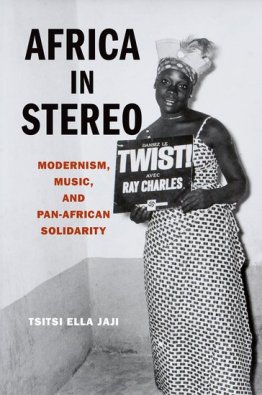 The site’s own characteristics mirror the theoretical ambition and methodological innovation of the book itself, which, in simplest terms, considers how Africans heard (and “read”) African-American music in the twentieth century. While the focus on listeners, audiences, and consumers might–in different hands–tend toward a kind of passivity, for Jaji it becomes a rich heuristic for understanding how Africans navigated modern media. By centering Africans as listeners and consumers, Jaji not only challenges the “originary” or “native” status of Africans in the diaspora but moreover uncovers new strategies for understanding the dialogic and intermedial processes through pan-African politics and culture were formed. She does so through a wide range of sources–including recordings, transcriptions, film, literature, websites, and magazines–which become an unprecedented archive of what Jaji terms “stereomodernism,” a “heuristic for analyzing texts and cultural practices that are both political and expressive, activated by black music and operative within the logic of pan-African solidarity” (14). Located largely in Senegal, Ghana, and South Africa, the book thus explores how music in particular helped to define real (and imagined) relationships across the Black diaspora.
After detailing her scope and methodology in the first chapter, Jaji then moves into substantive analysis in the following five chapters, which are organized around different modes of listening and reading, but are nevertheless chronological. She begins with the early twentieth century and in particular the work of transcription, which describes the act of creating musical notations for a recording or a piece of music. Looking at a group of South African writers, including Solomon Plaatje, John and Nokutela Dube, and Charlotte Maxeke, Jaji argues that the medium of transcription was in fact a way of finding (and sharing) oppositional strategies from the African-American musical tradition. As this chapter suggests, the liberatory potential in the musical form was amplified by the act of transcription, which created new linkages among South African and African American writers.
Jaji next turns to what she terms Négritude musicology, which serves as a rubric for reassessing Léopold Sédar Senghor’s theorization of black culture from the 1930s through the 1960s, a period that encompassed the explosion of interest in African-American music in the Francophone world. Influenced by both African-American writers and French jazz critics, Senghor found in jazz (and blues) a potent metaphor for the essential beauty and power of Black cultural traditions. Reminding us of the extraordinary gift of this poet-statesman, Jaji’s analysis clarifies the sonic dimensions in his poetry and prose–the “fricative phonemes” (77) and “rhythmic tension” (77)–and connects it to African-American aural traditions, like Stephen Henderson’s “worrying the line” (76) or Samuel Floyd’s “repetition with a difference” (75). She ends this chapter by returning to the culmination of Senghorian négritude–the 1966 World Festival of Negro Arts in Dakar–and how it became a critical forum for debating the meaning of Black Atlantic music.

Image by Flickr User Jean-Pierre Dalbéra, Documents présentés dans l’exposition Dakar 1966, 1er festival mondial des Arts Nègres du 1er au 24 avril 1966, Site de l’exposition du Musée du quai Branly (CC BY 2.0).
In one of the most exciting chapters, Jaji focuses on two magazines–Zonk! (South Africa) and Bingo (Senegal and France)–not so much to mine evidence of authorial intention but instead as a means to consider African women envisioned their realities and futures. In these magazines, Jaji finds evidence for how women would have navigated the emergence of new media forms, including magazines, radio sets, LPs, and film. While the advertisements suggested that modernity needed to be “ratified through consumption” (111), Jaji instead argues that women engaged in what she terms “sheen reading,” which enabled them to read these new forms critically and to, in effect, become modern through their critical engagement of consumerism and the new “audiotechnological landscape.” While specific in many respects to postwar Africa, Jaji’s careful and clear analysis of gender, media, and sound could (and should) be a heuristic for scholars in other domains.
While focused on distinct media forms, the last two chapters together help clarify the work of memory and futurity in the late twentieth century Black Atlantic. Jaji first examines the recording and reproduction of narratives of the Middle Passage, moving from Ghanaian poetry to the 1971 documentary Soul to Soul to many diasporic memoirs set in Ghana. Building from this corpus, Jaji considers the possibilites and limits in these varied acts of memorialization, particularly in response to the immense loss of transatlantic slavery.
The final chapter begins by looking at the memorialization of older technology (or “technonostalgia”) in two Senegalese films, Ousmane Sembene’s Camp de Thiaroye and Moussa Sene Absa’s Ça Twiste à Popenguine. Both films include scenes of somewhat furtive, or secretive, listening to African-American music on record players, which thus takes on a new kind of political meaning not simply because of the sounds themselves but in fact because of the “sonic world” that each has disrupted by introducing the literal and metaphorical record scratch.
Building from this analysis, Jaji considers how piracy figures into Black Atlantic musical formations in the digital age, using a film, novel, and the internet radio project, the Pan-African Space Station, which creates a future claim to pan-African solidarity not only by rejecting the logic of colonial and apartheid radio, but also the disingenuous claims to openness peddled by multinational corporations. The site doesn’t feature “podcasts”—and their barely disguised endorsements of “pod” products—but instead shares its own “passcasts” to open up the truly liberatory potential in music.
This last illustration exemplifies the broader impact of Jaji’s work, which clarifies the centrality of Africa (and African people) to global flows of media and culture and provides a powerful model for placing race, pan-africanism, and Black cultural production at the center of sound studies.

Studio One, set up by Rita Marley, Bob Marley’s widow, between Accra and Kumasi, Image by Flickr User Carsten ten Brink, April 2012 (CC BY-NC-ND 2.0)
In this, Jaji joins an exciting conversation among scholars who have challenged the ways in which the history of sound and technology have, as Alexander Weheliye has described, been heretofore been read as a white, Western project. This intervention is audible in a range of recent scholarship, including recent work on sound and empire by Ronald Radano, Tejumola Olaniyan, Hisham Aidi, J. Griffith Rollefson, and Michael Denning; in analyses of race and sound by Josh Kun, Dolores Inés Casillas, Jennifer Stoever, and Nina Eidsheim; in studies of sound in Africa by David F. Garcia, Robin D.G. Kelley, and Eric Charry; and finally, in recent interdisciplinary work that has explored the varied soundscapes of the African diaspora, including work by Shana Redmond, Tina Campt, Louis Chude-Sokei, Vanessa Valdés, Ingrid Monson, Njelle Hamilton, and Edwin Hill. What distinguishes Jaji’s work is her profound re-reading of the act of listening, which becomes in her analysis a critical means of challenging the racist logic of consumerism and empire. Indeed, she ends her book by asking the reader to “Come, listen with me.” After reading Africa in Stereo, it becomes clear that this request—and admonition—to simply listen is neither passive nor deferential, but instead a liberatory act, and one that has the potential to change the field.
—
Featured Image: Screen capture from Moussa Sene Absa’s Ça Twiste à Popenguine.
—
Celeste Day Moore is assistant professor in the Department of History at Hamilton College and is a historian of African-American culture, media, and technology in the twentieth century. She is currently completing first book, Soundscapes of Liberation, which traces the history of African-American music across the Francophone world, wherein it took on new meaning, value, and political power alongside the decolonization of the French empire. Most recently, her work has appeared in American Quarterly and in the first edited volume of the African American Intellectual History Society (AAIHS). Follow her on twitter at @celestedaymoore.
—
 REWIND! . . .If you liked this post, you may also dig:
SO! Reads: Hiromu Nagahara’s Tokyo Boogie-Woogie: Japan’s Pop Era and Its Discontents–Shawn Higgins
SO! Reads: Susan Schmidt Horning’s Chasing Sound: Technology, Culture and the Art of Studio Recording from Edison to the LP— Enongo Lumumba-Kasongo
SO! Reads: Steph Ceraso’s Sounding Composition: Multimodal Pedagogies for Embodied Listening–Airek Beauchamp
SO! Reads: Roshanak Khesti’s Modernity’s Ear–Shayna Silverstein
Share this:

SO! Amplifies: The Blues and Jazz Dance Book Club

—
Breaking down the paywalls of academia can take many forms, but lifelong learning collectives centered around a shared passion may perhaps be one of the most fun. The Blues and Jazz Dance Book Club is an international group of people connected by a love of blues and jazz culture, who read books together and tune in—free of charge—via Youtube Live to lectures and Q and As from experts and scholars from around the United States. Literature scholars such as Jessica Teague have discussed jazz poetry and August Wilson’s blues influence; dancer and scholar Dr. Fenella Kennedy has offered an online mini-workshop and discussion forum; and blues musician Tad Walters has played music and discussed the Delta Blues and its origins, among other lectures. All of these lectures are available on the Book Club’s website and on YouTube for anyone to enjoy.
 An open-access scholarly project founded in 2014, The Blues and Jazz Dance Book Club (BJDBC) was the brainchild of Sara Cherny, Damon Stone, Devona Cartier, Brenda Russell, and Kelly Porter (no longer a participating member). This team envisioned a free online space where people could learn about and discuss the history of blues, jazz, and African American dances, enriching both their own knowledge and the knowledge of the blues and jazz groups in which they participated. The Book Club’s current administrator, Chelsea Adams—PhD candidate at the University of Nevada, Las Vegas with a specialty in blues and African American dances in literature—took over operations in 2016.
Since then, Adams has worked hard to create a space where all blues and jazz lovers could access new scholarship on both the music and the dances done to that music, building a website to better facilitate the growing global group. Adams even coordinates live lectures at times that work the best to connect audiences who regularly chime in or visit the BJDBC website from Australia, England, Korea, Spain, France, Canada, Brazil, Sweden, the Netherlands, Germany, China and Hong Kong, among other places.
A Blues and Jazz Book Club live lecture by Dr. Jessica Teague, UNLV English
Recently, the Book Club has expanded to include multiple offerings for both scholar and enthusiast. One addition is quarterly feature articles, interviews, and community spotlights on blues and jazz topics. International dance instructor Julie Brown recently wrote the article “A Landscape of Slow Drag,” cataloguing and exploring how scholars and dancers have described the partnered blues idiom dance. Also featured is a never-before-published interview with Joe McQueen, the Oklahoma Jazz Hall of Fame inductee and Ogden, Utah’s King of Jazz.
Other feature articles have been spotlights on community engagements, literary criticism, and even a how-to on how to dive into research on blues and jazz topics. Practicioner and dance historian Damon Stone’s “A Brief Introduction to Savoy Walk,” Dr. Caryl Loney-McFarlane’s “‘Inside Nothing’: The Silent Protest March in Tony Morrison’s Jazz“ and Dr. Licia Morrow Hendricks’s “A Dog Named Blue: Song as Patrilineal Legacy in August Wilson’s Fences“ have all been popular pieces among group members and beyond. The website will soon publish an article all about Barbara Morrison‘s work in LA for the California Blues and Jazz Museum and the charity event called Signifyin’ Blues that raises money for her museum (forthcoming June 15th, 2019). And, in September 2019, Pat Taylor will be writing our third feature for the year on her work and life as a jazz dance choreographer.

Start Jookin’ with the Blues and Jazz Book Club this Summer!
The Blues and Jazz Dance Book Club’s signature offering is of course its quarterly book readings, where groups around the globe read together. Currently, we are reading Beyond the Crossroads: The Devil and the Blues Tradition by Adam Gussow, which we will finish during the first week of July 2019 (access the schedule here). Should you want to join us to read in 2019, future offerings include Jookin’: The Rise of Social Dance Formation in African-American Culture by Katrina Hazzard-Gordon (Summer 2019; start date July 21), Moanin’ at Midnight: The Life and Times of Howlin’ Wolf by James Segrest and Mark Hoffman (Fall 2019; start date September 15), and a blues-inspired novel for December 2019, Alice Walker’s The Color Purple (December 1). For the full 2019 reading list, click here.
Furthermore, the group’s website is a hub that also offers new reading lists and watch lists, including ones on African American history (and soon to include updated lists for blues and jazz music, and African American dance) and a discussion questions archive, where readers can find past discussion questions for previous books and films that they can access for their own thought or to read and discuss these books with others. Our Facebook page not only has regular posts about not only the Book Club, but also shares other research, news and information on blues and jazz around the United States, as does our Facebook Group.

The JBDBC will be reading Moanin’ at Midnight this Fall!
“Open access groups like Book Club offer a friendly environment to learn how to approach academic literature,” Book Club Organizer Adams says, “while enjoying gaining more knowledge about their hobbies and interests. It’s a form of scholarly outreach that I think is vital if we truly believe in the idea that our research can make a difference outside of the academy.
Groups like this are important because they offer guided access to scholarship and literature to people who for one reason or another do not have the opportunity to learn in formal academic environments or other professional institutions. Scholarly literature is a specific and often intimidating genre to tackle alone, even if someone is interested in learning more about a topic.”
And the engagements the Book Club has are rich and multifaceted. “My favorite experience with a live lecture,” Adams remembers, “was with Dr. Kennedy, when they demonstrated dances out of Jean and Marshall Stearns’ diagrams from their book Jazz Dance. Watching the group actually learn how to dance some of these dances listed in the book was a joy.”
In April 2018, the Blues and Jazz Dance Book Club announced the goal to provide two yearly scholarships: a Community Learning Scholarship for blues and jazz events to bring out a scholar, musician, or practitioner to teach about blues or jazz culture and history, and another for an individual with financial need to attend an event with a blues or jazz history and culture focus or to perform research. To provide these scholarships, the Book Club relies solely on community donations. To date, they have been able to raise the money to fund one Community Learning Scholarship, which will be open for applications starting in August of 2019.
If you would like to participate in the Blues and Jazz Dance Book Club, please check out our website: bluesjazzbookclub.com. We accept abstract submissions for feature articles on a year-round basis, and have multiple volunteer positions available, from one-time positions like guest lecturer to rolling positions such as book discussion leader. If you would like to support the open-access project goals but do not have time to volunteer, we always welcome donations to the cause!
—
Featured Image from the Blues and Jazz Book Club, “A Landscape of Slow Drag,” 1925/Published 1961, Info Likely from Harlem, NY Dancers.
—
Currently a PhD candidate in English at UNLV, Chelsea Adams focuses her studies on African American literature, blues and jazz music, and African American dance. She writes about minority culture representation in literature, with a focus of representation of black musicians, dancers, and the art forms they produce. She also runs the Blues and Jazz Dance Book Club, an international online book club project, to offer the public open access information about the history of blues, jazz, and black dances. You can learn more about Chelsea and her work at cjuneadams.com.
—
REWIND!…If you liked this post, you may also dig:
SO! Amplifies: Memoir Mixtapes–Kaitlyn Liu
SO! Amplifies: Cities and Memory–Stuart Fowkes
Share this:


Current Top Posts





April 2021

January 2020

November 2019

October 2019

August 2019

April 2014

November 2017

March 2015

December 2017

October 2015
 Sounding Out!
Recent Comments