
Animal Renderings: The Library of Natural Sounds

Today we bring you the latest post in SO!’s spring series, Live from the SHC, which follows the new research from the 2011-2012 Fellows of Cornell’s Society for the Humanities, who have gathered in the A.D. White House to study “Sound: Culture, Theory, Practice, Politics.” For the full series, click here. Today poet, scholar, and ecocritic Jonathan Skinner brings us all a treat for spring, so throw open your windows and take a deep listen. –Editor in Chief, JSA
—
DOI: https://doi.org/10.59350/6grk7-v6247
This planet is singing 24/7 but are we listening to it? Take out your earbuds, turn down the music and the air conditioning, walk away from the fridge, shut off your engine, open the windows, and tell me what you hear. If you are in the humid parts of the temperate regions, chances are you’ll hear right now, amidst the myriad human sounds, and depending on the time of day, the spring peepers going, the woodcocks peenting and displaying, a grouse drumming, the whistling of cardinals and robins, chickadees countersinging, blackbirds trilling, cawing of crows, blue jays scolding, honking of geese, hooting of an owl or two, woodpeckers drumming, house sparrows chirping (in this case, to a Satie carillon), perhaps some coyotes yapping it up after midnight. Not to speak of wind in branches and leaves, water, thunder and lightning. These are just some of sounds I can pick up, with a bit of careful listening, in and around the relatively urban environment of Ithaca, New York. If you put your ear to the grass, you might hear this astonishing Treehopper communication.
Or maybe you heard these sounds in some music you were listening to, in a movie soundtrack or videogame? Just as we pervade their worlds, animals pervade our environments, and their sounds are used to “render” these environments within the relatively flat dimensions of our media—the way three dimensions of spatial information get “crunched” to the two dimensions of a video game’s display (see 4:00 – 5:20 for a demonstration of Aiden Fry’s “generative birdsong” program below, developed through the analysis and sampling of birdsong as a solution to repetitive sound effects that can diminish the immersive quality of the game). Even the most sophisticated “surround sound” audio must “render” figuratively the environed experience of hearing.
.
The next time you watch a movie, listen to some “ambient” music or play a videogame that renders an outdoors environment, imagine subtracting the animal sounds (either literal or evoked) from these media scapes and consider how incompletely rendered the experience would be. A reversal of the effect, as in Gus Van Sant’s use of Hildegard Westerkamp’s “Beneath the Forest Floor” soundscape, to track and underscore the anomie of certain characters through Elephant, his thinly veiled recreation of the Columbine High School tragedy, also proves the rule (note especially the soundtrack from 3:10 – 3:40).
.
Greg Budney and Mike Webster explain their dedication to compiling the world’s largest and best quality archive of animal recordings (now in video as well as audio), the Macaulay Library of Natural Sounds at Cornell University, as a responsibility to future acoustic biologists, who may bring tools and concepts to the data we have not remotely conceived. Their mission is first and foremost a scientific one. However, conservation is also high on their list: Budney, an expert recordist, points out how high quality recordings—as of lekking Greater Prairie-Chickens—can be played back into the environment, to promote nesting of endangered populations.
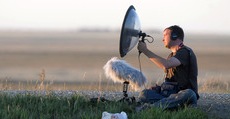
These bioacousticians agree that high quality sound recordings can be a powerful way to interest laypeople in the sounds of the robin in their backyard, and, by extension, in broader issues of conservation. Sounds in the Macaulay Library also are available to the entertainment industry, so that, indeed, myriad animal vocalizations contribute to the renderings of its various media. Licensing fees in turn contribute to the conservation mission of the Library.
Rendering is not so much a matter of reproduction—accurately representing a “real” environment—as of recreating, through a consistency that “completes” the aesthetic experience, the feelings associated with an environment. (Think of the difference in quality between the “finished” HD, surround-sound movie and the behind-the-scenes “special features” on a DVD.) In Audio-Vision: Sound on Screen, media theorist Michel Chion identifies an important feature of rendering in “materializing sound indices,” noises that help render, in sound and image, a particular “clump of sensations” (112-116).
For instance, spatial depth, in outdoor scenes, is often rendered through the presence of bird song or dogs barking, etc. Or consider the cooing of pigeons that often accompanies the opening of a garret window in a movie set in Paris. Or that ubiquitous red-tailed hawk’s cry indexing a “wild” landscape. The absence or thinness of these indices can be just as helpful to rendering, as when the landscape includes “ethereal, abstract, and fluid” entities: “out of touch” characters in Jacques Tati films or the drawn characters in Who Framed Roger Rabbit, where hollow, lightweight, plastic sounds help us believe that we are indeed seeing (or, as Chion reminds us, “hear-seeing”) cartoon characters (watch from 1:19 – 1:33 for the famous “clang” the drawn Jessica Rabbit makes as she collides with the live action Eddie Valiant).
.
Cormac McCarthy’s The Road, both the book and the film version, deploy effectively the total absence of animal sounds to convey the uncanny complex of feelings bound up in environmental apocalypse—the “silent spring” invoked by Rachel Carson a half century ago in her indictment of the toxic legacy of the chemical industry.
In his study of environmental aesthetics, Ecology Without Nature, ecocritic Timothy Morton faults rendering for perpetuating an “ecomimetic illusion of immediacy,” an “ambient” art that ultimately comes in between us and the life it is supposed to bring us close to (36). Rendering lures us into the “relaxing ambient sounds of ecomimesis,” precisely when we need to hear “the screeching of the emergency brake” (as Morton puts it: “whistling in the dark, insisting that we’re part of Gaia” 187, 196). However, Chion notes that “the disjunctive and autonomist impulse [à la Godard] that predominates in intellectual discourse on the question (‘wouldn’t it be better if sound and image were independent?’) arises entirely from a unitary illusion” that there is “a true unity existing elsewhere” (Audio-Vision 97-98). Such unity is in fact elusive: for instance, it can be difficult to identify the sources of sounds in “nature” (consider the bewildering variety of blue jay calls), while the notion that a sound can on its own invoke more abstract characteristics of its source, especially when it is produced by a nonhuman species, betrays a kind of magical thinking. (Forms of non-western magical thinking actually acknowledge the disjunctive quality of natural sounds by referring, for instance, to “voices in the forest.”) Also, sound is so context dependent, and our listening is so strongly influenced by the conventions of our media, that “sound in itself”can be a very slippery object. Chion notes that we need something like an “auditory analogy of the visual camera obscura” —i.e. the monitoring and recording of soundscapes—to help us listen to “sounds for themselves and to focus on their acoustical qualities” (108).
In a time of mass extinction, how are we to approach the rendering of animal sounds in our mediated environments? Do these sounds have agency? Does listening to and “capturing” animal sounds bring us closer to them, or only lure us, with an illusion of immersion and unity, away from realizing the dark nature of our ecology, and the urgent reforms needed, if we are actually to help animals (does our rendering and consumption of whale song—pace what Songs of the Humpback Whale has done for whale conservation—end up perpetuating the same extractive process that “renders” whale blubber)?
I would say that, so long as we approach these sounds neither as a substitute for, nor as an experience “less than,” the daily practice of listening to our environments, a resource like the Macaulay Library can add immeasurably to our awareness of the diversity, and the vulnerability, of life on Earth. (Another resource worth exploring is the British Library’s Environment & nature sounds archive, especially the collection of early wildlife recordings.) Careful attention to renderings of animal sounds in our media can make us aware of the extent to which we “render” the landscape around us, through selective habits of listening, and open us to the disjunctive, noisy, reverberant, distorted sounds such renderings obscure. (R. Murray Schafer made this point long ago, in his book The Soundscape urging us to listen to noise if we want to defeat it.) Clips posted here, of media using birdsong to render scenes of human violence, state the complexity of our pastoral aesthetics in an exaggerated way, but every day our listening has access to a range of sonic collisions.
Consider the famous recordings of nightingales in Beatrice Harrison’s backyard, to the accompaniment of her cello, as well as to RAF bombers—on Minnesota Public Radio’s Music & Nature. Part of what we will hear when we listen with open ears is our own domination of the soundscape, one that can have concrete implications for the survival of other species (Chris Clark, head of Bioacoustics Research at Cornell, has imaged the way the noise of shipping lanes impacts the acoustic habitat of endangered Right Whales.) How might the infrasonic or ultrasonic vocal communications—of blue whales, elephants, mice and bats, for instance—that operate beyond the range of the naked human ear (but not of our instruments) impact our media environments? The “materializing sound indices” of recordings can be used to return us to the embodied, imperfect natures of these other beings, whose vulnerability, philosopher Jacques Derrida suggests in The Animal That Therefore I Am, it is our own nature to follow.
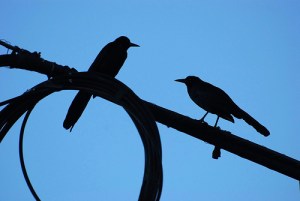
The more we listen to the environment acousmatically, the better critics we become of our media environments’ often crassly commercial renderings. Many of these sounds (see also some of the recordings collected on the Earth Ear label’s Dreams of Gaia) are simply beautiful, or astonishing—conveying an aesthetic dimension alluded to in veteran nature recordist Bernie Krause’s new book, The Great Animal Orchestra: Finding the Origins of Music in the World’s Wild Places. (My concern with a focus on the exotic is that privileging “wild places” might have the effect of devaluing the “not wild,” i.e. where most people live—places nonetheless full of wild creatures—and where we might best develop our listening.) Finally, the more we find ways to render these sounds meaningfully in our own lives, outside patterns of consumption, the better chances are we’ll begin to develop (politically, ethically) meaningful relationships with these other species, species with whom we must collaborate if we want to tend the web of life that so desperately needs our care.
—
**Featured Image Credit: Digital Collage Bird Art by Flickr User Peregrine Blue
—
Jonathan Skinner founded and edits the journal ecopoetics, which features creative-critical intersections between writing and ecology. Skinner also writes ecocriticism on contemporary poetry and poetics: he has published essays on the poets Mei-mei Berssenbrugge, Ronald Johnson, Bernadette Mayer, Lorine Niedecker, and Charles Olson; on Poetries of the Third Landscape, Documentary Poetics, and Poetry Animals; and an ethnographic study of the Tohono O’odham Mockingbird Speech. Skinner’s poetry collections include Birds of Tifft (BlazeVox, 2011), Warblers (Albion Books, 2010), With Naked Foot (Little Scratch Pad Press, 2009), and Political Cactus Poems (Palm Press, 2005). Skinner’s latest creative project is a book on the urban landscape designs of Frederick Law Olmsted.
—
Share this:

“The Happiest Day of the Year”: A Reparative (I Hope) Approach to Record Store Day

Editor’s Note: This post, by media scholar Norma Coates, was originally published on May 9, 2011, by the excellent folks over at Flow TV, a critical forum on television and media culture published by theDepartment of Radio, Television, and Film at the University of Texas at Austin. We thank them for permission to give this gem another spin for Record Store Day 2012. It was modified only infinitesimally to fit the SO! stylesheet. Enjoy! And don’t forget put the virtual needle on Sounding Out!‘s new Record Store Day 2012 Podcast, produced by Multimedia Editor Aaron Trammell and featuring interviews with Eric Lott, Damien Keene, Benjamin Gold, Rebecca Berkowitz, Quinn Bishop, Dave Truesdell, Miranda Taylor, and yours truly. –JS Editor-in-Chief
—-
DOI: https://doi.org/10.59350/gs0s8-e0x46
Several of my graduate students, in separate meetings, have shared their recent inspiration from the late Eve Kosofsky Sedgwick’s work on affect, especially as compiled in her book Touching Feeling. After the third student talked about it, I figured that I’d better read it. I was instantly plunged back into that wonderful feeling, or more appropriately affect, of discovering something compelling and useful, that could change the ways in which I think about certain things, or at least complicate my approaches. Hence this post about Record Store Day is going to be a bit different than my first drafts. I must proceed with the caveat that although my reading of Sedgwick’s theory of affect is still shallow and my approach necessarily speculative, I’m going to jump into it and use it anyway, in the hope of jumpstarting more careful thought and theorizing for later projects.

On April 16, this year’s Record Store Day [2012’s Record Store Day is April 21st], I proclaimed it to my family as “the Happiest Day of the Year.” My reading of Record Store Day was at the same time, in Sedgwick’s terminology, paranoid and reparative. Implicit in my paranoid stance, and in the first draft of this post, was my deep suspicion of and sadness about its commercial and consumerist co-optation. What began as a celebration of the continuing economic health and vibrancy of some independent record stores four years ago now has a glossy web site and sponsorship by major labels and industry players. Special “one-day-only” releases, usually on vinyl, sell for somewhat exorbitant prices and end up, unsealed and resold for even more exorbitant prices on Ebay the next day. This in turn feeds the “baseball card” collector mentality that in turn perpetuates gendered discourses and practices of inclusion and exclusion, as well as the vinyl fetishism that separates the “real” music fan from the poseur. I could go on and on with this paranoid reading, one laden with negative affect that critical theorists use to ward off any surprises and to comfort ourselves with the knowledge that the sources of our cultural oppression can be exposed. Sedgwick asks us to think about what such knowledge or exposure does for us. Perhaps it justifies a cynical and critical fatalism that ultimately goes nowhere.
The path that Sedgwick offers out of this conundrum is reparative reading, one open to surprises rather than to sureties. Record Store Day is, for me, a happy day. I even anticipate it. It celebrates several things that I love: music, community, independent cultural production and businesses, browsing racks of records and CDs, talking about music, hearing live music, and more. Despite the presence of corporate logos on the slick website, Record Store Day does manage to retain an element of, in the immortal words of Jack Black in School of Rock, “sticking it to the man.” That is, Tower Records and Virgin Megastores are gone, but a few local record stores are still thriving. That there are “few” is indeed problematic, as they are perhaps the last left standing after a ferocious cull over the past decade, with an uncertain future despite their alleged economic health.
A reparative reading, according to Sedgwick lacks the tight control of a paranoid reading, in which we fatalistically intuit or even call into being what we expect to find or expose. Record Store Day makes me, and I assume the others who were responsible for a 30-minute long check-out line at 10:30 am, feel good, even if we “shouldn’t.” For example, record stores and record collecting are assumed by scholars and laypeople to be space dominated by males, often but not always young ones. What to make, then, of the more than a handful of older women in the store? Or the general sense of camaraderie and celebration that seemed to transcend age and gender, at least? (Race and class weren’t as well-represented in my local record store.) What brought the biggest smile to my face was a woman, perhaps in her late twenties, whose arms were over-flowing with records and CDs. My initial, paranoid reading saw her as both an aberration or a updated version of one of Adorno’s “rhythmic obedients” [from “On Popular Music], blithely purchasing the tools of her own oppression. Or perhaps she was generally caught up in the celebration and needing to catch up on purchases. Maybe, like myself, she was genuinely caught up in the tactile and aural pleasures of music, especially that available in tangible form. I, too, succumbed to the lure of special editions, one-day only availability, and contests that tested my knowledge of rock trivia.

While in the middle of it Record Store Day tapped into what are for me dense layers of affective pleasure made available by listening to and otherwise interacting with recorded music. The hunt is itself enjoyable. Ripping the plastic off a CD provides the joyful and familiar sound of anticipation. The smell of vinyl, the crackle of the needle in the groove, even the preparatory cleaning of a record before playing all provide pleasurable feelings of positive affect. All of these things fit neatly into my original paranoid reading of Record Store Day. Special editions that are only available on record store day feed into two consumer economies: that of the major labels who produce some of these instant rarities, and those who buy them to take advantage of collectors on Ebay later. Plus, these affective “pleasures” could all be reduced to fetishism, or to false consciousness, but my reading of Sedgwick causes me to argue that they don’t have to be either of these things (or other negative things). Through a reparative lens, these feelings, the affect, generated by Record Store Day, could lead to different questions and answers that linger alongside and are equally valid as the set we already ask and the conclusions that we draw from them.
The paranoid critic in me wonders, though, if reparative approaches of media texts are nothing more than the return of 1980s and 1990s ideas about producerly consumption, theories roundly, if sometimes unfairly criticized for a lack of political efficacy. Moreover, affect theory can also return to a possibly problematic return to some notion of something innate, in this case affect or more simply, feeling. I do wonder, though, with Sedgwick, whether our existing critical tools may lead to the triumph of the paranoid reading and of negative affect. That is, our only way to deal with the present condition is tantamount to capitulation. Reparative readings enable us to place our pleasure alongside the negative aspects; that is, they may be capable of thinking beyond binaries, originations, and desires to unveil things that we already know are there. What does alongside mean? Is theorizing the alongside just another way of submitting to an increasingly depressing status quo? For now, I’ll just submit that Record Store Day is “the happiest day of the year,” (you can do what you want with the scare quotes) and that happiness and other positive affects are latent with political possibility, even if we are still figuring out how to access that potential.
For Poly Styrene, Hazel Dickens, and Phoebe Snow. Originally published on May 9, 2011, by the excellent folks over at Flow TV.
—
Norma Coates is Associate Professor with a joint appointment in the Don Wright Faculty of Music and the Faculty of Information and Media Studies at the University of Western Ontario. She writes and studies about popular music and sound and their interactions and intersections with other things such as gender, television, film, age, and the entertainment industry.
—
Share this:




Current Top Posts





April 2021

January 2020

November 2019

October 2019

August 2019

April 2014

November 2017

March 2015

December 2017

October 2015
 Sounding Out!
Recent Comments