
#Blog-O-Versary 3.0
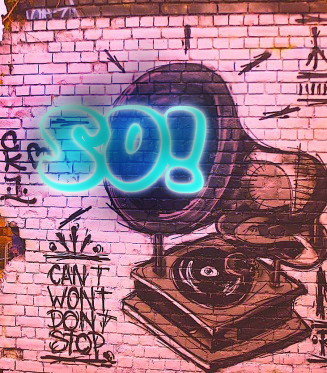
Click Phonograph to Download #Blog-O-Versary 3.0 Mix!
(Image by Mafleen; tunes picked by SO! writers & editors!)
Happy happy #Blog-O-Versary 3.0 to our readers, writers, retweeters, and supporters of all kinds!! This year proves that, to quote De La Soul quoting Schoolhouse Rock, “three is the magic number.” Of course a mic check also has to go out to another important trio, SO!‘s editorial crüe: Plug One: yours truly JSA, Editor in Chief and Guest Posts Editor, Plug Two: Liana Silva, Managing Editor, and Plug Three: Aaron Trammell, Multimedia Editor.
Here’s just a sample of the goodness that SO! has brought to y’all this past year, with some hints of how we “can’t stop won’t stop (the awesomeness)” on into year four!
- #itoughttobeillegaltolookthisgood: After copious troubleshooting meetings and readers’ polls–thanks for the great feedback, btw–we changed to our new layout on January 1st, 2012, an effort spearheaded by Managing Editor Liana Silva. #lovingit #ohsoreadable
- #ontheregular: SO! welcomed two new regular writers to our roster this year, multimedia artist Maile Colbert, who works out of Binaural Nodar in Lisbon, Portugal. and African American Studies scholar Regina Bradley, coming to you out of Florida State University. Look for their posts on full regular rotation in 2013.
- #puttingourbizinthestreets: The word is out! This year Sounding Out! has been all over the Internet and even the print-o-sphere–with citations (American Quarterly), links (The European Sound Studies Association), features (IASPM-US), re-posts (Cultural Weekly), allusions (Wi: A Journal of Mobile Media), recommendations (The Chronicle of Higher Ed‘s Prof Hacker), responses (SheSeesRed) , and even an analysis of our #Occupy coverage (The Incredible Kaleidophone). For the full listing of all the folks we’ve caught talking about Sounding Out! since Blog-o-Versary 2.0, see our brand spanking new media page. And, if you have taught an SO! post in your class, cited one in an article, discussed SO! in a blog, or even had a really good dream about SO!, drop me an email and tell me about it: jsa@soundingoutblog.com
- #hotoffthepresses: Sounding Out! worked overtime this year to be responsive to the sonic edge of major events–#Occupy, the murder of Trayvon Martin, the #casseroles protests, the Helen Vendler/Rita Dove American poetry anthology debates, the sudden international popularity of The Artist –showing the relevance of our scholarly work in everyday life and, now more than ever, the importance of the humanities and social sciences in interpreting the world we share.

Close-up of image by Flickr user Thomas Hawk
- #aaaahpushit: Our writers added over 15 new categories at SO! this year alone, based on the exciting new scholarship pushing sound studies into new directions: advertising, animals/animal studies, Carribbean Studies, curation, dance/movement, Deafness, economics, games/gaming, Islam/Muslim identity, Jewishness/Jewish identity, medicine, pedagogy, sound and region, religion and religious studies, time, vision/visuality, and writing. Big ups to Managing Editor Liana Silva for keeping our back catalogue up to date as new categories emerge, ensuring SO! will remain a fully searchable and usable tool for research, teaching, and pleasure reading.
- #seriesandforumsandCFPsohmy!: In addition to plotting our more broad general coverage, I began organizing special “Series” and “Forums” that took more lingering listens to specific issues and particular sites. In February 2012, SO! hosted a month-long forum on Deafness; throughout Spring 2012 we featured a series of dispatches, “Live From the SHC” that shared the new scholarship from the Sound Studies fellows gathered at Cornell’s Society for the Humanities. We just wrapped up a July forum on Listening in observation of World Listening Day and are in the midst of a summer series on radio history, “Tune in to the Past,” that sifts through the legacy of Norman Corwin. Look for a pedagogy forum to ring in the start of the academic school year in August, featuring the winner of our recent Call for Posts, “Sound and Pedagogy: Amplifying the Teachable Moment.” In fact, we received so many great pitches, we will offer a “refresher course” forum in spring 2013!
- #Puttingtheworldinworldlisteningday: U.S.-based sound studies is often critiqued for, well, being too U.S.-based. As a result I have sought out more posts that explore sound in transnational and diasporic contexts–such as “Everyone I listen to Fake Patois,” “Beat-ification: British Muslim Hip Hop and Ethical Listening Practices,” and “Listening to Disaster: Our Relationship to Sound in Danger”–and in sites across the globe: Ireland, Canada, England, and Portugal so far in 2012. Look for research focusing on (and located in) Ghana, Brasil, and Egypt in the months to come.
- #trippingthesoundpodcastic!: Directed by Multimedia Editor Aaron Trammell, SO!’s podcast series expanded this year to include regular quarterly installments, promising you a minimum of four experimental sonic explorations a year, with bonuses along the way. Since last year’s Blog-O-Versary podcast mixtape, we have taken you into the listening practices of sound artists, the roadside prayer containers of pious American truckers, memories of record store shopping, and deeper awareness of the soundscape. Subscribe to us on Itunes so you don’t miss a thing this year!
- #gonnagetourselvesconnected: Sounding Out! has forged relationships with many excellent sound-related organizations: American Studies Association Sound Studies Caucus, the Society for Ethnomusicology Sound Studies Special Interest Group, the Society for Cinema and Media Studies Sound Studies Special Interest Group, the Journal of Popular Music Studies, HASTAC (Humanities, Arts, Science, and Technology Advanced Collaboratory), the Society for the Humanities at Cornell and the World Listening Project. Look out for our upcoming IASPM-US collaboration (on tap for February 2013), which will involve cross-blog programming and conversation about the relationship (and tensions) between pop music studies and sound studies. Not to mention, we’ve hosted 46 guests and counting, representing over 37 unique institutions!
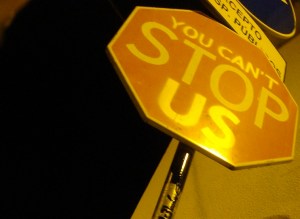
courtesy of Flickr user Stencil Terrorists
And that’s just a glimpse of how Sounding Out! “Can’t Stop, Won’t Stop (the Awesomeness)” on and on until the break of dawn (or at least until 9:00 a.m. every Monday morning). Now go ahead and take a listen with our annual downloadable mixtape–a seriously kick ass 90 minute TDK tape super-megamix that spans six decades and a dizzying array of genres–courtesy of Team SO! You’ve earned it!
–JSA, Editor in Chief
—-
Click here for Sounding Out!‘s Blog-O-Versary 3.0 mix with track listing
(Just in case you missed last year’s 2.0 celebration–and mix–click here; for our first Blog-O-Versary party mix click here)
—-
Jennifer Stoever-Ackerman is co-founder, Editor-in-Chief and Guest Posts Editor for Sounding Out! She is also Assistant Professor of English at Binghamton University and a 2011-2012 Fellow at the Society for the Humanities at Cornell University.
Share this:

Sounding Out! Occupies the Internet, or Why I Blog

Ticker Tape Parade, New York City Financial District, by Kitty Wallace
Welcome to our 100th post! It’s me, Jennifer Stoever Editor-in-Chief, Guest Posts Editor, and Co-Founder of Sounding Out! : The Sound Studies Blog, which has been faithfully “pushing sound studies into the red since 2009.” Together with Liana Silva, Co-Founder and Managing Editor, and Aaron Trammell, Co-Founder and Multimedia Editor, we thank you for your faithful readership, your enthusiasm, and of course, your likes, shares, retweets, and good, old-fashioned word-of-mouth!! We are going to keep serving up sound studies’ latest and greatest for a long time to come, for anyone who wants to listen. Keep a look out for our site redesign coming in January 2012: same good stuff, just that much easier on the eyes.
In honor of this momentous occasion, I am going to get all “meta-“ on you and take you behind the scenes of Sounding Out!, sharing some of the reasons why we decided to start a public conversation about sound studies on the Internet. A manifesto of sorts, this post is adapted from a talk I gave a few weeks back at the American Studies Association annual meeting in Baltimore as part of an excellent panel called “Digital Displays: Women Imagining The Blogosphere as Alternative Public Spheres,” sponsored by the American Studies Women’s Committee, organized by Nicole Hodges Persley (University of Kansas) and featuring the excellent work of Tanya Golash-Bolaza, Judy Lubin, and Jamie Schmidt Wagman.
With all that has happened in the short time that has passed since mid-October—especially at #Occupy sites across the country and around the world—I am only more convinced of the need to empower ourselves by building our own microphones, platforms, and audiences, rather than wait for “official” channels to open up; more often than not, they are cut off, nonresponsive, non-existent or just plain hijacked. Without stretching the metaphor too far or confusing what we do with front-line activism—no one is pepper spraying SO!, let’s be real—I’d like to think that the story of Sounding Out! is also a tale of occupation in its own way. In that spirit of solidarity and D.I.Y. information exchange, here’s a bit about why I blog. I hope to inspire you to join in the conversation.
(P.S. Check our November 2011 coverage of the acoustics of the #Occupy movement thanks to guest writers Gina Arnold and Ted Sammons)
***
In their introduction to the hot-off-the presses special issue of American Quarterly on sound studies—which actually mentions Sounding Out!, on page 451! Yes!—editors Kara Keeling and Josh Kun report receiving an unusual number of submissions from junior faculty members and graduate students, which they describe as “a sign not only of sound’s quantitative currency but the promise of its future as a field of ongoing inquiry, and its importance and relevance to the future of American Studies itself” (452). Keeling and Kun’s editorial openness to newer work is a wonderful exception in traditional academic publishing, where issues of access can loom large for emerging scholars struggling to publish and build a national reputation, particularly for women, scholars of color and/or first-generation scholars, whose expertise in their particular fields is rarely taken for granted. I use the term access here to refer to breaking into the centers of power on our campuses and/or in our respective fields. When you are a “nontraditional” scholar frequently isolated at and from your institution, marginalized in your field, and excluded from formal and informal networks of power, all key characteristics cited by Rosabeth Kanter’s influential study of “Tokenism,” gaining a foothold in the increasingly bleak academic landscape can seem insurmountable.

The Logo of the Women’s Audio Mission: Changing the Face of Sound
Because Sound Studies is not yet fully institutionalized—there are beginning to be sound studies masters’ concentrations at a few schools like NYU and the New School, but there are still no “sound studies” departments in the United States—I believe the kind of intervention that I am helping to stage with Sounding Out! is even more important. Scholars working in audio cultures are spread across, and often isolated in, many fields that are themselves identified as white and male dominated, both in terms of demographics and research agenda: media studies, the history of science and technology, popular music, sound art and design, and film studies, to name a few. When considered alongside the abysmal numbers of many professional fields for sound practitioners, like video game design, radio announcing, and audio recording—the Women’s Audio Mission reports that 95% of the professional recording industry is currently male—the need is even more clear for two-way channels that increase the access of women and people of color to the central conversations of their industries and academic fields while improving the access of other scholars and wider reading publics to our work.

Blast from the Pre-Sounding Out! Past: BU Sound Studies Collective Logo Circa 2008
Rather than wait for a platform for our sound studies scholarship to arise, I helped to build a public conversation in a medium that could not only be more responsive to the lightning-paced nature of sound studies’ breakthrough moment, but also one that could be more responded to: open, collaborative, and in conversation with a wide range of interested parties. Way back in 2009, there were few traditional publication venues for research on sound; sound studies scholars had to rely on rare special issues or occasional essays on the margins of various disciplines’ journals. The first print journal primarily devoted to sound launched in Summer 2008, Music, Sound, and the Moving Image, but it still left large gaps for those not working in film. Not only did we lack the considerable resources necessary to start a print journal, but the medium wasn’t quite up to our tasks. A blog seemed much more flexible, able to build a continuously updated, networked, public archive of sound studies scholars, while sustaining what Kathleen Fitzpatrick describes as “an open, post-publication review process [that] is a non-anonymous discussion by a community of scholars working together on collective issues” in her September 30th, 2011 interview with Inside Higher Ed.
Paul Krugman called such interventions “breaking in from anywhere” in his October 18th, 2011 blog for the New York Times, “Our Blogs, Ourselves,” arguing that the blogosphere makes academia’s “magic circles” seem “less formal and less defined by where you sit or where you went to school.” Krugman argues blogging has “showed what things are really like. If some famous economists seem to be showing themselves intellectually naked, it’s not really a change in their wardrobe, it’s the fact that it’s easier than it used to be for little boys to get a word in.” We at Sounding Out! like to think we’re also helping women (little, big, or otherwise) to join this conversation, and more importantly, to change it.
 While voices like those on Team Sounding Out! are often central to the “ground floor” conversations that shape a new field at conferences, online, and/or at our home institutions, they are often left behind when a field crystallizes in print journal publishing, which, given its limited space and slower-pace, favors the seasoned scholar. Publishing a blog can both complement peer-reviewed research and intervene in its recalcitrant institutional practices. As Claire Potter, author of the blog Tenured Radical, writes, the blogosphere “works against the stultifying tendency of the academy to keep untenured people in as subservient a state as possible for the longest possible time.” Sounding Out! enables our untenured but knowledgeable editorial crew to approach the field with agency and gusto, actively seeking out the “ground floor” intellectual labor and innovation happening in sound studies, making it audible and visible in a public forum that is far from ghettoized. We deliberately curate an integrated, and dynamic collaboration between junior scholars, senior scholars, graduate students, and sound professionals. Thanks to you, we’ll be topping 50,000 hits this week.
Before this all sounds too rosy, I should also be clear that running Sounding Out! is plenty of work, even with a brilliant editorial team. I am constantly surprised at how much time I spend just wrestling with WordPress, let alone the cooler parts of the gig. Not to mention, its role in my tenure case remains to be seen. However, even when the hours get long (squeezed in on nights and weekends after already impossibly long days and weeks), I will also say that it is work that is deeply satisfying and creative, work that feels both truly my own and yet deeply connected to a worthy collective goal.
I am also thrilled to report that several members of my non-academic family have told me that, thanks to the blog, they “finally understand what the hell it is I do,” which is one of the highest compliments I have received in a long while. As Editor-in-Chief, one of my main missions for Sounding Out! has always been for the blog to become—and remain—a smart, well-written, and informative-yet-irresistible venue for the work of emerging sound studies scholars for academics and non-academics alike. That is ultimately why we work so hard over here at SO!: to share the most vital and important findings of our field in a way that impacts lives as well as careers.
—
Jennifer Stoever is co-founder, Editor-in-Chief and Guest Posts Editor for Sounding Out! She is also Assistant Professor of English at Binghamton University and a Fellow at the Society for the Humanities at Cornell University.
Share this:


Current Top Posts





April 2021

January 2020

November 2019

October 2019

August 2019

April 2014

November 2017

March 2015

December 2017

October 2015
 Sounding Out!
Recent Comments