
Contra La Pared: Reggaetón and Dissonance in Naarm, Melbourne

 In “Asesina,” Darell opens the track shouting “Everybody go to the discotek,” a call for listeners to respond to the catchy beat and come dance. In this series on rap in Spanish and Sound Studies, we’re calling you out to the dance floor…and we have plenty to say about it. Your playlist will not sound the same after we’re through.
Throughout January, we will explore what Spanish rap has to say on the dance floor, in our cars, and through our headsets. We’ll read about trap in Cuba and about femme sexuality in Cardi B’s music. And because no forum on Spanish rap is complete without a mixtape, we’ll close out our forum with a free playlist for our readers. Today we continue No Pare, Sigue Sigue: Spanish Rap & Sound Studies with Lucreccia Quintanilla’s essay on reggaetón and Latinx identity in Australia.
Liana M. Silva, forum editor
—
The first time I heard Cypress Hill was at my fellow Salvadoran friend’s house in the outer suburbs of Brisbane, Australia. She was wearing big baggy clothes and announced that we needed to go in her room the very minute I arrived. So, we left our parents to talk in the lounge room and we sat on her bed and listened. Latin rap had arrived in my life! In the world of pop and the Latin American classics we kept hearing at quinceañeras, here was something new and energetic for us. It was our language, our people: in this way it provided a much needed connection to the outside world for us who existed in what was then quite a small and freshly arrived Latinx community. The place we found ourselves in was particularly racist, and for a moment we felt acknowledged and could just be proud of being who we were. The trumpets and snippets of familiar sounds mixed in with hip hop activated the familiar. But these Latinxs did not even try to be “good” migrants like we did. This was so refreshing to me.
It has been a long time since I was a fifteen-year-old, freshly arrived in Australia, in a classic story that involved fleeing from the Salvadoran Civil War and a period of migration to New York before finally landing in Australia. Pretty soon after arriving, I realised that Australia was not the place that I had seen in the documentary back in El Salvador about Indigenous people here. The one where thousands of years of culture were acknowledged and respected. Slowly, I came to the understanding that I too was a settler on this land at the expense of its indigenous people. Colonisation remains a continual process, and the effects of The White Australia Policy, which excluded non-European migrants until the late 1970s, is still clearly evident in the current political climate, epitomised by the treatment of asylum seekers coming from mainly Afghanistan, Iran, and Sri Lanka to these shores.
Because of Australia’s geographical and cultural disconnect it seemed rather difficult to find a space that was not an oversimplified or commodified version based on stereotypes of “Latinness” because of the relatively small communities where they played the old classics and followed traditions nostalgically closer than our relatives back home. As for me, back in El Salvador, I listened to the live music–which were mostly salsa and cumbias–playing in the party hall behind my house while I slept, which had an obvious and subliminal impact on me. I spent years humming Ivy Queen’s “Muchos Quieren Tumbarme” to myself until the day a decade later I sat down determined to find the original on Youtube. With all the might one has to muster to not be swept up by the broom of assimilation, I was exhausted and I had not found the time to listen to the music that was present in parts of my mind—and those parts were beginning to lose patience.
Until recently, World Music held Latin music as part of its domain at Multicultural events and festivals in mainstream Australia. Listen, there is nothing Latinxs love more than having our culture appreciated. We love it when non Latinxs also rush to the dance floor, liquid spilling out of their drink glasses, unable to keep up with the rush of the body that happens when Daddy Yankee’s “Gasolina” comes on. However, my focus here is to bring those who are ancestrally implicated in the music to the front. Music is where the multiplicity of Latinx cultural narratives converge, past, present and future all at once. This is what propelled me to finally take up DJing in my mid-twenties: I wanted to explore this way of telling stories at a time when I remembered how my body wanted to dance and I didn’t hear the right music for it around me. I spoke to some people who are engaging with and making space for themselves and others around reggaetón and Dembow. What follows are snippets of our online conversations.

“EDM / dance / festival” by Flickr user Patrick Savalle, CC BY-SA 2.0
In a place, haunted so actively by the cruelty of colonialism and so suspicious of difference it makes sense that music like reggaetón with its relentless beat becomes a disruption to a muffling veneer of politeness and civility. It is our punk! Peruvian– Australian writer, DJ and event producer Triana Hernandez aka Airhorn Mami sees a politics of disruption in the music she plays. In response to some questions I posed she writes:
Music has historically always been a healing and therapeutic experience, and this continues to be the case today. I think about how White Australia has a huge disease called National Amnesia, a mental illness mostly enforced by silencing and lacks of moments of self-expression I think perreo/dembow/etc. have a really Caribbean or sun-filled, upbeat mood and bass-heavy nature so it is somehow like feeding Vitamin D into people. It’s just really liberating and playful sounds.
For me, finding my own voice within the music of La Hill, Ivy Queen, and lately Tomasa del Real and Amara La Negra, amongst others has been a really exciting feminist moment. It is a feminism very far away from the offensive lyrics that have given the genre a bad name, but also from the prevailing privilege that infuses Western feminism here. Within a mainstream charged with expectations of emotional and sexual repression, music like reggaetón presents another possible way of existing as a woman: as one who tells it like it is, is proud of her sexuality and aware of her body, her community and her culture.
Argentinian/Australian community worker and DJ Rebeca Sacchero founder of Nuestro Planeta, a queer, feminist collective, describes her experience of navigating the contradictions that exist within reggaetón:
Eliza and I really wanted to make a femme-energy heavy party where people who are female, non-binary, trans, or queer would be able to feel welcome to enjoy music that isn’t always welcoming in its lyrical content or in the spaces it dominates. Being Latinx for me is fraught with contradictions, for example my staunch feminism and then deeply held cultural values which view gender and sexuality in ways which depart from western conditioning. I see these tensions and contradictions as beautiful yet difficult and I see the same things play out in the music I enjoy.
…That said, a lot of the music we love comes from unsafe spaces and is born from resilience and tension, so we appreciate and honour the magic that comes from having a diverse crowd and try to have patience and love for everyone and understand that knowledge about how to behave in a club space is a privilege. My work as a youth worker has also had a huge impact on Nuestro Planeta. I work in Fitzroy, running graffiti and djing programs mostly with young people from the housing estates in the city of Yarra and young people in and out of home care. Skating, graffiti, rap music, clubbing and art are all ways young people resist oppressive structures and I think that they are all beautiful and important, so my events need to be a space that offer an alternative to an oppressive structures not mimic one
On a more experimental front Galambo, the solo live project by Chilean-Australian Bryan Phillips who works with beats such as Dembow and Cumbia as well as experimental sound production, poetically describes the conversation that takes place as he performs:
Doing the Galambo is a process where composing and performing occur at the same time—specific to site, time and people. My joy is trying to join with people in an embodied experience—a sonic ritual—through electronic dance music. Electronica de raíz, embracing electronic music from its material roots.
Sound like river. Son las vertientes—the streams of altered states of consciousness, that meander and bifurcate and join waters. The main body being the sonido rajado—the torn sound of the Bailes Chinos of the southern Andes—el sonido originario. The loud and dissonant flutes or pifulcas that resonate through the valleys, from the highest altar¬—Andacollo. The Andean dissonance that resists and brings difference to the coloniser culture of taming the sound through equal tempered pitches and harmony itself. That performing involves everyone present, en el presente.
These are narratives articulated via sounds and fragments that activate memory while becoming new. Importantly, these sounds give voice to an ongoing mythology, to a landscape that has seen and interacted with generations of the artists’ ancestors to be transmitted via echoes across the ocean thousands of miles away and as Galambo puts it in the “present.”
There has been a surge of reggaetón and Latin trap on the mainstream charts all around the world; not only are these beats “spicy” and contagious but they are also a type of living cultural archive. Latinx people find ourselves there in the indigenous tempo, Africa via the Caribbean, the undeniable middle eastern presence via rhythms, and in there is also colonisation in the Spanish lyrics and the U.S. twangs amongst other things. We don’t need to read books for this. We know and feel these stories. There are more experimental artists working in the genre all over the world that want to highlight different aspects of this history, namely the indigenous and Afro-Latinx artists Kelman Duran and Resla, and Tayhana, and producers and DJs like Riobamba. Thank you, Soundcloud!
It has been hard over the years to imagine creatively generative discussions around reggaetón in Australia as community building that also acknowledges both its negative and productive aspects and that engage with ideas around gender and experimentation. Reggaetón is even entering the club scene being sprinkled over the techno sets of Melbourne. As an artist, it has been completely worth the wait because in an art world still largely focussed on an inclusion/exclusion binary, experiencing people creating space around culture via music is pretty exciting. By doing so, artists on the margins of a Western mainstream are not waiting to be let in but creating our own space on our own terms, outside of presenting generic stereotypes. Instead this is a dynamic alive and growing space. Bryan Phillips expands on his creative process and his role as creating music in Australia:
I converse in a process of embodiment of sound, en el presente, that allows for the voice to emerge, that sings in huaynos, punk rock and cantos a lo humano, somehow always in español. I speak with el Pueblo, through Violeta Parra and the lineages of poetas populares. La Nueva Poesía Chilena-La Nueva Canción. Cecilia Vicuña, shamana poeta, the songs that teach us so much. That teach us to care. That performing is a subversive political act in itself. That performing involves everyone present, en el presente. That it sings in a voice that is indígena and feminista.
Phillips is right, it is political and life-giving to play and dance to this music. Perhaps the misogynist ‘catch cry: ‘contra la pared’ – against the wall- can mean something new to the Latinx community in this far away diaspora. It can connote something of solidarity and identification with our siblings and cousins in Latin American and the U.S.A. who are enduring tougher times.
Editor’s note: tune in next week, when we will release a mixtape by Lucreccia Quintanilla to accompany this post.
—
Featured image: “DJ” by Flickr user Ray_LAC, CC BY 2.0
—
Lucreccia Quintanilla is an artist/DJ/writer and PhD candidate at Monash University in Naarm, Melbourne, Australia.
—
 REWIND!…If you liked this post, you may also dig:
Unapologetic Paisa Chingona-ness: Listening to Fans’ Sonic Identities–Yessica Garcia Hernandez
Share this:

SO! Reads: Jace Clayton’s Uproot

 “Music has always confounded value,” writes interdisciplinary artist and writer Jace Clayton in Uproot: Travels in 21st-Century Music and Digital Culture (FSG Originals, 2016, 22). Recounting his extensive international travels performing as DJ /rupture, Clayton presents a flow of cosmopolitan musical experiences that illustrate complex collisions between music and value around the world. Whether writing about homemade sound-systems in tropical clubs in Brooklyn, or about shellac preservation at the Arab Music Archiving and Research Foundation in Beirut, Clayton considers the technologies by which we make — and place value on — musical sounds in “a world where worth is created in radically different ways from what the market teaches us” (24).
Uproot is a narrative about the ways working musicians experience globalization. “Our music seems to sound the way global capital is — liquid, international, porous, and sped up,” the author writes (16). This homology between sound and economic processes echoes the theories of sociologists like Anthony Giddens and the late Zygmunt Bauman, both of whom argue that modern life is characterized by fluidity and fragmentation: employment is precarious, experience is mediated, and ethical decisions are full of ambiguity. These ideas clearly inspire Clayton’s narrative; that said, Uproot is not an academic publication. As Atossa Araxia Abrahamian writes at the Nation, the book evades genre, “at once travelogue and cultural ethnography, pop philosophy and memoir, a guide to contemporary music and a fanzine.”
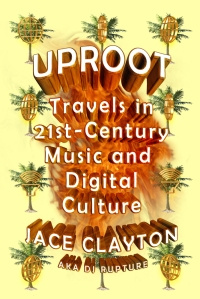 The book begins with a discussion of the history of Auto-Tune. While Clayton’s claim that Auto-Tune was the “first truly new sound effect of the internet era” might be overstated, his distinction between “corrective Auto-Tune” and “cosmetic Auto-Tune” is useful, the first of many moments of clarity in parsing the ways we use and mis-use musical media today. “The robot voice signifies differently everywhere you go,” he writes, an observation that becomes central to the book (49). By refusing to take a deterministic stance toward technology, Clayton empowers the musicians he writes about, acknowledging the ways in which artists mold trends to their own regional and local purposes. Of collaboration with a violinist in Morocco, Clayton writes: “We may have thought similarly, yet our ‘default settings’ were so far apart as to be almost incompatible” (185).
Uproot offers intimate insights into a range of tools and techniques of production, such as compression artifacts, “refixes,” and dozens of music-making interfaces, including Clayton’s own “music software-as-art project,” Sufi Plug Ins.
.
Even language itself is conceived as a form of technological mediation, as when Clayton compares Arabizi — a phonetic spelling of colloquial Arabic — to the hybrid sounds of mahraganat music that the language is used to describe. Of these “wandering genealogies” that emerge from international conversations, Clayton suggests that any hybrid genre we can imagine likely already exists: “Accordions and African techno? It’s called funaná” (102). The book describes at least a dozen other music traditions and microgenres–some very old, some just coalesced–from dabke to zar, each the product of a unique fusion of vocabularies.
Clayton on Mazaher (182): “Umm Sameh, Umm Hassan, and Nour el Sabah: these three women are some of the only people in Egypt keeping zar alive.”
Clayton’s own prose style, replete with metaphor and fluent in informal language, mirrors the ethos of music production he explores in the book: eclectic, energetic, and bursting with detail. What better way to describe Auto-Tune’s effect than as liquification of sound into a “bright neon stream, as if a dial-up modem and a river have fallen in love” (53)? Clayton’s technological travelogue extends beyond aural sensation alone. This is a story of “sidewalk vendors, radios, mosque loudspeakers,” (106) but it is just as much about “jerk chicken, fish tea, goatskin soup” (73). When Clayton describes his surroundings, we can touch the orange blossoms and smell the cigarettes.
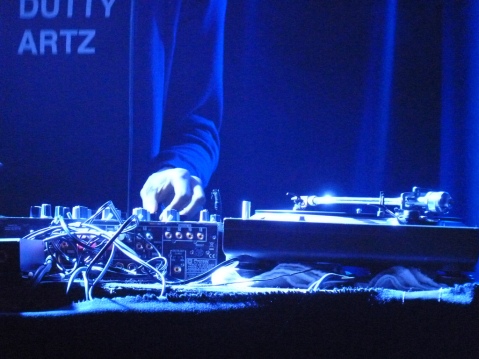
Dj /rupture performs in Minefield UK, 2010, image by Flickr User Paul Narvaez Attribution-NonCommercial 2.0 Generic (CC BY-NC 2.0)
The book’s recurrent question is how DJ practices in different locations are both constrained and inspired by financial flows. In any context, Clayton argues, “[m]oney runs to the people with the least imagination” (24). Early on, he establishes this view that musical experience is priceless, more valuable than any profit derived from rhythms of supply and demand, which reward the wrong people. That said, Clayton isn’t naive about musicians’ inevitable need for income, and throughout the text, readers are asked to inhabit ethical dilemmas that artists encounter throughout the world. At one point, Clayton describes his own moral quandary when asked to perform in front of a giant Red Bull logo, a “glowing lump of techno-fascist DJ furniture.” Later, Clayton critiques the hegemony of “Red Bull patronage” and similar systems of support for artists who are desperate for funding (121). He makes clear his disdain for corporate sponsors, companies that “appear generous as they let us know that our music is literally worthless to them” (123).
A tradeoff emerges between pragmatism and idealism. Clayton pokes holes in the empty rhetoric of “authenticity” that marketers encourage and exploit, even as we sense that he hasn’t yet relinquished his belief in something essentially good about the human spirit. Listening is a powerful social practice that, in Clayton’s view, gives true meaning to music in a global economy that otherwise undervalues it. “The heavier the workaday grind to escape from, the more a party transports us” (73), he writes, suggesting that listeners extract their own surplus value.
At times, Clayton’s observations could benefit from an engagement with ethnographic methods that can help mitigate fieldwork biases. For example, although the book does involve open discussions of gendered inequalities, they are limited in scope. At one point Clayton calls attention to “macho wrangling over propriety and womanhood” among managers and producers in Agadir, Morocco (52); he describes his own futile attempt to acquire a frank interview with female singers amid the patriarchal structure there. But despite Clayton’s awareness of gendered power dynamics, he does not critique the male musicians and producers who propagate such imbalances.
When female figures do appear, they are often treated as side characters. Rihanna, for example, is presented as exemplary of the business model of “singer as mouthpiece” (50), a person for whom others do the work. Clayton isn’t wrong to call attention to the large networks of employees that work behind any celebrity brand, but it is risky to do so at the expense of female workers, especially in the midst of a book that elsewhere describes women as decoration for the musical environments in which men perform what are presumably more important tasks. “Naked girls on pedestals [who] got their bodies painted” (19), “photoshopped young women” (49) and “demure girls” (49) all set scenes for tales of male creativity. This is not to critique how some women may choose to participate in music scenes, but rather to point out that women’s concerns and perspectives are not Clayton’s focus in these passages, nor in much of the book.
On Berber Auto-tune star Saadia Tihihit (49-50): “Like Justin Beiber or any child groomed to be a media star, Saadia Tihihit occupies a place at least initially defined more by the commercial strategies of those around her than by any desire for artistic autonomy.”
Comparably, Clayton’s conception of music and global inequality is sometimes uneven. Drawing stark divisions between the “civilized” and otherwise, he resorts to clichéd language when he writes of “backwater Uzbekistan” (31) and “war-torn Africa” (81). When he describes towns and villages near Casablanca where “ancient rhythms of life still hold sway” (33), he reproduces exoticizing tropes of African music. Elsewhere in the book, Clayton addresses musical accusations of fetishism, stating: “I know that Africans and blacks have been fetishized for centuries now, perhaps millennia. Who cares? You simply exist in all your complexity and let them deal with it. Fetishism is so vague” (84). He also critiques what he calls the “spectacle of a so-called ancient culture” (99) that is often at the heart of “world music” scenes, but then describes Appalachian musical performance as “the old-timey way with banjos and fiddles and washtub percussion” (32), opposing these practices against technological advancement, a false dichotomy that ethnomusicologists work to complicate, if not avoid.
Clayton brings these issues to a head during the book’s extensive discussion of “world music” as a marketing category. His commentary on the conundrums of appropriation surrounding figures such as Paul Simon, M.I.A., and Moby feels familiar, but he surpasses the usual analysis of these common case studies with more personal insights into “world music,” beginning with crate-digging excursions at record shops with deep international selections, such as the now-defunct RRRecords in Lowell, Massachusetts. Clayton contrasts his own on-foot exploration of foreign sounds with what he calls “World Music 2.0,” an internet-driven network of musical discovery based around the commodification of information and attention, in which middlemen reign supreme. His ambivalence is exemplified by this claim: “At its worst, World Music 2.0 offers the clubland equivalent of a package vacation. At its best, it propels some of the most exciting music in the world” (104-105).
The book’s ideas occasionally undermine themselves, but there is no question that the author ultimately intends to advocate for people on the margins. As Max Pearl has noted at the LA Times, Clayton consistently defends lo-fi, lo-tech, and lo-res sonic expression — that which is “distorted, homespun, libidinous” (80) — as valuable in its own right. Further, Sukhdev Sandhu has suggested at the Guardian that the book’s attention to homologies between “the movement of sounds and of migrant bodies” serves to recognize the struggles of global refugees and affirm their humanity.
Among Uproot’s many mentions of transport, readers never receive a clear statement about what, precisely, the relationship between music and motion is, or how exactly value emerges from that pairing. Rather than a weakness of the book, however, maybe such equivocation should be taken as an accurate reflection of the nebulous circumstances in which many of us find ourselves — creators and listeners who are regularly uprooted, usually at the mercy of those whom the money follows. Faced with this precarity, let Clayton’s enthusiasm for all sounds ground you.
Uproot is accompanied by an online Listening Guide that includes audio and visual examples of music from the book: http://www.uprootbook.com.
—
Featured Image: DJ /rupture performing at the Fórum Eletronika de Mídias Expandidas 2005 by Flickr user Brayhan Hawryliszyn (Attribution-NonCommercial 2.0 Generic (CC BY-NC 2.0)
—
Elizabeth Newton is a doctoral candidate in musicology. She has written for The New Inquiry, Tiny Mix Tapes, Real Life Magazine, the Quietus, and Leonardo Music Journal. Her research interests include musico-poetics, fidelity and reproduction, and affective histories of musical media. Her dissertation, in progress, is about “affective fidelity” in audio and print culture of the 1990s.
—
 REWIND!…If you liked this post, you may also dig:
SO! Reads: Dolores Inés Casillas’s ¡Sounds of Belonging!–Monica De La Torre
SO! Reads: Roshanak Khesti’s Modernity’s Ear–Shayna Silverstein
Lokananta: Sounds of Crisis and Recovery from Indonesia’s National Record Company — Ian Coss
Share this:


Current Top Posts





April 2021

January 2020

November 2019

October 2019

August 2019

April 2014

November 2017

March 2015

December 2017

October 2015
 Sounding Out!
Recent Comments