
The Noise You Make Should Be Your Own
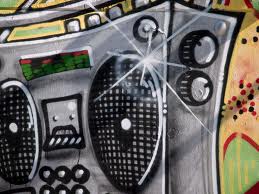 Before I suggested the name VIBE, even before the magazine was being called Volume, it was known as NOISE. I never liked that name. I mean, I knew what they were going for: “Noise” was meant to imply the loud raucousness of youth that defined the increasingly popular urban culture that would fill its pages. But the dominant strand of that youth culture was going to be represented by hip-hop, and I was quite sensitive to mainstream society’s tendency to think of hip-hop—what I liked to think of as the breakbeat concertos of inner city maestros—as not-music, as nothing but noise, something not necessarily from the street but of it, like a garbage truck or a knife fight.
I started to reminisce about the Noise name a coupla weeks ago when I walked into my university-owned apartment building and saw a note with the word “NOISE” poised at the top of it in a huge bold and italicized font, assured of getting everyone’s attention as they entered the elevator vestibule. According to the note taped to the wall, there was a noise problem in the building, and it was getting worse. Would tenants please be considerate of the other members of the apartment community and refrain from playing music loudly after certain proprietary hours?
I thought about it. I never heard music being played loudly. But maybe that was because I live on of the upper floors, away from the blaring speakers of others. The noise I was privy to was the natural noise of the many babies who lived in the building, the children of grad students, probably bored to tears (and tantrums) living in this austere monolith we all call home.
But then I thought about it some more. And I considered the musical noise I heard in this building, compared to the musical noise I’d heard in my building in Manhattan before I re-located to pristine, polite Cambridge, Massachusetts. In New York, I remember the guy on the second floor, the raging theater queen, who blasted cast albums and show tunes at top volume, usually during the day, when the only people in our small West Village building were him (a theater designer), me and the “model” who lived on the third floor—in other words, those of us who lived lives outside the traditional mainstream. The “model” cranked up the volume on her club-kid techno beats, while I was probably playing The Smiths or The Cure or R.E.M. at loud volumes, re-living my college rock days while missing a freelance deadline or two.
I remember, when I lived in New York, thinking that people had no shame when it came to making noise: people had loud  conversations about personal business on the subways; vendors shouted to (at?) delivery guys on street corners; sirens blared their way through the streets; boomboxes competed with car speakers for the ears and stares of passersby. But no one complained. If anything it was a competition of soundtracks in, on and around the streets of New York. Do the lipstick lesbians outside the bar across from my apartment mind, relish in the fact perhaps, that the iconic sound of Stevie Nicks growling out of the jukebox codifies them as queer women on the scene? That kid in the business suit and expensive Wall Street shoes on the train, bobbing his head to the rhythms of Jay-Z rapping loudly through his earbuds: does he really want those of us around him to know he was a hip-hopper? The 6’4” theatrical designer from the second floor who struts down 12th Street like a linebacker: does he simply want the world to know that Barbra’s star-making turn as Miss Marmelstein soothed his soul and that the Pippin version of “Corner of the Sky” is what gets him through the day?
And what was my noise telling the world? I was the queer black writer dude upstairs. But if someone had walked by the apartment, not knowing who was inside, and stopped to tap a toe or shed a tear at the mopey, fop-rock of Morrissey that so often cleared my door jamb, would I be what they expected? Perhaps; perhaps not.
But then I think about the times that I just had to hear Martika. And I had to hear her loud. Or I had to hear some 80s-style deep house, especially the tracks defined by the soul-shouting diva-fied orgasmic melismas that not only date me age-wise, but most definitely queer the space that was blasting the Rolling Stones’ Let It Bleed just a half hour before. I used to be self-conscious of those sonic shifts in my noise soundtrack, as if they highlighted a larger, deeper confusion about my own position, culturally-, racially-, and sexually-speaking.
But then I joined the team to start VIBE, a magazine once called NOISE. And my sensitivity over its possible name settled my own personal dilemma: We may want the world to hear our noise, because of its shorthand to who we are. But what we really want them to do is feel our noise, vibe it if you will, and hopefully feel our joy, pain, shame, love and contradictions in the process.
–SPB (Scott Poulson-Bryant)


Share this:

Sounds of Home
Last month, I braved hail, snow, and just about every kind of plague-like spring weather to hear Karen Tongson’s talk at Cornell about her soon-to-be-released book, Relocations: Emergent Queer Suburban Imaginaries (NYU Press’s Sexual Cultures Series). Karen’s project remaps U.S. suburban spaces as brown, immigrant, and queer, thus relocating the foundations of both queer studies and urban studies. While not a part of the “dykeaspora” of color that Karen deftly details, I am in solidarity with the lives she traces and the soundscapes she amplifies more passionately than Lloyd Dobler with his boom box.
 After all, Karen and I grew up together in the dusty, palm-tree lined streets of Riverside, California, meeting at Sierra Middle School and plotting our way the hell out of Dodge. . .only to later realize that our mutual plottings were really survivings—and a hell of a lot of fun—and the Riv—with its raincrosses and dry riverbeds, lifted trucks and low riders—would stay with us wherever we went.
Since leaving Ithaca—Karen’s voice still warm in my ears like it used to be when tying up our parent’s pre-call-waiting phone lines—I haven’t been able to stop thinking about the way in which Relocations also reimagines the power of music. For Karen, music can help us know and love who we are more deeply, to enable us to “make do” with what we have been given in a way that liberates rather than incarcerates. Music is not just about “the differences it makes audible” (as Josh Kun writes in Audiotopia) but also, as Karen argues, about the ways in which sound gives us back to ourselves.
For example, a song that is spliced into Karen and I’s mutual musical DNA is “There is a Light that Never Goes Out” by The Smiths, (from 1986’s The Queen is Dead). Its various revolutions—both on turntables and in life choices—have affected us profoundly. In “The Light that Never Goes Out: Butch Intimacies and Sub-Urban Socialibilities in ‘Lesser Los Angeles,’” Karen uses the song as an affective touchstone for the ways in which sound can create “queer sociability, affinity, and intimacy” (355) while providing sonic moments of “self- and mutual-discovery” (360) and mediating relationships of place, power, pleasure, and privilege.
Karen’s ideas have since helped me understand why I used to listen to the song over and over in my lonely yet womb-like suburban bedroom, as if it were revelation and incantation. As I struggled with issues—identity and otherwise—Morrissey’s silken voice had the power to sound out the shape of my most secret wounds and simultaneously soothe them. Although I now know I am not alone in this, I thought I was back then, alone and waiting for someone to:
“Take me out tonight
where there’s music and there’s people
who are young and alive.”
In a now slightly-embarrassing Anglophilic phase—this was also around the time I was reading The Adrian Mole Diaries, watching My Fair Lady with Karen, and exchanging mixtapes with my British penpal—the Smiths were part and parcel of an England that I imagined as a long lost home. The U.K.’s pop cultural exports made it seem so much more tolerant of misfits of all kinds, let alone more temperate than SoCal for black turtlenecks and Doc Martens. At the time, I thought I was listening to difference—to the most remote space imaginable from the sweltering hothouse of Riverside—but Karen’s work reveals that I was really hearing the maudlin voice of my own longing, the jangly chords of my own desire, the oddball rhythms of my own heart.
I finally got myself to the actual England years later, thanks to the wonders of credit-card leveraged conferencing in destination locations. After the conference—at which I was, ironically, presenting on Los Angeles—I had the pleasure of spending a damp, foggy day record-shopping my way through brick-bound Nottingham. While I was gleefully flipping through velvety fields of plastic covers and comparing American imports with their UK counterparts, “There is a Light that Never Goes Out” came on the shop’s PA. With the first flare of guitar, I looked up from the record bins, startled by the warm recognition I felt at the sound of “home.”
At the time, I remember thinking that my thirteen-year-old self would be totally geeked out. However, I harbor little nostalgia for the volatile claustrophobia of my lonely tweenhood. Karen would describe my flash of recognition as “remote intimacy,” an asynchronous experience of popular culture across virtual networks of desire, a way of “imagining our own spaces in connection with others.”
Singing along for the thousandth time to Morrissey’s bittersweet grain, I realized that I wasn’t listening to my past in that record shop, but rather my thirteen-year-old self had been hearing the future in her bedroom. Dreaming of England had given her a way to grapple with the pains that ultimately produced my deepest longings: to overcome the “strange fears that gripped” me, to one day be able take myself “anywhere, anywhere,” and to feel the “light” of a love that would “never go out.”

It had taken a 5500 mile plane ride for me to realize that “home” was, in fact, a feeling of arrival rather than site of destination . . .and I couldn’t wait to get back to L.A. to give my homegirl Karen a call.
“There is a light that never goes out
There is a light that never goes out
There is a light that never goes out
There is a light and it never goes out. . .”
JSA


Share this:


Current Top Posts





April 2021

January 2020

November 2019

October 2019

August 2019

April 2014

November 2017

March 2015

December 2017

October 2015
 Sounding Out!
Recent Comments