
Pentecostal Song, Sound, and Authentic Voices

"Altar Call" by Richard Masoner)
I grew up the Pentecostal Church of God in Christ in the Northeast. . .New Jersey, to be exact. And it was this particular religious and cultural world that gave me an appreciation for what music – and sound more generally – can do to move people, to have them inspired and changed. I’d like to expand on Regina Bradley’s recent post, OutKast and the Sounds of the Southern Black Church, and her theorizing of sound and space by remixing, spinning and scratching it, by grounding my reflection in a specific religious tradition in which I am most familiar. Thus, I want to use Black Pentecostalism in the United States and its performance of song and sound to better understand and critique the ideas of authenticity and voice we find in the performance of groups like OutKast.
Bradley’s piece traces Outkast’s borrowings from the Southern Black Church; I want to ask, what if borrowing from a common store is a way of theological life, not as theft, but as a means to producing a social world where sound and song are both gift and object of exchange? The concept of authenticity is a peculiar problem for music performance because implied within it are questions of who has the right to perform certain sounds and songs, or more pointedly, can any one group or even individual “own” a set of sounds and songs? I think that within the sound world of Black Pentecostalism (though not exclusively there) is the idea that music and sound exist in a public zone, a zone that is fugitive and insurrectionary. The public zone of music and sound experienced in Pentecostalism problematizes authenticity, ownership and the question of who can reproduce such musics.
The notion of the public zone helps us to understand the so-called authentic voice differently. Rather than it being the “ground zero” instance of purity or the discovery of some sort of truth or “essence,” I think of authentic voice as fundamentally a social experiment. The performance of song and sound from the public zone is a social experiment in that singing and sounding out are tentative, improvisational processes and they arise to the performance’s occasion. The social experient of utilizing song and sound produces inflection, accent, and most importantly, critical distance from other performances. Perhaps authenticity is not a reaching toward a foundational claim of origin/ality, but is a reaching outward, an extension, a centrifugal dance and play that seeks escape and refuge, creating sonic spaces in which one can inhabit that are, at the same time, the public zones in and through which contact occurs.
Consider, for example, the 1893 song “I Must Tell Jesus”
[Traditional]
And the way in which Vernon Price approaches and touches on the traditional version of the song, especially by withdrawing from and touching off it.
[William Ellis & Vernon Price]
Price’s play is most pronounced, I think, by the way she leaves the song undone, at a particular height, swell, spiritedness. Price left the song as it was – as a social experiment – available for others to enter into performance with her in the space of the refused lyrical end. Jesus can help us…Jesus (…) Refusing to sing the sounded word “alone” functions not merely as a placeholder, but as a reworking of the performance itself. In leaving the song undone, she leaves it critically open. At the end of Price’s incompletion, the organist’s chording changes tonal centers, from major mode to reflective minor with augmented and suspended chords or what Bradley might call, “takin’ em to chu[r]ch.”

"Dancing in the Spirit" by Richard Masoner
But and also: Price could not contain the song to the lyrics. Words don’t go there. She screamed, she spoke in tongues, she used melisma, slurred speech, bent notes and exaggerated forms of vibrato. That is, the song itself functioned as a point of transition, as a vessel to be filled with voice as she was a vessel of outpouring. Giving, taking, in the same breath, the same sound. She did not, it seems to me, desire to sing the song “correctly” and her performance of authenticity was not about the reproducibility of the traditional or “original” version. Just as the organist changed tonal centers at the end of her undone performance, so too singing from this Black Pentecostal religious, cultural public zone shifts epistemological centers – knowledge – of what is and is not singing, acceptable, holy. Her sound broke down the structures that mark her notes as “bent” and her vibrato as “exaggerated.” A normative mode of “correct” or “proper” singing from within this public zone would be to stifle creativity, surprise, discovery.
As a vessel, we can think of sound, song and subject as conduits for the exchange of ecstasy and ecstatics. The sonic public zone becomes, for Vernon Price’s improvisation of “I Must Tell Jesus,” a point of departure, where the song and the sounds she makes in it socialize, network, change. Songs and sounds, from within this zone, are available for a public engagement; the song and singers are both capacities to be filled, emptied and filled again. And I think the theological imperative of modern Pentecostalism – that the Holy Spirit fills the individual is important for performance tradition [this difference is indexed by the divergent questions: “did you see so-and-so catch the spirit” versus “does so-and-so have the Holy Ghost” and “when did you get filled with the Holy Ghost?”]. One is filled with the capacity to be filled, with the fullness of the spirit that is made evident by giving it away through song.

Vernon Oliver Price
As a vessel, we can think of sound, song and subject as conduits for the exchange of ecstasy and ecstatics. The sonic materiality of Price’s performance rubs up against and caresses, spins and spins off the performances that come previous to that moment in that church. This does not mean that she insouciantly called up the traditional in order to dismiss it. That would imply that Price was both lacking in attention and intentionality. What I think Price makes evident is how any performance of any song – the traditional “I Must Tell Jesus” included – occurs fundamentally within a social context. Any such performance – its “first” or the many that have come after it – are conduits, bridges. What we have then, by way of a sonic public zone, is a space that privileges the accrual of sound and song as a mode of sharing. The song was not created in order for Elisha Hoffman – writer of “I Must Tell Jesus” – to keep it. He got the song to share it and Price performed it to redouble such sharing. To be in a state of ecstasy is to be “beside oneself” and Price’s singing forced the song into ecstatic posture. Not only was she “beside herself” in praise to God, but she caused others to be beside as well, creating a new space for the beside of each self to celebrate and praise together.
Price riffed on the original, quickened herself to quicken others. She screamed because the heightened emotion moved her. And that heightened emotion moved others as well.


Share this:

Listening to Robots Sing: GarageBand on the iPad
 I recently had the opportunity to fool around with the iPad2’s new GarageBand suite. Enticed by the intuitive touch interface I soon found myself lost within the device’s labyrinthine architecture. Every poke, prod and press brought me to a new screen with a bevy of exciting options. A touch to create a drum loop, a tickle to evoke some reverb, and a brush to strum a guitar. I was one with the machine; it was a truly cybernetic, kinesthetic moment. This may sound naïve, but I had never realized how many tools were available to electronic musicians, or how intuitive using these tools could be. As digital tools to create music become more accessible and more intuitive, what is the role of the human in understanding their use? Further, what strategies can we adopt when listening to these creations?
This question may seem a bit outdated to those who have been researching post-humanist phenomena since the digital boom in the mid-nineties. Often conflicting perspectives regarding the negotiation of the human and the digital have been considered in the last decade or so. Some like Donna Haraway, Pierre Lévy, and even Ray Kurzweil offer particularly optimistic readings of the post-human (although for radically different reasons). While scholars like Nancy Baym and Jaron Lanier have offered decisively more sober readings of the problematic. They argue that splits between the human and post-human, or analog and digital are false dichotomies. Truth be told, none of the theorists above adequately address my feelings on this topic. Producing music with a digital audio suite makes me defensive of my humanism and it is by its very nature a project of preservation.
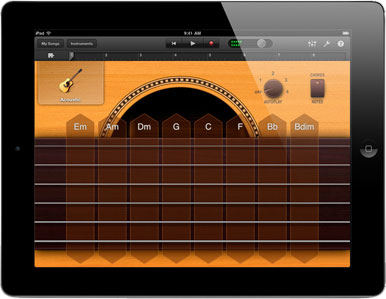 The algorithmic tools packaged within digital audio suites encourage a sense of aesthetic preservation. Tools like GarageBand’s Smart Guitar, Smart Drums, Smart Bass, various arpeggiators and Appleloops encourage the user to program music on a high level where the nuance of serendipity and improvisation play second fiddle to the overall sonic contours of a piece. Although the user is provided the tools to intervene and program music in a very specific way, it is by default a distinctly different experience than that of playing a guitar or piano. The ghost of the algorithm haunts such performances; reminding the user that these acts of spontaneous creation are no longer the default but deliberate…. This sense of deliberate improvisation forces me into a reflexive space where I am acutely aware of the mediations occurring within my performance. Succinctly, I must defend a sense of self within my creation. If I yield to the algorithms that seek to help me compose, I destroy all sense of the human within my work. Simply turning on robots and watching them sing.
For this reason, I propose an aesthetic of preservation as a way to understand the ways in which we listen to works created by digital audio suites. As algorithmic aids become more advanced and commonplace in music, the human becomes a less essential aspect of the form. Understanding what has been deliberately included in spite the seductive algorithmic environment is ultimately a project that seeks to recover the human in the machine; perhaps even, a project doomed from the start, as we grow ever closer to the means of our artistic production.
AT
Magnasanti – Check out the results of my collaboration with Colin Germain on GarageBand!


Share this:


Current Top Posts





April 2021

January 2020

November 2019

October 2019

August 2019

April 2014

November 2017

March 2015

December 2017

October 2015
 Sounding Out!
Recent Comments