
Further Experiments in Agent-based Musical Composition

Photo by whistler1984 @Flickr.
Editor’s Note: WARNING: THE FOLLOWING POST IS INTERACTIVE!!! This week’s post is especially designed by one of our regulars, Andreas Duus Pape, to spark conversation and provoke debate on its comment page. I have directly solicited feedback and commentary from several top sound studies scholars, thinkers, artists, and musicians, who will be posting at various times throughout the day and the week–responding to Andreas, responding to each other, and responding to your comments. Look for commentary by Bill Bahng Boyer (NYU), Maile Colbert(Binaural/Nodar, Faculdade de Belas Artes da Universidade do Porto), Adriana Knouf(Cornell University), Primus Luta (AvantUrb, Concrète Sound System), Alejandro L. Madrid (University of Illinois at Chicago), Tara Rodgers (University of Maryland), Jonathan Skinner (ecopoetics), Jonathan Sterne (McGill University), Aaron Trammell (Rutgers University, Sounding Out!) and yours truly (Binghamton University, Sounding Out!). Full bios of our special respondents follow the post. We wholeheartedly wish to entice you this Monday to play. . .and listen. . .and then share your thoughts via the comment page. . .and play again. . .listen again. . .read the comments. . .and share more thoughts. . .yeah, just go ahead and loop that. –JSA, Editor-in-Chief
—
I’m a musician and an economist. Sometimes you will find me playing acoustic folk rock and blues on guitar, harmonica and voice. And at other times I will be at work, where I apply my expertise in game theory to the computer modeling of social phenomena. I create simulations of people interacting – such as how people decide which way to vote on an issue such as a tax levy, or how people learn to sort objects given to them in an experiment. In these simulations, the user can set up characteristics of the environment, such as the number of people and their individual goals. After things are set up, users watch these interactions unfold. The simulation is a little story, and one need only tweak the inputs to see how the story changes.
As a musician, I was curious if a program that generates social stories could be refashioned to generate musical pieces. I wanted to build a music-generation engine that the listener could tweak in order to get a different piece each time. But not just any tune – a piece with some flow, some story. I like that tension between randomness and structure. On one hand, I want every song to vary in unpredictable ways; on the other hand, I want to create music and not structureless noise.
I created a basic story of predators and prey, whimsically naming the prey “Peters,” represented by rabbits, and the predators “Wolves.” My simulation depicts a plain in the savannah with a green oasis. The prey seek the oasis and the predators seek the prey. Each character has its own goals and the closer they are to achieving them, the happier they are. Both predators and prey want to have stomachs full of food, so naturally they want to be close to their target (be it prey or oasis). As they travel through the savannah, they learn what choices (directions of movement) make them happier, and use this experience to guide them.

Photo by bantam10 @Flickr
So how does this story become music? To this question there are two answers: a technical one and an intuitive one. The intuitive answer is that in real life the story of predators and prey plays out geographically on the savannah, but musically this is a story that plays out over a sonic landscape. To elaborate, I abstracted the movement of the prey and predator on the geography of the plain into the musical geometry of a sonic landscape. The farther north an agent travels, the higher the pitch. And, the farther east an agent travels the longer the duration. In other words, as an agent travels to the northwest, she makes longer-lasting tones that are higher pitched. I also mapped happiness to volume, so that happy agents make louder tones. Finally, so that each agent would have a distinct voice as they traveled through this space, I chose different instruments for each agent.
In the video below I assigned the “church organ” sound to prey, and the “brass section” sound to predators.
Ultimately, there are some things that I like about this piece and others that I do not.
As a harmonica player, I improvise by creating and resolving tension. I think this piece does that well. The predator will pursue the prey into a quiet, low-pitch corner, creating a distant, rumbling sound – only to watch prey escape to the densely polyphonic northwest corner. There is an ebb and flow to this chase that I recognize from blues harmonica solos. In contrast to my experience as a harmonica player, however, I have found that some of the most compelling parts of the dynamics come from the layering of notes. The addition of notes yields a rich sonic texture, much like adding notes to a chord on an organ.
Unfortunately, for largely technical reasons, there is a lack of coherent rhythm and pacing. The programming platform (agent-based modeling software called NetLogo) is not designed to have the interface proceed in real-time. Basically, the overall speed of the piece can change as the processing load increases or decreases. I found that as agents learnt more about their surroundings (and more system resources are allocated to this “memory”), they became slower and slower. To fix this, I capped the size of their memory banks so that they would forget their oldest memories. The closest I have come to a rhythmic structure is by ordering the way that the agents play. This technique makes the piece have a call-and-response feel. If only the piece to had a coherent rhythm, then I could imagine playing harmonica along with it.
One last comment on pitch: while an earlier version of this piece mapped each step in space to a semitone, things sounded too mechanical. Even though this was the easiest and most intuitive decision from a technical standpoint, it was aesthetically lacking, so I have now integrated traditional musical scales. The minor scale, in my opinion, is the most interesting as it makes the predator/prey dynamic sound appropriately foreboding.

Photo by deivorytower @Flickr.
You can play this piece yourself. Simply go to this link with Java enabled in your browser (recommended: Google Chrome). Pressing “Setup” then “Go” will create your own run of the piece. As it is running, you can adjust the slider above the graphic window to change the speed. Press “Go” again to stop the model, adjust any parameters you wish and press “Setup” and “Go” again to see how the piece changes. Here are some parameters to try: instA and instB to change the instruments associated with prey and predators; PlayEveryXSteps to change the pace of the piece (higher results in a slower paced piece); Num-PackAs and Num-PackBs changes the number of prey and predators; the vertical PeterVol and WolfVol adjust the overall volume of prey and predators.
In regards to my version of “Peter and the Wolf,” I have a number of things that I’m curious about.
First, how does this relate to what you think of as music? Do you like listening to it? Which elements do you like and which do you dislike? For example, what do you think about about the tension and rhythm – do you agree the first works and that the second could be improved? Would you listen to this for enjoyments’ sake, and what would it take for this to be more than a novelty? What do you think about the narrative that drives the piece? I chose the predator and prey narrative, admittedly, on a whim. Do you think there might be some other narrative or agent specific goals that might better drive this piece? Is there any metaphor that might better describe this piece? As a listener do you enjoy the experience of being able to customize and configure the piece? What would you like to have control over that is missing here? Would you like more interaction with the piece or less interaction?
Finally, and perhaps most importantly, what do you think of the premise? Can simple electronic agents (albeit ones which interact socially) aspire to create music? Is there something promising in this act of simulation? Is music-making necessarily a human activity and is this kind of work destined to be artificial and uncanny?
Thanks for listening. I look forward to your thoughts.

“The Birth of Electronic Man.” Photo by xdxd_vs_xdxd @Flickr.
– – –
Andreas Duus Pape is an economist and a musician. As an economist, he studies microeconomic theory and game theory–that is, the analysis of strategy and the construction of models to understand social phenomena–and the theory of individual choice, including how to forecast the behavior of agents who construct models of social phenomena. As a musician, he plays folk in the tradition of Dylan and Guthrie, blues in the tradition of Williamson and McTell, and country in the tradition of Nelson and Cash. Pape is an assistant Professor in the department of Economics at Binghamton University and is a faculty member of the Collective Dynamics of Complex Systems (CoCo) Research Group.
– – –
Guest Respondents on the Comment Page (in alphabetical order)
Bill Bahng Boyer is a doctoral candidate in music at New York University who is completing a dissertation on public listening in the New York City subway system.
Maile Colbert is an intermedia artist with a concentration in sound and video, living and working between New York and Portugal. She is an associated artist at Binaural/Nodar.
N. Adriana Knouf is a Ph.D. candidate in information science at Cornell University.
Primus Luta is a writer and an artist exploring the intersection of technology and art; he maintains his own AvantUrb site and is a founding member of the live electronic music collective Concrète Sound System.
Alejandro L. Madrid is Associate Professor of Latin American and Latino Studies at the University of Illinois at Chicago and a cultural theorist and music scholar whose research focuses on the intersection of modernity, tradition, globalization, and ethnic identity in popular and art music, dance, and expressive culture from Mexico, the U.S.-Mexico border, and the circum-Caribbean.
Tara Rodgers is an Assistant Professor of Women’s Studies and a faculty fellow in the Digital Cultures & Creativity program at the University of Maryland. As Analog Tara, she has released electronic music on compilations such as the Le Tigre 12″ and Source Records/Germany, and exhibited sound art at venues including Eyebeam (NYC) and the Museum of Contemporary Canadian Art (Toronto).
Jonathan Skinner founded and edits the journal ecopoetics, which features creative-critical intersections between writing and ecology. Skinner also writes ecocriticism on contemporary poetry and poetics.
Jonathan Sterne teaches in the Department of Art History and Communication Studies and the History and Philosophy of Science Program at McGill University. His latest book, Mp3 The Meaning of a Format comes out this fall from Duke University Press.
Jennifer Stoever-Ackerman is co-founder, Editor-in-Chief and Guest Posts Editor for Sounding Out! She is also Assistant Professor of English at Binghamton University and a former Fellow at the Society for the Humanities at Cornell University (2011-2012).
Aaron Trammell is Multimedia Editor of Sounding Out! and a Ph.D. Candidate in Media and Communications at Rutgers University.
Share this:

On the Lower Frequencies: Norman Corwin, Colorblindness, and the “Golden Age” of U.S. Radio
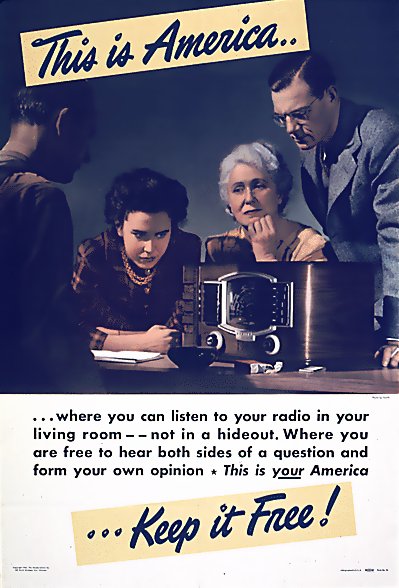
Editor’s Note: This is Liana, Managing Editor for Sounding Out!, introducing you to this special fall installment of our series “Tune Into the Past,” penned by our very own Editor-in-Chief and Guest Posts Editor, Jennifer Stoever-Ackerman. We at SO! have been waiting for months for Jennifer to share with us a brand-spanking new blog post! She’s back in action this month with a post that asks readers to listen to the cultural landscape that foregrounded Norman Corwin’s success as a radio writer and producer, inspired by her research on her book manuscript on the sonic color-line. In particular, Jennifer addresses the notion of colorblindness and its very real repercussions on radio artists and producers of color in the 1940s. Want to catch up on our series on Norman Corwin? Check out this summer’s posts by radio scholars Neil Verma, Shawn VanCour, and Alex Russo. If you’re all caught up, open your ears and your eyes then (to paraphrase Kurt Cobain). —LMS
—
Almost every day, I hear someone on the radio hailing America as the home of democracy. Yet almost every network is guilty of discrimination against the Negro performer. There are a few isolated cases of Negroes in broadcasting, but the lily-white policy is seldom violated.—Lena Horne, Chicago Defender 1940
The fine pieces in the “Tune in to the Past” series have thoughtfully considered the audible legacies of Norman Corwin: the “kaleidosonic” aesthetics that Neil Verma called the “Corwinesque,” the virtually seamless melding of artistic and commercial concerns that Shawn VanCour analyzed, and the echoes of Corwin remixed into WNYC’s Radiolab that Alexander Russo amplified. But the research I performed for my book manuscript, The Sonic Color-line: Race and the Cultural Politics of Listening, about the fraught relationship between race and 1940s radio, left me pondering the gaps and silences of Corwin’s soundscape. Radio’s “Golden Age” was also its most racially segregated: was the philosophy of “colorblindness” that Norman Corwin publicly espoused key to keeping it that way?
It’s not my goal to undermine Corwin’s work, but rather to enhance our understanding of it by embedding his broadcasts in the wider political, historical and sonic fields in which he was enmeshed. Just as Corwin’s sounded legacy left long-lasting traces in our media, so too have the silences and omissions fostered by the media executives, casting directors, union bosses, radio critics, and sonic auteurs of the “Golden Age.” If Corwin’s work is difficult to access save for far-flung archives and spotty collector’s catalogues, the exclusions of African-American producers, performers, and listeners are even harder to hear, in part because of his very insistence that radio’s microphones were colorblind. As the epigraph from Lena Horne testifies, the discourse of democracy is not mutually exclusive with segregation. In what follows, I discuss the intensely segregated history of the “Golden Age of Radio,” arguing that one of Corwin’s most far-reaching legacies may not have been set in motion by his virtuostic broadcasting, but rather by the World War II-era liberalism that shaped it.
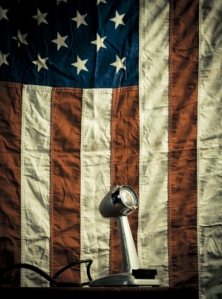 The apex of Corwin’s radio career coincided with a profound shift in America’s dominant racial formation, the beginnings of “colorblindness.” By colorblindness, I mean the belief that if individuals and institutions ignored skin color as a signifier and eliminating race as an official category of identity—particularly within governmental institutions—it would cease to matter in American life and all groups would have equitable access to the privileges, opportunities, and freedoms afforded by citizenship. The shift toward colorblindness—what Michele Hilmes calls America’s “wartime racial realignment” in Radio Voices—was predicated on creating a sense of unity that would inspire men across the color-line to sign up to fight what was dubbed a war to end racism and fascism, even as it raged on in their segregated hometowns. The Pittsburgh Courier’s Double V Campaign—Victory against fascism abroad and Victory against racism at home—addressed these ironies. Barbara Dianne Savage’s Broadcasting Freedom: Radio, War, and the Politics of Race details the suppression of many black newspapers on military bases due to the Double V Campaign, as well as the pressure it put on government radio programs to address race. However, she notes:
if black people had been forced to rely on radio as their primary means of communication about the failings of the federal government, they would have been on an impossible mission, since they were admitted to radio only as entertainers or as briefly invited guests expected to be on their best behavior (94).
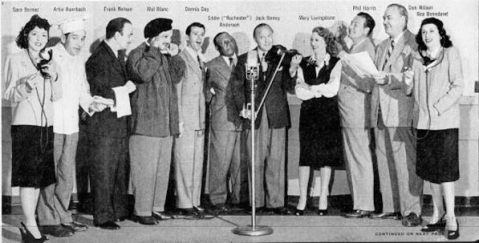
Cast Photo of the Jack Benny Program. Eddie Anderson, who played Benny’s valet, was one of only a handful of steadily working black radio actors in the 1940s
Despite high-profile protests in the black press, mainstream broadcasters constructed radio as an unmediated purveyor of equality and truth with increasing frequency during World War II—its “lofty aerials, symbols of freedom” according to New York Times radio critic Orrin Dunlap. In the case of Norman Corwin, he wrote a symptomatic (and nervy) editorial for Negro Digest in 1945 that depicted U.S. radio as a direct material and technological representation of colorblindness itself.
In “A Microphone. . . is. . . Color Blind”–what revealing ellipses!–Corwin assures black readers that “my feeling about Negroes in radio is that they belong as surely as the microphone.” This strange opening gambit compares black participation in radio to the mute technological presence of the microphone that, while absolutely central to broadcasting, is an object with no inherent agency. Unlike the proprietary, agenda-setting presence of whites in radio, a microphone amplifies the voices of others, while speaking not a word of its own. From his privileged vantage point, Corwin doesn’t quite realize how colorblindness enables him to use black people as tools.
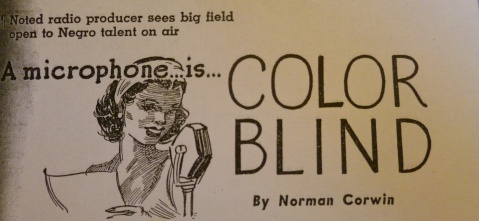
Norman Corwin’s “A Microphone is Color Blind” from Negro Digest (1945), Image by the author
And, while Corwin’s title insists on the microphone’s colorblindness, his article suggests otherwise. Much of his description of what America is missing without black people’s radio presence has to do with aural racial difference: “I have found the same thing that makes Negroes supremely great artists in song makes them great in speech. The color and warmth conveyed in the performance of a Negro artist is directly communicable by air. The microphone is a faithful reporter and says exactly what it hears.” In addition to perpetuating the old stereotype of black people as natural performers, Corwin’s realist depiction of the microphone as a “faithful reporter” that “says exactly what it hears” covers up exactly how much black voices were sculpted for white consumption during this period in radio; as actor Johnny Lee (“Algonquin C. Calhoun” on Amos ‘n’ Andy) told UCLA graduate student researcher Estelle Edmerson in 1954: “I had to learn how to talk as white people believed Negroes talked. Most of the directors take it for granted that if you’re a Negro actor, you’ll do the part of a Negro automatically.”

Johnny Lee as “Algonquin C. Calhoun” on Amos ‘n’ Andy
Whereas radio listeners were able to hear a wide range of white voices in a spectrum of roles—major and minor, comedic, dramatic, musical, informational—the sound and the content of black speech was circumscribed by the sonic color-line that marked it as “automatic,” essential, comedic, and potentially dangerous. Corwin’s use of the word “communicable” rather than “communicated,” for example, is a revealing flourish giving black sound a tinge of contagion and infectiousness. While ostensibly celebrating black voices, this passage simultaneously assures white listeners that they will still be able to unequivocally identify the race of any speaker over the “colorblind” airwaves and that this experience will be a pleasurable one for them. While the microphone may be color blind, it clearly is not color deaf.
That Corwin assumes a white audience becomes more obvious with his assertion a few lines later that “I have found too few Negroes who have taken an interest in radio. I suspect it’s because they don’t know about it.” This statement is fairly incredible, considering that the Research Company of America published a study in the radio industry magazine Sponsor that placed African American radio ownership at 87%, just shy of the national figure of 90% (October 1949, 25). Sponsor dubbed black audiences “The Forgotten 15,000,000.”
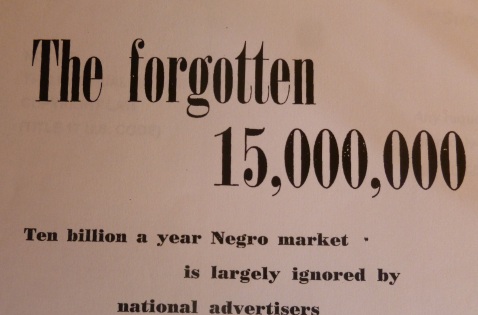
Sponsor, October 1949, Image by author
In addition to being inaccurate, Corwin’s suggestion that African Americans had limited knowledge of radio performs one of the signature moves of colorblindness; it makes institutional barriers to access—lack of training, networks, and mentorship, as well as straight up discriminatory hiring practices—invisible by asserting that black people only need to work harder to succeed in the American media industry. Under colorblindness, the failure to achieve success equitable to white citizens falls squarely on the shoulders of those oppressed. It also willfully mutes the protest of many black actors—such as Butterfly McQueen—who refused to participate in the segregated industry and the agency of all the black listeners who turned the dial on shows distasteful to them, allowing the fantasy of a unified (white) America to remain a powerful referent.
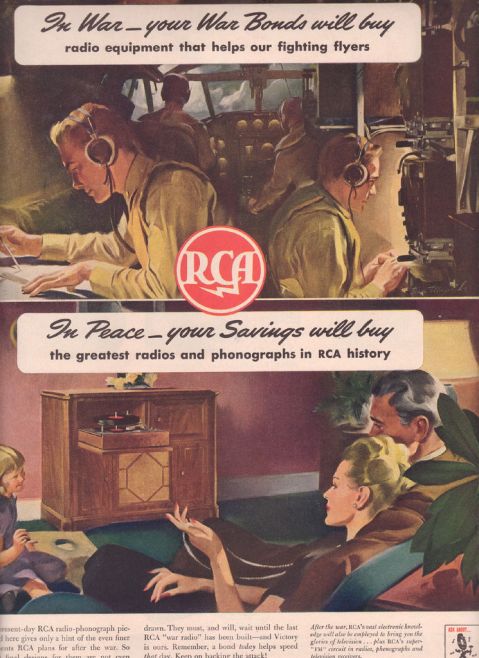
By and large, Corwin’s article paints colorblindness as already achieved. In his estimation, it is up to black people themselves to take advantages of the opportunities he suggests already await them via the colorblind microphone: “My attitude is not unique among radio directors—at least not in the main centers of radio[. . . ],“Corwin insists, “there is less prejudice in this field than in any other. It exists unfortunately, but you can get a hearing.” For someone whose bread and butter was rhetorical flourish, Corwin’s use of passive sentence construction to discuss racial prejudice is significant—he naturalizes it as something that merely “exists,” tooling along without any specific historical agent performing the discriminatory and oppressive actions. Such omission lets the white gatekeepers of the 1940s radio industry off the hook for both the institutional and individual forms of discrimination that kept the industry largely, as Lena Horne phrased it, “lily-white.”
Radio’s profound whiteness was aural as well as visual. In Corwin’s colorblind America, a radio “hearing” comes at a heavy price for African Americans. Without commenting on educational segregation, Corwin proclaimed: “Negro schools should have in their curriculum courses in public speaking, radio, theater. There is no reason why there should not be Negro announcers. It is important to study diction so that distinction in speech cannot be noted.” While Corwin begins “A Microphone. . . is. . .Color blind” by arguing that black voices should continue to retain the racial markings that are legible (and pleasurable) to white listeners, he then suggests they must also simultaneously sound enough like the white voices surrounding them in order to be heard and accepted as fellow American citizens. Radio didn’t just passively reflect the sounds of American citizenship during this period–it actively constructed them on a foundation of exclusion and silencing.
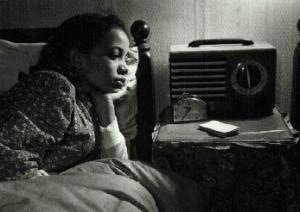 There remains, then, a profound disconnect between the full exercise of American citizenship, the idealized discourse of colorblind equality forwarded by government officials, media critics, and prominent broadcasters exemplified here by Corwin, and the actual representation of African Americans as radio producers, performers, and listeners during and after this period. At the same time as state-sponsored colorblind ideology rose to prominence during the war years, the U.S.’s airwaves became almost exclusively white. There were no black writers regularly employed by any national radio station during the 1940s and there was not a single black member of the Los Angeles Writer’s Guild. While black authors Langston Hughes and Carlton Moss wrote occasional scripts on one-shot contracts, they were about topics deemed of black interest by the networks. Black radio critic Joe Bostic—who would later become one of the nation’s first black radio sportscasters—described the limited openings for black radio performers:
publication last week of the most authoritative and comprehensive of the radio polls showed not a single Negro entertainer placing in the first ten of any branch of radio entertainment. Such a compilation outlines, in bold relief the disturbing fact that the Negro, long a leader in every phase of entertainment, is being excluded in this newest and most lucrative branch (People’s Voice, 1942).
Regular on-site broadcasts from nightspots that featured black performers all but vanished after 1940, meaning that the vast majority of black musical performances broadcast over the American radio networks were conditioned and mediated by white announcers and sponsors as well as the sounds of white-oriented programming that introduced and followed them.
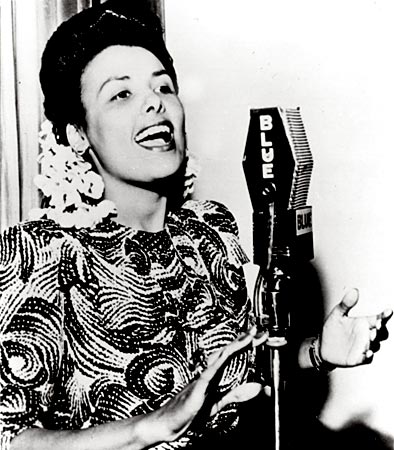
Lena Horne guesting for NBC’s Blue Network
To be clear, I don’t blame Corwin individually for the ideology of colorblindness and the world it has wrought, but I do think it is important to consider his role as a cultural producer in the “Golden Age” of segregated radio, and as a power broker who helped shape the media landscape with which we now contend. While we commemorate his labors as a sonic artist with high journalistic standards who undoubtedly worked to “glorify the ‘common man,'” we also have to consider the institutionalized privilege that enabled him to claim this role as his own, as well as the many people silenced by him doing so, inadvertently or not. Tuning in to the past demands a vigilant ear attentive to the profound silences of exclusion: the traces of words muted, mangled, disciplined and unsaid, as well as the subterranean reverberations ghosting the triumphant tones of the “Golden Age,” a shadow broadcast, on the lower frequencies, of all the sounds that might have been.
—
Jennifer Stoever-Ackerman is co-founder, Editor-in-Chief and Guest Posts Editor for Sounding Out! She is also Assistant Professor of English at Binghamton University and a former Fellow at the Society for the Humanities at Cornell University (2011-2012).
Share this:


Current Top Posts





April 2021

January 2020

November 2019

October 2019

August 2019

April 2014

November 2017

March 2015

December 2017

October 2015
 Sounding Out!
Recent Comments