
Hearing Change in the Chocolate City: Soundwalking as Black Feminist Method
 Since its inception at the World Soundscape Project in the 1970s, soundwalking has emerged as a critical method for sound studies research and artistic practice. Although “soundwalking” now describes a diversity of activities and purposes, critical discussions and reading lists still rarely represent or consider the experiences of people of color (POC). As Locatora Radio hosts Diosa and Mala have argued in their 2018 podcast about womxn of color and the sound of sexual harassment in their everyday lives and neighborhoods, sound in public space is weaponized to create “sonic landscapes of unwelcome” for POC.
While we often think of soundwalks as engines of knowledge production, we must also consider that they may simultaneously silence divergent worldviews and perspectives of space and place. In “Black Joy: African Diasporic Religious Expression in Popular Culture,” Vanessa Valdés explored alternate conceptions of space held by practicioners of Regla de Ocha, epistemologies rarely, if ever, addressed via soundwalks. “Within African diasporic religions . . . including Palo Monte, Vodou, Obeah, Macumba, Candomblé – there is respect for the seemingly inexplicable,” Valdés remarks, “there is room for the miraculous, for that which can be found outside the realms of what has been deemed reasonable by systems of European thought. There is room for faith.” Does current soundwalk praxis—either as research method, public intervention, artistic medium, field recording subject, or pop culture phenomenon—impose dominant ideas about space and knowledge production as much as—if not more–they offer access to alternatives? Are there alternate historiographies for soundwalking that predate the 1970s? Can soundwalks provide such openings, disruptions, and opportunities without a radical rethinking? What would a decolonial/decolonizing soundwalk praxis look and sound like?
Soundwalking While POC explores these questions through the work of Allie Martin, Amanda Gutierrez, and Paola Cossermelli Messina. Today, Allie Martin kicks off the series with a powerful reframing of the soundwalk as a black feminist methodology. —JS
In July 2018 I visited Oxford, Mississippi for the first time, to attend a workshop on conducting oral histories. Upon walking with a friend back to our accommodations on the University of Mississippi campus, we heard a voice calling to us from far away, up a hill somewhere. It was a catcalling voice—that much I definitely recognized—but I also felt sure that I heard the word “nigger.” My friend, who is also a black woman, heard the taunting sounds of the voice but not that word specifically. Herein lies one of the difficulties of black womanhood: I was unable to distinguish which of my two most prominent identity markers (blackness and womanhood) the speaker was using to harm me in that moment. I found it ironic that I came to Mississippi to learn best practices for listening to people’s stories, but could not hear my own story, could not say for sure what had happened to me.
In the time since that visit, I have come to embrace the speculative sonic ephemerality of black womanhood and utilize it on my soundwalks. Soundwalks are a popular method for understanding the everyday sonic life of a place. Reminiscent of Michel de Certeau’s “Walking in the City,” soundwalks offer the kind of embodied experience missing from other more static soundscape recordings. I argue here that soundwalks can operate as black feminist method, precisely because they allow me to center the complex, incomplete sonorities of black womanhood, and they are enough in their incompleteness. One of our foremost thinkers on black feminism, Patricia Hill Collins, has argued that black women’s knowledge is subjugated (1990). I understand this to mean that my knowledge is tainted somehow, too specialized or not specialized enough, and not considered fit for application by a broader audience. Soundwalks as method, though, rely on my own subjugated knowledge. What did I hear? Black feminism centers and humanizes black women, and I utilize soundwalks to humanize myself in a soundscape that would otherwise disregard my sonic perceptions in favor of white hearing as the default standard of sound.
I began soundwalking in Washington, DC as a part of my dissertation project, which explores the musical and sonic dimensions of gentrification in the city. Gentrification is often considered in visual terms, meaning that a neighborhood is considered gentrified because new coffeeshops, bike lanes, and dog parks make it “look” different from what was once there. I recognize these new additions as important markers of gentrification, but what do they sound like? And what do these sonic markers reveal about the sonorities of race?

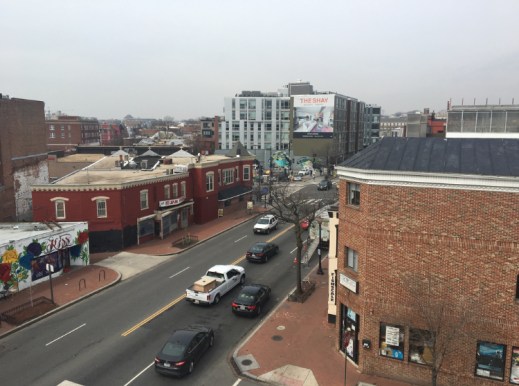
Rowhouses in the Shaw neighborhood, image by author
I have taken up the sonic exploration of gentrification, drawing inspiration from Jennifer Stoever’s Sonic Color Line and Regina Bradley’s exploration of the criminalization of black sound. As SO! writer and ethnic studies scholar Marlén Rios Hernandez has noted in her work on racial and spatial shifts in early punk in 1970s Los Angeles, it is crucial to work on “delinking gentrification as exclusively spatial and analyzing it as also a sonic force of expulsion.” Having spent time researching the auralities of gentrification in DC, I understand it to be a process that silences poor and marginalized populations while amplifying the concerns of those privileged enough to have the ear of the DC Council and developers. Gentrification displaces musicians and music genres, while increasing tensions around music and noise in “public” space. More than these changes, though, gentrification changes the soundscape of the city.
My soundwalks focus on the Shaw neighborhood in the Northwest quadrant of DC, part of the fastest gentrifying zip code in the country. Before the explosion of development, Shaw was a cultural hub of black DC, only blocks away from the U Street Corridor, formerly known as Black Broadway. From Pearl Bailey to James Brown, prominent black entertainers frequented the neighborhood because they were unable to perform in or have accommodations in other areas of the city. As the neighborhood shifts and transforms, the soundscapes grow louder with new nightclubs and quieter due to increased reporting of noise violations. The neighborhood diversifies in terms of languages, increases in siren whoops, and new sounds appear, such as the beep of a dockless scooter. Shaw has seen a concomitant increase in property values, community gardens, and bars; a Whole Foods is set to open in the neighborhood by 2020.
[The recording here is of a soundscape at 7th street and Florida Avenue NW, a busy intersection at the north edge of Shaw. Recorded on a mid-September afternoon, you can hear go-go music (DC’s indigenous subgenre of funk), engines idling, and the whoop of a siren. In the past two months, this intersection has become a battleground for cultural erasure, as artists, activists, and councilmembers attempt to legitimize the go-go music that has been playing in the area since 1995.]
During the day, Shaw oscillates between a quiet neighborhood and a busy city space. Traffic, horns, and sirens are frequent, yet so are the sounds of children at recess and old men chatting outside on their stoops or outside of corner stores.
Conducting soundwalks as a black woman in this gentrifying neighborhood is a curious space to tarry in. I am in some ways an outsider as a non-resident, mindful of who and what I record at any given moment because part of what makes gentrification such a tense and terrifying process is the lack of control that residents (particularly renters) have regarding their futures, and often their presence too. I am also an insider, a black woman in this space where being a black woman is not (yet) anything out of the ordinary. In fact, as the months went on, more of my recordings feature me speaking to people on the street, some I had come to know and some still strangers to me.
One of my favorite interactions on a soundwalk came early on, in late February of 2018. I was running late for an interview, listening intently to what was going around me, when I walked past a black man, seemingly in his 30s, on a narrow sidewalk. The exchange went something like this:
Man: Whoa, whoa, why you running up on people?
Me: My bad, my bad!
Man: It’s okay. Hey sis, you know how to make grits?
Me: [laughing], Nah, I don’t know how to make grits.
Man: What about pancakes?
Me: Yeah, I can make some pancakes.
Man: Ayyyee, I’m tryna get some breakfast!!
Me: I don’t know about all that!
The exchange, not quite a catcall but not quite comfortable either, consistently faded in volume, because during the entire time we spoke, I continued to walk away from him. I was in a position of wanting to speak, because I know the politics of being an outsider in a gentrifying neighborhood and not greeting folks as you walk by. However, I also know the dangers of being a black woman walking alone, and so I negotiated a lighthearted exchange while making my way to my destination. My soundwalks, then, act as a sonic record of gentrifying space as well as my attempts to keep myself safe.
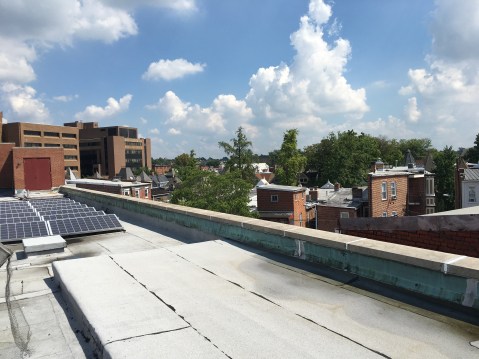
Shaw from a rooftop perspective, Image by author
These moments also inform the contours of my dissertation project on hearing gentrification in DC. The larger project involves passive acoustic recording in the same neighborhood, a methodology that entails creating a large amount of short soundscape recordings over a long period of time. Understanding both my soundwalks and passive acoustic recording as black feminist method allows for the consideration of multiple sonic perspectives of the neighborhood, rather than one record. When once describing passive acoustic recording to a colleague at a digital humanities workshop, they celebrated the idea that I would be able to “objectively” hear what was occurring in the neighborhood, instead of relying only on pieced together accounts from community members.
However, just as black feminist thought amplifies my “tainted” knowledge, it also mutes the authoritative “objective” knowledge of a rooftop recorder. The sounds of the stationary recorder placed on a rooftop at 7th and Florida are as partial and positioned as the recordings of my footsteps as I move around the neighborhood. As I continue to walk, be it through the unfamiliarity of Mississippi or my hometown DC, I do so with the reassurance that what I hear is enough.
—
Featured Image: Shaw From Above, by author.
—
Allie Martin is a PhD Candidate at Indiana University in the Department of Folklore and Ethnomusicology. Her dissertation project explores the musical and sonic dimensions of gentrification in Washington, DC, using a combination of ethnographic fieldwork, archival research, and soundscape recordings. Originally from the Washington, DC, metropolitan area, she received her BAs in music performance and audio production from American University.
—
 REWIND! . . .If you liked this post, you may also dig:
SO! Amplifies: Listening to the City Handbook
Sounding Out! Podcast #2: Springtime in KC: Soundwalking Kansas City—Liana Silva
Unlearning Black Sound in Black Artistry: Examining the Quiet in Solange’s A Seat At the Table–Kimberly Williams
Share this:

X! : Blog-O-Versary 10.0

** Click here to head straight to our free, downloadable X! 10.0 Blog-O-Versary Mix! It’s okay, like Tupac, we ain’t mad at ya! It’s cool to come back here though and check this out. **
We didn’t have a clue where the blog was headed when we started out in 2009, packed into AT’s humid apartment on Seminary in Binghamton, alternately helping him pack, looking through his records, and making plans for this writing thing we were going to do together to stay in touch. I had a newborn baby strapped on my chest, Aaron was leaving BU to start a PhD program at Rutgers and Liana was embarking deeply into her dissertation (and just a year later for Kansas City. . .for the full origin story, catch our recent co-authored piece “The Pleasure [is] Principle: Sounding Out! and the Digitization of Community” in Digital Sound Studies). Our tight-knit research crew was facing so much change and uncertainty, that I’m pretty sure we decided to name the blog Sounding Out! as a form of echolocation. If talking and thinking about sound waves had brought us together in the first place, perhaps their resonance could stretch out to fill the unknown contours of the future that lay ahead.
And over the past decade, it has. Not just for us as friends, co-workers, and eventually shared hive-mind cells, but for the field of sound studies, which in the same decade went from “huh?” to “emerging,” then from academic hipster cred and to everybody’s tryna put “soundscape” in everything, to the New York Times magazine does a cover story on it AND you can now get a Masters in it at Northwestern University in Chicago [shout out to SO! special editor Neil Verma, who not only edited a media stream for us from 2013-2016 but—among many other awesome things—helped get this very program up and running]. It’s no coincidence that the field’s trajectory and reach has grown exponentially along with ours, and we are proud as hell of that.
Other things we are most proud of:
- that, on separate occasions in the past year, two brilliant people have told us that reading SO! inspired them to go to grad school because our site hosted and valued research on sound by/about women of color (these stories are literally our favorite 😭 😭 😭 and inspire us to go even harder!).
- growing deep, connected relationships among scholars and professionals in the field infused with fun and feeling amongst the brilliance and rigor.
- surpassing one MILLION unique clicks (not that “metrics” has ever been our goal but holla!!).
- getting on the podcast tip early (2010!!) and staying weird as hell with it (free format por vida!).
- always being down to shout out and collabo (over the years we’ve worked with Antenna, Locatora Radio, The Radio Preservation Task Force, IASPM-US, Soundbox, The Middle Spaces, Tuned City Brussels, WHRW 90.5, Everything Sounds, Not Your Muse, and The UC Riverside Punk Con, among many others. In 2020 we have something going with the Zora Neale Hurston festival in Eatonville, Florida. . . stay tuned!).
- publishing a post on “Old Town Road.” IJS. Our regular writers always bring it. Thank you to Justin Burton and Robin James, our current roster, and to all of our past fam: Regina Bradley, Enongo Lumumba-Kasongo, Maile Colbert, Osvaldo Oyola, and Andreas Pape.
- pushing so hard for our reach, readership, and coverage to become increasingly global (in the past year we hosted pieces from and/or about Argentina, Australia, Canada, China, Cuba, Mexico, New Zealand, Russia, and Ukraine).
- developing a strong undergraduate internship program through Binghamton University that brings us literally the best interns in the WORLD 💯. They bring us new ideas, excitement, and new social media accounts, and we entrust them with everything we know about editing and digital publishing. It’s been a blast, and we are so proud they’ve all gone on to do wonderful work in the world.
- that our roster of writers more accurately represents the diversity of sound studies scholars than any other publication out there by leaps and bounds.
- that SO! has continued to evolve in interesting ways while strengthening and refining our guiding mission over the years: to find, nurture, and share accessible top-notch scholarship/art/thought that investigates how power impacts how we sound and listen, while amplifying sound studies knowledge toward social justice.
- AND MOST IMPORTANTLY, that so many readers have put their faith in us and so many amazing writers have thought of us as a home for their work. We take your trust so very seriously, and remain humbled by your generosity and confidence. Thank you, thank you, THANK YOU for being Sounding Out! along with us.
I’m trying to keep it short and cute today, not saying too TOO much because this post [our 624th!] is neither a retrospective nor a tribute, but a celebration. . .as Diddy once said, we ain’t going nowhere! [Editors’ Note: Other notables JS has referenced in the previous decade of Blog-o-Versary posts includes Bob Marley, LL Cool J, De La Soul, Schoolhouse Rock, Dionne Warwick, the Solid Gold Dancers, S.E. Hinton, Beyoncé, Langston Hughes, X-Ray Spex, A Tribe Called Quest, Fred Moten, Bill Withers, and . . . Taylor Swift. Oof.]. And bet, we have AMAZING things planned for next year, including forums on Soundwalking while POC (starts next week!), the 50th anniversary of Charles Mingus’s Ah Um (guest edited by Earl Brooks), audiobooks (edited by Liana Silva), and sound and climate change (guest edited by Anja Kanngieser), an undergraduate sound studies showcase, and . . . . . . . . . .
[🥁🥁🥁🥁🥁🥁🥁]
we just finished a book proposal for a Sounding Out! anthology: working title Power in Listening: The Sounding Out! Reader.
[🎉 insert airhorn sound here 🎉]
YES! We couldn’t be more grateful for the last ten years, and we couldn’t be more excited for what’s coming up next. Even though we didn’t know where we were headed in 2009, we have arrived nonetheless, and all because we knew what we wanted—to create a community just like this one. Happy X! Blog-o-Versary to all of us, today!
–JLS, LMS, and AT
XXXXXXXXXX Highlight Reel XXXXXXXXXX
- Enongo Lumumba-Kasongo successfully defended her dissertation, and had the chance to open for Bikini Kill in June, under her stage name Sammus. In fall of 2019 she will be starting a two-year postdoc at Brown University’s music department, and will be getting married to fiction writer Lance Akinsiku. She is presenting a Making/Doing session at this year’s 4S Conference in New Orleans in September.
- John Melillo has a new essay on the French sound poet Henri Chopin in Ties: Journal of Text, Image, and Sound. His book, The Poetics of Noise, is under contract for Bloomsbury’s Sound Studies list.
- In summer 2018 Kristin Moriah began a position as an Assistant Professor of African American Literary Studies at Queen’s University in Kingston, Ontario. “Where Are the Black Angels?” her review of Mickalene Thomas’s historic exhibition at the Art Gallery of Ontario is forthcoming in PAJ: A Journal of Performance and Art 123, as is “A Greater Compass of Voice: Elizabeth Taylor Greenfield, Mary Ann Shadd Cary and Black Performance in Nineteenth-Century North America,” which will be published in Theatre Research in Canada. She is excited to attend the ASA annual meeting in Honolulu where she will present “Playing the Red Record: Black Feminist Recording Practices.”
- Phillip Sinitiere published several pieces on W. E. B. Du Bois in The North Star. He also co-organized a forum on Shirley Graham Du Bois at Black Perspectives. He is the 2019-2020 W. E. B. Du Bois Visiting Scholar at UMass Amherst.
- SO! Ed-in Chief Jennifer Lynn Stoever published three essays in 2018/19: “‘Doing fifty-five in a fifty-four’: Cop Voice, U.S. Policing and the Cadence of White Supremacy” (Interdisciplinary Journal of Voice Studies), “Black Radio Listeners in America’s ‘Golden Age'” (Journal of Radio and Media Studies), and “Crate Digging Begins at Home: Black and Latinx Women Collecting and Selecting Records in the 1960s and ‘70s Bronx” in the Oxford Handbook of Hip Hop Studies, which you can download for free here.
And remember, the “notes” on our Facebook page is *still the best place to hear about calls for art, calls for posts, and upcoming conferences, shows, and volumes in sound studies. “Like” us here and please continue to keep us in the loop regarding new projects. We love to signal boost, as you can probably tell by our very active Twitter feed!
Clic here for Sounding Out!‘s Blog-O-Versary “X!” mix 10.0 with track listing (and of course which writers suggested which songs)!
—
Jennifer Lynn Stoever is co-founder and Editor-in-Chief of Sounding Out! She is also Associate Professor of English at Binghamton University, lead organizer of The Binghamton Historical Soundwalk Project and author of The Sonic Color Line: Race and the Cultural Politics of Listening (NYU Press, 2016).
—
REWIND! . . .If you liked this post, you may also dig:
-

- 2018
-
- 2017
-

- 2016
-

- 2015
-

- 2014
-

- 2013
-

- 2012
-
- 2011
-
- 2010
- 2018 “Sound the Alarm” mix 9.0
- 2017 “!!!!Resist!!!!” Blog-O-Versary mix 8.0
- 2016 Blog-O-Versary “!!!!!!!” mix 7.0
- 2015 Blog-o-Versary 6.0 Keep on Pushing! (Our 400th post!!)
- 2014 #flawless 5.0 celebration and mix
- 2013 Blog-o-Versary 4.0: Solid Gold Summer Countdown!
- 2012 #Blog-O-Versary 3.0: Can’t Stop Won’t Stop (The Awesomeness)!
- 2011 “Awesome Sounds from a Future Boombox” 2.0
- 2010 First Blog-O-Versary party mix: A Celebration of Awesomeness
Share this:


Current Top Posts





April 2021

January 2020

November 2019

October 2019

August 2019

April 2014

November 2017

March 2015

December 2017

October 2015
 Sounding Out!
Recent Comments