
“Ich kann nicht”: Hearing Racialized Language in Josh Inocéncio’s Purple Eyes (Ojos Violetas)

In Spring 2017, I brought Houston-based playwright/performer Josh Inocéncio to my campus—the University of Houston—to perform his solo show Purple Eyes (for more on the event, see “Campus Organizing, or How I Use Theatre to Resist”). Purple Eyes is what Inocéncio calls an “ancestral auto/biographical” performance piece which explores his upbringing as a closeted gay Chicano living in the midst of the cultural heritage of machismo. Following a legacy of solo performance storytelling aesthetics seen in John Leguizamo’s Freak and Luis Alfaro’s Downtown, Inocéncio plays with memory to understand how the United States and Mexico have influenced his family and his own identity formation. Moreover, Purple Eyes explores the intersections of queerness and Chican@ identity alongside the legacy of machismo in his family (For more on the play, see “Queering Machismo from Michoacán to Montrose”).

Still from Purple Eyes (Ojos Violetas), with permission from Josh Inocencio who retains copyright.
During my Intro to LGBT Studies course following the performance, students discussed issues of representation and how many of them had never seen a queer Latin@/x play or performance, with some of them having never seen a live play. Many students picked up on how Purple Eyes foregrounds the intersections of race, ethnicity, gender, and sexuality. While these discussions were indeed fruitful, what struck me most was how both classes harped on Inocéncio’s use of different linguistic registers. Put simply, what stayed with them was how the performance sounded. My students obsessed over the Spanish in the play, leading me to question why this group of students at a Hispanic-Serving Institution in a city that is over 40% Latin@ had so much trouble whenever Inocéncio spoke Spanish, or the sounds of Latinidad.
In what follows, I discuss how my students heard Purple Eyes. While the play is predominately in English, Inocéncio often code-switches into Spanish and German to more accurately embody particular family members. This blog adds to previous research by Dolores Inés Casillas, Sara V. Hinojos, Marci R. McMahon, Liana Silva, and Jennifer Stoever on the relationship between the Spanish language and non-Spanish speaking Americans. Indeed, my students racialized the Spanish in Purple Eyes while completely disregarding the German in the play. Why?
Drawing from sociology, racialization is the process of imposing racial identities to a social practice or group that might not have identified in such a way. Typically, the dominant group racializes the marginalized group; i.e. Latin@s in the U.S. become racialized by the mainstream. Even so, Latin@s are not a race, but are an ethnic group. Yet, I argue that non-Latin@ Americans view Latin@s through a lens of race which often becomes a sonic one, in which language becomes one of the most overt identity markers. In terms of Spanish, while many races and ethnicities speak the language, in the United States it is often viewed as a way to mark Spanish-speaking Latin@s as Other. In this way, language plays a fundamental role in shaping mainstream ideas about race. According to Dolores Inés Casillas, “For unfamiliar ears, the sounds of Spanish, the mariachi ensemble, and/or accented karaoke all work together to signal brownness, working-class,” and as Jennifer Stoever argues, the sounds of Latinidad indicate “illegality” in the U.S.
Drawing from the intersections of race, language, and racism, the relatively new academic field Raciolinguistics has emerged as a means to explain how people use language to shape their identity (For more, see Raciolinguistics: How Language Shapes Our Ideas About Race). Branching off from Raciolinguistics, I am most interested in exploring how the mainstream hears languages and racializes what they are hearing. The result is that Spanish is seen as Other, meaning that monolingual U.S. listeners hear Spanish-speakers as inherently different and a threat to a mainstream United States cultural and, more importantly, national identity.
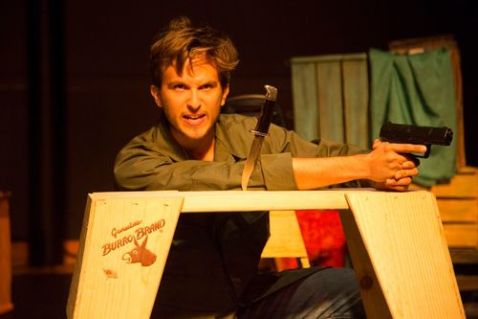
Still from Purple Eyes (Ojos Violetas), with permission from Josh Inocencio who retains copyright.
Reflecting Inocéncio’s cultural multiplicity, Purple Eyes features English, Spanish, and German strategically used at different moments in the play to reflect the temporality, positionality, and relationship to language of each character that Inocéncio inhabits. While the chapter on his father is entirely in English, the final chapter focusing on Josh himself opens with a monologue in Spanish in which the performer narrates the events of the FIFA World Cup before finally announcing to the crowd that the epilogue is Inocéncio’s journey of young love and heartbreak on his journey of queer discovery. This moment features the longest extended use of Spanish in the play. The remaining Spanish is sprinkled in as Josh code-switches between the two languages for added cultural specificity.
While some of my Spanish-speaking students appreciated hearing a play that reflected their linguistic identities, monolingual English speakers in my class claimed that the Spanish confused them and made it difficult for them to follow certain parts of the play. After several students echoed these thoughts, a student from Mexico without full fluency in English comprehension told others about how her experiences were the exact opposite. She had trouble following some of the parts in English since she is still learning the language. I then pivoted the conversation to discuss how my English-dominant students approached the play with the assumption that English is the norm and a performance on a university campus should reflect this. Case in point: several told me that the show should have been subtitled.
But what was most telling was the following exchange. After several expressed confusion over the Spanish, one particularly woke student from Nigeria raised her hand and said: “I haven’t heard anyone say anything about the German in the play and not being able to follow the play during the German part.” She then noted how, in the United States, Spanish is racialized whereas German is not. In fact, most of the students did not even recall German in the play. Admittedly, the play features far more Spanish than German, but the scene in which Inocéncio speaks German occurs while dramatizing his Austrian grandmother’s abortion. As Inocéncio (as Oma) frantically repeated “Ich kann nicht” (I can’t), my students had no trouble; to use some Millennial vernacular, it was with Spanish that they “couldn’t even.” Arguably, this is the most intense scene in the performance and one that my students wanted to discuss. That the majority of them understood this scene without fully registering the German, coupled with their confusion over lines spoken in Spanish, speaks to not only how race and ethnicity impact how languages are heard in the United States. German is viewed as familiar and accessible whereas Spanish is immediately heard as foreign, i.e. undesirable, not welcome here.
As the Latin@ population continues to grow and the Spanish language becomes an increasingly present reality in U.S. everyday life, audiences must consider possibilities not grounded in an English-only narrative. My experiences with Purple Eyes are not unique. I have witnessed and heard many stories about audiences at mainstream theatre companies who have struggled whenever a play included Spanish. While I don’t claim to have the answers to address this across the nation, as an educator, I question what tools I can give my students to help prepare them for sonic experiences outside of their comfort zone and, specifically, how they become aware of subconscious racialization practices. What will they hear? And, more importantly, how will they react?
—
Featured Image: Still from Purple Eyes (Ojos Violetas), with permission from Josh Inocencio who retains copyright.
—
Trevor Boffone is a Houston-based scholar, educator, writer, dramaturg, producer, and the founder of the 50 Playwrights Project. He is a member of the National Steering Committee for the Latinx Theatre Commons and the Café Onda Editorial Board. Trevor has a Ph.D. in Latin@ Theatre and Literature from the Department of Hispanic Studies at the University of Houston where he holds a Graduate Certificate in Women’s, Gender, & Sexuality Studies. He holds an MA in Hispanic Studies from Villanova University and a BA in Spanish from Loyola University New Orleans. Trevor researches the intersections of race, ethnicity, gender, sexuality, and community in Chican@ and Latin@ theater and performance. His first book project, Eastside Latinidad: Josefina López, Community, and Social Change in Los Angeles, examines the textual and performative strategies of contemporary Latin@ theatermakers based in Boyle Heights that use performance as a tool to expand notions of Latinidad and (re)build a community that reflects this diverse and fluid identity. He is co-editing (with Teresa Marrero and Chantal Rodriguez) an anthology of Latinx plays from the Los Angeles Theatre Center’s Encuentro 2014 (under contract with Northwestern University Press).
—
 REWIND!…If you liked this post, you may also dig:
“Don’t Be Self-Conchas”: Listening to Mexican Styled Phonetics in Popular Culture*–Sara V. Hinojos and Dolores Inés Casillas
Deaf Latin@ Performance: Listening with the Third Ear–Trevor Boffone
Moonlight’s Orchestral Manoeuvers: A duet by Shakira Holt and Christopher Chien
If La Llorona Was a Punk Rocker: Detonguing The Off-Key Caos and Screams of Alice Bag–Marlen Rios-Hernández
Share this:

Chicana Soundscapes: Introduction

Feminista Music Scholarship understands music production and listening as a collective site of engagement that sometimes produces and sometimes challenges social structures of race, class, gender, sexuality and nation. It is a method and practice that pushes on narrative frameworks that naturalize the absence of women of color and Chicanx subjects in music scholarship. It is always about imagining and practicing life, as the old-saying/ dicho goes says, to the beat of a different drum, to an alternative, more just reality and experience of time, built on the knowledge of buen vivir or sumak kawsay (a kichwe concept and practice that understands the good life cannot be attained without living right with others in convivencia, in mutual respect of marginalized communities, knowledges, cyclical non-linear time, and of La Pachama/mother earth, one that aligns with knowledge practices of many indigenous communities across Las Americas).
This Chicana Soundscapes/Feminista Music Scholarship Forum is inspired by the “Sounds Like Home: Mapping Chicana Mexicana/Indigena Epistemologies in Sonic Spaces” presented at the annual American Studies Association (ASA) Annual Conference, Denver 2017. Thanks to the roundtable organizers Yessica Garcia Hernandez and Iris Viveros Avendaño for inviting me to chair the panel and to ASA Sound Caucus committee for sponsoring the panel and putting a spotlight on this much-needed research. Many have worked tirelessly for over 25 years to make space at the ASA for such a panel–one that is focused on feminista music scholarship, robustly composed of emerging feminista scholars from different localities. It is truly a collective endeavor. That is took this long says much about the way such knowledge has been valued. That is finally happened says much about what’s coming next!
Curtis Marez contextualizes “Chicana Epistemologies/Sonic Spaces” “I’ve been waiting for this panel for my whole academic life” #2016ASA pic.twitter.com/cPTbph1vXb
— Sounding Out! (@soundingoutblog) November 19, 2016
The forum’s inspiring research by scholars/practioners Wanda Alarcón, Yessica Garcia Hernandez, Marlen Rios-Hernandez, Susana Sepulveda, and Iris C. Viveros Avendaño, understands music in its local, translocal and transnational context, and insists upon open new scholarly imaginaries. Not only does each scholar’s research point to the exciting present and future of music studies, it points to the work of feminista scholars and music practicioners who’ve pushed the frames of music studies, from inside and outside of ethnomusicology and musicology, scholars such as: Deborah Wong, Deborah Vargas, Sherrie Tucker, our own mentor Angela Davis, Maureen Mahon, Daphne Brooks, Andreana Clay, Martha Gonzalez, and others. Feminista scholars like Inés Casillas, Jennifer Stoever, Roshanak Kheshti, Monica De La Torre, and others, have made way for for feminista music studies in Sound Studies. And yet, it wasn’t so long ago that Susan McClary shocked the music studies world by insisting that gender mattered in music analysis. We still face constant pushback on that assertion, in particular subfields, especially now. Current times require us to bridge intersectional, decolonial, and gender analysis. Music, and our relationship to it, has much to reveal about how power operates within a context of inequality. And it will teach us how to get through this moment.

(Re)Sounding Misery and Resistance: Chicana Feminist Listening Practices in Radio, Theatre, and Television with Monica De La Torre, Marci McMahon, Sara V. Hinojos and D. Inés Casillas #soundstudiesday #thisistheasa
For the last 13 years my research for Chicanxfuturism manuscript has engaged the following question: What practices compose Feminista Music Scholarship? As a practitioner in dialogue with scholars and practitioners, I identify Feminista Music Scholarship as:
- a fluid practice of collective listening and producing music attentive to power relations
- an examination of power-flows through music via epistemologies birthed from feminist of color and indigenista theorizing and practice
- approaching all genres
- troubling the notion of home
- responding to community displacement & social alienation
- networked (through digital archive, social media, etc…; collaborative and collective; and social justice oriented
- recognizing the reciprocal exchange of knowledge and labor between community and scholarly collaborations
- a collective endeavor
- ever-transforming
Feminista Music Scholarship is what the participants of this forum are doing (among their many important interventions)!

Martha Gonzalez, Scholar and Quetzal vocalist. Photo by Nic Paget-Clarke. This photo was taken during a Quetzal concert at the first community get-together of the Eastside Cafe (May 17, 2002) in the Mazatlan Ballroom in El Sereno (Los Angeles).
Indeed, Feminist Music Scholarship disrupts what Daphne Brooks describes in “The Write to Rock: Racial Mythologies, Feminist Theory, and the Pleasures of Rock Music Criticism” as “the imagined subaltern sphere of independent rock culture (dubbed “indie-rock”) [that] depends on a narrow discourse of shared knowledge that largely marginalizes (if not altogether erases) the presence of women and particularly women of color in alternative music culture” (61). The conceptualization and development of recent pop music exhibits, scholarship by emerging scholars, and community music dialogues, decidedly influenced by Feminista Music Scholarship is one of many possible answers to Brooks’s serious question, “How do we break outside of these tightly policed spheres?” The scholars/music practitioners in this issue respond to the burning question, “how does Chicana feminist music criticism break out of these spheres and serve as a home for new methods for writing about punk, banda, and new wave, son jarocho and participatory community music production?”
During the ASA roundtable, Alarcón, Garcia Hernandez, Rios-Hernandez, Sepulveda, and Viveros Avendaño presented six-minute flash presentations and then opened the floor to a discussion that is wide-ranging yet grounded in the material practices of sound, music, feminism, and home. They continue that important discussion there. More than ever we need panels, forums, dissertations, articles and other forms scholarship that spotlight the ways vulnerable populations have found ways to disrupt systemic oppression through their raucous listening, producing and community practices. This permits us to remember that this fight is not over, that we are deep in it and we have much strategy to share.
Rock on forum readers, rock on!
—
Michelle Habell-Pallán, associate professor of performance culture of the Americas in the Department of Gender, Women & Sexuality Studies, and adjunct associate professor in the School of Music and Department of Communication, at the University of Washington (UW), is currently the Director of the Certificate for Public Scholarship. For her fifteen years plus of community engagement and the arts, she recently received the Barclay Simpson Prize for Scholarship in Public, which recognizes her efforts to foster the humanities as a public good. Her research examines music, performance, and theater as communal forms of expression that archive alternative histories used to imagine new futures. In tandem, her research also reflects on the way developing media platforms compel new methods of cultural expression, research, archiving and delivery. Her most current research considers dialogues between feminista movements and hip hop feminista musics in Ecuador and its relationship to indigenous social movements rooted in Andean concepts of Sumak Kawsai (Right-living). She is the Co-Director of the UW Honors Quito, Ecuador Study Abroad Program.
Habell-Pallán authored Loca Motion: The Travels of Chicana/Latina Popular Culture (NYU Press). Her most recent book is the bilingual American Sabor: Latinos and Latinas in US Popular Music: Latinos y Latinas en La Música Popular Estadounidense co-authored with Marisol Berrios-Miranda and Shannon Dudley, published by University of Washington Press (Autumn January 2017). Her single-authored book Chicanxfuturism: Punk’s Beat Migration and the Sounds of Buen Vivir is in-progress.
Habell-Pallán guest-curated the award-winning bilingual traveling exhibit American Sabor: Latinos in U.S. Popular Music hosted by Smithsonian Institution’s Traveling Exhibition Service (SITES). As a digital feminista she transforms digital humanities, through community engagement, as co-director of University of Washington Libraries Women Who Rock (WWR): Making Scenes, Building Communities Oral History Archive.
A former UC President’s Postdoctoral Fellow, Habell-Pallán is recipient of a Rockefeller Foundation Humanities Research Award, Woodrow Wilson Foundation Research Award, UW Royal Research Fund Award, and UW Simpson Center Digital Commons Faculty Fellowship (underwritten by the Mellon Foundation).
Habell-Pallán makes community & music with the Seattle Fandango Project, and is a member of the Fembot Collective|Gender, New Media & Technology. She collaborates with a range of local community partners to direct the Women Who Rock: Making Scenes, Building Communities Collective, whose free and family-friendly Seattle unConference/Encuentro takes place annually.
—
 REWIND! . . .If you liked this post, you may also dig:
If La Llorona Was a Punk Rocker: Detonguing The Off-Key Caos and Screams of Alice Bag– Marlen Ríos-Hernández
Chicana Radio Activists and the Sounds of Chicana Feminisms–Monica De La Torre
SO! Reads: Deborah R. Vargas’s Dissonant Divas in Chicana Music: The Limits of La Onda–Wanda Alarcon
Share this:


Current Top Posts





April 2021

January 2020

November 2019

October 2019

August 2019

April 2014

November 2017

March 2015

December 2017

October 2015
 Sounding Out!
Recent Comments