
On Whiteness and Sound Studies

 This is the first post in Sounding Out!’s 4th annual July forum on listening in observation of World Listening Day on July 18th, 2015. World Listening Day is a time to think about the impacts we have on our auditory environments and, in turn, their effects on us. For Sounding Out! World Listening Day necessitates discussions of the politics of listening and listening as a political act, beginning this year with Gustavus Stadler’s timely provocation. –Editor-in-Chief JS
—
Many amusing incidents attend the exhibition of the Edison phonograph and graphophone, especially in the South, where a negro can be frightened to death almost by a ‘talking machine.’ Western Electrician May 11, 1889, (255).
What does an ever-nearer, ever-louder police siren sound like in an urban neighborhood, depending on the listener’s racial identity? Rescue or invasion? Impending succor or potential violence? These dichotomies are perhaps overly neat, divorced as they are from context. Nonetheless, contemplating them offers one charged example of how race shapes listening—and hence, some would say, sound itself—in American cities and all over the world. Indeed, in the past year, what Jennifer Stoever calls the “sonic color line” has become newly audible to many white Americans with the attention the #blacklivesmatter movement has drawn to police violence perpetrated routinely against people of color.

“Sheet music ‘Coon Coon Coon’ from 1901” via Wikimedia, public domain
Racialized differences in listening have a history, of course. Consider the early decades of the phonograph, which coincided with the collapse of Reconstruction and the consolidation of Jim Crow laws (with the Supreme Court’s stamp of approval). At first, these historical phenomena might seem wholly discrete. But in fact, white supremacy provided the fuel for many early commercial phonographic recordings, including not only ethnic humor and “coon songs” but a form of “descriptive specialty”—the period name for spoken-word recordings about news events and slices of life—that reenacted the lynchings of black men. These lynching recordings, as I argued in “Never Heard Such a Thing,” an essay published in Social Text five years ago, appear to have been part of the same overall entertainment market as the ones lampooning foreign accents and “negro dialect”; that is, they were all meant to exhibit the wonders of the new sound reproduction to Americans on street corners, at country fairs, and in other public venues.
Thus, experiencing modernity as wondrous, by means of such world-rattling phenomena as the disembodiment of the voice, was an implicitly white experience. In early encounters with the phonograph, black listeners were frequently reminded that the marvels of modernity were not designed for them, and in certain cases were expressly designed to announce this exclusion, as the epigraph to this post makes brutally evident. For those who heard the lynching recordings, this new technology became another site at which they were reminded of the potential price of challenging the racist presumptions that underwrote this modernity. Of course, not all black (or white) listeners heard the same sounds or heard them the same way. But the overarching context coloring these early encounters with the mechanical reproduction of sound was that of deeply entrenched, aggressive, white supremacist racism.

“66 West 12th Street, New School entrance” by Wikimedia user Beyond My Ken, CC BY-SA 4.0
The recent Sonic Shadows symposium at The New School offered me an opportunity to come back to “Never Heard Such a Thing” at a time when the field of sound studies has grown more prominent and coherent—arguably, more of an institutionally recognizable “field” than ever before. In the past three years, at least three major reference/textbook-style publications have appeared containing both “classic” essays and newer writing from the recent flowering of work on sound, all of them formidable and erudite, all of great benefit for those of us who teach classes about sound: The Oxford Handbook of Sound Studies (2012), edited by Karen Bijsterveld and Trevor Pinch; The Sound Studies Reader (2013), edited by Jonathan Sterne; and Keywords in Sound (2015), edited by David Novak and Matt Sakakeeny. From a variety of disciplinary perspectives, these collections bring new heft to the analysis of sound and sound culture.
I’m struck, however, by the relative absence of a certain strain of work in these volumes—an approach that is difficult to characterize but that is probably best approximated by the term “American Studies.” Over the past two decades, this field has emerged as an especially vibrant site for the sustained, nuanced exploration of forms of social difference, race in particular. Some of the most exciting sound-focused work that I know of arising from this general direction includes: Stoever’s trailblazing account of sound’s role in racial formation in the U.S.; Fred Moten’s enormously influential remix of radical black aesthetics, largely focused on music but including broader sonic phenomena like the scream of Frederick Douglass’s Aunt Hester; Bryan Wagner’s work on the role of racial violence in the “coon songs” written and recorded by George W. Johnson, widely considered the first black phonographic artist; Dolores Inés Casillas’s explication of Spanish-language radio’s tactical sonic coding at the Mexican border; Derek Vaillant’s work on racial formation and Chicago radio in the 1920s and 30s. I was surprised to see none of these authors included in any of the new reference works; indeed, with the exception of one reference in The Sound Studies Reader to Moten’s work (in an essay not concerned with race), none is cited. The new(ish) American Studies provided the bedrock of two sound-focused special issues of journals: American Quarterly’s “Sound Clash: Listening to American Studies,” edited by Kara Keeling and Josh Kun, and Social Text’s “The Politics of Recorded Sound,” edited by me. Many of the authors of the essays in these special issues hold expertise in the history and politics of difference, and scholarship on those issues drives their work on sound. None of them, other than Mara Mills, is among the contributors to the new reference works. Aside from Mills’s contributions and a couple of bibliographic nods in the introduction, these journal issues play no role in the analytical work collected in the volumes.

“Blank pages intentionally, end of book” by Wikimedia user Brian 0918, CC BY-SA 3.0
The three new collections address the relationship between sound, listening, and specific forms of social difference to varying degrees. All three of the books contain excerpts from Mara Mills’ excellent work on the centrality of deafness to the development of sound technology. The Sound Studies Reader, in particular, contains a small array of pieces that focus on disability, gender and race; in attending to race, specifically, Sterne shrewdly includes an excerpt from Franz Fanon’s A Dying Colonialism, as well as essays on black music by authors likely unfamiliar to many American readers. The Oxford Handbook’s sole piece addressing race is a contribution on racial authenticity in hip-hop. It’s a strong essay in itself. But appearing in this time and space of field-articulation, its strength is undermined by its isolation, and its distance from any deeper analysis of race’s role in sound than what seems to be, across all three volumes, at best, a liberal politics of representation or “inclusion.” Encountering the three books at once, I found it hard not to hear the implicit message that no sound-related topics other than black music have anything to do with race. At the same time, the mere inclusion of work on black music in these books, without any larger theory of race and sound or wider critical framing, risks reproducing the dubious politics of white Euro-Americans’ long historical fascination with black voices.
What I would like to hear more audibly in our field—what I want all of us to work to make more prominent and more possible—is scholarship that explicitly confronts, and broadcasts, the underlying whiteness of the field, and of the generic terms that provide so much currency in it: terms like “the listener,” “the body,” “the ear,” and so on. This work does exist. I believe it should be aggressively encouraged and pursued by the most influential figures in sound studies, regardless of their disciplinary background. Yes, work in these volumes is useful for this project; Novak and Sakakeeny seem to be making this point in their Keywords introduction when they write:
While many keyword entries productively reference sonic identities linked to socially constructed categories of gender, race, ethnicity, religion, disability, citizenship, and personhood, our project does not explicitly foreground those modalities of social difference. Rather, in curating a conceptual lexicon for a particular field, we have kept sound at the center of analysis, arriving at other points from the terminologies of sound, and not the reverse. (8)
I would agree there are important ways of exploring sound and listening that need to be sharpened in ways that extended discussion of race, gender, class, or sexuality will not help with. But this doesn’t mean that work that doesn’t consider such categories is somehow really about sound in a way that the work does take them up isn’t, any more than a white middle-class person who hears a police siren can really hear what it sounds like while a black person’s perception of the sound is inaccurate because burdened (read: biased) by the weight of history and politics.

“Pointy Rays of Justice” by Flickr user Christopher Sebela, CC BY-NC 2.0
In a recent Twitter conversation with me, the philosopher Robin James made the canny point that whiteness, masquerading as lack of bias, can operate to guarantee the coherence and legibility of a field in formation. James’s trenchant insight reminds me of cultural theorist Kandice Chuh’s recent work on “aboutness” in “It’s Not About Anything,” from Social Text (Winter 2014) and knowledge formation in the contemporary academy. Focus on what the object of analysis in a field is, on what work in a field is about, Chuh argues, is “often conducted as a way of avoiding engagement with ‘difference,’ and especially with racialized difference.”
I would like us to explore alternatives to the assumption that we have to figure out how to talk about sound before we can talk about how race is indelibly shaping how we think about sound; I want more avenues opened, by the most powerful voices in the field, for work acknowledging that our understanding of sound is always conducted, and has always been conducted, from within history, as lived through categories like race.
The cultivation of such openings also requires that we acknowledge the overwhelming whiteness of scholars in the field, especially outside of work on music. If you’re concerned by this situation, and have the opportunity to do editorial work, one way to work to change it is by making a broader range of work in the field more inviting to people who make the stakes of racial politics critical to their scholarship and careers. As I’ve noted, there are people out there doing such work; indeed, Sounding Out! has continually cultivated and hosted it, with far more editorial care and advisement than one generally encounters in blogs (at least in my experience), over the course of its five years. But if the field remains fixated on sound as a category that exists in itself, outside of its perception by specifically marked subjects and bodies within history, no such change is likely to occur. Perhaps we will simply resign ourselves to having two (or more) isolated tracks of sound studies, or perhaps some of us will have to reevaluate whether we’re able to teach what we think is important to teach while working under its rubric.
—
Thanks to Robin James, Julie Beth Napolin, Jennifer Stoever, and David Suisman for their ideas and feedback.
—
Gustavus Stadler teaches English and American Studies at Haverford College. He is the author of Troubling Minds: The Cultural Politics of Genius in the U. S.1840-1890 (U of Minn Press, 2006). His 2010 edited special issue of Social Text on “The Politics of Recorded Sound” was named a finalist for a prize in the category of “General History” by the Association of Recorded Sound Collections. He is the recipient of the 10th Annual Woody Guthrie fellowship! This fellowship will support research for his book-in-progress, Woody Guthrie and the Intimate Life of the Left.
—
 REWIND! . . .If you liked this post, you may also dig:
Reading the Politics of Recorded Sound — Jennifer Stoever
Hearing the Tenor of the Vendler/Dove Conversation: Race, Listening, and the “Noise” of Texts — Christina Sharpe
Listening to the Border: “‘2487’: Giving Voice in Diaspora” and the Sound Art of Luz María Sánchez — Dolores Inés Casillas
Share this:

Soundscapes of Narco Silence
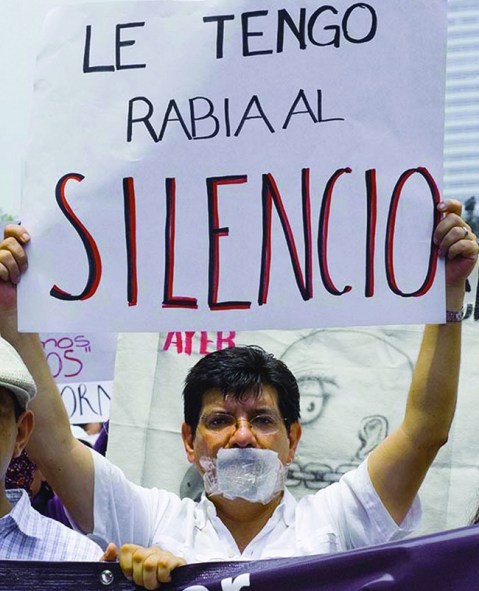
Journalists protest in silent march in Mexico City, Courtesy of the Knight Foundation
Since the drug war began, the lives of approximately 95,000 people have been claimed, with an estimated total of 26,000 disappearances (“Continued Humanitarian Crisis at the Border” June 2013 Report). At the University of Texas, Pan American – an institution located 25 miles north of Reynosa, Mexico (a Mexican city that has been hard hit by drug violence in recent years) – I teach students who have been dramatically impacted by drug war violence. Many have close relatives affected or hear horrific stories of those who have been kidnapped by the cartels; many fear traveling to Mexico to visit loved ones as a result and, in some cases, they report having relatives involved in the drug cartel business. Dinorah Guerra, psychotherapist and head of the Red Cross in Reynosa, describes the devastating psychological and physical toll: “There is a huge risk for people’s self esteem. They cannot speak about what they have seen or what they have heard. [They] lose [themselves] and lose [their] identity” (qtd. in Pehhaul 2010).
I name the space of the drug war and its resulting terror in the U.S.-Mexico border the “soundscape of narco silence.” This soundscape includes death and intimidation, from the brutal killings of news reporters by cartel members to the decapitation of citizen-activists who use online media to alert communities of narco checkpoints. It also consists of those powerful acts that call attention to silence as a tactic of terror. The Movement for Peace with Justice and Dignity, for instance, brought together tens of thousands of people in Mexico to speak out against drug violence through silent marches. Cultural productions, such as narcocorridos, or contemporary drug ballads that document the cross-border drug economy, also become part of the soundscape. The narcocorridos function as a powerful critical response to silence and fear because they enable those in Mexican society, as Jorge Castañeda, author of El Narco: La Guerra Falllida, explains, “to come to terms with the world around them, and drug violence is a big part of that world. The songs are born out of a traditional Mexican cynicism: This is our reality, we’ve gotten used to it” (Qtd. in Josh Kun 2010).
In this blog post, I focus on the role of U.S. Latina/o theater produced in the South Texas border region as it responds to the soundscape of narco silence. Building on David W. Samuels, Louis Meintjes, Ana Maria Ochoa, and Thomas Porcello’s definition of “soundscapes” in “Soundscapes: Towards a Sounded Anthropology” as “the material spaces of performance and ceremony that are used or constructed for the purpose of propagating sound” (330), I suggest that soundscapes of silence in theater function as material spaces of performance that focus the public’s attention on silence – with the intent of intervening in acts that propagate silence and fear. Soundscapes of narco silence are characterized not only by violence and terror, but by cultural productions that function as forms of critical resistance – those works that focus the publics’ attention on the economy of silence and fear that fuels the drug war, and in the process, enable communities to cope with narco violence.
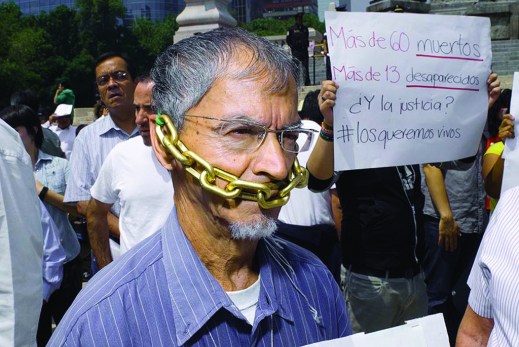
Journalists protest in silent march in Mexico City, Courtesy of the Knight Foundation
To closely listen to the soundscape of narco silence, I engage with the play script and production of Tanya Saracho’s play El Nogalar at South Texas College Theatre (STC) under the direction of Joel Jason Rodriguez in McAllen, Texas in June 2013. The play was first produced at the Goodman Theater in Chicago in April 2011, with a West Coast premiere at the Fountain Theater in Los Angeles in January 2012. I critically analyze the STC Theatre production’s incorporation of a multi-genre soundtrack that included narcocorridos, rancheras, and nortec (norteño + techno). I argue that this soundtrack focused audiences’ attention not only on the devastating effects of silence, but also the function of silence as a form of capital for those most excluded in society. I also offer a brief critical listening of the script’s rendering of silence through character dialogue and stage directions.
El Nogalar tells the story of an upper-class Mexican family comprised of three generations of women (Maité, Valeria, and Anita) whose land and home in the fictionalized estate of Los Nogales in Nuevo Leon, Mexico, and its adjacent nogalar (pecan orchard), are under threat by the maña (drug cartels) moving into the region. The play focuses on the women’s responses to the drug war economy as a result of their different relationships to home (both their estate and the space of Mexico). It also centers the experiences of Dunia, their maid, and López, a former field worker who now works for the maña.

STC Theater Production of El Nogalar. Photo Credit: Miguel Salazar
Cecilia Ballí, in her article “Calderón’s War: The Gruesome Legacy of Mexico’s Antidrug Campaign,” explains the particular circumstances of marginalized men in this society: “The worst casualties of this ‘civil war’ were the estimated 7 million young men to whom society had closed all doors, leaving them the options of joining a drug gang or of enlisting in the military, both of which assured imprisonment of death” (January 2012, 48). With the characters López and Dunia, the play asks audiences then to listen to the impact of the drug war on the most vulnerable populations in Mexico and the US-Mexico border region.
The play script conveys how “narco silence” can be used by those who either seek to preserve traditional class hierarchies (the story of the matriarch Maité) or to survive and profit in the new drug economy (the story of López). “Narco silence,” a term coined by reporter Jonathan Gibler in his book To Die in Mexico, refers to “not the mere absence of talking, but rather the practice of not saying anything. You may talk as much as you like, as long as you avoid the facts. Newspaper headlines announce the daily death toll, but the articles will not tell you anything about who the dead were, who might have killed them or why. No detailed descriptions based on witness testimony. No investigation” (2011, 23). In an early exchange between López and Dunia, López defends “narco silence” as a strategy of survival:

STC Theater Production of El Nogalar. Photo Credit: Miguel Salazar
DUNIA: Why are you the only one they leave alone, Memo?
LÓPEZ:….
DUNIA: All the men your age. Killed. Why Memo? (Beat).
LÓPEZ: Because I know when to keep my mouth shut which is not something I can say for you….
DUNIA: So that’s all it takes to be best of friends with the Maña? That doesn’t seem so hard to do? (American Theatre Magazine July/August 2011, 74).
Later in the play, Dunia, heeding López’s advice, offers a powerful observation of how “narco silence” enables her community to cope with death: “We all just walk around like we’re a movie on mute. You can see people’s mouths moving but all you hear is the static (my italics)” (American Theatre Magazine July/August 2011, 73-74).
The STC Theatre production enhanced the script’s soundscape of narco silence through its sound design, with a soundtrack that included rancheras, narcocorridos, norteño and nortec. This music provided audiences with a connection to the world of Los Nogales and captured each character’s process of coping with narco violence. For example, Maité’s soundtrack consists of several rancheras, such as Lola Beltran singing “Los Laureles” and Chavela Vargas’s powerful rendition of “Que te vaya Bonito.” Beltran’s “Los Laureles” – a cancion ranchera that includes Beltran’s powerful female vocals and mariachi orchestra instrumentation – invites audiences to hear Maité’s nostalgia and desire for an idealized Mexican society and her wish to preserve traditional class hierarchies.
.
Vargas’s powerful rendition of “Que te vaya Bonito” captures Maite’s pain and suffering as she loses her home to the cartels. In Vargas’s version of “Que te Vaya Bonito” – a song about love and abandonment – audiences hear Vargas’s choking and sobbing voice, accompanied by a single guitar.
.
Vargas’s voice conveys, what Lorena Alvarado powerfully argues, is “the body’s dilemma between the hysteria of sobbing and the intelligibility of words, between resignation and retribution” (2010, 4). Vargas’s powerful singing also conveys, as Alvarado further describes, “un nudo en la garganta,” a common expression in Spanish that describes “the knot in the throat, when one cannot speak because words will not come out, but the desperate, or quiet, breath of tears” (Alvarado 2010, 5).
To sonically register the drug cartel economy and lifestyle underlying the “new” Los Nogales, the soundtrack also included narcocorridos. The first sounds we hear in the play are from the narcocorrido “El Carril Número Tres” – which includes two acoustic guitars and an electric bass – by Los Cuates de Sinaloa.
.
“El Carril Número Tres” – tells the story of a secret “lane number three” that allows a Mexican drug lord to freely go back and forth between the US and Mexico because he makes a deal with the CIA and DEA. With this focus on the US government’s involvement in the drug trade, the song centers how silences north of the US-Mexico border have perpetuated drug violence.
The music also included nortec, with songs by the Mexican Institute of Sound, particularly the track “Mexico,” which is a critique of the Mexican government’s complicity with the narcos.
.
With “Mexico,” audiences hear a fusion of norteño, electronic, and hip-hop with lyrics that use the symbols of Mexican national identity and culture to focus the public’s attention on violence and terror. With the lyrics “green like weed, white like cocaine, red your blood” (referencing the Mexican flag) and “at the sound of the roar of the cannon” (alluding to the national anthem), the song powerfully invokes the visual and sonic soundscape of violence that terrorize Mexican residents. With this charged critique of government corruption, “Mexico” momentarily interrupts the soundscape of narco silence rendered in the play script and rest of the soundtrack.
Ultimately, the production’s combination of rancheras, narcocorridos, and nortec captured the class tensions in Mexican society and emphasized the play’s critique of class structures that have enabled drug war violence to persist. With this range of music, the director explains he wanted to “maneuver between the [various] aspects of [the story]: the nostalgia, the corridos, the narcocorridos, and also this fusion of saying ‘we want something more,’ and so that was the whole aspect of it; the blending of the old, the new, and what the present is” (Interview with author July 2013).
The production also deliberately incorporated the sound of silence, particularly in the final scene. By the end, López buys the Los Nogales estate, thereby increasing his class status and social power. Saracho’s stage directions in this final moment indicate “an interpretive sound of trees falling. Now don’t go cueing chainsaws because it’s not literal. Just make me feel trees are falling. Along with the upper class” (87). The play’s reference to the staging of “an interpretive sound of trees falling” brings to mind the philosophical question: “If a tree falls in a forest and no one is around to hear it, does it make a sound?” We might then interpret the final sounds of El Nogalar as inviting audiences to listen attentively to the soundscape of narco silence, implicating audiences as social actors in the politics of the drug war that continue to devastate Mexican society.
—
Featured Image: Journalists Protest against rising violence during march in Mexico, Courtesy of the Knight Foundation
—
Marci R. McMahon received her Ph.D. from the University of Southern California with affiliations in the Department of American Studies and Ethnicity. She is an assistant professor at the University of Texas, Pan American, where she teaches Chicana/o literature and cultural studies, gender studies, and theater and performance in the Departments of English and Mexican American Studies. She is the author of Domestic Negotiations: Gender, Nation, and Self-Fashioning in US Mexicana and Chicana Literature and Art published by Rutgers University Press’ Series Latinidad: Transnational Cultures in the United States (May 2013). Her essays on Chicana literature and cultural studies have been published in Aztlán: A Journal of Chicano Studies; Chicana/Latina Studies: The Journal of MALCS; and Frontiers: A Journal of Women’s Studies. Her second book project, Sounding Latina/o Studies: Staging Listening in US Latina/o Theater explores how contemporary Latina/o drama uses vocal bodies and sound to engage audiences with recurring debates about nationhood, immigration, and gender.
—
REWIND! . . .If you liked this post, you may also dig:
Listening to the Border: “’2487’: Giving Voice in Diaspora” and the Sound Art of Luz María Sánchez–D. Ines Casillas
Quebec’s #casseroles: on participation, percussion and protest–Jonathan Sterne
Deejaying her Listening: Learning through Life Stories of Human Rights Violations— Emmanuelle Sonntag and Bronwen Low
Share this:


Current Top Posts





April 2021

January 2020

November 2019

October 2019

August 2019

April 2014

November 2017

March 2015

December 2017

October 2015
 Sounding Out!
Recent Comments