
Xicanacimiento, Life-giving Sonics of Critical Consciousness


This series listens to the political, gendered, queer(ed), racial engagements and class entanglements involved in proclaiming out loud: La-TIN-x. ChI-ca-NA. La-TI-ne. ChI-ca-n-@. Xi-can-x. Funded by an Andrew W. Mellon Foundation as part of the Crossing Latinidades Humanities Research Initiative, the Latinx Sound Cultures Studies Working Group critically considers the role of sound and listening in our formation as political subjects. Through both a comparative and cross-regional lens, we invite Latinx Sound Scholars to join us as we dialogue about our place within the larger fields of Chicanx/Latinx Studies and Sound Studies. We are delighted to publish our initial musings with Sounding Out!, a forum that has long prioritized sound from a queered, racial, working-class and “always-from-below” epistemological standpoint. —Ed. Dolores Inés Casillas
—
In the past year, we, Esther, a first-generation profesora in Latinx culture and feminist studies in Chicago and Kristian, an L.A-raised Xicano de letras pursuing a doctoral degree in Santa Barbara, engaged in a multi-synchronous dialogue on the life-giving sonics of our critical consciousness. This Xicanacimiento, as theorized in Kristian’s current writing and in conversation with Irene Vasquez and an emerging generation of Chicana/o scholar-educators, refers to the incomplete process and life-giving knowledge forged in the socio-political and pedagogical activities of Chicanx worldmaking.
SO! writers note music listening as a powerful site for critical thinking. Erika Giselda Abad, for instance, teaches the Hamilton Mixtape so her Latinx students may “hear [their stories] from people who look and sound like them.” We reflected on the pedagogical implications of our music listening that informed our coming-into-critical consciousness. In this diálogo, we developed a playlist through experimenting with our sonic memories through the poetics of our rasquache sensibilities. Gloria Anzaldúa suggests something similar with notes from Los Tigres, Silvio Rodriguez, and others in La Frontera. Our auditory imaginary echoes our evolving conocimiento toward spiritual activism.
Here, we offer our musical resonances as shaped by our gendered, place-based, and generational Xicanx experiences as a pathway to hear the auditory dimensions of Xicanacimiento. Our listening is thus counter-hegemonic or a “brown form of listening” as suggested by D. Inés Casillas, “a form of radical self-love, a sonic eff-you, and a means of taking up uninvited (white) space,” when this listening evolves critical anti-imperialist and feminist consciousness that hears 500 years of opresión y resistencia.
Diverging from the mixtape genre, our Xicanacimiento playlist seeks to convey something beyond connection and emotion towards a sustained affective state. Instead of a sonic moment, we hear a sonic stream; a subaltern auditory repertoire that is multi-directional and open to expansion by any and all interpellated Xicanx ears.
Kristian: Tuning-in to Xicanacimiento is a symbiosis of feeling and listening to La Chicanada from Califas to all corners of Aztlán unearthed. I was raised to the sounds of my father’s rancheras played in his truck and the hip-thumping rhythms of bachata and reggaetón played in my mother’s kitchen after a workday.
Yet, my love for UK anarcho-punk and US hardcore punk developed in defiance of public schooling and of a disaffected civil society. As a youth during the Great Recession, a future without higher education meant prison, the military, death by overdose, or the eternal damnation of working the Los Angeles service industry. I thrashed in sound; numbing my ears with noise, bruising in the mosh pit; bearing witness to minors as mota and alcohol addicts; pierced by the cries of police sirens breaking up our communion.
I found refuge in Xicanacimiento as a community college student and as a transfer at UC Los Angeles. I came into Xicanx consciousness by studying Mexican anarchists and Chicanx organizing. As a MEChistA, I came to listen to the ways local elders, youth, organizers, and agents of social transformation in Los Angeles identified their struggle with land, life, and spirit. My primer to social movements gave me language, and it was MEChistAs who offered me a new soundtrack against the escapism of the Los Angeles punk scene. The resonances of marchas, fiestas, and the songs of danza azteca oriented me into a new modality of listening. Xicanacimiento was the sonic web of these social and cultural practices, rooted in my auditory encounters with the verses of Quetzal, the biting guitars of Subsistencia, the rhythms of Quinto Sol, and the lyrical narratives of Aztlán Underground. The life-giving sonics of Xicanacimiento grazed against my wounded sonics of broken glass, nos tanks, drunk noise, and the cacophonous affair of a raided gig as intoxicated Latinx youth disperse into the discordant symphonies of the urban soundscape.
Esther: I listen as a campesina migrante translocada from Jalisco to California, Texas, and Illinois. Some twenty years ago, while attending Cal State en el Valle Central, I heard Xicanacimiento as concientización; an evolving awareness about la lucha obrera, the open veins of Latinoamerica and my place within the interlocked hierarchies of race, class, and gender in US society. With Chicanx and brigadista musics I felt connected to la lucha and acquired the language to name capitalist imperialism rooted in white supremacy as the enemy of humanity and Pachamama.
My early sonic memories include the sequence of my Alien number, the urging tones of radio hablada discussing Prop 187 (insisting we were aliens), Prop 227 (banning our language), and reports of Minuteman harassing la raza. I was immersed in listening; my mother’s sobremesa, my sister’s Temerarios at 5 am, Selena on the school bus, and 90s hits-from Chalino to Morrissey-on Columbia House CDs I traded with my older brother. Among other norteñas, La Jaula de Oro, the theme song of the diaspora of papás mexicanos, played at random-at the marketa, en los files, in passing cars, and so on…- to remind us of my father’s sacrificio en el norte caring for 500 dairy cows, six days a week, in two 5-hour shifts, to provide us el sueño americano.
I studied music in college, playing jazz and orchestral bass until the racist and sexual harassment targeting my young Latina body turned me away. I left the scene but continued my communion with music through library loans, traveling vendors, and trips to Amoeba. In reggae and canción nueva I found otros mundos posibles in the upbeat, cariño in 2 over 3, and the poetics of black and brown history; manos abiertas, muchas manos.
In 2002, “El Rasquache Rudo” a poet from the Rudo Revolutionary Front brought me sounds from Azltán; the UFW unity clap rallying in Modesto, a recitation by José Montoya in Sacramento, and brigadista music synergizing the 1492 quincentennial resistance with the uprising of the Ejército Zapatista de Liberación Nacional (EZLN). As Omar Marquez argues, the Zapatista uprising shifted Chicano ideology to speak from the position of a living indigenous present; still loud in the work of Xicanx activists like Flor Martinez. Into the 21st century, Aztlán Underground, Manu Chao, and Todos Tus Muertos, among others, soundtracked our protests against the invasions of Afghanistan and Iraq.
Julieta Venegas’s distinctly vulnerable voice over the controlled chaos of ska and Martha Gonzalez’s tension over the wall of sound that is Quetzal, was transformative as I heard In Lak’ech; hearing in their voices possibilities for my Chicana existence.
Some of these selections anchor my first-year lectures at the University of Illinois in Chicago, where most of my students are working-class Latinx and Black. I do this with the intention of “opening affective pathways toward Xicanacimiento” as Kristian offered, and to insist on the point that Latina/o/x Studies is to be a critical, anti-hegemonic, subaltern field of study that hears a history from el mundo zurdo.
Outro:
In a gesture to deconstruct the term Xicanacimiento, one might think of the words “renacimiento”and “conocimiento.” What might emerge is a “regenerative force” and “collective knowledges” in consideration to how we listen, what resonances are made, and what sounds we inhabit when Xicanacimiento is invoked or felt as sound. Tuning into this auditory imagination guides the listener to a myriad and select decisions of what constitutes the Xicanx resonance for the local sonic geographies and the soundscapes which emerge from music. This curated sonic experience is one where voice, instrument, memory, and affect intersect.
—
Featured Image by Jennifer Lynn Stoever
—
Esther Díaz Martín is a researcher and educator in the Latin American and Latino Studies and the Gender and Women’s Studies program at the University of Illinois in Chicago. At present, she is working towards finishing her manuscript Latina Radiophonic Feminism(s) which seeks to amplify the acoustic work of popular feminism in contemporary Spanish-language radio and Latina podcasting.
Kristian E. Vasquez is a Xicano writer, poet, and zinester born and raised in Los Angeles, California currently pursuing a doctoral degree in Chicana and Chicano Studies at UC Santa Barbara. His research on the affects, sounds, and semiotics of La Xicanada expands the concept of Xicanacimiento, centering the affective force of expressive culture.
—

REWIND!…If you liked this post, you may also dig:
Ronca Realness: Voices that Sound the Sucia Body—Cloe Gentile Reyes
SO! Podcast #74: Bonus Track for Spanish Rap & Sound Studies Forum—Lucreccia Quintanilla
“Heavy Airplay, All Day with No Chorus”: Classroom Sonic Consciousness in the Playlist Project—Todd Craig
Deep Listening as Philogynoir: Playlists, Black Girl Idiom, and Love–Shakira Holt
Mixtapes v. Playlists: Medium, Message, Materiality–Mike Glennon
SO! Amplifies: Memoir Mixtapes
Could I Be Chicana Without Carlos Santana?–Wanda Alarcón
Tape Hiss, Compression, and the Stubborn Materiality of Sonic Diaspora–Christopher Chien
Sounding Out! Podcast #28: Off the 60: A Mix-Tape Dedication to Los Angeles–J.L. Stoever
“Oh how so East L.A.”: The Sound of 80s Flashbacks in Chicana Literature–Wanda Alarcón
Share this:

Sounding Out Tarima Temporalities: Decolonial Feminista Dance Disruption

 For the full intro to the forum by Michelle Habell-Pallan, click here. For the first installment by Yessica Garcia Hernandez click here. For the second post by Susana Sepulveda click here. For last week’s post by Wanda Alarcón click here,
The forum’s inspiring research by scholars/practioners Wanda Alarcón, Yessica Garcia Hernandez, Marlen Rios-Hernandez, Susana Sepulveda, and Iris C. Viveros Avendaño, understands music in its local, translocal and transnational context; and insists upon open new scholarly imaginaries. . .
Current times require us to bridge intersectional, decolonial, and gender analysis. Music, and our relationship to it, has much to reveal about how power operates within a context of inequality. And it will teach us how to get through this moment. –MHP
—
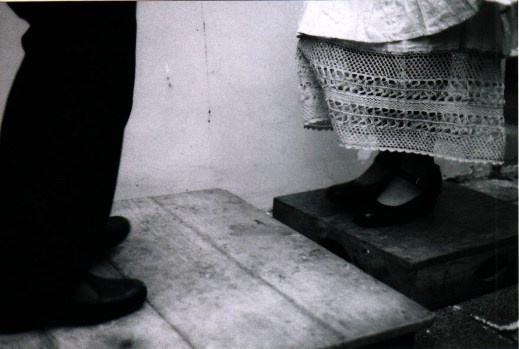
The knowledge presented in this piece is reflective of countless conversations, and the many interactions I have had with teachers, practitioners, and extended fandanguerx communities in Mexico and the U.S. In my scholarly work, I draw from these conversations and my personal experiences as a bailadora in the fandango tradition to illustrate the power of community music as a practice to generate and articulate knowledge in relation to personal and social change. My work centers the study of rhythmic synchronicity in the fandango tradition from Veracruz, Mexico embodied in Zapateado; the percussive sound of women rhythmically stomping their feet on wood.
I am particularly interested in conversations that approach the study of rhythm from a feminist perspective as it allows us to claim visibility to the gendered and racialized voices of resistance that are often absent in academic discourse. My analysis builds on the contributions of Martha Gonzalez, who through her term rhythmic intention explains in “Sonic (Trans)Migration of Son Jarocho Zapateado: Rhythmic Intention, Metamorphosis, and Manifestation in Fandango and Performance”: “[rhythms] processed by the body are not varying forms of making time in music practice, but they are indeed political acts rooted in a history of resistance” (60). To this, I theorize the ca-fé con pan––a polyrhythm cyclically played by women in the majority of sones in the fandango repertoire––to argue that rhythms embodied by the tarima speak of a learning practice that moves beyond the idea of individual knowledge to the concept of relational knowledge. The polyrhythmic zapateado that bailadoras sound out on the tarima is rooted in, and flourishes through interpersonal relationships among women as dancers, and through a more profound awareness and synchronized relationship with nature, all the plants, animals, and natural resources which comprise it as Shawn Wilson discusses on Research Is Ceremony : Indigenous Research Methods (4). The relational embodied knowledge of the bailaoras through zapateado, can thus be understood as a political act, one of decolonial resistance.
My approach to the study of this rhythm comes from the perspective of a bailadora. Although, I respect the work of scholars who capture the technicality of sound and rhythm, I do not offer an analysis of it from the perspective of a trained musician. I learned to dance and play music in informal settings, with my family and the people in the neighborhood. With a working class background, formal training in music or dance was a luxury enjoyed by the elites. Even though I lived in Veracruz for many years, I did not grow up within the tradition, but knew about the music through my dad who taught me some steps. My formation in community dances was primarily through family parties and the sonidos in Mexico City; block parties with huge speakers blasting a variety of tunes ranging from old cumbias, salsas, banda, merengue, and Mexican urban rock. Sonidos in the capital city are most popular in neighborhoods with high concentration of workers in informal economies, many of whom are migrants from states through the republic, who have been displaced due to neoliberal capital flows, various degrees of violence related to drug trafficking, and other socio economic devastation. I grew up going to sonidos in Iztapalapa, and “Neza’–Short for Netzahualcoyotl–a working class neighborhood outside Mexico City., where I lived before moving to Veracruz. From a young age, my ear became familiar to the sound of polyrhythms in family parties and sonidos dancing to cumbias and salsas.
Tlacotalpan, Veracruz, Festival de Son Jarocho, feb’13, image by Flickr User boerries nehe (CC BY-NC 2.0)
Even though I attended a few fandangos before I emigrated to the U.S. in 2004, I started to regularly practice them in Seattle with my mentor and friend Chicana artivista Gonzalez who co-founded the Seattle Fandango Project, a collective of students of the fandango tradition based in Seattle, WA. Martha was the first person who I heard using the term polyrhythm to describe the texture and rhythmic basis of fandango. With Indigenous, African, and European influences, amongst many elements in the fandango, the tarima is a notably polyrhythmic instrument that in its majority is played by women. It also carries the driven pulse of the fandango, where multiple bailadoras stomp with their feet fixed rhythms and syncopated improvisations. The basic fixed rhythm danced in the majority of sones is the ca-fé con pan composed of two independent rhythms of duple and triple meters playing simultaneously. This foundational understanding of polyrhythm as the simultaneous sound of two independent rhythms allows us to perceive the manner in which the cyclical repetition of the cafe con pan, embodied by bailadoras on the tarima, disrupts colonial logics of linear an individualized progress marked by the hegemony of the single bit of a clock. The dancer, processing and articulating rhythms through the body, engages in decolonial (learning) practices that generate a shift in consciousness from individual to relational knowledge.
This recording of “El Siquisiri” from a huapango (another name for fandango, most used in communities in the South of the state) in Michapan de Osorio, Vercruz with Colectivo Alteppe, from Acayucan gives us two in a half minutes of community soundscapes.
“El Siquisiri,” Chacalpa, Veracruz
.We can hear fireworks, the tuning of strings, “aganse para aca” (“como this way/come over here”) and “No se pongan atras” (“don’t stay behind”). Followed by the requinto’s call of the son, the jaranas join in, almost in unison, with the percussive footwork coming at last. In some cases bailadoras dance after the first verse is sung. With the sound of the footwork, in between taking turns to get on and off the tarima, you can hear dancers showing their skills in the afinque de su zapateado, their grounding of the step. By listening to the changes in style, rhythm, and force of sound of the zapateado, you can tell different bailadoras have taken their turn to get on the tarima. There are changes in the volume, intensity, and grounding sound in styles of stomping on the tarima. I say that these changes articulate through sound the inclusive nature of fandango, particularly the collective listening that makes space for each other’s rhythms.

Seattle Fandango Project. Photo credit: Scott Macklin.
Articulated by Gloria Anzaldúa, I often think of bailadoras as Nepantleras: boundary crossers, thresholders who initiate others in rites of passage, activistas who from listening, receptive spiritual stance, rise to their own visions and shift into acting them out, haciendo un mundo nuevo (making a new world). They encourage others to ground themselves to their own bodies and connect to their own internal resources, thus empowering themselves. Empowerment is the bodily feeling of being able to connect with inner voices/ resources (images, symbols, beliefs, memories) during periods of stillness, silence, and deep listening or with kindred others in collective actions.
The bailadora in fandango is an example of someone who listens with a decolonial ear. Bailadoras recognize that the rhythmic vibrations they collectively create on the tarima are potential spaces to embody Nepantla. Anzaldúa explains in Light in the Dark/Luz en lo Oscúro: “Nepantlas are places of constant tension, where the missing or absent pieces can be summoned back, where transformation and healing might be possible, where wholeness is just out of reach but seems attainable” (2). Nepantla is the space where change happens, the kind of change that requires more than words on a page: it takes perseverance, and creative ingenuity. In learning the percussive footwork in fandango one practices listening in relation to others. A good dancer has to be aware of the space and improvisations of other dancers.
As a bailadora myself, I have often been reminded by teachers,––Ruby Oseguera, Laura Rebolloso, Martha Gonzalez and Gemma Padua–– to always stick to the cafe con pan and improvise when a good moment in the son comes up. Zapateado fandanguero cares about the cadencia del son, the feeling in the fixed rhythm: the ca-fé con pan. To maintain the groove of the son, bailadoras engage with one another in a decolonial listening practice that extends to the rest of the fandango soundscape changing the focus from a personal to a collective awareness. When we are referring to a decolonial listening practice we must understand that we are talking about an active sensorium that has personal and collective implications. Best articulated by Chela Sandoval in Methodology of the Oppressed, a decolonial praxis “depends on the practitioner’s ability to read the current situation of power, and self-consciously choosing and adopting the ideological stand best suited to push against its configurations. This is a survival skill well known to oppressed peoples” (50). The conditions that people within communities create in polyrhythmic music practices extend beyond the musical experience. Fandango and polyrhythm are the materialization of ways of being center on the awareness of our relationships and the relationship one shares with reality.

Son Jarocho Band, Image by Flickr User ilf_ (CC BY-NC 2.0)
Collective rhythmic practices are potential spaces where alternative consciousness to the hegemony of coloniality can originate. They activate an epistemology of differential consciousness that relies on the integration of the self as tuning into reality through sound. These acts of knowing connect to notions of relationality situated at the center of indigenous epistemologies. As Walter Mignolo claims in “Geopolitics of Sensing and Knowing: on (De)Coloniality, Border Thinking and Epistemic Disobedience,” Relationality gives us the ability to think and do decolonially dwelling and thinking in the borders of local histories confronting global designs (277). Using music as a tool to organize collectively, fandanguerxs in Mexico, and the U.S. challenge global designs of social organization that continue to displace communities of color around the world. To exemplify this sentiment I share this video of el son de la morena, the Dark skin woman performed by Collectivo Altepee’s in one of their visits to the U.S. Before the beginning of the son, Sael Bernal shares:
There are many types of music. This music has to do with people’s hearts, and everyone is different and this is the reason why this music sounds different depending on where you are, but in our hearts we all have this characteristic of humanity based on our capacities to relate to one another. This is the reason why we can share space and live together… ¡y qué viva la diversidad!
Chicago, 2012. Mario Gervacio, Sael Bernal, Gema Padua, Luis Sarmiento, Alberto Alor, & Simon Sanchez.
Featured Image: “encuentro de jaraneros y decimistas, tlacotalpan, veracruz, enero/febrero ’14” by Flickr user boerries nehe (CC BY-NC 2.0)
—
Iris C. Viveros Avendaño was born and raised in Mexico. She is a Ph.D. Candidate and a McNair Scholar in the Gender, Women, and Sexuality Studies department at the University of Washington. Her academic interests emphasize the integration of third world feminist approaches to the analysis of colonial legacies and projects in present-day systems of violence. To this effect, she focuses on the role of social structures and state-mediated technologies of power and domination in perpetuating violence against Afro Indigenous [descent] women. In addition, Iris’s scholarly work focuses on study of decolonial cyclic temporalities embodied on the tarima, or platform drum center stage in fandangos as practices of resistance, recovery, and healing from trauma. A central idea throughout her scholarly work is the exploration of the rhythmic body in fandango–In its collective and individual manifestation–particularly on the tarima, where knowledge is produced, reproduced, and transmitted.
A major source of Iris’s academic and personal inspiration comes from her involvement as a bailadora/percussive dancer and active co-organizer in the Seattle Fandango Project, a community dedicated to forging relationships and social activism through participatory music, poetry, and dance.
—
 REWIND! . . .If you liked this post, you may also dig:
SO! Reads: Deborah R. Vargas’s Dissonant Divas in Chicana Music: The Limits of La Onda–Wanda Alarcon
SO! Amplifies: Sounding Board Curated by Leonardo Cardoso–Jay Loomis
Spaces of Sounds: The Peoples of the African Diaspora and Protest in the United States –Vanessa Valdés
Share this:


Current Top Posts





April 2021

January 2020

November 2019

October 2019

August 2019

April 2014

November 2017

March 2015

December 2017

October 2015
 Sounding Out!
Recent Comments