
The Sonic Roots of Surveillance Society: Intimacy, Mobility, and Radio


It’s an all too familiar movie trope. A bug hidden in a flower jar. A figure in shadows crouched listening at a door. The tape recording that no one knew existed, revealed at the most decisive of moments. Even the abrupt disconnection of a phone call manages to arouse the suspicion that we are never as alone as we may think. And although surveillance derives its meaning the latin “vigilare” (to watch) and French “sur-“ (over), its deep connotations of listening have all but obliterated that distinction.
Rounding out our series on surveillance, Kathleen Battles offers a historical perspective that shows how early twentieth century crime drama naturalized practices of citizen surveillance. A million eyes were activated as millions of listeners learned that the immediacy of radio and telephone allowed for an unprecedented level of participation in law enforcement. Calling all cars…Calling all cars… -AT
—
Police Headquarters, a 1932 radio crime drama, was produced in the infancy of narrative radio. Containing barely 12 minutes of narrative content, the program opened each episode with a repeating segment of call, connection, and dispatch to quickly establish both the crime committed and how the police responded to it. For example, in the “Payroll Robbery” episode it takes just over a minute and a half to hear a phone call to the titular headquarters, its connection to the proper unit, a radio call to a specific police car, and the responding officers arriving at the assigned location. Compared with the graphically and visually intense images of modern surveillance in contemporary popular culture, this brief exchange no doubt sounds quaint, simplistic, and even banal. After all, radios, cars, and telephones have served as the routine backdrop of most police dramas for some 70 years. But in 1932 the interlinking of these technologies was factually, as well as imaginatively, novel. This essay shows how radio, as “new media,” was central to imagining surveillance in sonic terms, prefiguring many features of contemporary surveillance practices.
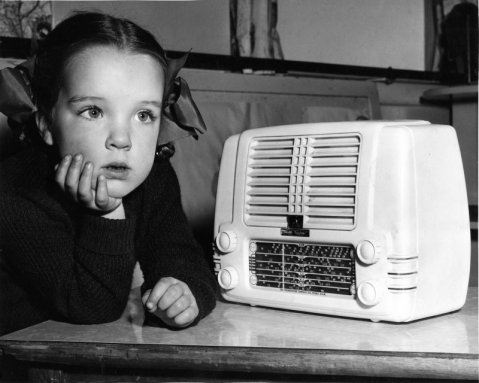
“Kindergarden of the Air,” by the Australian Broadcasting Corporation CC BY-NC-ND.
The introduction of radio and cars into police work took place in the first decades of the twentieth century, especially during the years between the two world wars that Richard Popp (2011) calls “the machine age”. He argues that this period witnessed vast transformations brought on by cars and radios, which, when combined with existing technologies like the telephone, forged new communication networks that transformed both work and leisure. These changes were central to the narratives of criminality and policing that emerged during the interwar years. Police were the focus of radio dramas, including Police Headquarters and Calling All Cars. These dramas played with the intermingling of automobility, telephony, and radio in ways that spoke to the main problems police forces saw themselves facing: organized, professional, mobile, machine-age criminals. Cars, telephones, and automobiles were not just tools to criminals, but they were also the building blocks for a machine age surveillance made possible by the sonic power of radio.
Recently, Robin James (2014) has suggested that the acousmatic is a useful metaphor for understanding the emerging practices of data based surveillance. Acousmatic surveillance listens for patterns in “ambient data environments” instead of profiling individuals in the panoptic sense. At the turn of the twentieth century, radio allowed for a panacoustic mastery of spaces that bridged both panoptic and acousmatic surveillance. Radio also speaks to another key feature of information age surveillance, what Mark Andrejevic (2011) describes as the “redoubling of tools for communication and leisure as technologies for surveillance and security.” (165-66) The technical capabilities and imaginative potentials of radio help us to consider it both as a police technology and entertainment medium. The sonic power of radio was often figured as an “Invisible Man Hunter,” whose realignment of spatial and temporal arrangements rendered criminal escape impossible. As an entertainment medium, radio’s aurality was key to understanding its imaginative potential as highly intimate and mobile: invasive and expansive.
In Police Headquarters we hear how radio’s sonic and aural qualities come together. Radio acts as the link between the telephone and car, allowing for a swift response to a citizen request. The tactical use of sound effects and narrative compression in the broadcast situate the listener inside a machine like apparatus that presents the police as always available. At their broadest level, radio crime dramas aurally situate communication and transportation technologies, like radio, as key to both the narrative organization of the story and as a plot element. In the opening to the “Stop That Car” episode of Calling All Cars, a dispatcher advises for cars to be on the lookout for a specific car involved in a hit and run, including the address of the crime and possible location of the vehicle. Overlaid with sound effects made to signify a car, these openings situate listeners as riders eavesdropping on the adventures of mobile police officers. As the program’s title suggests, each episode opened with a police radio call, often voiced by real life LAPD dispatcher, Jessie Rosenquist. The program’s sponsor was the gasoline company that supplied the fuel for LAPD patrol cars – further linking cars and radio as a key theme. In the opening to the “Two Man Crime Wave Episode,” the very ad for the product is performed as a police radio call.
The conceit of eavesdropping on a police adventure did much to link private life and the police. This theme runs tandem to radio’s sonic immediacy, which allowed listeners to imagine a seemingly instantaneous response to citizen phone calls.. For example, the “July 4th in a Radio Car” episode of Calling All Cars situates radio listeners as sonic participants, able to ride along with police from the comfort of their own living rooms. Here, cars respond to a number of calls made by private citizens that bring the policing function into daily life. There is even one call that involves domestic violence, in particular. Throughout the episode, police are situated as an available force – thanks to the telephone, radio, and automobile – to adjudicate all manner of private disputes. In these particular instances the intimacy of radio as a machine age technology is “redoubled” with radio as a police technology. Radio’s intimate address allowed the voices of police officers to enter the private space of the home. At the same time, the machinery of crime fighting required citizen participation, most often figured through the phone call from within the space of the home to the police.

“Radio Police Automation 1924,” by Robert Wade, CC BY-NC-SA.
If the intimacy of radio served to cross the divide between public and private, the spatial-temporal collapse achieved by radio made it ideal for sonically monitoring great swaths of space. Intimately linked with cars, radio was understood as especially mobile. Radio’s ability to compress the relationship between space and time is frequently dramatized. For example, in the “Crime vs. Time” episode of Calling All Cars, the host explains how radio has rendered the average response time to a police call for help only two minutes and forty seconds. The episode then proceeds to show how radio was used by the police to track and apprehend two men who robbed a movie theater. Representing phone and radio calls, while specifically referencing geographic locations, radio dramatists used radio’s aural dimensions to render radio’s sonic power of surveillance. Capable of reaching everywhere, police radio, when linked with the telephone and automobile, could be used to sonically pinpoint any somewhere that a criminal might try to escape to.
In our era of high-tech and sophisticated technologies, visually rich narratives, and algorithmically driven methods of tracking, there is certainly something simple, comforting, and even nostalgic in these tales of low-tech machine age criminal apprehension. Depression era true crime dramas certainly do not offer the kind of sophistication as information age narratives, such as The Wire. The medium’s sonic qualities were key to linking together its use as both a police instrument and as a domestic entertainment technology. With sonic forces invisibly and silently crossing the into intimate domestic spaces and covering large swaths of territory, radio became key to imagining many features that we take for granted as “new” about the information age: the control of movement across space, the constant availability of communicative connection, the promise of perfect coordination across a field of institutional actors, the marshaling of citizen participation in surveillance efforts, and the construction of increasingly intimate links between domestic life and law enforcement procedures. In serving as central node in refiguring shifting notions of space and time that existing institutions were not prepared to handle, radio’s sonic qualities remapped the meaning of police work and helped to establish a relationship between the police and citizen body that still resonates today. While not as technologically sophisticated, machine age policing and police narratives took advantage of radio’s double function as both a machine of coordination and medium of entertainment to extend the policing function into more areas of life. This reflects a sonic mode of power that allows neither the interior space of the home nor the exterior world of the road relief from police presence. This moment of technological interconnection, however, evoked the excitement and anxiety that made sonic surveillance at once thrilling and calming; a salve to soothe the woes of a world that now seemed intensely close and impossibly far flung. Is it any wonder that while some fret over the power of corporate and state dataveillance today, that some continue to find comfort in the possibility of being recognized as someone in a world of ever more intense interconnection?
—
Featured image “Radio for Backup” by Jonathan Flinchbaugh CC BY-NC-SA.
—
Kathleen Battles is Associate Professor and Graduate Director in the Department of Communication and Journalism at Oakland University. Her research focuses on radio history, especially as it relates to issues of policing, sound and surveillance, questions concerning technology and culture, and sexuality and the media. She is the author of Calling All Cars: Radio Dragnets and the Technology of Policing (University of Minnesota Press, 2010); co-editor (with Joy Hayes and Wendy Hilton-Morrow) of War of the Worlds to Social Media: Mediated Communication in Times of Crisis (Peter Lang, 2013); and co-author (with Wendy Hilton-Morrow) of Sexual Identities and the Media: An Introduction (Routledge, 2015). In addition, her work has appeared in Critical Studies in Media Communication, The Radio Journal, and the Journal of Homosexuality.
—
 REWIND!…If you liked this post, check out:
Acousmatic Surveillance and Big Data-Robin James
The Dark Side of Game Audio: The Sounds of Mimetic Control and Affective Conditioning–Aaron Trammell
À qui la rue?: On Mégaphone and Montreal’s Noisy Public Sphere-Lilian Radovac
Share this:

Radio Ambulante: A Radio that Listens

 Welcome back to the final article in our three-part series, Radio de Acción. Special thanks to you, our readers, and to editors Jennifer Stoever and Neil Verma at Sounding Out! for hosting this addition to a burgeoning field of Latin American critics and producers who are changing the way we hear radio as history, as theory, and in practice.
Over the past several weeks we have tried to bring you into the multiple worlds made possible by radio in Latin America. If you missed our previous posts, please find Alejandra Bronfman’s stunning history of radio in the Caribbean here, and Karl Swinehart’s fascinating study of Aymaran-Spanish radio here.
Both of these critical approaches set the stage for Carolina Guerrero’s extraordinary work with radio in the Americas. An executive director and co-founder of Radio Ambulante—a program that fellow co-founder and novelist Daniel Alarcón calls “This American Life, but in Spanish, and transnational”—Guerrero’s post takes us behind the scenes of her show to consider how the sounds on radio come to life for us as listeners, and the significance of hearing someone’s words in her or his own voice and language. For more Radio Ambulante after you finish reading and listening to Carolina’s post, please visit their website and download their podcasts.
–Guest editor Tom McEnaney
—
In late 2007, novelist Daniel Alarcón was hired by the BBC to produce a radio documentary about Andean migration in his native Peru. He spent 10 days traveling around the country, from the highlands to Lima, conducting interviews in both English and Spanish, talking to a wide range of people with very personal stories about migration. But when Daniel received the final mix from London, he was disappointed to find that the editor had privileged the English language voices, and left out many of the most compelling Spanish language storytellers. Daniel was left with a question: what if there was a space for those voices on the radio waves? What would it sound like?
Over coffee in San Francisco in January 2011, Alarcón and I decided to create that space, inspired by US public radio shows like This American Life and Radiolab, which had no Spanish counterpart. We knew that poignant, fun, surprising, unique, sometimes sordid, sometimes romantic, absurd and incredible stories we often heard in Latin America were out there, just waiting to be reported. We knew that they would make great radio. And we knew there was an audience—in Latin America and the US—that wanted to hear it. The result became Radio Ambulante.
 .
.
FIRST STEPS
We began by asking many of our print journalist friends in Latin America to share stories with us. We sent them links to stories from some of our favorite American radio programs, and then contacted a few bilingual independent radio producers here in the US, and asked them for advice on the basics of radio production. Many directed us to Transom.org, which was an absolutely essential resource.
In March of 2012, we launched a Kickstarter campaign. All we had was an idea and a sampler with less than 45 minutes of audio—and still, we managed to raise $46,000 with the support of 600 backers. The success of this campaign was a huge confidence boost, and we knew we were on to something. We used this money to produce our pilot season.
.
Since then, we’ve worked with more than twenty different producers in more than a dozen countries. These are the characters that emerge from Radio Ambulante stories: a transgender Nicaraguan woman living with her Mexican wife in San Francisco’s Mission District; a Peruvian stowaway telling his harrowing tale of coming to New York in 1959, hidden in the hold of a tanker ship; the Chilean soccer player who dared challenge the authority of General Pinochet; a young Argentine immigrant to North Carolina, trying to find his way through the racially charged environment of an American high school. Taken together these voices create a nuanced portrait of Latino and Latin American life:
.
PERSONAL STORIES FOR ALL EARS
Now in our third season, we’ve been working hard to create a group of trusted producers and editors across Latin America; people we can turn to with an idea, people we know we can trust with our limited time and resources; reporters we can send to Cuba, send to Honduras, send to Venezuela, and be certain they’ll come back with usable tape, and a good story. We want these first time producers to become long-term contributors.
That’s the case of Camila Segura, Radio Ambulante’s current Senior Editor. She had no prior experience as a radio producer when she reported her first story for us in 2012. That piece, El otro, el mismo (The Other, The Same) is about two men, one Colombian, one Argentinian, who not only share the same name, but who look almost identical. From this coincidence, the story becomes something much stranger, funnier, more subtle, and ultimately quite moving:
.
We want the listener to be able to relate and identify with the characters, to feel what they feel. A good Radio Ambulante story should be universal and shouldn’t have an expiration date.
One story from our first season captures this universal quality. In 2011, River Plate, one of the most famous soccer clubs in South America, was relegated to the Argentine Second Division. This event shook the entire nation, and anyone who listens to this story could relate to the sadness and pain that the protagonist is feeling. Two years later, the story still has that raw power:
 .
.
HOW WE SOUND
Martina Castro, Senior Producer, has designed most of Radio Ambulante’s sound, finding the balance between music and sound effects in order to support the voice of the main characters. As she explains,
There are many kinds of pieces that make it to Radio Ambulante. Sometimes the story is focused on one person and their experience: something that happened long ago. Like with Mayer Olórtegui in Polizones (The Stowaways), and the story of how he and his friend Mario jumped aboard a ship headed to the United States. There is no substitute for a dynamic storyteller like Mayer. He not only recreates moments, sometimes even imitating the sounds of what he heard, but he remembers the emotion of what happened, and really feels deeply what he is talking about, like when his voice breaks up at the mention of saying goodbye to his friend Mario.
.
Other, more symphonic, multi-voiced pieces provide a different kind of production challenge. The script must showcase the many characters, while giving the listener enough grounding so as not to get lost. A particularly successful example is our award-winning piece “N.N.”, about Puerto Berrio, Colombia, by reporter Nadja Drost. Nadja gathered recordings of this river town, and conducted interviews with many locals, always focused on the issue of the floating, anonymous dead and the town’s strange relationship with these bodies. The music in a piece like this is only meant to support those real-life sounds and characters, and a repeated melody serves as a ghost-like echo of the dead, those voices we never hear.
We use music carefully to shift the mood, to mark the end of a section, and to alert the listener that something new is coming. The music is also meant to break up chapters of a story, give us a moment to reflect on what we just heard, or to indicate when something is about to change. There are examples in Yuri Herrera’s “Postcard from Juárez,” produced by Daniel Alarcón. It tells the story of Diana la Cazadora, or Diana the Hunter, a vigilante who set about killing bus drivers in one of the world’s most violent cities, allegedly as revenge for years of misogyny and sexism.
.
In this particular story, we were able to do something that the English version (produced for This American Life) could not: read in the original Spanish the letter that the supposed killer sent the local Ciudad Juárez newspaper explaining her actions. We had this read by Lizzy Cantú, a Mexican journalist who’d worked with us before, and then distorted her voice, to give it that dark ambience. The listener is supposed to feel the grim violence in those words: the desperation.
 THE STORY IS KEY
In three seasons producing the show, we’ve learned that the craft of radio comes from listening, and that the most challenging aspect of producing radio is not in the technical details of recording those voices or sounds, but in the story itself.
The most basic building block of a good radio story is a good interview. The technical aspects of gathering sound are less important than phrasing the questions to get vivid, almost filmic answers, full of details that set the scene.. As Executive Producer Daniel Alarcón explains,
We ask our reporters to push interviewees to describe scenes in great detail, to unpack moments. Our interviews can last two hours or more, and many are surprised that we go so in depth. We like our reporters to circle back, and then circle back again, so that we’re sure we’re getting the most vivid version possible of a given story’s crucial moments.
We ask our reporters to write colloquially, to imagine they’re telling the story to a friend at a bar. It’s important to have immediacy in the language, an expressive tone that can seem almost improvised, even when it isn’t. The emotional impact of radio is that it feels as though a secret is being shared. The script and the production should always be in service of this intimacy.
Before a script is final, it’s shared with other editors on the team around the globe (California, Colombia, Puerto Rico, Chile), mixed, edited, soundtracked, and refined through hours of collective work online.
 .
.
ONWARD
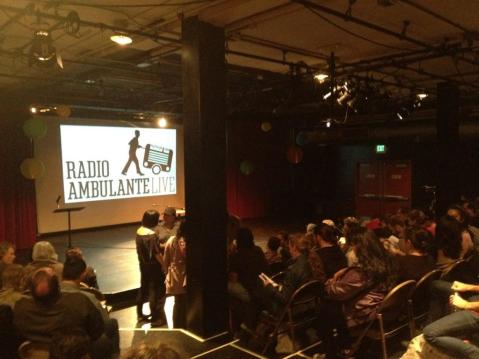
While creating our own sound and storytelling style, Radio Ambulante is constantly experiment with different formats and looking for new ways to interact with our listeners. We’ve done three live radio shows, in Los Angeles, San Francisco, and New York. In addition, we’ve produced two English Language specials, and partnered with writers and animators on hybrid multimedia storytelling. With our partners at PRI, we’re developing a new interview series, and are working with Latin American universities and media outlets to teach more journalists to use radio. Our hope is that Radio Ambulante’s success will mean more innovative radio work in Spanish, and more experiments in the possibilities of bilingual radio.
—
Carolina Guerrero is the Executive Director of Radio Ambulante. Before getting into journalism, she was a promoter for cultural and social projects, creating a bridge between organizations in three different continents. She has worked with public and private institutions in several countries, for which she has designed and overseen festivals, art exhibits, teaching workshops and fundraising events. Carolina is a John S. Knight Journalism Fellow at Stanford University 2014-15. She is the proud mother of León and Eliseo. (@nuncaduermo)
All images courtesy @radioambulante on Twitter
—
REWIND!…If you liked this post, you may also dig:
“We wanted to tell stories about sound: Opening Ears Through the Everything Sounds Podcast”-Craig Shank
“Chicana Radio Activists and the Sounds of Chicana Feminisms”-Monica De La Torre
“Óyeme Voz: U.S. Latin@ & Immigrant Communities Re-Sound Citizenship and Belonging”-Nancy Morales
Share this:


Current Top Posts





April 2021

January 2020

November 2019

October 2019

August 2019

April 2014

November 2017

March 2015

December 2017

October 2015
 Sounding Out!
Recent Comments