
Yellow Rain and The Sound of the Matter: Kalia Yang’s Sonorous Objection to Radiolab

The critically acclaimed WNYC program Radiolab found itself embroiled in a controversy for its recent broadcast segment “Yellow Rain.” Released on September 24, 2012 as part of the episode entitled “The Fact of the Matter,” the 20 minute segment “Yellow Rain” recounted the slaughter of hundreds of thousands of the Hmong by the Viet Cong and the Pathet Lao after the United States left Vietnam and the subsequent debates surrounding the chemical weapon called “yellow rain. The episode pitted the witnessing of Eng Yang, a survivor and documenter of the genocide—whom producer Pat Walters describes as the “Hmong guy” at one point—and his niece, award-winning writer Kao Kalia Yang—referred to only as “Kalia” by hosts Robert Krulwich and Jad Abumrad—against the research of university scientists and the relentless questioning of Krulwich.
Following the episode’s broadcast, many listeners and critics argued that Radiolab’s treatment of their the Yangs was Orientalist and unethical. Jea, writing on Radiolab’s “Yellow Rain” comment page suggested “Ms. Yang and her uncle were dismissed and even reduced to pawns in the larger scheme of RadioLab’s agenda.” Others, such as Bob Collins, writing for Minnesota Public Radio worried that “the story appeared […]to invalidate the Hmong loss and suffering in Laos.” Aaron, a commentor on Current Magazine’s coverage of the controversy called Radiolab’s coverage “inexcusable science, nothing close to journalism, and if only ‘a story,’ one that cements erroneous ideas in the minds of its listeners.” Kirti Kamboj, writing for Hyphen, a magazine dedicated to Asian American arts, culture, and politics, described the episode as “heartbreaking,” “utterly infuriating,” and an exemplar of “Orientalist, ethnocentric framing” designed to privilege Western knowledge.
From my perspective as a scholar of rhetoric, communication, and debate, to call Radiolab’s game rigged would be an understatement. The interview was not conducted on an even playing field and it smacks of a white Western privilege that the writers and producers failed to fully acknowledge even in their on-air discussion following the interview. Radiolab determined the questions, edited the exchange, and retained the capacity to both frame and amend the discussion (there is a debate concerning whether or not the Yangs knew the questions prior to the interview—this discussion can be found here, Radiolab’s response here , and answer to Radiolab’s claims here.).
In addition to the whether or not Radiolab misrepresented the Yangs and downplayed the mass murder of the Hmong in their pursuit of “truth,” I find that this episode is important for the insights it contains into argumentative invention, journalism, and new media ethics, all sparked by the grain of Kalia Yang’s voice in response to Krulwich’s questions. I argue that Kalia’s sounded distress functioned as what I call a “sonorous objection,” instigating the critique of Radiolab’s tactics. Borrowing from argumentation theory, an objection describes an argument that draws the context of an argumentative exchange into view. Research on objections has most often examined the use of visual images, such as the controversy sparked by the photographs coming from of Abu Ghraib. In this short piece, I will wed prior research on objections with theories about sound to argue that Kalia used the grain of her voice to call out—and call into question—the opaque assumptions that governed the interview and its reception.

Kao Kalia Yang, Image courtesy of the Fox Cities Book Festival
“Yellow Rain” recalls the Hmong genocide following the Vietnam War. The Hmong were recruited by the CIA to help disrupt supply lines to Ho Chi Minh City (or Saigon). After American troops withdrew, the Viet Cong and the Pathet Lao persecuted the Hmong for aiding the US. The communists attacked the Hmong, eradicating villages and blanketing populations with a sticky, yellow substance. Attempting to escape systemic annihilation, the Hmong receded into the jungle, where many still reside today. Some of the Hmong that were able to escape brought with them leaves covered in the yellow stuff, which they gave to local aid workers. These workers then shipped the samples back to the United States where labs diagnosed it as a chemical agent known as “yellow rain.” A concerned Reagan administration reasoned that only the Soviet Union had the technical capacity to produce such a weapon. As a result, Reagan restarted the Unites States’ then-dormant Chemical and Biological Weapons (CBW) program. Radiolab’s hosts, Abumrad and Krulwich take issue with this narrative; troubling the assertion that yellow rain was in fact a chemical weapon and insinuating that Reagan used the Hmong incident as an excuse to start producing CBWs.
“Yellow Rain” progressed like many other segments of Radiolab. Abumrad and Krulwich began by recounting the story of the Hmong from the perspective of retired CIA agent Merle Prebbenow and the Yangs. Next, they interview Harvard professor Matthew Meselson and Cornell professor Thomas Seeley, using their testimony to suggest that “yellow rain” was actually bees releasing their bowels en masse after hibernation. Then Abumrad and Krulwich brought this provocative hypothesis to the Yangs. Here, the show intensifies, the music fades, and Krulwich begins to question the Yangs, “as if he were a cross-examining attorney” according to Bob Collins, blogger for Minnesota Public Radio. As the interview goes on, Krulwich’s tone increasingly stiffens as he repeats a similar line of questioning: “But, as far as I can tell,” Krulwich asserts, “your uncle didn’t see the bee pollen fall, your uncle didn’t see a plane, all of this is hearsay.”
Kalia’s voice beings to fray:
My uncle says for the last twenty years he didn’t know that anyone was interested in the deaths of the Hmong people. He agreed to do this interview because you were interested. What happened to the Hmong happened, and the world has been uninterested for the last twenty years. He agreed because you were interested. That the story would be heard and the Hmong deaths would be documented and recognized. That’s why he agreed to the interview, that the Hmong heart is broken and our leaders have been silenced, and what we know has been questioned again and again is not a surprise to him, or to me. I agreed to the interview for the same reason, that Radiolab was interested in the Hmong story, that they were interested in documenting the deaths that happened. There was so much that was not told. Everybody knows that chemical warfare was being used. How do you create bombs if not with chemicals? We can play the semantics game, we can, but I’m not interested, my uncle is not interested. We have lost too much heart, and too many people in the process. I, I think the interview is done [This is Kalia’s transcription of her statements, from Hyphen].
Kalia reflects on her experience with Radiolab in a post for Hyphen, characterizing the interview as more of an interrogation. I add an additional layer: that of the deliberative exchange. While it is certainly true that there was a great discrepancy between the interlocutors, both parties adduced reasons for their respective positions producing an argumentative encounter that challenged the norms that govern discourse and language.
In the above quotation, Kalia claims that Radiolab ambushed her and their meeting occurred under a pretense of telling the Hmong story. She then rhetorically situates her interlocutor within a broader history of silencing the Hmong. While it may be tempting to look at the Radiolab interview as an isolated event, Kalia’s arguments cast it as another iteration of the Hmong being discounted. We cannot, in other words, cleave “Yellow Rain” from a history of oppression.

August 2004, Image by Flickr User Awning
Additionally, Kalia chides Radiolab’s concerns, calling them a “semantics game.” Here, both the use of semantics and game is instructive. Semantics speaks to the trivial nature of Krulwich’s questions. His focus on yellow rain and its dubious status as a chemical weapon obfuscates the fact that weapons were used against the Hmong. Or, to reformulate Kalia’s argument, Radiolab is trading purely in language and ignoring the material reality of her people. The invocation of game is also important because it suggests that Krulwich does not understand the historical gravity of his actions. And, perhaps more importantly, that Radiolab is not taking the incident seriously. These arguments coalesce to trouble the assumption that the interview –and the inclusion of the Yang’s voices–was fair, equal, and inclusive. This culminates in Kalia wresting her agency from this context by ending the interview.
However, an exclusive focus on language ignores the intersecting effects of histories–personal, interpersonal and social–sounds, cultures, moods, and affects. Indeed, the grain of Kalia’s voice operates as an affective vector. Teresa Brenna, in The Transmission of Affect, explains, vocal rhythm “is a tool in the expression of agency, just as words are. It can literally convey the tone of an utterance, and in this sense, it does unite word and affect”(70). Different vocal inflictions invoke both biographic and cultural histories, as the body attempts to discern meaning. Political theorist William Connolly, in Neuropolitics, calls this space between sound and meaning the virtual register of memory. Virtual memory describes a background below conscious recollection that discerns sensory data, like sound, and renders it intelligible (24). We often see this register at work when we watch a movie, as different scenes are stored below the level of reflection and are called up to interpret a scene. Virtual memory is recursive, folding in present experiences to help guide future encounters and using previous encounters to make sense of the present. Thus the rhythm of Kalia’s voice guides the entrainment of affect by drawing on listeners’ previous encounters with similar sounds. This process infuses listeners’ perceptions and resulted in what commentators called “painful” and “emotional.”
While Kalia’s words claim Radiolab ambushed her and her uncle, the grain of her voice draws the unequal distribution of power into sharp relief. Her vocal cracks resonated with listeners, imparting an intense, visceral experience and provoking an outcry. One listener, Mathew Salesses sums up the response: “Every time I listen to this, I start to cry. Every time. About ten times now.” It demonstrates that Kalia was through reasoning with Krulwich; his use of Western science to discredit indigenous knowledge made sincere argumentation impossible. Her cry was not only an act of resistance, but also an objection that troubled Radiolab’s claims of journalistic excellence, highlighting vexing issues with editing and story construction.
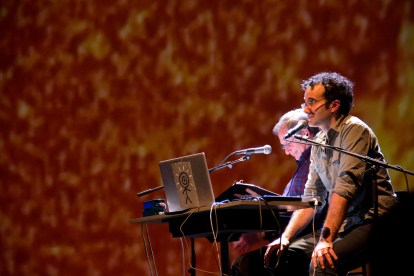
Robert Krulwich and Jad Abumrad, Image by Flickr User Carlos Gomez
In argumentation parlance, Kalia’s voice operated as an “objection.” In “Entanglements of Consumption,” argumentation scholars Kathryn M. Olson and G. Thomas Goodnight (1994) explain how an objection functions within an argumentative encounter: “absent a common agreement as to the means of reaching consensus, debate over the ‘truth’ of an asserted claim is set aside, in whole or in part, and challenges are raised as to the acceptability of the communicative context within which the argument is offered as secured”(251). That is, when deliberation occurs within a shared context—agreed upon values, goals, rules, and facts—the argument progresses smoothly. However, when there is a disjunction between interlocutors, such as in “Yellow Rain” where both parties disagree on basic facts, hegemonic beliefs take precedence. Objections function to evidence this differential, making both parties (and often an audience) aware of this gap. As such, objections are not concerned with refuting previous claims—the way that Kalia states neither she nor her uncle are interested in having a semantic debate—but questions the very context—and the conditions–of the debate itself.
Despite Radiolab’s attempts to fetishize her voice to evidence the “fact of the matter” and the “complicated nature of truth,” Kalia’s voice retained her agency. Through the invocation of the sonorous objection, she eluded capture and demonstrated the unequal terrain of the interview. Her pain enveloped the listener, leaving a resonance that Radiolab listener Cecilia Yang called “painful to listen to” in her personal blog. As Olson and Goodnight remind us, objections arise in a repressive context, when people are denied a voice. For Kalia, histories of racism and colonialism infused the argumentative encounter, making it impossible for her to “reason,” a framework she exposes as a stacked game. As such, her sonorous objection functioned to evidence this disparity, while directing the listener’s attention to her cause. Just as the pictures of prisoners coming out of Abu Ghraib incited outrage about U.S. imperialism and violence, Kalia’s sonorous objection provoked a conversation about the Hmong, Radiolab, and the ethics of journalism in the new media age.
—
Justin Eckstein is a doctoral candidate and former director of debate at the University of Denver. His work explores the intersection of listening, affect, and argumentation. Justin’s writing has appeared in Argumentation & Advocacy,Relevant Rhetoric, and Argumentation in Context. Currently, he is writing his dissertation on the micropolitics of podcasting in the post-deliberative moment.
Share this:

SO! Reads: Jonathan Sterne’s MP3: The Meaning of a Format

The promiscuity of the mp3. Borrowed from NYCArthur on Flickr.
 The point that had lingered with me after first reading Jonathan Sterne’s essay “The mp3 as Cultural Artifact,” was the idea that the mp3 was a promiscuous technology. “In a media-saturated environment,” Sterne writes, “portability and ease of acquisition trumps monomaniacle attention . . . at the psychoacoustic level as well as the industrial level, the mp3 is designed for promiscuity. This has been a long-term goal in the design of sound reproduction technologies” (836). A technology, promiscuous? I did not have to look far to find support. Like germs, I could find copies of mp3s that I had downloaded from Napster in 2000 scattered across generations of my old hard drives. Often they were redundant, too – iTunes having archived a copy separate from my original download.
But, for Sterne, mp3s are also socially promiscuous. They accumulate in the hard drives of the working class and are shared, almost anywhere, through the branching left/right wires of iPod earbuds. Since the popularization of the mp3, there have been new opportunities to share how we listen with others. This is promise of the mp3, and the reason it forms such a key point of scholarly meditation.
 MP3: The Meaning of a Format (Duke University Press, 2012) finds Sterne revisiting many of these key themes, with a larger focus on the genealogical beginnings of the mp3 technology. While many of the book’s chapters are extrapolations of prior work Sterne has done regarding the genealogy of listening practices, this work concerns itself less with the 19th century, and more with the 20th century. Perhaps this is related to some of the methodological decisions Sterne has made in planning the book – in seeking out the genealogical origins of the mp3, Sterne worked from archives and manuals described in interviews by engineers who were fundamental to the technology’s production. As such it finds much in common with Trevor Pinch and Frank Trocco’s Analog Days and Dave Tompkins’ How to Wreck a Nice Beach but incorporates the genealogical methods regarding sonic technology present in Sterne’s earlier work The Audible Past and Emily Thompson’s The Soundscape of Modernity. In MP3 Sterne positions himself as a critical cultural studies scholar working between the humanities and sciences, focusing specifically on the mp3 due to its social and technological relevance today. The critical is key here as MP3 is truly a work devised to underscore the economic connections between the construction of our selves as “hearing subjects” and the media industries.
Certainly, the mp3 can still be considered a promiscuous technology, but it is corporate capitalism that had failed to recognize the extent to which it relies on technological promiscuity to support its infrastructure. This focus, ironically, displaces the mp3 as the main object of Sterne’s analysis. It highlights instead the pathological logic of corporate capitalism, and the ways that this rationality has mutated, now, in the wake of mass replicable, malleable, and iterative digital culture. In other words, the mp3 is endemic to a much larger plot, wherein the culture industries adapt to their own deus ex-machina. The naive development of the mp3 by the motion picture industry is a large part of the story here, but it is only a small bit of a much larger whole. The real story involves understanding how a handful of vested corporate interests have shaped the ways that we interpret and understand what listening is. In MP3 Sterne addresses one of the great questions of sound studies: What are the politics of listening? Or, which individuals and institutions have a vested economic interest in questions of how we hear?
Sterne recalls this drama in three parts, each unfolding in a somewhat autonomous fashion, but unified in so far as they explore the economic interests behind the scientific construction of “hearing subjects.” In the first part, Sterne is at his best exploring AT&T’s (and the affiliated Bell Laboratories’) role in funding psychological, physiological, and cybernetic research on hearing. In the second, Sterne explains how this early research has been applied to the visual and technical abstraction of sound in the 1970s. And, in the third part of this genealogy, he explains how these analogs were made digital, specifically the corporate politics which went into the construction of the mp3 standard. Throughout this surprising and detailed trajectory, Sterne makes the invisibility of corporate interests apparent and explicit.

AT&T and Infrastructure. Borrowed from djbones on Flickr.
Sterne also hints toward several powerful economic rationalities that have guided the construction of the mp3. Key among these insights is the monetization of cybernetic discourse, or the incorporation of the human body within a scientific understanding of technical systems. In order to engineer an efficient technical system, the capacities and limits of how we interact with (or serve as parts of) these systems must be taken into account. Sterne refers to this mode of engineering as “perceptual technics,” and he goes to great lengths to explain it.
Basically, at the turn of the 20th century, AT&T had taken a keen interest in the science of how people listen because they wanted to maximize the amount of simultaneous conversations broadcast through a single telephone wire. More conversations meant the purchase of fewer wires, and therefore greater profits. Eventually, drawing on the research of the oft-cited Claude Shannon and Warren Weaver (within SO!: What Mixtapes Can Teach Us About Nois and Pushing Record; and soundBox: Mapping Noise), AT&T recognized an economic problem of technical efficiency within their wires – there was too much ambient noise. Because of this, AT&T sought to limit the audible signal transmitted from one phone to another. This would allow for more signals (and therefore conversations) to be transmitted through the same wire. Physiological research provided clues that some frequencies were more audible than others, so engineers worked to compress audio signals to reflect this scientific abstraction of hearing.

The scientific capture of listening. Borrowed from img.informer.com .
The reduction of listening–as an embodied practice–to the quantification and control of the audible spectrum, is, in other words, the history of compression. Which, according to Sterne, should be understood as the true meaning of the mp3. While the mp3 format, like the CD or cassette, may become obsolete, technologies of compression will not. Sterne argues convincingly that most advances in compression technologies have been guided by the invisible logic of corporate capitalism. It is this exact tendency of compression–to make things smaller and more efficient–that threatened to undo the entire project of corporate and branded music distribution in the year 2000, via platforms like Napster. Sterne is well aware of this irony throughout MP3, and uses the final chapter to discuss, briefly, the moment of cultural transformation that is defined by file-sharing and mass distribution.
Bringing things full circle with a somewhat stoic conclusion about the democratic potentials of this moment, he remarks: “The end of the artificial scarcity of recording is a moment of great potential. Its political outcome is still very much in question, but its political meaning should not be” (224). Sterne points to the globalization and ubiquity of mediated listening as a sign that things may not have changed much even though mass networked society at one point promised freedom from a commodity form which privileged things like “liberal notions of property, alienated labor, and ownership” (224). He argues that even the music industries shall persevere, mostly because people have a sublime attraction to listening and music. In other words: Meet the new boss, same as the old boss. There are few moments of liberation to be found within MP3; it is instead a drama of the status quo where the conspirators of corporate capitalism succeed in spite of themselves.

The ubiquity of listening. Borrowed from κεηι on Flickr.
The disparity in Sterne’s tone, when juxtaposing the nefarious and efficient dispositifs of capitalism with an untroubled and authentic construction of music is striking to say the least. And although Sterne is clear to explain that he locates his scholarship as work on a container technology (the mp3) and not its content (the music), this is a somewhat unsatisfying distinction as an embodied practice, such as listening, must take both into account. And while I agree that the mp3 reflects the promiscuity of corporate capitalism, is this challenged by the plethora of ideological nuance coded into song lyrics and arrangements? Do the corporate ideologies of the music industries flow beyond the container of the mp3 into the music itself? Is there any crosstalk, or overlap between these historical constructions? In other words, what are the limits to theorizing a container technology, and how much does the discursive path of the mp3 sculpt the content of what we listen to?
Despite, or perhaps, because of the rather dystopic scene that Sterne alludes to at the end of MP3, it falls nicely in the space between Sound Studies and Critical Information Studies. It bridges humanistic scholarship on embodied listening practices with a critique of the economic interests that have funded much of the scientific research relating to the phenomenology of sound. To that end, MP3 reveals much about the social construction of hearing and the ways that the familiar mythology of audio fidelity has been produced, discussed and exploited by several communication industries. Even though the mp3 may have been eclipsed by industry as the main object of inquiry in the eponomously titled MP3, Sterne succeeds admirably in detailing the promiscuity of corporate capitalism in the listening practices of our everyday lives.
–
Aaron Trammell is co-founder and Multimedia Editor of Sounding Out! He is also a Media Studies PhD candidate at Rutgers University.
Share this:


Current Top Posts





April 2021

January 2020

November 2019

October 2019

August 2019

April 2014

November 2017

March 2015

December 2017

October 2015
 Sounding Out!
Recent Comments