
Orality and Cybernetics in Battleship
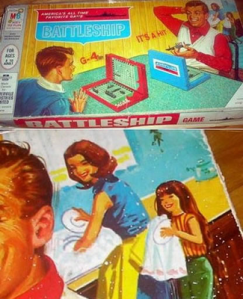
The gendered space of play. Borrowed from superpunch.blogspot.com.
His moment has come. After having scoured each vector of a ten by ten grid, the young tactician makes his move. “G-4,” he announces, possessing some intelligence of a large ship in the south-west quadrant of enemy territory. There is a moment of tension, as his dad sizes up the situation. “It’s a hit,” Dad admits, smiling, as he resignedly lifts a token from his board. The women in the family beam proudly from the kitchen. For a brief moment the social hierarchy is undermined as the house patriarch on the front of the Battleship box concedes victory to his progeny.
Sound has been integrated in different ways into the production of simulated warfare after World-War II. Simulated warfare involves, namely, the cybernetics of paper machines (as board games have been coined by Matthew Kirschenbaum), and the gradual effacement of oral mediation therein. As technologies of interactivity improve, the need for oral communication amongst the games participant’s decreases. The following is a case study of four Battleship commercials that aims to chronicle a set of shifting cultural tendencies parallel to the integration of sound-effects within the material game-form.
As Ong (1982) has noted, writing is powerful because it mediates the vastness of imagination. Once spoken words become grounded in text and inscribed on paper, they become, “locked in our visual fields forever” (p. 11). This is not as totalizing as it sounds, for as words are recirculated in oral cultures, the trace of writing yields slowly to the performative nature of ritual, oral culture. The rules of tabletop games, such as Battleship, although first established in the manual included with the game, are passed through oral ritual more often than not (Fine, 2002; Bowman, 2010). The oral maintenance of game rules is a practice which lends itself, critically, to the cultural attitudes of the group which maintains them. As is evident in the box art above, the game of Battleship is a gendered space where the rules have likely been explained (and maintained) by the household patriarch, then shared with his enthusiastic son.

Borrowed from badhaven.com.
There is an ideological element at play here as well. The box art for Battleship is unmistakably American. From Milton Bradley’s strong red-and-blue branding to the white trim of the son’s shirt, dad’s sweater and the soap suds in the kitchen. After all, the company owed its success to America and the war effort. A 1940s bailout saw Milton Bradley producing landing gear for fighter planes and gunstock for soldiers alongside portable game kits for soldiers seeking diversions in their down-time. The production of board games in post-World War II America owes as much to the military-industrial complex, as the production of video games does today (Dyer-Witherford and dePeuter, 2009). The relationship between the military production and simulation has been well documented by Crogan (2011), who has argued that the production of game interfaces, from the start, has been the by-product of a military desire to map real space onto the virtual in the design of ballistics. To this point, the bombastic introduction to a late-1960s commercial for Battleship (see video below) should come as no surprise. The sonic blast of a real-world battleship is calculated to lure consumers into believing that the game is an authentic simulation of maritime warfare.
The players in this commercial are actively engaged in a discussion amongst themselves. They laugh, and joke as they engage one-another in a tactical crossfire. In some cuts, the players seem particularly engrossed in the games strategy. Even though the commercial showcases two players actively engaged in oral communication, it is important to note that the players are both white males, and that the winner callously gloats as his opponent tumbles into the water. Milton Bradley’s connection to the American military is distinct here, and it plays out as a set of social relationships between the players. Reminiscent of Cold-War politics, the games action plays out as a series of tactical exchanges. Consumers are urged to practice at winning in their living-rooms, or on the go. The portable elements of Battleship are played down in an advertisement about 15 years later. Here, Battleship is situated as a centerpiece of family life.
Also integrating stock footage of real-world military battleships the narrative in this mid 1980s commercial begins with a squabble over domestic space. The actors are (at first) two boys (10 and younger), playing Battleship in the bedroom. After winning, the older boy banishes his younger brother, presumably forever, from his bedroom. Although this act could easily be imagined as selfish, in the context of the 1985 nuclear family, competition is fostered and encouraged. In a second skit, the older boy emerges again victorious at Battleship, his opponent (and father) slouches, consoled by the mother while the grandfather eagerly congratulates the young victor. Electronic Battleship is introduced here as a product as well, and the players are depicted commanding the electronic elements of the game. Feedback is given to the players sonically, as programmed game moves result in dynamic military explosions. There is still a residue of oral communication here, notably the father lamenting, “You sunk my battleship,” as the older boy lets out a strong cheer. Even though the embarrassed father is a commercial trope designed to stimulate the consumer imagination of aspiring child tacticians, it also functions as an in-joke for caring parents looking to instantiate intellectual (mathematical) competition as a centerpiece of domestic life in the age of Reagan’s Star Wars economics and family values.
Ten years later, the commercial narrative has more to do with overt warfare than family life. The competing children are spliced alongside clips of competing Navy officers performing various technical tasks on a real Battleship. As the background music takes on a tense, and somewhat militaristic tone, a command to “Man your battle stations,” is echoed as the two boys careen into their chairs. No longer is the narrative established as a civil exchange between two military masterminds, Electronic Talking Battleship uses sound to enhance the player experience of the simulation. When a hit is scored, a quick shot of the player pumping their fist and shouting is quickly replaced by stock footage of a battleship-explosion. Even wavy radio-lines are used to enhance the over-the-top comic feel of the product’s sound. A number of shots showcase the players programming their battle-stations. The commercial explicitly connects the discourse of soldier-controlled military technology, to player controlled information technology. Good players are able to program on their toes, the only conversation between players is a series of taunts and cheers. At one point, a player refers to the rules. Electronic Talking Battleship is evidence of the increasing capital of information technologies, and deterioration of orality in electronic games in the mid-1990s.
A final, 1997, commercial for Electronic Talking Battleship disposes entirely of the oral element of gameplay. The commercial begins with a child in what seems like an office conference room. After he presses a green button, a virtual matrix appears before him, and two navy officers materialize across the table from him. The viewer is to assume that one is an officer, and the other his superior. The narrative has the Navy officers desperately trying strategies against a hooting and smiling child. The Navy officers are a metaphor for the game’s computer, which can, at this point, serve as a virtual Battleship opponent. The affective work of companionship, which was once performed by one’s friends and family is now, in at least this commercial, replaced by a machine interface. The oral communication, which once governed the rule-set in a social space, has been outsourced to a machine which governs the rules, precisely, in cybernetic space
As computers begin to take a more active role in our culture, a by-product is the exchange of oral ritual for cybernetic participation. This odd shift can be read as having both positive and negative potential. One positive aspect is the estrangement of the social hierarchies which have been a necessary for the ritual infrastructure of oral communication dating back to Homeric times. While the children in the commercials (and on the original box) seem increasingly autonomous, they also begin to dialogue less with themselves, and more with the game. This, unfortunately, is the negative potential of this cybernetic shift. Where the early advertisements of the game depicted a product which provided a potential escape from a war-ravaged world, later advertisements seek to situate the consumer in the center of the action. A common thread amongst these social, and technical shifts is the instantiation of an electronic voice and interface as keeper of the rules. And, with this shift, the military discursivity of the game-form and its accompanying electronics is inscribed, and made to seem innocent in our imagination and understanding of childhood games and play.
—
Aaron Trammell is co-founder and multimedia editor of Sounding Out! He is also a Media Studies PhD student at Rutgers University.
Share this:

Hearing the Tenor of the Vendler/Dove Conversation: Race, Listening, and the “Noise” of Texts
In the beginning there were no words. In the beginning was the sound and they all knew what the sound sounded like. –Toni Morrison, Beloved

How were Truth's words heard? By whom?
A conversation in my Black Feminist Theories class on the two versions of Sojourner Truth’s famous speech from the Ohio Women’s Convention—the one published in 1863 that renders her words in a black southern dialect or the 1851 version that does not—elicited the following story about listening. A black male student was student teaching/observing in a classroom — the teacher was white, the student teacher black. The exercise he observed involved transcribing speech and then reading it back. A black male student in the classroom spoke and the white teacher and black student teacher each transcribed the speech and read their transcriptions aloud. The white teacher’s transcription/recording was in dialect, the black student teacher’s was not. The student teacher maintained that what and how the white teacher heard the black student was not, in fact, either what or how the black student spoke.
Discussions like these have spurred me to meditate more deeply on sound. And now that I’ve really begun to consider it, texts have become much noisier places; the white spaces and black marks becoming places for reading and hearing. Thinking more deeply about sonic affinities and communities has helped me really begin to understand how sound shapes sight and sight shapes sound.
An example: Since reading Fred Moten’s In the Break, in particular “The Resistance of the Object,” it’s not only impossible for me to read the scene of Captain Anthony’s beating/rape of Aunt Hester in Frederick Douglass’s Narrative without hearing Abbey Lincoln’s hums, moans, and screams, it is not possible for me to read the entire text without populating it with sound, even as those sounds are, in my imagining of them, not always specific.
.
Perhaps it’s most accurate to say that I am aware that the world that the text references is a world filled with sounds peculiar to it, many of which may no longer be present in our contemporary world. At the same time, I try to bring at least some of those sounds—talking drums, field hollers, whips cracking, the sounds of chains, etc.—and approximations of sounds into the classroom when I teach Douglass’s Narrative and My Bondage and My Freedom (as well as when I teach other texts).
In “The Word and the Sound: Listening to the Sonic Colour-line in Frederick Douglass’s 1845 Narrative” (2011) Jennifer Stoever-Ackerman writes, “The emphasis Douglass places on divergent listening practices shows how they shape (and are shaped by) race, exposing and resisting the aural edge of the ostensibly visual culture of white supremacy, what I have termed the “sonic colour-line” (21). Stoever-Ackerman riffs on Elizabeth Alexander’s “Can you be BLACK and Look at This: Reading the Rodney King Video” (and Alexander riffs on Pat Ward Williams’s “Accused, Blowtorch, Padlock”) to ask, “Can you be WHITE and (really) LISTEN to this?” or alternatively, “Are you white because of HOW you listen to this?” (21).
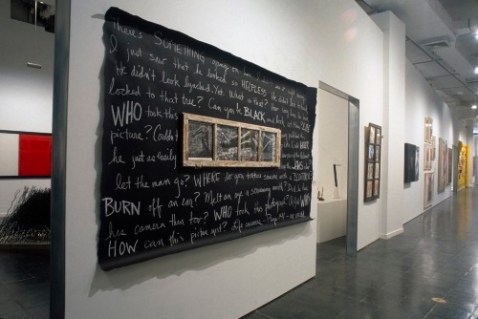
Pat Ward Williams's "Accused/Blowtorch/Padlock" (1986), Courtesy of the Artist and the New Museum, New York
.
In his review of Shane White and Graham White’s The Sounds of Slavery: Discovering African American History Through Songs, Sermons, and Speech (Beacon Press, 2005) in the July 2009 issue of the Journal of Urban History, Robert Desrochers contrasts the abolitionists who were attuned to how to make a white audience hear the sounds that surrounded and produced the (performances of the formerly) enslaved, to the “Virginia patriarch who failed to mention the singing of his slaves even once in a diary that ran to hundreds of manuscript pages” (754). Given these examples of the ways that many white ears had to be systematically attuned to hearing slavery’s sounds as well as the understanding that, “the very things that made slave sounds distinctive—chants, grunts, and groans; melismatic, repetitious, and improvisational lyric play; pitch and tonal inflections and cadences; timbral variations, polyrhythms, and heterophonic harmonies—struck whites mostly as strange, inappropriate, wrong” (754)—the answers to Stoever-Ackerman’s questions may be respectively “no” and “yes” (or several combinations of no and yes), particularly if we engage “whiteness” as an ideology and not simply (or not only) a “raced” description of those people constituted socially and legally as (presumably) white.
 It was with these kinds of questions of sound and sonic whiteness on my mind (especially this question of who hears, who doesn’t hear, and then again what is and isn’t heard) that I read and was brought up short by Helen Vendler’s recent November 24, 2011 New York Review of Books review of Rita Dove’s The Penguin Anthology of 20th Century American Poetry. In this piece, Vendler takes Dove to task for what she considers the anthology’s over-inclusiveness (“No century in the evolution of poetry in English ever had 175 poets worth reading”), the “accessibility” of the poems (“short poems of rather restricted vocabulary”), and the appearance of a large number of black and other non-white poets in the latter part of the twentieth-century. In short, from Vendler’s perspective, Dove is choosing “sociology” and complaint over artistry; mixing the wheat and the chaff.
Vendler writes, “Rita Dove, a recent poet laureate (1993–1995), has decided, in her new anthology of poetry of the past century, to shift the balance, introducing more black poets and giving them significant amounts of space, in some cases more space than is given to better-known authors. These writers are included in some cases for their representative themes rather than their style. Dove is at pains to include angry outbursts as well as artistically ambitious meditations.”
And Vendler on Dove on Hart Crane: “sometimes one wonders whether Dove is being hasty. She speaks, for instance, of ‘the cacophony of urban life on Hart Crane’s bridge.’ But the bridge in his ‘Proem’ exhibits no noisy ‘cacophony’; its panorama is a silent one. The seagull flies over it; the madman noiselessly leaps from ‘the speechless caravan’ into the water; its cables breathe the North Atlantic; the traffic lights condense eternity as they skim the bridge’s curve, which resembles a ‘sigh of stars’; the speaker watches in silence under the shadow of the pier; and the bridge vaults the sea. The automatic—and not apt—association of an urban scene with noise has generated Dove’s ‘cacophony.’”
Why does Vendler insist on silence where Dove joins sight and sound? That Vendler imagines silence and takes Dove to task for attaching cacophony to the city scene in the bridge poem is a struggle over meaning, over epistemology and ontology. How is Vendler registering not only the poem but also the entire text differently? This isn’t the only instance of Vendler’s insistent sonic “whiteness” whereby and wherein the reading of the poem, the anthology, and the anthologizer herself are disciplined.

Can you hear these poems? Image by Crossett Library Bennington College
Speechlessness though, is not soundlessness, and it seems to me that Dove locates herself on the bridge (and in the soundscape of the contemporary written poem) such that she hears the water, the seagull, and the leap and curve and flap of gull and man. As Dove herself responded (also in the New York Review of Books), “A cursory sweep over just the section [Vendler] excerpted in my anthology yields a host of extraordinary sounds: what with trains whistling their “wail into distances,” chanting road gangs, papooses crying—even men crunching down on tobacco quid—my gasp of surprise at Vendler’s blunder can barely be heard.”
In Vendler’s remarks and Dove’s response we might read the kind of cultural dissonance that continues to both construct and give insight into how different communities of readers and listeners are formed and the ways they are and aren’t racialized. By the end of the review, Vendler wants to be heard by those whom she imagines as the anthology’s likely readers: she wants to turn to them and “say,” to “cry out,” that there are better poems than those included here. For the sounds that in this anthology that Vendler hears most often in the “minor” poems, in the “minority” poets, and the “minority” anthologizer, are simplicity, noise, and needless complaint. And Vendler and Dove have been here before – see Vendler on Dove and Delaney on Vendler and Dove.)
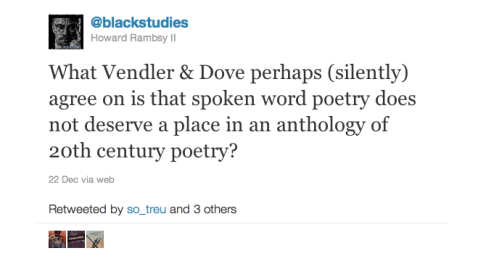
But despite the debate putting poetry front and center and enacting ways that it matters, Vendler’s critique and Dove’s response are each conservative, though in quite different ways. Neither Vendler nor Dove in the review, anthology, and defense of the anthology imagines the inclusion of spoken word, hip-hop (see Howard Rambsy II), and other forms of contemporary rhyme and verse that speak to a broad range of audiences across race, sex, and class. The inclusion of rap might further change the tenor of the conversation, opening up in important ways the debate over what counts as poetry, and expanding how black musical and poetic forms are heard and by whom.
—
Christina Sharpe is Associate Professor of English and American Studies at Tufts University where she also directs American Studies. Her book Monstrous Intimacies: Making Post-Slavery Subjects was published in 2010 by Duke University Press. Her current book project is Memory for Forgetting: Blackness, Whiteness, and Cultures of Surprise.
Share this:


Current Top Posts





April 2021

January 2020

November 2019

October 2019

August 2019

April 2014

November 2017

March 2015

December 2017

October 2015
 Sounding Out!
Recent Comments