
It’s Our Blog-O-Versary 2.0!

..........Click the Cassette Tape to Download Our Free Blog-O-Versary 2.0 Mix!........ (Image by miss_rogue; tunes suggested by our writers and editors!)
Happy Blog-O-Versary 2.0 to our amazing community of writers, readers, and listeners! Sounding Out! has finished an incredible second year of growth, exploration, and accomplishment. ‘Scuse us while we blow our own vuvuzela a bit:
· We Got Organized: Can we re-introduce you to our editorial collective: Jennifer Stoever-Ackerman (Editor-in-Chief and Guest Posts Editor), Liana Silva (Managing Editor), and Aaron Trammell (Multimedia Editor)? Thanks!
· We Got Regular: Every Monday @ 9:00 EST, you’ll see a new post up on the site. You’ll also notice two new regular contributors on our rotation, Osvaldo Oyola Ortega, and Andreas Duus Pape.
· We Hosted Guests: This year Sounding Out! began dedicating the last Monday of each month to guest writers from across the field and the globe (shoutout to Binaural in Lisbon, Portugal!). SO! has worked hard to recruit the finest work from a variety of voices— artists, professors, graduate students, sound practitioners like singers and radio voices —as well as introducing you to the up-and-coming scholars in the field. You know that special sound studies issue of American Quarterly (edited by Josh Kun and Kara Keeling) that you can’t wait to get your hands on? We can’t either, but until September rolls around, read postings from four of the contributors on Sounding Out! : Tara Rodgers, Nina Sun Eidsheim, Dolores Inés Casillas, and our own Jennifer Stoever-Ackerman. To see the full line-up of our bad ass writing roster, click here. We couldn’t be more thrilled with our guests and we look forward to more.
· We’ve Been Linked: Not only have we been added to many excellent blogrolls, like Designing Sound, Weird Vibrations, Preservation Sound, and Hear is Queer, but posts from Sounding Out! have been mentioned in Media Watch, Pandagon, threadbared, Sonic Terrain, Blogging Ethnomusicologists, Parallax View, Pullquote, The Long Harvest, True Chip Till Death, and Game Culture.
· We Pushed Our Coverage: Thanks to the brilliant work (and excellent prose) of our writers, we sounded out even more audio-cultural terrain this year in the contexts of queer studies, politics, hip-hop, television, film, sound art, sound walks, comics, and audio technologies both digital (ipad, video games) and analog (tape recording, synthesizers). We even dabbled briefly into the sound of #tigerblood but we swear we can stop at any time.
· We’ve Had Beef: You wanted head-to-head posts debating the cultural meaning of Bob Seger? Girl Talk and Mash-Up Culture? Classical Music? The Sounds of the Southern Black Church? Yeah, we hosted all that.
· We Were There: Editor-In-Chief Jennifer Stoever-Ackerman scoured the programs of the national meetings of three major academic organizations (the American Studies Association, the Modern Language Association, and the Society for Cinema and Media Studies) to give you the freshest picks in sound studies research presentations. Look for expanded coverage (and more live-tweeting!) in the upcoming year.
· We Became More Searchable: Hey, folks, our soundwalk is a marathon, not a sprint. Dedicated more than ever to becoming your long-term go-to guide for emerging thought in sound studies, our Managing Editor Liana Silva has been working hard to preserve Sounding Out!’s back catalogue by keeping older posts current with our newer categories so you can always find everything that you need.

Awesome Sounds From a Future Boombox (photo by Katie Dureault)
· We Listen to You!: Never content to ride out the same groove, Sounding Out! wants to bring it even harder in year 3.0. That’s why we are passing the mic to you, Dear Listeners, and asking you to complete our (very brief) Survey Monkey survey to find out how our site has been resonating with you and what we can do to fine-tune the vibe even more. Think of our killer Blog-O-Versary 2.0 mix, “Awesome Sounds from a Future Boombox” as a thank you bonus for your time as well as the soundtrack for what is already shaping up to be another great year together. Let’s rock on into the future with our bad selves.
Click here for Sounding Out!‘s Blog-O-Versary Survey
Click here for Sounding Out!‘s Blog-O-Versary 2.0 mix with track listing
(Just in case you missed last year’s party–and mix–click here)


Share this:

Hearing Queerly: NBC’s “The Voice”
DOI: https://doi.org/10.59350/mhdvf-97d24
Tuesday, April 26, 2011 turned out to be a red-letter day for prime time Sapphism. The Fox smash, Glee, continued its hamfisted campaign against teen bullying with a subplot about the label-averse Santana scheming to bring her lesbian (or “Lebanese”) love for Britney to fruition. Airing opposite this “Born This Way”-anchored, supersized Glee, was the debut of the vocal reality competition series, The Voice on NBC. Remarkably, not one, but two out lesbians survived the first elimination round of the show’s blind auditions: Vicci Martinez from Tacoma, WA, and Beverly McClellan from Ft. Lauderdale, FL.
The Voice pitches itself as the democratic alternative to FOX’s American Idol. Whereas Idol’s early audition rounds derive considerable schadenfreude from oddball characters excluded from the expansive realm of what is deemed “pop hot”–remember Kenneth Briggs, the infamous “Bush Baby”?–The Voice eliminates looks altogether from the audition process, including the panel’s ability to look at the singers onstage. Seated in hydraulically-controlled swivel chairs evocative of Dr. Evil’s high-backed perch, the celebrity panel of coaches (not “judges”)–Christina Aguilera, Cee Lo Green, Adam Levine of Maroon 5, and country hunk, Blake Shelton–have their backs to the stage at the beginning of each performance. Only when the singer’s voice sufficiently moves a coach does he or she press a button to swing around and face the talent. If none of the four coaches turns around before the song ends, the singer is eliminated and sent away with only two-and-a-half glorious minutes on national TV as a consolation prize.
While latter-day Idol has increasingly focused on the “total package,” sometimes excusing vocal defects for good looks, performance prowess, and passion (“I had fun with it” is the mantra of anyone who’s suffered a tepid response from the judges, and “you look great tonight” is what a judge says when someone biffs their vocals), The Voice purports to strip away the smoke and mirrors of performance—at least in the live selection process—in order to focus exclusively on vocal talent. Furthermore, as “coaches,” the celebrity panel is meant to cultivate talent rather than simply eviscerate bad performers for the audience’s amusement. As Cee Lo opines in the premiere episode: “it’s not about the judgment; it’s about the journey.” (Has reality competition taken a critical turn from the critical turn? But that’s another topic.) Idol has been explicitly called out on the show, from Adam Levine’s reassurance to dejected contestants that “The people we are not turning our chairs around for could win American Idol,” to the sensational rehashing, ad nauseum, of Frenchie Davis’s disqualification from the Idol competition for nude photos nearly a decade ago.
As the anti or alterna-Idol, The Voice–complete with kitschy, faux Futurist set pieces–would have us believe that truly anyone from anywhere could be a vocal superstar, whether they’re fat, thin, chinless, hirsute, gorgeous, hideous, straight, gay, Mormon, or dykey. The disparate optics offered by Vicci Martinez and Beverly McClellan, the two lesbians who won the celebrity panel over with their raw-throated rock vocals (right in the pocket of what we might call the Etheridgean mode), would seem to affirm the show’s “blind” ethos. Martinez’s audition was shot so that just like the coaches, the TV audience couldn’t see the singer until she was selected. In the package leading up to her performance, we are made privy to her coming out story, offered a glimpse of her skinny jeans and boots, and invited to “listen along with our coaches and see if you would pick Vicci Martinez.”
As it turns out, Martinez is quite a little hottie: a lesbian heartthrob in the making with a cute asymmetrical shag, winning smile and sensibly curated fashion (think PacNorthwest sportif meets urban hipster enclave).
McClellan, meanwhile, offers an “edgier” look that complements her ethos of fighting–in her own words–“against the man.”
TV audiences see McClellan before hearing her, creating some element of narrative suspense: we anxiously await “the reveal” should one of the coaches select McClellan for their team, only to swivel around to confront a bald, bad-ass dyke with ample tattoos, piercings and leather wrist accoutrement, chewing on Janis Joplin’s “Piece of My Heart” with barroom tenacity.
The queer blogosphere has certainly picked up on Martinez and McClellan’s success on the show. (As of this writing, Martinez has already advanced passed the “Battle Rounds” to the live shows where audience members are are allowed to vote). After Ellen and Unicorn Booty posted items immediately, encouraging queer audiences to tune in, while After Ellen followed up with extended interviews, first with Martinez, then with McClellan. Both were asked about whether or not the format of The Voice made it “easier” for queer contestants to succeed without being judged for their appearance. Martinez famously bowed out of the Hollywood rounds of American Idol because producers asked her to buy a new wardrobe (read, “femme up” a bit), so she offered a more affirmative response in line with The Voice’s own rhetoric of leveling the playing field. McLellan, meanwhile, offered a goofy “one love” answer to the question, evoking a universal vibe of human generosity. Different as their public temperaments may be, both have been praised for amplifying lesbian visibility on network television.
Though some robust, “score two for the team” chest-bumping is surely in order after the success of these Sapphic sirens, how might we actually move past the greater frenzy for queer visibility to better grasp how lesbianism fits, or inevitably fails to fit, within the pop landscape? In other words, what would happen if we weren’t so quick to celebrate these “aren’t-we-GLAAD?” moments of prime time visibility, but instead took to heart The Voice’s premise about prioritizing listening?
Throughout the institutional life of queer studies, debates about lesbian visibility have unfurled in elaborate fugue-like variations. Rather than rehash them here, allow me to commit the theoretical heresy of constructing a binary in order to highlight some key positions. In the “real” world of mainstream LGBTQIA organizations and cultural producers, quantifying positive representations of queer folk qualifies as measuring progress. The more gays and lesbians we see on screens big and small, the logic goes, the better the world gets. In the more rarified realms of queer theory (my own habitat), this desire for representation and belonging calls forth the very crisis inherent in politicizing visibility as an end in itself. Film and media scholar, Amy Villarejo, explains this dynamic best when she remarks in Lesbian Rule that “the common sense of visibility is that it does both [parlays representation’s double meaning as ‘portrait’ and ‘proxy]: by appearing, so it would go, we belong…[but]…to present lesbian as image is to arrest the dynamism such a signifier can trigger” (14).
What, then, would be the sonic dynamism of lesbianism? Is it a transformative “grammar” that modifies the terms with which it becomes intimate? (Villarejo explores this possibility in her book.) Is it in the grain of a voice?
Far be it from me to theorize the “butch throat” here, as my dear pal and colleague Elena Glasberg already has with more eloquence and profundity than my mind can muster these days; but even if we hadn’t been primed by the show’s intro packages, might we not have heard the lesbianism in Martinez and McClellan’s throats? In their urgent, tremulous and toothsome strivings through the repertoires of “fierce females” like Adele and Janis Joplin?
There is something marked, and remarkable, in the yearning and temporal drag (see Elizabeth Freeman’s work) modeled by Martinez and McClellan’s respective vocalities, voices that could only break the surface in a format that (at least initially), thwarts the edicts of visibility: of fashion, generic niches, and the avant sensibility demanded by pop. Instead of being one step ahead, Martinez and McClellan constantly pull us back to something we’ve heard before, often in a half-empty bar that reeks of Bud and Marlboros (both Light). And for letting us hear this again, I’m willing to give The Voice the benefit of the doubt, despite its unwieldy format, liberal use of Carson Daly, and trumped up feud between Adam Levine and the real Xtina. Just maybe in this singing competition’s overdetermined relationship to blindness, we will find enough insight to hear queerly.
—
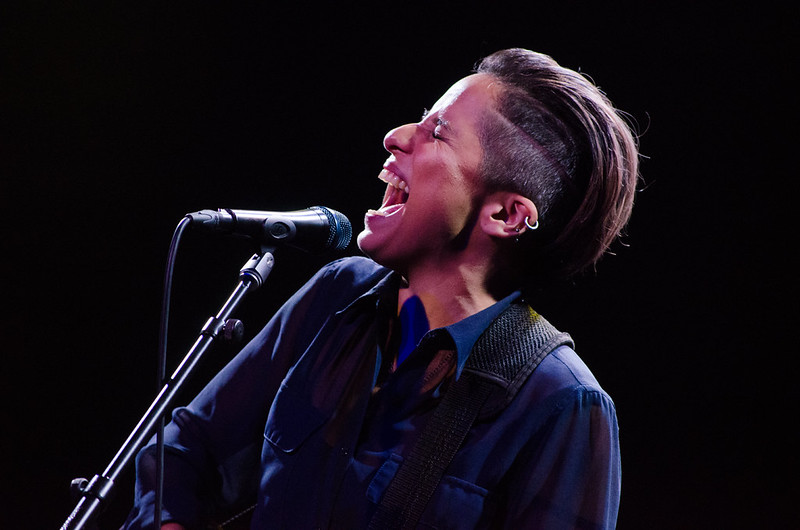
Featured Image: Vicci Martinz by Flickr User Jeff Hitchcock, CC-BY-2.0
—
Karen Tongson
—
Share this:




Current Top Posts





April 2021

January 2020

November 2019

October 2019

August 2019

April 2014

November 2017

March 2015

December 2017

October 2015


Recent Comments