
Quiet on the Set? : The Artist and the Sound of a Silent Resurgence
On a recent episode of Law and Order: SVU Mariska Hargitay’s Olivia Benson takes her new paramour, David Haden (played by Harry Connick Jr.) to see Michel Hazanavicius’s The Artist. When Benson asks him what he thought of the film, he replies with notable disdain: “I think maybe there’s a reason they don’t make silent films anymore.” When Benson responds nervously to his subsequent display of affection, presumably fearing that someone from work might see them, Haden pronounces, “Don’t worry. Nobody we work with could sit through two hours of black-and-white, no talking.”
Haden’s response might seem surprising given the box-office and critical success of the film, with The Artist grossing more than $120 million worldwide and receiving five of the Academy’s most coveted Oscars, including Best Picture, Best Direction, and Best Actor in a Leading Role. In fact, with both The Artist and Martin Scorsese’s Hugo walking away with a preponderance of Academy Awards, many critics, including the editors of Cineaste, began to wonder if we were finally seeing a long-overdue challenge to “long-entrenched cultural prejudices against silent cinema.” There seems to be a renewed optimism that, with The Artist’s critical and commercial success, the popular stereotypes about silent film—heavy-handed acting, artless cinematography, mundane plots—may finally begin to break down.
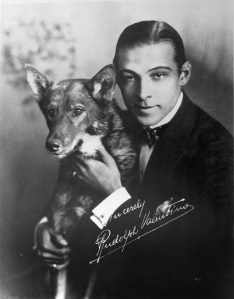
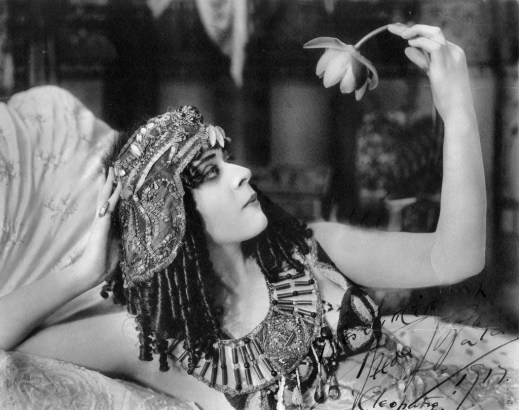
Rudolph Valentino and his Dog, this and featured photo of Theda Bara as Cleopatra (1917) courtesy of the Orange County Archives
As a film studies professor who specializes in the pre-sound era and frequently asks even my freshman students to engage with at least one silent film, I am both buoyed and dubious about this supposed sea change in public attitudes toward silent cinema. While some of my students sound a lot like David Haden after I ask them to watch even the most accessible silent slapstick comedies, many of my upper-level students now count works like F. W. Murnau’s Sunrise among their favorite films. And I’ve discussed the merits of The Artist with many of those same students, who easily recognized the film’s many references to other silent-era works, and appreciated its ability to mimic a very particular brand of silent film. I honestly believe there is some truth to the claim that films like The Artist and Hugo have encouraged spectators to engage with other silent films, including the recently restored color version of Trip to the Moon that is showcased in Scorsese’s film. In fact, in recent weeks there has been considerable buzz about skyrocketing demand for silent films via streaming services and even Cinemark’s XD-equipped theaters will be screening the 1927 film Wings as part of its “Reel Classics” series in late May. Rumor has it that Broadway will soon be hawking a production about Charlie Chaplin’s life and 2012 will see the life of silent film star Rudolph Valentino represented in Silent Life.
Michel Hazanavicius explains in the production notes to The Artist that his desire to make a silent film had been brewing for years: “From the beginning of my career, I fantasized about making a silent film.” But he also viewed the dream as far-fetched, one that would be unlikely to draw support in contemporary film production circles: “I call it a fantasy because whenever I mentioned it, I’d only get an amused reaction—no one took this seriously.” Despite this resistance, Hazanavicius refused to let go of the idea and continued to imagine how he might capitalize on the unique artistic potential of the silent medium: “As a director, a silent film makes you face your responsibilities. . . .Everything is in the image, in the organization of the signals you’re sending to the audience. And it’s an emotional cinema, it’s sensorial; the fact that there is no text brings you back to a basic way of telling a story that only works on the feelings you have created. I thought it would be a magnificent challenge and that if I could manage it, it would be very rewarding.”
Despite the initial skepticism Hazanavicius faced, The Artist’s unexpected international success has revealed consumers’ (perhaps temporary) appetite for silent film. Parody trailers of upcoming Hollywood blockbusters like The Avengers have aped silent film form and The Artistifier allows users to transform any Youtube video into a silent film.
.
Even hipster clothiers, Shabby Apple, have taped into silent film’s newfound cultural cache by launching a “Silent Era” collection of swimsuits with names like the “Bara swim mini” and the “Karloff swim top.” Despite this recent upsurge in references to and imitations of the silent film medium, advertisers, filmmakers, artists, and musicians have expressed a nostalgic reverence for silent film for decades. Between 2007 and 2010, Janelle Monáe released her Metropolis and ArchAndroid Suites, which refashioned Fritz Lang’s iconic 1927 film, Metropolis.
.
Mimicking both the film’s visual style and political message, Monáe also refashioned herself as Metropolis’s iconic android and adopted her trademark tuxedo attire after seeing photos of Marlene Dietrich, the silent and sound film star who helped mainstreamed this androgynous look in the 1920s (and also as a tribute to the working class uniforms of her parents). From AFLAC’s 2006 satirizing of the medium’s stereotyped damsel in distress, to IBM’s 1986 series of ads featuring Charlie Chaplin, marketers have frequently banked on silent films’ ability to attract the public eye.
.
What do we make of this renewed interest in silence? We must first remember that, as I tell my students, silent films were never designed for silent viewing at all given that most were screened with musical accompaniment that ranged from a single organist to a 40-piece orchestra. Even the composition of The Artist reveals the lie behind silent film “silence,” with composer Ludivic Bource employing 80 musicians from the Flanders Philharmonic Orchestra in developing the score for the film. Despite the fact that live orchestral accompaniments of silent film have become staples of film festivals around the world, most of today’s viewers’ experiences with silent film are limited to watching DVD transfers of varying quality, with canned music that is sometimes recycled from one DVD release to another, regardless of film title or subject matter. Few viewers, including those who have attended screenings of The Artist, have truly experienced the “silent” medium as it was intended, with sound and image working in tandem via a combination of “live” music and projected celluloid. Two years ago, I saw the transformative effect of recreating a more authentic silent film viewing experience when I arranged a screening of Sunrise at the University of Northern Colorado with the Mont Alto Chamber Orchestra providing live musical accompaniment. Many of my students still speak of that experience with tremendous reverence, explaining that they finally understood what it meant to truly experience a “silent film.”
While popular audiences tend to neglect how integral sound was to silent film, Rick Altman has argued in Silent Film Sound that sound has thus far failed to establish its own “autonomous measure of worth,” with scholars arguing that because film’s historical roots are bound up in silence “cinema is thus essentially a visual art” (6). Yet, this bias seems to be belied by the reaction to The Artist, with even the Oscars ceremony choosing to use the film’s only synchronized sound scene when introducing it as a the Best Picture nomination. It seems that even an acclaimed twenty-first century silent film must flaunt its, albeit brief, reliance on synchronized sound. Certainly, the many viewers who demanded refunds from their local cineplexes reflect the prevailing opinion that film must include sound if it hopes to maintain their interest and earn their cinema-going dollars.

Silent Film Festival Winter event at the Castro by Flickr User Steve Rhodes
So, what is the appeal then of these “silent” films in which, though accompanied by music and sound effects, dialogue is not spoken but read via soundless lips or intertitles? For me, the attraction comes from both understanding the aesthetic and technological roots of an art form that I admire and the fact that they require the development of character and narrative in purely visual terms. I am also attracted to its higher degree of abstraction, its ability to create a kind of poetry while also defying the very essence of language itself. And I see in the absence of sound a refreshing denunciation of contemporary demands for ever-increasing realism. Silent film is the antithesis of today’s fetishizing of 3-D.

Projector, Chaplin by Flickr User Stephen Coates
While I acknowledge this statement may seem naïve given that Scorsese’s aforementioned film manages to combine that “new” technology with a tremendous reverence for silent film’s seemingly “primitive” techniques, I firmly believe that the aesthetics of “silence” have an important resonance for contemporary viewers raised on Dolby. After hearing my frequent complaints about the current impetus toward 3-D, one of my students has taken to calling me Charlie Chaplin, seeing in my resistance a mirroring of the great comedian and director’s opposition to sound technology. Like Chaplin’s Tramp in Modern Times who cannot keep up with the machine-age and its insistence on productivity, I often find myself longing for something simpler from film, something more retrained and abstracted, less motivated by the demand for “progress” and, at least on the surface, The Artist’s return to silence seems to fulfill that admittedly nostalgic desire. While it is an imperfect, and perhaps misleading, example of the silent medium, even the modernized form of silent cinema that we see in The Artist demands that viewers consider the relationship between history and memory, between film’s relatively youthful heritage and its contingent representations of the past, between sound and silence.
—
April Miller is an Assistant Professor and Director of Film Studies at the University of Northern Colorado. Her research focuses primarily on the intersections between literature, film and socio-scientific concerns such as criminality and mental illness. She is currently completing a book manuscript, Offending Women: Modernism, Crime, and Creative Production, which investigates the female criminal and her often-overlapping sites of representation in literature, journalism, and silent film.
Share this:

“Everyone I listen to, fake patois. . .”

It may seem a little crazy to take Das Racist seriously. Their songs are deep in the realm of the ridiculous, but I can’t help but feel that “Combination Pizza Hut/Taco Bell” is a commentary on how the compression of urban space is shaped by our relationship to consumption. Close-reading of their songs provide repeated evidence for the underlying tenor of seriousness in that absurdity—even if they’re being playful about it. As one of my favorite Das Racist songs says, “we’re not joking / just joking / we are joking / just joking / we’re not joking.” (For those who need help parsing, no, they are in fact, not joking). Take for instance Das Racist’s “Fake Patois” off of their free downloadable “mixtape” Shut Up, Dude! (2010). This satirical and intelligent exploration of the sounds of authenticity and their relationship to the reggae-hip hop dyad uses fake patois itself, working off an ironic tension that is as troubling as it is funny—and it’s also a banging song.
The “patois” used in American hip hop is clearly meant to be Jamaican-sounding, mixing elements of Jamaican creole language with a generous sprinkling of terms specific to Rastafarian English. The sounds of “fake patios” are a stylistic choice, reinforced through a dancehall reggae cadence of rapid-fire clipped words, rapped melodically. “Fake Patois” recalls the role of reggae in identifying an authentic origin for hip-hop. And certainly the connection cannot be denied. That Kool Herc brought Jamaican DJ culture with him to the Bronx is originary, and Run D.M.C brought it up in 1984’s “Roots, Rap, Reggae” (featuring Yellowman). If you want a more detailed mapping of a particular reggae meme’s journey through hip hop, check out Wayne Marshall’s fantastic essay on the subject, which demonstrates that even when contemporary artists think they are paying homage by imitating their rap fore-bearers they are also unknowingly paying homage to the influence of Jamaican music on American rap.
.
Das Racist’s “Fake Patois” speaks with a deep awareness of this tradition in rapping, but what may on the surface seem like an indictment of the “fake” nature of the adopted style is actually an example of what George Lipsitz called “strategic anti-essentialism” in Dangerous Crossroads. While critical of reckless appropriation of various ethnic musics by western whites, Lipstiz nevertheless sees this music as a way for individuals to express their identity through solidarity, sharing a respect for that music’s history as it is embedded in a framework of power. The song shows this respect through its knowledge, but also immediately calling out artists that have used the “fake patois,”—respected ones like KRS-One, b ut also “My man Snow,” a white Canadian performer of dancehall reggae. Snow is probably the quintessential example of the “fake patois,” as his 1993 break-out hit, “Informer” was for much of white America the first exposure to the sounds of dancehall reggae. Snow withstood attacks on his authenticity throughout his career and tried to shore it up through his incarceration narratives and associations with blacks of Caribbean descent.
Das Racist doesn’t limit their list to musicians, and their choices highlight the different ways patois is put to work. For example, they mention Miss Cleo of psychic phoneline fame, who claimed to be from Jamaica, but is an actress and playwright from Seattle. Through her patois the Miss Cleo character sold the authentic origins of her mystic powers. Das Racist seems to be suggesting that the use of the patois sound in songs is selling something as well, even as they use it to sell their own song.
.
Similarly, the lyric, “Even Jim Carrey fuck with the patois,” makes reference to the actor’s parody of Snow’s “Informer.” While “Imposter,” is clearly meant to call out Snow’s lack of ‘blackness,’ Carrey’s mocking “Day-O” and his characterization of dancehall lyrics as “gibberish” also underlines a disdain for the music form itself. While potentially problematic, Snow’s performance is clearly born of an earnest appreciation of dancehall reggae. The parody, on the other hand, despite its comedic intent, does not have the performer’s genuine affect to mitigate its buffoonish mimicry.

"Even Jay-Z did a fake patois" by Flickr User NRK P3
Das Racist’s song also reveals a degree of comedic intent. The use of autotune highlights the artificiality of the sung patois. Their straight delivery of ridiculous references (“Crunch like Nestle. . .Snipe like Wesley”) and their use of repetition to re-emphasize the absurdity of their performance is funny. They revel in the dumb fun of referencing Half-Baked—when Dave Chappelle, posing as a Jamaican, is asked what part of Jamaica he is from and he replies “right near the beach.” Das Racist’s demonstrated mix of absurdity and awareness destabilizes their position as a means to open up a field of possibilities. It does not set limits by associating authenticity with a singular origin, but rather to establish it as a connection with an ongoing tradition.
The song continues to question the stability of the authentic by calling out two singers with a “real” patois, Shabba Ranks and Cutty Ranks, for their past homophobic songs and comments. Das Racist sings, “Your M.O. Is ‘mo / Me say no thanks.” That “’mo” is short for “homo,” and that “no thanks”serves to distance them from the popular examples of male Jamaican artists whose homophobia has been linked with a hypermasculine ideal played out through violent fantasy—whether it’s Shabba’s defense of Buju Banton’s “Boom Bye Bye” or Cutty’s “Limb By Limb.” Their apologies attempted to connect their bias with their “culture,” trying to excuse their ideas in terms of how they authentically inform their problematic songs. In this lyric, Das Racist is implicitly rejecting homophobia as a litmus for authenticity, while playing with a homophobic term. In other words, for artists like Shabba and Cutty to defend homophobia in reference to a “realness” in their music is suggesting that bias against gays is a precondition for making “real” music.
For me, the broader question that emerges from this interrogation of “fake patois” is: to what degree can a variety of popular music sound choices (singing style, melodic influence, etc that are associated with a particular culture or nationality) be similarly destabilized or revealed as “fake”? The Beatles sang like fake Americans, imitating their favorite (mostly black) artists, and Green Day have sounded like fake Brits, identifying with some authenticating element found in the sound of English punks. What ground does this destabilization open up? What possibilities for connection does it provide and what framework can we use to discuss it when the results seem problematic?
Lipsitz writes, “In its most utopian moments, popular culture offers a promise of reconciliation to groups divided by power, opportunity and experience,” and Das Racist certainly seems to be doing their best to critically fulfill that promise. Their self-conscious undermining of their position and their willingness to simultaneously suggest that there may be something problematic with mimicking patois–while highlighting that so-called authentic identities are sutured together into a particular kind of sounded performance–articulates a bond through an identification, not a singular origin. In doing so, Das Racist suggest a network of identities bound by points of solidarity, making room for South Asia in the Black Atlantic by way of the Caribbean.
—
Osvaldo Oyola is a regular contributor to Sounding Out! and ABD in English at Binghamton University.
Share this:


Current Top Posts





April 2021

January 2020

November 2019

October 2019

August 2019

April 2014

November 2017

March 2015

December 2017

October 2015
 Sounding Out!
Recent Comments