
Resounding Silence: Learning to Hear the Hysteric’s Voice


This week we are pleased to welcome Guest Editor Karly-Lynne Scott kick off the last Thursday Series that Sounding Out! is running in 2015. Over the last ten months, this stream has reconsidered historical figures from radio preacher Elder Michaux to folklorist Alan Lomax, found new ways to tune in the weird voices in literature from Joseph Conrad to H.P. Lovecraft, and featured unsettled soundscapes from Vancouver to Havana.
All year, our Thursday authors have been challenging sonic archives and remaking historical and contemporary problems. That trend continues with Scott’s exciting work and that of her authors in Hysterical Sound.
— Special Editor Neil Verma.
—
Hysteria, the infamous and now-discredited psychological disorder that was a common diagnosis for women during the 19th century, has important sonic dimensions that have often been overlooked. Indeed, sound holds a prominent place in both the symptoms and treatment of hysteria: from the silence of hysterical aphonia to the hysteric’s vocal ejaculations, from fits triggered by sound to auditory hallucinations, from the hysteric giving up speech to the implementation of the talking cure.
Our four part series Hysterical Sound brings together writers and artists to explore hysteria’s sonic dimensions, as well as its continued legacy and importance for sound studies. In the coming weeks, Gordon Sullivan will consider the video art series Hysterical Literature in relation to a long history of women’s vocalizations serving as aural fetishes of female sexuality for the pleasure of male listeners. Veronica Fitzpatrick will explore the hysterical quality of the horror film soundtrack in its rejection of verbocentrism—the privileging of language and meaning. Finally, John Corbett, Terri Kapsalis and Danny Thompson share an excerpt from their performance art project The Hysterical Alphabet.
Today, I kick off this series with a discussion of what it means to listen to the silence of the hysteric. Looking at Sam Taylor-Johnson’s silent film Hysteria I argue that the hysteric is not mute, rather her vocalizations go unheard because we have tuned them out.
— Guest Editor Karly-Lynne Scott
—
The silence of Sam Taylor-Johnson’s eight-minute film Hysteria announces itself loudly. As the film holds in close-up the face of a woman as she cries and laughs indiscriminately, and with abandon, it is difficult to ignore that the woman’s voice is missing.
Today, Taylor-Johnson is famous for directing feature films like Nowhere Boy (2009) and Fifty Shades of Grey (2015), but she first rose to prominence in 1990s as a fine art photographer, film and video artist creating works like Hysteria. In the film, the image and absent soundtrack function together to conflate the two sonic extremes symptomatic of hysteria: the loss of voice (including dysphonia, aphonia and aphasia), and the sound of hysterical fits, irrepressible yet inarticulate vocal ejaculations—moans, cries, murmurs and screams— that we might call hysterical vocalizations. The resulting silent scream recalls Jean-Martin Charcot’s Iconographie photographique de la Salpêtrière, in particular Plate XV “Onset of the Attack—Scream.”
In this post, I want to consider these two works together, asking not only how they figure the silent hysteric each in its own way, but also how we can ‘learn to listen’ to this silence in both cases.

Plate XV “Début de L’attaque—Cri” (Onset of the Attack—Scream) from Iconographie photographique de la Salpêtrière, public domain
Jean-Martin Charcot was a celebrated nineteenth century French neurologist and professor of pathological anatomy, best known today for his work with hysteria at the Salpêtrière Hospital in Paris. Describing himself as a visuel, or a “man who sees,” Charcot demonstrated little concern for the sounds of hysteria (11). “You see how hysterics shout,” Charcot said, “Much ado about nothing” (53). Focusing on the visual dimensions of hysteric’s symptoms at the expense of her voice, Charcot photographed the physical symptoms of hysteria, creating an archive of still, silent women. Martha Noel Evans tells that Charcot “would have the patients brought into his office and stripped naked; he would observe them, ask them to perform certain movements, stare, meditate, and then have them led out. … he rarely exchanged words with the patients” (20).
As Janet Beizer explains in Ventriloquized Bodies: Narratives of Hysteria in Nineteenth Century France, because the hysteric’s vocalizations were nonverbal they were considered meaningless in themselves. It was deemed necessary for someone to speak for her in order to make sense of her incoherence, to interpret and translate her nonverbal communication into meaningful speech. Medical professionals exhibited a verbocentrism—a bias privileging language and meaning over other types of vocalizations—that not only caused the voice of the hysteric to go unheard, but also led to her being ventriloquized by others, particularly male doctors.
To rectify this history Beizer asserts, “I cannot hope to reintegrate the nineteenth-century hysterical body with its voice; I can only mouth the voicelessness and strive to expose the discourse that spoke in its place” (12). This is precisely the approach taken by Taylor-Johnson’s film. It does not attempt to reintegrate the hysterical body with its voice, a gesture that might function only to further ventriloquize the hysteric. Instead, in removing the soundtrack, it mouths the hysteric’s voicelessness, emphasizing it to the point that it can be heard.
In Iconographie, the stillness of the photographs allows their silence to be easily ignored, not only because we are accustomed to still photography’s absence of sound, but because silence, stillness, and death go hand-in-hand. The living body, however, is never truly silent. For that reason, the uncanniness of the silent, moving body in Taylor-Johnson’s film draws attention to not only the film’s absence of sound, but the silencing of the hysteric.
 .
.
Although Hysteria is without a soundtrack, to say that it is silent misses something crucial. As Michel Chion asserts in The Voice in Cinema what we call silent cinema, films without soundtracks, might be better termed “deaf cinema” (7). “It’s not that the film’s characters were mute,” Chion explains, “but rather that the film was deaf to them” (8). As he explains, spectators watching a film without a soundtrack know that the characters are speaking, even in the absence of sound, because they see them speak. We not only see the woman of Hysteria shout and laugh, scream and cry, but close-ups of her mouth agape make visible the movement of her tongue and pharynx. Thus, although we cannot hear the noise she is making, we see that she is making it. Chion quotes filmmaker Robert Bresson, who speaking to this idea said, “For the characters did in fact talk, only they spoke in a vacuum, no one could hear what they were saying’” (8). It is not that the hysterical woman is silent, but that we, like Charcot, have tuned her out.
Reframing the hysteric’s silence this way, it is no longer she that is deficient for being unable to speak in a meaningful way. Rather, it is we who lack the ability, or willingness, to listen. She screams and shouts, moans and laughs, but her vocalizations are lost on us. What Hysteria makes perceptible through its image-track is that the hysteric is speaking—we cannot hear her because she has been stripped of her voice, as the film has been stripped of its soundtrack, but she is not silent. The film encourages us to learn to perceive vocalizations that have been silenced with our other senses, to recognize and acknowledge their existence even when we cannot hear them. In bringing our attention to the hysteric’s silence Hysteria helps us learn to listen her and, in doing so, reveals that this silence in fact speaks volumes.
—
Karly-Lynne Scott is a Ph.D. candidate in Screen Cultures at Northwestern University. Her dissertation considers pornography in relation to philosophical conceptualizations of the body and the history of sexology. Her work appears or is forthcoming in Porn Studies, In Media Res, and World Picture, where she is an assistant editor.
—
 REWIND! . . .If you liked this post, you may also dig:
Vocal Gender and the Gendered Soundscape: At the Intersection of Gender Studies and Sound Studies — Christine Ehrick
Quiet on the Set?: The Artist and the Sound of a Silent Resurgence — April Miller
Eye Candy: The Absence of the Female Voice in Sports Talk Radio — Liana M. Silva
Share this:

SO! Reads: Dolores Inés Casillas’s ¡Sounds of Belonging!

 In Sounds of Belonging: U.S. Spanish-Language Radio and Public Advocacy (NYU Press, 2014), Dolores Inés Casillas turns up the volume on the sonic and the political dynamics of the Latino immigrant experience in the United States. A theoretically rich yet accessible book, Sounds of Belonging jump-starts Spanish-language radio studies, proving that the broader field of radio and sound studies can no longer continue to ignore or silence the importance of Spanish-language radio—from its historical significance for Spanish speaking Latinos to its lucrative place in radio markets today. Spanish-language radio reveals the power of sound in shaping the lived experiences of Latina/o communities, including immigrants and those with deep roots in the United States. Casillas shows how sound acts as a platform through which Latin Americans insert themselves in the U.S. imaginary, despite the nation’s attempts to erase their presence.
Sounds of Belonging provides keen insight into the constant buzz of immigration on the airwaves. Some questions that propel this book: What sonically constitutes the Latina/o experience in the United States? Also, what immigration-related sounds are found on Spanish-language radio airways? Casillas’s emphases shows how little we know of how the Latina/o sounds.
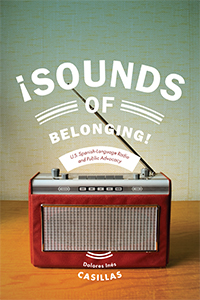 Sounds of Belonging deftly navigates the historical and contemporary domains of Spanish-language radio, theorizing them as a dynamic sonic terrain where we can listen to struggles for and against power, as well as to modalities of difference. Beginning with the traces of Spanish-language radio that emerged early in American radio’s so-called “Golden Age” in the 1930s-1940s, moving through the activist-driven bilingual Chicano community radio of the 1960s and 1970s, and then laying out the landscape of the highly profitable world of Spanish-language broadcasting today, Casillas guides readers through a historical trajectory of Spanish-language radio. She draws from Spanish-language radio broadcasting in its commercial and non-commercial iterations, while keeping tuned to the transnational connections transmitted through these frequencies.
Casillas engages with critical cultural studies, Chicana/Latina studies, and radio/media studies to explore the production of masculinity on El Cucuy’s morning radio program. Casillas studies El Cucuy as both an on-air personality and a political figure advocating for immigrants’  rights, illustrating the “complex interplay of gender, labor, and globalization” (104). While El Cucuy’s “shock-jock” style–imbued with sexual humor–often garners him comparison to Howard Stern or Rush Limbaugh, El Cucuy does more than shock and entertain his listeners. Casillas argues that sound and immigrant listening practices are integral to El Cucuy’s discursive aural constructions of a transnational working-class male audience, one that is not shamed for speaking Spanish, enjoying ranchera music, or laboring in “women’s work.” However, by highlighting how El Cucuy and his listeners reinscribe traditional gender roles that silence and marginalize Latinas, Casillas reveals the complexity of El Cucuy’s political advocacy for male workers on the one hand, and the program’s misogynistic message on the other.
Sounds of Belonging pushes scholars to think more thoroughly about the role format and genre play in the characterization of radio stations, as well as the audience constructed through these programming choices. She characterizes Spanish-language radio as both on-air dialogues and conversations between callers and radio hosts. This approach provides an intersectional analysis comparing radio listeners to those working in production. Casillas opens a line of inquiry into non-normative or non-hegemonic radio practices by positing that Latino radio listening is public and communal and not a solitary practice. Casillas shows how research that frames listeners as a market—simply audiences or consumers—polarizes our understanding of radio practices, particularly within research on Spanish-language radio.
One of Casillas’s most important interventions is her granular analysis of the role of radio in Latino communities, particularly within migrant and working class groups who may have easier access to and familiarity with radio, as opposed to other media such as the Internet. For these communities, radio becomes as an anchor, grounding the cultural ties Latinos have to the communities they migrated from—through stations’ language and music—but it also functions as a way to aurally migrate between borders, specifically when listeners-turned-callers locate themselves bi-nationally.

Casillas also argues that Spanish-language radio is an alternative site of congregation and dialogues amongst communities that are marginalized and made hyper visible by mainstream English-language media. Anti-immigrant policy and legislation—heard and seen in popular media as a narrative of “illegal aliens” invading America—is the backdrop against which Casillas explores the role of Spanish-language radio as an “acoustic ally,” a concept she explores in the chapters “Acoustic Allies: Early Latin-Themed and Spanish-Language Radio Broadcasts, 1920s-1940s,” and “Sounds of Surveillance: U.S. Spanish-Language Radio Patrols La Migra.” She explains that Texas and California were home to the debut of U.S. Spanish-language radio in the 1920s, crafted specifically for Mexican listeners. Radio announcers such as Pedro J. Gonzalez brokered airtime, typically broadcasting during the unfavorable times of late night or early morning. As a method of resistance, radio provided Spanish-language audiences with the capability of listening to “home.”

Images of Pedro J. González, who was also a musician and a founding member of Los Madrugadoras in addition to an important early Spanish language radio announcer
In the chapter “Mixed Signals: Developing Bilingual Chicano Radio, 1960s-1980s,” Casillas uncovers a major gap in research on the aurality of the Chicano Media Movement. She pivots the analytical lens of Chicano movement activism from urban to rural areas and traces the emergence of bilingual community in conjunction with farm worker activism in California and Washington. Bilingual community radio stations such as Radio KDNA in Granger, Washington, KBBF-FM in Santa Rosa, California, and Radio Bilingüe in Fresno, California—places that rely heavily on low-wage farmworker labor—showcase how the political activism of this movement era took place on emergent community airwaves. Listener-focused Chicano community radio stations “sought to broadcast independent of commercial influence, produce local programming, and, perhaps most significant, operate under the full control of Mexicans and Chicanos themselves” (52-53). While under the control of Chicano/a community radio producers, Casillas demonstrates how the funding model for community radio stations—namely, a heavy reliance on grants from the Corporation for Public Broadcasting—underscores the bureaucratic limitations for public broadcasts.
Sounds of Belonging opens the path for a new line of inquiry regarding Spanish-language radio while revealing that there is much work to do in the area of Spanish-language radio studies. Despite the chapter “Mixed Signals”’s focus on the community radio format, Casillas’s dedication to commercial radio highlights an urgent need for scholarship on non-commercial radio. Studying non-commercial stations will advance necessary conversations around content and innovation rather than economic success and failure.

Overall, Sounds of Belonging is an exciting and foundational text for scholars and readers interested in Latina/o media studies, sound, radio, cultural production, immigration and the Latina/o experiences in the United States as experienced and lived through sound and listening. Casillas’s agility in drawing from various theoretical and methodological perspectives provides a rich analysis of Spanish-language radio situated in a transnational context that reflects not just the listenership, but also the continued importance of radio for Latina/o communities living throughout the U.S. borderlands.
—
Monica De La Torre is a doctoral student in the Department of Gender, Women and Sexuality Studies at the University of Washington. Her scholarship bridges New Media and Sound Studies by analyzing the development of Chicana feminist epistemologies in radio and digital media production. A member of Soul Rebel Radio, a community radio collective based in Los Angeles, Monica is specifically interested in the ways in which radio and digital media production function as tools for community engagement. She is an active member of the UW Women of Color Collective and the Women Who Rock Collective. Monica earned a B.A. in Psychology and Chicana/o Studies from University of California, Davis and an M.A.in Chicana/o Studies from California State University, Northridge; her master’s thesis was entitled “Emerging Feminisms: El Teatro de las Chicanas and Chicana Feminist Identity Development.” Monica received a 2012 Ford Foundation Predoctoral Fellowship, which recognizes superior academic achievement, sustained engagement with communities that are underrepresented in the academy, and the potential to enhance the educational opportunities for diverse students.
—
Featured image: “Hi-Fi” by Flickr user Feans CC BY 2.0
—
REWIND! . . .If you liked this post, you may also dig:
SO! Reads: Daniela Cascella’s F.M.R.L. (Finding Materials for Remembering and Listening) — Kyle D. Stedman
The Sonic Roots of Surveillance: Intimacy, Mobility, and Radio — Kathleen Battles
Sounding Out Podcast #24: The Raitt Street Chronicles: A Survivor’s History — Sharon Sekhon and Manuel “Manny” Escamilla
Share this:


Current Top Posts





April 2021

January 2020

November 2019

October 2019

August 2019

April 2014

November 2017

March 2015

December 2017

October 2015
 Sounding Out!
Recent Comments