
Curatorial Dispatches from the Nendu Archives: The Journals of Rui Chaves and Tiago Costa

Rui Chaves will be documenting his creation of Nendu—an archive of Brazilian sound artists—in real time on Sounding Out! throughout 2016-early 2017. A Portuguese version of Chaves’s journals was published in Linda, an online platform created by a composers’ collective called NME. Rui Chaves’s postdoctoral research is funded by FAPESP (São Paulo Research Foundation) Project 2014/15978-9.
—
Nendu—the title of my archive—envisages the creation of an online platform dedicated to presenting and mapping the work of contemporary Brazilian sound artists. I have based my based upon the following four objectives:
1) Creating a ‘map’ that enables the dissemination and discovery of local praxis;
2) Prompting conversations or different types of documentation that better illustrate individual creative processes (‘journal’);
3) Re-affirming the idea of the ‘archive’ as a research tool;
4) Writing a historical and critical report on Brazilian sound art;
Nendu’s online ‘map’ will enable users to discover different practitioners based on location, but more importantly on what categories the artists themselves have asked to be associated with.
These categories consist of designations of practices that cross the current imaginary of sound art historiography and reflection. A porous and rizomatic territory, to be sure, the categories will echo the obvious specificity of the experience and presentation of sounding artworks — temporally, spatially and formally — without excluding practical, historical and conceptual connections with music, architecture, performance or visual arts.
My selection framework interweaves individual research with contacts with curators, friends, and other researchers. It is important to mention that this process remains open to any individual that wants to be part of the platform until the end of the project in June 2017. This openness facilitates a dialogue between the archivist and interested parties, while at the same time enables reflection regarding the relationship with the idea of “sound art” and the role of sound within different artistic practices.
The second element (called a ‘journal’) consists of field work (to be done until the end of 2016) where I–together with a smaller selections of artists–attempt to present different in-depth reports of “ways of doing” sound art. The journal will consist of interviews, photos, videos, audio recordings and other relevant items. I will publish this material in tandem with the map in the form of a blog and I will share dispatches from the journal with SO!’s readership regularly throughout 2016.
The articulation of the map and journal foregrounds a critical reasoning regarding the idea of the archive as a research tool. My archive will not only be a repository of artists and work done, but also a way of doing an ‘archeology’ of discourses, made objects, and creative processes of sound practitioners. Methodologically, I support my archive via an ethnographic approach, tracing common ideas or patterns between conversations, materials, and/or other artifacts (texts, videos, audio recordings or photographs) gathered during the project. This not only allows an understanding of a possible formal aesthetic discourse (collective or individual), but also offers insights and possible contextualizations of various thematics within a broader cultural arena. Through mapping particular ways of doing, I argue, my archive will allow participants/artists—and also future users—a better comprehension of the prevalent cultural terms.
In the end, this methodology is geared toward the creation of a historical and critical report regarding the current panorama of Brazilian ‘sound art’. Because Nendu is also Tupi for “listening to one-self,” it functions as a metaphor for the creation of an archive that envisages alternative reflections and historiographies from European/American narratives.
For my introductory presentation for Sounding Out!, I want to take the opportunity to present a a ‘journal’ that I made with the artist Tiago Costa in the town of Tiete (state of São Paulo). We perform this activity with “two-voices,” each one of us writing about their experience — starting with me.
//
RUI CHAVES:
Day 1
My rendez-vous point with Tiago was at the Barra Funda metro station and bus station. Our meeting results from a series of conversations and our eagerness to record the sound of the cicadas in his home town (Tietê). He was also interested in using binaural microphones, which end up being the main recording setup for what we did in the weekend between the 29th to the 31st of January 2016. Over the course of this weekend, I ended up in a series of conversations where I try to explain how these microphones work—in a very imprecise manner.
Our trip begins early in the morning, so I wake up early and still in night time to travel to the metro station, carrying all the recording equipment. When I arrive, there is already a lively buzz in the place. I have breakfast and, still feeling hungry, I have a second. As always, I arrive way too early and I look for the travel information center in order to try to find the right bus ticket sales booth. Fortunately, Tiago also arrives really early and I get an SMS from him telling me that he had already bought the tickets. We meet up and immediately get along. The conversation between us will constantly flow during our time together. He is an artist with a vast experience in audio post-production and he’s also pretty active and interested in São Paulo’s experimental music scene. This type of in-depth knowledge will also be a good source of jokes and gossip regarding particular musicians in the scene.
The conversation continues inside the bus, during which I compliment the vehicle’s air conditioning set temperature, quite mild at that time. Everyone that has travelled by bus in Brasil is acquainted with the cold that one has during long distance travels. While we continue to chat and get farther away from the city, we start to gaze a landscape that cuts through our daily experience of living in São Paulo—it is so hard to see the horizon in that city!
We came across and stop briefly in a town with a weird and funny name to me: Boituva!
Boituva is really well known for its paragliding activities. Sometime during our weekend together, I discover that Tiago is afraid of heights and that he is not planning to paraglide any time soon—I agree. It also during this stop over that Tiago describes to me a regional musical traditional called “Cururu”: a form of song-off duel between two “violeiros”; based on that description, I commented to him that it sounded a lot like a rap battle. A smile comes up on Tiago’s face, a smile that grew larger and larger due to my inability to say “Cururu” the right way: Pururu, Cururuca, Pururuca.
We arrive to Tietê early and sleepy. At first sight, the city has a contrasting scale and size in regards to São Paulo. The height of the buildings is relatively small, punctuated by a few condos slightly off the main urbanscape. The bus station has a small boteco, and not much else. Botecos are common in Brazil; to me, they seem like a cross-over between a pub, restaurant and coffeehouse. There are a few clouds in the horizon, but Tiago tells me that the city is much warmer and drier than São Paulo. He also tells me that signs of Italian immigration are quite present in the city, as well as assorted religious events. Not long after, Tiago’s mom arrives and she is extremely kind.
At Tiago’s place I have my third breakfast (called café da manhã here). With some effort and excitement, we go out to check a few places near Tiago’s home for recording and I’m impressed by the relatively diversity of the nearby soundscape. Besides the sounds of birds, insects and some motorbikes—there is a pungent smell of sewer in the air that envelops us.

Bairro Seis Irmãos – Tietê (São Paulo). 29/01/2016. Picture by Rui Chaves
We also see a series of houses with an architecture that reminds me of other parts of the world. We make the most of this small trip and Tiago records a small route in that area using the binaural microphones.
Tiago Costa field recording // Best heard with headphones
We go back home and Tiago listens to the recording we just made. We have a small talk about this process. We sit at the table to have lunch and I try to explain to Tiago’s mom my research and what the process of binaural recording entails:
The head is a filter that enables to create a 3D image during the recording process.
I think I have a limited understanding of the process.
We end up having a quiet afternoon. I’m still a bit excited, so I decide to go out to run a few tests with the camera I bought to document my research work. Tiago and his mom suggest that I go and visit the river.
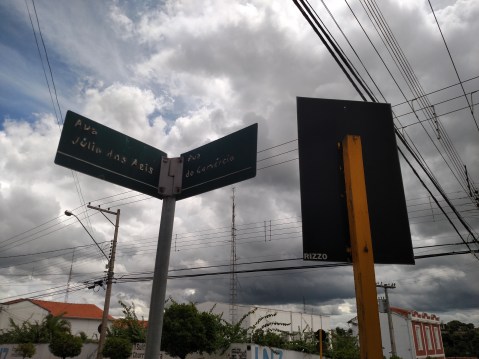
Rua Júlio dos Reis – Tietê (São Paulo). 29/01/2016. Picture by Rui Chaves
I do a small video recording through the city using a gadget that enables me to strap the camera to my head. Following their indications, I find the river Tietê. The color of the water is really brown and there is a smell that I can’t explain. It seems that in bygone times one could have a swim there, and that there was also a swimming club. With time that changed, but there is a small religious celebration where two boats meet in the same place.
I find a small wooden stage near a construction site and inadvertently, I hear a conversation about which national team has the biggest number of fans in the country. I start to get really tired and decide to go back home. I try to transfer the files to watch the videos. The computer has problems playing them, so I give up and fall asleep.
We wake up for dinner and after, we go on a stroll through the city, literally going in circles around the main plaza. The conversation is good and we continue talking over a few beers on the porch of Tiago’s house. I don’t know if it was on that day or the next, but we comment on the lack of representation of certain groups in the São Paulo experimental music scene.
Tiago also describes to me a map of the local labels. We decide that it might be interesting to have a dedicated field recording label, because there are none in Brasil. We laugh at the possibility of the project being profitable or manageable. It would be one of those things that you would do out of passion, as were most things that we talked about during that evening.
We decide to wake up early in order to do our first recording of the day and try to capture the local dawn chorus. It was a really warm night, so I fall asleep to the sound of the ceiling fan refreshing me.
Day 2
I had an idea for a possible project between us, having sent Tiago a plan beforehand. The project consisted of using the binaural recording process as a metaphor for a collaborative recording process. I soon realize that that could be too complex for the time we had, and that I didn’t want to condition our weekend meeting and recording process. From now on, the focus would be on documenting Tiago’s work.
The alarm rings and I prepare the audio and video recording equipment. We both look tired, but are in good moods. The idea is to document the recording/path that Tiago is going to make—so I strap the camera to my head and Tiago sets up the binaural microphones; for some reason there is a glitch with the audio recorder SD card, but I manage to solve the problem.
Tiago – Field Recording // Better heard with headphones
We go back in order to get bit a more rest; we must, as later on we are going to do a few more recordings. I try, but I end up staying awake. It starts to get hot, so I get out of bed and have have breakfast. Tiago’s mom is already doing some house chores. It is a beautiful day and I am quite excited about what we are going to do in the afternoon. The area surrounding Tietê is quite beautiful with sugar cane plantations all over the place, supposedly for the production of bio-diesel.
We were meant to go out early, but we are going to meet a friend’s of Tiago and he suggested that we went after lunch. So we did that, just before leaving an intense rainfall strikes Tietê. We head out anyway, toward a place whose name I forgot. After we arrive, and while we wait for the weather to improve, we decide to recording the momentary ambience.
When the rain stops, we meet up with Marcos—a really gentle and nice person. On our way, I explain my research project to him and lend him my recorder to listen to how binaural recordings sound. He tells me that it feels like the sounds are happening around him. Discreetly, I record their conversation and I am briefly taken away by stories about friends and TV shows that discuss the evolutionary nature of pain.
We arrive at the dirt track where we are going to do a few recordings. We have to jump a fence and my shoes get all dirty with mud. In the end, all of our clothing ends up wet and dirty and Tiago’s mom’s car will suffer the consequence of our little adventure. At the same time, I can’t understand if we are actually allowed to enter this property.
The surrounding landscape is amazing and we walk, hopping a few more fences until we reach the river. We stop there in order to do another recording. The river water has an intense brown color and the sky is still cloudy. We mainly record the sound of the water coursing. After we finish, Marcos goes out to do a recording and disappears for a few minutes.
Marcos André Lorenzetti recording // Best heard with headphones
After a while, we get a bit worried about him, but he soon arrives saying that we have to change to another, more interesting place. We start walking, avoiding our initial choice of a route due to the possibility of existing spiders or snakes, crossing a small ranch where we encounter a family getting ready for a barbecue. Marcos, a former vegetarian who now eats chicken, asks Tiago if he misses eating barbecue. He says he doesn’t.
At another part of the river bed, for some odd reason we decide to go through a complicated route (especially for people carrying equipment!). I worry I’m going to get wet. So it was, but Tiago and his friend helped me with my bag. We arrive to a small island of rocks and we do another recording. The weather is nicer now and it feels really wonderful. Tiago and Marcos go for a swim in the water and I get in a little bit to make a video recording. After a while, I felt obliged to go for a swim too, although I was a bit phobic regarding germs, bacteria or other nasties that could be in that water. I join them and suddenly we spot a sewer drainage pipe. I ask Marcos if the water is clean and he replies that:
Clean, clean, it never is!
Returning to the ‘mainland.’, I accidentally misplaced one of my feet, and slip on my back on one of the rocks. Fortunately, none of the equipment gets wet and I leave with only a few bruise marks.
TIAGO COSTA
In mid-November 2015, there was a strong heat wave in the interior of São Paulo. I was in the city of Tietê, my home town, two hours west. I remember being home, the seasonal dry air and the surrounding sounds picked up my attention, in particular the strong sound of the cicadas. I became interested in capturing them, and imagined myself in a recording situation in the middle of the woods, just a few meters from my house. At that time, I had been listening to a few interesting works that utilized binaural microphones and start querying colleagues that used that type of setup in their work. That’s when I contacted Rui.
Rui is developing research about Brazilian sound art, and for that he interviews and documents a series of artists that work with sound. Part of his process consists in spending some time with them, documenting what they usually do and proposing interventions. I explain what I wanted to do; Rui got interested and he invited me to do something in Tietê.
Due to our agendas, our meeting had to be postponed a few months after this conversation, unfortunately when he finally had time, the cicada weren’t ‘sounding’ as as much as before. We decide to maintain our intent to meet, and during the month of January, we left for a weekend to do some field recordings together.
We went to Tietê on the 29th of January and the soundwalk happened briefly after we arrive. With the recorder and binaural microphones in hand, we visit the outskirts of the woods in proximity to a neighborhood called Seis Irmãos (literally translating to “six brothers”).
In the past, that part of town had only a few small farms (called chácaras in Brasil), and although today it has been replaced by urban development, it still maintains a considerable native green area. Well, partially native. as we encountered a mix and pipes that send untreated sewage to a water stream called Ribeirão da Serra.
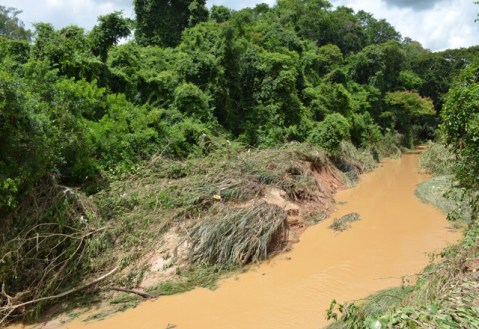
Bairro Seis Irmãos water stream/sewage – Tietê (São Paulo). no date available. Picture by Tiago Costa
During that walk, we had a go with binaural recording, and we discussed a possible ‘narrative’ that could be done the next day, This ‘narrative’ would consist of emphasizing the first morning sounds, starting in the middle of the neighborhood houses, until a particular moment when we would enter the woods for a more contemplative appreciation. We also recorded a few ‘urban sounds’ during the walk, inside a car on the way to the next recording spot: a brief rain storm, the car’s mechanical sounds and our casual conversations.
Rui Chaves field recording // Better heard with headphones
The second stage happened in a nearby town, Cerquilho. This was a plan parallel to the cicadas that we made at the banks of the Sorocaba River, a place with less human intervention and strong currents, so it demanded the help of someone that knew it well. I invited my friend Marcos to accompany us. He had practiced canoeing and regularly frequents that spot, building a very close relationship with this river. During the trip he told us about an experience he had spending the night close to the river with only a hammock. He described how the sound part of this experience transformed his perception:
One time I went to sleep close to the river [. . .] in the hammock, and during the day the sound of water is harmonic, but during the night it transforms into something really intense. And since it was night time and our perception gets a lot sharper, more alert, because there could be an animal close, so with any noise made we become more alert. There were times where the experience of the water ‘noise’ became so intense that it somehow even changed my consciousness [. . .] it was incredible [. . .] because it is a constant sound, right, [. . .] the current is constant [. . .] and if you don’t feel trapped by it, you set yourself free.
Tiago Costa Field Recording // Usar fone de ouvido
The sound recordings made in that afternoon captured a river with a strong presence in constituting that acoustic space, taking upstage presence in regard to all other sounds. After the recordings, we had a swim and talked until the end of the afternoon.
***
This multi-vocal diary manifests the methodological frame for the ‘type’ of archive that I am building — a performative endeavor that envisages presenting process and work through a multi-layered weave of text, audio-visual documentation, and online material. Ultimately, its format signals a dialogical movement between archivist and artist, the underlying force in building a critical and historical report on Brazilian sound art. This publication is part of a series of installments that will run until mid-2017. The next post will focus on the work of Lilian Nakao Nakahodo, a composer/performer and researcher that created the Curitiba Sound Map.
—
Featured Image: In a ranch between Tietê and Cerquilho. 30/01/2016. Picture by Rui Chaves
—
Rui Chaves is a Portuguese sound artist, performer and researcher. His research and work foregrounds a discussion of presence — both physical and authorial — in the process of making sound art. This endeavor is informed by a contemporary critical inquiry and exploration of the thematics of body, place, text and technology. He has presented his work in several institutions and events throughout the United Kingdom, Brazil, France, Canada, Portugal and Germany. He holds a PhD in music from Queen’s University Belfast and is currently a postdoctoral researcher at NuSom (University of São Paulo).
Written in collaboration with Tiago Costa.
—
REWIND!…If you liked this post, you may also dig:
Six Years in Nodar: Sound Art in a Rural Context–Rui Gomes Costa
SO! Amplifies: Ian Rawes and the London Sound Survey–Ian Rawes
Sound-politics in São Paulo, Brazil–Leonardo Cardoso
Reflective Sound Gathering via the New England Soundscape Project
–Daniel Walzer
Share this:

Make a Noise Joyful: Cirm in the Old English Exodus


Series co-editors Dorothy Kim and Christopher Roman
When the narrator of the Old English poem Exodus declares “Gehyre se ðe wille” (Let him hear who will), what sounds is he asking us to attend to? [Note: Text from Peter Lucas’s edition, 7b. All translations are author’s own.] This post argues that the Old English noun cirm (noise, shout, outcry) challenges our conceptualization of noise. In the Anglo-Saxon corpus, cirm most often refers to the indistinguishable, non-linguistic hum of a crowd, rather than the meaningful utterance of an individual. This accords with the popular view of noise in sound studies: whether medieval or modern, noise (as opposed to meaningful sound) is associated with alterity, disruption, and violence.
However, and strikingly, in the Old English Exodus, words for noise describe not only the terrible sounds of the drowning Egyptians as the roaring waters of the Red Sea rush over them, but also the survival of the Israelites. I argue that this cirm is a mark of the Israelites’ triumphal assertion of their continued presence and plenitude, a celebration of the fact that they can still be a multitude despite captivity. That cirm may not sit easily within our definition of noise should provoke not a redefinition of cirm’s joyful use, but a reconceptualization of Anglo-Saxon noise.

‘Amalek Attacks Israel and Is Defeated’, in the Old English Hexateuch, British Library, MS Cotton Claudius B IV
What is Noise?
“Noise” has a range of meanings, but most often implies “unwanted sound” as R. Murray Schafer argues in The Soundscape (73). Following the work of Jacques Attali and Jeffrey J. Cohen, noise has been associated with alterity, difference, and monstrosity. Noise, as opposed to sound, may be non-linguistic or disordered: nonsense, babble, the roar of a jet engine. According to David Novak’s contribution to Keywords in Sound, noise is not present in nature, but is created by modern technology (129). In the modern world, noise is often considered negative: cities have rules about noise pollution, apartment buildings set quiet hours, and airplane passengers don noise-cancelling headphones. In the pre-industrial age, noise was not exempt from criticism, though the word could also be applied to more pleasant sounds, like birdsong.
In the European Middle Ages, Valerie J, Allen argues in “Broken Air,” noise was often figured as violent, transgressing boundaries, inappropriately closing the distance between sound producer and sound receiver (310 and 317-318). According to Macrobius, it was not silence that was the opposite of sound, but noise (311). Grammar, which was “devoted to the pursuance of ratio through sound,” was ethical; noise was therefore considered “a kind of audible violence; corruption [wa]s something one can hear” (305). But some medieval noises were more ambiguous: the Old English word dream (joy, joyful sound) could also be applied to the terrible sounds of Hell or the terror of Judgment Day, as in Kazutomo Karasawa’s analysis in “OE dream for Horrible Noise in the Vercelli Homilies.” Likewise, “clamor,” which originated as a (mostly) negative noise, became an important legal instrument, as discussed by Richard Barton in “Making a Clamor to the Lord: Noise, Justice and Power in Eleventh- and Twelfth-Century France.” But in general, we tend to assume medieval noise is negative, or marks its producer as other.
Noises in Exodus
The Old English Exodus, found in the c. 1000 manuscript known as Bodleian MS Junius 11, is a notoriously difficult and complex poetic adaptation of the Old Testament Exodus 12-14. The author and date of composition are unknown, though it is often considered quite early, perhaps as early as the eighth century as Paul Remley and Lucas argue. Few institutions were rich enough to own a complete Bible. The author of Exodus may have had access to a written Latin version of Exodus, or may have been exposed to the text via the liturgy, especially the liturgy of the Easter Vigil.

The Junius Manuscript, Oxford, Bodleian Library, MS. Junius 11, pp. 84-5
Exodus delights in sensory details, but until recently, I had always thought of Exodus as primarily visual – the gleaming of war-gear, the glittering of Egyptian spoils washed up on the shore, tents and a pillar of cloud to protect the Israelites from the desert sun, and a pillar of fire to guide them. But the poet is also attentive to the larger sensory world, including the world of sound and noise. Those who accept the poet’s opening challenge to his audience (“Gehyre se ðe wille!” [Let him hear who will!]) will recognize that the poem is in fact filled with sounds – the battle trumpets that provide order and structure to the movements of the army, the rushing and later silencing of waters, the terrible evening songs of wolves eager for battle, the awful rasping of the blade Abraham draws to sacrifice Isaac in the poem’s digression on the patriarchs, the triumphant songs produced by Israelite men and women in praise of God after the Egyptians are defeated. In what follows, I focus on the multiple deployments of a single word for noise (cirm), applied to both Israelites and Egyptians, asking what this word can reveal about Anglo-Saxon conceptions of noise.
It has often been remarked that the poet resists easy distinctions between Israelites and Egyptians, applying similar vocabulary to both, and this is certainly illustrated by the poet’s sonic play. In a climactic scene near the end of the poem, the drowning of the Egyptians in the Red Sea is accompanied by horrible noises:
Storm up gewat
heah to heofonum, herewopa mæst;
laðe cyrmdon (lyft up geswearc)
fægum stæfnum. Flod blod gewod:
randbyrig wæron rofene, rodor swipode
meredeaða mæst. Modige swulton,
cyningas on corðre. Cyrm swiðrode
wæges æt ende; wigbord scinon.
[A storm went up high to the heavens, the greatest of cries of the army; the hostile ones cried out with doomed voices (the air grew dark above). Blood pervaded the water: ramparts were broken, the greatest of sea-deaths lashed the sky. The brave ones died, kings in a troop. The noise fell silent at the end of the water; battle-boards shone. (460b-467; emphasis added)]
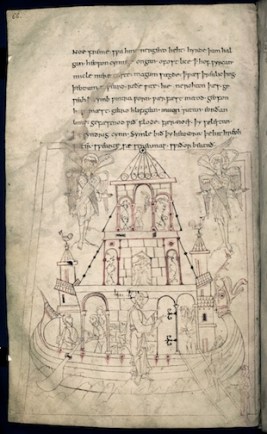
The Junius Manuscript, Oxford, Bodleian Library, MS. Junius 11, p. 66.
Cirm occurs twice in this passage, first as a verb (cyrmdon) and then as a noun (cyrm). The manuscript reading in 466b is cyre (choice). Lucas emends to cyrm because cyre is not a poetic word, and I would argue that the echo with the Israelites’ cyrm (107) must be deliberate. Even if we accept MS cyre, the passage still includes the verb cyrmdon (462a), and other sonic vocabulary (herewopa, “army’s cries” [461], and fægnum stefnum, “doomed voices” [463]). The noun occurs roughly 60 times in the corpus; the verb 17 times (DOE).
In the Old English corpus, cirm is often negative, applied to the tortures of hell or the terror of Judgment Day, and indicates a particularly loud sound (DOE, Lucas). According to the DOE, the noun means “shout, cry, shriek” or “noise of non-human origin, clamour.” The Egyptian cirm is obviously threatening, the meaningless cries of men who, like a raging storm, lash out in terror as the waters close over their heads. Even the visual horror of blood mingling with water maintains sonic affiliations: this line is a rare example of internal rhyme in Old English poetry (flod blod gewod). The end of the Egyptian threat is marked by the silencing of their voices and cirm, metaphorically a silencing of the army’s advance against the Israelites.
Given the negative associations with noise in both medieval and modern sound theory, that the Egyptian defeat is accompanied by their terrible cirm may not seem particularly surprising. Strikingly, this is not the only such noise in the poem. Near the beginning of the poem, the Israelites celebrate their initial escape from Egypt by producing not just any noise, but cirm. On the third day, after the pillar of cloud has appeared, the Israelites awaken with trumpets, and seeing the pillar,
Folc wæs on salum,
hlud herges cyrm.
[The people were joyful, loud was the noise of the army. (106b-107a; emphasis added)]
If cirm is threatening, loud noise, associated with difference and violence, why would the Israelites produce it? I would like to suggest that cirm suggests not merely loud noise, but crowd noise. The Israelites’ cirm is not an assertion of difference, or the meaningless babble of a drowning, almost non-human army, but an assertion of triumphant plenitude. Their joyful cirm is a fulfillment of God’s covenant with Abraham, which the poet will remind us of later in the poem (435-442). Just as God promised Abraham innumerable offspring, his support of the Israelites in their exodus signals that they will continue to be a multitude (as they certainly are in this battle, in which they have 600,000 fighting men (224-233).
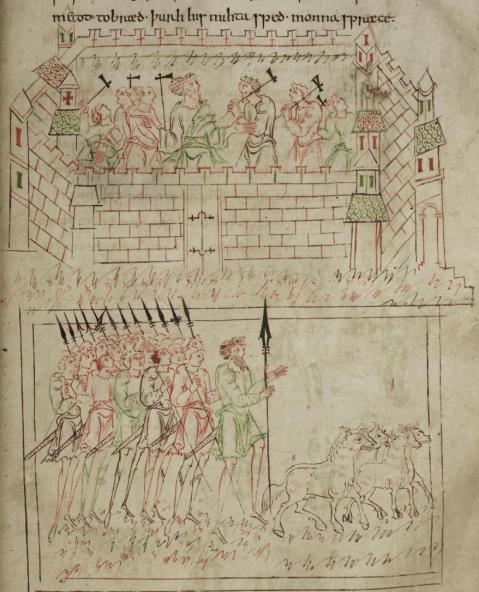
The Junius Manuscript, Oxford, Bodleian Library, MS. Junius 11, p. 81.
In fact, the Israelites’ triumphant crowd noise is echoed at the end of the poem as well. After the defeat of the Egyptians, who make terrible cirm as they perish in the Red Sea (460b-467), the Israelites issue more celebratory sound, this time transformed from crowd noise to harmonious music:
Æfter þam wordum – werod wæs on salum –
sungon sigebyman (segnas stodon),
fægerne sweg
[After these words – the troop was joyful – victorious trumpets sang a beautiful sound (battle-standards stood). (565-67a; emphasis added)]
The Israelites’ cirm (107), which they produced while on salum (joyful), is balanced and echoed by the celebratory sounds of the end of the poem, also produced by a people who are on salum (565). Whatever threat the Israelites’ assertion of plenitude and cirm may have made possible is mitigated by replacing that cirm (noise) with a beautiful sound (fægerne sweg), a harmonious, if also loud and multiple, expression.
According to Attali, music can be used to produce order, but “noise is violence: it disturbs. To make noise is to interrupt a transmission, to disconnect, to kill. It is a simulacrum of murder” (26). In this sense, the Israelites’ crowd noise in the desert is violent – it threatens the order of the Egyptians, or the hierarchy the Egyptians have sought to impose on the Israelites in their captivity. But because this story ends in the triumph of the Israelites, told from the point of view of their Christian descendants, it celebrates this assertion of communal power and communal violence without fully othering them. The true violence is inflicted on the Egyptians by God in the Red Sea, allowing the Israelites to reassert their normativity, their cohesion, their power, and their non-otherness. While the drowning Egyptians produce cirm, it is silenced because the cirm of the Israelites has conquered them. Noise, or at least cirm, is therefore not merely negative or disruptive; it is a powerful claim to be blessed by God, an assertion of belonging rather than a boundary crossing.
—
Featured Image:Detail of a miniature of the plague of hail (Exodus 9:22-25), Add MS 15277, f. 7r
—
Jordan Zweck is an assistant professor in the Department of English at the University of Wisconsin-Madison. She specializes in early medieval vernacular literature and culture, especially Old English, and is interested in documentary culture, media studies, and sound studies. She is currently completing a book on Anglo-Saxon epistolarity and early English media, examining the representation of letters in vernacular texts such as letters from heaven, hagiography, and poetry. She is also working on a second book on sound, noise, and silence in Anglo-Saxon England, a portion of which is forthcoming in Exemplaria. Zweck is a recipient of the University of Wisconsin-Madison Center for the Humanities’ First Book Award, has held a resident fellowship at the Institute for Research in the Humanities at UW-Madison, and has won several teaching awards.
—
REWIND!…If you liked this post, you may also dig:
‘A Clateryng of Knokkes’: Multimodality and Performativity in “The Blacksmith’s Lament”–Katherine Jager
Mouthing the Passion: Richard Rolle’s Soundscapes–Christopher Roman
Sounding Out! Podcast #54: The Sound of Magic-K.A. Laity
Share this:


Current Top Posts





April 2021

January 2020

November 2019

October 2019

August 2019

April 2014

November 2017

March 2015

December 2017

October 2015
 Sounding Out!
Recent Comments