
Ghosts in the Machine: Sampling Dr. King

Education is never politically neutral. Many of us advocate for social justice when we’re outside of the classroom but struggle to continue that work inside as well, especially with issues that appear on the surface largely unrelated to our disciplines. This inaction maintains the centering of the white experience, continuing to normalize and prioritize it at the expense of all others. Marginalized voices remain marginalized. We don’t need our own students to be directly impacted by policies to advocate on behalf of those who are. This is work we all must do.

“New Orleans Street Musicians …” by Flickr user sswj, CC BY-NC-ND 2.0
While social issues have made important inroads within musicology and ethnomusicology, they rarely make an appearance in music theory or composition, especially in a classroom setting. To begin these conversations, we must expand the scope beyond the purely technical and examine the ways in which music is a social and cultural phenomenon. Understanding how a triad functions, for example, is only part of the story. We must also recognize that any musical activity involves a network of people who might be engaged in any combination of producing, performing, buying, selling, listening, analyzing, teaching, institutionalizing, and so on. Discussing these networks means discussing their persistent systemic inequalities and power differentials, and understanding that these are social and not just musical issues. Cultivating this awareness is crucial in the development of our students as critical thinkers who can question the society in which they live, who can locate injustice and fight to advance social good. Abstract music theory is important, but music theory combined with a social awareness is vital.
Georgetown University hosts an annual Let Freedom Ring! initiative, a recurring project to honor the legacy of Dr. Martin Luther King. “Teach The Speech,” in particular, is a cross-campus curriculum project where interested faculty and staff incorporate that year’s selected work by Dr. King in our courses and workshops, sparking campus-wide conversations rooted in themes of social justice. The first time I joined the “Teach the Speech” efforts, I redesigned my basic theory class to include guiding principles from King’s entire body of work. In addition to covering the expected chords, scales, and other technical material, we discussed the disparity in representation faced by women and POC within music, viable modes of protest in music, and the possible roles of government sponsorship and censorship of artists. We rooted these issues in the real-life examples of the Grammy’s, the Women’s March, and the threats by the Trump administration to cut funding to the NEA and the NEH. Final projects based on these bigger-picture topics provided students further opportunity to reflect on the ways in which these and similar topics manifest in their own lives, transcending a preoccupation with “notes on a page.”

“Free at Last” by Flickr user Thomas Hawk, CC BY-NC 2.0
My second time participating in the “Teach the Speech” initiative, I used a recording of Dr. King delivering “I Have Been to The Mountaintop” as part of a module on sampling for my DJing and production class. Students had to create short tracks using this recording as the only permissible sound source. Anything resembling a kick, snare, hi-hat, melody, or harmony had to be constructed from a sample. Using something we don’t typically consider to be music as the sound source for creating music demonstrates the power of the studio and illustrates just how far creative slicing, dicing, and processing can take us. Beyond these important practical applications, though, the use of speech provides us with a framework for discussing why context matters. Do context and history always travel alongside the immediate acoustic phenomenon of sound? Can we identify something as “the music itself”? Through wrestling with these and related questions, students begin to understand sample-based composition as both a musical and a moral undertaking.
The process of sampling is largely a process of curation, involving a responsibility not just for the product but also for the source. If a student chooses to sample a large-enough portion of Dr. King’s speech, so that one can recognize words, phrases, even full sentences, then her choice includes the layers of extra-musical meaning attached to those words in addition to their musical qualities. “Violence,” for example, has a particular sonic profile and meaning that most listeners understand. How we actually interpret this word depends on many factors, including the context in which it is used in the original source, the identity of the speaker, and any audio processing that students might apply. The addition of distortion, for example, will influence the impact of that word on and its reception by the listener. The sampled word might be a fragment of a larger word, “violence” snipped from “nonviolence,” and never appear in its own right in the source. These and other complex issues involved in the process of sampling exist whether or not the student chooses to engage with them.
If the student samples an extremely small fragment of the Dr. King speech, obscuring the source and working with sound on an almost molecular level, then perhaps these questions go away. Can we still discuss the attendant connotations and denotations of indecipherable fractions of words or slices of the ambient hiss between the words? In this situation, is the origin of the sample still relevant for the work being done? When the ties connecting a heavily processed source to the finished product are untraceable, does it matter where we sampled from? Is white noise simply white noise?

“White noise on the Columbia” by Flickr user jaisril, CC BY-NC-ND 2.0
Arriving at these kinds of questions is largely the point of the exercise. With a little deliberation, students realize that there is a very clear distinction between sampling the word “violence” from a speech by Trump and from a speech by MLK. There is a context, a lineage, and a history to samples that lives outside the phenomenon of pure sound, and this holds true even at the molecular level. This is crucial for students to understand, and its implications extend far beyond a music class.

“Pride (In the Name of Love)” by Flickr user T, CC BY-NC-ND 2.0
We can, for example, ask students to consider the related question about whether or not it’s possible to separate art from the artist. Can we ever listen to pre-MAGA Kanye with the same ears? How do we interpret a post-MAGA Kanye song about uplift and resilience? What does it mean to watch a film where Harvey Weinstein had a major role in producing? A minor role? Moral dilemmas form a part of every media interaction we have, and similar questions comprise other aspects of our lives. Can we continue to allow the misappropriation of Dr. King’s “I have a dream that my four little children will one day live in a nation where they will not be judged by the color of their skin, but by the content of their character” without acknowledging the “radical” Dr. King? Can we reconcile a country built on expropriation, slavery, and genocide with one whose propaganda extolls the principles of equality and freedom? These are indeed crucial lines of moral inquiry, and our pretending otherwise enables current systems to remain in place. Sampling King’s speech enables my students to engage with those lines of inquiry from an angle they have not considered before: at the level of sound.
This is work we all must do. Within academia, we need to combat injustice inside the classroom as well as outside to bend the arc of the moral universe toward justice. One way we can engage is through careful attention both to the examples we choose and the way we contextualize them. Students and educators alike need to understand the political nature of education that is too often a means of upholding the power structures within society that position whites at the top, and white males at the very top. These largely invisible systems have very real impacts on our lives, and the only way we can evolve to a more just society is by questioning their seeming inevitability. We must foster dialogue that transcends the classroom. We must engage with social problems. We must look beyond the accumulation of knowledge as an end in itself. We must, in short, to do good. This is work we all must do.
—
Featured image: “Martin Luther King, Jr. Memorial” by Flickr user Cocoabiscuit, CC BY-NC-ND 2.0
—
Dave Molk teaches composition and theory at Georgetown University. He’s close friends with producer Olde Dirty Beathoven, a founding member of District New Music Coalition, and a board member of New Works for Percussion Project. Outside of music, Dave is a leader of CCON, an organization devoted to supporting undocumented communities in higher ed in the DMV. Find him online at https://www.molkmusic.com/ and @DaveMolkMusic.
—
 REWIND!…If you liked this post, you may also dig:
A Listening Mind: Sound Learning in a Literature Classroom–Nicole Furlonge
Freedom Back: Sounding Black Feminist History, Courtesy the Artists– Tavia Nyong’o
My Music and My Message is Powerful: It Shouldn’t be Florence Price or “Nothing”–Samantha Ege
Share this:

“Music More Ancient than Words”: W.E.B. Du Bois’s Theories on Africana Aurality

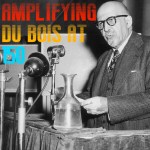 Inspired by the recent Black Perspectives “W.E.B. Du Bois @ 150” Online Forum, SO!’s “W.E.B. Du Bois at 150” amplifies the commemoration of the occasion of the 150th anniversary of Du Bois’s birth in 2018 by examining his all-too-often and all-too-long unacknowledged role in developing, furthering, challenging, and shaping what we now know as “sound studies.”
It has been an abundant decade-plus (!!!) since Alexander Weheliye’s Phonographies “link[ed] the formal structure of W.E.B. Du Bois’s The Souls of Black Folk to the contemporary mixing practices of DJs” (13) and we want to know how folks have thought about and listened with Du Bois in their work in the intervening years. How does Du Bois as DJ remix both the historiography and the contemporary praxis of sound studies? How does attention to Du Bois’s theories of race and sound encourage us to challenge the ways in which white supremacy has historically shaped American institutions, sensory orientations, and fields of study? What new futures emerge when we listen to Du Bois as a thinker and agent of sound?
Over the next two months, we will be sharing work that reimagines sound studies with Du Bois at the center. Pieces by Phillip Luke Sinitiere, Kristin Moriah, Aaron Carter-Ényì, Austin Richey, Julie Beth Napolin, and Vanessa Valdés, move us toward a decolonized understanding and history of sound studies, showing us how has Du Bois been urging us to attune ourselves to it. To start the series from the beginning, click here.
Readers, today’s post by Aaron Carter-Ényì delineates two central strands in Du Bois’s work that have proven key to what we now call sound studies–the historical and affective meanings that sound carries as well as its ability to travel great distances through time and space.
–Jennifer Lynn Stoever and Liana Silva, Eds.
I know little of music and can say nothing in technical phrase, but I know something of men, and knowing them, I know that these songs are the articulate message of the slave to the world. – W. E. B. Du Bois, The Souls of Black Folk (1903, p. 253)
W. E. B. Du Bois claimed to “know little of music,” yet his writings offer profound insights into aurality, foreshadowing the transdisciplinary of sound studies, by connecting language, music, sonic environments and aural communication. Du Bois published the souls of The Souls of Black Folk in 1903, less than a decade after becoming the first African American to receive a PhD from Harvard in 1895. In it, he addresses the color line, reflected in the policy of “separate but equal,” forming arguments that continue in Black Reconstruction in America. He also introduces themes that reappear in his later works including The World and Africa (1947), which formed the seeds of Afropolitanism and many modes of enquiry of Sound Studies. This short essay explores two concepts in Du Bois’s writings: that melodies may last longer than lyrics as cultural retentions; and, that drummed language may travel further than spoken language as communication.
By the time Du Bois published The Souls of Black Folk, what he termed the “Sorrow Songs” (alternatively Slave Songs or Spirituals) had entered the popular canon of American song. As incipits (or epigraphs) for each essay in the book, he entered the songs into a new literary and scholarly canon, ultimately changing the concept of what a book could be by fusing language and music in a new way. Even in a divided society following the U.S. government’s disinvestment in Reconstruction and the sharp uptick in lynching and other forms of racial terror, the “Negro folk-song” could not help but have a profound impact “as the most beautiful expression of human experience born this side the seas” (Souls XIV), particularly due to the efforts of Fisk’s Jubilee Singers. Du Bois’s choice to include musical transcriptions without lyrics at the opening of each essay in Souls reflects a view of melodies as having a life–and a value– of their own.

Du Bois paired a quote from “Childe Harold’s Pilgrimage ” by Lord Byron with a musical citation from the African American spiritual “The Great Camp Meeting” to open Chapter III, “Of Mr. Booker T. Washington and Others.”
Although Du Bois’s work quite clearly accounts for the development of what has usually been called the African American oral tradition, the concept of an oral tradition is credited to Harvard comparative literature scholars Milman Parry and Albert Lord, who popularized the term in American scholarship by establishing a binary theory of orality and literacy, that not only pitted the two against each other, but implied that they were hierarchical, evolutionary phases of “culture” (1960). This divide both widened and became more nuanced with Walter Ong’s recognition of “secondary orality” (1982), acknowledging that aspects of orality persist in literate societies.
But much earlier than these texts, Du Bois offers an alternate theory of how orality and literacy work, and even concepts similar to secondary orality, in the last essay of Souls, “XIV On the Sorrow Songs.” Notably, he describes his earliest experience with African music via a song that “travelled down” from his “grandfather’s grandmother”:
The songs are indeed the siftings of centuries; the music is far more ancient than the words, and in it we can trace here and there signs of development. My grandfather’s grand-mother was seized by an evil Dutch trader two centuries ago; and coming to the valleys of the Hudson and Housatonic, black, little, and lithe, she shivered and shrank in the harsh north winds, looked longingly at the hills, and often crooned a heathen melody to the child between her knees, thus:
The child sang it to his children and they to their children’s children, and so two hundred years it has travelled down to us and we sing it to our children, knowing as little as our fathers what its words may mean, but knowing well the meaning of its music (254).

Du Bois makes no mention of a spoken oral tradition throughout Souls. In fact, quite the contrary. In this passage, he implicitly argues it is not the meaning of the words, but the meaning of the music that survived the Trans-Atlantic Slave Trade. Instead of an “oral tradition”, Du Bois identifies four steps in the development of American Sorrow Songs: (1) African; (2) “Afro-American”; (3) blending of “Negro and Caucasian” (a creolization); and (4) songs of white America influenced by the Sorrow Songs (256). The search for continuity between African and American culture has been a quest for many, including African-born scholars such as Lazarus Ekwueme. It is clear that melody (both pitch and rhythm) is the most idiosyncratic element of a piece, more so than lyrics, and is the most durable when a people and their culture experience extreme duress. As language (and certainly the meaning of the language) can fade (or be violently submerged) in diaspora, melodies can often hold fast, and be held on to.
At an early date (1903), Du Bois already arrives at a point that is now a consensus: the Gullah-Geechee communities of the Sea Islands of South Carolina and Georgia have closely retained African practices, such as the ring shout.
Gullah-Geechee ring shout performed by McIntosh County Shouters (Carter-Ényì, Hood, Johnson, Jordan and Miller 2018)
Du Bois states that the Sea Island people are “touched and moulded less by the world about them than any others outside the Black Belt” (251–2). The Language You Cry In (1988), traces a Gullah song passed down back to its origins in Sierra Leone. Though separated by 200 years and 5000 miles, the melody was immediately recognizable to Baindu Jabati, a woman of the village, Senehum Ngola, even the lyrics were “strikingly similar.”

Sheet Music, “Old Folks At Home,” A project of the Digital Scriptorium Rare Book, Manuscript, and Special Collections Library, Duke University
The Gullah-Geechee are exceptional because of their linguistic retentions, documented by Lorenzo Dow Turner in his 1949 book. The preservation of linguistic features was possible because of relative isolation, but as Du Bois notes, this source of African music is fundamental to American music in steps (2), (3) and (4), of which he offers famous examples of each. It is the recognition of the crossing of the African and African-American influence across the racial divide into the music of white America, in songs such as Stephen Foster’s “Old Folks at Home” (more popularly known as “Swanee River”) that was the most controversial. Du Bois approaches this matter cautiously: “One might go further and find a fourth step in this development…” (256), but then goes full force: “a mass of music in which the novice may easily lose himself and never find the real Negro melodies” (257).
Racist musicologist George Pullen Jackson (1874-1953) fought hard against the position that white hymnody had been influenced by black spirituals for much of his career. In “White and Negro spirituals, their life span and kinship” (1944), he argued just the opposite, that black spirituals were derivative of white hymnody and conducted an early corpus study to prove it. William H. Tallmadge, in “The Black in Jackson’s White Spirituals” (1981), summarizes Jackson’s findings:
Jackson, after examining 562 white items and 892 black items, found only 116 pairs which he thought demonstrated tune similarities, and of these 116, only 70 pairs actually prove to have had a valid melodic relationship… These seventy items represent slightly less than eight percent of the 892 black spirituals (150).
Jackson could not find the empirical support for his claim to of primacy (perhaps supremacy) of white spirituals, even with some ample confirmation bias. In fact, his findings fit well into Du Bois’s account, particularly his identification of step 3 in the development of the Sorrow Songs: “blending of Negro music with the music heard in the foster land” (256). Essentially, it took a nearly a century for musicology to recognize what Du Bois laid out in 1903.
The aural tradition Du Bois describes, which includes various versions of songs and the steps of sorrow song development, is more sympathetic to Ngugi wa Thiong’o’s concept of “orature” than the Parry/Lord dichotomy. In “Notes towards a Performance Theory of Orature” (2007), Thiong’o points out that:
What is often arrested in writing is a particular version, a particular rendering, … as performed by a particular performers at a particular moment. Nature, then, in orature manifests itself as a web of connections of mutual dependence … in active communications within themselves and with others (5).
For example, the black and white spirituals with similar tunes in Jackson’s corpus both are and are not the same, which challenges the very notion of intellectual property (IP), and the flawed IP debate over spirituals that Jackson pursued. Even in a segregated society, under which racist laws separated the performers, a mutual dependence developed between black and white spirituals. Despite the affinity of the melodies and common heritage in the aural culture (and perhaps even common sources in either Africa or Europe), divisions were articulated in writing, through different hymnbooks and different words, once again supporting the veracity of Du Bois’s claim that the “music is far more ancient than the words.”

Waves on the Ghanaian Shore, Image by Flickr User Yenkassa (CC BY 2.0)
Later in his life, Du Bois’s attention turned more and more toward Africa. In The World and Africa (1947), he confronts colonialism and Eurocentric history, foreshadowing Afrocentrism and to some extent Afropolitanism. He also, very briefly, reprises his discussion of aurality, citing German musicologist and father of organology, Erich von Hornbostel, as affirmation of the virtues of both African and African American music from the 1928 article “African Negro Music”:
The African Negroes are uncommonly gifted for music-probably, on an average, more so, than the white race. This is clear not only from the high development of African music, especially as regards polyphony and rhythm, but a very curious fact, unparalleled, perhaps, in history, makes it even more evident; namely, the fact that the negro slaves in America and their descendants, abandoning their original musical style, have adapted themselves to that of their white masters and produced a new kind of folk-music in that style. Presumably no other people would have accomplished this. (In fact the plantation songs and spirituals, and also the blues and rag-times which have launched or helped to launch our modern dance-music, are the only remarkable kinds of music brought forth in America by immigrants (60).
Du Bois studied in Germany from 1892–94 before attending Harvard. According to Kenneth Barkin (2005), Du Bois’s “affection” for Imperial Germany has “remained a puzzle to historians” (285). Hornbostel too had a complicated relationship to Germany: though celebrated in his home country for much of his life, in 1933 he was forced into exile because his mother was Jewish; he died in 1935. The passage Du Bois cites from Hornbostel echoes some aspects of Souls XIV Sorrow Songs, particularly the centrality of the spirituals in American culture, but not all. In particular, “abandoning their original musical style … to that of their white masters” is incongruent with Du Bois’s earlier perspective. Though Hornbostel is clearly impressed with the musicality of black people(s), Hornbostel’s summary conclusions stated at the beginning of the same article do not mesh with Du Bois’s own (more insightful) work in Souls: “African and (modern) European music are constructed on entirely different principles, and therefore they cannot be fused into one, but only the one or the other can be used without compromise” (30).
Unfortunately, Du Bois does not contest Hornbostel with his narrative of continuity and “steps” of development from Souls. Du Bois recognized both the happenings and possibilities of creolization and syncretism in black culture of which Hornbostel only captures glimpses. Ultimately, despite a generally positive perspective on black music, Hornbostel’s position is one of not only continental, but racial, division, promoting segregation of musical practice as the only way. It is disconcerting that Du Bois cites this article and Hornbostel as a musical expert with its main argument when Du Bois identified the color line as the singular issue of the twentieth century.
In The World and Africa, Du Bois goal is a bit different: in the pursuit of repositioning Africa and moving towards both a corrected history and post-colonial future, there were stranger bedfellows than Hornbostel. A more pristine vision of recasting Africa and Africana aurality is found on the same page (99), in Du Bois’s mention of an astonishing form of music as communication, the talking drum: “The development of the drum language by intricate rhythms enabled the natives not only to lead in dance and ceremony, but to telegraph all over the continent with a swiftness and precision hardly rivaled by the electric telegraph” (99).
The recent intellectual current within African studies, Afropolitanism, is embodied in Du Bois’s juxtaposition of African tradition with modernity. A recent book on West African talking drums by Amanda Villepastour, Ancient Text Messages of the Yorùbá bàtá drum also draws an analogy to telecommunication. While Du Bois’s brief 1947 account is only a single sentence, Villepastour’s lengthy 2010 account confirms Du Bois conjecture was not a metaphor or empty comparison, the talking drum and telegraph share the same utility, and while we are keeping track, the talking drum came first and is a lot more efficient in terms of infrastructure.
Yorùbá talking drummers in Ọ̀yọ́, Nigeria (Carter-Ényì 2013)
For those unfamiliar with them, here are some rough calculations regarding how talking drums work. Singing or shouting is about 80 decibels (dB) at one meter. Drumming is over 100 dB at one meter. This 20 dB differential means that a speech surrogate (like a talking drum) could travel up to 10 times the distance under the same environmental conditions. With those intensities at the source, a loud voice could travel one kilometer before becoming inaudible (at around 20 dB), while a drum could reach 10 km, easily communicating with the next village.

Hausa Talking Drum, Image by African Studies Library BU (CC BY-NC 2.0)
Within a regional network of drummers that “speak” the same language—such as in the Yorùbá-speaking region of southwest Nigeria—long distance communication was possible, and much earlier than the telegraph. A recent study (2018) by Frank Seifert and his colleagues on Amazonian Bora drumming, “Reducing language to rhythm,” finds minute timing variations represent the placement of consonants suggesting there is detail in speech surrogacy, beyond the representation of lexical tone previously documented. Seifert’s findings suggest that the “precision” Du Bois described is exactly what talking drummers have (throughout the Global South). Now the “swiftness” part may have been a bit exaggerated (electric signals travel much faster than sound waves).
Du Bois’s practiced a transdisciplinary study of sound and understood Africa as Afropolitan long before most of the West. In addition to foreshadowing the interdisciplinary moves of sound studies—which also connects sound to speech to music and examines their coexistence—Du Bois’s thinking also prefigures the current intellectual (and urban-cultural) vogue of Afropolitanism, which has to some extent displaced the Pan-African movement that drew Du Bois to Ghana.In a 2016 interview, Achille Mbembe positions Afropolitanism as a way “in which Africans, or people of African origin, understand themselves as being part of the world rather than being apart.” Much like the African cultures he first encountered in melody in the nineteenth century and then heard firsthand as a contemporary when he moved to Ghana in 1961, Du Bois heard beyond Eurocentric disciplinary divides of music and language that served to portray African cultures as somehow always already outside of modernity, yet not the right color of “ancient.” Du Bois wholeheartedly believed music could change the narrative of Black life, history and culture, a message first crooned to him as a child between his grandmother’s knees, to which he never stopped listening.

Housatonic River, Great Barrington Massachusetts, W.E.B. Du Bois’s Home Town. Image by Flickr User Criana, (CC BY-NC-ND 2.0)
—
Featured Image: Brooklyn African Festival Drum, 2010, Image by Flickr User Serge de Gracia (CC BY-NC 2.0)
—
Aaron Carter-Ényì teaches music theory, class piano, and music appreciation in Morehouse’s Department of Music. He holds a PhD from Ohio State University (2016), was a Fulbright Scholar to Nigeria in 2013, and is a 2017 fellow of the American Council of Learned Societies (ACLS). Recent scholarship appears in Africa (Journal of the International African Institute), Ethnomusicology, Music Theory Online, Oxford Handbook of Singing and Tonal Aspects of Languages; or is forthcoming in Performance Research and Sounding Out! He is the director of the interdisciplinary Africana Digital Ethnography Project (ADEPt) and is currently developing the Video-EASE Toolbox and ATAVizM. During the summer, he is a STEAM instructor for federally-sponsored student enrichment programs including MSEIPand iSTEM for which he provides workshops and courses in the Morehouse Makerspace.
—
 REWIND! . . .If you liked this post, you may also dig:
Music Meant to Make You Move: Considering the Aural Kinesthetic–Imani Kai Johnson
Black Mourning, Black Movement(s): Savion Glover’s Dance for Amiri Baraka –Kristin Moriah
Share this:


Current Top Posts





April 2021

January 2020

November 2019

October 2019

August 2019

April 2014

November 2017

March 2015

December 2017

October 2015
 Sounding Out!
Recent Comments