
SO! Amplifies: Allison Smartt, Sound Designer of MOM BABY GOD and Mixed-Race Mixtape
 SO! Amplifies. . .a highly-curated, rolling mini-post series by which we editors hip you to cultural makers and organizations doing work we really really dig. You’re welcome!
—
Currently on the faculty and the associate technical director of California Institute of the Arts Sharon Lund Disney School of Dance, Allison Smartt worked for several years in Hampshire’s dance program as intern-turned-program assistant. A sound engineer, designer, producer, and educator for theater and dance, she has created designs seen and heard at La MaMa, The Yard, Arts In Odd Places Festival, Barrington Stage Company, the Five College Consortium, and other venues.

Allison Smartt
She is also the owner of Smartt Productions, a production company that develops and tours innovative performances about social justice. Its repertory includes the nationally acclaimed solo-show about reproductive rights, MOM BABY GOD, and the empowering, new hip-hop theatre performance, Mixed-Race Mixtape. Her productions have toured 17 U.S. cities and counting.
Ariel Taub is currently interning at Sounding Out! responsible for assisting with layout, scoping out talent and in the process uncovering articles that may relate to or reflect work being done in the field of Sound Studies. She is a Junior pursuing a degree in English and Sociology from Binghamton University.
__
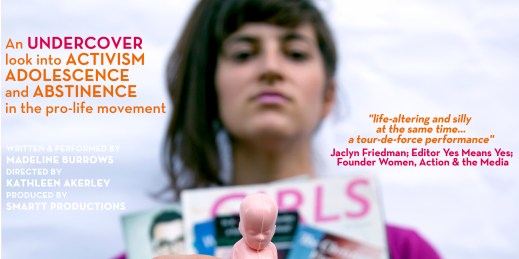
Recently turned on to several of the projects Allison Smartt has been involved in, I became especially fascinated with MOM BABY GOD 3.0, of which Smartt was sound designer and producer. The crew of MOM BABY GOD 3.o sets the stage for what to expect in a performance with the following introduction:
Take a cupcake, put on a name tag, and prepare to be thrown into the world of the Christian Right, where sexual purity workshops and anti-abortion rallies are sandwiched between karaoke sing-alongs, Christian EDM raves and pro-life slumber parties. An immersive dark comedy about American girl culture in the right-wing, written and performed by Madeline Burrows. One is thrown into the world of the Christian Right, where sexual purity workshops and anti-abortion rallies are sandwiched between karaoke sing-alongs, Christian EDM raves and pro-life slumber parties.
It’s 2018 and the anti-abortion movement has a new sense of urgency. Teens 4 Life is video-blogging live from the Students for Life of America Conference, and right-wing teenagers are vying for popularity while preparing for political battle. Our tour guide is fourteen-year-old Destinee Grace Ramsey, ascending to prominence as the new It-Girl of the Christian Right while struggling to contain her crush on John Paul, a flirtatious Christian boy with blossoming Youtube stardom and a purity ring.
MOM BABY GOD toured nationally to sold-out houses from 2013-2015 and was the subject of a national right-wing smear campaign. In a newly expanded and updated version premiering at Forum Theatre and Single Carrot Theatre in March 2017, MOM BABY GOD takes us inside the right-wing’s youth training ground at a more urgent time than ever.
I reached out to Smartt about these endeavors with some sound-specific questions. What follows is our April 2017 email exchange [edited for length].
Ariel Taub (AT): What do you think of the voices Madeline Burrows [the writer and solo actor of MOM BABY GOD] uses in the piece? How important is the role of sound in creating the characters?
Allison Smartt (AS): I want to accurately represent Burrows’s use of voice in the show. For those who haven’t seen it, she’s not an impersonator or impressionist conjuring up voices for solely comedy’s sake. Since she is a woman portraying a wide range of ages and genders on stage and voice is a tool in a toolbox she uses to indicate a character shift. Madeline has a great sense of people’s natural speaking rhythms and an ability to incorporate bits of others’ unique vocal elements into the characters she portrays. Physicality is another tool. Sound cues are yet another…lighting, costume, staging, and so on.
I do think there’s something subversive about a queer woman voicing ideology and portraying people that inherently aim to repress her existence/identity/reproductive rights.
Many times, when actors are learning accents they have a cue line that helps them jump into that accent. Something that they can’t help but say in a southern, or Irish, or Canadian accent. In MOM BABY GOD, I think of my sound design in a similar way. The “I’m a Pro-Life Teen” theme is the most obvious example. It’s short and sweet, with a homemade flair and most importantly: it’s catchy. The audience learns to immediately associate that riff with Destinee (the host of “I’m a Pro-Life Teen”), so much so that I stop playing the full theme almost immediately, yet it still commands the laugh and upbeat response from the audience.
AT: Does [the impersonation and transformation of people on the opposite side of a controversial issues into] characters [mark them as] inherently mockable? (I asked Smartt about this specifically because of the reaction the show elicited from some people in the Pro-Life group.)
AS: Definitely not. I think the context and intention of the show really humanizes the people and movement that Madeline portrays. The show isn’t cruel or demeaning towards the people or movement – if anything, our audience has a lot of fun. But it is essential that Madeline portray the type of leaders in the movement (in any movement really) in a realistic, yet theatrical way. It’s a difficult needle to thread and think she does it really well. A preacher has a certain cadence – it’s mesmerizing, it’s uplifting. A certain type of teen girl is bubbly, dynamic. How does a gruff (some may say manly), galvanizing leader speak? It’s important the audience feel the unique draw of each character – and their voices are a large part of that draw.
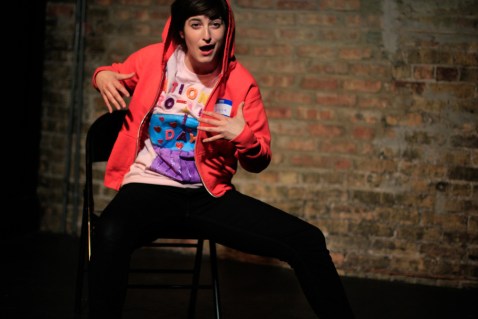
Madeline Burrows in character in MOM BABY GOD (National Tour 2013-2015). Photos by Jessica Neria
AT: What sounds [and sound production] were used to help carry the performance [of MOM BABY GOD]? What role does sound have in making plays [and any performance] cohesive?
AS: Sound designing for theatre is a mix of many elements, from pre-show music, sound effects and original music to reinforcement, writing cues, and sound system design. For a lot of projects, I’m also my own sound engineer so I also implement the system designs and make sure everything functions and sounds tip top.
Each design process is a little different. If it’s a new work in development, like MOM BABY GOD and Mixed-Race Mixtape, I am involved in a different way than if I’m designing for a completed work (and designing for dance is a whole other thing). There are constants, however. I’m always asking myself, “Are my ideas supporting the work and its intentions?” I always try to be cognizant of self-indulgence. I may make something really, really cool but that ultimately, after hearing it in context and conversations with the other artistic team members, is obviously doing too much more than supporting the work. A music journalism professor I had used to say, “You have to shoot that puppy.” Meaning, cut the cue you really love for the benefit of the overall piece.
I like to set myself limitations to work within when starting a design. I find that narrowing my focus to say…music only performed on harmonica or sound effects generated only from modes of transportation, help get my creative juices flowing (Sidenote: why is that a phrase? It give me the creeps)[. . .]I may relinquish these limitations later after they’ve helped me launch into creating a sonic character that feels complex, interesting, and fun.
AT: The show is described as being comprised of, “karaoke sing-alongs, Christian EDM raves and pro-life slumber parties,” each of these has its own distinct associations, how do “sing alongs” and “raves” and our connotations with those things add to the pieces?
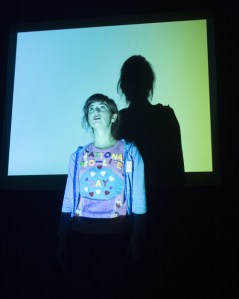
Madeline Burrows in character in MOM BABY GOD (National Tour 2013-2015). Photos by Jessica Neria
AS: Since sound is subjective, the associations that you make with karaoke sing-alongs are probably slightly different from what I associated with karaoke sing-alongs. You may think karaoke sing-along = a group of drunk BFFs belting Mariah Carey after a long day of work. I may think karaoke sing-alongs = middle aged men and women shoulder to shoulder in a dive bar singing “Friends In Low Places” while clinking their glasses of whiskey and draft beer. The similarity in those two scenarios is people singing along to something, but the character and feeling of each image is very different. You bring that context with you as you read the description of the show and given the challenging themes of the show, this is a real draw for people usually resistant to solo and/or political theatre. The way the description is written and what it highlights intentionally invites the audience to feel invited, excited, and maybe strangely upbeat about going to see a show about reproductive rights.
As a sound designer and theatre artist, one of my favorite moments is when the audience collectively readjusts their idea of a karaoke sing-along to the experience we create for them in the show. I feel everyone silently say, “Oh, this is not what I expected, but I love it,” or “This is exactly what I imagined!” or “I am so uncomfortable but I’m going with it.” I think the marketing of the show does a great job creating excited curiosity, and the show itself harnesses that and morphs it into confused excitement and surprise (reviewers articulate this phenomenon much better that I could).
AT: In this video the intentionally black screen feels like deep space. What sounds [and techniques] are being used? Are we on a train, a space ship, in a Church? What can you [tell us] about this piece?
AS: There are so many different elements in this cue…it’s one of my favorites. This cue is lead in and background to Destinee’s first experience with sexual pleasure. Not to give too much away: She falls asleep and has a sex dream about Justin Bieber. I compiled a bunch of sounds that are anticipatory: a rocket launch, a train pulling into a station, a remix/slowed down version of a Bieber track. These lead into sounds that feel more harsh: alarm clocks, crumpling paper…I also wanted to translate the feeling of being woken up abruptly from a really pleasant dream…like you were being ripped out of heaven or something. It was important to reassociate for Destinee and the audience, sounds that had previously brought joy with this very confusing and painful moment, so it ends with heartbeats and church bells.
I shoved the entire arc of the show into this one sound cue. And Madeline and Kathleen let me and I love them for that.
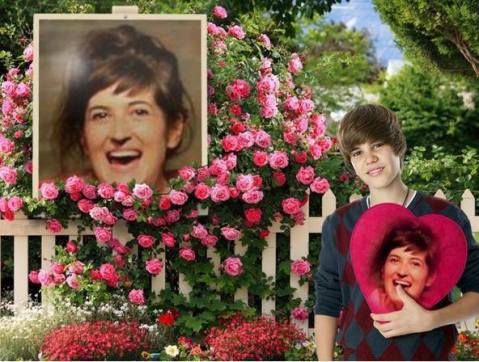
from madelineburrows.com
AT: What do individuals bring of themselves when they listen to music? How is music a way of entering conversations otherwise avoided?
AS: The answer to this question is deeper than I can articulate but I’ll try.
Talking about bias, race, class, even in MOM BABY GOD introducing a pro-life video blog – broaching these topics are made easier and more interesting through music. Why? I think it’s because you are giving the listener multiple threads from which to sew their own tapestry…their own understanding of the thing. The changing emotions in a score, multiplicity of lyrical meaning, tempo, stage presence, on and on. If you were to just present a lecture on any one of those topics, the messages feel too stark, too heavy to be absorbed (especially to be absorbed by people who don’t already agree with the lecture or are approaching that idea for the first time). Put them to music and suddenly you open up people’s hearts.
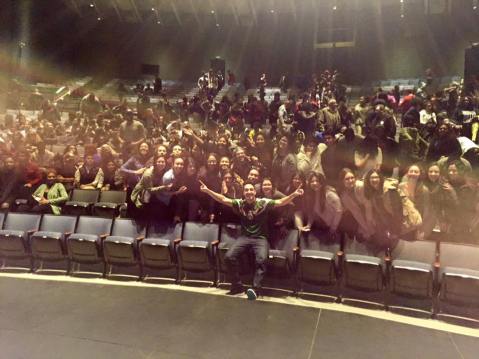
Post- Mixed-Race Mixtape love, William Paterson University, 2016 Photo credit: Allison Smartt
As a sound designer, I have to be conscious of what people bring to their listening experience, but can’t let this rule my every decision. The most obvious example is when faced with the request to use popular music. Take maybe one of the most overused classics of the 20th century, “Hallelujah” by Leonard Cohen. If you felt an urge just now to stop reading this interview because you really love that song and how dare I naysay “Hallelujah” – my point has been made. Songs can evoke strong reactions. If you heard “Hallelujah” for the first time while seeing the Northern Lights (which would arguably be pretty epic), then you associate that memory and those emotions with that song. When a designer uses popular music in their design, this is a reality you have to think hard about.
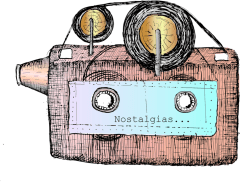
Cassette By David Millan on Flickr.
It’s similar with sound effects. For Mixed-Race Mixtape, Fig wanted to start the show with the sound of a cassette tape being loaded into a deck and played. While I understood why he wanted that sound cue, I had to disagree. Our target demographic are of an age where they may have never seen or used a cassette tape before – and using this sound effect wouldn’t elicit the nostalgic reaction he was hoping for.
Regarding how deeply the show moves people, I give all the credit to Fig’s lyrics and the entire casts’ performance, as well as the construction of the songs by the musicians and composers. As well as to Jorrell, our director, who has focused the intention of all these elements to coalesce very effectively. The cast puts a lot of emotion and energy into their performances and when people are genuine and earnest on stage, audiences can sense that and are deeply engaged.
I do a lot of work in the dance world and have come to understand how essential music and movement are to the human experience. We’ve always made music and moved our bodies and there is something deeply grounding and joining about collective listening and movement – even if it’s just tapping your fingers and toes.
AT: How did you and the other artists involved come up with the name/ idea for Mixed-Race Mixtape? How did the Mixed-Race Mixtape come about?
AS: Mixed-Race Mixtape is the brainchild of writer/performer Andrew “Fig” Figueroa. I’ll let him tell the story.
Andrew “Fig” Figueroa, Hip-Hop artist, theatre maker, and arts educator from Southern California
A mixtape is a collection of music from various artists and genres on one tape, CD or playlist. In Hip-Hop, a mixtape is a rapper’s first attempt to show the world there skills and who they are, more often than not, performing original lyrics over sampled/borrowed instrumentals that compliment their style and vision. The show is about “mixed” identity and I mean, I’m a rapper so thank God “Mixed-Race” rhymed with “Mixtape.”
The show grew from my desire to tell my story/help myself make sense of growing up in a confusing, ambiguous, and colorful culture. I began writing a series of raps and monologues about my family, community and youth and slowly it formed into something cohesive.
AT: I love the quote, “the conversation about race in America is one sided and missing discussions of how class and race are connected and how multiple identities can exist in one person,” how does Mixed-Race Mixtape fill in these gaps?
AS: Mixed-Race Mixtape is an alternative narrative that is complex, personal, and authentic. In America, our ideas about race largely oscillate between White and Black. MRMT is alternative because it tells the story of someone who sits in the grey area of Americans’ concept of race and dispels the racist subtext that middle class America belongs to White people. Because these grey areas are illuminated, I believe a wide variety of people are able to find connections with the story.
AT: In this video people discuss the connection they [felt to the music and performance] even if they weren’t expecting to. What do you think is responsible for sound connecting and moving people from different backgrounds? Why are there the assumptions about the event that there are, that they wouldn’t connect to the Hip Hop or that there would be “good vibes.”
AS: Some people do feel uncertain that they’d be able to connect with the show because it’s a “hip-hop” show. When they see it though, it’s obvious that it extends beyond the bounds of what they imagine a hip-hop show to be. And while I’ve never had someone say they were disappointed or unmoved by the show, I have had people say they couldn’t understand the words. And a lot of times they want to blame that on the reinforcement.
I’d argue that the people who don’t understand the lyrics of MRMT are often the same ones who were trepidatious to begin with, because I think hip-hop is not a genre they have practice listening to. I had to practice really actively listening to rap to train my brain to process words, word play, metaphor, etc. as fast as rap can transmit them. Fig, an experienced hip-hop listener and artist amazes me with how fast he can understand lyrics on the first listen. I’m still learning. And the fact is, it’s not a one and done thing. You have to listen to rap more than once to get all the nuances the artists wrote in. And this extends to hip-hop music, sans lyrics. I miss so many really clever, artful remixes, samples, and references on the first listen. This is one of the reasons we released an EP of some of the songs from the show (and are in the process of recording a full album).
.
The theatre experience obviously provides a tremendously moving experience for the audience, but there’s more to be extracted from the music and lyrics than can be transmitted in one live performance.
AT: What future plans do you have for projects? You mentioned utilizing sounds from protests? How is sound important in protest? What stands out to you about what you recorded?
AS: I have only the vaguest idea of a future project. I participate in a lot of rallies and marches for causes across the spectrum of human rights. At a really basic level, it feels really good to get together with like minded people and shout your frustrations, hopes, and fears into the world for others to hear. I’m interested in translating this catharsis to people who are wary of protests/hate them/don’t understand them. So I’ve started with my iPhone. I record clever chants I’ve never heard, or try to capture the inevitable moment in a large crowd when the front changes the chant and it works its way to the back.
.
I record marching through different spaces…how does it sound when we’re in a tunnel versus in a park or inside a building? I’m not sure where these recordings will lead me, but I felt it was important to take them.
—

REWIND! . . .If you liked this post, you may also dig:
Beyond the Grandiose and the Seductive: Marie Thompson on Noise
Moonlight’s Orchestral Manoeuvers: A duet by Shakira Holt and Christopher Chien
Aural Guidings: The Scores of Ana Carvalho and Live Video’s Relation to Sound
Share this:

The Love Below (the Mason Dixon Line): OutKast’s Rejection at the 1995 Source Awards

During his acceptance speech at 2017’s Golden Globe awards, actor and rapper Donald “Childish Gambino” Glover thanked the black people of the city of Atlanta for “being alive,” and the Atlanta trap rap group Migos for their single “Bad and Boujee.” As the camera panned out into the crowd, it showed dominantly white faces full of confusion and polite yet uncomfortable laughter. These audience members seemed unfamiliar with Migos and with categorizing a “black” Atlanta (and South) separate from the pop culture hub we know as Atlanta today. Glover’s speech re-affirmed the sentiments of Outkast’s Andre “3000” Benjamin over twenty years’ prior at the 1995 Source Awards, that the (black) South got something to say.
As I’ve argued previously, Andre and Big Boi’s acceptance speech at the Source Awards was the springboard for what I call the “hip hop south,” the social-cultural experiences that frame southern blackness after the Civil Rights Movement. The declaration “the South got something to say”—and the booing that ensued—is important to engaging how southerners see and hear themselves in a contemporary landscape. The Source Award’s dominantly New York audience booing both jolts the ear and affirms hip hop’s hyper-regional focus in the early to mid 1990s. The booing crowd identifies hip hop as northeastern, urban, and rigidly masculine, an aesthetic that was a daunting task for non-northeastern performers to try and break through. Even celebrated west coast artists like Snoop Dogg, who menacingly and repeatedly asked the crowd “you don’t love us?” during the show, struggled with the challenge of being recognized – and respected – by northeast hip hop enthusiasts.

The 1995 Source Awards proved to be the climax of the beef instigated by both West Coast Death Row Records and East Coast Bad Boy Records, the bitter lyrical and personal battle between Tupac Shakur and Notorious B.I.G., and OutKast, a Southern act, chosen as “Best New Rap Group.” The crowd’s increasingly despondent sonic rejection of hip hop outside of New York foregrounds my reading of OutKast’s acceptance speech as blatant and unforgiving southern black protest, a rallying cry that carves a space for the hip hop south to come into existence.
A recap of that night, in which Christopher “Kid” Reid and Salt-N-Pepa presented OutKast their award. Upbeat and playful, Kid says “ladies help me out” to announce the winner, but there is a distinctive drop in their enthusiasm when naming OutKast the winner of the category. The inflection in their voices signifies shock and even disappointment, with Kid quickly trying to be diplomatic by shouting out OutKast’s frequent collaborators and label mates Goodie Mob. The negative reaction from the crowd was immediate, with sharp and continuous booing.
Big Boi starts his acceptance speech, dropping a few colloquial words immediately recognizable as proper hip hop – “word” and “what’s up?” Over a growingly irritated crowd, Big Boi acknowledges that he is in New York, “y’alls city,” and tries to show respect to the New York rappers by crediting them as “original emcees.” Big Boi recognizes he is an outsider, his southern drawl long and clear in his pronunciation of “south” as “souf,” yet attempts to be diplomatic and respectful of New York. There is also a recognition that where he is from, Atlanta, is also a city: his statement, “y’alls city,” is not only a recognition of his being an outsider but a proclamation that he, too, comes from a city—except it’s a different city.
Big Boi’s embrace of Atlanta as urban challenges previous cultural narratives of southerners as incapable of maneuvering within an urban setting. Because of a long-standing and comfortable assumption that the American south was incapable of anything urban (i.e. mass transit, tall buildings, bustling neighborhoods and other forms of communities), beliefs about southerners’ perspectives remained aligned with rural – read ‘country’ and ‘backward’ – sensibilities incapable of functioning within an urban cultural setting. These sensibilities often played out in longhand form via literature or in popular black music, with focus on dialect and language standing in as a signifier of regional and cultural distinction.

Big Boi still repping ATL in 2012, Outside Lands Music Festival, San Francisco, CA, Image by Flickr User Thomas Hawk, (CC BY-NC 2.0)
Consider Rudolph Fisher’s southern protagonist King Solomon Gillis from the short story “City of Refuge” (1925). Fisher’s characterization of Gillis, a black man from rural North Carolina, is one of naiveté and awe for not only New York and its sounds, but the premise of city life in general. In the opening of the story Fisher describes Gillis’s ride on the subway as “terrifying,” with “strange and terrible sounds.” References to the bang and clank of the subway doors and the close proximity of each train as “distant thunder” is particularly striking, a subtle sonic nod to Gillis’ rural southernness and his inability to articulate the subway system outside of his limited southern experiences. The references to “heat,” “oppression,” and “suffocation” also lend premise to southern weather, a well as the belief of the American south as an unending repetition of slavery and its effects.
It is important to point out that Gillis certainly isn’t a fearful man in the literal sense: his reason for migrating to Harlem was out of necessity and desperation after shooting a white man back home to avoid being lynched. Yet Fisher’s attention to sound presents Gillis as an outsider. Further, Fisher describes Gillis as “Jonah emerging from the whale,” both a biblical allusion to triumph over a difficult situation as well as a rebirth, the possibility of a new life and new purpose. This can be connected to the biblical reckoning of southern black folks migrating out of the south for social-economic change and advancement.
Still, southern black folks emerging in the city is not an easy transition, with Gillis’ train ride and his discomfort with the sounds it produces symbolizing the move from one difficult landscape to another. Although Gillis ultimately is confronted with the brutality he was trying to avoid in North Carolina, his repetitive proclamation, “they even got cullud policemans!” amplified his southernness and naiveté. Fisher’s intentional use of written dialect enhances the repetitiveness of the impact of seeing black police officers, which blots out the characteristic of region but not white supremacy as a whole. Gillis’s acceptance of black police officers blurred the binaries of the Great Migration as a testament to black folks not only looking for social-economic change outside of the American South, a terroristic space for blacks, but the unfortunate anxiety of those deciding to remain in the south, complacent in the lack of social equality.

Panel 35 of Jacob Lawrence’s Migration Series, documenting Black Americans’ move to Northern Urban Centers : “They Left the South in Great Numbers. They Arrived in the North in Great Numbers.” Photo by Flickr User Ron Cogswell, (CC BY-NC 2.0)
Seventy years later Big Boi, a Georgian, returns to New York with the confidence of both rural and southern sensibilities outside of the immediately recognizable urban trope embodied by New York. Big Boi’s full embrace of being “cullud,” in both the linguistic and cultural elements that Fisher’s long-hand dialect represented as authentic southernness, is jarring because his intentional embrace of southern blackness as othered anchors his approach to rap music. Big Boi does not posture the south as a space or place in need of escape or reposturing. Rather, the hyper-awareness from both Big Boi and Andre in front of the dominantly New York crowd ruptures the accepted narrative of the south as needing saving by non-southern counterparts. Big Boi’s speech forces the audience to de-romanticize their notions of northeastern supremacy and recognize the south as capable of hip hop. Their direct booing is a sonic representation of that discomfort.
From this perspective, André’s now iconic remarks from the acceptance speech further emphasized Big Boi’s departure from reckoning with northeastern hip hop as the standard. He stumbles in his speech, possibly because of nerves or irritation, and, like Big Boi, must talk over the crowd. André speaks about having the “demo tape and don’t nobody wanna hear it,” a double signifier of not only being rejected for his southernness but also the difficulty of breaking into the music industry. André’s frustration with being unheard as a southerner can also be extended into the actual production of the tape by OutKast’s production team Organized Noize, who drew from southern musical influences like funk, blues, and gospel to ground their beats. Andre’s call-to-arms, “the south got something to say,” rallied other southern rappers to self-validate their own music. It is important to note that André’s rally called to the entire south, not just Atlanta. This is significant in thinking about southern experiences as non-monolithic, the aural-cultural possibilities of multiple Souths and their various intersections using hip hop aesthetics.

OutKast at the Pemberton Music Festival, CREDIT MARK C AUSTIN(CC BY 2.0)
OutKast moves past their rejection at the Source Awards via their second album ATLiens (Atlanta aliens), which offered an equal rejection of hip hop culture’s binaries. The album’s use of ‘otherworldly’ sonic signifiers i.e. synthesizers and pockets of silence that sounded like space travel – embodied their deliberate isolation from mainstream hip hop culture. Still, OutKast didn’t forget their rejection, sampling their acceptance speech in the final track from their third album Aquemini titled “Chonkyfire.” The brazen and hazy riffs of an electric guitar guide the song, with the recording from the source appearing at the end of the track. There is a deliberate slowing down of the track, with both the accompaniment and the recording becoming increasingly muddled. After André’s declaration “the south got something to say,” the track begins to crawl to its end, a sonic signifier of not only the end of the album but also the end of OutKast’s concern with bi-coastal hip hop expectations. Sampling their denial at the Source Awards was a full-circle moment for their music and identities. It was a reminder that the South was a legitimate hip hop cultural space.
In this contemporary moment, there is less focus and interest in establishing regional identities in hip hop. The dominance of social media collapses a specific need to carve up hip hop spaces per physical parameters. Sonically, there is an intriguing phenomenon occurring where rappers from across the country are borrowing from southern hip hop aesthetics, whether it be the drawl, bass kicks, or lyrical performance. Although our focus on social media has seemingly collapsed the physical need to differentiate region and identity, geographical aesthethics remain central to our listening practices. With this in mind, OutKast’s initial rejection from then mainstream hip hop in favor of sonic and cultural reckonings of southern blackness keep them central to conversations about how the Hip Hop South continues to ebb and weave within and outside the parameters of hip hop culture. Their rejection of hip hop’s stage solidified their place on it.
—
Featured Image “Big Boi I” by Flickr user Matt Perich (CC BY 2.0)
—
Regina N. Bradley, Ph.D is an instructor of English and Interdisciplinary Studies at Kennesaw State University. She earned her Ph.D in African American Literature at Florida State University in 2013. Regina writes about post-Civil Rights African American literature, the contemporary U.S. South, pop culture, race and sound, and Hip Hop. Her current book project explores how critical hip hop (culture) sensibilities can be used to navigate race and identity politics in this supposedly postracial moment of American history. Also known as Red Clay Scholar, a nod to her Georgia upbringing, Regina maintains a blog and personal website and can also be reached on Twitter at @redclayscholar.
—
REWIND! . . .If you liked this post, you may also dig:
Caterpillars and Concrete Roses in a Mad City: Kendrick Lamar’s “Mortal Man” Interview with Tupac Shakur—Regina Bradley
I Been On: BaddieBey and Beyoncé’s Sonic Masculinity — Regina Bradley
The (Magic) Upper Room: Sonic Pleasure Politics in Southern Hip Hop—Regina Bradley
Share this:


Current Top Posts





April 2021

January 2020

November 2019

October 2019

August 2019

April 2014

November 2017

March 2015

December 2017

October 2015
 Sounding Out!
Recent Comments