
SO! Amplifies: Radio Coyote’s #DIASPORADICAL Sound
 SO! Amplifies. . .a highly-curated, rolling mini-post series by which we editors hip you to cultural makers and organizations doing work we really really dig. You’re welcome!
—
This whole world’s wild at heart and weird on top —Wild at Heart
Por tu amor. . . — Buyepongo
Radio Coyote is a San Francisco-based web radio program & podcast I co-host with my friend Jesus Varela, aka Sweet Jesus. Radio Coyote is our effort at amplifying expression which is #DIASPORADICAL – acknowledging movement and humanity in a world alive with ART; most especially of those on the margins who in the current structure, have become the invisible inspiration for the priviliged, hardly benefiting from the soul they emit.
Recently, Jesus and I recorded with Los Angeles’s own future-rooted band of immigrant brothers – Buyepongo – live from the scrappy but charming Radio Valencia studios in the Mission District. Some topics we talked about included connections between the Bay Area and Los Angeles, the hip-hop influence of Wu-tang Clan & Madlib on the group, and, importantly, the burgeoning yet connected #DIASPORADICAL network building alternatives and manifesting the visceral spirit of our ancestors through drumming.
This particular episode’s conversation is emblematic of how we use sound and voice on Radio Coyote to bring energies together to counter the hegemonic corporate $tandard currently funding the arts and culture industries—live music and entertainment but also tech and media, not to mention the spaces where they intersect—all reflective of a standard which is essentially: THE STRIVE FOR MONETARY SUCCESS MARKED AS WHITE ACHIEVEMENT A/K/A the land of the “Free” where the inspired benefit from those on the margins.
Nahhhhh, FUCK THAT. – emcee Nani Castle in To The People
The type of capitalist cultural extraction we challenge on Radio Coyote can be heard and seen everywhere. Justin Bieber, for example, has a #1 record right now (produced by Skrillex) that is clearly influenced by Caribbean dembow. I’m still waking up from that dream where Macklemore wins a Grammy award over the 2014 jazz griot giant that is Kendrick Lamar. The FADER, like so many media outlets, assigns white writers to cover emerging Latin culture in the US: Exhibit A on contemporary cuban music & Exhibit B on J. Balvin and reggaton. And, I could go on. But because it is so pervasive, we need to keep asking, “Who benefits?”
It don’t make you right cause you majority.- Bree Newsome, South Carolina-based activist & artist who removed the Confederate Flag earlier this past Summer from SC’s capital
Mamacita, pass me a beer-a – Will Smith on Bomba Estereo’s “Fiesta” (Remix) for SONY
Because all around the world – or the worldwild, I like to say, people are waking up and acknowledging themselves, their neighbors, and the stories of their movement, exploring what those moves truly meant and what they will mean for a humanity needing to be increasingly inter-reliant in our crumbling late-Capitalist era. Radio Coyote is a product, a revelation, and a confluence of these worldwild movements, amplifying the true vibration and rhythms of a very specific history and examining how they will mutate in the future.
Our voices and spirits have always been dangerous. During the conquest in what is now Mexico, for example, the Spansh conquistadors killed the ceremonial drummers first. In Chile, when Augosto Pinochet seized power in 1973, he ordered revolutionary singer Victor Jara executed, and his soldiers kidnapped Jara, smashed his hands and wrists and shot him 44 times. But what was once dangerous has been disempowered and I predict, increasingly exploited. Now Canadian DJ A-Trak calls himself “Plantain Papi,” Roots drummer Questlove goes by “Questlove Gomez,” and Kendrick raps in Spanish. Bieber just dropped that dembow-influenced pop record while dembow legacy artists, Los Rakas (via Panama & Oakland) switched to Latin pop.
Cause I just need one more shot at second chances – Justin Bieber in “Sorry”
I get a lot of success because I’m white. – Diplo in YourEDM.com
Radio Coyote is our chance to explore these ideas and who benefits from the global flows of culture . To empower me. To empower us. To get back to the place where this expression was dangerous . We are smuggling these sounds to you over what was once pirate radio – now, online – because the boundaries between u$ are quite pronounced. Radio Coyote is my moment of love in a land$cape of domination and hate. We are powerful. It’s clarity through the confusion. Radio Coyote simply must be. It’s an effort at radically witnessing the expressions all over the world of people who’ve had access to Internet these last 10 – 15 years, but who also seek to honor, understand & feel a past which we are indisputably products of!
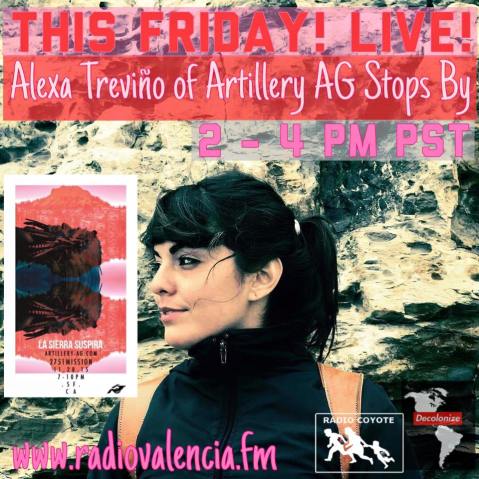
Though I am fiercely frightened to get on the mic every Friday from 2 – 4 PM PST, I like to think I’m reversing the common programming Latinas go through, constantly told to shush in this world. I also feel a true duty. We simply need to step up and be ourselves! We need to acknowledge and be proud of our own particular story of being human in a world with the same level of equality as the other, together, with immense respect for the planet we live on and all the resources she provides (another topic I like to think about, but more on #PACHAMAMAISM at another time…).
There is nothing else we should be doing but seeing ourselves in each other and being very adamant about that. So this is my love force to you and I hope you continue to enjoy/share it. Lift your voice in love, too, in any way you feel is important out in the worldwild! And, then, tell me about it so we can have you call in and talk to us on Radio Coyote: radiocoyotesf@gmail.com! 😀
Tune-in to #RadioCoyote: Smuggling #DIASPORADICAL Sounds Across Borders Every Friday From 2 – 4 Pm PST With DJ Nipslip aka Naticonrazon and Jesucio aka Sweet Jesus: www.radiovalencia.fm. Archives:www.soundcloud.com/radiocoyote
—
all images courtesy of the author
—
Nati Linares aka Nati Conrazon is an artist advocate and cultural lobbyist rebalancing the world who was raised in New York City, but is currently living a #Bicoastalidad lifestyle which is rooted in Oakland, California. Her womanagement clients include Brazil-via-Brooklyn’s Vocalista Making Interracial Music Babies, Zuzuka Poderosa & Powerfully Raw Chilean/Irish Emcee, Nani Castle. Check out all her current projects: www.conrazon.me/projects/current-projects and follow her on Twitter: @conrazon, Instagram: naticonrazon and beyond! Embrace the hybrid!
—
—
 REWIND!…If you liked this post, you may also dig:
SO! Amplifies: Sounding Board Curated by Leonardo Cardoso–Jay Loomis
SO! Amplifies: Shizu Saldamando’s OUROBOROS–J.L. Stoever
Share this:

Tape Hiss, Compression, and the Stubborn Materiality of Sonic Diaspora

In an article for Pitchfork, music critic Adam Ward reminisces about digital music files that sound as if they’re “being played through a payphone,” and calls the extreme compression of the low-quality MP3 “this generation’s vinyl crackle or skipping CD.” The crackles, hisses, and compression that characterize such sound files are what I term “encoded materiality.” Focusing on the encoded materiality of the digital helps us to reconfigure our approach to sonic media, understanding how the compression of early MP3s and tape hiss remind us not only of lost fidelity, but also of the richness of exchange. These warm and stubborn sonic impurities, having been encoded in our digital listening formats and thus achieving repeatability and variability, act as persistent reminders that we can think diaspora beyond melancholy and authenticity, sidestepping the questions of purity and loss that so often characterize dialogues in the field of diaspora studies.
In Mechanisms, his work on electronic textuality, Matthew Kirschenbaum proposes a “material matrix governing writing and inscription in all forms” composed of four elements: “erasure, variability, repeatability, and survivability” (xiii). The defects of sonic technology that become encoded in digital files are one such type of inscription. Tape hiss and other recording accidents–such as Casey Kasem ruining your attempt to tape record the first Western song you fell in love with after leaving Hong Kong by fading the outro and butting in with his banter–achieve repetition and survival during the digital encoding process, becoming a welcome reminder of time and place. Such materiality helps us to better understand the politics of diaspora. It clues us in to how the elements of textual encoding (erasure, variability, repeatability, and survivability) become embedded within diaspora’s complex logic.

Image by DraconianRain @Flickr CC BY-NC.
To think through these complex moments of exchange, let me offer a story about my experience with tape hiss. I grew up listening to music touched by this particular sonic grain: a ground level of noise upon which my sonic experiences were built. After I received my first iPod in 2005, I connected a tape player to the input of my computer, recorded a stack of tapes, and then manually split them into MP3s—pseudo-piracy committed in earnest. A few weeks ago, I dug up these same files and put them on my phone, once again returning the buried albums to their former glory on a constant rotation playlist. I keep returning to these particular files, rather than finding the now easily available digital versions, because I admire the survivability of their materiality. The materiality of these tracks allowed me to trace the complexity of my own history—the tape hiss is just as much a part of this history as the songs themselves.
After first moving to Canada from Hong Kong, my family and I established ourselves by unswervingly performing the same routine each weekend. We would have late lunch at our favorite dim sum restaurant, drive around for a bit, and then relax at home; there wasn’t much to do in the ex-urbs of Toronto. On those drives, we listened to selections from a stack of cassette tapes in the glovebox of our old Pontiac Bonneville. Sally Yeh’s 1987 album Blessing was on constant rotation and received its fair share of wear. This was one of the tapes I recorded to my computer, destined for digitization.
Because I hit the record button a few seconds early, my MP3 of Sally Yeh’s Blessing begins with a few seconds of silence. It’s enough to trick me into thinking that the song isn’t playing. In a quiet enough spot, I can hear that it’s actually tape hiss. No matter where I am, on the road or in the shower, my mind fills in the blank with the thick ker-chunk of the cassette entering that Pontiac stereo right before that familiar tape hiss would fill the car, always giving us a few sometimes-needed, sometimes-awkward moments of silence before the music started. The sonic texture of that tape stems from its material nature as plastic and metal. The hiss itself is due to the size of the magnetized particles on the plastic. Because of these sounds, the song tells its own story. It recalls our shared sonic and material experience as I migrate it from device to device.
Before Blessing made its way into our car, it was one of the few cassette tapes that my parents carefully packed into a dozen cardboard boxes and shipped by sea to Canada in the late 1980s. This was in the midst of the countrywide protests in China that led to the events at Tiananmen Square. That insistent ker-chunk of plastic on metal that my brain inserts every time I play the MP3s keeps my experience of the music grounded in this earlier history, too. Strange that a fluffy pop song would remind me of the serious political strife taking place on the doorstep of a Hong Kong nervously awaiting its “handover.” This sonic anchor’s ability to recall to me these snippets of history, both personal, national, and transpacific has been crucial in the development of my own diasporic identity. Listening to this particular recording of Blessing helps me to keep track of my self and my history.
Ker-chunk.
The act of withdrawal that many of us perform in order to interface with our sonic technologies, as Alexander Weheliye shows in his reading of Ralph Ellison’s Invisible Man in Phonographies, can play a powerful role in understanding one’s own racial subjectivity. Weheliye focuses on the scene in which the titular narrator-protagonist retreats to a subterranean cave-like space to listen to Louis Armstong’s recorded, disembodied voice in complete solitude. He asserts that the narrator builds his own subjectivity through a recognition of the self by projecting that self onto Louis Armstrong’s “vocal apparatus,” that is, his voice coming through a phonograph (143). “The phonograph’s ability to disconnect the singing voice from its face, or rather to replace it with a technological visage, further heightens its materiality, which impels the protagonist to imbue Armstrong’s voice with a surplus of signification” (Weheliye 145).
More than a black and white photo or a stern historical lecture from the elders, the “heightened materiality” of the digital format, a type of “technological visage” cathects my own diasporic history most forcefully to the sonic anchor of tape hiss because it acts as a “voice without a face” in the same way as the phonographic Armstrong. But despite the privacy of the phonographic listening act in this scenario, Weheliye suggests that
the phonographic listening modality also bears the traces of sociality… since the listening subject is drawn out of him/herself by encountering the technologically mediated sounds of other subjects—we might even go so far as to suggest that the phonograph itself functions as a subject, especially in its interfacings with various humans. (165)
So it is with similar sonic technologies that can encourage the “eschewing [of] the social” such as iPhones, CDs, and, yes, cassette tapes. Like Ellison’s narrator interfacing with the mechanical apparatus that conveys Armstrong’s voice, the insistent “defects” kept on the digital file keep the mechanism of its delivery at the fore, allowing me first to understand that diasporic feeling of dis-ease—and to imagine beyond it.
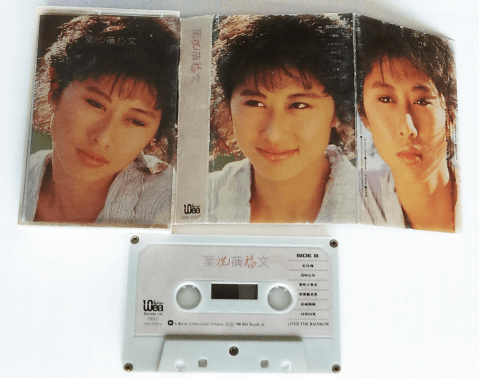
Sally Yeh’s “Blessing.” Image used with permission by the author.
What I gain from the digital yet still stubbornly material tape of Blessing is not any overt lyrical or thematic gesture to a diasporic subjectivity on the artist’s part, but rather an induction into what Giorgio Agamben calls, “the idea of an inessential commonality, a solidarity that in no way concerns an essence” (18), or perhaps a community based on “belonging itself” (84). Likewise, Weheliye’s “diasporic citizenship coarticulate[s] the national and transnational instead of playing a zero-sum game with political identification” (369). If diaspora is defined by the perpetual desire to seek an imagined originary point of true identity that inevitably leads to melancholy, as psychoanalysis maintains, tape hiss and other encoded materialities turn the gaze away from the mists of origin, validating instead the development of diasporic identity in the aftermath of emigration. Of course, loss and melancholy are legitimate psychic aspects of the diasporic experience, as persuasively demonstrated by scholars such as David Eng, Shinhee Han, Anne Anlin Cheng, but they neither define the whole experience nor are they mutually exclusive to it. It is in this way that we can think of diaspora as a community of belonging by becoming.
A consideration of the stubborn ways that materiality is encoded in the digital helps us to think of diaspora as more than psychic fait accompli—it is also a ‘coming community’ characterized by the process of belonging. Kirschenbaum’s matrix provides the right foundation for a study which considers how material inscriptions are related to our diasporic lives. The inscription that defined my diasporic becoming came from the cassette tape that travelled across the ocean in a boat for five weeks, escaped erasure, survived repeated playings, became digital, and lives on now as a hissing reminder of our history of emigration. What else may we find about our own becoming and belonging if we attune our ears to the encoded materialities of sonic diaspora?
–
Featured image “Decayed Cassette” by darkday @Flickr CC BY.
–
Chris Chien is a Ph.D. candidate in the Department of English at the University of Southern California working variously in the areas of sound, diaspora and transpacific studies, all with a distinctly queer bent. He completed his M.A. in English Literature at Loyola Marymount University and his Honors B.A. in English Literature and Latin at the University of Toronto. Chris has presented papers on angelic gender fluidity in John Milton’s Paradise Lost and post-colonial affect in the work of Herman Melville and Amitav Ghosh at the Rocky Mountain MLA and South Atlantic MLA conferences respectively. He is currently developing a paper that examines the performativity of diaspora, masculinity, and the capitalist ethos in Eddie Huang’s memoir Fresh Off the Boat and its adaptation as an ABC sitcom.
–
 REWIND! . . .If you liked this post, you may also dig:
Pushing Play: What Makes the Portable Tape Recorder Interesting?—Gus Stadler
SANDRA BLAND: #SayHerName Loud or Not at All — Regina N. Bradley
Listening (Loudly) to Spanish-language Radio — Dolores Inés Casillas
Brasil Ao Vivo!: The Sonic Pleasures of Liveness in Brazilian Popular Culture — Kariann Goldschmitt
Share this:


Current Top Posts





April 2021

January 2020

November 2019

October 2019

August 2019

April 2014

November 2017

March 2015

December 2017

October 2015
 Sounding Out!
Recent Comments