
DIY Histories: Podcasting the Past

 This is article 3.0 in Sounding Out!‘s April Forum on “Sound and Technology.” Every Monday this month, you’ll be hearing new insights on this age-old pairing from the likes of Sounding Out! veteranos Aaron Trammell and Primus Luta along with new voices Andrew Salvati and Owen Marshall. These fast-forward folks will share their thinking about everything from Auto-tune to techie manifestos. Today, Salvati asks if DIY podcasts are allowing ordinary people to remix the historical record. Let’s subscribe and press play. –JS, Editor-in-Chief
—
Was Alexander the Great as bad a person as Adolph Hitler? Will our modern civilization ever fall like civilizations from past eras?
According to Dan Carlin’s website, these are the kind of speculative “outside-the-box” perspectives one might expect from his long-running Hardcore History podcast. In Carlin’s hands, the podcast is a vehicle for presenting dramatic accounts of human history that are clearly meant to entertain, and are quite distinct from what we might recognize as academic history. Carlin, a radio commentator and former journalist, would likely agree with this assessment. As he frequently emphasizes, he is a “fan” of history and not a professional. But while there are particularities of training, perspective, and resources that may distinguish professional and popular historians, an oppositional binary between these kinds of historymakers risks overlooking the plurality of historical interpretation. Instead, we might notice how history podcasters like Carlin utilize this new sonic medium to continue a tradition of oral storytelling that in the West goes back to Herodotus, and has since been the primary means of marginalized and oppressed groups to preserve cultural memory. As a way for hobbyists and amateurs to create and share their own do-it-yourself (DIY) histories, I argue that audio podcasting suggests a democratization of historical inquiry that greatly expands the possibilities for everyone, as Carl Becker once said, to become his or her own historian.

“Modified Podcast Logo with My Headphones Photoshopped On” by Flickr user Colleen AF Venable, CC BY-SA 2.0
Frequently listed among iTunes’ top society and culture podcasts, and cited by several history podcasters as the inspiration for their own creations, the popularity of Hardcore History stems from Carlin’s unconventional and dramatic recounting of notable (but sometimes obscure) historical topics, in which he will often elaborate historical-structural changes through contemporizing metaphors. Connecting the distant past to more immediate analogies of present life is the core of Carlin’s explanatory method. This form of explanation is quite distinct from the output of academic historians, who assiduously avoid this sort of “presentism.” But as the late Roy Rosenzweig (2000) has suggested, it is precisely this kind of conscious and practical engagement with the past – and not the litany of facts in dry-as-dust textbooks – that appeals to non-historians. Rosenzweig and David Thelen claim have found that most Americans perceive a close connection with the past, especially as it relates to the present, through their personal and family life. Using the medium of podcasting to talk about the past is a new way of making the past vital to the present needs and interests of most people. This is how podcasters make sense of history in their own terms. It is DIY insofar as it is distinct from professional discourse, and less encompassing (and expensive) than video methods.
Podcasts can present an alternative model for making sense of the past – one that underscores the historymaker’s interpretive imprints, and which cultivates a sense of liveness and interactivity. Admittedly, Dan Carlin’s own style can be rambling and melodramatic. But to the extent that he practices history as a kind of storytelling, and acknowledges his own interpretive interventions, Hardcore History, like other independently produced history podcasts (I am thinking about a few of my favorites – Revolutions, The History Chicks, and The British History Podcast) give their listeners the sense that history is not necessarily something that is “out there,” or distant from us in the present, but part of a living conversation in the present. Podcasters construct a dialogue about history which, when combined with the interactivity offered by website forums, draws the listener into a participatory engagement. Rosenzweig and Thelen’s explain, Americans interested in popular history are skeptical of “historical presentations that did not give them credit for their critical abilities – commercialized histories on television or textbook-driven high school classes.” Such analytic skills are precisely what we as historians and teachers aim to develop in our students. Podcasting, when it constructs a collaborative dialogue in which audience and producer explore history together, can both be a valuable supplement to traditional historiography, and a way for people to connect with the past that overcomes the abstraction of textbooks and video.

“The histomap – four thousand years of world history” by Flickr user 图表汇, CC BY-SA 2.0
But is the podcast as intellectually freeing as it might seem? Jonathan Sterne (et. al., 2008) notes that podcasting encompasses a range of technologies and practices that do not necessarily determine the liberation of content production from the dominance of established institutions and economies of scale. Indeed, there are many professional historians and media producers who have utilized audio (and sometimes video) podcasting to reach a wider audience. While the History Channel has not (yet) entered the field, one can surely imagine the implications of corporate-produced history content that homogenizes local and cultural particularities, or which present globalized capitalism as a natural or inevitable historical trajectory.
The kind of podcasts I am concerned with, however, are created by independent producers taking a DIY approach to content production and historical inquiry. While their resources and motivations may differ, podcasts produced on personal computers in the podcaster’s spare time have an intimate, handcrafted feel that I find to be more appealing than, say, a podcasted lecture. Ideally, what results is an intimate and episodic performance in which podcasters can, to use Andreas Duus Pape’s phrasing from an earlier Sounding Out! post, “whisper in the ears” of listeners. This intimacy is heightened by the means of access – when I download a particular podcast, transfer it to my iPhone, and listen on my commute, I am inviting the podcaster into my personal sonic space.
Complimenting this sense of intimacy is a DIY approach to history practiced by podcasters who are neither professional historians nor professional media producers. Relatively cheap and easy to produce (assuming the necessary equipment and leisure time), podcasting presents a low barrier of entry for history fans inspired to use new media technologies to share their passion with other history fans and the general public. Though a few podcasters acknowledge that they have had some university training in history, they are usually proud of their amateur status. The History Chicks, for example, “don’t claim to know it all,” and that any pretense toward a comprehensive history “would be kinda boring.” Podcasting and historical inquiry are hobbies, and their DIY history projects allow the relative freedom to have fun exploring and talking about their favorite subject matter – without having to conform to fussy disciplinary constraints. For Jamie Jeffers, creator of the British History podcast, most people are alienated by the way history gets taught in school. However, “almost everyone loves stories,” he says, and podcasting “allows us to reconnect to that ancient tradition of oral histories.” Others justify the hobby in more bluntly. For the History Chicks, women in history is “a perfect topic to sit down and chat about.” Talking about history, arguing about it, is something that history fans (and I include myself here) enjoy. Podcasting can broaden this conversation.
Despite my optimistic tone in this post, however, I do not want to suggest uncritically that the democratizing, DIY aspects that I have noted (among just a handful of podcasts) comprises the entire potential of the format. Nuancing a common opposition between the bottom-up potential of podcasting with the prevalent top-down (commercial) model of broadcasting for example, Sterne and others have asserted that rather than constituting a disruptive technology – as Richard Berry has suggested – podcasting realizes “an alternate cultural model of broadcasting.” Referring to earlier models of broadcasting – such as those Susan Douglas (1992) described in her classic study of early amateur radio – Sterne and company assert that analyses of podcasting should focus not on the technology itself, but on practice; not on the challenge podcasting poses to corporate dominance in broadcasting, but rather how it might offer a pluralistic model that permits both commercial/elite and DIY/amateur productions.

“Podcast in Retro” by Flickr user David Shortle, CC BY-NC 2.0
Adapting these recommendations, I argue that podcasting can help us conceptualize an alternate cultural model of history – one that invites reconsideration of what counts as historical knowledge and interpretation, and about who is empowered to construct and access historical discourse. Rather that privileging the empirical or objective histories of academic/professional historians, such an expanded model would recognize the cultural legitimacy of diverse forms of historiographical expression. In other words, that history is never “just” history, or “just” facts, but is always a contingent and situated form of knowledge, and that, as Keith Jenkins writes, “interpretations at (say) the ‘centre’ of our culture are not there because they are true or methodologically correct … but because they are aligned to the dominant discursive practices: again power/knowledge” (1991/2003, p. 79). But to reiterate Sterne’s (et. al.) caution however, such an alternative model would not necessarily determine a role-reversal between professional and DIY histories. Rather through podcasting, we might discover alternative ways of performing history as a new oral tradition – of becoming each of us our own historian.
—
Andrew J. Salvati is a Media Studies Ph.D. candidate at Rutgers University. His interests include the history of television and media technologies, theory and philosophy of history, and representations of history in media contexts. Additional interests include play, authenticity, the sublime, and the absurd. Andrew has co-authored a book chapter with colleague Jonathan Bullinger titled “Selective Authenticity and the Playable Past” in the recent edited volume Playing With the Past (2013), and has written a recent blog post for Play the Past titled “The Play of History.”
—
Featured image: “Podcasts anywhere anytime” by Flickr user Francois, CC BY 2.0
—
 REWIND!…If you liked this post, you may also dig:
“Music is not Bread: A Comment on the Economics of Podcasting”-Andreas Duus Pape
“Pushing Record: Labors of Love, and the iTunes Playlist”-Aaron Trammell
“Only the Sound Itself?: Early Radio, Education, and Archives of ‘No-Sound’”-Amanda Keeler
Share this:

A Tribe Called Red Remixes Sonic Stereotypes


Welcome back to “The Wobble Continuum,” a three part series here on Sounding Out!. When we last left you, Mike D’Errico had brought us to the intersection of patriarchal cultural norms, music production practices and aesthetics, and the Military Entertainment Complex. His particular focus was on the sounds and practices of brostep (be sure to check out D’Errico’s SO! Comment Klatsch from last week on gendered sounds, too), and some of those sounds leak through to today’s post from Christina Giacona. Giacona turns her ear to the group A Tribe Called Red in order to hear how they reappropriate and redress the sounds of colonization and racism.
As the series’ title suggests, her essay entails another journey to the low end, where things will once again get wobbly.
Guest Editor Justin D. Burton
—
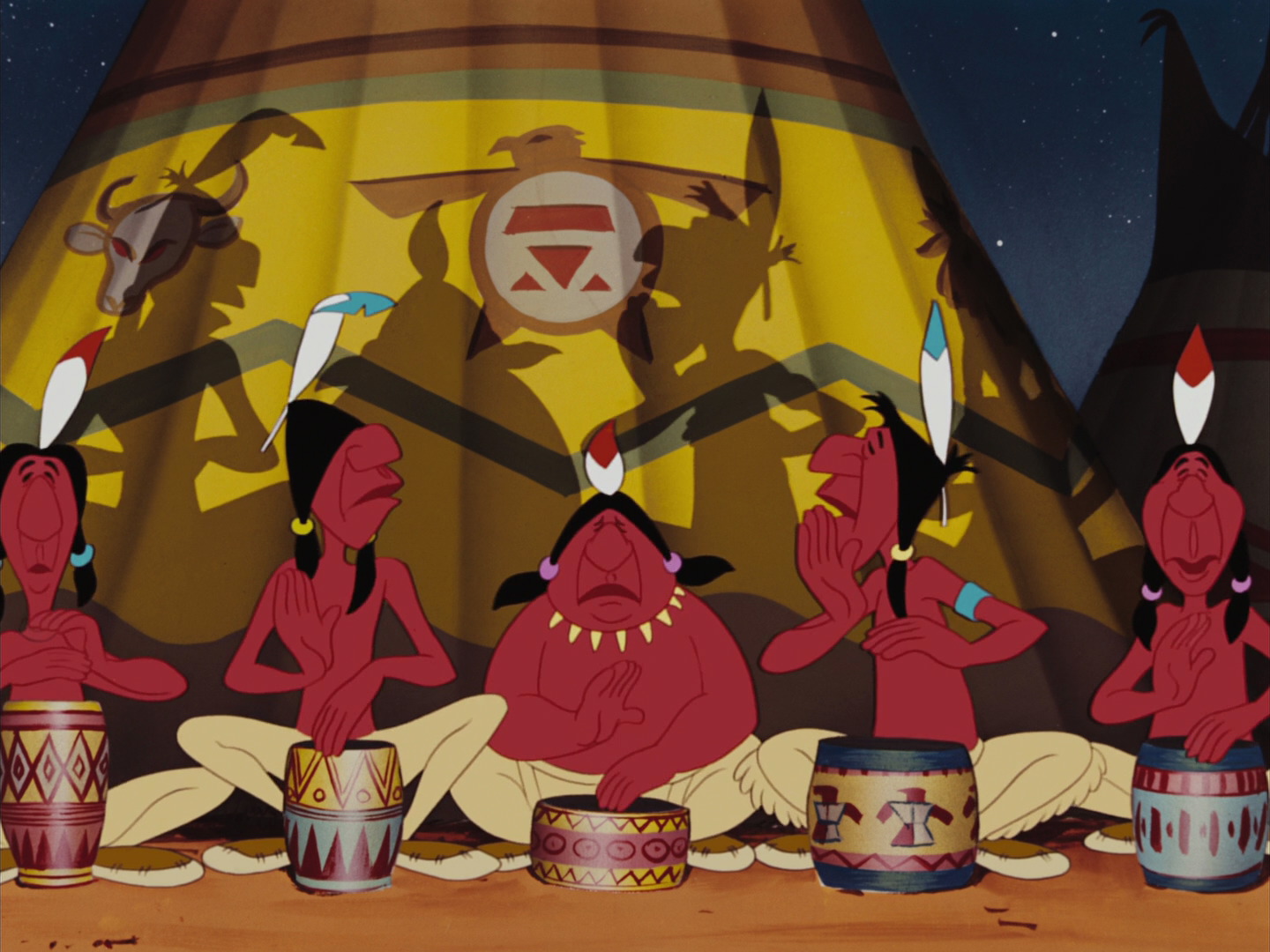
Since first contact, Native Americans have consistently needed to combat the European stereotypes that portray them as inferior and uncivilized. Barraged with echoes of the same handful of Native tropes since Buffalo Bill’s Wild West Shows, contemporary American society often treats the stereotypical Native American princess, chief, and savage as historical truths, represented recently in Johnny Depp’s portrayal of Tonto in The Lone Ranger. But it is not just the visual image of the Native American that has been stereotyped, so has their sonic sensibility. As documented in the film Reel Injun, Native languages and musics have consistently been “faked” by Hollywood with tricks like backwards English, pig-Latin, and Westernized imaginings of a ubiquitous Native music based on a pan-Indian society that never actually existed. Hollywood often uses Native American music to show a “primitive” society where music’s sole function is to prepare for war. However, the “Indian” drumbeat that accents the first beat of a group of four cannot be found in any traditional Native American or Aboriginal music.
While Native American-directed motion pictures such as Smoke Signals, Powwow Highway, and Atanarjuat: The Fast Runner finally gave agency to Natives in film, it was the all-Native DJ collective A Tribe Called Red’s self-released album and popularization of the Electric Powwow that directly challenges the perception of Native American music in modern society. In this post, I analyze the sonic composition of ATCR’s song “Braves,” exploring how A Tribe Called Red challenges North American stereotypes of Native Americans through the cultural re-appropriation of racist sounds.

“A Tribe Called Red – Hall 4 (1)” by Flickr user Trans Musicales, CC BY-NC 2.0
After World War I, intertribal powwow gatherings served as a place to celebrate newfound unity among Native Nations returning home from the war. By the 1950s intertribal powwows had spread throughout North America. With the continued strength and importance of the powwow in contemporary Native society, urban Natives in locations like New York City and Ottawa, Canada, have begun to search for ways to create the same sense of unity in urban venues. In 2008, DJs NDN and Bear Witness formed the DJ collective “A Tribe Called Red” and began curating performances in Ottawa the second Saturday of every month called the Electric Powwow: a “wild party” focused on showcasing native talent and aboriginal culture. ATCR’s website describe the music as “ the soundtrack to the contemporary evolution of the powwow.“ Bear elaborates in an interview with NOW magazine, “[the Electric Powwow] was also about creating a space for our community within the club environment.” Hip-hop DJ and turntable champ DJ Shub was invited to join the group in 2010, and the trio spent the next two years evolving the sound of the Electric Powwow into a mash-up of powwow and First Nations music with contemporary club sounds including hip-hop, dubstep, and dance hall.

“Tribe Called Red” by Flickr user Dav Yaginuma, CC BY-NC-SA 2.0
Much like Fela Kuti’s popularization of Afrobeat in the 1970s, made up of a combination of traditional Nigerian Yoruba polyrhythms with a blend of Western jazz and funk, and Reggaeton’s fusion of Caribbean rhythms with the aesthetics of American hip-hop in the 1990s, the Electric Powwow merges a historically traditional and non-syncretic music with popular and cosmopolitan music in a way that both honors cultural heritage and makes it relevant to a new generation. As NDN points out on Noisey, even their name follows this trend, simultaneously referencing the introduction of Nations at powwows and famous Afrocentric hip-hop group A Tribe Called Quest. The Electric Powwow events are not just about the creation of a new genre of music, but they also serve as a site for ATCR to speak publicly about aboriginal issues and represent themselves as a contemporary face for the urban Native youth renaissance. ATCR’s music videos and live-show projections extensively sample racist imagery from movies and cartoons including old westerns, Back to the Future III, Bugs Bunny, and Disney’s Peter Pan. As a result of their audio-visual activism, the group has become the unofficial soundtrack for the Idle No More movement, which is attempting to reassert Indigenous sovereignty rights and previously signed treaties in Canada.
By taking both visual and sonic symbols that depict racist stereotypes out of their cultural contexts, ATCR draws attention to both the specific racism of each individual image and the ubiquity of racist stereotypes. In their track “Braves,” A Tribe Called Red takes on the U.S. baseball team the Atlanta Braves by remixing the baseball organization’s Tomahawk Chop anthem, itself adopted from Florida State University.
ATCR’s version transforms the innocuous-sounding chant by showcasing its core as a Hollywood-esque stereotype of Native American song. By re-contextualizing the anthem, “Braves” prompts listeners to reinterpret this facet of American sports culture as a racist pageantry of “savage violence.”
The association of the “war chant,” the motion of the Tomahawk Chop, and the fact that these actions call for one team to attack all make it clear that American sports culture appropriates Native Culture as an example of “savagery” and “uncivilized” behavior. The Tomahawk Chop also forgoes the use of a language-based text entirely and instead chooses to use vocables that cannot be attributed to any particular Native nation, ceremony, or meaning. Like Hollywood’s use of backwards English and the war drumbeat to represent “Indians,” the Tomahawk Chop bears no resemblance to any real Native Nation’s music, acting as yet another imagined primitive stereotype that marginalizes actual Native American music.
On A Tribe Called Red’s SoundCloud page, “Braves”’s description reads, “We wanted to make a song for all the racist and culturally inappropriate sports teams that are still used today!” The group accomplishes this by creating dissonance between contemporary electronic drumbeats and the “traditional” paramilitary marching band arrangement of the “Tomahawk Chop.” “Braves” utilizes a standard dubstep song structure in 4/4 at 140 beats per minute that includes an intro, two main sections that include melodic materials, a breakdown/buildup section, a vocal “drop” which announces and is followed by the climax of the piece, and an outro that brings the track to a close. However, “Braves” does differ from other dubstep songs in the marked separation and interaction between the Tomahawk Chop samples performed by voices and marching band and the composed elements of the song performed as the Wub—a deep, wobbly synthesized sound—and accompanied by a HiHat cymbal pecking away at syncopated rhythms. Even though all the melodic content of “Braves” is based on variations of the Tomahawk Chop melody, ATCR never fully integrates actual samples of the Tomahawk Chop into the composition. The marching band and chant samples are treated as an unwanted and unexpected visitor to a party; they seem important at the entrance, but they are given an increasingly diminished role until they finally exit with a whimper.
Written as a protest against racist sports organizations to help convince them to stop using characterized ceremonies and mascots, “Braves” contains that struggle within the composition itself: dubstep, sounded as the Wub and HiHat, eventually renders the Tomahawk Chop sonically impotent. The “Tribe” drop, when ATCR marks the song by saying “tribe,” acts as the turning point in “Braves.” After this point the Wub and HiHat consistently overwhelm the sampled material. In a standard dubstep song, the tribe drop would be followed by the climax: the strongest, most complex musical section of the piece. However, the Tomahawk Chop sample that follows this drop is immediately swallowed up by a low-pass filter that rubs out the tune, starting with the highest pitched sounds, over the course of sixteen measures, heightening the lower end of the sonic spectrum. Only then does the true climax occur. The Wub and HiHat appear here for the first time without the sample band or vocalizations. After the “Tribe” drop, the samples of the Tomahawk Chop are either dominated by the Wub or swallowed up by low-pass filters and fades.

“Tomahawk” by Flickr user Lorianne DiSabato, CC BY-NC-ND 2.0
In this way, “Braves” acts as a three-minute sonic story of reappropriation. The marching band arrangement and vocables represent the common stereotypes of Native American music perpetuated by Western Culture. The Wub and HiHat act as disapproving commentary on these stereotypes. “Tribe,” the only word used in the entire song, not only sounds ATCR as a group, but also marks the point in the song when ATCR begins to create their own image of Native music while simultaneously disempowering the strength of the marching band.
Just like the rebel American marching band’s reappropriation of the song Yankee Doodle in the Revolutionary War, A Tribe Called Red employs irony: in order to get the song the audience has to understand the racism, and while that sort of understanding seems to represent a steep learning curve for a culture so saturated in racist stereotypes, it is also exactly the sort of understanding a multicultural nation needs in order to thrive. Like Afrobeat, Reggaeton, and the more recent alternative hip-hop group Das Racist, ATCR is an underground voice within American popular culture that speaks with reverence for its own traditions while challenging the popular perception of race relations and breaking new ground in contemporary art. “Braves” proves that the reappropriation of sonic space is a powerful tool in the fight for cultural agency.
—
Featured image: “ATCR 4” by Flickr user MadameChoCho, CC BY-NC-SA 2.0
—
Christina Giacona is the Director of the Los Angeles New Music Ensemble and Instructor of Music at the University of Oklahoma. Dedicated to performing and researching the music of her generation, Christina teaches courses in Native American, World, and Popular Music. Since founding the Los Angeles New Music Ensemble in 2007, Christina has commissioned and premiered over twenty new works for the ensemble; run an international composers competition, recorded three albums, and collaborated with DJs, MCs, animators, choreographers, projectionists, and film producers.
—
REWIND!…If you liked this post, you may also dig:
“One Nation Under a Groove?: Music, Sonic Borders, and the Politics of Vibration”-Marcus Boon
“Live Electronic Performance: Theory and Practice”-Primus Luta
“Remixing Girl Talk: The Poetics and Aesthetics of Mashups”-Aram Sinnreich
Share this:


Current Top Posts





April 2021

January 2020

November 2019

October 2019

August 2019

April 2014

November 2017

March 2015

December 2017

October 2015
 Sounding Out!


Recent Comments