
Rallying Cries as Suffering Sounds: “Allah-O-Akbar” and the Aurality of Feminized Iranian Suffering
By July of 2009 dozens of pitch-black videos began to appear on YouTube. Documenting ambient noise, in some cases narration and, most prominent of all, impromptu collective outcries of “Allah-o-Akbar,” these videos resonate with an urgent gusto, punctuated with an eerie sense of desperation through faint echoic reverberations. By the level of desperation audible in every voice, at once dulcet and melancholic in tone, there is a distinct sense that Allah very well may be called forth. While most of these videos received scant attention, one entitled “Inja Kojast”](translated as “Where is this Place”) received over 174,000 hits (as of writing).
It was dubbed with English, Spanish, and Japanese subtitles, was sampled by a music producer (“Tehran’s Roof Tops _Remix”) and also played a prominent role in the 2010 French film Fleur du Mal. What is enabled, invoked, and signified by the layering of these multiple and disparate incantations? What is affectively evoked in the widespread circulation of these chants by YouTube and in Fleur du Mal? Why was this video circulated so widely and deemed so affectively resonant by disparate audiences?
Due to the fact that the Iranian government had barred entry to representatives of foreign media and systematically jailed Iranian journalists accused of being hostile to the regime, the disputed 2009 Iranian elections and ensuing protests were largely reported on by a new breed of “citizen journalists”. Filling in the information vacuum, citizen journalists tweeted and uploaded to the Internet raw video footage of protest marches and confrontations with Basiji militiamen by day – and the voices of dissent performed on Iran’s many rooftops by night. Donning the cloak of darkness, residents of Iran’s major cities climbed to the rooftops of their buildings to chant “Allah-o-Akbar” in numbers – a brief reprieve from the violent suppression of their street protests by Basiji militiamen.

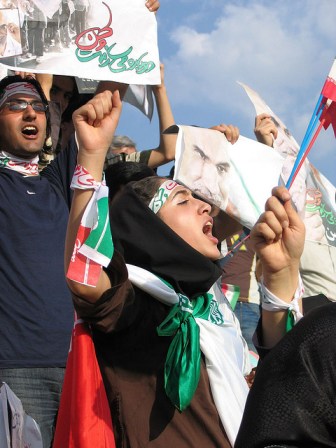
“Women Smash the Shah’s Crown,” Poster from the Iranian Revolution, Courtesy of Flickr User Voyou Reserve
As Negar Mottahedeh has written in her online essay “Allah-o-Akhbar”: “The cry of “Allah-o-Akbar” was the defining sound of the 1978 protests against the Shah of Iran, during a revolution that toppled the Pahlavi monarchy and established the Islamic Republic of Iran.” This earlier revolutionary context is represented in the video for “Allah o Akbar, Khomeini Rahbar”, which hailed a politically diverse citizenry to stand behind this “rahbar” or new “leader.” The chanting of “Allah-o-Akbar” was further exploited as a nationalistic call-to-arms during the Iran-Iraq war in the music video for the anthemic “Allahu Akbar Iran, Iran.” The chant’s versatility and instrumentality in this immediate post-revolutionary period is due not only to its capacity to appeal to the pious and patriotic backers of the newly formed Islamic Republic but also because of its power as a performative political rallying cry. Mottahedeh’s essay title employs a pun: the addition of ‘h’ to the word “Akbar” in transliteration changes the word to “Akhbar” or news. Although she does not elaborate on this, her title suggests that this chant is itself a form of citizen journalism, a broadcast calling forth the revolutionary spirit that Iranians pride themselves for always having at the ready. But what kind of journal is “Allah-o-Akbar”? Is it a call to arms, a rallying cry, a collective sound of suffering or all of the above?
Despite its pious provenance and deployment as the paradigmatic cry of the revolutionary uprising against the Shah, the Islamic Republic currently led by Ali Khamenei and Mahmood Ahmadinejad–which was inaugurated by these earlier revolutionary calls–has interpreted the post-2009 chanting of “Allah-o-Akbar” as blasphemous and an affront to their authority. Journalist Jalal Hosseini argues that this is due in part to the fact that opposition candidate Mir Hossein Mousavi called upon his supporters to remember the revolutionary history of this performative chant in an open letter, stating “Let’s not abandon the green colour which is a symbol of spirituality, freedom and religious mentality and moderateness and the Allah O Akbar slogan that tells us of revolutionary roots.”
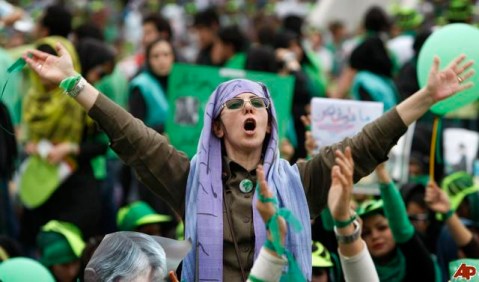
Women at the Front, 2009, Image by Flickr User Raymond Morrison
As Hosseini has written, “In a religious state, where religion is present in every aspect of life, Iran’s protestors have managed to turn religion against their government…Allah-o Akbar is perhaps the single most symbolic phrase in the Muslim world, yet Iran’s current rulers, who themselves employed this slogan in their struggle against the Pahlavi regime in the 1979 Revolution, did not tolerate the protesters’ cries of Allah-o-Akbar after the 2009 presidential election. Allah-o Akbar has essentially become a forbidden phrase.” Hosseini goes on to quote numerous Tehranis who testify to their disparate intentions behind the chanting, highlighting the ambivalence inherent to the slogan, which makes it available to Iranians of many stripes, and, as he argues, allows the calls to resonate even beyond the nation by appealing to other Muslims globally. But the widespread circulation of these videos and their popular impact on global YouTube audiences also suggests that the chanting has had an impact on non-Muslims as well.
Susan Moeller, who penned a Huffington Post piece right around the time of “Inja Kojast’s” semi-viral circulation, argues that this most recent phase of the chant’s resignification has helped to win Americans over to the protesting Iranian’s cause, writing, “watching Americans are learning to reframe the meaning of ‘Allah O Akbar’ and re-imagine the people of Iran. The pictures from Tehran are showing that Iranians are not monolithic in their beliefs.” Moeller suggests that this collective chanting has somehow cut through the status quo Islamophobic representations of a fundamentalist Iran to create an affective and empathetic pathway through which Americans can “re-imagine the people.” Moeller’s argument echoes the sentiment of the comments written on the YouTube page for “Inja Kojast,” comments like “This breaks my heart!” left by Annabanana23663 or “I have listened to this so many times already that you would think I would have moved on BUT I continue to listen and will continue to listen for there is truth in that voice of pain. And only by embracing pain can we love truth. And truth not only will set us free but without truth we cannot be free. Go you beautiful Persians. The people of the USA love you for your defiance” (by YouTube viewer HulkSmashPunyHumans).

“Where is this Place?” San Francisco, CA, 20 June 2009, Image by Flickr User Steve Rhodes
Not only were YouTube users impacted by “Inja Kojast” but the video’s representation of Iran’s rooftop chants inspired the narrative arc of French filmmaker David Dusa’s Fleur du Mal (Flowers of Evil, 2010), a film that explores the precarity and instability of Iran after the 2009 elections. Through a chanting scene in which the two main characters, Gecko (Rachid Youcef) and Anahita (Alice Belaïdi), vociferously call out “Allah-o-Akbar” on the edge of a rooftop in the avowedly anti-Islamic nation of France, they thumb their noses at both nation-states at once while also sealing their romantic bond. Perhaps in an ironic play on Khomeini’s exile in the same city, the beautiful, educated and upwardly mobile Anahita is incubated in Paris for a time while the political instability following the 2009 elections settles down. Completely obsessed with the post-election struggles that she and her friends were actively engaging in on the streets of Tehran, she daily follows every new tweet and YouTube video. She bides her time in Paris by convincing Gecko, the bellhop at her swanky hotel, to give her a tour of the city and the two soon become lovers.
Despite the somber context of the film’s main narrative preoccupations with Iran’s botched 2009 elections, this plot point, I argue, enables the cathexis of an Orientalist drive that is shared by Western audiences: a drive to consummate the desire for the feminized Muslim woman seen to have suffered under the despotic rule of Muslim masculinity. It is this same desire that gets sublimated in a consumption of feminized Muslim suffering which has led to a reductive popular reading of “Inja Kojast” that eclipses the ambivalence of and disparate intentions behind the chanting it documents. In particular, it is through the cries of the narrator’s own female sounding voice that “watching Americans are learning to…re-imagine the people of Iran” as finally available to and eligible for their empathy, attention and yearning.
Fleur du Mal weaves narrative scenes with YouTube footage of Iranian post-election street protests and, in one scene, an image of Neda Agha Soltan’s assassination. Viewed over 1,200,000 times (as of this writing), there has been a wide-scale promotion through documentary films, video diaries, songs and various other imagery of what has been called Neda’s martyrdom for Iran’s “green revolution”. This representation of a feminized Iranian suffering at the hands of an Islamic fundamentalist Iranian masculinity has become a privileged symbol for Iran’s Green Movement outside of Iran. This has enabled an affective attachment to be made which has, quoting Moeller yet again, enabled Americans to “re-imagine the people of Iran.” This time, somewhat counter to Moeller’s claim, it is not only “pictures” that are functioning to transform perceptions of Iranians; sound operates as a critical conduit to an interiority characterized by pain and suffering that has particular appeal.

Image by Shahin Edlata, San Francisco
I argue that the suffering sounds of “Inja Kojast” resonate within what I have elsewhere termed an “aural imaginary” through which Americans and the West “re-imagine[s] the people of Iran.” Through the suffering sounds of an anonymous feminine-sounding voice–reflecting upon and poetically translating the suffering sounds of a nation’s nightly chanting of “Allah-O-Akbar”– a direct link has been made to the feminized victim of Islam.
As US-backed Israeli war-drums are beaten, and as conspiracy theories regarding Iran’s hand in the recent spike in oil prices resuscitate decades-long antagonisms, we must be mindful of the multi-sensorial cooptations of empathetic and affective attachment that have constructed feminized suffering as justification for military intervention and the instrumentalization of sound in support of this. The old Orientalist desire for a feminized opening through which to re-imagine and know the radical other that is Iran has been found through a new gateway: aurality.
—
Featured Image: “Iran 06” courtesy of Flickr User Chong Head
—
Roshanak Kheshti is Assistant Professor of Ethnic Studies and affiliate faculty in the Critical Gender Studies Program at the University of California, San Diego. She is currently completing a manuscript entitled “Modernity’s Ear: The Aural Imaginary and the World Music Culture Industry,” which theorizeshow an other to the listening self is racialized and gendered within the world music listening event. She has published in American Quarterly, Feminist Studies, Hypatia and Parallax.
Share this:

Thrills, Chills, and Safe Sexuality: The Sounds of Michael Jackson’s “Thriller”

Next month may mark the 30th Anniversary of the release of Michael Jackson’s Thriller, but chances are that if you are going to a Halloween dance party this year –or have since 1982–the musical highpoint of the night will still be when they play the title track. While thematically and sonically appropriate for Halloween getting down, there is more to the song’s sonic exploration of fear, both its “scary sounds” and the lyrical references to sound–the stolen scream, the creeping from behind–in the role of scaring an audience. There is startling disconnect between the scariness the song describes (and the stock sounds of classic Hollywood horror films it samples) and its ability to make something potentially scary palatable to a pop mainstream. It is not so much the elements of horror themselves that Michael Jackson’s song makes acceptable, but the potential scariness of sexuality for which it is a metaphor.
There is a long tradition of horror movies as metaphors for sexuality, in particular adolescent sexuality. Iconic examples include Michael Landon’s untrustworthy violent tendencies in 1957’s I Was a Teenage Werewolf (a film clearly being referenced in the opening to the John Landis-directed video for “Thriller”) or more recent incarnations like Joss Whedon’s Buffy the Vampire Slayer, where sleeping with your boyfriend can literally lead to the loss of his soul.
While written by Rod Temperton, a white Briton, “Thriller,” as performed by Michael Jackson and produced by Quincy Jones, takes on the horrors of emergent sexuality via a racial lens. The pop song becomes self-referential, metaphorically about the very taboo thrills that have made young white people seek out black music, and their parents fear for the consequences. And while 1983 was a far cry from the 1950s-era outrage over white kids listening to and making their own “black” rock n’ roll, we also can’t forget that it was an era of a newly-launched MTV almost completely devoid of black artists (before hip hop’s explosion among young white males). It was largely Jackson’s popularity, in fact, that prompted MTV to finally include more black artists in its programming.

Photo by Shaun Wong via Flickr
While references to race in “Thriller” may be oblique, the lyrical references to sex are fairly obvious. The menace of the sexual encounter is present throughout the song as it is in the genre—sex itself is thrilling, desirous despite its potential physical, emotional or even social dangers.The scariness of the late night creature feature on television becomes an excuse to “cuddle close together.” This comforting occurs “all through the night” and the singer “can thrill you more than any ghost would ever dare try” (and the use of “ghost” to make a distinction between it and the singer reverberates with racial meaning). There is a dichotomy present in the song, in that the speaker is both the comfort from the fear of violence, and potentially “the beast about to strike.” Of course “nothing can save you” from that beast, when it is also the figure you are counting on to save you to begin with.
Similarly, at the height of his popularity, Michael Jackson embodied a safe version of black male sexuality. (In contrast, consider Prince, who in the early 80s was putting it all out there with albums like Dirty Mind (1980) and Controversy (1981), and would not get anything remotely like Thriller success until 1984’s Purple Rain). Despite Jackson’s pelvic thrusts or his videos featuring dark alleyway dancing, he represented a form of sexless sexiness, as emasculated in the eyes of the public as his doll (as famously demonstrated by Eddie Murphy on SNL). Perhaps most indicative of that position was Jackson’s bringing Brooke Shields as his date to the 1984 Grammy awards, while having Emmanuel Lewis accompany them. At the time MJ’s Peter Pan latency meant that Brooke was safe from predation and Emmanuel Lewis was an innocent child-friend to the child-like entertainer. Michael Jackson’s persona would not be undone by the accusations of monstrous pedophiliac tendencies for another nine years. Like the Thriller-themed doll pictured, Jackson was safe for both children and mainstream America, despite his ability to be transformed into something ostensibly terrifying.

Eddie Murphy shows what MJ has between his legs on SNL
The song is arranged and produced by Jones to echo this dichotomy of safe danger. The bass groove is a creeping disco loop never arriving, but suggestive of the warning music of the slasher genre. The hook is introduced with a sudden and shocking chords on a synthesizer, like the title screen music of an old monster movie. The high-pitched synthesizer whine that warbles during Vincent Price’s rap emulates the sci-fi spookiness of a theremin. The availability of Vincent Price was a coup for Jones and Jackson—a well-known figure of the genre, but even by 1980s, he was already a throwback to an older and out-of-date notion of horror—known for his low-budget work in Roger Corman films like Masque of the Red Death (1964) and appearances on Scooby-Doo. Furthermore, the song is marked by stock creaks, footsteps, thunderclap, slamming doors, wind and howls, sounds that enter the realm of kitsch. The sound effects are so exaggerated and artificial as to undercut the sense of the scariness the song describes and potentially represents. It disguises the supposed threat of black sexuality so successfully that it is now performed at many a white American wedding.
The campiness of the song’s excess, both sonically and lyrically, takes the edge off the sexual desire—the very thrill the song is meant to evoke. Even John Landis’s vision of the song in his 14-minute long video that remixes the album track for cinematic effect, mixes its film-quality monster effects with a playfulness evident in Jackson’s multiple incarnations in the video. In the movie inside the dream inside the video narrative, he seems more concerned with teasing his date about how easily she is scared (and scaring her some more) than sleeping with her—but his mischievous grin signals an unspoken desire that comes alive in his date’s alternating desire and fear of him. The dangers of werewolves and zombies are always arrested to reveal a level of artifice, a gotcha moment for his date–and for the audience–that undermines any real risk.

Michael Jackson transformed into a literal “black beast.”
The title track on what remains one of the best selling albums in history, “Thriller” evinces the ways in which Jackson and Jones figured out how to perfectly package and promote this tamed sexuality through their manipulation of sound. Sonically, the song (and other songs on Thriller such as “Beat It,” Billie Jean,” and “Wanna Be Startin’ Something”) evokes the tantalizingly forbidden and yet makes it accessible. The infectiousness of “Thriller”‘s groove, along with the appeal of pop hook sung by Jackson’s unmistakable voice, threatens possession of the listener but always allows for her to “change that number on your dial.” Part of what made this music broadly appealing (aside from Jackson’s obvious talent) is its success at dissembling, avoiding the backlash against the figure of “the black beast” rapist while subconsciously evoking the fear of it.
But there is a price to be paid for this sonic disconnection. There was certainly something horrific in Jackson’s physical transformation in the years that followed his Thriller apogee. Could it be that MJ’s desire to further improve on this formula led to what Richard Middleton describes in his book, Voicing the Popular (2006): a change from black child star to a “simulacrum of white middle-class woman” (128)? The extremity of such camp collapsed on itself, allowing that sexual anxiety to flow back through the disconnect his “safe” persona was supposed to shore up. Whatever fear that the sexless sexiness of Michael Jackson was actually a cover for queerness was brought to the fore because he stood accused of molesting little boys, allowing for a depiction of monstrousness that works across both gender and racial lines (and also highlighting a difference in attitude from when girls are the victims).

“Thriller” re-enactment held in October 2010 in Springfield, MO.
Photo by Darin House via Flickr
Jackson’s fall from grace may have come in the form of molestation accusations, but it still provides insight into the long history of fear of black America and black music that still lingers, proving that the mainstream’s love can turn to suspicion, even hate, in a heartbeat. Jackson’s broad appeal narrowed significantly when there was even a chance he wasn’t the sexless figure he appeared to be. As James Baldwin, whose writing and social criticism was always focused on the intersection of race and sexuality in America, wrote in 1985’s “Here Be Dragons” in regards to the hysteria of Michael Jackson’s popularity:
The Michael Jackson cacophony is fascinating in that it is not about Jackson at all. I hope he has the good sense to know it and the good fortune to snatch his life out of the jaws of a carnivorous success. He will not swiftly be forgiven for having turned so many tables, for he damn sure grabbed the brass ring, and the man who broke the bank at Monte Carlo has nothing on Michael. . . Freaks are called freaks and are treated as they are treated–in the main, abominably–because they are human beings who cause to echo, deep within us, our most profound terrors and desires.
—
Osvaldo Oyola is a regular contributor to Sounding Out! and ABD in English at Binghamton University.
Share this:


Current Top Posts





April 2021

January 2020

November 2019

October 2019

August 2019

April 2014

November 2017

March 2015

December 2017

October 2015
 Sounding Out!
Recent Comments