
Listening to #Occupy in the Classroom

 Yes, it’s that time again, readers. You are going to have to stop pretending the “Back to School” aisles haven’t been appearing in stores for the past few weeks. We at SO! are here to ease your transition from summer work schedules to the business of teaching and student-ing with our fall forum on “Sound and Pedagogy.” Developed to explore the relationship between sound and learning, this forum blends the thinking of our editors (Liana Silva), recruited guests (D. Travers Scott), and one of the winners of our recent Call For Posts (Jentery Sayers) to explore how listening impacts the writing process, the teachable moment, and the syllabus (and vice versa). We hope to inspire your fall planning–whether or not you teach a course on “sound studies”–and encourage teachers and students of any subjects to reconsider the classroom as a sensory space. We also encourage you to share your feedback, tips, and experiences in comments to these posts and on our Twitter, Facebook, and Reddit sites. As I said in the Call for Posts for this Forum: “because teaching is so crucial—yet so frequently ignored at conferences and on campus—Sounding Out! wants to wants to provide a virtual space for this vital discussion.” This conversation will be ongoing: we will also bring you a “Spring Break Brush-Up” edition in 2013 featuring several more excellent posts by writers selected from our open call. Right now, the bell’s about to ring–so take a seat, open those ears, and enjoy this shiny auditory apple of an offering from D. Travers Scott in which he discusses how the sounds of #Occupy invigorated his classroom. And, yes, it will be on the test. —JSA, Editor-in-Chief
—

In the late fall of 2011, I was teaching a class on cultural studies of advertising. I presented the Occupy Student Debt campaign, a subcategory or spinoff of the larger Occupy movement, while we were examining ways people challenged consumer culture. We discussed education as a commodity and students as consumers. Unsurprisingly, my seniors were dissatisfied consumers. They expressed that what had been advertised to them was a product that guaranteed or at least would strongly increase their chances for quality employment (of course, it was also a product they had worked for years in creating, and one they couldn’t return.) If higher education really did land you the lucrative job it had been advertised as guaranteeing, in theory, then, you would be able to more easily pay off student loan debt. To address this dissatisfaction, I showed them two artifacts: a video from the launch in New York City on November 12, 2011, and the OSD debtors’ pledge*.
In the video, OSD founder Pamela Brown reads the pledge one line at a time, with each line chanted back by others. I played the video in a dark classroom. I also projected it on the room’s main screen, but I didn’t use the room’s amplification system because it sounds too much like an authoritarian public address and disperses the audio in a dominating way. External speakers connected to my laptop made the sound feel, to me, more localized and objectified, something we could focus on rather than an institutional part of the room. The students’ first reaction was, not to the words, but the sound: the verbal relay used at the public demonstration. Brows furrowed and heads cocked quizzically, they asked, “Why are they all repeating the speaker like that?” I explained how this provides additional amplification, but the students’ listening experience was instructive to me. Their unfamiliarity with a sonic practice of vocalization indicated their unfamiliarity with larger practices of collective, public social action.
Listening to OSD, and paying attention to how my students listened to it, informed me of larger contexts they needed to understand and discuss it, in ways that the object of the text did not suggest to me. It made me think about the experience and process of my students’ encountering OSD. I immediately noticed its ambient sounds of city life, which I no longer hear. These sounds of traffic, the acoustics of being surrounded by buildings, etc. gave several urban dimensions to the movement the pledge text did not. From the perspective of Upstate South Carolina, “urban” is not a simple thing, an identity or geography category, but intersectional: our largest city, Greenville, has a population under 60,000. City noises feel not merely urban, but un-Southern, and thereby alien. (I say un-Southern rather than Northern or Yankee because another thing I’ve learned here is the inadequacy of that binary: Los Angeles, for example, is not a Northern city but most certainly is as un-Southern as New York. Cities also carry a class dimension.) Even though my school is one of the elite institutions in this area, this region is still worse off economically than the rest of the country and has a generally lower cost of living. Cities require money to live in. In spatial, class, and urban dimensions, OSD felt alien.
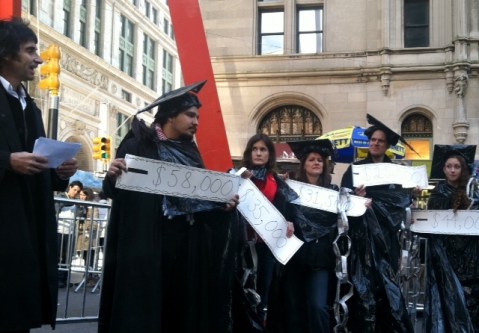
Opening of the Occupy Student Debt Campaign, Image by Flickr User JohannaClear
The experience of listening to the ODS rally illustrates how a sound studies perspective foregrounds experiential processes over exclusive categories of things and ideas. For example, when I read the OSD Debtors’ Pledge aloud to my students—vocalizing the text and sounds and listening to them— it brought the text into my body, making it an action. It also made students uncomfortable. Even just a round-robin reading of theory seems to make then anxious and fidgety. While I try to understand and accommodate anxieties around public speaking, I think the way sound makes a text enter the body can be a powerful affective experience. And no one ever said the classroom always had to be comfortable. For me, reading the text aloud personalized the OSD pledge. It evoked sensory memories: “Pledge of” evoked saying the pledge of allegiance in public school; saying “We believe” took me to attending Lutheran church services with my husband at the time where they collectively recite the Apostles’ Creed. These associations evoked emotional disidentifications from organized religion and mandatory collective professions of patriotism. It also temporalized and spatialized OSD for me, positioning it in relations to Dallas, Texas in the 1970s and Greenville, SC today.
Overall, the reading aloud of the pledge staged a tension or dialectic of identification and disidentifications. Although I agreed and identified with the sentiments of the movement, several alienating and unsettling aspects of the pledge came through as I read aloud: the blithe collapsings of “we” and “as members of the most indebted generations” made me wary (collectives always do, but so do easy historical assertions. Really? Are we more indebted than indentured servants who came to America, or people born into slavery?), and the sudden shift to first person singular at the very end seemed jarring: (After saying “we” six times, suddenly it’s ‘I’ now – what happened?). Lastly, the numerous alliterations also had an alienating effect, making the text seem sophistic and manipulative, artificial, composed.
The auditory experience of OSD can also provide insight into how we create texts. A video of Andrew Ross shows him presenting the first, “very rough draft” weeks earlier at an OWS event. Listening to him read this different, earlier version underscores the text as process. The pledge is something that developed. While his flat tone and straight male voice do not appeal to me, they do complexify and dimensionalize Brown’s reading, giving it depth. They also show that some things that bothered me in the final version – the collectivity and alliterations – were not there. This intertextual, diachronic listening does not erase troublesome aspects of the ‘final’ text, but it mediates them. I am moved closer to it by listening to its different origin.
Arguably, any of these points could have been arrived at by good ole’ textual analysis. My point is not that listening always should supplant visual modes; sound studies tries to break that false dichotomy by not denigrating or replacing the visual but by elevating the sonic to complementary – not superseding – status. I argue that reading aloud should be a fundamental, basic component of sound studies methodology, as it allows anyone to hear, voice, embody, and experience a text. I not only noticed these aspects sooner through listening – my first time speaking it aloud, despite having read it at least a dozen times before. Moreover, I didn’t just notice them: I felt them on a personal, emotional, level, which spurs thinking and analysis that is, if not completely new and unique, definitely qualitatively different in its potency and urgency.
Listening to OWS, and the OSD in particular, brings insights affective and personal. Yes, I can read a statistic from a survey stating that a certain percentage of participants in OWS feel angry or betrayed. That doesn’t mean anything to me in a specific, personal, and empathetic way – and empathy is crucial for a social movement to garner support. Listening to both Ross and Brown, I am reflective and conflicted over my professional role – no longer a grad student, but certainly not an established scholar like Ross. I feel connected to OSD in ways beyond the literal facts of my debt. Listening draws me into a contemplative, reflexive space beyond a sticky note on my office desk saying “OWS: teachable moment.” I can see a map with big, red OWS circles over Washington D.C. and New York, but I don’t feel the distance from myself and my students in the same way—and this is crucial for my teaching and engaging them in dialogue about what could be the most significant social movements of their lifetimes.
Share this:

The Sound of Radiolab: Exploring the “Corwinesque” in 21st Century Public Radio

 Editor’s Note: Today, radio scholar Alex Russo, author of Points on the Dial: Golden Age Radio Beyond the Networks , continues our summer series “Tune In to the Past,” which explores the life and legacy of radio broadcaster Norman Lewis Corwin, the “poet laureate of radio” who died last summer at the age of 101. Sounding Out!‘s three-part exploration of his legacy by radio scholars Neil Verma (June), Shawn VanCour (July), and Russo (August) not only gives Corwin’s work new life (and critique), but also speaks to the growing vitality of radio studies itself. And now, hey everyone, you are listening to . . .Alex Russo Alright? Okay? Alright?–JSA
P.S. Look for a special bonus fall installment of the Corwin series in September!
—
Voice 1: What if you were the best in the world at something…
Multiple Voices: [background] He is the greatest….most stupendous…. most thrilling…most inventive
Voice 1: and then your entire industry collapsed.
Voice 2: [continuing and fading out] Radio[?] Writer.
Voice 1: But you kept on working?
SFX: Typewriter, continuing until coming to a dead stop when return bell rings and the carriage returns with a clunk on “pass away”
Voice 1: Outliving all your peers, until, 77 years later, you pass away?
Voice 3: Norman Corwin? Never heard of him. He defined a generation’s engagement with sound?
Voice 1: And there is no one left to eulogize you? What is your legacy?
This post is the third in a series that engages with the legacy of Norman Corwin, a – perhaps the – preeminent radio writer and producer of the late 1930s and 1940s. Specifically, it picks up on Neil Verma’s challenge back in June to consider the legacy of the “Corwin-esque.” Verma devotes considerable space to mapping the aesthetic syle of Corwin in his post and his incredibly insightful and astute book, Theater of the Mind.
The analysis that follows leans on Verma’s argument with a caveat. The question of legacy stems in part from Verma’s assertion that Corwin lived for so long, few were left to speak for his legacy. Corwin may not have the name recognition that he should within the broader public, but for radio practitioners, he is regarded with considerable reverence. In this sense, the Corwinesque style lives on by inspiring contemporary radio producers, especially, I will argue, in the aural style of the syndicated WNYC public radio program Radiolab, hosted by Jad Abumrad and Robert Krulwich. Radiolab describes itself as “a show about curiosity. Where sound illuminates ideas, and the boundaries blur between science, philosophy, and human experience.” While ostensibly a science program, designed to make complicated scientific phenomena comprehensible to a general audience, the show engages in fundamental questions about nature, being, and experience in creative ways.

Certainly, Abumrad and Krulwich regard Corwin as an inspiration, such as when Krulwich responded to a claim by This American Life‘s Ira Glass that the turn of the 21st century is the true Golden Age of Radio, by describing Corwin as “Homer in a modern form. . .a lyrical reporter who wrote and spoke like he was wearing a toga and sometimes was so spectacular you’d get dizzy listening and sometimes seems a little too old fashioned and oratorical.” In his earlier post, Verma defines Corwin’s aesthetic style through a number of formal elements, including what he describes as a kind of “overworked literary calisthenics.” Putting their own spin on Corwin’s dizzy oratory, Abumrad and Krulwich mark Radiolab with complicated and intentionally convoluted speech patterns. The program features Abumrad and Krulwich in rapid fire banter – far faster than typical public radio fare. Often, this onslaught of language crowds and overlaps, producing a highly staged simulation of conversational flow. Often, Abumrad is a voice of enthusiastic discovery, while Krulwich plays the role of skeptic, particularly in the early seasons. Abumrad’s voice is more nasal, higher pitched and, notably, recognizably younger than that of grizzled veteran Krulwich, creating a contrapuntal effect.

Radiolab Producers/Hosts Robert Krulwich (l) and Jad Abumrad (r), Image by Flickr User ThirdCoast Festival
These voices usually interact with a third voice, what typically radio documentary calls the “actuality.” However, instead of than separating “the real” from the narration’s voice of authority, Radiolab juxtaposes sentence fragments from all the voices (analysis, counter-argument, evidence) to create a conversation that proceeds dialectically, on parallel parts that intersect at points to lead to a thematic conclusion. While Radiolab’s dialogic style has been explored by other radio scholars, like Andrew Bottomley and Eleanor Patterson, its link to Corwin’s model of radio drama deserves more attention. While not exactly the same as Corwin’s signature “choral” vocal style, with voices chiming in from all directions, it performs a similar function, aurally representing a multiplicity of viewpoints.
Furthemore, Abumrad and Krulwich work hard to create a feeling of liveness and connection with Radiolab‘s listeners, much like Corwin did. Radiolab is certainly not a live program, but we must also remember that much of Corwin’s work was also developed to be recorded and sold–as Shawn VanCour discussed in his offering to this series. Although violating typical news protocols, mangled sentences, mis-matched vocal levels, and cross-talk are not removed during Radiolab‘s editing process; rather they are left in to create the feeling of spontaneity. Krulwich and Abumrad as quite conscious of this effect, with the latter noting in a New York Times profile, “It’s a funny thing, when you find yourselves laboring for weeks to create what you felt at that first moment.”

Abumrad and Krulwich, performing a live version of Radiolab, Image by Flick’r User Jared Kelly
A final connection, Abumrad and Krulwich blend two aural styles, “intimate” and “kaleidosonic,” descriptors Verma coins in Theater of the Mind as the hallmark of Corwin’s formal mastery. Verma defines broadcast intimacy through radio’s address to the listener as an individual, its placement of a program’s “audioposition” alongside the narrator, as well as its emphasis on place-centered narratives. Kaleidosonic style addresses the listener as a public, uses a multiplicity of auditing positions, and creates a broad model of engagement with narratives centered on events (70). A wonderful representative example of this combination of styles on Radiolab can be heard at several points in season two’s episode, “Detective Stories.” First, the end of the opening beat features the stylized repetition of a New York Sanitation official describing the Fresh Kills sump as a “time capsule.” As the phrase “time capsule” echoes eight times, Krulwich begins to chant “time capsule” in a lightly mocking and metallic sounding tone. Abumrad tells him, “You can stop that now.”
Later in that episode, a segment entitled “Goat on a Cow,” follows Laura Starcheski across the country as she investigates the twelve-year story behind of a box of old letters found by the side of the road.
This segment takes place at different locations, a hallmark of the intimate style. At the same time, it also uses elements of the kaleidosonic style because the narrative turns on particular events, moments where new evidence is found and new theories of the story of Ella Chase, the letters’ recipient. Throughout this segment Starcheski’s voice fades in and around those of her actualities. When she intervenes to provide context, the other voices are not stopped, they continue, telling their story under hers until at specific moment both voices say an identical phrase. This juxtaposition suggests that the letters hold different meanings for the individuals who come in contact with them: For Starcheski they are a reminder of her childhood desire to invent life stories of strangers; For Erick Gordon, an English teacher who found the letters, they are a great mystery on which he can project his own imagined histories and build a teaching curriculum; Finally, for Robert Chase, they represent a relief that he is no longer the archivist of his grandmother’s life. Like Corwin’s work, “Goat on a Cow” combines intimate and kaleidosonic styles, creating pleasures that are linked not to narrative closure but to the process of sonically representing investigation and theorization.

Letters, by Flickr user aroid
In allowing the pleasures of aural storytelling to enable the show’s narrative, Radiolab’s Corwin connection expands conceptions of the imagination. Like Corwin (and radio writers of the network-era), Abumrad sees radio as both an act of “co-authorship” and “co-imagining” between the writer/performer and the listener. However, he also sees his “job” as “put[ting] certain images and feelings in your head.” This link to discourses of the imagination is clear in the series’ opening episode, “Who Am I?” One segment in this episode, “The Story of Me,” suggests that what defines humanity is “introspective consciousness,” the ability to abstract images or events into a story of self.
Citing neuroscientist Dr. V. S. Ramachandran, Krulwich notes: “Only humans can take images from the real world, pull them into their heads, divide them into parts, and take those parts and turn them into abstractions.” To demonstrate, Krulwich leads Abrumrad through an example where the latter conjures the image purple striped red canary in his head. Ramachandran follows, noting that only humans can rearrange and manipulate “tokens” of “bird,” “striped,” and “red” to “imagine” something that doesn’t exist. The “peculiar human muscle” is that “ability to experience things and abstract them into a story. This definition is telling, while ostensibly it is about human consciousness, I would argue it could just as easily be seen as a description of the job of radio writing, taking recognizable symbolic tokens, manipulating them, and turning them into story. By equating human consciousness with radio, Krulwich and Abumrad exemplify a final theme that Verma attributes to network-era radio drama, its evolution “from being a theater in the mind to being a theater about the mind” (3).
Indeed, the segment of “The Story of Me” finishes by noting that neural actions can only be understood in a group: “Even the thought ‘I am a one’ springs from a hundred million cells connecting through a trillion synapses and that all of this multiple activity paradoxically creates the you of this moment. You are always plural.” I imagine that Corwin, no stranger to celebrations of plurality, would completely agree.
—
Featured Image by Flickr User Jared Kelly
—
Alexander Russo is an Associate Professor in the Department of Media Studies at The Catholic University of America in Washington, DC. He is the author of Points on the Dial: Golden Age Radio Beyond the Networks (Durham, NC: Duke University Press, 2010) as well as assorted articles and book chapters. His research interests include the technology and cultural form of radio and television, the aesthetics of sound, the development of “old” new media, the history of music and society, the relationship between media and space, and the history of popular culture.
Share this:


Current Top Posts





April 2021

January 2020

November 2019

October 2019

August 2019

April 2014

November 2017

March 2015

December 2017

October 2015
 Sounding Out!
Recent Comments