
Deejaying her Listening: Learning through Life Stories of Human Rights Violations

 **Co-authored by Emmanuelle Sonntag and Bronwen Low
Are you listening?
Because sound specialist Julian Treasure argues, “We are losing our listening” due to the invention of multiple methods of recording and with the world being “so noisy . . . with this cacophony going on visually and auditorily, it’s just hard to listen, it’s tiring to listen.” In response, Treasure claims that we need to improve our conscious listening skills; he suggests teaching the skill of listening in school.
As co-directors of the “Education and Life Stories” working group of a large oral history project, we have been thinking a good deal about listening and pedagogy. The project is entitled “Life Stories of Montrealers Displaced by War, Genocide, and other Human Rights Violations,” shortened here as “Montreal Life Stories project.” From 2007 to 2012, a team of university and community-based researchers in the frame of the Canadian Community-University Research Alliances (CURA) Program recorded life story interviews with approximately 500 Montrealers who experienced mass violence and displacement. Members of the survivor communities (Tutsi, Haitian, Cambodian, and Holocaust) were key partners in both the research and the diffusion of the project, fundamentally shaping the project’s philosophy, activities and outcomes.
One of the Education Working Group’s principle accomplishments was developing an educational package called We Are Here, containing five Learning and Evaluation Situations (LES), the curricular units in the Quebec Education Program. The units are designed for “cycle two” secondary school, where the students are generally 14 to 16 years old. As of yet, these have not yet been piloted, but we plan to do so.
 Our goal while designing “We Are Here” was to have teachers and students engage with the life stories of human rights violations, in order to foster a more inclusive cultural memory that would develop “le vivre-ensemble,” our capacity to live well together. Featuring the stories of immigrants and refugees to the province, the curriculum offers students a more complex understanding of human rights violations. First-person accounts bring world history and politics to life, helping us to understand the processes and human costs of violence and war, and expand our awareness of our fellow residents and citizens. At the same time, we recognized that the difficult stories of human rights violations make particular demands upon their listeners. We needed to consider how to ethically support students and teachers in engaging with the stories of people who have survived traumatic experience—while, importantly, respecting the interviewees themselves.
We sensed from the beginning that these goals and commitments would require us to develop our own “pedagogy of listening” to support teaching and learning from the life stories, and we foregrounded listening in all of the materials. For instance, each unit begins with the students listening to one or more project interviews, in the form of digital stories edited collaboratively by the interviewees and the editor. These digital stories tend to be under 10 minutes and bring together video, images, sound, and text (see for example, Bracha Rosenblum’s digital story). They are much more accessible than the original video interviews, which can be many hours long.
There is an irony in building a case for listening in schools. Students are commanded daily to “be quiet and listen to the teacher.” Despite the long history in educational theory of critiquing this model, the student-who-listens-in-silence versus the teacher-who-speaks-loudly is still regularly invoked in practice as an ideal relation. The demand for silence is in part a pragmatic response to the inherent noisiness of schools filled with people. At the same time, the listening imperative is also a key tool in the establishment of teacher authority and power.

Image by Flickr User I Am Rudy
We wanted to rethink the process of listening in our curricular design beyond these traditional power dynamics. Our pedagogy of listening draws on concepts of testimony, communities of memory, dialogue, and the principle of shared authority in oral history, which we describe in detail elsewhere (forthcoming in the Journal of Curriculum Studies). In this blog post, we explore our pedagogy’s indebtedness to philosopher and musicologist Peter Szendy’s work on listening and its potential in the public school classroom.
Listening begins with the desire to be signed and addressed
The address is a central notion in Peter Szendy’s Listen: A History of Our Ears. The early 2000s, as Szendy explains, saw the birth of the peer-to-peer file sharing service Napster (created by Shawn Fanning in 1999), where listeners exchanged and circulated music. Through the lens of file sharing, Szendy began reflecting on the rights of listeners and the nature of musical listening more generally. He argues that sharing shapes the listening act: while listening can be passive–I am listening to you, receiving what you are saying–we also offer up what we are listening to. Rather than envisioning listening as a two-way engagement, Szendy triangulates it, structuring listening around a listening subject, the sonorous object the subject is listening to, and the addressee (le destinataire) of the subject’s listening. In Szendy’s theory of address, as we listen to somebody or something, we also address our listening to an “other” (who might be another beside me, or in myself).
That students would address and engage with “an other” through their listening appeased, in part, our concerns about having students listen to difficult stories of mass violence. If listening is akin to a peer-to-peer sharing system, students were somehow not “alone” anymore in the experience; listening is a building of relation.
Closely related to the concept of listening as address is Szendy’s idea of signature, especially through the digitalization of sound where “listeners become authors” (136) naming, tagging, and classifying the files that they share with others. Szendy describes this process in terms of the singularity of listening:
It is more simply as a listener that I want to sign my listening: I would like to point out, to identify, and to share such-and-such sonorous event that no one besides me, I am certain of it, has ever heard as I have (3).
While all listening necessarily involves an appropriation of what has been listened to, we wanted to amplify the process of students “signing” or marking their listening, and so making it their own. We would deepen students’ engagement with the video interview and the “other” by having them actively edit, rework, even remix, and so adapt the original. We gave students the right to enter into the difficult stories from the survivors interviewed in the Montreal Life Stories project, responding as individuals and as members of a classroom community. While the dynamic of students listening to and making something in response to the life stories takes many forms in our curricular units (including timelines, maps, and audio-tours), we here share the unit which most explicitly embodies the remixing in Szendy’s notion of listening.
What a Story!
What a story!: Life stories and digital storytelling, is designed for senior students in the English Language Arts, and asks students to work in groups to create their own digital story version of a segment from one of the life story interviews.
In the preparation phase, the students listen to a 5 minute digital story of a Holocaust survivor living in Montreal that enables them to discover the multimedia elements and narrative structure of a digital story.

In the production phase, students approach their main task: producing a 5 minute digital story from a 34 minute life story interview with another Holocaust survivor. The phase begins with “deep listening” exercises where students work in groups to summarize the story and decide which parts of the larger interview they would like to keep in their edited versions. In doing this, they reflect on their experience as “listener“ vs. ”reader” and their responsibilities as listeners of difficult stories.
While the expression “deep listening” recalls the work of the composer Pauline Oliveros, in the Montreal Life Stories project the concept stems more directly from the notion of “shared authority,” a phrase coined by oral historian Michael Frisch (1990) to describe the process of co-creating an interview. The community-university model was collaborative at all levels, and researchers and the researched were partners in dialogue. In turn, we frequently used “deep listening” (as in the profound listening between interviewers and interviewees) as an expression during our working sessions. The concept also draws on the work of oral historian Martha Norkunas on interview techniques and deep listening exercices; her visit to the project shaped our curriculum design process, and students are encouraged to engage in dialogue and sharing, and to “Listen with close attention and deeply, in an empathetic and respectful manner.“(13). These appeared, to our eyes, to be consistent with Szendy’s notion of listening as address and signature.

The production phase continues with the creation of the digital story, the editing and the montage. Students then reflect on the ethics of the process of cutting and reworking another’s story, exploring the way narratives can be modified, the meaning built into the digital story vs. the meaning of the interview, and the question of narrative form.
Peter Szendy chooses the deejay, or of the musical arranger, as a figure for the contemporary listener. Indeed, we imagined the students in groups, headphones on, in front of computers, slowing down the cadence, augmenting the sound, rewinding or fast-forwarding, cutting, pasting, annotating. We thought of them as highly skilled listeners, intervening in what they were listening to and interpreting their listening for the “other” ( in the manner of composition theory in which students are asked to write for real audiences for real purposes). As deejays of their listening!
Having students edit the life stories of others, especially stories of violence and war, brings with it risks of misinterpretation and manipulation. However, the unit asks students to think carefully about these risks, and unlike projects which use testimonies in the service of someone else’s argument, this editing assignment has students select from the larger interview in order to craft a narrative that respects the original. As Norkunas says, “When Michael Frisch coined his now famous phrase, “a shared authority,” he wrote of the shared responsibility of listener and narrator for creating the interview document, for interpreting it and for sharing the knowledge created.”(2) If editing and interpreting are critical to the process, adds Norkunas, “the first moment of creation takes place in the interview, in the act of listening.” Hence, the ethical issues raised by the editing assignment–and more generally by having students and teachers engage with personal stories of human rights violation–are addressed by considerable attention to the act of listening (13), and by the cultivation of trust, dialogue and sharing. In short, an attention to the “other.”
Rather than deciding that this content is too challenging for students or reproducing a passive listening dynamic in which students listen to the interviews in reverential silence, we work to support student engagement — as both an attention and response — with these stories as part of a community of listeners. And while listening to these stories can be difficult work, we hope that through our pedagogy of listening, students will gain a greater awareness of the lives of those Quebecois who are not often part of the national narrative, and grapple with some of the difficult knowledge of human pain and survival.
—
Bronwen Low is an Associate Professor in the Department of Integrated Studies in Education at McGill University. She researches the implications of popular culture for education, curriculum theory, and adolescent (multi)literacy practices. Areas of interest include hip-hop and spoken word culture; informal, arts-based and participatory education with youth; and community media and participatory video programs.
Emmanuelle Sonntag defines herself as a “knowledge organizer.” She offers consultancy services in communication, education, curriculum design, information management and knowledge mobilization while pursuing her PhD in Sociology on… Listening at Université du Québec à Montréal. She tweets on listening, sounds, stories and other noises @lvrdg.
—
 REWIND! . . .If you liked this post, you may also dig:
Audio Culture Studies: Scaffolding a Sequence of Assignments–Jentery Sayers
The Sounds of Writing and Learning— Liana Silva
Listening to #Occupy in the Classroom–– Travers Scott
Share this:

Sounding Out! Podcast #12: Animal Transcriptions: Listening to the Lab of Ornithology
CLICK HERE TO DOWNLOAD: Animal Transcriptions: Listening to the Lab of Ornithology
SUBSCRIBE TO THE SERIES VIA ITUNES
This podcast culls material from seven hours of interviews about sound and animal life with scientists, engineers, programmers, archivists and other staff working in the Bioacoustics Research Program (BRP) and in the Macaulay Library of Natural Sounds (LNS) at the Cornell Lab of Ornithology. The interviews were conducted as part of a research project situated at the intersection between sound in poetry (prosody) and environmental sound (soundscape), specifically focused on animal vocalizations.
Poetry might help us to use, study, and deploy animal morphologies in ways that hope to better, rather than merely exploit, the human relation with such life forms, if not to improve the welfare of the species themselves. As Katy Payne, Mike Webster and others suggest, when we speak of animal “song,” we bring metaphors from the arts of poetry and music to complement our limited scientific understanding of the intricacies of animal communication.
At the same time, the process of capture, practiced by poets and recordists alike, heightens ethical choice in a time of accelerated species extinction: many of the techniques and resources developed at LNS and BRP are currently used for basic monitoring of conflict between animal life and human industry. This podcast explores both why and how the Macaulay LNS collects animal sounds (which some of the archivists refer to as “specimens”), and how such a collection is conceptualized, deployed and situated within a matrix of concerns (philosophical, aesthetic, ethical, and political) about human relations to other-than-human life forms.
This article continues the work on “rendering” I began here at Sounding Out! last spring. My interest in the Macaulay LNS, directed by Mike Webster and Greg Budney, introduced me to the vital, cutting-edge, and often mind-blowing work being done in BRP, under the leadership of Chris Clark as well as of a pioneer in animal communication and conservation such as Katy Payne, who founded the Elephant Listening Project and has also contributed to the podcast. Although I did not get Chris’s voice on record, his groundbreaking research, activism and leadership on behalf of a “singing planet” nevertheless loom large behind much of the work featured here. I was fortunate to be able to speak with Tim Gallagher, of Ivory-billed Woodpecker fame, in the Lab of Ornithology. The podcast also explores the crucial work of audio engineers Bill McQuay and Karl Fitzke, and of software analysts and research specialists LIz Rowland, Ann Warde, Laura Strickland, and Ashakur Rahaman, amongst others.
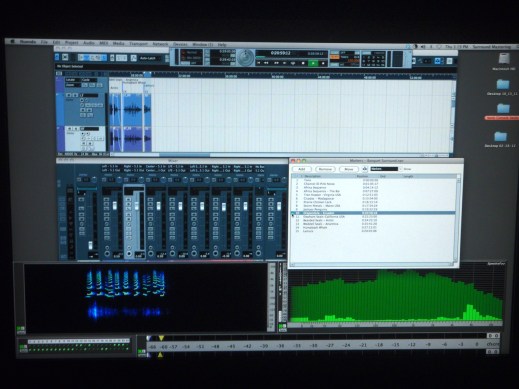
The staff at the Lab of Ornithology generously granted me a tour of their archive, showed me their gear, explained their sound visualization software, and sat me down in the surround sound listening room, where I heard some unforgettable recordings, which opened up my investigation to acoustic dimensions I had never before suspected. We sounded these dimensions in wide-ranging conversations about archiving, acoustics, field work, gear, communication, looking at sound, music, evolution, and conservation. This podcast offers, in a condensed form, some of the highlights of those conversations and experiences.
Thanks are due to the staff whose voices the podcast features: Mike Webster, Greg Budney, Bill McQuay, Liz Rowland, Alexa Hilmer, Ann Warde, Mary Winston, Tim Gallagher, Ashakur Rahaman, Katy Payne, Laura Strickland, and Karl Fitzke. Thanks are equally due staff who consented to be interviewed or otherwise helped out but whose voices didn’t make it onto the podcast: Chris Clarke, Christianne McMillan White, George Dillmann, Connie Bruce, Tammy Bishop. Thanks to Aaron Trammell for crucial editorial and technical help. Thanks finally to the Cornell Society for Humanities for the 2011-2012 research fellowship and the scholarly community that made this research possible.
Animal Transcriptions: Listening to the Lab of Ornithology – Contents and Credits
Intro
Mike Webster
Winter Wren, at normal and at one-half speed (Greg Budney, from The Diversity of Animal Sounds, Macaulay Library of Natural Sounds sampler CD)
Sound: Greg Budney and Musician Wren (Cyphorhinus arada, LNS 8897, Peter Paul Kellogg)
Archive 2:40
Mike Webster
Greg Budney
Bill McQuay
Sound: Ashakur Rahaman and Blue Whale (Balaenoptera musculus, played back at eight times normal speed, LNS 128263, Paul Thompson)
Acoustics 5:45
Liz Rowland
Bill McQuay, Greg Budney: Africa Sequence (The Bai)
Alexa Hilmer
Ann Warde
Sound: Greg Budney and Townsend’s Solitaire (Myadestes townsendi, LNS 50192, Geoffrey Keller) and Brown-backed Solitaire (Myadestis occidentals, LNS 136544, Michael Andersen)
Field 11:00
Bill McQuay
Greg Budney
Mary Winston
Tim Gallagher
Liz Rowland
Sound: Ann Warde and Beluga Whale (Delphinapterus leucas, LNS 126105, Donald Ljungblad)
Gear 14:30
Ann Warde
Ashakur Rahaman
Greg Budney: Beluga multi-array recording
Liz Rowland
Sound: Katy Payne (Humpback Whale)
Communication 20:05
Greg Budney: Madagascar lemur family group
Bill McQuay
Ann Warde
Laura Strickland
Bill McQuay: Treehopper sequence (NPR Radio Expedition)
Katy Payne
Tim Gallagher
Sound: Mike Webster and Crested Oropendola (Psarocolius decumanus, LNS 12830, Ted Parker), Common Potoo (Nyctibius griseus, LNS 59964, Paul Schwartz)
Looking at Sound 27:25
Liz Rowland
Laura Strickland
Alexa Hilmer
Ashakur Rahaman
Katy Payne
Sound: Alexa Hilmer and Humpback Whale (Megaptera novaeangliae, LNS 110847, Paul Perkins)
Music 36:05
Bill McQuay
Ann Warde
Laura Strickland
Katy Payne
Karl Fitzke
Alexa Hilmer
Sound: Laura Strickland and Wood Thrush (Hylocichla mustelina, LNS 11316, Arthur Allen; LNS 125223, Michael Andersen)
Evolution 40:10
Greg Budney (Spot-breasted Oriole duet, LNS 164045, David Ross)
Mike Webster (Black-throated Blue Warbler, LNS 27208, Randolph Little)
Katy Payne (Humpback whale group singing, LNS 118147, William Steiner)
Sound: Alexa Hilmer, Katy Payne with Common Loon (Gavia mimer, LNS 107964, Steven Pantle)
Conservation 47:05
Greg Budney: Attwater’s Prairie Chicken lek
Ashakur Rahaman
Tim Gallagher
Liz Rowland
Sound: Karl Fitzke and European Starling (Sturnus vulgaris, recording by Greg McGrath)
Recordings used with permission of Macaulay Library, Cornell Lab of Ornithology.
Starling recording used with permission of Greg McGrath.
–
Jonathan Skinner founded and edits the journal ecopoetics, which features creative-critical intersections between writing and ecology. Skinner also writes ecocriticism on contemporary poetry and poetics: he has published essays on Charles Olson, Ronald Johnson, Lorine Niedecker, Mei-mei Berssenbrugge, Bernadette Mayer, Cecilia Vicuña, translations of French poetry and garden theory, essays on bird song from the perspective of ethnopoetics, and essays on horizontal concepts such as the Third Landscape and on Documentary Poetry. Currently, he is writing a book of investigative poems on the urban landscapes of Frederick Law Olmsted, and a book on Animal Transcriptions in contemporary poetry. He teaches poetry and poetics in the Department of English and Comparative Literature at the University of Warwick.
—
REWIND! . . .If you liked this post, you may also dig:
Listening to Disaster: Our Relationship to Sound and Danger— Maile Colbert
Animal Renderings: The Library of Natural Sounds— Jonathan Skinner
Six Years in Nodar: Sound Art in a Rural Context— Rui Costa
Share this:


Current Top Posts





April 2021

January 2020

November 2019

October 2019

August 2019

April 2014

November 2017

March 2015

December 2017

October 2015
 Sounding Out!
Recent Comments