
“Take ‘Em to Chuch”: OutKast and the Sounds of the Southern Black Church
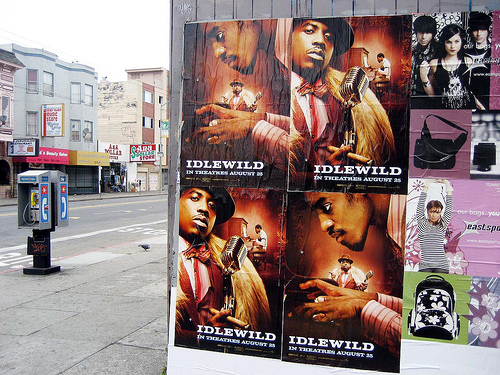
Advertising for Outkast
In 2006, I ventured into Hoosier Country. I found myself in the middle of…nowhere. And I was depressed. No, not because I decided to move to Indiana all by my lonesome on a huge leap of faith to pursue a graduate degree – I was too smooth for that – but because I found myself in a town where I couldn’t watch Outkast’s debut film Idlewild. Where they do that at? I am a Southern-bred, Southern-fed kinda girl. And Outkast was my muse. Hell, as a certified Down South Georgia Girl, all things Georgian were my muse. I planted my feet in red clay. My soundtrack was Organized Noise, the production team and heavy hitters that worked with OutKast, Goodie Mob, and a slew of other folks out of a rinky dink house basement that would later become known as the Dungeon (Family). I took pride in being from the Dungeon. And here I was, hundreds of miles away, frantically trying to find a theatre that would, if only for a brief 90 minutes, thrust me back into that familiarity of Southern life.
Of course, OutKast (comprised of members Andre Benjamin and Antwan “Big Boi” Patton) is hardly considered strictly Southern today. However, their 1994 release Southernplayalisticadillacmuzik shattered perceptions that Southern Rap was an oxymoron. In fact, OutKast’s initial sound updated tropes of southern black resistance and retaliation, fusing a lethal mastery of lyricism and flecks of a contemporary Southern culture too easily dismissed by non-Southerners. Calling upon and subverting the stereotypical traits of the Southern black voice – drawn out, slow, and heavy – OutKast sets up shop in hip hop by showcasing a rich history of Southern flair and homegrown sounds. The album made this intervention at the precise moment when hip hop became much more accessible to a mainstream white American market and the idea of being “post-Civil Rights” gained cultural traction. Combining narratives of being young, black, and frustrated with a sonic backdrop that includes an instrumental arsenal of horns, harmonicas, organs, drums, and bass, OutKast challenged and reconfigured how Southernness, Americanness, and contemporary black experience sounded at the turn of the millenium. Their initial releases seem to pick up the question of what it means to be displaced, Southern, and black after the South settled from its liberatory movements, pulling from the voices, images, and music of Southern protest like the Freedom Singers or Sweet Honey in the Rock and fusing these sounds with hip hop.

Andre Benjamin Onstage in 2003, Photo by Tulane University Public Relations
In order to discuss how they challenge and reconfigure notions of Southerness, Americanness, and contemporary black experiences, we should look at their musical nods to the black church. OutKast draws heavily on the Southern black church through sermon-esque flow, call and response, and snatches of “chuch” (lose the ‘r’) music. The black church is a staple in OutKast’s sound, reflecting what Guthrie Ramsey refers to in Race Music as community theatre, a site where “cultural, communal, and family memories associated with forms like music often become standards against which many explore and create alternative and highly personal identities for themselves” (33). The Southern black church provides such a site for communal and collective memory not only in Outkast’s music, but in African American history. Celebrated and upheld as a site of refuge from an abrasive and openly racist white supremacist environment, the black church provided a safe haven for freedom of cultural expression and social commentary unavailable in Southern white public space and discourse. OutKast challenges this older, static definition by updating its purpose to reflect the shifting social climate of the late-20th century American South. While they continue the resistance narrative tradition by bringing their marginalized experience to the forefront, they also sonically reorient mainstream views of contemporary Southern black life.
Instantly recognizable across OutKast’s recordings, their funky blend of sacred and secular musics–the blues, gospel, and hip hop–give sonic texture to something quiet-as-its-kept in black churches, how the so-called “bad” folks still come to church on Sunday, even if they were unholy on Saturday night. OutKast plays upon this unspoken understanding in songs like “Jazzybelle” from 1997’s ATLiens, “B.O.B. (Bombs Over Baghdad)” from their 2000 release Stankonia, and the straightforward “Church” from SpeakerboXXX/The Love Below (2003).
A particularly striking instance is heard on “B.O.B.,” a song which brazenly discusses issues that are often reserved for closet prayer and silent suffering. As Andre weaves a lyrical assault on the poor conditions of living in the black working class:
One-Nine-Nine-Nine, Ano Domini, anything goes, be whatchu wanna be
Long as you know consequences are given for livin – the fence is
too high to jump in jail
Too low to dig, I might just touch hell – HOT!
Get a life, now they gon’ sell
Then I might cast you a spell, look at what came in the mail
A scale and some Arm and Hammer, slow grow grid and a baby mama
Black Cadillac and a pack of pampers
Stack of question with no answers
Cure for cancer, cure for AIDS
Make a nigga wanna stay on tour for days
Get back home, things are wrong
Well not really, it was bad all along
Andre rhymes across an instrumental blend of bass and the church organ, inundating his listener’s ear with agency and anger. The church organ is as angry and explosive as his flow, with riffs and keys banged out loudly, quite different from the soft accompaniment often heard in a church setting. By heavily utilizing the organ and church choir at the end of the track, chanting “Bible music electric revival” OutKast subverts and updates the celebrated Black Church Revival, a gathering of church folk and the lost, swinging church music to give a voice to the marginalized black working class. The hybrid, urban sound of “B.O.B.” provides a space for the reclamation of a disenfranchised southern African American narrative that blends the suffering trope mandating much of African American religion with current trends in cultural expression reflected in Hip Hop. In Idlewild (which I FINALLY saw a year later, by the way), Andre and Big Boi visually annotate their secularized black church by creating an imagined community in rural Georgia that revolved around the jukejoint Church. OutKast’s audio-visual syncretism paved the way for later acts like Pastor Troy, who secularizes tropes of black masculinity and leadership in the black church, likening them to the struggles of being at war with those who don’t understand the struggles of a young black south.
The black church provides OutKast with a blueprint for reconciling displacement and authenticity by creating a sound that maneuvered a Post-Civil Rights landscape of shifting markers of social-economic identities and race. By connecting the historical context of the Southern black church with Hip Hop, OutKast’s sound reflects not only the historical residue of a pre-Civil Rights Movement South but also the constant search for a space of expression in an era where a stagnant or nonexistent “modern South” is a popularly comfortable disbelief. Perhaps this is why I was so desperate to find a theatre showing Idlewild; I found myself a geographically displaced Southern black youth searching to situate and sustain a new layer of my own post-Civil Rights narrative.


Share this:

Listening to Modern Family’s Accent
**This piece is co-authored by Juan Sebastian Ferrada and Dolores Inés Casillas

The Cast of ABC
Since debuting in 2009, American audiences have fallen in love with ABC’s Modern Family, a mockumentary comedy starring Ed O’Neill, Julie Bowen, and Colombian actress Sofía Vergara who plays the curvaceous, gorgeous, and ”accented” Gloria. Clearly a satirical comedy, the show presents three interrelated modern day versions of nuclear families. The patriarch Jay (O’Neill, formerly of Married With Children) marries Gloria, a much younger Latina who has an eleven-year-old son from her previous marriage (the wise-beyond-his-years Manny, played by Rico Rodriguez). The heterosexual suburban nuclear family is represented through Claire (Jay’s daughter, played by Bowen) and Phil (Ty Burrell) who have three children. The homosexual nuclear family is fashioned through the characters of Mitchell (Jay’s son, Jesse Tyler Ferguson), his partner Cameron (Eric Stonestreet) and their adoptive daughter, Lily, from Vietnam. The show follows the tried-and-true conventions of family sitcoms, complete with exaggerated portrayals of their characters and a feel good message delivered in 22 minutes. Our current fascination is Gloria—arguably the most popular character on the show (see her lucrative Pepsi deal here)—and the use of her “accent” to mark her Latina body. Visually audiences may be ogling over her curves, but it is her vocal body – her “accent,” tone, and staged grammatical blunders – that work to racialize her character as much as sexualize it.
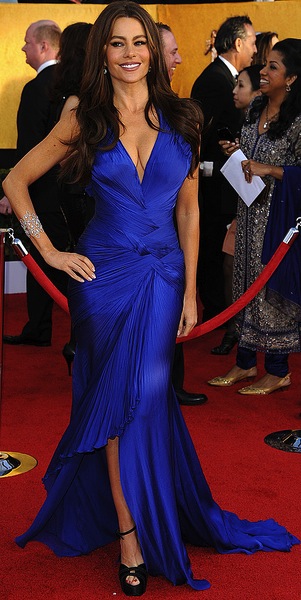
Vergara at the 2011 SAG Awards
Vergara’s character Gloria hails from the same township of Barranquilla, Colombia as the actress herself. Despite her emerging star status in the U.S., Vergara is no stranger to Spanish-language television viewers. (Wilson Valentín-Escobar refers to such English-language media discoveries as “Columbus effects”). Vergara rose to fame through the immensely popular telenovela format and in recent years has gained popularity through various comedic roles type cast as the “sexy Latina.” Visually, the spitfire Latina is characterized by her red-painted lips, seductive clothing, curvaceous hips, long brunette hair, extravagant jewelry, and an inherent ability to dance. (See Priscilla Peña Ovalle’s fabulous SO! blog piece on Latinas, dance, and the “aural Otherness” of Rita Moreno). Vergara, in her personification of Gloria, embodies many of these attributes quite well. For instance, a natural blond, Vergara was forced to color her hair in order for American viewers to imagine her as an “appropriate” brown Latina.
In an equivalent vocal vein, Vergara showcases the required Spanish “accent.” Case in point, from the pilot episode:
Phil: Hi Gloria. How are you? Oh, what a beautiful dress.
Gloria: Ay, thank you Phil [Ph-eee-l].
Phil: Okay. [Proceeds to touch Gloria]
Claire: [Slaps Phil’s hand] No, honey. That’s how she says Phil. Not feel, Phil!
The communication mishap serves as the underlying funny because of Gloria’s accent and at the expense of Gloria’s body; her voice and her body are both subjected to gratuitous scrutiny. Phil, once again in episode 5 of season 1, does understand Gloria’s “accent” but seems to confuse the context. He greets Gloria upon arriving to his house to watch a football game:
Phil: Hey, for you! [Gives Gloria a bottle of wine] Nice to see you, Gloria. [Hugs Gloria]
Gloria: Two times today.
Phil: Okay. [Proceeds to hug her again]
Claire: Phil! She means we’ve seen them two times today.
In this case Phil is confused by Gloria’s inflection and repeatedly mistakes Gloria’s unintentional statements as personal invitations to her body. These acts sexualize and racialize Gloria as a desired “other” because of her apparent “accent.” Once again, repeated in this scene, Claire (Phil’s wife) is required to intervene or harness her husband’s sexual prowess by announcing what Gloria means, stripping Gloria of her voice to defend herself.

Vergara and Co-Star O
Perhaps most frustrating and audibly apparent feature of Gloria lies in her incessant grammatical errors scripted within her English-language lines. Yes, scripted. Vergara certainly has an audible “accent,” especially to Americans not accustomed to Latino-speak (although there are 35 million Latinos in the U.S.) or to those in denial that we all carry some sort of accent influenced by our social locations – class, race, and in this case, migration. But to Vergara’s own admission, she is bilingual and biliterate, which means the grammatical blunders that serve as punch lines or as a means of laughing at her, are largely owed to the script itself. Gloria’s grammar, like her “brown” hair, is an important false feature that helps make her a true Latina immigrant character.
Listeners have always struggled to make sense of one’s accent and speech style especially if the speaker’s body does not match stereotypical perceptions based on race and gender. A key study showed, for instance, that when participants were shown a recorded lecture by an Asian American woman voiced over with a white woman’s voice, they overwhelmingly insisted that the Asian American woman spoke with an Asian accent. A classic case of what sociolinguists refer to as “accent hallucination.” Listeners truly have a hard time believing what they hear or believe they hear.
In the case of comedian Margaret Cho, audiences laugh their heads off with her signature act – vocal reenactments of her immigrant Korean mother. Elaine Chun offers a brilliant analysis of Margaret Cho’s revoicings of her immigrant Korean mother (Chun refers to this as “Asian speech”). According to Chun, Cho’s comedic routines are not only incredibly funny but they offer a critique of racist mainstream ideologies precisely because Margaret Cho is read as an Asian American.
Which makes us wonder, how is Sofia Vergara read within a U.S. context and to non-Latino audiences? Ideally, folks would see her as a U.S. Latina role playing a recently arrived immigrant and offer viewers a critique of accented Latina spitfire. But alas, Vergara’s vocal performance of an immigrant Latina wrought with grammatical errors only helps her character Gloria become the quintessential racialized Other (or a true U.S. Latina).


Share this:


Current Top Posts





April 2021

January 2020

November 2019

October 2019

August 2019

April 2014

November 2017

March 2015

December 2017

October 2015
 Sounding Out!
Recent Comments