
The Sounds of Anti-Anti-Essentialism: Listening to Black Consciousness in the Classroom

Image by Flickr User Pere Ubu
 In teaching the many interrelated and complicated aspects of the Civil Rights movement, Black Power, and the Black Arts Movement, the challenge for me is to help students understand the “facts” of this period, and to simultaneously destabilize the teleological historical narrative these “facts” seem to suggest. In a pedagogical context, sound helps fill in the gaps that fall outside of the knowledge produced–and contained within–certain archival accounts of black cultural and political history. While crucial, having students listen to the gaps, can be daunting, especially in our current historical moment, as the decades-long push against identity politics has been solidified by the recent (re)election of the nation’s first black president, Barack Obama. This point demands more elaboration than I can provide here, but the critical pedagogical issue it raises within the province of black studies, is that it is becoming increasingly difficult to consider black political culture outside of the sedimented lines of American pluralism and black radical thought.
I use sound as a pedagogical tool to help outline a middle ground–what Frantz Fanon refers to in The Wretched of the Earth as “zone of hidden fluctuation” (166)–based upon articulations of resistance and identity that refuse to be frozen in time. Building on Paul Gilroy’s conceptualization of anti-anti-essentialism in The Black Atlantic, an idea of black consciousness that is flexible and moves between the insufficient terms of “essentialist” and “anti-essentialist,” I use specific pedagogical examples to suggest that teaching about race and sound is a rich, evolving, and productively interactive continuum. The auditory sense opens up new terrains of knowledge and dynamically expands the possibilities for students to think through the intricate and multifaceted formations of black consciousness during the volatile years of the 1960s and the resonance of those years in our present.
The recorded presence of Martin Luther King, Jr., for example, represents an important aural site for engaging in reflexive pedagogy, because King’s tonality–the resonance of his voice–creates a certain familiarity and is pivotal to the construction of the American myth of the radical transformation of the civil rights movement and the idea of post-civil rights racial equality. For many students, King’s sound signals the dream of, and the pathway towards, a unified America. Conscious of how this idea of King reflects a linear understanding of civil rights as simply a desire for inclusion, I direct students’ attention to the sound of King’s last recorded speech in Memphis on April 3, 1968. Given the evening before his assassination, this speech resounds with King’s deepening critical perspective on black struggle through its haunting concluding notes. I point out to my classes that King’s final years (1965-1968) were marked by his increasing focus on ideas of black resistance outside of the Civil Rights mainstream, including his critique of U.S. involvement in the Vietnam War, and his radical rethinking of the possibilities for black economic and political self-determination.

Martin Luther King in 1968, Image courtesy of UIC Digital Collections
Centered on the economic injustice and dehumanization of Memphis’s striking black sanitation workers, King’s speech details the need for the Memphis black community do more than simply boycott municipal entities, but rather articulate their resistance by boycotting prominent national brands such as Wonder Bread and Coca-Cola. Against this background, I play segments (particularly the final minutes) of King’s speech, entitled, “I’ve Been to the Mountaintop.”
The acoustic dimensions of King’s final speech resonate with a social and political complexity that troubles the sonic memories many students have of King’s “I Have a Dream” speech, delivered on the steps of the Lincoln Memorial in 1963. The much more intimate and less overtly majestic soundscape of Memphis’ Mason Temple underlines King’s shift from national icon back to local, community activist. The frequent audience shifts–applause, extemporaneous interjections, and silence–create a reverberating sonic energy that accumulates throughout the speech. Rather than relying strictly on a call-and-response interpretation of the interactive exchanges between King’s voice and the audience’s response, I have students consider the non-linear ebbs and flows in King’s sound in this latest of moments (as Fred Moten would say, the totality of King’s tonality). For example, as King’s audience considers the weight of his analyses and what it means to articulate black resistance as “a dangerous unselfishness” that “puts pressure where it really hurts,” I identify moments of uncertainty, hesitation, and contemplative reflection that mark a non-linear interactive sonority between King and his audience.
Listening to King’s final thoughts offers a disturbing and disruptive emphasis on the stakes of breaking with entrenched modes of activist thinking. He concludes the speech with a series of prophetic thoughts on mortality as a cost of making a stand against “our sick white brothers.” Set within the historical and ideological context I have sketched above, the delivery distinguishes the sound of King’s words. As we listen I draw attention to King’s expression of a lack of fear in anything, any man, as King seems to convey an eerie foreknowledge of his murder and his irreverence in its face.
“I’ve Been to the Mountaintop” –Listen to the concluding two minutes
The apocalyptic sound of King’s concluding notes to this political sermon leaves much to contemplate. From the mention of the potential threat posed to his life by “our sick white brothers,” through the speech’s last line, there is a tonal, timbral shift in his voice and demeanor. Through sound and posture, and the reaction of the audience to those factors, King’s affect seems to convey something more momentous occurring beneath the event’s surface dynamics. King projects a confrontational edge through the sound of fearlessness in the face of mortality. Did he know he was going to be killed shortly after giving this speech? It’s a question that the peculiar tonality of his concluding lines raises for students. If so, what does it mean to use the sermon as a site of prophetic, aural documentation of the fact that a force of transformation exists beyond the flesh and blood of leadership, a force that assassination can’t kill? In the speech’s final synesthetic moment, I have the students listen and watch the shift that occurs in King’s demeanor as he closes, and the way that this shift culminates in an almost ecstatic moment as he delivers the final line: “Mine eyes have seen the glory of the coming of the Lord.” His defiant turning away from the microphone is crucial as it amplifies the meaning of the voice, letting those watching know that, much like an emcee, King has just “served” white power with a delivery that will outlast the sniper’s bullet the following evening.

Nina Simone, Image courtesy of Flickr User GlingG
I want to briefly point to two other examples that show additional ways in which sound complicates ideas of racial identity and expression during the 1960s. When I teach Nina Simone’s composition, “Mississippi Goddamn,” (recorded live at Carnegie Hall in 1964), I ask students to consider the relationship between the distinctive sound of her voice and the ironic and critical elements of her lyrical meaning as this interaction creates a complex idea of radical black consciousness. Composed in the aftermath of the murder of Medgar Evers and the bombing of the 16th Street Baptist Church in Birmingham, Alabama, Simone offers a musical, and more broadly sonic meditation on white supremacy.
Most students find the timbre of Simone’s voice, its grain (as Roland Barthes would say) and depth, immediately striking. Her unique sonority and its context, greatly influence attempts by students to understand her reference to the song as simply a tune: “The name of this tune is Mississippi Goddamn” she says, and “This is a show tune, but the show for it hasn’t been written yet.” Clearly it isn’t simply a tune, and the caustic quality of lines such as, “Oh but this country is full of lies/ You’re all gonna die and die like flies,” creates a critical depth through the sound of Simone’s commitment to a black radical perspective. What does it mean, for instance, that Simone projects such sarcasm and biting critique to a predominately white audience at Carnegie Hall? How might we hear the specific grain of her voice in this setting? How does Simone’s projection of critical black sonic resistance, emerge at the conjuncture of anti-black racism and the beginning of legislative efforts under the Johnson administration to rectify racial inequality through civil rights bills? What can be taken from the simultaneity and contrast that Simone projects her sound within? I pose such questions to my students as a way of considering what it means to be committed to critical thought and social transformation that falls outside of the dominant lines of American national consciousness, and how the sound of such commitment, heard in the pitch and tenor of Simone’s voice, matters as a different kind of historical documentation.
In considering how the sound of music can offer an intervention within the formation of black political consciousness in the Black Arts Movement, I often use the 1966 recording of Amiri Baraka’s signal poem, “Black Art,” as it set to the experimental musical sounds of Sonny Murray’s ensemble (Murray-drums, Albert Ayler-tenor saxophone, Don Cherry-trumpet, Henry Grimes, Lewis Worrell-bass). Having first read the poem, students then are able to hear it set to– and against–the unconventional instrumentation of Murray’s ensemble.
The musicians create an unconventional sonic context for Baraka’s reading that de-emphasizes and re-situates the apparent dimensions of black rage that seem to arise from verse that can “shoot guns,” through an almost carnivalesque, comedic, and off-kilter sound that troubles the linear expectations one might have of instrumentation amplifying the words on the page. The dissonance between page and sound allows for useful pedagogical opening, in that it underlines the non-conformist, avant-garde aspects of the movement, and the fine line that artists such as Baraka were imagining between the intensity of black radical consciousness and the ability to articulate that standpoint outside of the expected forms of black cultural nationalism.

Image Courtesy of UIC Digital Collections
As these examples have shown, I incorporate sound into my pedagogical framings of black cultural and political identity as an opening through which students may expand their understandings of black consciousness and black political culture well beyond stagnant ideas of racial authenticity, while still preserving an understanding of the transformative and often radical possibilities that have been projected through black expression during the period. It is the open space of sound that invests the project of black radical thought with the uncanny spontaneity of experimentation. Having students understand ideas of expansiveness, asymmetry, and non-linearity as central to black cultural expression and critique–even as artists refuse to sacrifice an expressed political commitment to black resistance–begins to suggest ways for students to contemplate the intersection of identity politics with the unexpected, fantastic elements of expression that lie outside of more recent flattened diagnoses of black nationalism. Teaching at the intersections of race and sound opens up new terrains of knowledge, dynamically expanding students’ abilities to think through the intricate and multifaceted formations of black consciousness during the volatile years of the 1960s and the resonance of those years in our present.
—
Carter Mathes is an assistant professor of English at Rutgers University. He has completed a book manuscript entitled, Imagine the Sound: Experimental Form in Post-Civil Rights African American Literature, that focuses on the relationship between sound and literary innovation during the 1960s and 1970s. He is co-editing a volume of essays on Black Arts Movement writer and critic Larry Neal; and also has essays in print or forthcoming on Toni Cade Bambara, Peter Tosh, and James Baldwin. At Rutgers, he regularly teaches classes focusing on African American literature, Twentieth-century literature, music and literature, and experimental writing.
—
 REWIND! . . .If you liked this post, you may also dig:
Audio Culture Studies: Scaffolding a Sequence of Assignments–Jentery Sayers
They Do Not All Sound Alike: Sampling Kathleen Cleaver, Assata Shakur, and Angela Davis–Tara Betts
Freedom Back: Sounding Black Feminist History, Courtesy the Artists–Tavia Nyong’o
Share this:

Love and Hip Hop: (Re)Gendering The Debate Over Hip Hop Studies
Today’s post from Cornell professor Travis Gosa (Africana Studies) marks the return of our “Sound and Pedagogy” Forum for a spring semester refresher course. It’s a hard time of the school year–fatigue can creep up in exponential relation to the sudden increase in sunshine. We at SO! want to put some spring back into your classroom with Gosa’s discussion of the relationship between hip hop and the university classroom–to sample De La Soul, stakes is high–followed up next week with Emmanuelle Sonntag and Bronwen Low‘s (McGill) exploration of hip hop pedagogies in the urban classroom in their joint post on “The Student as Broadcaster and DJ of Her Listening,” and rounded out with a hands-on self-assessment of how sound media can be a productive classroom tool in teaching black political history by Carter Mathes (Rutgers). Grab a new notebook, sharpen some pencils, and enjoy some (funky) fresh perspectives this spring. And now, I pass the mic to Dr. Travis Gosa–Editor-in-Chief Jennifer Stoever-Ackerman
—
The three-year appointment of DJ Afrika Bambaataa at Cornell University has caused me to think about the sexual politics of sound created by the artist-centered hip hop studies movement. College students have been reading hip hop textbooks since the early 1990s, and Arizona University students can now earn a minor in hip hop studies. However, the recent professorial appointments of artists like Bambaataa, Bun-B of UGK (Rice University), M1 of dead prez (Haverford College), Wyclef Jean (Brown University), and 9th Wonder (Harvard University) is shaping how hip hop is heard.
The embodied collision of instrumentation, lyricism, and experience in the artist-centered classroom can create spaces for empowerment and emancipatory learning. There is also a risk, however, that the artist-professors trend will reproduce the same sexist logic about hip hop and women that recirculates in mass-mediated rap music.
Since Common’s 1994 song “I Used to Love H.E.R,” the bodies of women of color have served as the sonic battlefield for wars over the authentic boundaries of hip hop culture. On the track, Common falls out of love with H.E.R (“hip hop”) when White corporations and West-Coast emcees gangbang his once virgin, “untampered” girl, and turn her into a promiscuous, weed-smoking “gangsta bitch.”
.
Compared to Lil’ Wayne’s lyrics about “beating the pussy up like Emmett Till,” or Rick Ross’ molly-infused date rap anthem, Common’s nostalgic back-in-the-day rhymes are tame. The love affair is sonically wrapped in the thick intertexuality of George Benson’s mellow jazz guitar of “The Changing World,” timeless emcee clichés like “yes yes ya’ll,” and classic quotables like Easy-E’s “Easily I approach…” (minus the punchline about having sex with your momma).
Rap legends Scarface and Nas use the H.E.R. trope to frame the appropriation of hip hop by colleges. On the DJ Khaled assisted track “Hip Hop,” they describe hip hop as a “middle-aged cougar,” and threaten to murder the “bitch” for being a gold digging “whore.”
.
According to Scarface, he has fallen out of love with Ms. Hip Hop because she is sleeping around with everyone, including college professors:
Now you all in the lectures
Being studied by the college’s professors
Now I regret the day I met ya, Bitch
I’ll be the first one to say it
She ain’t the one you want to play with
I fucked Hip Hop
When the imaginary borders of hip hop are expanded or violated by academia, Scarface defends hip hop by slut shaming Black women. The hegemonic masculine frame perpetuates the virgin/whore dichotomy of womanhood, justifies violence against women, and evaluates women (“hip hop”) according to their ability to fulfill the needs of men. DJ Khaled’s production reinforces the message by sampling Mott The Hoople’s “She Does It.” The 1975 British glam rock song is a little ditty about cocaine and/or rough sex with groupies.
Too often, loving hip hop involves remaining uncritical about sexualized violence and the silencing of women in the culture. “Sentimental attachment” to music, as Barry Shank described at the 2013 IASPM conference, is not the same as “interrogative listening,” the recognition that musical pleasure can involve dominance and oppression. Interrogative listening begins by acknowledging that being a member of a musical community comes with responsibility.
Hip hop studies professors face the monumental task of reeducating students in the art of interrogative listening. As scholar Tricia Rose noted in her keynote address at the opening of the Cornell Hip Hop Collection in 2008, the commercial rap industry has trained young people to nod to the beat while passively accepting misogyny and oppression. Rose writes in her book The Hip Hop Wars that pointing to real life “tricks” and “hoes” is often a strategy used to absolve male hip hop artists of their culpability in profiting from rape culture.
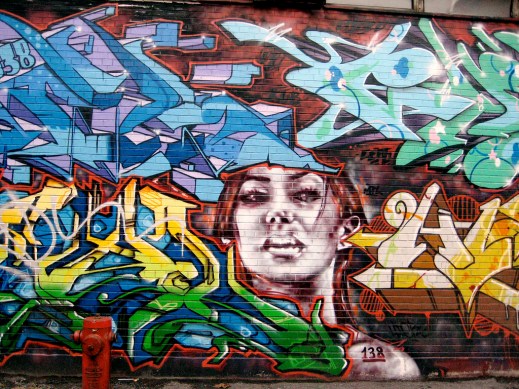
I have been impressed by the ability of pre-rap, 1970s hip hop artists to demonstrate a love for the culture without reproducing the woman-hating narrative found in rap music. The South Bronx DJs (i.e., BreakBeat Lou), graffiti artists (i.e., Carlos “Mare 139” Rodriguez), photographers (i.e., Joe Conzo, Jr.), and break-dancers (i.e., Richard “Crazy Legs” Colon and Jorge “Popmaster Fabel” Pabon) who make guest appearances in my courses explicitly disassociate themselves from the logic of commercial rap industry. Not surprisingly, it has been most intriguing to listen to the sexual politics created by the Afro-futuristic DJ Bambaataa.
Bambaataa is known for transforming the notorious Black Spades gang into the fledgling 1970s South Bronx hip hop scene. His Universal Zulu Nation has forcibly removed drug dealers from neighborhoods, rallied around political prisoners, and just last month, warned WorldStarHipHop.com to stop pandering violent and sexual images to youth.

Image by Pete Best, Courtesy of Cornell News
Less obvious is Bambaataa’s political work through sound performance. His signature soulsonic soundspace mocks the boundaries of music genre and the specificities of race, social class, and place, in favor of the universal. For example, when asked to explain early hip hop to my undergraduate class last fall, he sat back and played Ray Steven’s 1969 hit “Gitarzan” and The Music Man’s “Ya Got Trouble.” Hilarity and cognitive dissonance ensued, as the country-rock and Broadway tunes shattered the commonsense of hip hop as “rap music,” “black,” “youth,” or “urban.”
His universalism is not meant to obscure the contributions of women with a generic masculine narrative. Bambaataa has spent the first year of his appointment mapping out the centrality of women’s role in creating hip hop culture. Like Kyra Gaunt in Games Black Girls Play: Learning The Ropes from Double-Dutch to Hip Hop, Bambaataa traced rap and dance to double-dutch, hand-clipping, and rhythm games played by Black girls. To demonstrate how women pioneered rapping, he played Shirley Ellis’ The Name Game and The Clapping Song. During his first official sound lecture, a DJ set at an Ithaca nightclub, the music of Aretha Franklin and Miriam Makeba were interwoven into the more recognizable hip hop staples like James Brown.
Observing Bambaataa’s musical performances at Cornell gives me hope that sound and listening can be used to disrupt dominant modes of gender politics in the hip hop classroom. However, the ability of Black male artists to articulate the contributions of women is in no way a replacement for creating spaces which are actually inhabited by those who are not Black, male, or heterosexual. There is nothing universal about male bodies, thoughts, or voices. Unfortunately, this new trend of artists in the classroom is being constructed almost exclusively around Black/Brown, heterosexual men.
To date, no “b-girls,” “femcees,” or “flygirls” have been appointed to high profile positions in the academy. I struggle with this at my home institution, as Cornell’s “Born in the Bronx” archival project risks perpetuating the myth of a woman-less birth. This gender-limited vision of hip hop’s roots has been compounded by the silencing of legendary battle emcee Roxanne Shanté, whose relationship with Cornell ended after a witch-hunt surrounding her academic credentials back in 2009. MC Sha-Rock, an early female emcee, will end the four-year estrogen drought when she participates in Cornell’s 2013 Unbound From the Underground hip hop celebration on April 4-7, 2013.
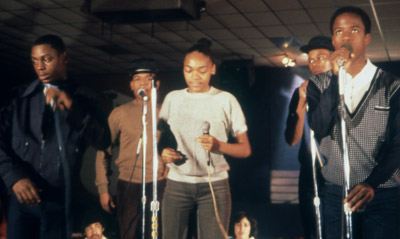
MC Sha-Rock in 1982’s Wild Style, Charlie Ahearn/Cornell Hip Hop Collection
Our efforts to connect academic hip hop studies to its cultural practitioners must honor women and empower female agency. The critical praxis has already been constructed by Black feminist scholars, such as Tricia Rose, Joan Morgan, Patricia Hill-Collins, Gwen Pough, Kyra Gaunt, Ruth Nichole Brown, and countless others. Hip hop feminism or “Crunk feminism” dictates that academic spaces support emancipatory gender politics, which starts with teaching and celebrating a truthful history focused on the agency of women of color. It does not involve participating in Black male violence under the guise of loving hip hop.
Every university that claims to teach or “preserve” hip hop should appoint female/feminist/queer artists. No doubt, fierce emcees like Yo-Yo, MC Lyte, Missy Elliott, and Lauryn Hill should be on the short list at many colleges. Still, we have to be wary of gender tokenism; the end-game should not be finding a honorary female artist to provide “a woman’s point of view.” Rather, the goal should be to create opportunities for women to narrate history, redefine the spaces occupied by hip hop, and to rearticulate the logic of critical listening.
Regendering hip hop studies will require a paradigm shift and a new soundtrack about love. Perhaps we can begin the work by replacing the H.E.R. tracks with Akua Naru’s “The World is Listening.” It is a dope, feminist homage to women’s journey through hip hop history, without all the slut shaming.
—
Featured Image by Flickr User LizSpikol
—
Travis L. Gosa is an Assistant Professor at Cornell University’s Africana Studies & Research Center. He teaches courses on hip hop culture, African American families, and education. He is an advisory board member of Cornell’s Hip Hop Collection, the largest archive on early hip hop culture in the United States. He can be reached at tlg72@cornell.edu and on Twitter @basedprof.
—
REWIND! . . .If you liked this post, you may also dig:
“‘I’m on my New York s**t’: Jean Grae’s Sonic Claims on the City”––Liana Silva
“Ill Communication: Hip Hop Studies & Sound Studies @ Show And Prove”— J. Stoever-Ackerman
“The Victoria’s Secret Fashion Show and the Soundtrack of Desire“— Marcia Dawkins
Share this:


Current Top Posts





April 2021

January 2020

November 2019

October 2019

August 2019

April 2014

November 2017

March 2015

December 2017

October 2015
 Sounding Out!
Recent Comments