
When I Think of Home*
*title comes from a line in the song “Home” from the film The Wiz
This month I want to share with Sounding Out’s readers part of an essay that is very dear to me: an essay on home and African American urban identity in hip hop. In my longer essay I look closely at several hip hop songs and discuss the representations of urban space present in them. It is very dear to me because it is my first venture into what would eventually become my dissertation topic (dissertation in the works). As I am revising the essay for publication, I am eager to hear from our readers what they think about this excerpt and suggestions for expansion.
***

Home: it is a small word, but it opens up such a big world full of meanings. When people ask me, “where’s home for you?” I cannot help but feel confused. What home do they mean? Do they mean my home town in Puerto Rico, where my parents live? Do they mean Kansas City, where I live now, where I move around and do my grocery shopping? Or do they mean New York City, which started out as home? For me, home can be a household, a town, a family, a community; this would explain the confusion on my face when they ask me that question.
One example of the different meanings that home can have is seen in Dave Chappelle’s Block Party. The film takes the viewer to Bedford-Stuyvesant, a neighborhood in Brooklyn NY, where the comedian congregates friends, neighbors, and fans for a day of hip-hop music, food, and comedic skits. Interestingly enough, Dave Chappelle is not from Brooklyn, but from Washington DC—unlike Mos Def and Talib Kweli, both born and raised in Brooklyn, who pepper their performances with shout-outs to the borough. Dave and director Michel Gondry (according to the DVD extra for the film, titled “September in Brooklyn: The Making of Block Party“) chose Bed-Stuy for the block party because of the borough’s legacy as the birthplace of hip-hop. Their hip-hop coordinates are slightly off, since hip-hop’s roots are found in the South Bronx—even though many of hip-hop’s stars have come from Brooklyn.
However, a young man from Ohio’s Central State University’s marching band sheds some light on the question of location: “It’s wonderful, it’s great, being out here in New York for my first time. I feel kind of like I’m at home. Seeing all these people out here with locks, it’s comfortable. It’s nice though.” The young man from Ohio has never set foot in New York City before, but he claims to feel a sense of comfort from being surrounded by people who look like him. This can be read as just another iteration of the perceived sense of freedom and openness associated with urban locations, but it could also be read as a comment on the racial/ethnic composition of the city and his sense of comfort because of this. Dave Chappelle mentions earlier in the film, “5000 black people chillin’ in the rain, 19 white people peppered in the crowd…hard to find a Mexican.” New York–and Brooklyn in particular–represent a kind of home for the band member because of the historic presence of blacks in the city and its hip-hop legacy. However, the urban African American experience, at least as it is seen in the documentary, seems to equate an experience that African Americans across the country can relate to.
Of course, there is no such thing as a single contemporary African American experience; there are as varied experiences as there are towns, as there are shades of brown. However, both the marginality and community that African Americans in urban locations have historically felt resonates with many across the United States, no matter if they live in the South or the Midwest or the Northeast. Urban places have proven to be a key source of inspiration for African American musical artists, like Stevie Wonder (“Living for the City”) and Marvin Gaye (“Inner City Blues [Make Me Wanna Holler]”). But it has gained more visibility in hip-hop music, from songs like “Heart of the City” by Jay-Z to “L.A.” by Murs. Different representations of urban space abound in black cultural production, but the one that stands out for me is that of the city as home.
Even though some hip-hop artists depict the city as a center of crime and danger, there are others who talk about it as home and describe it as a locus for community, for cultural memory, and for emotional nourishment. The hip-hop artists I look at in my longer piece (Kanye West, Common, Lauryn Hill, and Mos Def) do not locate this home in a household but rather in urban locales. The representation of cities as locations for home is a way to reclaim urban space, and this act of claiming is crucial for the development of a contemporary African American urban identity. In this excerpt, I present Mos Def as an example of that reclaiming.
Mos Def’s “Habitat” was issued on his album Black on Both Sides (1999). Mos, like Common and Kanye West, uses the city as inspiration for many of his songs. (Examples of this are Common’s “Southside” and West’s aptly titled “Homecoming.”) In fact, on Black on Both Sides he not only has “Habitat” but also “Brooklyn,” in which he pays homage to his borough and to the day-to-day occurrences on the street. “Brooklyn” starts out with a few lines taken from the song “Under the Bridge” by The Red Hot Chili Peppers, but in reference to his neighborhood. The sentiments conveyed in those first few lines resonate with the theme of “Habitat”: “Sometimes I feel like I don’t have a partner, sometimes I feel like my only friend, is the city I live in, it’s beautiful Brooklyn.” This emphasizes a cross-genre trend of calling out one’s hometown (city).
“Habitat” starts with the chorus stating, “We’ve all got to have a place where we come from, this place that we come from is called home.” (I should point out that before the chorus comes in, we can hear Mos Def singing the line, “When I think of home, I think of a place,” which comes from the song “Home,” cited earlier in this post. The musical was an adaption of L.Frank Baum’s The Wonderful Wizard of Oz with an all-black cast. The film version of The Wiz was set in New York City.) Over the chorus we can hear Mos Def defining the word “home,” very much like you would find in a dictionary, although with a twist:
Home: a place where someone lives; a residence; the physical structure within which one lives, such as a house; a dwelling place with the social unit that occupies it; a household; an environment offering security and happiness; a valued place; a native habitat; a place where something is discovered, founded, developed, or promoted; a source; a headquarters; a home-base; of or relating to a team’s place of origin; on or into the point at which something is directed to the center of the heart.
After the definition, the speaker talks about their childhood in the city: sometimes nice, sometimes dangerous, sometimes sad. In juxtaposition to this is the fact that one of the motifs of the song is the motif of travel. Images of travel and mention of different cities pepper the bridge of the song; the protagonist seems to connect its neighborhood with other cities. The speaker talks from another location, he/she is not right now at home. However, the speaker repeats throughout the song, as if to insist, “it ain’t where you from, it’s where you at.”
By starting the song with a definition, the speaker seeks to identify what home is for him/her. Habitat, which connotes dwelling instead of a homespace, is put in juxtaposition with home. The song sets place against space, and the speaker correctly tries to take home outside of its stable, fixed location. Even though the subject begins by privileging place in the definition, he/she points out the emotional ties that people may have with the house—ultimately these ties are what make a house a home, like the saying goes. By displacing those ties form the household to urban space, the speaker is moving from place to space. The definition resonates with the OED entry for “home”: The Oxford English Dictionary (online) states that home is a physical residence, a place where someone lives, as well as the region from which one comes. However it also asserts that home is a “place of one’s…nurturing, with the conditions, circumstances, and feelings which naturally and properly attach to it, and are associated with it…a place, region, or state to which one properly belongs, in which one’s affections centre, or where one finds refuge, rest or satisfaction.” Here, the home embodies community, nurturing, and the cultural memory of the street.
Another reason why the subject of the song privileges place in this definition is because the rest of his song presents the listener the mean streets of the home: “I came up in the streets ‘round some real wild brothers…Got more than one enemy and more than one gun.” The violence and crime we see in the first section of the song constructs the city as a dangerous place. Later on the speaker claims them when he says, “Regardless where home is, son, home is mine.” The fact that the protagonist of the song knows his/her way around this dangerous place points to his/her dominance of this urban space, a dominance that holds cultural significance for the African American urban community.
Even though the environment the subject presents here is not a healthy or secure one, there is a sense of attachment to it because of having grown up there. In the next verse the protagonist goes over childhood memories: “When I think of home, my remembrance of my beginning, Laundromat helping ma fold the bed linen, chillin’ in front of my building with my brother.” The personal development on the streets is juxtaposed with the development within the actual household, but neither one nor the other is given predominance. The circumstances the speaker has faced and the racial politics witnessed at work in this neighborhood (“funeral homes packed with only dark bodies”) have influenced his/her outlook on life. Murray Forman, in The Hood Comes First: Race, Space, and Place in Rap and Hip-Hop argues, “members of the hip-hop culture articulate notions of subjective and collective identities, urban experience, racial consciousness, and spatially structured patterns of power” (xviii). Home is not only an empty location that one inhabits; rather, where one lives is the intersection of so many other spaces and identities, but from this location the speaker has learned how to navigate the urban space.
The protagonist of “Habitat” does not romanticize the pain and struggle taking place on the streets of Bushwick, like other hip-hop artists do. Regarding the ghetto Michael Eric Dyson argues in an interview with Meta Du Ewa Jones, “A lot of people in the ghetto are trying to get the hell up out of there. They don’t want to romanticize it. So it’s not the ghetto that’s being romanticized—its physical geography—so much as the intellectual attachment and intimacy that it breeds, a bond established with those who are fellow sufferers and fellow strugglers who long for an exit from its horrible limits” (Callaloo 29.3, 2006; 794). The speaker shows the social relationships that intersect on the city streets, and the connections that arise from those interactions. Those connections become significant, for when the protagonist travels around the world, they keep him/her grounded as seen in the last verses of the song: “we’ve traveled this big earth as we roam….it ain’t where you from, it’s were you at, it’s where you hang your hat.” No matter where the speaker may be located, home can be retrieved for comfort and solace (embodied in the phrase “it’s where you hang your hat.”)
, via Wikimedia Commons”]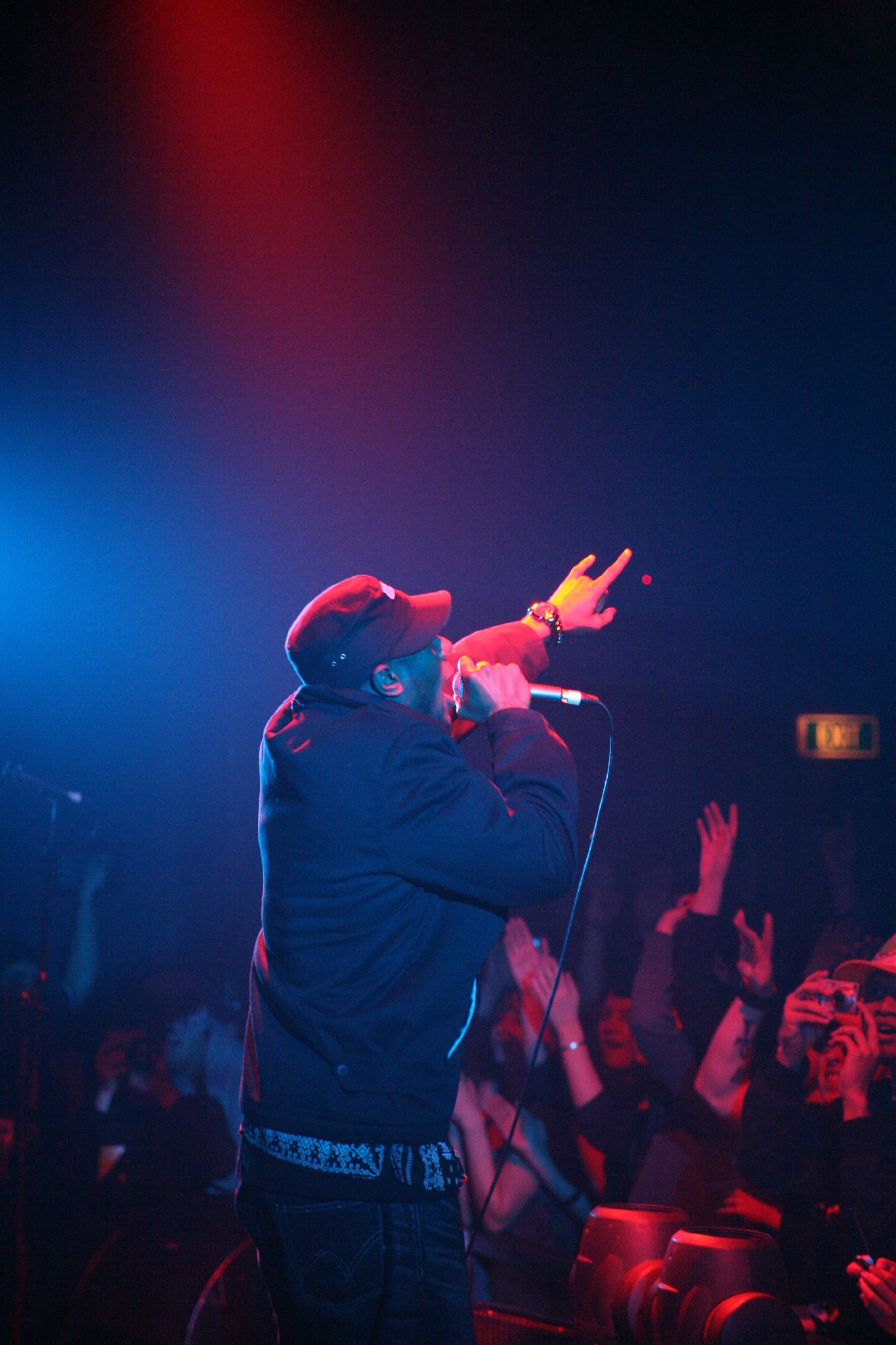 Mos Def is positing here the home and the city streets as an urban “[site] of significance.”(Forman xix). Through his experiences on the streets in Brooklyn he has constructed a new site of knowledge of oneself and one’s community for those who live in that area. He has taken the ghetto, commonly conceived as a site of extreme poverty and crime, and elevated in the song to a much more noble location: home. At the same time he has complicated the idea of home; to what point can a person hold a neighborhood in high esteem when you are not sleeping “cause the nights ain’t peace, it’s more war”? However this attempt to redefine the streets of Brooklyn as home is part of a larger attempt within hip-hop to create identity within urban space.
Part of why I am writing on representations of urban space in hip-hop (particularly representations of urban space as home) is because I believe that our listening practices are part of how we construct our identities. That’s one venue that I’d like to explore further in my paper: listening practices. I also want to talk more about how class comes to play in these representations. From what I can gather Mos Def comes from a working-class family, but Common and Kanye West do not. In fact, Common and Kanye West both had one parent with a PhD and that worked in education.
It’s not “just” music, folks.


Share this:

President Obama: All Over But the Shouting?
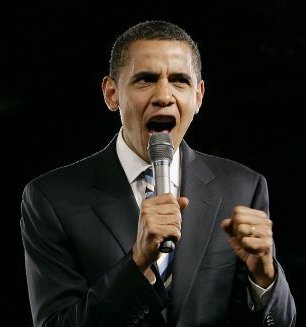
Ishmael Reed’s 12/12/2010 op-ed for the New York Times, “What Progressives Don’t Understand About Obama,” certainly struck a nerve amongst the Left. In the piece, Reed calls out far-Lefters for their misplaced–and dangerous–desire for President Obama to essentially “bust a can of whup ass” out on the Republicans over the tax cut debacle. Citing a lifetime of being labeled rhetorically “rowdy” by white teachers and peers, Reed calls attention to a deeply embedded and racialized double standard for the public expression of anger in the United States. Beyond turning a deaf ear their own pleas for a “sane” national debate back in October–see Mark Brantner‘s Sounding Out! analysis of the rhetorical logic of John Stewart’s Rally to Restore Sanity here–Reed argues that white liberals are also disregarding the racialized difference between white perceptions of their own anger (represented as righteous and authoritative) and their characterizarions of black anger (as a loud, dangerous “whup ass”–or as Reed phrases it “paranoid,” “bitter,” “rowdy,” “angry,” [and] “bull[ying]”). In other words, behind the cries in Reed’s comments for Obama to regain his “drama and passion” and to “stand up and tell these idiots to stuff it” lies a flirtation with and fear of “black anger,” which has a long history in the United States. As Reed mentions, black intellectuals have “been accused of tirades and diatribes for more than 100 years.”
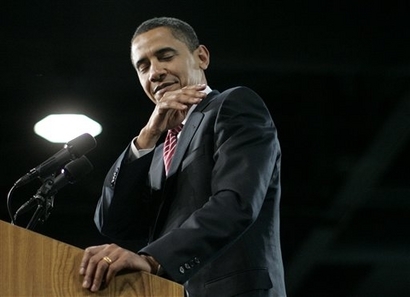
As someone who researches the racialization of sound and listening, I have been tracking Obama’s struggle with sonic stereotypes for quite some time now, and I think it is important to connect Reed’s recent thoughts with the utterance of another man named Reid almost a year ago. Woven into comments supposedly intended as praise of President Obama’s political prowess, Former Senate Majority Leader Harry Reid (D-Nevada) told two political journalists that he had known Obama would be elected president in 2008 because he was “light skinned” and had “no Negro dialect, unless he wanted to have one.” In this brief sound bite, the other Reid acknowledged the increased role that vocal grain and diction would play in a “post-racial” or “colorblind” world, linking the racialization of skin pigmentation with its less acknowledged yet perhaps more insidious counterpart, the racialization of sounds, voices and speech. Unfortunately, incendiary media coverage focused bluntly on Reid’s alleged racism for using the antiquated term “Negro” rather than sparking a more nuanced conversation about the role that race plays in perception and the multifaceted ways in which this racialized perception affects American politics and culture, down to the very level of the senses.
What was most disturbing about Reid’s comments (and the least talked about) was how they showed aural markers of race aligning with—and even superseding—visual codes of race, exposing the seeming comfort Americans have developed with this “sonic color-line,” as I have termed it. Inspired by and indebted to W. E. B. Du Bois’s concept of the visual color-line in The Souls of Black Folk (1903) and his later reimagining of that color-line as a suffocating plate-glass enclosure in Dusk of Dawn (1940), my notion of the sonic color-line posits listening as an interpretive site where racial difference is coded, produced, and policed. In short, we hear race in addition to (and sometimes even before) seeing it. As I have argued elsewhere, the socially constructed division between “sound/noise” marks one border of the sonic color-line; the hierarchies pointed out by Reed (quiet/loud) and exacerbated by Reid (proper/improper) mark still others. The sonic markers of whiteness (“sound”/”quiet”/”proper”) are culturally associated with both intellect and full citizenship privileges; the sonic markers representing blackness (“noise”/”loud”/”improper”) are repeatedly trotted out as signs of deviance, danger, and deserved abjection.
Though I very rarely find myself agreeing with Conservative linguist John McWhorter, I couldn’t help concede to the sentiment expressed in his January 9, 2010, blog for the The New Republic, “Reid’s Three Little Words; The Log in Our Own Eye”: “And who among us—including black people—thinks someone with what I call a ‘black-cent’ who occasionally popped up with double negatives and things like aks could be elected President, whether it’s fair or not?” Both Reid’s statement and McWhorter’s embellishment imply an unspoken sonic color-line, a racial “common sense” that African Americans are not only identifiable by a particular type of sound—the so-called “Negro dialect” or “black-cent” and its attendant loudness—but are aberrant and unelectable because of it, a sonic standard that does not appear to apply to white people. After all, the preceding two white presidents were known for their distinctive dialects and the ways in which they used them to mobilize their respective electorates; Bill Clinton’s soft-spoken Southern drawl was often read as smooth, intimate, and reassuring during the 1990s and George Bush’s folksy Texas-by-way-of-Andover twang attempted to sonically bridge the gaping class divides in the Republican coalition. But even before the recent debates that have pitted Obama’s “coolness”–itself a racialized jazz form of “quiet revolution” a la Miles Davis–against the imagined explosive heat of his anger, contemporary pundits heard the sound of Obama’s crisp, cosmopolitan voice with anxious and divisive ears, leading some to question his “blackness” and his political commitment to black people (Salon,“Colorblind,” 1.22.07)while still others called his baritone “magic” and immediately connected its resonant qualities with Martin Luther King Jr.’s, despite clear differences of tone, cadence, and regional inflection (Salon,“Does Obama’s Baritone Give Him an Edge?”2.28.2008).
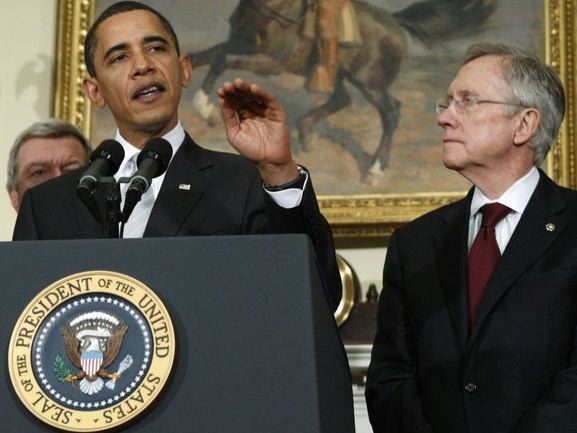
Senator Harry Reid (D-Nevada) Listens to Obama Speak
In other words, Americans continue to hear Obama’s voice through the historical filter of “loudness” and the so-called “Negro dialect” whether or not Obama wants them to and whether or not he “wanted to have one.” While Reid’s prompt and profuse apologies to Obama may have pulled the story from the news cycle—the President called the remarks “unfortunate”—the phenomenon Reid’s clumsy words exposed remains an invisible yet palpable cultural force in the U.S., one whose longer historical genealogy has yet to be reckoned with. Sure to be labeled “rowdy” for beginning to do so, Reed’s recent commentary suggests that Obama’s social and historical knowledge has led him to an astute awareness of “when not to shout” that white Liberals need to recognize. I offer a perhaps less consoling conclusion, that we need to concentrate less on the sound of Obama’s voice and more on the racialized listening practices that can radically distort public discourse in this country. Unless we understand (and eventually dismantle) the relationship between the dominant American “listening ear” and the sonic color-line that shapes it for many (white) liberals and conservatives alike, we will continue to shout into the wind.


Share this:


Current Top Posts





April 2021

January 2020

November 2019

October 2019

August 2019

April 2014

November 2017

March 2015

December 2017

October 2015
 Sounding Out!
Recent Comments