
SO! Reads: Deborah R. Vargas’s Dissonant Divas in Chicana Music: The Limits of La Onda


Deborah R. Vargas’s Dissonant Divas in Chicana Music: The Limits of La Onda (2012) presents an alternate story of Chicana music through a collection of case studies in Chicana/o music history centering on Chicana/Tejana musicians active between the early decades of the 20th century to the present. Vargas assembles a mix of archival documents, interviews, images, songs, recordings, performances, ephemera, fragments, memories and engages intersectional feminist theory and queer of color critique to trace the music scenes her subjects inhabit.
A feminist oral historian, Chicano/Latino cultural studies scholar, and Associate Professor of Ethnic Studies at UC Riverside, Vargas’s research overlaps these disciplines and facilitates a conversation between popular music and sound studies that significantly considers gender, sexuality, and racialization in the construction of borderlands imaginaries. With Dissonant Divas Vargas makes an intervention both theoretical and methodological that greatly expands the Chicana/o musical archive and as well as the audiences for sound studies research. Furthermore, Vargas’s reflective writing voice locates her own Tejana/Chicana story in relation to her project and offers helpful insights into her research process at key moments. [The brief essay titled “Selena, Jenni Rivera, Eva Garza—meditations on an author’s soundtrack” published on the Minnesota Press webpages for Dissonant Divas is a generous methodology piece that should be read along with this comprehensive, satisfying, highly readable and often riveting text.]

“Dissonant Divas in Chicana Music” copyright University of Minnesota Press, all rights reserved
Vargas defines the term, la onda, in a general sense as “an umbrella term for Mexican American/Chicano/Tejano music (x).” More critically, la onda also “operates to represent musics that have been prominent in academic and cultural sites that have produced dominant discourses of sexuality, gender, class, race, geography, and language in the constructions of Chicano music.” “Dissonance” can be understood variously as “chaos, cacophany, disharmony, static” and “out-of-tuneness” that draws attention to “the power of music with regard to Chicana gender and sexuality (xiv).” Vargas’s main critique notes how the “limits of la onda” reveals the heteronormative and patriarchal underpinnings that construct dominant narratives of Chicano music historiography. She argues that the force of these narratives have naturalized a way of thinking about Chicano music in terms of the various “fathers” of Chicano rock, conjunto music, and of the field of borderland studies itself. The distortions produced by the assimilating cultural nationalist logic of “la onda” have not only suppressed Chicana music histories and/or enabled their mishearing, but they also hide the complex ways that race, class, gender, and sexuality converge to produce Chicana subjectivities within and against the Chicano musical canon. In theorizing “dissonance,” Vargas thus productively sounds the Chicana histories in Dissonant Divas as alternatively gendered and/or queered against the heteromasculine concord of la onda.
The chapter “Borders, Bullets, Besos: The Ballad of Chelo Silva” contains perhaps the most provocative pages, detailing Chelo Silva, a bolero singer with a distinct repertoire of songs that are still performed and kept alive by a diverse lineage of performers and audiences, yet whose renown is seemingly inseparable with her former marriage to Américo Paredes. Ubiquitous in borderlands studies, Paredes’s name and legacy are defined largely by his study of the corrido, With His Pistol in His Hand: A Border Ballad and Its Hero (1970). Vargas strategically positions Silva and Paredes as “embodied representations” of the bolero and the border ballad, respectively, taking up Sonia Salídvar-Hull’s proposal to “imagine new corridos” by proposing Silva’s boleros as “feminist border ballads.” Vargas parses the constructions, aesthetics, and values carried in each song form, exploring how the border ballad has been the primary counter-site for narrating the injustice of Tejano/Anglo conflict (bullets) while the bolero, whose constant subject is love, luxuriates in all its jouissance (besos). Vargas reveals that the border ballad “has allowed its authors, singers, and scholars to sound the borderlands imaginary into being,” illuminating how the contest over historical representation is tied to musical representation. Silva’s story cannot be found within this articulation of la onda without, in part, redefining the border ballad (54).
Vargas innovates and meticulously crafts an alternative archive better suited to narrating and hearing Silva’s fragmented story, what Vargas felicitously calls her archisme of knowledge. Engaging the silences in Silva’s story, the archisme sounds her presence in the recorded memories of her fans which include testaments to her unique vocal qualities, her powerful and evocative performances, her improvisations in music and in life,,along with a healthy amount of the chisme or gossip surrounding Silva. Proposing the archisme as a “feminist project for historicizing nonnormative Chicana/o genders and desires” Vargas extends both Sonia Saldivar-Hull’s directive for Chicana scholars to look in nontraditional places for theory and Lisa Lowe’s theorization of gossip as a destructuring site of knowledge production (Saldivar-Hull, 1998; Lowe, 1996).
As I read through the first three chapters, a question that kept coming up concerned why we should not consider this study on more specific regional terms, or why this book isn’t titled, “Tejana Divas”? Vargas finds the overdetermination of these Chicana/Tejana musicians as “regional” subjects a problem not typically encountered by musicians from a city like Los Angeles, for example, because of its construction as a global metropolis. I cannot dispute Los Angeles’s status as a world center and I wondered how to earnestly engage Vargas on this point. What are the stakes of locating this study of Tejana/Chicana musicians within a broader Chicano/a musical context?
The final two chapters make the case for remapping Chicana music, advanced in part by the capacious notion of queer “diva-scapes.” In “Sonido de las Americas: Crossing South-South Borders with Eva Garza,” Vargas employs what she calls a “transfrontera musical compass,” a feminist methodology deftly juxtaposing the notion of a “musical scale” with the concept of “geographic scale.” Eva Garza’s career begins in her San Antonio hometown but she eventually came to embody the “la vóz de las Américas” in a hemispheric sense via her participation in early Spanish language radio, recordings, and live performances in nightclubs and films that took her to Mexico City and Havana for significant periods; her genre-crossing repertoire mirrored her travels. Garza began as a singer of the appropriately feminine bolero, but through her contact with Cuban musicians, the Afro-Caribbean guaracha song–decidedly phallocentric and risqué in its subject matter–also became part of her repertoire. The song she was most known for, “Sabor de Engaño” adds a sensual register to her transfrontera compass, a lingering sabor or taste exceeding regional, national, formal, and gendered limits. This is most evident in the repeated examples of impromptu performances of a song verse or refrain of “Sabor de Engaño” by many Cubanos Vargas encountered in her research travels. Vargas employs the transfrontera musical compass as a “listening instrument” to trace Garza’s musical trajectory through spatial-temporal moments disrupting rigid and normative notions of community, nation, and Chicano music (147).

“Selena Live” by Flickr user hellboy_93, CC BY-ND 2.0
In “Giving Us That Brown Soul: Selena’s Departures and Arrivals,” Vargas addresses the multiple problems in the mainstream media’s designation of “crossover star” to narrate Selena’s story as a spectacular rise in fame marked by her violent death in 1995. Vargas seeks to correct the assimilationist narratives of Selena’s musical history that, in addition to figuring her as a marginalized Latina on the verge of “legitimate” status, problematically narrates a south-north trajectory “devoid of blackness and queerness.” Vargas both critiques how “brown soul” has been musically deployed to stand in for cultural nationalist “brown power” and extends previous work focusing on blackness in Chicano/Latino music that includes R&B and Afro-Caribbean influences but not necessarily the Afro-diasporic. Cumbia, an Afro-Columbian dance form popularized in Mexico in the 1940’s – 50’s is central to Selena’s Tejano sound as are 70’s era disco and 80’s freestyle, particularly in the cultivation of her iconic diva look which together resonate a queer of color musical legacy on the sonic and visual planes.
Selena’s “brown soul” and style moves Tex-Mex cumbias in what Vargas calls “queer misdirections” by traveling north-south, for example, while sounding counterhegemonic femininities that continue to reverberate in the many tribute drag performances to Selena in and beyond the borderlands of Tejas. In these ways, Vargas traces the “topography of Selena’s transformations and remappings of Chicano music (205). Just as audio technologies have been key in circulating Eva Garza’s and Selena’s music in multiple directions, so are the memories, repeated performances, and queer embodiments of their music by their diverse audiences. For both of the these artists, sound expands Vargas’s engagement with spatialization theories so that we may hear these productive dissonances and in these ways begin to imagine alternative borderlands imaginaries.
Upon finishing, a question that remains in considering “diva dissonance” is the implied consonance of Vargas’s theorization of “la onda.” At times, the term becomes too totalizing, and I would argue for the presence of heterogeneity and other musical diversities even within what Vargas denotes as la onda. We must both make and leave room to imagine the possibility of many unrecorded, captured, or yet unsounded transgressions for Chicanas whose paths may appear to follow a heteronormative logic. For this reason I found the reiteration of such rich findings against la onda asomewhat repetitive distraction from the richer tales Vargas’s archival work tells. What would these histories sound like if they weren’t always positioned against la onda—if they were sounded instead more toward each other?
What Deborah R. Vargas richly accomplishes in Dissonant Divas responds to Alejandro Madrid’s call for musicologists to establish critical conversations beyond “the conservatory” and to engage larger intellectual dialogues (AMS Vol. 64, No. 3, 2011).Vargas’s intersectional feminist-of-color argument extends the body of feminist Chicana/o cultural studies scholarship and equally extends Chicano music histories that may engage gender to some degree but do not fully interrogate those categorical constructions. Her theorization of the title’s key term “dissonance” as “both a methodological and analytic device” and her construction of a differential archive combine to create “alternative sonic imaginaries of the borderlands (xii).” More broadly, Dissonant Divas is an intervention to the problems of conducting research in marginalized communities and the racialized subjects often left out of official archives, institutional records, and studies of sound (Trouillot, 1995; Taylor, 2003). Each chapter reveals and addresses various barriers to conducting research on Chicana musicians whose uneven historical representation lead Vargas to turn to other sites, methodologies, and embodied practices where Chicana voices resound across temporal and spatial lines. In these ways, Vargas’s sustained engagement of race, class, gender, and sexuality with Chicana/o borderlands music is thoroughly new.
—
Featured Image: Pauline Oliveros by Flickr user Horacio González Diéguez, CC BY-NC-SA 2.0
—
Wanda Alarcón is a doctoral candidate of Comparative Ethnic Studies with a Designated Emphasis in Women, Gender, and Sexuality at the University of California, Berkeley where she is writing a dissertation titled: “Sounding Aztlán: Music, Literature, and the Chicana/o Sonic Imaginary”. Her research interests include Chicana/o cultural studies, U.S. ethnic literatures, popular music, sound studies, queer of color theory, and decolonial feminism. At Berkeley she has facilitated the working groups, “Decolonial Feminisms” and “Popular Music in Chicana/o Cultural Studies” at the Center for Race and Gender (CRG). Wanda is originally from Los Angeles and before starting graduate school she created the poetry zine, JOTA (2002 – 2006) and is updating that project by creating an archive for queer Chicana writing in cyberspace. She is a fan of radio genres and podcasts and writes micro radio plays while on the road. She is suspicious of the MP3 format yet enjoys curating party, tribute, and mood themed playlists on Spotify immensely. You can find her on Twitter depending on writing deadlines @esawanda.
—
 REWIND! . . .If you liked this post, you may also dig:
Chicana Radio Activists and the Sounds of Chicana Feminisms— Monica De La Torre
Could I Be Chicana Without Carlos Santana?— Wanda Alarcon
Listening to the Border: “‘2487’: Giving Voice in Diaspora” and the Sound Art of Luz María Sánchezˆ— Dolores Inés Casillas
Share this:

SO! Reads: Susan Schmidt Horning’s Chasing Sound: Technology, Culture and the Art of Studio Recording from Edison to the LP

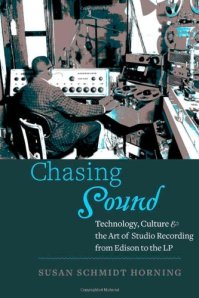
The recently published Chasing Sound: Technology, Culture & the Art of Studio Recording from Edison to the LP (Johns Hopkins Press, 2013) is historian Susan Schmidt Horning’s first book. Veering away from the usual sound recording suspects (like the phonograph), Chasing Sound shows the studio and the audio engineer as central to the cultural and technological changes associated with the production and reproduction of sound.
According to Schmidt Horning, such changes were reflected in the shifting ideal of recorded music as a representation of live performance to the ideal of recorded music as a studio-engineered creation. Using the accounts of those responsible for recording sound, Schmidt Horning constructs a rich narrative that manages to be accessible while still focused on the highly technical work required of studio workers. That said, by focusing so heavily on user practices and anecdotes she misses an opportunity to engage with the theoretical implications of the ways audio engineers imagine and describe the actual space in which they work. Still, I contend that Chasing Sound represents an indispensable and critical approach for historians of sound, one that is unafraid of reconfiguring the central players in a narrative as big as the history of recorded music.
As a contribution to sound studies, Chasing Sound follows in the footsteps of Trevor Pinch’s Analog Days, the first work to explicitly apply Science and Technology Studies (STS) approaches to the history of a musical instrument. For Pinch, a critical understanding of sound requires examining the ways in which society and technology produce historical sites of change and stabilization. This approach focuses on understanding the ways people engage with technologies of sound, in order to interrogate their cultural and historical meanings. A historian of science and technology by training, Schmidt Horning has thus devoted much of her academic career to writing about the production and reproduction of sound through the practices and tacit knowledge of engineers, producers, musicians and technicians at music studios. By following the breadcrumbs dropped by these actors, Chasing Sound reveals the rich history of commercial studios and the cultural ideals cultivated therein.
 Methodologically, the author draws on a mixed bag of sources, which include oral histories from early recordists, interviews with more contemporary audio engineers, her own ethnomethodogical studio research, trade literature, and archival documents from big studios like EMI. The book proceeds in chronological order, with each chapter laying out changes in the physical and acoustic qualities of commercial studios as they shifted from bare-walled rooms with “the recording horn jutting through a wall at the far end of the room” (9) to multi-track studios complete with “Mission furniture, [and] hand-laid distressed wood floors.” (209) The author plots these changes alongside improvements in the science of acoustics, the importation of techniques and tools from the more well developed medium of radio broadcasting, the consolidation and growth of the recording industry, the rise of independent labels, the emergence of new attitudes and musical tastes, and the professionalization of audio engineering.
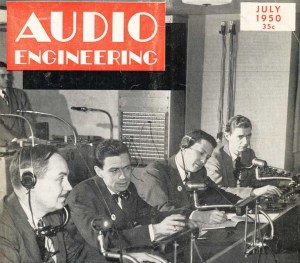
Chasing Sound, unlike many other books on the topic, places the studio in relation to a set of changing cultural expectations regarding recorded music. Where recordings were once understood as a reflection of live performance, they later were seen as a signature creation of music studios. Rather than focusing on the phonograph, gramophone, microphone, or magnetic tape, the author argues that the recording studio belongs at the center of recorded music because it was there that the ideal of music as a “technologically mediated art” was first engineered into cultural listening norms. Consequently the audio engineer, or recordist as he (or in rare cases, she) was known prior to the 1930s, must also be understood as central to narratives regarding recorded sound from its inception. In this way, Schmidt Horning aims to recontextualize and centralize the studio and its inhabitants within histories of the production and reproduction of sound.
Because the audio engineer represents an inextricable part of this history, each chapter devotes time to the technologies and practices cultivated by the amateur recordists and trusted professionals responsible for recording sound. Initially such practices formed the basis of their tacit knowledge regarding the proper “staging” of artists in relation to acoustic recording horns among other techniques, but by the 1950s, sound engineers were responsible not just for positioning artists, microphones, and the increasingly important work of “enhancing” recordings during post-production. The book concludes by charting the unfettered rise of independent studios as well as the consequent proliferation of (and backlash to) new sound manipulation technologies in the 1970s.
Throughout the text the author notes the ways in which audio engineers often lamented the increasing technological mediation involved in record production, even as it granted them more creative control and prestige.
 Schmidt Horning’s methodology represents Chasing Sound’s strongest quality. The rich narratives of the audio engineers allow the author to directly connect their technologically and culturally informed ideas about what constitutes good sound to the desires and expectations of listeners. In addition to this work, Schmidt Horning also highlights the ways in which advances in engineering technology did not necessarily overlap neatly with cultural norms. Throughout the text the author notes the ways in which audio engineers often lamented the increasing technological mediation involved in record production, even as it granted them more creative control and prestige. Such examples reveal the tightly knit relationship between ideas of liveness, talent, creativity, and authenticity. Chasing Sound is full of stories that detail the complex material, artistic, and ethical constraints around which recordists and engineers navigated in order to achieve the perfect sound.
The author’s methodological approach certainly helps to structure the narrative, but there are also ways in which it prevents her from digging in to important theoretical discourses regarding the studio. As Eliot Bates notes in his article, “What Studios Do,” the way audio engineers conceive of their workspaces is crucial for making sense of the power relations and social interactions that govern and are governed by studio spaces. Chasing Sound does not pursue these discourses. The author briefly mentions how the metaphor of flight is often used by sound engineers regarding the increasingly complex console controls of the 1950s and 60s but does not provide further elaboration on the implications of such a comparison. Even if the participants in her study did not reflect on their colloquial notes about the studio space, it would have been interesting to see Schmidt Horning consider what these metaphors reveal about the changing roles of the engineer.
These points aside, Chasing Sound is an important read both for those with a general interest in the history of sound production and reproduction as well as those scholars more specifically invested in understanding the role of recorded sound in society. Since I discussed the book’s limitations in “Making Music in Studio X,” Chasing Sound has become a foundational text in much of my research. Specifically, the author’s claim that the studio is (and has been) a critical site for examining broader industrial, technological, and cultural changes resonates deeply with me because it offers a critical methodology for considering issues of identity and power within studio spaces that are often neglected. In this regard, Chasing Sound is important not just for what it discusses, but also for what it does not. Noting the lack of female and black audio engineers discussed throughout the book, the author laments, “For the first century of sound recording, the field of audio engineering and recording studios in particular comprised a profoundly white male-centered culture that reflected corporate culture at large and technical professions in particular.” (9) The absence of these faces serves to remind us that while successfully “chasing sound” certainly relies on the cultivation of craft skill, and tacit knowledge, it also depends heavily on access.

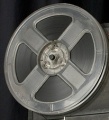
Reproduced under a Creative Commons Attribution license from Reel2ReelTexas.com
Chasing Sound stands out as the most exhaustive history of audio engineering available. Schmidt Horning’s user-focused narrative successfully ties together changes in studio configurations and audio engineering practices with cultural expectations regarding recorded music. This helps to show how the studio and audio engineer can easily be recognized as central figures in the history of sound reproduction. Chasing Sound’s intervention is necessary as the history of recording is often told through artifacts like the phonograph, microphone, and magnetic tape, not living spaces like the studio and its inhabitants. Schmidt Horning’s dedication to telling these neglected stories is what makes the book come to life. Her research promises to open up new avenues for others interested in these issues. For me, this means pursuing lines of inquiry related to the growing philanthropic interest in the recording studio as a site for engaging and “assisting” low-income communities. In this way Chasing Sound asks us to recognize the recording studio as a critical site for the production and reproduction of our assumptions about what counts as appropriate, good, or real in music and people.
—
Featured Image: My Recording Studio by Flickr User Fabio Dellutri
—
Enongo Lumumba-Kasongo is a PhD student in the Department of Science and Technology Studies at Cornell University. Since completing a senior thesis on digital music software, tacit knowledge, and gender under the guidance of Trevor Pinch, she has become interested in pursuing research in the emergent field of sound studies. She hopes to combine her passion for music with her academic interests in technological systems, bodies, politics and practices that construct and are constructed by sound. More specifically she would like to examine the politics surrounding low-income community studios, as well as the uses of sound in (or as) electronic games. In her free time she produces hip hop beats and raps under the moniker Sammus (based on the video game character, Samus Aran, from the popular Metroid franchise).
—
REWIND! . . .If you liked this post, you may also dig:
Making Music at Studio X: The Identity Politics of Community Studios— Enongo Lumumba-Kasongo
SO! Reads: Japanoise: Music at the Edge of Circulation— Seth Mulliken
SO! Reads: Isaac Weiner’s Religion Out Loud: Religious Sound, Public Space, and American Pluralism— Jordan Musser
Share this:


Current Top Posts





April 2021

January 2020

November 2019

October 2019

August 2019

April 2014

November 2017

March 2015

December 2017

October 2015
 Sounding Out!
Recent Comments