
Play it Again (and Again), Sam: The Tape Recorder in Film (Part One on Noir)
 Being a teacher, I can’t resist giving out a summer reading list. Being a researcher, I can’t help but want to share the projects that I am working on–which right now includes excavating the cultural history of the magnetic tape recorder in the United States. So, in honor of the Summer Solstice tomorrow (marking the official start of the season) I compiled a three-part summer series for Sounding Out! that does both: “Play it Again (and Again) Sam: The Tape Recorder in Film.”
My summer sound studies A-V list encourages you to fill your idle hours watching the “top 6” featured appearances of the magnetic tape recorder in film, in chronological order (2 each month, with a bonus “supporting role” nod rounding out each post). Not only will “Play it Again (And Again) Sam” help you beef up your cinema buff credentials, but it will trace a little-known history, asking you to consider how the recorder tangled its thin brown plastic tape so effectively into the warp and weft of our twentieth-century lives. You’ll find that my “top 6” list reveals much more human desire than technological determinism; the representations I examine express a complex mixture of fear and fascination, optimism and regret, change and stasis. Often a tool of the powerful, sometimes a weapon of the weak, the tape recorder was a cold war domestic product that could never truly be domesticated. As you will see in this spoiler-free three part series, interactions with the tape recorder remixed America’s workplaces, schools, homes, public spaces and private moments, ultimately shifting how the world was heard (and heard again and again).
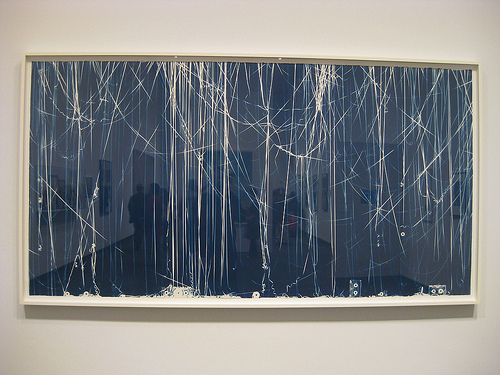
Memento (Soul II Soul) 2008 by Christian Marclay, Photo by Nathan Bowers
So, load up your Netflix queue, shake up your Jiffy Pop, and take a much-needed couch-break from the heat and humidity with these oh-so-cool black-and-whites from the 1940s and 1950s. Of course, we can’t start our films without some “Coming Attractions”: look for part two on July 18th (spotlight on Walter Murch) and part three (the 1980s) on August 15th.
1. Double Indemnity (Paramount, 1944, Directed by Billy Wilder)
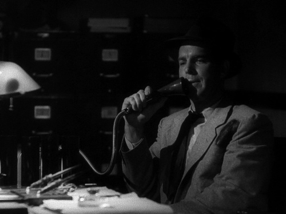
Walter Neff (Fred MacMurray) speaks his sordid tale into the dictaphone
Okay, so it is actually a dictaphone that appears in this film and the tormented insurance salesman Walter Neff (Fred MacMurry) is “putting it on wax” rather than magnetic tape, but this once ubiquitous, now long forgotten recording device has such a haunting presence and a structuring role in this grim noir confessional that, like Neff himself, I am suddenly willing to break my own rules. Outside of femme fatale Phyllis Dietrichson’s (Barbara Stanwyck) elaborately sculptured coiffure, the key image of Double Indemnity is Neff’s lips murmuring his murderous late night confessions into the dictaphone’s horn, a physical and metaphorical stand in for the ear of his hardnosed boss (and the true object of his desire) claims investigator Barton Keyes (Edward G. Robinson).
The dictaphone was Billy Wilder (director/screenwriter) and Raymond Chandler’s (screenwriter) deliberate addition to the filmscript; James M. Cain’s 1943 novella was essentially Neff’s scrawled confession to the reader of his almost-perfect plot to kill Phyllis’s husband and reap double insurance rewards. The introduction of the dictaphone transformed the standard noir flashback voiceover into an even-more intimate exchange of anxious aspiration, guilty pleasure, and homosocial desire channeled through Neff’s tense vocal grain and fierce grip on the machine’s cord. A familiar office machine made strange by Neff’s late-night admissions, the dictaphone mediates the entire film, transforming the audience into eavesdroppers, listening in to an act of recording made for Keyes’s ears only. After stumbling into his office and jamming a cylinder into the machine, Neff begins, sternly: “Office memorandum. ‘Walter Neff to Barton Keyes, Claims Manager, Los Angeles, July 16, 1938. Dear Keyes: I suppose you’ll call this a confession when you hear it. Well, I don’t like the word ‘confession.’ I just want to set you right about something you couldn’t see because it was smack up against your nose.” Sound, in the form of Neff’s heated breath pressed through the dictaphone’s curves and into our waiting ears, is the perfect device to exorcise the unseen desire in a film that tests the boundaries of darkness.
..
2. Blackboard Jungle (MGM, 1955, Directed by Richard Brooks)

Screen Capture by JSA
Most people remember Blackboard Jungle for its seductive visual representations of juvenile delinquency, stoked by the sound of Bill Haley and the Comet’s “Rock Around the Clock,” the song (written in 1952, recorded in 1954) that opened and closed the film (and became a smash hit as a result, as I discussed in a previous archival blog post here). I’d like to add an often-overlooked image to the film’s legacy, that of teacher Mr. Dadier (Glenn Ford) plunking a bulky case down on his desk and triumphantly announcing “This is a tape recorder!” A cutting edge device at the time—magnetic tape was only introduced in the states after World War II, largely through the efforts of Bing Crosby and Les Paul—Dadier’s recorder is part and parcel of the technological milieu of the 1950s, which evoked positivistic fascination with “progress” even as it was shaped by existent fears and inequalities.
At the point of almost giving up on his surly working class, ethnic, inner-city students to seek a cushy job in the segregated suburbs, Dadier brings in the reel-to-reel as a Hail Mary attempt to quell his students’ noise and remake them into good Cold War citizens once and for all. As he tells them, “We all talk, but nobody listens.” From the moment he enters the classroom, the students continue to defy the white male authority embodied in Dadier and housed in his machine—“Did you bring your cosmetics to school, Chief?” taunts one student (Gregory Miller, played by Sydney Poitier)—and they undermine his assignment by selecting the “noisiest” student in the class to make a recording: Puerto Rican Student Pete Morales. As I have discussed on this blog and in print, the concept of “noise” has a racialized edge, particularly in the 1950s, when Cold War cosmologies of colorblindness and “enemies within” ruled the day. Sound was an efficient way to separate “Us” from “them”—the noisy dissident from the quiet citizen—without making explicit reference to visual markers of race. And, let me tell you, Morales’s obscene, heavily-accented speech—peppered with “stinkin’”s, 14 of them in total—really makes Dadier’s spools spin. To hear more on the tape recorder in 1950’s American life and this film, see my essay “Reproducing U.S. Citizenship in a Blackboard Jungle: Race, Cold War Liberalism and the Tape Recorder” forthcoming in the American Quarterly special issue on sound (September 2011).
[youtube=http://www.youtube.com/watch?v=tr7n9Wxmcf4]..
And. . .in a supporting role:
Kiss Me Deadly (Parklane Pictures, 1955, Directed by Robert Aldrich)

Hammer Screens His Calls: Screen Capture by Michael Leddy
The byzantine stairwalks and gingerbread Victorians of Los Angeles’s defunct Bunker Hill neighborhood are not the only ghosts you will encounter in the noir classic Kiss Me Deadly. Our first glimpse of Mike Hammer’s (Ralph Meeker) space-age Wilshire Boulevard bachelor pad includes a shot of his wall mounted, reel-to-reel answering machine, quite a technological marvel in 1955; it would be over 15 years before Phone Mate introduced the first commercially viable home model in 1971. His recorder manages to look both ridiculously large yet streamlined–and to twenty-first century audiences, old yet futuristic. However, it also allows the hunted, haunted private detective to take just a little more control of his tailspin of a life. After the jarring ring of a telephone call, the spools spin, and a sultry female voice intones: “This is Crestview 5-4124. Mister Hammer, whom you are calling, is not available at present. If you wish to leave a record of your call, please state your message at the sound of the tone.” His back inevitably against the wall, Hammer brings a suave tension to an act that has now become mundane: call screening. Removing the small surprise of who’s on the line, Hammer uses his recorder to listen just a step ahead, pacing an increasingly mysterious world given over to the dangerous riddle of the “whatsit” that leaves so many in the morgue by the film’s end. For a more general take on sound in this film (with a brief mention of Mike Hammer’s tape recorder), see Noira-Blanchè-Rougi’s November 2009 blog post, “The Use of Sound in Kiss Me Deadly.”


Share this:

From Illegitimate to Illmatic: On Tiger Mothers, Ethnoburbs, and Playing the Violin While Dreaming of Nas
“Don’t tell me you’re still listening to that shit.”
“I told you, I like it.”
“This is why we have so much trouble with you.”
“You don’t know anything about it.”
“Listen to that cursing…it’s nothing but garbage!”
“What are you doing?”
“All of these CDs are going in the basement. No more rap until you start listening to your parents! Now, go practice your violin!”
Growing up, exchanges like these were common between my Korean American mother and me—a multiracial Korean Euro-American. In her eyes, there was no such thing as enough violin practice. Rap—the vulgarity! The noise! It was turning me into a juvenile delinquent! She was convinced I had it in me to be the next Korean-American classical music virtuoso, the next Sarah Chang—if only I would practice more scales and stop trying to imitate “black men shouting.” (However “conversational” the rap world considered Nas’s flow, my mother still heard yelling.)
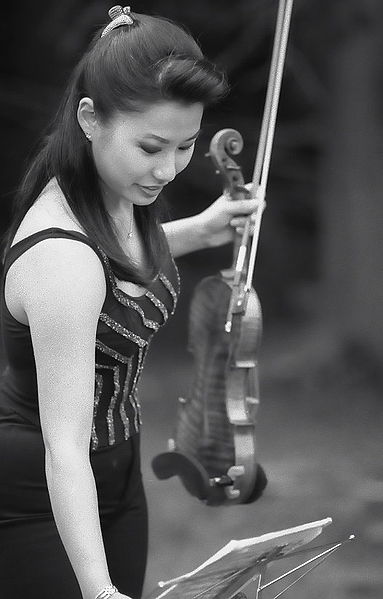
Violinist, Sarah Chang
It’s not that I didn’t like classical music—I watched Amadeus on loop until the VHS squealed—but my mother, like the mothers of most all my Asian friends, insisted on it consuming a fairly large chunk of my life. While immensely diverse in its makeup, most of the Asian population where I lived was either Korean or Chinese, and were forced by their parents to learn violin, piano or cello. Not only was it criminal to play an instrument other than one of these; but, whichever one (or two) you chose, you had better be the best at it.
Author and Yale Law Professor, Amy Chua, recently incited an online firestorm when the Wall Street Journal published an excerpt from hercontroversial new memoir, Battle Hymn of the Tiger Mother, in which she recounts calling her daughters “worthless” and “garbage” if they couldn’t perform a piece of classical music up to her exacting standards. University of Hawai’i at Manoa Professor, Mari Yoshihara’s study, Musicians from a Different Shore: Asians and Asian Americans in Classical Music(2008) describes similar instances of “tiger mothering,” such as virtuoso violinist, Midori Goto’s, mother, Setsu Goto, who (it was rumored) was so strict that it forced Midori into a mental breakdown and an eating disorder. Many would likely agree that “Tiger Mothering” such as this is morally questionable (and in some cases abusive), but I should note that instances like these are only part of a much bigger picture. Scores of students and performers would no doubt concur with Dr. O’C’s recent SO! account of the potential for classical music praxis to have ameliorative effects. Despite this, however, classical music training seems to have become a central tenet of “Tiger Mother” methodology. In all the kerfluffle over Chua’s book, no one has been asking the most foundational question: Why is it so important to Asians and Asian Americans that their children play classical music?

Amy Chua, (CC) Larry D. Moore
In a recent interview on why she chose classical violin and piano for her children, Chua fancifully suggests that classical music is the antidote to materialism. She says that “classical music all about depth” and calls the violin and piano “very respectable instruments.” Indicative of more than just a love of classical music, Chua’s statements imply that other forms of music lack comparable artistic value and require less cultivation to perform and enjoy. In a similar vein, the Asian-descent classical musicians interviewed in Yoshihara’s Musicians From a Different Shore divulge their belief that playing classical music anchors one to a high social stratum. Acknowledging the contradiction between classical music’s high cultural status and its mostly poor compensation, the musicians identified social factors such as educational attainment and musical taste and ability as more important determining factors of class standing than income. Yoshihara thus links the importance Asians and Asian Americans place on classical music praxis to class consciousness and the production of cultural capital.
Class consciousness no doubt accounts for some of the zealousness exhibited by Tiger Mothers with regard to their children’s classical music training, but it’s not the only thing that keeps them roaring. Chua’s Battle Hymn illustrates that, in addition to class consciousness, the pressure to study classical music stems from an intra-racial expectation to perform Asianness adequately. Chapter 5 of Chua’s memoir, titled, “On Generational Decline,” is her cut-and-dried summarization of how subsequent generations of Chinese Americans become lazier as they’re allowed to revel in the comforts of middle class life. Chua chooses classical music for her children because it is “the opposite of decline, the opposite of laziness, vulgarity, and spoiledness.” Constructed as an appeal to Chinese Americans, Chua essentially argues that classical music training is key to an Asian person’s cultural and racial legitimacy. Unwilling to relinquish “the high cultural tradition of [her] ancient ancestors,” she expects her children to uphold a racially and culturally endorsed standard of melody-making that reinforces Asian gender norms and encourages other Asian parents to do the same.

One of Ellicott City’s Korean Shopping Plazas, photo by Barbara Fisher
In Ellicott City, Maryland, the wealthy, culturally diverse “Ethnoburb” of Baltimore where I grew up, Asian American classical musicians abound and Asian American rappers are few. Here, (where the community-wide motto is “Choose Civility”) Asian youth gained a sort of “cred” for mastering the violin or piano, and this pressure to “prove” oneself along racial lines was something I always felt—particularly as a teen of mixed race. It was probably the biggest reason why I didn’t quit the violin until I graduated from high school. I hated it, but resentfully continued attending orchestra and private lessons in the fear that I would lose the meager amount of “cred” I’d built up. It hardly mattered, though. There was no chance of me getting into an Ivy League school or playing Carnegie Hall—I listened to rap and sometimes didn’t do my homework. In short, I would never be a “Super Asian” (a term coined by my Indian music stand partner and me), and as any Asian kid knows, if you’re not the best, you needn’t bother trying. None of the “Super Asians” had any interest in rap, and one even joked that I was a “chocolate-filled twinkie” for wearing a Pelle Pelle jacket to practice one week.
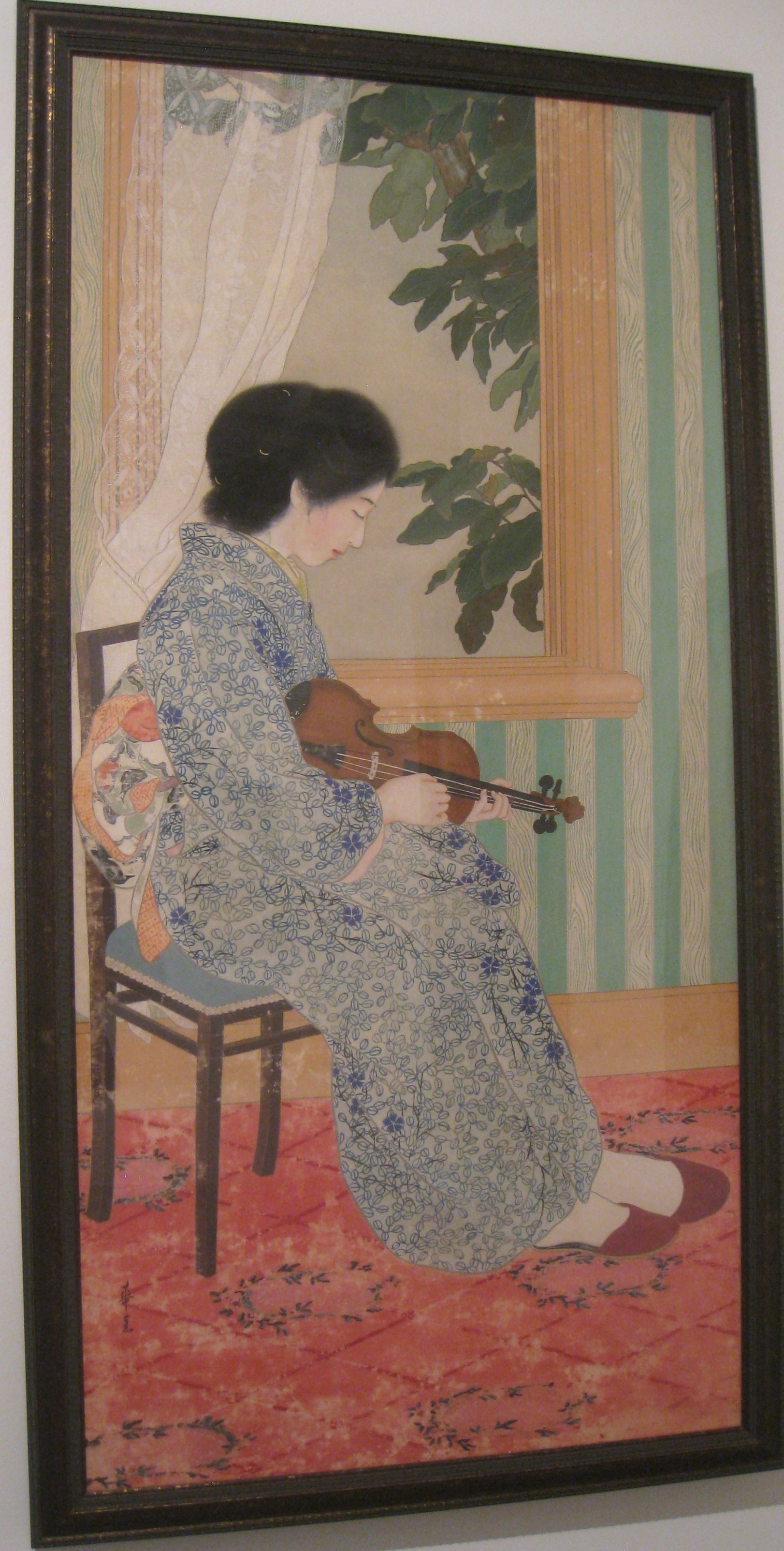
Wolfosonian Museum, Unknown Artist
People who looked like Sarah Chang were supposed to be in the business of making melodies, not rhymes. Chang performing a violin concerto is a comforting scene, a sonic image that reaffirms a familiar cultural narrative of femininity and class stature associated with Asianness in the US. A result of the gradual process of East Asian modernization (instigated by Western Imperialism), classical music was initially adopted by the people at the behest of the state, eventually becoming a integral part of middle class life in East Asia and a social marker of bourgeois womanhood that functioned to situate women vis à vis the domicile. Uncomfortable defining myself in this way (and feeling, also, that I never truly could), I gravitated towards something more “disruptive” that would allow me to show a different face to the world.
Rap became a vehicle for me to explain myself in more hybrid terms. On drives into Baltimore City, I heard it bellowing from the windows of the West Side’s crumbling row homes. The loud, curt, interjections! The spontaneity and candor! This loudness was initially what drew me in, but eventually I realized that rap had just as much profundity as anything classical you could throw at it. Listening to rap, I was finally on offense. It was a medium that spoke to me, because it made me feel capable of speaking back. And there was an entire legion of disaffected youth who seemed to feel the same way.
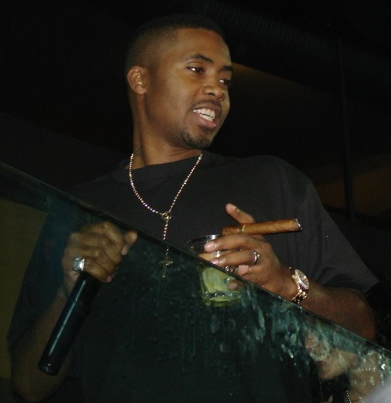
Nas performing in 2007
Despite this popularity, however, critics of rap maintain that the sounds that (predominately African American) rappers produce are nothing more than “noise.” In Black Noise, Tricia Rose observes that despite (and perhaps because of) rap’s widespread popularity and cultural relevance, it is often pitted as classical music’s polar-opposite—“unintelligible yet aggressive sound that disrupt[s the] familial domain” (63). Against charges that rap lacks “depth,” purveyors of hip hop (despite their hefty salaries) often accrue little to no widespread artistic acclaim. Evidence of what Jennifer Stoever-Ackerman terms the “sonic color-line,” this demotion and “Othering” of non-white sounds into “noise” (discussed further in her recent SO! post) has historically functioned to both generate and underwrite public attitudes about race, class and gender and to create dominant ideas about listening that she dubs “the listening ear.”
It seems that dominant modes of listening have everything figured out. If you look like this, you sound like that. But, what about people who look like me? What are we supposed to sound like? With which sonic cultural productions am I supposed to ally myself, and do I have a choice in the matter? How does “the listening ear” interpret a biracial Korean Euro-American or any person of mixed race heritage? Was there a distinction to be heard? I was sure there was, but didn’t quite know how to voice it.
For most of my life I have lived on the precipice of Asianness and something else, leaving me to feel—at times—confused, demoralized and illegitimate. As Michael Omi and Howard Winant famously note in their seminal work, Racial Formation, “Without a racial identity [in America], one is in danger of having no identity.” Acutely aware of my difference, I searched for ways of being heard as a multiracial subject in a fiercely stratified, race-conscious society. In the Introduction to The Sum of Our Parts: Mixed-Heritage Asian Americans, Michael Omi notes that within the historical and political context of the United States, (the “one-drop rule,” eugenic fears of racial intermixing, anti-miscegenation laws, etc.) multiracial identities have consistently been “contained, disregarded, [and] denied.” Disruptive to fixed notions about race, it is often a challenge for multiracial subjects to be recognized or understood by the state or the ear.
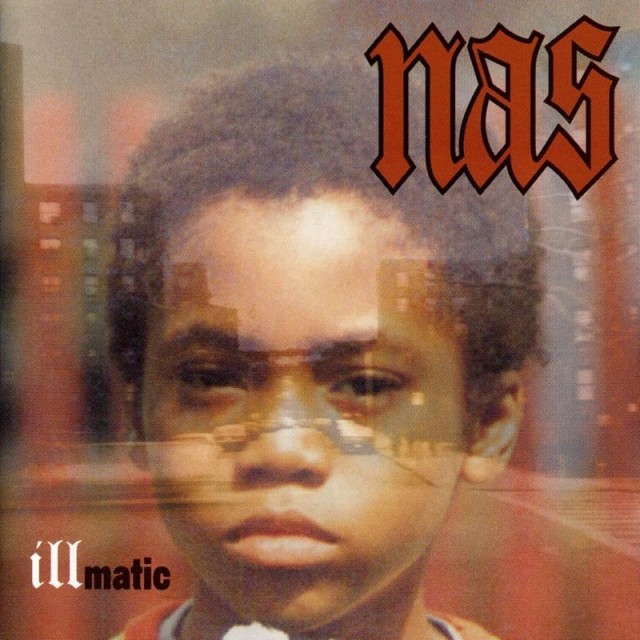
Rap assisted me in my effort to be heard as a multiracial person. While my Asian friends in All-State Orchestra were polishing their four-octave chromatic scales for the judging panel at Julliard, I was conscientiously studying Rakim’s flow and the RZA’s beats, hoping that one day it might make sense for me to show my face at a rap battle, if only as an observer. After the realization that Nas wasn’t the reason I could never be a “Super Asian,” my mom returned my copy of his masterpiece debut, Illmatic. As previously, I spent the hours before bedtime reciting the lyrics to Nasty classics like “It Ain’t Hard to Tell,” moved by every skillful turn of phrase: “Nas is like the Afrocentric Asian/half man-half amazin,” I would repeat over and over until I got the cadences just right. Whatever the hell he was talking about, I was sure it applied to me.


Share this:


Current Top Posts





April 2021

January 2020

November 2019

October 2019

August 2019

April 2014

November 2017

March 2015

December 2017

October 2015
 Sounding Out!
Recent Comments