
Sonic Lessons of the Covid-19 Soundscape
It’s understandable to resist reading or thinking about Covid in late-2021, even as the Delta variant’s new surges are making headlines around the world. Covid has surrounded and overwhelmed us for over a year, and many people’s reluctance to engage meaningfully with it at this time is fueled by feelings of fatigue, mental exhaustion, and frustration. However, I urge in this post that we have a continued responsibility to sustain our sonic engagement and listen to what the Covid-19 soundscape teaches us.
Covid-19, as most of us now know now, is a virus caused by the coronavirus strain SARS-CoV-2. While the symptoms of Covid-19 are many and varied, one symptom seemed most vital and censorious—a nagging and persistent dry cough that became referred to as the “Covid cough” in everyday vernacular. The Covid cough became an intrusive and yet all too familiar presence in the Covid soundscape—an isolated acoustic environment that allows us to study its characteristics. For instance, investigations within the Covid soundscape have studied the noise annoyances of traffic, neighbors, and personal dwellings; have recorded the quieting of the usually bustling streets of New York City; have researched whale stress hormones linked to less noise pollution in our ocean waters; and have analyzed the reception and aural imagery of sirens. I seek to add to this research by bringing the sounds of the Covid body (or a body perceived to have Covid) into the larger soundscape conversation.
It is of vital importance to attend to the Covid soundscape while we are still in it because the Covid soundscape is bound by time and place and is ever-changing. Once Covid is eradicated, our access to the sounds surrounding it disappear as well. So, I dwell in the soundscape where the Covid cough is still an everyday reality. With the Covid cough present in approximately sixty percent of Covid cases according to WebMD, the cough quickly became the virus’s warning bell, identifying who might be infected with the virus. In the early days of the viruses’ rapid spread in the United States, coughing became an acoustic red flag—a sign that danger could be near. So much about the virus and its spread was unknown, and the uncertainty heightened desires for control and reassurance. Because of this, we attended to coughing in ourselves and others, consciously and unconsciously, in ways we probably never had before.
All of this auditory attention focused on coughing is a process of listening. Different from hearing—perceiving sounds—listening requires attentiveness and consideration. Listening to sounds, as Ceraso states, “influences our feelings and behaviors as we move through the world” (176). I, like Eckstein and other sound scholars, insist that sound is an argument and that sounds have persuasive power. Sounds can evoke different responses from different people—perhaps your favorite song elicits painful memories for someone else. Listening then, can be personal. However, sound studies scholars know, and Covid-19 has amplified, that listening is also shaped by social and cultural contexts (Rice, “Listening”). During the pandemic, people listened to bodies in ways that were shaped by the news, the medical community, the culture, and the environment. While listening as a medical practice is used to diagnose and treat, the listening I refer to here is not one of compassionate care, but rather a practice of fear, surveillance, and othering.
For many people—in the United States, particularly white, hetero, cis-gendered, able-bodied, people—their bodily sounds came under social and cultural scrutiny for the first time——bringing up issues of autonomy and self-control. “It’s just allergies,” folks muttered while passing someone in the grocery store, just as a cough that could no longer be suppressed escaped their lips. Suddenly, as suspicious eyes were cast every which way, people felt compelled to disclose their medical histories to complete strangers in order to have their coughs—their bodily sounds—be deemed socially acceptable and their public presence allowable. Shildrick reminds us that bodies are leaky, but Western medicine and practice reinforce European-descended cultural teachings that our bodily boundaries should be secure (i.e. not leaky) and that otherness should be excluded. The “Covid cough” taught many of us for the first time that our bodies are leaky, noisy, and permeable, and they are not always under our command. Listening to our bodies took on an all-new meaning as we attended to our bodily sounds in hyper-vigilant ways.

Attending to the leaky, noisy nature of bodies, however, was certainly not new to everyone. Stoever’s The Sonic Color Line details the hypervigilance and rigid compliance long demanded of Black and brown bodies—often violently—by the white listening ear’s norms regarding “propriety” and personhood. Ehrick’s concept of the “gendered soundscape” thinks through surveillance in regard to female-presenting bodies and vocal gender. Casillas’s notion of “listening loud(ly)” while Chicanx, Martin’s Black feminist soundwalk methodology , and Blake’s discussion of the “gas station voice” many trans people take on to protect themselves from attack reminds us that the stakes for surveillance are higher at the intersection of race, gender, class, sexuality, accent, and citizenship status, but that resistance can also be also quite powerful.
For individuals with health conditions, impairments, or disabilities, too, concerns about control and disclosure are not recent issues, as their bodies have long been listened to in ways non-disabled bodies simply have not. For example, for a time after my mother had emergency surgery for colon cancer, her body required the use of a colostomy bag. One day she and I were shopping in a department store when a sales clerk heard my mother’s body leak (i.e. make sounds that we’ve been taught to believe are only acceptable in private spaces and bathrooms). The sales associate listened to my mother’s body in a way that bordered on disgust and looked at her in a way that beckoned my mom to justify her leaky, fallible body.
This kind of listening—the surveillance of others’ bodies—is used to regulate and control bodies, and is a long-standing tradition in disability history. For instance, St. Pierre highlights the embodied act of stuttered speech that is not only constructed by cultural norms but that challenges our cultural fantasy of the body as an invisible channel for communication and disrupts the disabled/able-bodied binary. Mills’s research on deafness and hearing technologies explores the irony and paradox that hearing aids and cochlear implants were invented to “treat” the invisible disability of deafness, but yet visibly mark their wearers. And while not explicitly writing of disabled bodies, Booth and Spencer contend that non-vocal bodily sounds are rhetorical and therefore create rhetorical challenges and provoke us into attempted management of the sounds our body produces. Individuals with impairments, diseases, and disabilities have long been listened to, scrutinized, and surveilled in these ways. Such listening is culturally bound and rooted in the ableist myth that bodies should be self-contained and controlled at all times.
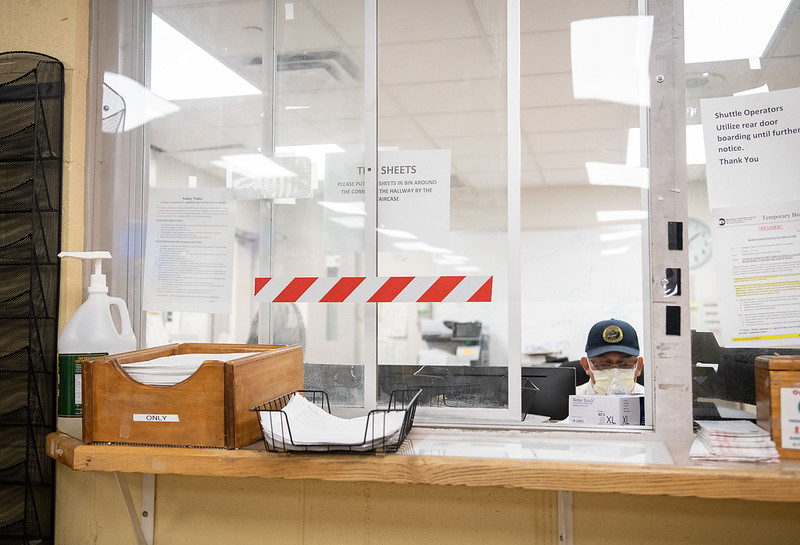
As the Covid-landscape meant that our ability to visually surveil bodies was diminished due to masks, barriers, and plexiglass partitions, our impulse to sonically surveil became heightened. Thus, many of us listened differently. Our fears of being surveilled were heightened by the fear of the Other—in this case, the fear of being othered as unwell. Our anxiety about the Covid cough was attached to ableism and the horror of being perceived as sick because, as Davis states, the “nightmare of the body is one that is deformed, maimed, mutilated, broken, diseased” (Normalcy: Link 7). The Covid cough reminded all of us that we are not as self-controlled and autonomous as we would like to think, and that we are all capable of being–or of becoming–a dissed (diseased or disabled), othered body, if we are not already.

But what if we could revisit the Covid cough and consciously listen to it in other, less fear-driven ways? If we move from listening to the cough as a surveillance practice and situate our listening as a critical rhetorical practice–a practice that examines the relationship of discourse and power and advocates for social change–then we can begin to think about what the Covid cough can teach us. Novak and Sakakeeny claim that sound only becomes known through its materiality. The Covid cough is indelibly material and embodied; it requires lungs and airways, breath and mucus. The Covid cough, distinguishable from other coughs, was described similarly by medical professionals around the world, reminding us that while listening is a highly cultured act, our sound bodies are comprised of blood, bones, and organs—substance that tethers our listening practices to a material body. We are, as Eidsheim claims in Sensing Sound, interconnected in material terms: “we cannot exist merely as singular individuals” (20). The stuff and guts of our material bodies reminds us of our connectivity, of our shared humanity, of our oneness.
The sound of the Covid cough, then, assures us of our vulnerability—a vulnerability precipitated by our lived, material body. It is important to note that not all individuals have been equally vulnerable. Individuals who are immunocompromised and essential workers, for instance, were much more susceptible to being exposed to the Covid-19 virus, as was anyone unable to work to home and many Black and brown Americans made more vulnerable by years of racist neglect by the nation’s health care system. But, still, no one is invincible. The sounds of the Covid-19 soundscape reify this truth and reinforce that through our material bodies, we are interconnected; we are all sound, and sounding, bodies.

Covid-19 brought, and is still bringing, daily horrors. The sounds of the Covid-19 soundscape are not yet absent from our consciousness or our communities. My hope is that by re-immersing ourselves into its soundscape, we can continue to remember that our fight against Covid-19 is a collective one and that we all have a shared responsibility toward our fellow humans. It is also important for sound studies to think critically and rhetorically about normalized listening practices and how those practices shape cultural understandings of what it means to be sick or disabled. Listening is not only an embodied practice; it also has bodily implications. While the Covid-19 soundscape heightened our awareness of our own vulnerability and, for some, their fears of “the other”—and (hopefully) some reflexivity on how one’s own listening can drive practices of othering—it also reassured many of our connectivity, for better or worse.
We remember those whose lives were lost to Covid-19. We listen to honor them and we listen to learn. . .and hopefully we can listen to one another with renewed empathy to build new collectivities that will forever change the Covid soundscape, along with the many other intersecting inequities that collectively brought us here too.
—
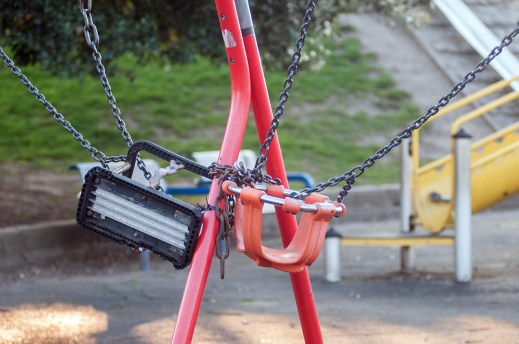
Featured Image: Coronavirus, Playground on Lockdown, Sheffield, UK, Image by Tim Dennell (CC BY-NC 2.0)
—
Sarah Mayberry Scott (Ph.D., University of Memphis) is Assistant Professor of Communication Studies at Arkansas State University in Jonesboro, Arkansas. Her research centers on representations and rhetorics of deafness. Scott is particularly interested in how sound impacts the Deaf community and how multi-modal literacies can be of particular interest and utility. She explores these issues in her works, “Re-Orienting Sound Studies’ Aural Fixation: Christine Sun Kim’s ‘Subjective Loudness,’” (2017), “Disability Gets Dissed: How Listening Rhetorically with Cultural Humility Amplifies the Concerns of Disability Culture,” (2021), and “Toward a More Just Rhetorical Criticism Through Situated Listening” (in press).
—

REWIND! . . .If you liked this post, you may also dig:
my mother’s voice, my father’s eye, and my other body: the sound of deaf photographs— Cara Cardinale
SO! Reads: Steph Ceraso’s Sounding Composition: Multimodal Pedagogies for Embodied Listening--Airek Beauchamp
SO! Podcast #79: Behind the Podcast: deconstructing scenes from AFRI0550, African American Health Activism – Nic John Ramos and Laura Garbes
Queer Timbres, Queered Elegy: Diamanda Galás’s The Plague Mass and the First Wave of the AIDS Crisis– Airek Beauchamp
Share this:

Critical bandwidths: hearing #metoo and the construction of a listening public on the web
“A focus on listening [with technology] shifts the idea of freedom of speech from having a platform of expression to having the possibility of communication” (K. Lacey)
One of the biggest social media event of the past decade, #metoo stands out as a pivotal shift in the future of gender relations. Despite its persistence since October 2017, #metoo is still under-theorized, and since its permutations generate countless hashtag sub-categories each passing week, making sense of it presents a conceptual quagmire. Tracing its history, identifying key moments, mapping its pro- and counter-currents present equally tough challenges to both data science and feminist scholars.
Meta-communication about #metoo abounds. Infographics and visualizations attempt to contain its organic growth into perceivable maps and charts; pop news media constantly report on its evolution in likes, counts, and retweets, as well as—and increasingly—in number of convictions, lawsuits, and reports. At the same time, #metoo has arguably created a discernible listening public in the way that Kate Lacey (2013) argues emerged with national radio: women’s stories have never been listened to with such wide reach and rapt attention.

The project I discuss here takes ‘hearing’ #metoo a step further into the auditory realm in the form of data sonification so as to to re-imagine an audience compelled to earwitness not just the scope but the emotional impact of women’s stories. Data sonification is a growing field, which from its inception has crossed between art and science. It involves a conceptual or semantic translation of data into relevant sonic parameters in a way that utilizes perceptual gestalts to convey information through sound.
Brady Marks and I created the #metoo sonification you’ll hear below by drawing from a public dataset spanning October 2017 to the early Spring of 2018 obtained from data.world. Individual tweets using the hashtag are sonified using female battle cries from video games; the number of retweets and followers forms a sort of swelling and contracting background vocal texture to represent the reach of each message. The dataset is then sped up anywhere between 10x to 1000x in order to represent perceivable ebbs and flows of the hashtag’s life over time. The deliberate aim in this design was to convey a different sensibility of social media content, one that demands emotional and intellectual attention over a duration of time. Given Twitter’s visual zeitgeist whereby individual tweets are perceived at a glance and quickly become lost in the noise of the platform the affective attitude towards “contagious” events becomes arguably impersonal. A sonification such as this asks the listener to spend 30 minutes listening to 1 month of #metoo: something impossible to achieve on the actual platform, or in a single visualization. The aim, then, is to interrupt social media’s habitual and disposable engagements with pressing civic debates.
A critique of big data visualization
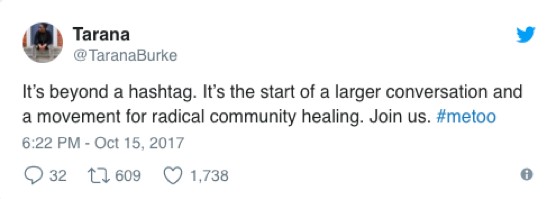
To date, there have been more than 19 million #MeToo tweets from over 85 countries; on Facebook more than 24 million people participated in the conversation by posting, reacting, and commenting over 77 million times since October 15, 2017. In a global information society ‘big data’ is translated into creative infographics in order to simultaneously educate an overwhelmed public and elicit urgency and accord for political action. Yet ideological and political considerations around the design of visual information have lagged behind enthusiasm for making data ‘easy to understand’. At the other end of the spectrum, social media delivers personalized micro-trends directly and in real time to always-mobile users, reinforcing their information silos (Rambukkana 2015). Between these extremes, the mechanisms by which relevant local, marginalized or emergent issues come to be communicated to the wider public are constrained.
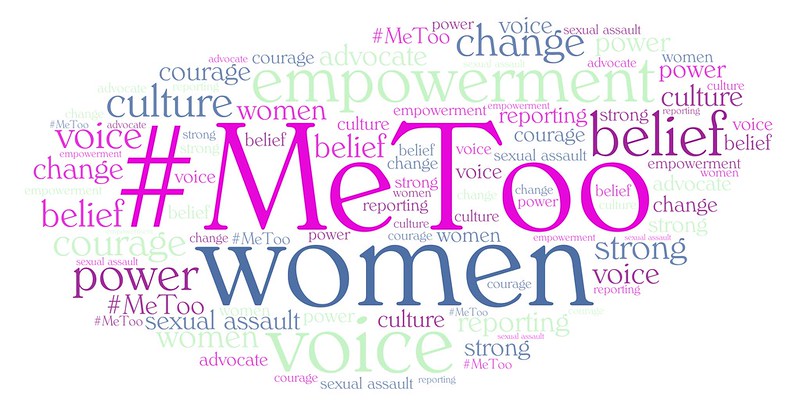
With this big idea in mind, the question we ask here is what would it mean to hear data? Emergent work in sonification suggests that sound may afford a unique way to experience large-scale data suitable for raising public awareness of important current issues (Winters & Weinberg 2015). The uptake of sonification by the artistic community (see Rory Viner, Robert Alexander, among many others) signals its strengths in producing affective associations to data for non-specialized audiences, despite its shortcomings as a scientific analysis tool (Supper, 2018). Some of the more esoteric uses of sonification have been in the service of capturing what Supper calls ‘the sublime’ – as in Margaret Schedel’s “Sounds of Science: The Mystique of Sonification.”
Who’s listening on social media?
Within the Western canon of sound studies “constitutive technicities” (Gallope 2011) or what Sterne calls “perceptual technics” embody historically situated ways of listening that center technology as a co-defining factor in our relationship with sound. Within this frame, media sociologist Kate Lacey traces the emergence of the modern listening public through the history of radio. Using the metaphor of ‘listening in” and “listening out,” Lacey reframes media citizenship by pointing out that listening is a cultural as well as a perceptual act with defined political dimensions:
Listening out is the practice of being open to the multiplicity of texts and voices and thinking of texts in the context of and in relation to a difference and how they resonate across time and in different spaces. But at the same time, it is the practice and experience of living in a media age that produces and heightens the requirement, the context, the responsibilities and the possibilities of listening out (198)
According to Lacey, a focus on listening instead of spectatorship challenges the implicit active/passive dualism of civic participation in Western contexts. More importantly, she argues, we need to move away from the notion of “giving voice” and instead create meaningful possibilities to listen, in a political sense. Data sonification doesn’t so much ‘give voice to the voiceless’ but creates a novel relationship to perceiving larger patterns and movements.
Our interactions with media, therefore, are always already presumptive of particular dialogical relations. Every speech act, every message implies a listening audience that will resonate understanding. In other words, how are we already listening in to #metoo? How and why might data sonification enable us to “listen out” for it instead? In order to get a different hearing, what should #metoo sound like?

Sonifying #metoo: the battle cries of gender-based violence
It is unrealistic to expect that your everyday person will read large archives of testimony on sexual harassment and gender-based violence. Because of their massive scale, archives of #metoo testimony pose a significant challenge to the possibility for meaningful communication around this issue. Essentially drowning each other out, individual voices remain unheard in the zeitgeist of media platforms that automates quantification while speeding up engagement with individual contributions. To reaffirm the importance of voice would mean to reaffirm inter-subjectivity and to recognize polyphony as an “existential position of humanity” (Ihde 2007, 178). This was the problem to sonify here: how to retain individual voices while creating the possibility for listening to the whole issue at hand. Inspired by the idea of listening out, myself and artist collaborator Brady Marks set out to sonify #metoo as a way of eliciting the possibility for a new listening public.

The #metoo sonification project intersected deeply with my work on the female voice in videogames. My choice to use a mixed selection of battle cry samples from Soul Calibur, an arcade fighting game, was intuitive. Battle cries are pre-recorded banks of combat sounds that video game characters perform in the course of the story. Instances of #metoo on Twitter presumably represent the experiences of individual women, pumping a virtual fist in the air, no longer silent about the realities of gender-based violence. So hearing #metoo posts as battle cries of powerful game heroines made sense to me. But it’s the meta layers of meaning that are even more intuitive: as I’ve discussed elsewhere, female battle cries are notoriously gendered and sexualized. Listening to a reel of sampled battle cries is almost indistinguishable from listening to a pornographic soundscape. Abstracted in this sonification, away from the cartoonish hyper-reality of a game world, these voices are even more eerie, giving almost physical substance to the subject matter of #metoo. Just as the female voice in media secretly fulfils the furtive desires of the “neglected erogenous zone” of the ear (Pettman 2017, 17), #metoo is an embodiment of the conflation of sex with consent: the basis of what we now call ‘rape culture.’
Sonifying real-time data such as Twitter presents not only semantic (how should it sound like) but also time-scale challenges. If we are to sonify a month – e.g. the month of November 2017 (just weeks after the explosion of #metoo) – but we don’t want to spend a month listening, then that involves some conceptual time-scaling. Time-scaling means speeding up instances that already happen multiple times a second on a platform as instantaneous and global as Twitter. Below are samples of three different sonifications of #metoo data, following different moments in the initial explosion of the hashtag and rendered at different time compressions. Listen to them one at a time and note your sensual and emotive experience of tweets closer to real-time playback, compared to the audible patterns that emerge from compressing longer periods of time inside the same length audio file. You might find that the density is different. Closer to real-time the battle cries are more distinctive, while at higher time compressions what emerges instead is an expanding and contracting polyphonic texture.
Vocalizations of female pleasure/affect, video game battle cries already have a special relationship to technologies of audio sampling and digital reproduction as Corbett & Kapsalis describe in “Aural sex: the female orgasm in popular sound.” This means that the perceptual technics involved in listening to recorded female voices are already coded with sexual connotations. Battle cries in games are purposely exaggerated so as to carry the bulk of emotional content in the game’s experiential matrix. Roland Barthes’ notion of the “grain of the voice”—the presence of the body in (singing) voice—is frequently evoked in describing the substantive role that game voices play in the construction of game world immersion and realism. In the #metoo sonification, I decontextualize the grain of the voice—there are no visual images, narrative, or gameplay; the battle cries are also acousmatic, in that there are no bodies visually represented from which these sounds emanate.
The battle cry in this #metoo sonification is the ultimate disembodied voice, resisting what Kaja Silverman (1988) calls the “norm of synchronization” with a female body in The Acoustic Mirror (83). As acousmatic voices, these battle cries could be said to exist on a different conceptual and perceptual plane, “disturbing the taxonomies upon which patriarchy depends,” to quote Dominic Pettman in Sonic Intimacy. (22). In other words, the sounds exist in a boundary space between combat sounds and orgasmic sounds highlighting for the listener the dissonance between the supposed empowerment of ‘speaking out’ within a culture that remains staunchly set up to sexualize women; something one can hardly ignore given the media’s reserved treatment of #metoo.

Liberated from the game world these voices now speak for themselves in the #metoo sonification, their sensuality all the more hyper-real. The player has no control here, as the battle cries are not linked to specific game actions, rather they are synchronized autonomously to instances of #metoo confessionals. In fact, the density of the sonification as time speeds up will overwhelm listeners with its boundlessness; echoing how contemporary media treats the sounds of the female orgasm as a renewable and inexhaustible resource, even as reports of sexual harassment and gender-based violence continue to pile on in 2021. Yet we intend that the subject matter resists pleasure, rendering the sonic experience traumatic as the chilling realization sets in that listeners are hailed to accountability by #metoo. The experience should instead be unsettling, impactful, grotesque, and deeply embodied.
Concluding remarks
Listening both metaphorically and literally goes to the very heart of questions to do with the politics and experience of living and communicating in the media age. In her paper on the sonic geographies of the voice, AM Kanngieser notes in “A Sonic Geography of Voice“: “The voice, in its expression of affective and ethico-political forces, creates worlds” (337). It is not just in the grain but in the enunciation that battle cries find their political significance in this sonification. As the hyper-real gasps and moans of game heroines animate individual moments of #metoo the codification of cartoonish voices resists being subconsciously “absorbed into the dialogic exchange” (342) of habitual media consumption. Listening to the sonification is instead an experience of re-coding the voice, reconfiguring the embedded meanings of game sound to a new and contradictory context: a space that challenges neoliberal appropriations of radical communication and discourse (348). This is not data sonification that delights the listener or simply grants them access to ‘information’ in a different format; rather it calls on the listener to de-normalize their received technicity and perceptions and to connect to the emotional inter-subjectivity of this call to action.
Most importantly, the #metoo sonification invites the auditeur to listen in, to take an active role in the reconfiguration of meanings and absorb their political dimensions. These are the stories of #metoo; these are the voices of women, of men, of marginalized peoples, emerging from the zeitgeist of Twitter to ask us to earwitness gender-based violence. We are a new listening public, wanting and needing to create new worlds. A critical bandwidth is the smallest perceivable unit of auditory change, in psychology terms. This sonification begs the question, how many battle cries will it take for us to end gender-based violence by fostering equitable worlds?
—
Featured Image: “Listen to What You See” by Flickr User Hernán Piñera (CC BY-SA 2.0)
—
Milena Droumeva is an Assistant Professor and the Glenfraser Endowed Professor in Sound Studies at Simon Fraser University specializing in mobile media, sound studies, gender, and sensory ethnography. Milena has worked extensively in educational research on game-based learning and computational literacy, formerly as a post-doctoral fellow at the Institute for Research on Digital Learning at York University. Milena has a background in acoustic ecology and works across the fields of urban soundscape research, sonification for public engagement, as well as gender and sound in video games. Current research projects include sound ethnographies of the city (livable soundscapes), mobile curation, critical soundmapping, and sensory ethnography. Check out Milena’s Story Map, “Soundscapes of Productivity” about coffee shop soundscapes as the office ambience of the creative economy freelance workers.
Milena is a former board member of the International Community on Auditory Displays, an alumni of the Institute for Research on Digital Learning at York University, and former Research Think-Tank and Academic Advisor in learning innovation for the social enterprise InWithForward. More recently, Milena serves on the board for the Hush City Mobile Project founded by Dr. Antonella Radicchi, as well as WISWOS, founded by Dr. Linda O Keeffe.
—
REWIND! . . .If you liked this post, you may also dig:
“One Scream is All it Takes: Voice Activated Personal Safety, Audio Surveillance, and Gender Violence“—María Edurne Zuazu
Gendered Sonic Violence, from the Waiting Room to the Locker Room–Rebecca Lentjes
SO! Amplifies: Mendi+Keith Obadike and Sounding Race in America
detritus 1 & 2 and V.F(i)n_1&2 : The Sounds and Images of Postnational Violence in Mexico–Luz María Sánchez
Hearing Eugenics—Vibrant Lives
Share this:


Current Top Posts





April 2021

January 2020

November 2019

October 2019

August 2019

April 2014

November 2017

March 2015

December 2017

October 2015
 Sounding Out!
Recent Comments