
One Nation Under a Groove?: Music, Sonic Borders, and the Politics of Vibration
 Welcome to week three of our February Forum on “Sonic Borders,” a collaboration with the IASPM-US blog in connection with this year’s IASPM-US conference on Liminality and Borderlands, held in Austin, Texas from February 28 to March 3, 2013. The “Sonic Borders” forum is a Virtual Roundtable cross-blog entity that will feature six Sounding Out! writers posting on Mondays through February 25, and four writers from IASPM-US, posting on Wednesdays starting February 6th and ending February 27th. For an encore of weeks one and two of the forum, click here. And now, get up and get ready for Marcus Boon, because there’s no parking on the dance floor at Sounding Out!–JSA
—
What borders remain when it comes to thinking about sound today? The field of sound studies has exploded in so many far-flung directions in the last few years. However, I argue that what is still somewhat off limits in the field is a consideration of the ontological status of sound: in other words, what it means to understand our own being in the world as a sonic phenomenon. Out of attempts to approach this sonic ontology, comes the realization that there are prohibitions, perhaps universal ones, on thinking about sound in this way, and from that emerges what I call the politics of vibration.
For those, such as myself, who have grown up as a part of sonic subcultures, it is not difficult to ponder sonic ontologies, for the simple reason that many of the most intense and powerful experiences we have had have occurred on dance floors or at clubs, as DJs, musicians, clubbers and/or listeners. I still remember the moment of first hearing Funkadelic’s “One Nation Under a Groove” blasting through the speakers at a Pop Group gig at the Electric Ballroom in London in the late 1970s: tumbling polyrhythms, polyphony, polysexuality, polyeverything. The feeling was: “wow, the universe contains this! And it contains other people who know what it is!” And contrary to the warnings of Slavoj Zizek concerning the “autistic jouissance” to be found at the limits of language, here we all were: high; the histories of Afrodiasporic displacement and solidarity echoing off the walls; our own implication in those histories illuminated; flickering between utopia and shame.
To quote Eric Satie: “When I was young they told me: You’ll see when you’re fifty. I’m fifty. I’ve seen nothing.” Me too. But I’ve heard a lot and I still experience that same power of sound in more or less the same way. If anything, sound’s power is more intense and surprising, each time it appears. Partly because I have learned how to be a social being through sound—how to love and be loved—enabling me to be more open to its impact than I was as an awkward youth. It makes me sad the way in Canada and elsewhere in el Norte people seem to lessen their involvement in the more intense aspects of sound cultures as they hit 30 or 40. It makes me sad that my four-year-old son rarely gets to hear a real sound system. I look for music at carnivals, weddings, community centers, on the beach. . .anywhere that those age barriers are ignored. Even as a DJ, I increasingly look for new or different kinds of publicness than that of club or dancehall.
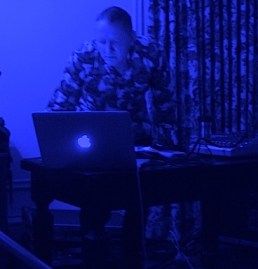
Marcus Boon DJ-ing, image by JSA
Still, I do wonder. Was the movement into sonic subcultures that my generation (and those that followed) made–especially in the UK where music (and intoxicants, and immigration) were one of the few escape routes from the brutalities of Thatcherism–a mistake, precisely because we accepted as ontological, a structure that in fact was smoothly integrated into the operations of late capitalism? From the Factory and Paradise Garage to Berghain or Ministry of Sound. . . how will history look on the era of the mega-club?
Although one could argue that the Internet put an end to the idea of subculture, since it breaks down the locality and secrecy around which particular subcultural communities grow, in fact what seems to be happening is an acceleration in the generation and dissolution of subcultural formations. Hip-hop has adapted very quickly to the internet. The cassettes or CD-Rs sold out of DJ Screw’s record store in Houston, Texas, for example, morph into the world of online mixtapes, Youtube clips and Twitter battles; the gray market availability of samples sounds a lacuna of time, appearing for a day on a hosting site rather than flying below the radar in some particular geographical location. At the same time, sonic subcultures are expanding around the world. If Jacques Attali was right that sound is prophetic, then #idlenomore was announced by Ottawa Native dubstep crew A Tribe Called Red; Tahrir Square by Chaabi and North African hip-hop.
In his book 1989, Joshua Clover describes popular music in the period of neo-liberal globalization as the sound of ideological containment. It’s true that popular music is full of ontological claims about sound, of music that celebrates setting us free. . .but which fails to actually do so. A quote from Ray Brassier just came up on my Twitter feed:

If true, this would suggest that the intensity of moments of sonic jouissance does not necessarily mean anything in terms of ontology or the truth about what’s Real. It could be entirely delusional.
All of which might be true. We might come to realize that, to put it in Heideggerian terms, we’ve been thrown into this, and that maybe there’s not much difference between being thrown and being played. But somehow I think people on dancefloors already know this. The dramas of seduction, commitment and loss are at the core of disco, and many other kinds of popular music too. To quote the disco classic “Lost in Music” by Sister Sledge (later covered by post-punks The Fall):
We’re lost in music; caught in a trap.
No turning back. We’re lost in music.
We’re lost in music. Feel so alive.
I quit my nine-to-five. We’re lost in music.
Other examples are not lacking.
Perhaps sound and music border on a vibrational ontology, rather than being truly the core of one. This is why, as Michael Taussig, Jayna Brown, and others have suggested, they can be concerned with healing. Perhaps any practice that is meaningful — and sonic subcultures are certainly a matter of practice, as Julian Henriques indicates in his book Sonic Bodies — must necessarily work at the boundary of a space that it can never entirely inhabit as a practice, but which it can push one towards, and also receive one from. The anticipation, fear, desire before one goes out, for example, but also the blinding daylight, the sensation of cool air on exposed skin when one leaves a dancehall or a party.

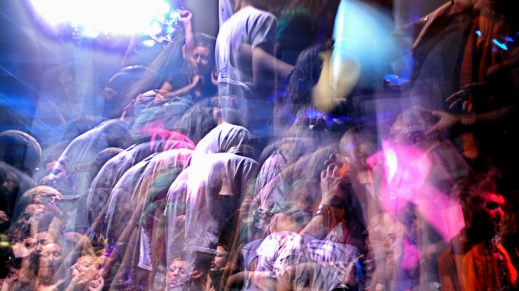
Lasers in a dance club, image by flickr user gabriel.jorby
Sound studies has not truly begin to explore these moments of exposure to and abjection from the vibrational core of sound. No doubt, Steve Goodman performed heroic work in Sonic Warfare—which sets out a proposal for a vibrational ontology in the midst of the commodification and militarization of the sonic —as have various explorations of the phenomenology of sound, such as those in Salome Voegelin‘s Listening to Noise and Silence. Yet in both cases, a full consideration of sonic ontology is in the end foreclosed. In Goodman’s case by Sonic Warfare’s emphasis on the militaristic applications of sound and vibration that are appropriated by sonic art and subcultures, which gives the violence of sound and vibration something like ontological status, while the aesthetic and cultural “uses” of the same have only a secondary, somewhat parasitic status. Conversely, in Voegelin’s work, an emphasis on the phenomenological rendering of the moment or event of sonic relationship forecloses a broader investigation of sonic ontology, because it “brackets” (to use Husserl‘s term) considerations beyond that of the subject-object relationship. In both cases, the sonic thing in itself, or indeed an ontology of vibration, risks being lost.
The recent turn to the speculative and to realism in philosophy has yet to make an impact in sound studies, despite the fact that the object of sound presents a provocative and very intimate entry point to that problematic. One of the more intriguing and improbable hypotheses emerging from the speculative realist movement is that of Quentin Meillassoux, who, in After Finitude, makes an argument that speculative knowledge of the real, unmediated by correlation with the Kantian subject, is possible through mathematics. It is roughly Alain Badiou‘s thesis in Being and Event too. As much as music is clearly about the contingency of sonic experience, there are strong arguments, going back to Pythagoras and beyond, about the relation of music to mathematics. Natural harmonics, rhythm: the elements of music express mathematical relationships. I am not interested in reducing music to a kind of vulgar scientism. But what if when we listen to music, we are exposed to a mathematical ontology and at the same time, the contingency of an unprecedented event? What if music is speculatively real? The word “speculative” here would refer not to philosophical propositions, but to the uncanny movement across subject/object individual/collective borders that the sonic matrix offers when “we” listen to “it.” Music not as the source of a speculative discourse on the real, but a speculative practice in which order and contingency meet.

A cymatic image, made by sound vibrations on a visible medium by flickr user evan grant
Genres, styles form around places of cohesion, of transport, of passage. Not an instrumental mathematics (though it can be that too), but a speculative one that seeks out locations of collective affect, of resonance between micro and macro spheres. It matters little whether a specific knowledge of mathematics is invoked here, since many traditional musics find their way to structures that, according to scholars such Alain Danielou, already express mathematical relationships. And in this way, music and musicians can be said to participate in a sonic ontology.
Reluctantly perhaps. Ready or not. The question remains: how many institutional, historical, disciplinary, intellectual, social and political barriers remain in order that a cultural artifact like “One Nation Under a Groove” can be considered to have ontological significance? That is what I mean by the politics of vibration, and in terms of borders, it’s an important set of borders for researchers in sound studies to consider.

Tyler, the Creator crowdsurfing, image by flicker user choe.brandon
Much of my current work focuses on tropes of abjection in recent hip-hop and RnB music, notably that of Odd Future members Tyler, the Creator and Frank Ocean, artists like Azealia Banks, and a new generation of queer rap MCs emerging out of New York City such as Zebra Katz, Le1f and Cakes Da Killa. All of their work is bracingly obscene, funny, violent. . .a tumbling deck of cards of performances of gender, race, sexuality, class and more. Of course, cursing to a beat is nothing particularly new, but the way in which these artists multiply and collapse identities to an ever more minimal, humming beat perhaps is.
Katz’s remarkable “Ima Read” and its equally remarkable video is a case in point. Although Katz occasionally claims dryly that the song is “pro education,” the “reading” in question mostly refers to the drag queen balls of the Harlem ballroom/voguing scene of the late 1980s/early 1990s, where to read meant to verbally trash, i.e. abject, someone at a ball. The song is rapped by male and female voices, crisply denouncing a “bitch” who they are going to “take to college.” The violence of the song is ironic, as much a marker of queer community and Eros as of sexual difference, of racial and trans-racial solidarity as much as racialized violence. It is performed over a minimal beat with a humming, in-your-face bass drum that is the only recognizable tonal element.
Why make the leap to talking about ontology in discussing this admittedly awesome Youtube clip? Both Judith Butler’s famous elaboration of the performativity of gender, one of the bases of queer theory, and Katz and friends play with taboos concerning gender, sexuality and race in contemporary hip-hop emerge from that moment of the ballroom scene.
But what if Butler’s emphasis on performance actually covered up or abjected the ontological nature of experiments at the balls? Perhaps we need to rethink why the ultimate ball anthem is Cheryl Lynn’s “Got To Be Real.” What is sonic ‘realness’? In restoring the sonic dimension to the ballroom scene, and learning, from Zebra Katz, to face that constitutive abjection that Kristeva amongst others has pointed us towards, we can begin to feel for ourselves what a vibrational ontology is.
—
My thanks to Catherine Christer Hennix, Steven Shaviro, Kevin Rogers and Ken McLeod for conversations that helped me in thinking this through, and to Jennifer Stoever-Ackerman for luminous remix skills.
—
Featured Image by Flickr User depinniped
—
Marcus Boon is associate professor of English at York University in Toronto, and was a Fellow at Cornell’s Society for the Humanities in 2011-12. He is the author of The Road of Excess: A History of Writers on Drugs (Harvard UP, 2002) and In Praise of Copying (Harvard UP, 2010). He writes about contemporary music for The Wire. He is currently co-editing a book on Buddhism and critical theory, and a new edition of William S. Burroughs and Brion Gysin’s The Third Mind. He is also working on a book entitled The Politics of Vibration.
Share this:

Music Meant to Make You Move: Considering the Aural Kinesthetic

“Dance!” by Flickr user Clearly Ambiguous, under Creative Commons License 2.0
In the two weeks prior to my drafting this piece, the world lost Adam “MCA” Yauch, Robin Gibb, Donna Summer, and Chuck Brown. In their wake they leave a profound legacy of music, yes, but of dance music particularly. MCA declared your right to party while demonstrating that white MCs aren’t always gimmicks. The BeeGees gave you a new strut courtesy of the bounce-funky soundtrack to Saturday Night Fever. The goddess Donna Summer seduced your ears with her orgasmic whispers, then pumped up the pulsating synthetic beats that brought the discotech from its urban centers directly to you. And go-go’s blaze, though not as far-reaching as disco’s, grew out of Chuck Brown’s musical sensibility, and burned deep in the hearts of Chocolate City natives. For all of these artists, moving to the music isn’t merely a possibility or inclination, but a deeply irresistible impulse. Altogether, these artists brought music that not only called out to people to dance, but if you didn’t dance you missed something essential: the inextricable ties between music and movement. One acts as a key that opens up a dimension to understanding the other.
Seeing people dance to a live go-go band taught me how to appreciate their music. When I finally heard go-go for the first time at a club in 1995, it challenged my musical sensibilities, which were more attuned to smooth R&B and jazzy Hip Hop. By then, go-go music seemed so fast, and coupled with the multiplicity of drums that I didn’t know how to get inside of the groove. In the midst of the bubbling fervor I stood noticeably still as the young woman next to me ripped the shirt off her sweaty body and whipped it above her head (like a flag at carnival), never once missing a beat in her frantic jumping and pumping to the live drums while wearing only her bra and a pair of jeans. The dancing bodies of the whole club fueled my understanding, and by extension appreciation, of what go-go does. Without them, I would have missed out on something deeper.
I am drawing your attention both to music meant to make you dance and dancing that is necessarily done to music—i.e the arena of social dance. Julie Malnig, in Ballroom, Boogie, Shimmy Sham, Shake: A Social & Popular Dance Reader, defines “social dancing” by “a sense of community often derive[d] less from preexisting groups brought together by shared social and cultural interests than from a community created as a result of the dancing” (4, emphasis in original). That might include social dances that correspond to particular songs, or called and standardized steps, like the twist or the electric slide. My focus is more broadly on a visceral, embodied, kinesthetic response to dance music in a particular social space, which is not explicitly directed by the lyrics or a set of moves but by the feel of a song as a whole. In the Hip Hop social dances I write about, rather than a finite set of moves there are infinite possibilities for improvisational play within a particular style (like b-boying or popping) that the music draws out of the dancer. As David F. García states in his piece on mambo titled “Embodying Music/Disciplining Dance: The Mambo Body in Havana and New York City,” “the embodied experience of sound and movement [are] merged through the body” (172).
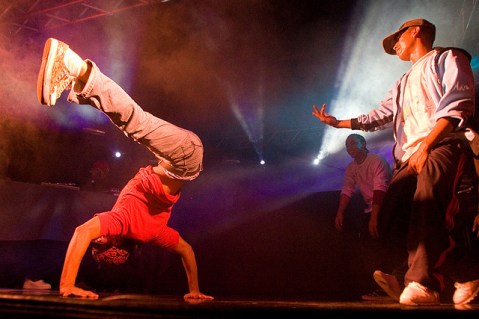
Break Dancing en Costa Rica, 2009 by Flickr User Néstor Baltodano, under Creative Commons License 2.0
I have come to name the frame for analyzing the simultaneity of social dance and music (and sound broadly) as aural-kinesthetics. While these words capture sound and movement separately, together I am looking to engage more than just the sensory response of moving to what one hears. The term develops out of works by music scholars like Kyra Gaunt (The Games Black Girls Play: Learning the Ropes From Double Dutch to Hip Hop), Kodwo Eshun (More Brilliant Than the Sun: Adventures in Sonic Fiction), and Kai Fikentscher (“You Better Work!”: Underground Dance Music in New York City), who shift our orientation to music and rhythm by drawing on our kinesthetic responses to it. Aural kinesthetics recognize that social dance practices are kinesthetic forms within the all-encompassing aurality of an environment. I use spatial terms to acknowledge sound’s omni-directionalality, coming at you from all sides and helping to actually produce the social dance place. In other words, the aural kinesthetic is also a kind of spatial practice (along the lines of Henri Lefebvre’s The Production of Space). For example, consider how a bomba dancer orchestrates the primary bomba drummer’s rhythms within the rhythmic arena created by the second and tertiary drummers; or how loud music in street dance performances fills the immediate surroundings and bleeds out into other areas, attesting to their capacity to claim public spaces (the volume has volume). Music in particular plays a fundamental role in establishing the conceptual performance arena that ultimately makes the physical space functional for certain dance practices.
Despite the fact that social dances necessarily have a musical component, dance is typically overdetermined by the visual, which in Western cultures we are better equipped to address. The sound and feel of dance experiences are often overridden by the spectacle of dancing, which the following clip demonstrates. In this clip showcasing the final battle from the 2007 Freestyle Sessions in Los Angeles, the spectacle of these amazing dancers distracts you from the actual social dynamics of their battle, of which music is central.
.
The exchange between dancers is truncated, spliced together for dramatic effect. You focus on the center of the cypher, lost in the visual thrill of it all. The song they were actually dancing to is replaced by another that, though danceable, prevents us from appreciating a particular song’s nuances as well as the crowd and emcee’s involvement in the event. Overdubbing songs that you do not have clearance for is in compliance with copyright laws that force the video’s producers to instead play songs to which they have legal access, in sacrifice of aural-kinesthetic experiences the videos attempt to capture. Yet even in cases of the below clip where we hear the original song, the recording cannot capture the quality of the force of the music that is loud enough to feel throughout your entire body, thereby promoting a shared sensorial experience in the room. Whether one is recording with a camera or in writing, capturing the aural-kinesthetic can be tricky.
2009 Dutch B-Boy Championships Semi-Finals between Hustle Kids and Rugged Solutions
For me, the aural-kinesthetic is useful insofar as it opens up creative space for me in writing the simultaneity of sound and movement. Scholars like Mary Fogarty (Dance to the Drummer’s Beat: Competing Tastes in International B-Boy/B-Girl Culture) have approached the topic by distinguishing between notions of musical taste and musical competency in clarifying the contours of b-boying’s dance-music relationship. In my own writing, I’ve tended toward storytelling and descriptive analyses. In contrast, considerations such as those of Roland Barthes’ “The Grain of the Voice” (in Image, Music, Text) propose to expand the language on (vocal) music in general by shifting the object of analysis to create new ways of writing music, which we can extend to writing social dance.
So what is a productive approach for writing the aural-kinesthetic? I’m not prescribing a method, but I do want to consider the possibilities of shifting the focus of analysis in such a way that it allows for the simultaneity of music and movement. For example, there may be value in examining a gesture repeatedly made to a particular part of a song to understand what that song is doing; or examining the physical layout of a room and how that space gets used through the song that fills it. Perhaps coming at social dance indirectly and on multiple fronts makes for a richer depiction.
For now, let’s take advantage of this digital space and collectively consider our options. Here’s a task I hope you might take up: post a link to a song or a video clip that makes you move. Describe some quality of your visceral response to the song and place your thoughts in the comments section below. Include the multiple fronts that help you to articulate your experience. While music and dance have the capacity to “speak” in ways that verbal language cannot always reach, my hope is that a range of possibilities might get us there. or at least much closer.
—
Dr. Imani Kai Johnson is a Ford Dissertation Fellow, who has just completed a three year postdoctoral fellowship at NYU’s Performance Studies Department. She received her PhD in American Studies & Ethnicity at the University of Southern California in 2009, where she wrote a dissertation titled,”Dark Matter in B-Boying Cyphers: Race and Global Connection in Hip Hop,” which considers the cultural and performative dimensions of Hip Hop dance as a global phenomenon through cyphers (dance circles), and the invisible forces of the collaborative ritual. Dr. Johnson is currently completing a manuscript based on her dissertation.
Share this:


Current Top Posts





April 2021

January 2020

November 2019

October 2019

August 2019

April 2014

November 2017

March 2015

December 2017

October 2015
 Sounding Out!
Recent Comments