
Contra La Pared: Reggaetón and Dissonance in Naarm, Melbourne

 In “Asesina,” Darell opens the track shouting “Everybody go to the discotek,” a call for listeners to respond to the catchy beat and come dance. In this series on rap in Spanish and Sound Studies, we’re calling you out to the dance floor…and we have plenty to say about it. Your playlist will not sound the same after we’re through.
Throughout January, we will explore what Spanish rap has to say on the dance floor, in our cars, and through our headsets. We’ll read about trap in Cuba and about femme sexuality in Cardi B’s music. And because no forum on Spanish rap is complete without a mixtape, we’ll close out our forum with a free playlist for our readers. Today we continue No Pare, Sigue Sigue: Spanish Rap & Sound Studies with Lucreccia Quintanilla’s essay on reggaetón and Latinx identity in Australia.
Liana M. Silva, forum editor
—
The first time I heard Cypress Hill was at my fellow Salvadoran friend’s house in the outer suburbs of Brisbane, Australia. She was wearing big baggy clothes and announced that we needed to go in her room the very minute I arrived. So, we left our parents to talk in the lounge room and we sat on her bed and listened. Latin rap had arrived in my life! In the world of pop and the Latin American classics we kept hearing at quinceañeras, here was something new and energetic for us. It was our language, our people: in this way it provided a much needed connection to the outside world for us who existed in what was then quite a small and freshly arrived Latinx community. The place we found ourselves in was particularly racist, and for a moment we felt acknowledged and could just be proud of being who we were. The trumpets and snippets of familiar sounds mixed in with hip hop activated the familiar. But these Latinxs did not even try to be “good” migrants like we did. This was so refreshing to me.
It has been a long time since I was a fifteen-year-old, freshly arrived in Australia, in a classic story that involved fleeing from the Salvadoran Civil War and a period of migration to New York before finally landing in Australia. Pretty soon after arriving, I realised that Australia was not the place that I had seen in the documentary back in El Salvador about Indigenous people here. The one where thousands of years of culture were acknowledged and respected. Slowly, I came to the understanding that I too was a settler on this land at the expense of its indigenous people. Colonisation remains a continual process, and the effects of The White Australia Policy, which excluded non-European migrants until the late 1970s, is still clearly evident in the current political climate, epitomised by the treatment of asylum seekers coming from mainly Afghanistan, Iran, and Sri Lanka to these shores.
Because of Australia’s geographical and cultural disconnect it seemed rather difficult to find a space that was not an oversimplified or commodified version based on stereotypes of “Latinness” because of the relatively small communities where they played the old classics and followed traditions nostalgically closer than our relatives back home. As for me, back in El Salvador, I listened to the live music–which were mostly salsa and cumbias–playing in the party hall behind my house while I slept, which had an obvious and subliminal impact on me. I spent years humming Ivy Queen’s “Muchos Quieren Tumbarme” to myself until the day a decade later I sat down determined to find the original on Youtube. With all the might one has to muster to not be swept up by the broom of assimilation, I was exhausted and I had not found the time to listen to the music that was present in parts of my mind—and those parts were beginning to lose patience.
Until recently, World Music held Latin music as part of its domain at Multicultural events and festivals in mainstream Australia. Listen, there is nothing Latinxs love more than having our culture appreciated. We love it when non Latinxs also rush to the dance floor, liquid spilling out of their drink glasses, unable to keep up with the rush of the body that happens when Daddy Yankee’s “Gasolina” comes on. However, my focus here is to bring those who are ancestrally implicated in the music to the front. Music is where the multiplicity of Latinx cultural narratives converge, past, present and future all at once. This is what propelled me to finally take up DJing in my mid-twenties: I wanted to explore this way of telling stories at a time when I remembered how my body wanted to dance and I didn’t hear the right music for it around me. I spoke to some people who are engaging with and making space for themselves and others around reggaetón and Dembow. What follows are snippets of our online conversations.

“EDM / dance / festival” by Flickr user Patrick Savalle, CC BY-SA 2.0
In a place, haunted so actively by the cruelty of colonialism and so suspicious of difference it makes sense that music like reggaetón with its relentless beat becomes a disruption to a muffling veneer of politeness and civility. It is our punk! Peruvian– Australian writer, DJ and event producer Triana Hernandez aka Airhorn Mami sees a politics of disruption in the music she plays. In response to some questions I posed she writes:
Music has historically always been a healing and therapeutic experience, and this continues to be the case today. I think about how White Australia has a huge disease called National Amnesia, a mental illness mostly enforced by silencing and lacks of moments of self-expression I think perreo/dembow/etc. have a really Caribbean or sun-filled, upbeat mood and bass-heavy nature so it is somehow like feeding Vitamin D into people. It’s just really liberating and playful sounds.
For me, finding my own voice within the music of La Hill, Ivy Queen, and lately Tomasa del Real and Amara La Negra, amongst others has been a really exciting feminist moment. It is a feminism very far away from the offensive lyrics that have given the genre a bad name, but also from the prevailing privilege that infuses Western feminism here. Within a mainstream charged with expectations of emotional and sexual repression, music like reggaetón presents another possible way of existing as a woman: as one who tells it like it is, is proud of her sexuality and aware of her body, her community and her culture.
Argentinian/Australian community worker and DJ Rebeca Sacchero founder of Nuestro Planeta, a queer, feminist collective, describes her experience of navigating the contradictions that exist within reggaetón:
Eliza and I really wanted to make a femme-energy heavy party where people who are female, non-binary, trans, or queer would be able to feel welcome to enjoy music that isn’t always welcoming in its lyrical content or in the spaces it dominates. Being Latinx for me is fraught with contradictions, for example my staunch feminism and then deeply held cultural values which view gender and sexuality in ways which depart from western conditioning. I see these tensions and contradictions as beautiful yet difficult and I see the same things play out in the music I enjoy.
…That said, a lot of the music we love comes from unsafe spaces and is born from resilience and tension, so we appreciate and honour the magic that comes from having a diverse crowd and try to have patience and love for everyone and understand that knowledge about how to behave in a club space is a privilege. My work as a youth worker has also had a huge impact on Nuestro Planeta. I work in Fitzroy, running graffiti and djing programs mostly with young people from the housing estates in the city of Yarra and young people in and out of home care. Skating, graffiti, rap music, clubbing and art are all ways young people resist oppressive structures and I think that they are all beautiful and important, so my events need to be a space that offer an alternative to an oppressive structures not mimic one
On a more experimental front Galambo, the solo live project by Chilean-Australian Bryan Phillips who works with beats such as Dembow and Cumbia as well as experimental sound production, poetically describes the conversation that takes place as he performs:
Doing the Galambo is a process where composing and performing occur at the same time—specific to site, time and people. My joy is trying to join with people in an embodied experience—a sonic ritual—through electronic dance music. Electronica de raíz, embracing electronic music from its material roots.
Sound like river. Son las vertientes—the streams of altered states of consciousness, that meander and bifurcate and join waters. The main body being the sonido rajado—the torn sound of the Bailes Chinos of the southern Andes—el sonido originario. The loud and dissonant flutes or pifulcas that resonate through the valleys, from the highest altar¬—Andacollo. The Andean dissonance that resists and brings difference to the coloniser culture of taming the sound through equal tempered pitches and harmony itself. That performing involves everyone present, en el presente.
These are narratives articulated via sounds and fragments that activate memory while becoming new. Importantly, these sounds give voice to an ongoing mythology, to a landscape that has seen and interacted with generations of the artists’ ancestors to be transmitted via echoes across the ocean thousands of miles away and as Galambo puts it in the “present.”
There has been a surge of reggaetón and Latin trap on the mainstream charts all around the world; not only are these beats “spicy” and contagious but they are also a type of living cultural archive. Latinx people find ourselves there in the indigenous tempo, Africa via the Caribbean, the undeniable middle eastern presence via rhythms, and in there is also colonisation in the Spanish lyrics and the U.S. twangs amongst other things. We don’t need to read books for this. We know and feel these stories. There are more experimental artists working in the genre all over the world that want to highlight different aspects of this history, namely the indigenous and Afro-Latinx artists Kelman Duran and Resla, and Tayhana, and producers and DJs like Riobamba. Thank you, Soundcloud!
It has been hard over the years to imagine creatively generative discussions around reggaetón in Australia as community building that also acknowledges both its negative and productive aspects and that engage with ideas around gender and experimentation. Reggaetón is even entering the club scene being sprinkled over the techno sets of Melbourne. As an artist, it has been completely worth the wait because in an art world still largely focussed on an inclusion/exclusion binary, experiencing people creating space around culture via music is pretty exciting. By doing so, artists on the margins of a Western mainstream are not waiting to be let in but creating our own space on our own terms, outside of presenting generic stereotypes. Instead this is a dynamic alive and growing space. Bryan Phillips expands on his creative process and his role as creating music in Australia:
I converse in a process of embodiment of sound, en el presente, that allows for the voice to emerge, that sings in huaynos, punk rock and cantos a lo humano, somehow always in español. I speak with el Pueblo, through Violeta Parra and the lineages of poetas populares. La Nueva Poesía Chilena-La Nueva Canción. Cecilia Vicuña, shamana poeta, the songs that teach us so much. That teach us to care. That performing is a subversive political act in itself. That performing involves everyone present, en el presente. That it sings in a voice that is indígena and feminista.
Phillips is right, it is political and life-giving to play and dance to this music. Perhaps the misogynist ‘catch cry: ‘contra la pared’ – against the wall- can mean something new to the Latinx community in this far away diaspora. It can connote something of solidarity and identification with our siblings and cousins in Latin American and the U.S.A. who are enduring tougher times.
Editor’s note: tune in next week, when we will release a mixtape by Lucreccia Quintanilla to accompany this post.
—
Featured image: “DJ” by Flickr user Ray_LAC, CC BY 2.0
—
Lucreccia Quintanilla is an artist/DJ/writer and PhD candidate at Monash University in Naarm, Melbourne, Australia.
—
 REWIND!…If you liked this post, you may also dig:
Unapologetic Paisa Chingona-ness: Listening to Fans’ Sonic Identities–Yessica Garcia Hernandez
Share this:

The Theremin’s Voice: Amplifying the Inaudibility of Whiteness through an Early Interracial Electronic Music Collaboration

On an October evening in 1934, Clara Rockmore made her debut performance with the theremin, a then-new electronic instrument played without touch, in New York City’s historic Town Hall. Attended by critics from every major newspaper in the city, the performance not only marked the beginning of Rockmore’s illustrious career as a thereminist, it also featured the first known interracial collaboration in electronic music history. A sextet of Black male vocalists from the famous Hall Johnson choir performed a group of spirituals arranged by Johnson with Rockmore, whom the press—apparently unaware of her Jewish heritage—considered white. The collaboration was an anomaly: no other record exists of Black musicians performing with Rockmore (she toured with Paul Robeson in the 1940s, but no evidence has surfaced showing the two ever on stage together).
Though the Johnson Sextet’s performance with Rockmore is of intense interest to me as a historian, at the time the white press mostly ignored the collaboration. This is surprising given Johnson’s fame: his choir and work were critically acclaimed in productions including the 1930 Pulitzer-Prize-winning play The Green Pastures and the 1933 musical Run Little Chillun’. The Sextet’s spirituals were prominently featured in Rockmore’s debut, with four songs closing the program (“Stan’ Still Jordan,” “Swing Low, Sweet Chariot,” “Water Boy,” and “O Lord Have Mercy On Me”) and “Old Man River” likely serving as an encore. Yet only two writers—one Black, one white—discussed the spirituals in any detail. Though brief, these two reviews can help us understand why most critics ignored the spirituals at Rockmore’s debut, and illuminate the role that race played in the reception of Rockmore’s career, the theremin, and electronic musical sound.
One of these reviews was by an anonymous critic writing for the New York Amsterdam News, the city’s highly influential weekly African-American newspaper. Though unidentified, the author was likely Black, given the source. The critic described Rockmore and the Sextet’s rendition of the song “Water Boy” as “particularly effective,” ascribing the theremin’s expressive power to its sonority: “the deep ’cello tone of the instrument was more than faintly reminiscent of the throaty humming of a Negro singer.” The white critic who wrote about the collaboration—Paul Harrison, in his syndicated column, “In New York,” that ran in several newspapers across New York State—seemed to corroborate the Amsterdam reviewer’s hearing, writing that the theremin had been “improved so that it now can be made to sound like the choral humming of a hundred Negro voices.” Remarkably, Harrison made the comparison without so much as mentioning the presence of the Johnson Sextet or the spirituals, erasing the very real presence of Black musicians in the performance.
These reviewers agreed that the theremin sounded like a Black voice during the spirituals. Yet Harrison used the comparison to disparage. His use of the word “improved” was clearly ironic, and the overall tone of his review was mocking (he described twenty-three-year-old Rockmore as “a lovely and graceful girl, but too serious about her new art”). The Amsterdam critic, meanwhile, compared the theremin’s tone to that of a Black voice to communicate the instrument’s expressivity—its beauty, emotion, and humanity. They validated their own hearing of the powerful performance by noting that the capacity crowd “hailed Miss Rockmore’s mastery of the theremin and demanded several encores.” Despite the contrasts, these pieces share something absent from nearly every contemporary theremin review: an explicit discussion of race and the theremin’s timbre. These seemingly anomalous takes, when understood in the context of the theremin’s broader contemporary reception history among (mostly white, mostly male) critics, can amplify what Jennifer Stoever identified in The Sonic Color Line as the “inaudibility of whiteness” in the history of the theremin and electronic musical sound (12).

Clara Rockmore playing the theremin (c. 1930s) by Renato Toppo, courtesy of The Nadia Reisenberg / Clara Rockmore Foundation
When Rockmore performed as a soloist, critics tended to describe the theremin’s timbre in the context of western art music sonorities, making comparisons to the cello, violin, and classical voices. Reviewers frequently remarked on the instrument’s expressive powers, describing its tone as warm and rich, and writing of its “vivid expressiveness” and “clear, singing, almost mournful” tone. Many attributed the instrument’s expressivity to Rockmore’s skill as a trained classical performer, praising her repertory choices, musicianship, and technique.

Close-Up of “Figure 1109,” Image by Flickr User Theremin Player
Alongside celebrations of the theremin’s emotionally charged sonority was an opposing rhetoric of noisiness, one that critics employed to mark the theremin as sonically obnoxious. Early critics often complained about the “excessive” use of vibrato and portamento employed by thereminists, most of whom, like Rockmore, were (at least perceived as) white women. There is a practical explanation for this: if you’ve ever played a theremin, you know that without the use of these techniques, it is nearly impossible to locate pitches, or create even the impression of accurate intonation. Critics turned to identity politics to signal their displeasure with the instrument’s slippery chromaticism, taking a cue from the long history of linking copious chromaticism with bodies deemed sexually, racially, or otherwise aberrant. They compared the theremin’s timbre variously to that of a “feline whine,” a fictional Wagnerian soprano one critic dubbed “Mme. Wobble-eena” and “fifty mothers all singing lullabies to their children at the same time.” Such reviews used bodies and instruments assumed to be white and female as points of comparison: sopranos, violins, mothers (who were racially unmarked and thus by default white). To critics, the theremin was objectionable, was “other,” in a specifically white, specifically feminine way.
Critics were especially concerned with the theremin’s timbre, projecting onto it their hopes and anxieties about the potential impact of technology on their musical world. Since the theremin’s 1929 arrival in New York, critics had been assessing the instrument’s potential, treating it as a bellwether for technology’s impact on the future of music. Rockmore stoked this interest by claiming that her debut would “prove that the [theremin] may be a medium for musical expression.” Critics centered their hopes and anxieties about the promise and threat of electronic music in analyses of the theremin’s timbre, where the instrument could either be exposed as a fraud—a poor substitute for “authentic” “living” music—or celebrated as a breakthrough.
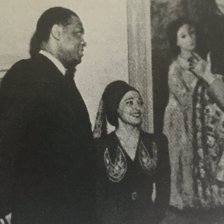
Paul Robeson and Clara Rockmore
Discussions among New York’s white critics about the theremin’s musical promise unfolded specifically and exclusively with regard to the white western classical tradition. Just as Toni Morrison noted in her book Playing in the Dark that “the readers of virtually all American fiction have been positioned as white,” whiteness was the default for writers and readers of music criticism on the theremin (xii). Though most white critics at Rockmore’s debut never mentioned race, their tacit dismissal of the spirituals she performed with the Johnson Sextet reveals that race was a central organizing force in their assessments of the instrument. The brief reception history of the spirituals Johnson arranged for voice and theremin, wherein writers—listening to the instrument perform with Black voices—clearly heard the theremin’s tone as Black, is the exception that proves the rule: white critics, by and large, heard the instrument as sounding white.
Just as Morrison asked: “how is ‘literary whiteness’ and ‘literary blackness’ made, and what is the consequence of that construction,” we must explore the ramifications of the assumptions we’ve made about whiteness and electronic musical sound (xii). For it is not only critics of the 1930s who heard the theremin’s sound as white: most current histories continue to focus on and reify a predominantly white academic and avant-garde electronic music history canon. The Amsterdam critic’s hearing opens new possibilities for understanding the history of electronic musical sound. While popular perceptions often frame electronic musical sound as “lifeless” or emotionally “flat,” the Amsterdam critic’s comparison of the theremin to the voice opens our ears to alternative hearings of electronic musical sound as expressive, affective, even human. When we hear this aspect of electronic music’s sound, we can begin to account for histories that go beyond the white western canon that dominates our understanding of electronic music history. We can populate such accountings with performers like Rockmore and composers like Johnson who worked and lived outside the boundaries we have traditionally drawn around electronic music history.
Dr. Madd Vibe (aka Angelo Moore) plays theremin in his band The Brand New Step, covering “Brothers Gonna Work it Out” Angelo Moore been playing theremin for over 20 years.
—
Featured Image: “Theremins are Dreamy” by Flickr User Gina Pina, (CC BY 2.0)
—
Kelly Hiser is co-founder and CEO of Rabble, a startup dedicated to empowering libraries to support and sustain their local creative communities. Kelly holds a Ph.D. in music history from the University of Wisconsin-Madison and embraces work at the intersections of arts, humanities, and the public good. She talks and writes regularly about music, technology, identity, and power.
—
Share this:




Current Top Posts





April 2021

January 2020

November 2019

October 2019

August 2019

April 2014

November 2017

March 2015

December 2017

October 2015


Recent Comments