
SO! Amplifies: Mega Ran and Sammus, The Rappers With Arm Cannons Tour

 SO! Amplifies. . .a highly-curated, rolling mini-post series by which we editors hip you to cultural makers and organizations doing work we really really dig. You’re welcome!
—
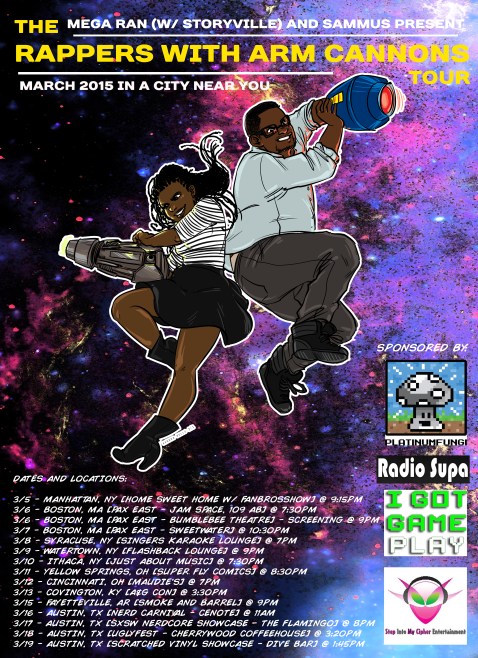
Throughout the month of March, nerdcore MCs Mega Ran (Raheem Jarbo) and Sammus (Enongo Lumumba-Kasongo) will be embarking on the “Rappers with Arm Cannons” Tour. Both artists independently based their monikers on two of the most notable video game characters to possess arm cannons, (Mega Man and Samus respectively), but they have since collaborated on several songs and a SoundScan charting Castlevania project, as well as sharing the stage at numerous concert venues and conventions, and releasing individual albums and videos that have received international attention and critical acclaim. Now three years later the two teachers-turned-rappers have decided to take their show on the road alongside rapper and sound engineer Storyville (Matthew Weisse), who has recently joined forces with Mega Ran to release their February 2015 album “Soul Veggies.”
 .
.
While at first glance the name of the tour appears a bit tongue-in-cheek, it calls necessary attention to the growing presence of Black nerdcore artists like Mega Ran and Sammus who cast their experiences as people of color against the backdrop of nerd and geek culture. In Mega Ran’s case, this has meant writing verses about his struggle to make sense of his Black nerd identity while growing up amongst a very rough crowd in Philadelphia. For Sammus, being a rapper with an arm cannon has largely meant reconciling her ideas about the lack of diverse representations of Black women in notable movies, games, and cartoons among other media forms.
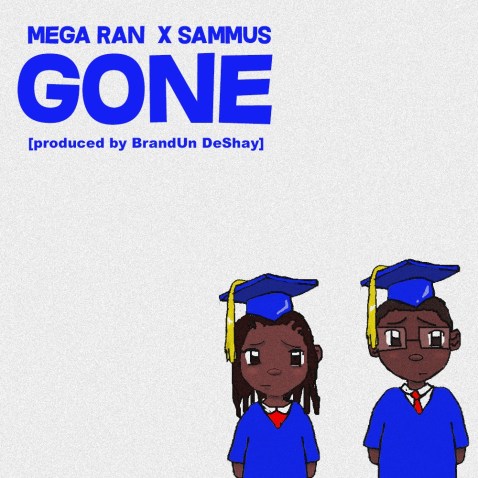
Click to “pay what you want” to download the new Sammus X Mega Ran track “Gone” in support of “The Rappers With Arm Cannons” Tour: https://sammusmusic.bandcamp.com/track/gone
Both Mega Ran and Sammus began making beats on the Playstation game MTV Music Generator. Since that time Sammus has brought together the production styles of Kanye West, Daft Punk, Björk and various video game composers to produce beats that are rich with video game synths and uniquely chopped samples. Mega Ran has similarly drawn on his love of hip hop artists, such as Redman, Nas, and Busta Rhymes as well as music from video games such as Mega Man, Final Fantasy VII, and River City Ransom.
On Tuesday, March 10th, the tour stopped at Cornell University’s Just About Music center where SO! Editors J. Stoever And Aaron Trammell sat down with the trio for a very frank and open discussion on how to survive and thrive as independent artists in the new music economy. Here’s a choice sample of that conversation:
The tour began on March 5th in NYC and will continue through March 19th with final stops in Austin, TX at this year’s South-by-South-West (SXSW). For full details on tall of the dates visit http://sammusmusic.com/shows-tour-dates/
Mega Ran on Twitter, Soundcloud, Bandcamp, Facebook, and Megaranmusic.com
Sammus on Soundcloud, Bandcamp, Facebook, and sammusmusic.com.
Storyville on Soundcloud, Bandcamp, and Facebook.
—
Enongo Lumumba-Kasongo is a PhD student in the Department of Science and Technology Studies at Cornell University. Since completing a senior thesis on digital music software, tacit knowledge, and gender under the guidance of Trevor Pinch, she has become interested in pursuing research in the emergent field of sound studies. She hopes to combine her passion for music with her academic interests in technological systems, bodies, politics and practices that construct and are constructed by sound. More specifically she would like to examine the politics surrounding low-income community studios, as well as the uses of sound in (or as) electronic games. In her free time she produces hip hop beats and raps under the moniker Sammus (based on the video game character, Samus Aran, from the popular Metroid franchise).
—
 REWIND!…If you liked this post, you may also dig:
Making Music at Studio X: The Identity Politics of Community Studios-Enongo Lumumba-Kasongo
SO! Amplifies: Regina Bradley’s Outkasted Conversations-Regina Bradley
Love and Hip Hop: (Re)Gendering The Debate Over Hip Hop Studies— Travis Gosa
Share this:

SO! Reads: Shana Redmond’s Anthem: Social Movements and the Sound of Solidarity in the African Diaspora
 To follow a song, to trace its roots and genealogy, to consider the context of its emergence as well as its lineage. To consider how sound and song propels political movement. To trace histories and concepts through the enunciative force of sound, of song. This is the work of Shana L. Redmond’s Anthem: Social Movements and the Sound of Solidarity in the African Diaspora (NYU Press, 2014). Redmond is Associate Professor of American Studies and Ethnicity at University of Southern California and the 2014-2015 Ella Baker Visiting Associate Professo of Black Studies at UC Santa Barbara, with research interests in music and popular culture, history and social movements, labor and working-class studies and critical ethnic studies. And this is to say nothing of her interests inAfrican Diaspora and Black political and social life. All these interests are made explicit within Anthem, a book that compels readers and listeners not only to ask questions about bygone eras, but to consider the soundscapes and beat drops of their own milieus. Redmond’s work, in other words, causes readers to consider the efficacy of sound and song making as the vibratory force that inheres in any social mood and movement. Anthem‘s power lies in the attention Redmond gives the circulation of sound and song: how each emerges from specific contexts as well as how songs end up being contested sonic sites wherein an intellectual practice of justice organizing can be articulated and Black sociality and personhood asserted and contended.
 In particular, Redmond utilizes the concept of the Black anthem as a theoretical tool in order to consider the efficacy of organizing and fighting against practices of racism, sexism and imperialism. Redmond documents Black anthems as “sonic productions” that “were not ancillary, background noise” but “were absolutely central to the unfolding politics because they held within them the doctrines and beliefs of the people who participated in their performance” (8). That sounds, that songs, have so much potential to enunciate otherwise modes of living; that sounds, that songs, have within them the capacity to announce otherwise worlds, is something well known to those violently excluded from modernity and its epistemologies of the human, the citizen, the subject. We know this otherwise mode of living, this otherwise modality of world, affectively. And this affectivity is born out in aesthetic practice. Thus, to attend to the organizing of sound – as song – and how such musics made their way from, for example, Harlem to Cuba in the case of the Universal Negro Improvement Association’s “Ethiopia” or from women’s singing in Charleston to international stages, is all within the analysis and the archives offered by Redmond. What pleases is how her historical archival work is inflected by sonic analyses of songs; Redmond discusses the musicality of songs, how chord changes, harmonies, and melodies offer fresh insight into ways to think sonically about the movement of sound and song.
Anthem appeals to those interested in Black social movements of the twentieth-century, to be sure. But the book also makes musicological argumentation central to its thesis. So, for example, readers not only learn about lyrical content and history of brothers James Weldon and John Rosamond Johnsons’ “Lift Ev’ry Voice and Sing,” but they are also compelled to think about the song in its sonic registers, with its musicological features. For example,
The first measure of the vocal line is a half measure and offers a running start to the A-flat major key signature, with the text ‘lift ev’-ry’ notated by three eight notes in the 6/8 time signature. While the song was written in 6/8, its performance follows a 12/8 phrasing, placing it alongside the Black gospel tradition, which…was growing in dynamic ways at this very moment. The quick introduction leads the vocalist to a strong tonic chord on the downbeat of measure 2. The melodic emphasis lands on the word ‘voice’ with ‘and sing’ (measures 10 and 11) following as long notes (72-3).
This so say that Redmond takes seriously the ways songs are constructed as part of the argument she wants to put forward about the efficacy of the Black anthem. Her work models how to attend to the musicological as a fundamental feature of sound and song-making in Black sociality.

In considering the context of emergence for sounds and songs, Redmond produces a text that fits squarely within Black performance theory, since she is less concerned with the rightness or wrongness and much more with the efficacy of performance. The concern and the question of efficacy displaces the necessity for results-driven analyses in Black performance theory, placing emphases on how the production of sound and song proliferates, how it finds life, how it creates – while also being created by – worlds. Impressively, Redmond’s thorough sonic-historical approach to her archive gives her method resonance beyond even its richness. Anthem can be radicalized through generalizing its treatment of to songs as objects that are both part of and propel movements, enabling us to consider the context of emergence for any song and performance. Generalizing Anthem means that readers would take seriously the attempt to move from the specific sonic moment to the general, from various, plural moments of emergence to considering how sounds and songs move, how they create otherwise temporalities and spatial zones. Anthem produces a new theory of thinking relation between specific performances and their history and social movements, both in local and in global diasporic contexts.
In addition, Redmond analyzes how songs–and sounds within such songs–can at times be utilized to further racialist, sexist, imperialist impulses and practices. For example, Redmond analyzes “Ol’ Man River” in multiple forms and contexts, including the performance changes produced by Paul Robeson. Here Redmond begins the tension in the dialect as written by Oscar Hammerstein II and Robeson’s deployment of the song in performance.
The dialect demonstrates a particular version of blackness out of sync with the ‘fine intelligence’ of Robeson, a Phi Beta Kappa scholar at Rutgers University and Columbia Law School graduate. Hammerstein’s dialect not only distinguishes Black from white in the musical but also serves to contain the Black characters in their natural state as uneducated and simple laborers and confidants (105).
Thus, sound and song can also be deployed otherwise, can be used in order to critique, to produce an intervention into such normative conceptions of blackness. And from Redmond’s text, readers learn something of Robeson’s radicalizing, of his deep engagement with thinking global blackness, through the way he changed the lyrical content, and thus the dialect and mood, of “Ol’ Man River.”

Paul Robeson Leading Moore Shipyard Workers in the “Star Spangled Banner,”
Oakland, CA, September 1942, Image courtesy of the National Archives and Records Administration
Still Picture Branch, Record Group 208, National Archives Identifier: 535874
Ultimately, Anthem produced for me the occasion to wonder if we can think the very concept of diaspora otherwise, as a following of vibrational moods and movements, as antiphonal participation in an ongoing call. And as an ongoing call that is resistive in its enunciation, that is ongoing and open-ended. If we did so, perhaps we would also come to understand Black sociality otherwise. In other words, perhaps we can think of it as making a claim on us, a ceaseless and performative ceaseless pulse that beckons and convokes. We are then forced to consider what our response will be to this ongoing call, what reply and resolve we give. In such a response, reply and resolve will have been irreducible, will have had no grounds, will have been constant. Sound and song are resistant to any desire for capture because of the internal disruptive capacities of vibration. Whatever the sound, whatever the song, it has within it vibration, vibration as the materiality that makes anything audible, that gives anything over to its possibly being heard. And if vibration is the grounds from which sound and song emerge, if thoughts of diaspora and blackness and sociality were inflected through such vibration, what we are called to consider is the ongoing sound, the ongoing echo, the ongoing verve and materiality of otherwise modes of living into the world.
As vibrational, Anthem forces readers to think of possibilities for sociality not grounded in categorical distinction as pure or as possibly maintained. “Through anthems,” Redmond argues, “the delineation between art and politics as well as listener and actor is blurred” (2). This blurring can be radicalized as a generalized feature of Black performance as theory and critical intervention into the normative world that depends upon invented–and distinct–categories in order to produce ongoing violence. In their accounting, the sounds, songs, and sonicity of blackness, Black sociality and Black antiphonal force demand a radical rethinking of categorical distinctions of racial classifications, gender binaries, and nation-states. And their vibrations resonate outward. On and on and on and on.
—
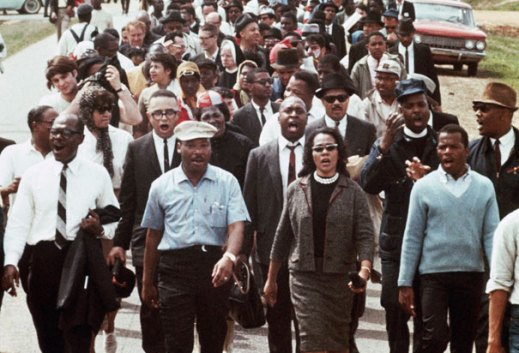
Featured Image: American Civil Rights Movement leaders singing on the 1965 March from Selma to Montgomery, Alabama, Photo Credit: Bettman/Corbis
—
Ashon Crawley is Assistant Professor of African American Studies in the Ethnic Studies Department of University of California, Riverside. He earned his doctoral degree from Duke University in the English Department with a certificate in African and African American Studies. Before Duke, he attended the Candler School of Theology at Emory University, earning a Master of Theological Studies degree with a concentration in feminist thought and queer theology. His research and teaching experiences are in the areas of Black Studies, Performance Theory and Sound Studies, Philosophy and Theology, Black Feminist and Queer theories. He has published work in Current Musicology; Souls: A Critical Journal of Black Politics, Culture and Society; The Journal of Theology and Sexuality; Black Theology: An International Journal and in Pneuma: The Journal of the Society for Pentecostal Studies. He is completing my first manuscript, titled Blackpentecostal Breath: The Aesthetics of Possibility, which investigates the relationship of aesthetic productions to modes of collective intellectual practice. this work contributes to interdisciplinary scholarship by engaging queer theory, sound studies, literary theory, theological studies, continental philosophy and visual studies.
—
 REWIND! . . .If you liked this post, you may also dig:
SO! Reads: Deborah R. Vargas’s Dissonant Divas in Chicana Music: The Limits of La Onda– Wanda Alarcon
Pentecostal Song, Sound, and Authentic Voices– Ashon Crawley
Quebec’s #casseroles: on participation, percussion and protest– Jonathan Sterne
Share this:


Current Top Posts





April 2021

January 2020

November 2019

October 2019

August 2019

April 2014

November 2017

March 2015

December 2017

October 2015
 Sounding Out!
Recent Comments