
Óyeme Voz: U.S. Latin@ & Immigrant Communities Re-Sound Citizenship and Belonging

En Espanol siguiente.
Post by Nancy Morales. Translation by Martha Unzueta-Perez, m.unzueta.perez@gmail.com
My recent experiences—both inside and outside the academy—as a U.S. citizen with an “ivy league education” make it crystal clear to me that I am a brown mujer who will always be criminalized by the state regardless of how many “privileges” I acquire or believe to have obtained through my “hard work.” I cannot continue my path toward self-determination without acknowledging that the privileges I acquire will not guarantee my protection, let alone my liberation. In other words, people of color are perpetually vulnerable regardless of their education, wealth, and/or social status. In “Speaking in Tongues: A letter to Third World Women Writers” in This Bridge Called My Back: Writings by Radical Women of Color, Gloria Anzaldúa explored this notion in her letter to third world women writers, where she expressed that we have never had any privileges and we never will (165). Anzaldúa makes this statement not to foreclose our dreams but rather to enable our liberation; in essence, we have nothing to lose by imagining other ways of being. If we were to perform as the imagined ideal U.S. citizen under the hetero-normative standards (racial, gender, and sexuality, including sonic markers of citizenship), it would always be at the expense of displacing each other. Privilege is too often misunderstood as a form of protection from displacement and a claim of worthiness as human beings.
Amplifying and extending the resonance of Anzaldúa’s powerful declaration, my scholarship is personally healing because I seek to understand the very modes of knowledge production: how meaningful research is undertaken and actualized, particularly by and for immigrant communities, by exploring how these groups help us imagine new and yet unknown territories wherein our differences are valid. Los Jornaleros del Norte, Radio Ambulante and other immigrant rights folks provide examples of imagining other ways of being, including the production of sonic markers of citizenship that are not state-sanctioned. In other words, they are doing the work of knowing themselves better in order to respect and understand each other. Often, some of the most crucial knowledge production happens through the materiality of sounds and the material impacts of listening practices, both dominant and resistant.

Rallying the Crowd with a Bullhorn, Arizona SB 1070 Protest, May 2010, Image by Flickr User Xomiele
Citizenship is (mis)understood as a privilege that guarantees protection by the nation-state. The current nation-state’s dominant discourse of national security creates draconian federal, state, and local legislation that belie immigrants’ differences. Rising anti-immigrant rhetoric attempts to homogenize both Latinas/os and immigrants as criminals. In other words, such discourse is used to justify the nation-state as the reference point for recognizing a legitimate community. The Department of Homeland Security’s agenda deems who may be tolerable and who is deportable, even if you are a U.S. citizen. Distinguishing, for example, between exceptional students who “deserve to be here” and those who do not, creates a hierarchy of immigrants. Consequently, public discourse over the worthiness of recognition and belonging creates limitations that categorize immigrants in restrictive ways. Similarly, attacks on bilingual education and ethnic studies attempt to displace Latinos as foreign and “alien” within US territories.
Jennifer Stoever-Ackerman’s “The Noise of SB 1070: or Do I Sound Illegal to You?” provides sonic examples of discrimination to reveal how citizenship is further constructed through sound. The dominant listening ear, as Jennifer Stoever-Ackerman coins, reveals:
how racialized norms about sound exist and circulate through popular culture. As a result dominant groups use sound with impunity to forge “reasonable suspicion” about the citizenship status of anyone who sounds different from them and who creates, consumes, and appreciates sounds differently from them (5).
More importantly we learn that sonic markers of citizenship are just as unreliable as biological/physical ones i.e. racial profiling. One may have an accent or speak Spanish but that doesn’t prove or disprove their citizenship status. However, what we understand more prominently is the various ways brown bodies are displaced through structural racism such as sonic markers of citizenship.

Image by Wikipedia
In order to more fully understand the legacy of the U.S. conquest of Latin America and the Caribbean—of which contemporary anti-terrorist and anti-immigrant rhetorics are an extension—we must recognize how colonizers use language as a weapon that can shame, humiliate and further colonize people of color. bell hooks testifies to this notion in “Teaching New Worlds/New Words” from Tongue-tied: The Lives of Multilingual Children in Public Education: “standard English is not speech of exile. This is the language of conquest and domination in U.S.” (255). We often begin to think that we can acquire privileges of upward mobility, class, citizenship or race as our source of protection, particularly through linguistic “passing” (Anzaldúa,“Linguistic Terrorism” Borderlands/ La Frontera: The New Mestiza, 217). However, as Anzaldúa explains in “How to Tame a Wild-Tongue” from Borderlands/ La Frontera: The New Mestiza: “Until I can take pride in my language, I cannot take pride in myself. Until I can accept as legitimate Chicano Texas Spanish, Tex-Mex and all other languages I speak, I cannot accept the legitimacy of myself” (81). Deborah Vargas’s 2012 book Dissonant Divas in Chicana Music: The Limits of La Onda (University of Minnesota Press) also explores these issues and comes at an important moment to continue to learn how the power to push the boundaries of heteronormative standards can be understood in Chican@-Laitn@ culture. By dis-placing the dominance of standard English and acknowledging the multiplicity of languages they speak and seek to listen to, Chican@s-Latin@s can begin to acknowledge their wealth of knowledge as meaningful instead of meaningless.

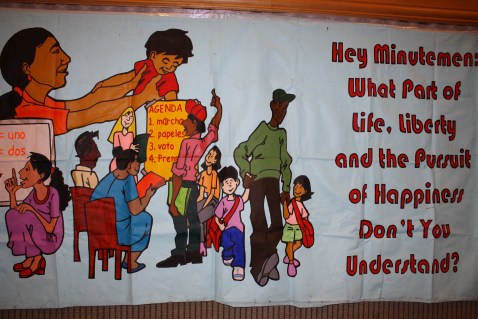
NDLON Banner, Image by Flickr User NDLON
Meaningful Sounds: Dignity and Respect
It is important, then, to recognize the critical work that immigrant rights communities create that push the boundaries of the dominant listening ear, particularly through the inclusion of the vocal materialities of people of color. Such immigrant rights groups mobilize the sounds of immigrant voices not as a neoliberal way of “proving their worthiness” but, like Sebastien de la Cruz, the San Antonio-area ten-year-old who sang the national anthem at game three of the 2013 NBA finals in his mariachi outfit, they use sound to create and amplify fair representations that vocally resist the dominant binaries of foreign/citizen, illegal/legal.
Los Jornaleros offer the people their talent and their love with their music of resistance and struggle
Los Jornaleros del Norte is a musical group that formed out of the struggles of day laborers. They are part of the National Day Laborer Organizing Network (NDLON) where they realize their cultures and languages as forms of resistance. They sing songs in Spanish at protests, rallies, on the radio and in all other public spaces.
In this clip, Los Jornaleros interject their voices to denounce deportations, wage theft and to energize (im)migrant families’ wishes and desires. Through live performances and Internet circulation, this group amplifies the actual voices of people directly affected by immigration enforcement policies and refuse to be silenced by the dominant American listening ear.
In addition, organizations such as the National Day Laborer Organizing Network (NDLON) and Education for Fair Consideration (E4FC) use various organizing tools to amplify the voices of immigrant communities. Alongside and in solidarity with E4FC, a network of artists, writers, and filmmakers, including Favianna Rodriguez, actively fight for just immigration reform using sound. These artists are crucial to the defense and protection of immigrant rights and for changing dominant discourses about immigrants as unworthy. For example, La Santa Cecilia, an L.A. band committed to social justice issues, collaborated with NDLON to produce a song in Spanish wherein the music video showcases people affected by un-sound immigration policies.
“ICE/El Hielo”—a multilingual play on the acronym of the U.S. Immigration and Customs Enforcement—combines visual imagery of immigrants with a multiciplicity of langages, musical styles and vocal tones to help us understand the trauma and pain that immigrant communities endure on a daily level due to the dominant discourse of national security that homogenizes Latina/os and (im)migrant communities as less than human. [Note: The song can also be heard on Sounding Out!’s annual free downloadable mix for 2013. Click here—JSA]
Practices like La Santa Cecilia’s encourage Latinas/os and immigrants—who are often spoken about instead of directly spoken to— to participate in public spaces, including digital spaces. Digital spaces, I believe, can become potential safe spaces that allow Latina/os and immigrant communities to produce their own sounds and to therefore make an alternative claim to belonging that is not predicated upon speaking “Standard” English and/or being “real” American citizens. Through digital outreach, E4FC encourages undocumented youth to share their immigrant stories sonically connect immigration issues on a global scale.
While musical interventions are effective, I use the remainder of this post to address the more nuanced ways in which Latina/o and (im)migrant communities add the sound of their voices to global discourses through storytelling, music, and language(s) in beautiful (though sometimes painful), telling ways. Immigrant communities produce and circulate sounds meaningful to them to contextualize and reveal their differences within Latina/o communities. In other words, they push the boundaries of citizenship through methods of self-organizing that sounds dignity and respect for each other. I argue that sharing their perspectives and stories—here and elsewhere on the Internet—captures more than just a sound bite. The sound of “everyday voices” mobilized against—and remarking on—the nation-state’s attempts to mark immigrant communities as vulnerable exerts an impactful and profoundly material agency.
Voz Mob Logo, Image by Flickr User RisetoMovement
For instance, Voces Móviles (VozMob), a collaboration between the University of Southern California’s Annenberg School and Instituto de Educación Popular del Sur de California/ Institute of Popular Education of Southern California (IDEPSCA) uses SMS technology to document immigrant workers’ voices online.
VozMob enables day laborers and other immigrant communities to use their cell phones as a tool to share their perspectives and become narrators of their own stories via text, images and video. Users upload their content directly to the VozMob webpage where you can read, see, and/or listen their daily experiences. In this video clip Luis Valentán shares his perspective as a day laborer about immigrant rights.
[vimeo http://vimeo.com/84067495]Rejecting the label of a “Dreamer,” Valentán sounds differences within immigrant communities by encouraging others to recognize that they are “Doers.” He also pushes the boundaries of an immigrant rights framework that values and respects people who strive for a better life in the face of limited opportunities.
Radio Ambulante also creates a digital space for the voices of people from Latin America and the U.S. It is the first Spanish-language radio program that tells stories where culture and belonging have no borders. The programmers broadcast various thematic episodes highlighting stories that explore differences by using speakers’ primary language(s). This approach, as heard in the November 2013 episode “la palabra prohibida,” enables diverse listeners to hear people who share, and more importantly, complicate notions about cultures, origins, and perceptions of belonging.
In “la palabra prohibida,” the broadcasters make no attempt to profile the episode’s participants as fitting the “good” or “bad” dichotomy of the immigrant narrative. Instead, Radio Ambulante creates a sonic medium that juxtaposes voices to make human complexity material for its listeners.
Click to play Radio Ambulante, “la palabra prohibida” episode
It is crucial to continue to understand the power of our voices, housed in their expression and their sound. (Im)migrant communities have a wealth of knowledge in their lived experiences, and they tell it well through these digital and public spaces, showing us how knowledge is produced not only through words and sounds, but in the powerful relationship between them. By further amplifying immigrant voices in new sites, both “traditional” and digital, I continue the important work they have begun, helping us to realize where and when the power of our sounds resonates as a catalyst to mobilize people beyond perceived borders, where we all have the right to migrate and the right to just be.
—
Featured Image by Flickr User Claudia A. De La Garza, 5-6-06
—
Nancy Morales is a faculty lecturer for the Latina/o Studies minor in the Center for the Study for Culture, Race and Ethnicity (CSCRE) at Ithaca College. Morales has research interests in U.S third world feminist theory, immigration policy, labor relations, critical ethnic studies, cultural and sound studies. She focuses on how Latina/o workers and immigrant workers have been excluded from the ranks of the working-class because of their racial, cultural, gender and immigration-status differences. She received a B.A. in Social Psychology from UC Santa Cruz and a Master’s from Cornell’s Institute for Public Affairs with a minor in Latina/o Studies. Morales has done research for the National Day Laborer Organizing Network (NDLON) and for the National Domestic Workers Alliance (NDWA) in order to further explore how race and gender become necessary for understanding workers’ struggles within the Immigration, Labor, and Civil Rights Movements.
—
Óyeme Voz”: Comunidades Latinas y Inmigrantes de EE. UU. Resuenan Ciudadanía y Pertenecer
Post by Nancy Morales. Translation by Martha Unzueta-Perez, m.unzueta.perez@gmail.com
Mis experiencias recientes—tanto dentro como fuera de la academia—como una ciudadana de Estados Unidos con una educación “Ivy League” lo hace muy claro que soy una mujer de color que siempre va ser criminalizada por el estado sin importar cuantos “privilegios” adquiero o creer haber obtenido a través de mi “trabajo duro.” Yo no puedo continuar mi camino hacia la autodeterminación sin reconocer que los privilegios que adquiero no me garantizaran mi protección y mucho menos mi liberación. En otras palabras, las personas de color son perpetuamente vulnerables sin importar su educación, riquezas y/o estatus social. En “Speaking in Tongues: A letter to Third World Women Writers” en This Bridge Called My Back: Writings by Radical Women of Color, Gloria Anzaldúa explora esta noción en su carta a escritoras del tercer mundo, donde expreso que nunca hemos tenido ningún privilegio y nunca lo tendremos (165). Anzaldúa hace esta declaración no para anular nuestros sueños sino más bien para hacer posible nuestra liberación; en esencia, no tenemos nada que perder al imaginar otras formas de ser. Si fuéramos a actuar como el imaginado ciudadano ideal de Estados Unidos bajo las normas hetero-normativas (racial, genero y sexualidad, incluyendo señales sónicas de la ciudadanía), siempre seria al costo de desplazarnos el uno al otro. El privilegio a menudo es mal entendido como una forma de protección de desplazamiento y una reclamación de merecimiento como seres humanos.
Amplificar y extender la resonancia de la poderosa declaración de Anzaldúa, mi trabajo académico me ayuda personalmente a sanar porque yo busco a entender los modos de producción de conocimiento: cómo la investigación significativa es emprendida y actualizada, particularmente por y para las comunidades de inmigrantes, al explorar cómo estos grupos nos ayudan a imaginar nuevos y aún desconocidos territorios donde nuestras diferencias son validas. Los Jornaleros del Norte, Radio Ambulante y otras personas de los derechos de inmigrantes proporcionan ejemplos de imaginarse otras formas de ser, incluyendo la producción de señales sónicas de la ciudadanía que no son sancionados por el estado. En otras palabras, están haciendo el trabajo de conocerse mejor para respetarse y entenderse. Frecuentemente, alguna de la producción de conocimiento más importante ocurre a través de la materialidad de los sonidos y los impactos materiales de las prácticas de escuchar tanto dominante y resistente.

Rallying the Crowd with a Bullhorn, Arizona SB 1070 Protest, May 2010, Image by Flickr User Xomiele
La ciudadanía es (mal) entendida como un privilegio que garantiza la protección por la nación-estado. El discurso dominante actual de la nación-estado de la seguridad nacional crea una legislación draconiana federal, estatal y local que desmienten las diferencias de los inmigrantes. La creciente retórica anti-inmigrante intenta homogeneizar tanto los latinos e inmigrantes como criminales. En otras palabras, tal discurso es utilizado para justificar la nación-estado como un punto de referencia para reconocer una comunidad legitima. La agenda del Departamento de Seguridad Nacional considera quien puede ser tolerable y quien puede ser deportado, aún si usted es un ciudadano estadounidense. Distinguir, por ejemplo, entre los estudiantes excepcionales que “merecen estar aquí” y aquellos que no, crea una jerarquía de los inmigrantes. Consecuentemente, el discurso publico sobre el merecimiento de reconocer y pertenecer que categorizan a los inmigrantes en maneras restrictivas. Similarmente, los ataques contra la educación bilingüe y los estudios étnicos intentan desplazar a los latinos como extranjeros y “alien” en los territorios estadounidenses.
El artículo “The Noise of SB 1070: or Do I Sound Illegal to You?” de Jennifer Stoever-Ackerman proporciona ejemplos sónicos de discriminación para revelar como la ciudadanía se construye aún más a través del sonido. El oído dominante, como Jennifer Stoever-Ackerman revela:
Como las normas racializadas sobre el sonido existen y circulan a través de la cultura popular. Como resultado grupos dominantes utilizan el sonido con impunidad parar forjar una “sospecha razonable” sobre el estatus de la ciudadanía de cualquier persona que se escucha diferente a ellos y que crea, consume y aprecia los sonidos de manera diferente a ellos (5).
Más importante nosotros aprendemos que las señales sónicas de ciudadanía son tan poco fiables como los biológicas/físicas, es decir discriminación racial. Uno puede tener un acento o hablar español pero eso no demuestra su estatus de ciudadanía. Sin embargo, lo que nosotros entendemos de manera más prominente es las diferentes formas en que la gente de piel morena es desplazada a través del racismo estructural tal como señales sónicas de la ciudadanía.

Image by Wikipedia
Para entender más completamente el legado de la conquista de EE.UU. de America Latina y el Caribe—de cual la retórica contemporánea anti-terrorista y anti-inmigrante son una extensión—nosotros debemos reconocer cómo los colonizadores utilizaron el lenguaje como un arma que pude avergonzar, humillar y colonizar aun más a la gente de color. bell hooks atestigua a esta noción en “Teaching New Worlds/New Words” del Tongue-tied: The Lives of Multilingual Children in Public Education: el ingles estándar no es el habla de exilio. Este es el lenguaje de conquista y dominación en los EE.UU.” (255). A menudo empezamos a pensar que podemos adquirir privilegios de movilidad hacia arriba, clase, ciudadanía o raza como nuestra fuente de protección, en particular “pasando” lingüísticamente (Anzaldúa, “Linguistic Terrorism” Borderlands/ La Frontera: The New Mestiza, 217). Sin embargo, cómo Anzaldúa explica en “How to Tame a Wild-Tongue” de Borderlands/ La Frontera: The New Mestiza: “Hasta que yo pueda tener orgullo en mi lenguaje, no puedo tener orgullo en mi mismo. Hasta que yo pueda aceptar como legitimo el español chicano tejano, tex-mex y todos los otros idiomas que hablo, No puedo aceptar la legitimidad de mí mismo” (81). Deborah Vargas’s 2012 libro Dissonant Divas in Chicana Music: The Limits of La Onda (University of Minnesota Press) también explora estas cuestiones y llega a un momento importante para continuar a aprender como el poder de empujar los limites de las normas hetero-normativas pueden ser entendidas en la cultura chincan@s-latin@s. Al descolocar el dominio del ingles estándar y reconocer la multiplicidad de los lenguajes que hablan y buscan escuchar, chican@s-latin@s pueden comenzar a reconocer su riqueza de conocimiento como significativo en vez sin sentido.
NDLON Banner, Image by Flickr User NDLON
Sonidos Significativos: Dignidad y Respeto
Es importante, luego, reconocer el trabajo crítico que las comunidades de derechos de inmigrantes crean que empuje los límites del oído dominante, particularmente a través de la inclusión de las materialidades vocales de la gente de color. Tales grupos de derechos de inmigrantes movilizan los sonidos de las voces de los inmigrantes no como una forma neoliberal de “demostrar su merecimiento” pero, como Sebastien de la Cruz, el niño de diez años de edad de San Antonio que canto el himno nacional para el tercer juego de la final 2013 del NBA en su traje de mariachi, ellos utilizaron el sonido para crear y amplificar una justa presentación que vocalmente resiste binarios dominantes de extranjero/ciudadano, ilegal/legal.
Los Jornaleros ofrecen a la gente su talento y su amor con su música de resistencia y lucha
Los Jornaleros del Norte es un grupo musical que fue formado de las luchas de los jornaleros. Ellos son parte del National Day Laborer Organizing Network (NDLON) donde ellos realizan sus culturas y lenguajes como formas de resistencia. Ellos cantan canciones en español en las protestas, en mítines, en el radio y en todos otros espacios públicos.
En este clip, Los Jornaleros interponen sus voces para denunciar las deportaciones, el robo de salarios y energizar los deseos de las familias in(migrantes). A través de actuaciones animadas y la circulación de Internet, este grupo amplifica las voces actuales de la gente directamente afectada por las políticas de inmigración y se niegan a ser silenciados por el oído dominante Americano.
Además, organizaciones como el National Day Laborer Organizing Network (NDLON) y Education for Fair Consideration (E4FC) utilizan varias herramientas de organización para amplificar las voces de las comunidades de inmigrantes. Junto y en solidaridad con E4FC, una red de artistas, escritores y cineastas, incluyendo Favianna Rodríguez, luchan activamente para una reforma de inmigración justa utilizando el sonido. Estos artistas son cruciales para la defensa y protección de los derechos de inmigrantes y por cambiar los discursos dominantes sobre inmigrantes que son vistos sin dignidad. Por ejemplo, La Santa Cecilia, una banda local en Los Ángeles comprometida a la cuestiones de justicia social, colaboro con la organización NDLON para producir una canción en español en el que el video musical muestra las personas afectadas por las políticas poco acertadas.
“ICE/El Hielo”—una obra de teatro multilingüe sobre las siglas de la Oficina de Inmigración y Aduana d EE.UU. (U.S. Immigration and Customs Enforcement)—combina una imagen visual de inmigrantes con una multiplicidad de lenguajes, estilos musicales y tonos vocales para ayudarnos a entender el trama y dolor que las comunidades de inmigrantes perduran a diario debido al discurso dominante de la seguridad nacional que homogeniza a las comunidades latinas y (in)migrantes como menos que humanos. [Editor’s Note: La canción también puede escucharse y descargarse en el mix anual gratuito de Sounding Out! para el 2013. Haga clic aqui—JSA]
Prácticas como la de La Santa Cecilia animan a los latinos e inmigrantes—que a menudo se habla de ellos en vez de directamente hablar con ellos— a participar en espacios públicos, incluyendo espacios digitales. Los espacios digitales, yo creo, pueden convertirse en potenciales espacios seguros que permite a las comunidades latinas e inmigrantes a producir su propio sonido y por lo tanto hacer una reclamación alternativa a pertenecer que no se predica al hablar en ingles “estándar” y/o ser un ciudadano americano “real.” A través del alcance digital, el E4FC anima a la juventud indocumentada a compartir sus historias de inmigrantes sónicamente para conectar los temas de inmigración a un nivel global.
Mientras intervenciones musicales son efectivas, yo utilizo el resto de este articulo para hablar sobre las formas más matizadas en la cual las comunidades latinas e de (in)migrantes agregan el sonido de sus voces a discursos globales a cuentos, música y lenguaje(s) en maneras bellas (y a veces dolorosas) de contar. Las comunidades inmigrantes producen y circulan sonido significante a ellos para contextualizar sus diferencias entre las comunidades latinas. En otras palabras, ellos empujan los límites de la ciudadanía a través de métodos de auto-organización que se escucha con dignidad y respeto para uno al otro. Yo sostengo que compartir sus perspectivas y historias—aquí y en otros lugares en el Internet—captura más que una picadura de sonido. El sonido de “voces cotidianas” movilizadas contra—y comentando sobre—los intentos de la nación-estado para marcar las comunidades inmigrantes como vulnerables causa una impactante y profunda agencia material.

Voz Mob Logo, Image by Flickr User RisetoMovement
Por ejemplo, Voces Móviles (VozMob), una colaboración entre La Escuela de Annenberg en Universidad del Sur de California (University of Southern California’s Annenberg School) y el Instituto de Educación Popular del Sur de California (Institute of Popular Education of Southern California – IDEPSCA) utiliza la tecnología SMS para documentar la voces de los trabajadores inmigrantes en la Internet.
VozMob permite a los jornaleros y otras comunidades inmigrantes a utilizar sus teléfonos celulares como una herramienta para compartir sus perspectivas y convertirse en narradores de sus propias historias vía texto, imágenes y video. Usuarios suben su contenido directamente a la pagina Web VozMob webpage donde uno puede leer, ver y/o escuchar sus experiencias diarias. En este videoclip Luis Valentán comparte su perspectiva como un jornalero sobre los derechos de inmigrantes.
[vimeo http://vimeo.com/84067495]Al rechazar la descripción de “Soñador,” Valentán sonora las diferencias entre las comunidades inmigrantes al animar a otros a reconocer que son “Hacedores.” El también empuje los limites de un marco de derechos de inmigrantes que valora y respeta a las personas que luchan por una vida mejor que enfrentan oportunidades limitadas.
Radio Ambulante también crea un espacio digital para las voces de la gente de América Latina y de EE.UU. Es el primer programa de radio en español que cuenta las historias donde la cultura y pertenecer no tienen fronteras. Los programadores transmiten varios episodios temáticos destacando historias que exploran diferencias mediante el uso del lenguaje primario. Este enfoque, como se escucho en el episodio de noviembre 2013 “la palabra prohibida,” permite a oyentes diversos a que escuchen a personas que comparten y, más importante, complican las nociones sobre culturas, orígenes y percepciones de querer pertenecer.
Radio Ambulante, “la palabra prohibida”
En “la palabra prohibida,” los locutores no hacen ningún intento a perfilar a los participantes del episodio como una en la dicotomía “buena” o “mala” de la narrativa de inmigrantes. En cambio, Radio Ambulante crea un medio sónico que yuxtapone las voces para hacer material de complejidad humano para sus oyentes.
Es crucial continuar a comprender el poder de nuestras voces, que se encuentran en su expresión y su sonido. Las comunidades (in)migrantes tienen una riqueza de conocimiento en sus experiencias vividas y lo dicen bien a través de estos espacios públicos y digitales, enseñándonos como el conocimiento se produce no solo a través de palabras y sonidos sino en la poderosa relación entre ellos. Al amplificar aún más las voces inmigrantes en nuevos sitios, tanto “tradicional” y digital, yo continuo la importante labor que han iniciado, ayudándonos a realizar donde y cuando el poder de nuestros sonidos resuenan como un catalizador para movilizar a la gente mas allá de las fronteras percibidas, donde todos tenemos el derecho a migrar y el derecho de ser.
—
Nancy Morales es profesora en la especialización de estudios latinos en el Centro para el Estudio de Cultura, Raza y Etnicidad (Center for the Study for Culture, Race and Ethnicity – CSCRE) en el Colegio Ithaca (Ithaca College). Morales tiene intereses de investigación en la teoría feminista del tercer mundo de EE.UU., política de inmigración, relaciones labores, estudios étnicos críticos, estudios culturales y de sonido. Ella se centra en cómo los trabajadores latinos y trabajadores inmigrantes han sido excluidos del los rangos de la clase obrera por sus diferencias raciales, culturales, del genero y el estatus inmigrante. Ella recibió su licenciatura en psicología social de la Universidad de California Santa Cruz y su maestría del Instituto de Negocios Públicos de la Universidad de Cornell (Cornell University) con una especialización en estudios latinos. Morales ha realizado investigaciones para la Red de Organización Nacional de Jornaleros (National Day Laborer Organizing Network – NDLON) y para la Alianza Nacional de Trabajadores Domésticos (National Domestic Workers Alliance -NDWA) para poder explorar más a fondo cómo la raza y el género son necesarios para comprender la lucha de los trabajadores dentro de la inmigración, labor y el movimiento de derechos civiles.
—
 REWIND! . . .If you liked this post, you may also dig:
Soundscapes of Narco Silence--Marci McMahon
Sonic Brownface: Representations of Mexicanness in an Era of Discontent–reina alejandra prado
Chicana Radio Activists and the Sounds of Chicana Feminisms–Monica De La Torre
—
Share this:

Fiddling With Freedom: Solomon Northup’s Musical Trade in 12 Years a Slave

 Editor’s Note: Sound Studies is often accused of being a presentist enterprise, too fascinated with digital technologies and altogether too wed to the history of sound recording. Sounding Out!‘s last forum of 2013, “Sound in the Nineteenth Century,” addresses this critique by showcasing the cutting edge work of three scholars whose diverse, interdisciplinary research is located soundly in the era just before the advent of sound recording: Mary Caton Lingold (Duke), Caitlin Marshall (Berkeley), and Daniel Cavicchi (Rhode Island School of Design). In examining nineteenth century America’s musical practices, listening habits, and auditory desires through SO!‘s digital platform, Lingold, Marshall, and Cavicchi perform the rare task of showcasing how history’s sonics had a striking resonance long past their contemporary vibrations while performing the power of the digital medium as a tool through which to, as Early Modern scholar Bruce R. Smith dubs it, “unair” past auditory phenomena –all the while sharing unique methodologies that neither rely on recording nor bemoan their lack. Today, the series kicks off with Mary Caton Lingold‘s exploration of the materialities of Solomon Northup’s fiddling as represented through sheet music embedded in his 1853 narrative, amplifying a sound that was key to both his freedom and his enslavement.—Jennifer Stoever-Ackerman, Editor-in-Chief
—
Steve McQueen’s recent film Twelve Years a Slave has renewed interest in the original 1853 narrative, which has long been a valued resource for historians of nineteenth-century slavery, literature, and music. Because Solomon Northup was a highly-skilled fiddler and a keen observer of plantation culture, his autobiography is one of the most substantive accounts of musical life during slavery and, to my knowledge, the only slave narrative that includes sheet music in its text. As such, it preserves in audible form a precious record of Northup’s musical artistry and facilitates a sound-based study of nineteenth-century black fiddling, a tradition that was flourishing during Northup’s lifetime.
Uncovering the sounds of vernacular music of the pre-recorded era can be incredibly challenging. For this reason, Northup’s descriptions, when coupled with musical notation, make it possible for us to hear something historically significant. Although “slave music” was all the rage in the 1850s due to the widespread popularity of blackface minstrelsy, print-based compositions by enslaved (or free) musicians are difficult to come by and even more challenging to verify. The tune presented in Northup’s memoir has its own complex relationship to the minstrelsy genre, but it remains a unique sample of African-American music that warrants close-listening.

“Roaring River.” In Twelve Years a Slave: Narrative of Solomon Northup, by Solomon Northup, 322. Auburn, NY: Miller, Orton & Mulligan, 1854. Courtesy of the David M. Rubenstein Rare Book & Manuscript Library, Duke University
I use performance as a research method for exploring historical vernacular music, offering here my interpretation of “Roaring River: A Refrain of the Red River Plantation.” As I discuss in an essay titled “Listening to the Past,” the process of performance illuminates the subtleties of musical expression. (Do I play it like this or like that? At what tempo?) The aim of such exercises is not historical accuracy, but rather, an attunement to the sonic possibilities of a given piece. These possibilities cannot tell me how Northup would have played the song or what it meant to him, but they allow me to consider the kinds of choices that he would have had to make as a performer, thus illustrating the intellectual and sensorial richness of his music-making. Rather than simply presenting and describing the sheet music, I aim to make it possible for people to hear what would otherwise sit silently on the page.
In the first recording I play Northup’s melody solo to give you a sense of the tune.
In the second, I am joined by guitar.
The use of guitar accompaniment would have been highly unlikely during the period, but it helps to support my amateur playing by providing a livelier, fuller feeling. Northup connected with banjoists, percussionists and dancers as an enslaved and free musician and it’s interesting to imagine how a single song like this would have been transformed according to the talents, desires, and constraints of the performers assembled. It is unclear from the narrative whether or not the tune is an original composition or something Northup learned while living along the Red River, where he was enslaved in Louisiana. One also wonders how many nineteenth-century readers would have plucked the melody at a keyboard or bowed it on a family fiddle. What might their motivations have been?
Though Northup does not discuss the fiddle tune in the text, he does describe the lyrics below it, remarking that they were accompanied by a percussion technique called “patting” among his fellow slaves. He describes this widely documented practice as follows: “The patting is performed by striking the hands on the knees, then striking the hands together, then striking the right shoulder with one hand, the left with the other—all the while keeping time with the feet, and singing” (219). According to Northup, the lyrics that accompanied patting were often nonsensical because they were made to conform to the tonal and rhythmic pattern being patted. He offers “Harper’s Creek” as suitable for the practice but it’s worth noting that the lyrics voice a presumably white man’s desires to own a piece of land and a slave. Though presented below the sheet music at the end of the book, the lyrics are ill-fitting for the fiddle tune provided, which seems more likely to have been played without vocal accompaniment. In light of Northup’s descriptions, the sheet music creates an interesting blend of various performance modes, from popular folksy vocal diddy (with possible origins in minstrelsy), to patting, and fiddling. Here you can see a wonderful example of patting accompanying a nineteenth-century fiddle tune as performed by the Carolina Chocolate Drops and guest Danny Barber (Intricate patting begins at 1:22).
In addition to serving as auditory artifact, the presence of sheet music in the narrative relates to the way Northup’s musicality was commodified within the aesthetic economy of slavery during and after his captivity. After regaining freedom, his talents are presented for sale in the book presumably to appeal to the sort of audiences who would also have coveted the sheet music of minstrelsy, which caricatured and lampooned black performances. Popular appetites for representations of plantation culture left an imprint on Northup’s autobiography as well as other abolitionist publications, like Uncle Tom’s Cabin.

“Jumbo Jum,” Courtesy of the Newberry Library, Chicago. J.F. Driscoll Collection of American Sheet Music, Box 307a.
Music-making was both labor and leisure for Solomon Northup and it profoundly influenced his experiences as a slave. His narrative also illuminates the far-reaching impact that he and other black musicians had on their communities as well as nineteenth century music.
Alas! had it not been for my beloved violin, I scarcely can conceive how I could have endured the long years of bondage. It introduced me to great houses —relieved me of many days’ labor in the field—supplied me with conveniences for my cabin—with pipes and tobacco, and extra pairs of shoes, and oftentimes led me away from the presence of a hard master, to witness scenes of jollity and mirth. It was my companion—the friend of my bosom triumphing loudly when I was joyful, and uttering its soft, melodious consolations when I was sad. (217)
Solomon Northup’s biography is highly atypical of slave narratives because he is a free man who is sold into slavery. Some have criticized the popularization of his circumstances, arguing that because he conforms to modes of respectability as a literate, propertied black man, he serves as an ideal hero for white audiences while inadequately representing the experience of slavery. Though many aspects of Northup’s biography are unusual, his status as a highly sought-after musician is emblematic of a legion of black fiddlers who dominated music scenes North and South, from ballrooms to barns, beginning as early as the late seventeenth-century, as Dena Epstein explains in her indispensable study, Sinful Tunes and Spirituals: Black Music to the Civil War (1977).
Prior to enslavement, fiddling, “the passion of [his] youth,” provides Northup with supplemental income that helps to sustain his family during periods of insufficient employment in agriculture and carpentry. Music was an ideal side-career for someone in such circumstances, though, as Northup’s story shows, it did not protect him from the dangers of being black in the United States. He is captured and enslaved while touring as a circus musician. Ferrying South toward the Louisiana plantations that would become his deplorable home, Northup’s freedoms are violently stripped away. But his talent as a first-rate fiddler travels with him, becoming a defining element of his experience of slavery.
Fiddles were extraordinarily popular instruments during the era. Lightweight, portable, and increasing in mass production during the nineteenth-century, a single fiddle could service a large dance if need be. As such, slaves were encouraged (or forced) to take up the instrument and musical ability was considered a highly prized skill. Fiddling granted (primarily male) slaves an unusual degree of mobility as well as opportunities for economic advancement. The fact that numerous runaway slave ads note that the sought-after individuals were fiddlers or had in their possession a violin suggests that the increased mobility and access to income may have facilitated escape for some. For more information about these trends and their eighteenth-century origins, I highly recommend Richard Cullen Rath’s How Early America Sounded (2003), an excellent cultural history of sound.

Etching of Solomon Northup “in his Plantation Suit” accompanying his 1853 Narrative
Just before being sold at market to his first master, Northup encounters an enslaved young man in possession of a fiddle and sizes him up by asking if he could play the “Virginia Reel,” a popular dance. The young man cannot and so Northup takes the instrument from him, boldly showing off his more substantial repertoire and ability, much to the delight of those around him. Though about to be sold into an unknown and terrifying fate, this seemingly mundane interaction underscores how important musicianship is to Northup’s identity and also how significant it was to the societies through which he was forced to move. Whether in New York State, a New Orleans slave market, or a backwoods swamp plantation, fiddling was a thoroughly popular form of entertainment, widely enjoyed by Americans, slave and free, rich and poor, native and immigrant.
Northup expresses pride in the fame he earns in the Red River region, noting that he was known widely as the “Ole Bull of Bayou Boeuf.” Ole Bull was a famous Norwegian violinist, who was one of the first musicians to professionally tour the United States in the 1850s; he became a widely-known celebrity. Because of Northrup’s sought-after talents, his masters hired him out extensively to play at the fashionable balls of nearby plantations as well as the Christmas dances held yearly for slaves. At one ball, he was tipped seventeen dollars, an extraordinary amount that he used to furnish his cabin with bare necessities. In contrast to these more favorable gigs, Northup was also forced to perform during his savage Master Epps’ alcoholic binges. These events were held for hours on end in the middle of the night as Northup’s fellow slaves were commanded to dance. The violent, dreaded affairs interrupted precious sleep and were utterly humiliating for the participants. Depicted memorably in both the memoir and the recent film, the horrifying scenario shows the way slavery degrades Northup’s musicianship and his peers’ dancing, turning these arts into yet one more thing that the master possesses. For Master Epps, Northup is a mere musical device, a kind of proto-phonograph, full of tunes that can be made to play on command. Northup’s “passion” and economic livelihood are thus converted into a mechanized musical labor commodity under slavery.
Through Northup, we can see how before the eras of sound reproduction and broadcast, the circulation of music across North America was greatly facilitated by the forced migration of enslaved people. At the time of Northup’s capture, large numbers of mid-Atlantic slaves were being sold South to the booming plantations along the frontier of Louisiana and Texas. Northup brought a unique repertoire on his journey and he also learned new music that he transported back to the New York publishers of his autobiography. Afro-diasporic musicians began revolutionizing Western music centuries before Northup was born, and as we can see, continued to do so in profoundly significant ways in the Antebellum era both in spite of and due to the harsh conditions of their enslavement.
—
I’d like to thank the students in my course “Sounds of the South” for their lively discussion and excellent essays regarding music in Solomon Northup’s Narrative. I’m also deeply grateful to my musical collaborator, Eric Olsten.
—
Featured Image by Flickr User kubotake
—
Mary Caton Lingold is a doctoral candidate in English at Duke University researching early Afro-Atlantic literature, music, and sound. She leads a collaborative experiment called the Sonic Dictionary at Duke’s Audiovisualities Lab and co-directs Soundbox, a project dedicated to enhancing the practice of using sound in digital scholarship.
—
REWIND! . . .If you liked this post, you may also dig:
“Como Now?: Marketing ‘Authentic’ Black Music,” –J. Stoever-Ackerman
Hearing the Tenor of the Vendler/Dove Conversation: Race, Listening, and the “Noise” of Texts –Christina Sharpe
How Svengali Lost His Jewish Accent––Gayle Wald
Share this:


Current Top Posts





April 2021

January 2020

November 2019

October 2019

August 2019

April 2014

November 2017

March 2015

December 2017

October 2015
 Sounding Out!
Recent Comments