
Introduction: Medieval Sound

A text arrives and the buzz of a cell phone jolts you from your idle thoughts. The sound–like an alarm, another kind of bell to mark out the day–shifts you from one audition to another. The spatiality of competing sounds fills our consciousness and shapes our attitudes towards music and noise, privacy and pollution. These themes surround the issue of sound and articulate a variety of questions and problems. How does one delineate between noise and sound? How does sound individualize us within the community? How does sound create space? Why is the scopic the privileged sense?
Sound studies is the name for an interdisciplinary field encompassing the study of noise, music, vibrations, and what T.S. Eliot called “auditory imagination” in The Use of Poetry and The Use of Criticism (111). It is a capacious field, encompassing examinations of the individual sonic space of iPod use and the historical sound of rural and urban life. Sound (or the lack thereof) immerses a subject in worlds that may not be, or can distance the listener from the world that is. To put on headphones, to lose oneself in chant, to be awakened by an alarm, to lose the sound of voices in the crashing waves, transfers us, immerses us, and connects us in a variety of sonic worlds.

Medieval musician reinactment. Image borrowed from Byronv2 @Flickr CC BY-NC.
Each of the essays in this month’s “Medieval Sound” forum focuses on sound as it, according to Steve Goodman’s essay “The Ontology of Vibrational Force,” in The Sound Studies Reader, “comes to the rescue of thought rather than the inverse, forcing it to vibrate, loosening up its organized or petrified body (70). These investigations into medieval sound lend themselves to a variety of presentation methods loosening up the “petrified body” of academic presentation. Each essay challenges concepts of how to hear the Middle Ages and how the sounds of the Middle Ages continue to echo in our own soundscapes.
The posts in this series begins an ongoing conversation about medieval sound in Sounding Out!. Our opening gambit in April 2016, “Multimodality and Lyric Sound,” reframes how we consider the lyric from England to Spain, from the twelfth through the sixteenth centuries, pushing ideas of openness, flexibility, and productive creativity. We will post several follow-ups throughout the rest of 2016 focusing on “Remediating Medieval Sound.” And, HEAR YE!, in April 2017, look for a second series on Aural Ecologies of noise!
Multimodality and Lyric Sound
The essays clustered in the group “Lyric Sound” re-center lyric soundscapes—onomatopoeia, mashups, music box, witnesses to queer temporalities—in order to reorient the critical terrain of our understanding of the medieval lyric. Recent criticism on digital rhetoric has defined multimodality as the process of creating, rather than the product. In Daniel Anderson et al’s “Integrating Multimodality into Composition Curricula: Survey Methodolgy and Results from a CCCC Research Grant” (2006), multimodality, “acknowledges the practices of human sign-makers, who select from a number of modalities for expression (including sound, image, and animation, for example), depending on the rhetorical and material contexts within which the communication is being designed and distributed.” In this body of criticism, the term “multimedia” becomes condensed to the “integration of multiple forms of media” (59-84).
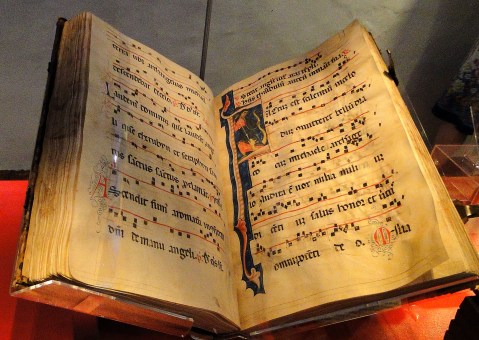
An illuminated music manuscript. Image by Richard White @Flickr CC BY-NC-SA.
This interest in semiotics is, however, not a new one; rather, it is one that has deep roots in medieval rhetoric, especially with regard to music. The two medieval writers most important to the discussion of rhetoric and music in the thirteenth century are John of Salisbury, particularly his twelfth-century work Metalogicon, and Gilbert of Crispin’s well-known debate Disputatio Iudei et Christiani from the late eleventh century. John of Salisbury’s Metalogicon, lays out the relation between symbols, sounds, and notation, writing:
Letters, that is, written symbols, in the first place represent sounds (voce). And secondly they stand for things, which they conduct into the mind through the windows of the eyes. Frequently, they even communicate, without emitting a sound, the utterances of those who are absent (Book 1, Chapter 3, 59).
John of Salisbury also links the notation of music with the notation of writing under the rubric of grammar, noting:
That such great import has existed in such tiny notations should not seem strange, for singers of music likewise indicate by a few graphic symbols numerous variations in the acuteness and gravity of tones. For which reason such characters are appropriately known as “the keys of music” (Book 1, Chapter 13, 59).
Gilbert of Crispin also considers the semiotics of visual notes. In the Disputatio Iudei et Christiani, he writes:
Just as letters stand in one way as images and notations of words, so also pictures exist as likenesses and notation of things written (qtd. in Michael Clanchy’s From Memory to Written Record 290).
Therefore what Isaiah saw, said and wrote, what Ezechiel saw, said and wrote, may after them be said and written and signified by some pictorial notation (290).
Both of these writers rework material from Isidore of Seville, and both describe correlations between reading “nota” in relation to music and images in post-Conquest Britain.
The elision between writing down letters and writing down musical notes is furthered by the slippery quality of the Latin from which the term “note” is derived. The Latin word “notare” means “to record writing,” while the second most common meaning of the noun “nota” [noter] means “to sing, to interpret musically.” The resulting duality of the term “note” survives today in both English and French, as Ardis Butterfield has pointed out in a November 2009 conference paper “A Note on a Note,” writing that “a note is both a sound and a sign.” The ambiguity of the term in Latin also indicates that the distinctions between the two meanings—“to record in writing” and “to interpret musically”—are constantly in flux.
The issues of the development of musical notation—a recording technology of sound—and the interface issues at stake in medieval manuscripts mean that our view of the medieval lyric comes primarily through the eyes. In other words, the medium—the manuscript page—in which the medieval lyric is recorded explains how our interpretations are deeply ocularcentric. However, we believe that we can think of the medieval manuscript as a flexible recording medium that allows for a “mise-en-système,” what Joanna Drucker describes as “an environment for action” in Graphesis: Visual Forms of Knowledge Production (139). A digital mise-en-système is a digital ecology in which the main question posed is how the interface can create the subject/user/reader. Interface then becomes a “border zone between cultural systems and human subjects;” it is the co-dependent space where “speaker and spoken are created. (148, 158-59).

“The Story of the Written Word” from the NY Public Library McGraw Rotunda. Photo by Wally Gobetz @Flickr CC BY-NC-SA.
Drucker tackles the theoretical stakes of digital visuality by explaining that “all images are encoded by their technologies of production and embody the qualities of the media in which they exist. These qualities are part of an image’s informations” whether this be illuminated manuscript, daguerreotype, painting, photograph, or digital image (21). The issues of layout, marginalia, paratext, columns, table of contents, indexes, chapter headings, are as Malcolm Parkes discusses in Scribes, Scripts, and Readers, a development of the medieval scholarly book (121-142). These experimental page structures became standard in printed books and eventually in digital texts.
In this series, we push back a bit on Drucker’s idea that the manuscript page is actually just a static mise-en-page. If the codex (as it developed in the Middle Ages) is one of the earlier kinds of informational “interfaces” then we should consider it as a mediating apparatus: one in which the mise-en-page and material features, its myriad graphic cues explain how to read, use, navigate, and access information in the codex book. We argue today with the example of the medieval English lyric as it emerges, that manuscripts are functionally an interactive media ecosystem, a mise-en-système where subject/user/reader can pull different threads and create and recreate meaning.
Over the next six weeks, the writers featured in our forum on Lyric Sound–Christopher Roman, Dorothy Kim, David Hadbawnik, Marla Pagán-Mattos, Katherine Jager--examine the different forms that medieval lyrics take and how the lyric is ensounded in terms of the mouth, recording medium, as well as the performance. Historical sound is always about negotiating the past through the present. Silence in the Middle Ages would not be our silence, just as music or noise today may not be defined as such then. These essays ask us to listen, create, make noise, open our senses in multimodal and multitudinous ways. We close with Andrew Albin‘s meditation on what it means to remediate medieval sounds in our contemporary moment, an intellectual call to the present as well as the future, as we will return with more on “Remediating Medieval Sounds” in April 2017. –Forum Guest Co-Editors Dorothy Kim and Christopher Roman
—
Dorothy Kim is an Assistant Professor of English at Vassar College. She is a medievalist, digital humanist, and feminist. She has been a Fulbright Fellow, a Ford Foundation Fellow, a Frankel Fellow at the University of Michigan. She has been awarded grants from the National Endowment for the Humanities, Social Science and Humanities Research Council of Canada, and the Mellon Foundation. She is a Korean American who grew up in Los Angeles in and around Koreatown.
Christopher Roman is Associate Professor of English at Kent State University His first book Domestic Mysticism in Julian of Norwich and Margery Kempe deals with the creation of queer families within mystical theology. His forthcoming book Queering Richard Rolle deals with the intersection of queer theory and theology in the work of the hermit, Richard Rolle. His research also deal with quantum theory and Bede, ecocritical theory, and medieval soundscapes. He has published on medieval anchorites, ethics in Games of Thrones, and death and the animal in the works of Geoffrey Chaucer.
—
 REWIND! . . .If you liked this post, you may also dig:
Musical Encounters and Acts of Audiencing: Listening Cultures in the American Antebellum–Daniel Cavicchi
Sounds Difficult: James Joyce and Modernism’s Recorded Legacy–Damien Keane
The Amplification of Muted Voices: Notes on a Recitation of the Adhan––David Font-Navarrete
Share this:

SO! Amplifies: #hearmyhome and the Soundscapes of the Everyday
 SO! Amplifies. . .a highly-curated, rolling mini-post series by which we editors hip you to cultural makers and organizations doing work we really really dig. You’re welcome!
—
Pause for a moment.
Listen.
What do you hear?
Is it the quiet hum of a furnace or fan? Perhaps the muffled chatter of your colleagues or children down the hall? Can you hear sirens or birds or the passing of a car or train? Likely, these are sounds that, over time, you have learned to tune-out. Perhaps you have even complained about such ‘noise’ as something that distracts you from your work or disrupts you from your sleep.
But are these sounds really just noise? What would it mean to move beyond hearing such sounds as noise and instead (re)learn to listen to these soundscapes of the everyday as representative of community?
From February to April of 2016, #hearmyhome encourages users to play, innovate, and compose soundscapes through a series of eight sonic events. In doing so, our goal is to help users ‘tune-in’ to their everyday surroundings. By (re)learning to listen to the sounds that surround them, participants may begin to better understand community. In other words, #hearmyhome considers how hearing difference and listening to community may (re)educate our senses by attuning to the rhythms and reverberations of culture.
Prefer an Audio Overview? Listen here and follow us on SoundCloud!
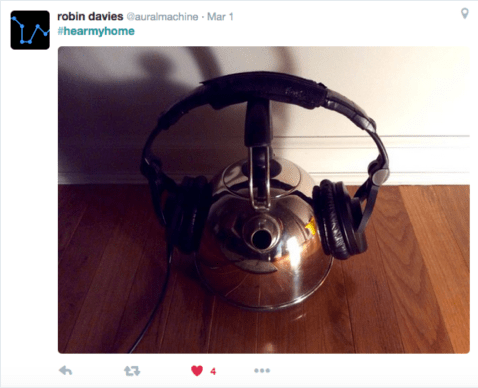
User example from Sonic Event #4: Visualizing Listening
Currently in its earliest phases, #hearmyhome, led by Jon M. Wargo and myself, explores how choosing to ‘tune-in’ facilitates not only an increased awareness of the acoustic territories and rhythmic rituals which surround us, but also the impact of such sonic experiences on our bodies. In doing so, #hearmyhome interrogates how, with and through sound, people write and compose community.
Each of us became interested in studying soundscapes through different avenues. For Jon, his interest in sound and sonic composition emerged from his longitudinal ethnographic examination of LGBT youth writing with mobile media. Sound was a medium used by many of the young people to architect experience and write community. As a traditionally neglected mode, he was curious how historically marginalized youth (LGBT youth of color) used sound to compose counter-narratives of self and community.
Sparked by travels abroad, I first began capturing soundscapes while in Indonesia during Ramadan. Using Snapchat’s video tool, I not only captured the sounds of the call to prayer, but also sounds across Southeast Asia—from the busy streets of Jakarta to the dropping of coins into the 108 bowls within the Temple of Reclining Buddha in Bangkok, Thailand. Through these sonic experiences, I began to question how sound might be used by educators and youth to explore difference and diversity amongst local and global communities.
Developing materials on a multitude of scales—from local community asset maps in teacher education classes to the larger collaborative of networked sounds—each is created with the goal of hearing, recognizing, and sustaining community. #hearmyhome takes heed of the frequencies and rhythms of culture in hopes to architect, design, and teach towards equitable landscapes for learning. Refracted through the aural perspective, we see sound re-teaching the senses by working with participants to compose constructs like ‘home’ and ‘place.’ Geared towards PK-16 teachers and students, #hearmyhome is a pedagogical endeavor. Yet, as a research project, we are interested in examining the following research questions: What are the soundscapes of a networked collaborative? How do users and participants compose with sound, attune towards difference, and write with place?
Towards a Networked Vision for Tuning-In to Sound
#hearmyhome’s vision is guided by three central tenets: collaboration, pedagogy/praxis, and research
Collaboration
Focusing on “everyday” cultural heritage, #hearmyhome invites youth and adult participants to “earwitness” community through expansive personal learning networks (PLN). At the conclusion of the sonic events, participants’ soundscapes and ambient acoustics will be archived on an open-networked soundscapes map. We hope that these will be accessed as curricular resources for youth and teachers globally. #hearmyhome is an “affinity space” wherein participants share both knowledge and life experiences (hosted and inspired through their sonic events series). Through this map, for instance, a teacher in Montana may have access to the sounds of Chicago’s subway while simultaneously youth in Michigan may opt to write with the sounds of a kookaburra captured by second graders in Australia. Ideally, an “affinity space” helps to form interpersonal relationships and collaboratively create a fuller understanding of community and culture for participants. As the community expands through new partnerships and members, we hope it serves as a hub connecting participants with research opportunities, (g)local initiatives—integrating and making the more global knowledge local—and online resources and tools.
Pedagogy/Praxis
One of #hearmyhome’s larger goals is to develop curricular materials for teachers via the collaborative network and shared space on writing with and through sound. As an “open” project, resources will be shared widely via the #hearmyhome website as well as across our social media platforms as we hope to develop powerful practices of hearing, listening, and witnessing sound across communities. Interested in contributing? While our sonic events are available now, throughout the summer #hearmyhome’s homepage will be updated with additional curricular resources. If you are an educator, please consider contributing to this crowd-sourced effort. Join us by signing up for our weekly emails here or like our page on Facebook for more information on each sonic event, or simply ‘lurk and learn’ by following the #hearmyhome hashtag across Instagram, Facebook, and Twitter!
Research
Supported by the Cultural Heritage Informatics Fellowship and the National Council of Teachers of English’s Conference on English Education Research Initiative, #hearmyhome explores the sonic possibilities of writing with sound. We use sound to amplify what Steph Ceraso calls “multimodal listening,” or attending to the bodily, material, and contextual aspects of sonic interactions and relations. Sound allows for more expansive understandings of space, place, and self. We decided to hang our research on the hashtag, #hearmyhome, to aggregate data because it allows us to index user-produced soundscapes while attending to the wider goal of exploring the multiple homes of our global participants. The research component of the project investigates how the acoustic territories of the everyday write culture. For example, how might the writing of a ‘Where I’m From…’ poem shift if one does not choose to write using alphabetic print, but instead chooses to use sound? However, #hearmyhome by its very nature is open to everyone regardless of participation in the formal “research” study. Researchers will always seek members’ consent before sharing any work beyond the online community networked collaborative. For more on this, please see our standards of research statement.
Follow Along with #hearmyhome’s Sonic Events
https://twitter.com/allievoigt/status/701785249454247936
Joining #hearmyhome is as simple as opting in to our sonic events. To do so, visit the #hearmyhome homepage and select “Sonic Events.” Then, after reading across the prompt, use your phone or another device to record the soundscapes that are the focus of the sonic event. You can easily upload and share your recording using Instagram, Twitter, or Soundcloud. By including the #hearmyhome hashtag as well as the appropriate hashtag for the sonic event you are responding to (ex. #SE5 for sonic event 5), your response will be indexed in the #hearmyhome stream. To later be included in our networked map, it is important to also turn on the geotag to demarcate your location. Your contribution will then be accessible to teachers and youth as they explore different communities and writing with and through sound!
While there is no right or wrong way to participate in #hearmyhome, we wanted to share an example from one of our participants, sound scholar Steph Ceraso. By clicking the Soundcloud link below, you can listen to how Steph responded to the prompt for our fifth #hearmyhome sonic event that asked participants to share the sounds of the ‘in-between’ moments of their day. We chose Steph’s example as it illustrates not only the beauty of noise, silence, and everyday hearings, but also for her ability to remix these sounds into a song all of their own.
Although the sonic events go “live” during the weeks listed on the homepage (February 7 to April 1 2016), we encourage you to use these sounds in any way and to join the #hearmyhome collaborative at any time. Reading across the soundscapes of networked participation, we ultimately believe attuning towards difference and “hearing” home and community will help (re)mediate learning about culture by voicing stories of the everyday, highlighting the rhythmic resonances of ritual, and attuning towards community difference.
—
Cassie J. Brownell is a Graduate Fellow in the Residential College in the Arts and Humanities and a doctoral student in Curriculum, Instruction, and Teacher Education at Michigan State University.
Jon M. Wargo, an International Literacy Association (ILA) 30 Under 30 awardee, is a University Fellow and doctoral candidate in Curriculum, Instruction, and Teacher Education at Michigan State University. In Fall 2016, Jon will join the Wayne State University faculty as an Assistant Professor of Reading, Language, and Literacy.
Follow #hearmyhome on Soundcloud, Twitter, and Instagram.
—
REWIND!…If you liked this post, you may also dig:
SO! Amplifies: Ian Rawes and the London Sound Survey–Ian Rawes
SO! Amplifies: Cities and Memory–Stuart Fowkes
Share this:


Current Top Posts





April 2021

January 2020

November 2019

October 2019

August 2019

April 2014

November 2017

March 2015

December 2017

October 2015
 Sounding Out!
Recent Comments