
Sound Designing Motherhood: Irene Lusztig & Maile Colbert Open The Motherhood Archives

A Conversation Article in Chat with Irene Lusztig, Director of The Motherhood Archives and Sound Designer Maile Colbert
In 2011 filmmaker Irene Lusztig contacted me about designing sound and composing for her film project, The Motherhood Archives.
Irene had spent several years buying discarded educational films on eBay and working in historical archives to amass an unusual and fascinating collection of archival films aimed at teaching women how to be pregnant, give birth, and look after babies. The Motherhood Archives uses this extraordinary archival treasure trove to form a lyrical essay film excavating hidden histories of childbirth in the twentieth century, illuminating our changing narratives of maternal success and failure, and raising questions about our social and historical constructions of motherhood.
I was immediately intrigued by her concept and construction process as well as her desire to work with sound design in a very collaborative manner at an earlier stage in the project than most filmmakers would. Geographically distant, Irene and I mostly worked by “satellite,” using email, chat, Skype, phone, and file sharing software to communicate and send files. We did manage to have a few production weeks in New York and Santa Cruz, but the majority of the work was woven back and forth across an ocean and continent…California to Lisbon, Portugal, West Coast to West Coast. Rather than hindering, this method lent itself to an exquisite corpse nature to the work. In the creation of this article we followed much the same process, using an initial Gmail chat.
Maile Colbert (MC): So, I’m both shy and excited about asking this… why me, Irene?
Irene Lusztig (IL): I had heard your work in both Adele Horne’s film [The Tailenders, 2005] and Rebecca Baron’s [How Little We Know of Our Neighbors, 2005], both films with beautiful sound.
.
The sound in How Little We Know of Our Neighbors in particular does something with natural / unnatural that I was really interested in – field recordings that somehow become other kinds of things as they are layered, transformed, and processed. I think of myself as a documentary maker / artist who is invested in actuality, but not very invested in traditional documentary form, and I think your sound has similar investments and disinvestments. It begins with the sounds of the real world but takes those sounds to very unexpected places that are often quite far from their original context.
.
MC: I love that you brought up the “natural/unnatural.” It not only really describes well my work and approach in general, but also the experience we get in your film with mediated motherhood. We would often talk about certain sections being very science fiction…then you think, wow, this really happened, this is part of a history that led up to our experience now, and one I’m currently having, having recently become pregnant for the first time!
IL: I think there is a lot to say about science fiction and sound! First, there is a great tradition of feminist science fiction that I feel like our work is very connected to: Margaret Atwood, Ursula Le Guin, and even stuff like Shulamith Firestone’s futuristic vision of external uteruses. A lot of that work has in common a willingness to “make strange” or denaturalize aspects of female reproduction and mothering in ways that feel radical.
MC: I’m not sure if I was able to contain my excitement when you first mentioned a section felt sci-fi to you. This is something that I think has a root back in my childhood. My father was and is an obsessive science fiction film watcher: I grew up with a soundtrack of The Day the Earth Stood Still and Lost in Space. These soundscapes that “weren’t” became such a part of what I wanted to listen to.
.
IL: I always thought I had no interest in science fiction when I was younger, but I think growing a human inside my own body probably shifted my relationship to that!
I think science fiction is almost always expressing our anxieties about the future, about our technologies, about things that we struggle to control. And of course questions and anxieties about trying and failing to control things are completely at the heart of our experiences with pregnancy, birth, and learning to be new mothers in the 21st century. As are questions around technological mediations that we feel ambivalent about, whether it’s fertility technologies, medicalized birth technologies, or things like baby monitors or worrying about whether the iPad is rewiring your baby’s brain. So science fiction feels like a sonic space that totally makes sense for negotiating these maternal anxieties.
MC: One of our biggest struggles was trying to make sure things weren’t too dark for the audience.
IL: People often respond with anxiety to the film and its sound design. I’ve never before made a film where the sound comes up so often in post-screening discussions, and generally the question is something like “why is the sound so dark / scary / anxiety-provoking?” It seems very specific to the subject of The Motherhood Archives – how anxious we are societally about the whole topic, and also how uncomfortable we are being open about these anxieties.
MC: I’m still shocked at how shocked I am when I realize how some people react to this film, how uncomfortable they are. U.S. society seems just as afraid of birth as death in this manner! We speak of each in such a similar way and we’re not allowed the complexity of, for example, being simultaneously anxious about how this will affect our careers and identity, and how in love we are when we hear that heartbeat!
IL: Do you think of yourself as a feminist artist? I ask because becoming a mother (and making art about motherhood) has made me much more aware of myself as a feminist artist.
MC: I absolutely consider myself a feminist– it’s woven into every part of my life and my work. I’m also beginning to feel this in a new way with the pregnancy: I recently lost a gig I was really looking forward to because there was an assumption that I couldn’t do it somehow because I was pregnant. A recent interviewer asked me about how I navigate motherhood and my work, and I couldn’t help consider that this question would never come up with a male artist.

My recent recordings of my future daughter growing and moving have been wonderful to listen to: watery and subdued, you still feel like you’re only getting a little of her sonic world, so mysterious. But it reminds me of when I was a child – in any body of water I loved to dive down to the bottom, let go of my breath and just rest there as long as I could…it was an ultimate peace. I loved the visual perspective of the world above me, but most loved the deep gentle filter of everything aural coming through this watery world. Some might argue that peace refers to our first soundscape experienced…and listening to my own active womb, it doesn’t seem far-fetched.
IL: There are a lot of watery sounds in the film! My friend Irene Gustafson made this great connection between all the water in the soundtrack and the voiceover passage in the twilight sleep section about how the “soothing sound of running water muffles newborn cries to prevent the formation of what are called islands of memory.” That description of water literally being used to erase memory allows all the water sounds throughout the film to become a metaphor for the erasure of historical memory… the fact that we no longer remember the historical moment where feminists were advocates for anesthetic drugs and medicalized childbirth, for instance…the many ways that the histories in the film are now forgotten.
.
MC: I think sounds are like cells in a way…they carry a memory, even though abstracted.
That’s why I love working with natural sources initially, something comes through from that palette, a shadow is carried from its initial source. As animals, we use sound for information, much processing and translation happens that we aren’t even aware of. So I do feel like when a sound is removed by processing, it still carries its source information with it, and we pick up on some of that.
IL: Talking about cellular memory makes me think about the section of the film that a friend described as “crispy cells:” the image is from a very early 20th century educational film about reproduction – sheep cells that are dividing and reproducing – and the sound is the sound of the magnetosphere, which I love!
.
MC: I find listening to the magnetosphere sort of grounds me. I use a VLF recorder very often when I travel. If there are lightening storms or space weather, like solar storms, you get these very beautiful and strange soundscapes. I often use the recordings in my work, but your film is the first that seemed to demand them as a sound source! That section just called out for them, in their “pure” form. When you placed them there and sent it to me, I was blown away…it seemed like that was the sound of the video itself somehow.
I’ve been collecting and working on my sound library for over a decade now, and I’ve never been in a situation where a client or collaborator was interested in it in such a hands-on way. It seemed so right to share it with you and build upon it together for this project. For each sound – some of them going way back – I still remember the source, recording conditions, what was surrounding it (or rather what it was surrounding usually!). They become symbols, but also memory triggers. Now some of them have changed and were saved with this project, so there are generations as well. And the historic archival sounds you added to it…they come with their own history and memory; your film and their use is then added to that.
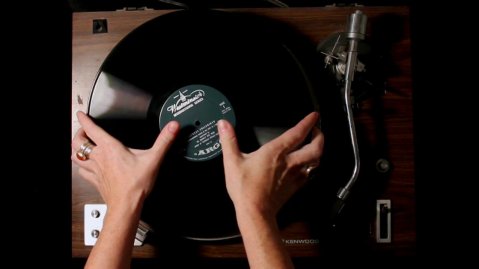
IL: Speaking of archival sound, one of the most amazing (to me) moments in our collaboration was really close to the end when you sent me the end credit sound. We’ve actually never talked about this because as soon as you sent it I totally intuitively and immediately knew that it was perfect. The sound is a backwards transformation of the wax cylinder Chopin Waltz recording that is used earlier in the film during the pregnant ballet sequence. There’s something so brilliant about your instinct to bring back that very polite, restrained music at the end, but have it reversed – both because it turns something familiar and half-remembered on its head, but also because I think it says something about history that is so attuned to the way the film works. The film thinks about histories of childbirth, but the chronological structure is circular, not linear – which I think of as a kind of challenge to the conventional forward-marching progress narrative. History is always haunting the present, and history is always circular. It makes amazing and beautiful sense that this music that we’ve heard before returns at the end in this uncanny backwards form.
—
Maile Colbert is a multi-media artist with a concentration on sound and video who relocated from Los Angeles, US to Lisbon, Portugal. She is a regular writer for Sounding Out!
—
 REWIND! . . .If you liked this post, you may also dig:
Wayback Sound Machine: Sound Through Time, Space, and Place— Maile Colbert
Sounds Like a Baby— Liana Silva-Ford
Playing with Bits, Pieces, and Lightning Bolts: An Interview with Sound Artist Andrea Parkins— Maile Colbert
Share this:

Óyeme Voz: U.S. Latin@ & Immigrant Communities Re-Sound Citizenship and Belonging

En Espanol siguiente.
Post by Nancy Morales. Translation by Martha Unzueta-Perez, m.unzueta.perez@gmail.com
My recent experiences—both inside and outside the academy—as a U.S. citizen with an “ivy league education” make it crystal clear to me that I am a brown mujer who will always be criminalized by the state regardless of how many “privileges” I acquire or believe to have obtained through my “hard work.” I cannot continue my path toward self-determination without acknowledging that the privileges I acquire will not guarantee my protection, let alone my liberation. In other words, people of color are perpetually vulnerable regardless of their education, wealth, and/or social status. In “Speaking in Tongues: A letter to Third World Women Writers” in This Bridge Called My Back: Writings by Radical Women of Color, Gloria Anzaldúa explored this notion in her letter to third world women writers, where she expressed that we have never had any privileges and we never will (165). Anzaldúa makes this statement not to foreclose our dreams but rather to enable our liberation; in essence, we have nothing to lose by imagining other ways of being. If we were to perform as the imagined ideal U.S. citizen under the hetero-normative standards (racial, gender, and sexuality, including sonic markers of citizenship), it would always be at the expense of displacing each other. Privilege is too often misunderstood as a form of protection from displacement and a claim of worthiness as human beings.
Amplifying and extending the resonance of Anzaldúa’s powerful declaration, my scholarship is personally healing because I seek to understand the very modes of knowledge production: how meaningful research is undertaken and actualized, particularly by and for immigrant communities, by exploring how these groups help us imagine new and yet unknown territories wherein our differences are valid. Los Jornaleros del Norte, Radio Ambulante and other immigrant rights folks provide examples of imagining other ways of being, including the production of sonic markers of citizenship that are not state-sanctioned. In other words, they are doing the work of knowing themselves better in order to respect and understand each other. Often, some of the most crucial knowledge production happens through the materiality of sounds and the material impacts of listening practices, both dominant and resistant.

Rallying the Crowd with a Bullhorn, Arizona SB 1070 Protest, May 2010, Image by Flickr User Xomiele
Citizenship is (mis)understood as a privilege that guarantees protection by the nation-state. The current nation-state’s dominant discourse of national security creates draconian federal, state, and local legislation that belie immigrants’ differences. Rising anti-immigrant rhetoric attempts to homogenize both Latinas/os and immigrants as criminals. In other words, such discourse is used to justify the nation-state as the reference point for recognizing a legitimate community. The Department of Homeland Security’s agenda deems who may be tolerable and who is deportable, even if you are a U.S. citizen. Distinguishing, for example, between exceptional students who “deserve to be here” and those who do not, creates a hierarchy of immigrants. Consequently, public discourse over the worthiness of recognition and belonging creates limitations that categorize immigrants in restrictive ways. Similarly, attacks on bilingual education and ethnic studies attempt to displace Latinos as foreign and “alien” within US territories.
Jennifer Stoever-Ackerman’s “The Noise of SB 1070: or Do I Sound Illegal to You?” provides sonic examples of discrimination to reveal how citizenship is further constructed through sound. The dominant listening ear, as Jennifer Stoever-Ackerman coins, reveals:
how racialized norms about sound exist and circulate through popular culture. As a result dominant groups use sound with impunity to forge “reasonable suspicion” about the citizenship status of anyone who sounds different from them and who creates, consumes, and appreciates sounds differently from them (5).
More importantly we learn that sonic markers of citizenship are just as unreliable as biological/physical ones i.e. racial profiling. One may have an accent or speak Spanish but that doesn’t prove or disprove their citizenship status. However, what we understand more prominently is the various ways brown bodies are displaced through structural racism such as sonic markers of citizenship.

Image by Wikipedia
In order to more fully understand the legacy of the U.S. conquest of Latin America and the Caribbean—of which contemporary anti-terrorist and anti-immigrant rhetorics are an extension—we must recognize how colonizers use language as a weapon that can shame, humiliate and further colonize people of color. bell hooks testifies to this notion in “Teaching New Worlds/New Words” from Tongue-tied: The Lives of Multilingual Children in Public Education: “standard English is not speech of exile. This is the language of conquest and domination in U.S.” (255). We often begin to think that we can acquire privileges of upward mobility, class, citizenship or race as our source of protection, particularly through linguistic “passing” (Anzaldúa,“Linguistic Terrorism” Borderlands/ La Frontera: The New Mestiza, 217). However, as Anzaldúa explains in “How to Tame a Wild-Tongue” from Borderlands/ La Frontera: The New Mestiza: “Until I can take pride in my language, I cannot take pride in myself. Until I can accept as legitimate Chicano Texas Spanish, Tex-Mex and all other languages I speak, I cannot accept the legitimacy of myself” (81). Deborah Vargas’s 2012 book Dissonant Divas in Chicana Music: The Limits of La Onda (University of Minnesota Press) also explores these issues and comes at an important moment to continue to learn how the power to push the boundaries of heteronormative standards can be understood in Chican@-Laitn@ culture. By dis-placing the dominance of standard English and acknowledging the multiplicity of languages they speak and seek to listen to, Chican@s-Latin@s can begin to acknowledge their wealth of knowledge as meaningful instead of meaningless.

NDLON Banner, Image by Flickr User NDLON
Meaningful Sounds: Dignity and Respect
It is important, then, to recognize the critical work that immigrant rights communities create that push the boundaries of the dominant listening ear, particularly through the inclusion of the vocal materialities of people of color. Such immigrant rights groups mobilize the sounds of immigrant voices not as a neoliberal way of “proving their worthiness” but, like Sebastien de la Cruz, the San Antonio-area ten-year-old who sang the national anthem at game three of the 2013 NBA finals in his mariachi outfit, they use sound to create and amplify fair representations that vocally resist the dominant binaries of foreign/citizen, illegal/legal.
Los Jornaleros offer the people their talent and their love with their music of resistance and struggle
Los Jornaleros del Norte is a musical group that formed out of the struggles of day laborers. They are part of the National Day Laborer Organizing Network (NDLON) where they realize their cultures and languages as forms of resistance. They sing songs in Spanish at protests, rallies, on the radio and in all other public spaces.
In this clip, Los Jornaleros interject their voices to denounce deportations, wage theft and to energize (im)migrant families’ wishes and desires. Through live performances and Internet circulation, this group amplifies the actual voices of people directly affected by immigration enforcement policies and refuse to be silenced by the dominant American listening ear.
In addition, organizations such as the National Day Laborer Organizing Network (NDLON) and Education for Fair Consideration (E4FC) use various organizing tools to amplify the voices of immigrant communities. Alongside and in solidarity with E4FC, a network of artists, writers, and filmmakers, including Favianna Rodriguez, actively fight for just immigration reform using sound. These artists are crucial to the defense and protection of immigrant rights and for changing dominant discourses about immigrants as unworthy. For example, La Santa Cecilia, an L.A. band committed to social justice issues, collaborated with NDLON to produce a song in Spanish wherein the music video showcases people affected by un-sound immigration policies.
“ICE/El Hielo”—a multilingual play on the acronym of the U.S. Immigration and Customs Enforcement—combines visual imagery of immigrants with a multiciplicity of langages, musical styles and vocal tones to help us understand the trauma and pain that immigrant communities endure on a daily level due to the dominant discourse of national security that homogenizes Latina/os and (im)migrant communities as less than human. [Note: The song can also be heard on Sounding Out!’s annual free downloadable mix for 2013. Click here—JSA]
Practices like La Santa Cecilia’s encourage Latinas/os and immigrants—who are often spoken about instead of directly spoken to— to participate in public spaces, including digital spaces. Digital spaces, I believe, can become potential safe spaces that allow Latina/os and immigrant communities to produce their own sounds and to therefore make an alternative claim to belonging that is not predicated upon speaking “Standard” English and/or being “real” American citizens. Through digital outreach, E4FC encourages undocumented youth to share their immigrant stories sonically connect immigration issues on a global scale.
While musical interventions are effective, I use the remainder of this post to address the more nuanced ways in which Latina/o and (im)migrant communities add the sound of their voices to global discourses through storytelling, music, and language(s) in beautiful (though sometimes painful), telling ways. Immigrant communities produce and circulate sounds meaningful to them to contextualize and reveal their differences within Latina/o communities. In other words, they push the boundaries of citizenship through methods of self-organizing that sounds dignity and respect for each other. I argue that sharing their perspectives and stories—here and elsewhere on the Internet—captures more than just a sound bite. The sound of “everyday voices” mobilized against—and remarking on—the nation-state’s attempts to mark immigrant communities as vulnerable exerts an impactful and profoundly material agency.

Voz Mob Logo, Image by Flickr User RisetoMovement
For instance, Voces Móviles (VozMob), a collaboration between the University of Southern California’s Annenberg School and Instituto de Educación Popular del Sur de California/ Institute of Popular Education of Southern California (IDEPSCA) uses SMS technology to document immigrant workers’ voices online.
VozMob enables day laborers and other immigrant communities to use their cell phones as a tool to share their perspectives and become narrators of their own stories via text, images and video. Users upload their content directly to the VozMob webpage where you can read, see, and/or listen their daily experiences. In this video clip Luis Valentán shares his perspective as a day laborer about immigrant rights.
[vimeo http://vimeo.com/84067495]Rejecting the label of a “Dreamer,” Valentán sounds differences within immigrant communities by encouraging others to recognize that they are “Doers.” He also pushes the boundaries of an immigrant rights framework that values and respects people who strive for a better life in the face of limited opportunities.
Radio Ambulante also creates a digital space for the voices of people from Latin America and the U.S. It is the first Spanish-language radio program that tells stories where culture and belonging have no borders. The programmers broadcast various thematic episodes highlighting stories that explore differences by using speakers’ primary language(s). This approach, as heard in the November 2013 episode “la palabra prohibida,” enables diverse listeners to hear people who share, and more importantly, complicate notions about cultures, origins, and perceptions of belonging.
In “la palabra prohibida,” the broadcasters make no attempt to profile the episode’s participants as fitting the “good” or “bad” dichotomy of the immigrant narrative. Instead, Radio Ambulante creates a sonic medium that juxtaposes voices to make human complexity material for its listeners.
Click to play Radio Ambulante, “la palabra prohibida” episode
It is crucial to continue to understand the power of our voices, housed in their expression and their sound. (Im)migrant communities have a wealth of knowledge in their lived experiences, and they tell it well through these digital and public spaces, showing us how knowledge is produced not only through words and sounds, but in the powerful relationship between them. By further amplifying immigrant voices in new sites, both “traditional” and digital, I continue the important work they have begun, helping us to realize where and when the power of our sounds resonates as a catalyst to mobilize people beyond perceived borders, where we all have the right to migrate and the right to just be.
—
Featured Image by Flickr User Claudia A. De La Garza, 5-6-06
—
Nancy Morales is a faculty lecturer for the Latina/o Studies minor in the Center for the Study for Culture, Race and Ethnicity (CSCRE) at Ithaca College. Morales has research interests in U.S third world feminist theory, immigration policy, labor relations, critical ethnic studies, cultural and sound studies. She focuses on how Latina/o workers and immigrant workers have been excluded from the ranks of the working-class because of their racial, cultural, gender and immigration-status differences. She received a B.A. in Social Psychology from UC Santa Cruz and a Master’s from Cornell’s Institute for Public Affairs with a minor in Latina/o Studies. Morales has done research for the National Day Laborer Organizing Network (NDLON) and for the National Domestic Workers Alliance (NDWA) in order to further explore how race and gender become necessary for understanding workers’ struggles within the Immigration, Labor, and Civil Rights Movements.
—
Óyeme Voz”: Comunidades Latinas y Inmigrantes de EE. UU. Resuenan Ciudadanía y Pertenecer
Post by Nancy Morales. Translation by Martha Unzueta-Perez, m.unzueta.perez@gmail.com
Mis experiencias recientes—tanto dentro como fuera de la academia—como una ciudadana de Estados Unidos con una educación “Ivy League” lo hace muy claro que soy una mujer de color que siempre va ser criminalizada por el estado sin importar cuantos “privilegios” adquiero o creer haber obtenido a través de mi “trabajo duro.” Yo no puedo continuar mi camino hacia la autodeterminación sin reconocer que los privilegios que adquiero no me garantizaran mi protección y mucho menos mi liberación. En otras palabras, las personas de color son perpetuamente vulnerables sin importar su educación, riquezas y/o estatus social. En “Speaking in Tongues: A letter to Third World Women Writers” en This Bridge Called My Back: Writings by Radical Women of Color, Gloria Anzaldúa explora esta noción en su carta a escritoras del tercer mundo, donde expreso que nunca hemos tenido ningún privilegio y nunca lo tendremos (165). Anzaldúa hace esta declaración no para anular nuestros sueños sino más bien para hacer posible nuestra liberación; en esencia, no tenemos nada que perder al imaginar otras formas de ser. Si fuéramos a actuar como el imaginado ciudadano ideal de Estados Unidos bajo las normas hetero-normativas (racial, genero y sexualidad, incluyendo señales sónicas de la ciudadanía), siempre seria al costo de desplazarnos el uno al otro. El privilegio a menudo es mal entendido como una forma de protección de desplazamiento y una reclamación de merecimiento como seres humanos.
Amplificar y extender la resonancia de la poderosa declaración de Anzaldúa, mi trabajo académico me ayuda personalmente a sanar porque yo busco a entender los modos de producción de conocimiento: cómo la investigación significativa es emprendida y actualizada, particularmente por y para las comunidades de inmigrantes, al explorar cómo estos grupos nos ayudan a imaginar nuevos y aún desconocidos territorios donde nuestras diferencias son validas. Los Jornaleros del Norte, Radio Ambulante y otras personas de los derechos de inmigrantes proporcionan ejemplos de imaginarse otras formas de ser, incluyendo la producción de señales sónicas de la ciudadanía que no son sancionados por el estado. En otras palabras, están haciendo el trabajo de conocerse mejor para respetarse y entenderse. Frecuentemente, alguna de la producción de conocimiento más importante ocurre a través de la materialidad de los sonidos y los impactos materiales de las prácticas de escuchar tanto dominante y resistente.

Rallying the Crowd with a Bullhorn, Arizona SB 1070 Protest, May 2010, Image by Flickr User Xomiele
La ciudadanía es (mal) entendida como un privilegio que garantiza la protección por la nación-estado. El discurso dominante actual de la nación-estado de la seguridad nacional crea una legislación draconiana federal, estatal y local que desmienten las diferencias de los inmigrantes. La creciente retórica anti-inmigrante intenta homogeneizar tanto los latinos e inmigrantes como criminales. En otras palabras, tal discurso es utilizado para justificar la nación-estado como un punto de referencia para reconocer una comunidad legitima. La agenda del Departamento de Seguridad Nacional considera quien puede ser tolerable y quien puede ser deportado, aún si usted es un ciudadano estadounidense. Distinguir, por ejemplo, entre los estudiantes excepcionales que “merecen estar aquí” y aquellos que no, crea una jerarquía de los inmigrantes. Consecuentemente, el discurso publico sobre el merecimiento de reconocer y pertenecer que categorizan a los inmigrantes en maneras restrictivas. Similarmente, los ataques contra la educación bilingüe y los estudios étnicos intentan desplazar a los latinos como extranjeros y “alien” en los territorios estadounidenses.
El artículo “The Noise of SB 1070: or Do I Sound Illegal to You?” de Jennifer Stoever-Ackerman proporciona ejemplos sónicos de discriminación para revelar como la ciudadanía se construye aún más a través del sonido. El oído dominante, como Jennifer Stoever-Ackerman revela:
Como las normas racializadas sobre el sonido existen y circulan a través de la cultura popular. Como resultado grupos dominantes utilizan el sonido con impunidad parar forjar una “sospecha razonable” sobre el estatus de la ciudadanía de cualquier persona que se escucha diferente a ellos y que crea, consume y aprecia los sonidos de manera diferente a ellos (5).
Más importante nosotros aprendemos que las señales sónicas de ciudadanía son tan poco fiables como los biológicas/físicas, es decir discriminación racial. Uno puede tener un acento o hablar español pero eso no demuestra su estatus de ciudadanía. Sin embargo, lo que nosotros entendemos de manera más prominente es las diferentes formas en que la gente de piel morena es desplazada a través del racismo estructural tal como señales sónicas de la ciudadanía.

Image by Wikipedia
Para entender más completamente el legado de la conquista de EE.UU. de America Latina y el Caribe—de cual la retórica contemporánea anti-terrorista y anti-inmigrante son una extensión—nosotros debemos reconocer cómo los colonizadores utilizaron el lenguaje como un arma que pude avergonzar, humillar y colonizar aun más a la gente de color. bell hooks atestigua a esta noción en “Teaching New Worlds/New Words” del Tongue-tied: The Lives of Multilingual Children in Public Education: el ingles estándar no es el habla de exilio. Este es el lenguaje de conquista y dominación en los EE.UU.” (255). A menudo empezamos a pensar que podemos adquirir privilegios de movilidad hacia arriba, clase, ciudadanía o raza como nuestra fuente de protección, en particular “pasando” lingüísticamente (Anzaldúa, “Linguistic Terrorism” Borderlands/ La Frontera: The New Mestiza, 217). Sin embargo, cómo Anzaldúa explica en “How to Tame a Wild-Tongue” de Borderlands/ La Frontera: The New Mestiza: “Hasta que yo pueda tener orgullo en mi lenguaje, no puedo tener orgullo en mi mismo. Hasta que yo pueda aceptar como legitimo el español chicano tejano, tex-mex y todos los otros idiomas que hablo, No puedo aceptar la legitimidad de mí mismo” (81). Deborah Vargas’s 2012 libro Dissonant Divas in Chicana Music: The Limits of La Onda (University of Minnesota Press) también explora estas cuestiones y llega a un momento importante para continuar a aprender como el poder de empujar los limites de las normas hetero-normativas pueden ser entendidas en la cultura chincan@s-latin@s. Al descolocar el dominio del ingles estándar y reconocer la multiplicidad de los lenguajes que hablan y buscan escuchar, chican@s-latin@s pueden comenzar a reconocer su riqueza de conocimiento como significativo en vez sin sentido.
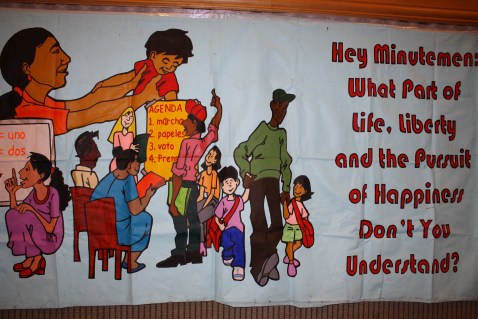
NDLON Banner, Image by Flickr User NDLON
Sonidos Significativos: Dignidad y Respeto
Es importante, luego, reconocer el trabajo crítico que las comunidades de derechos de inmigrantes crean que empuje los límites del oído dominante, particularmente a través de la inclusión de las materialidades vocales de la gente de color. Tales grupos de derechos de inmigrantes movilizan los sonidos de las voces de los inmigrantes no como una forma neoliberal de “demostrar su merecimiento” pero, como Sebastien de la Cruz, el niño de diez años de edad de San Antonio que canto el himno nacional para el tercer juego de la final 2013 del NBA en su traje de mariachi, ellos utilizaron el sonido para crear y amplificar una justa presentación que vocalmente resiste binarios dominantes de extranjero/ciudadano, ilegal/legal.
Los Jornaleros ofrecen a la gente su talento y su amor con su música de resistencia y lucha
Los Jornaleros del Norte es un grupo musical que fue formado de las luchas de los jornaleros. Ellos son parte del National Day Laborer Organizing Network (NDLON) donde ellos realizan sus culturas y lenguajes como formas de resistencia. Ellos cantan canciones en español en las protestas, en mítines, en el radio y en todos otros espacios públicos.
En este clip, Los Jornaleros interponen sus voces para denunciar las deportaciones, el robo de salarios y energizar los deseos de las familias in(migrantes). A través de actuaciones animadas y la circulación de Internet, este grupo amplifica las voces actuales de la gente directamente afectada por las políticas de inmigración y se niegan a ser silenciados por el oído dominante Americano.
Además, organizaciones como el National Day Laborer Organizing Network (NDLON) y Education for Fair Consideration (E4FC) utilizan varias herramientas de organización para amplificar las voces de las comunidades de inmigrantes. Junto y en solidaridad con E4FC, una red de artistas, escritores y cineastas, incluyendo Favianna Rodríguez, luchan activamente para una reforma de inmigración justa utilizando el sonido. Estos artistas son cruciales para la defensa y protección de los derechos de inmigrantes y por cambiar los discursos dominantes sobre inmigrantes que son vistos sin dignidad. Por ejemplo, La Santa Cecilia, una banda local en Los Ángeles comprometida a la cuestiones de justicia social, colaboro con la organización NDLON para producir una canción en español en el que el video musical muestra las personas afectadas por las políticas poco acertadas.
“ICE/El Hielo”—una obra de teatro multilingüe sobre las siglas de la Oficina de Inmigración y Aduana d EE.UU. (U.S. Immigration and Customs Enforcement)—combina una imagen visual de inmigrantes con una multiplicidad de lenguajes, estilos musicales y tonos vocales para ayudarnos a entender el trama y dolor que las comunidades de inmigrantes perduran a diario debido al discurso dominante de la seguridad nacional que homogeniza a las comunidades latinas y (in)migrantes como menos que humanos. [Editor’s Note: La canción también puede escucharse y descargarse en el mix anual gratuito de Sounding Out! para el 2013. Haga clic aqui—JSA]
Prácticas como la de La Santa Cecilia animan a los latinos e inmigrantes—que a menudo se habla de ellos en vez de directamente hablar con ellos— a participar en espacios públicos, incluyendo espacios digitales. Los espacios digitales, yo creo, pueden convertirse en potenciales espacios seguros que permite a las comunidades latinas e inmigrantes a producir su propio sonido y por lo tanto hacer una reclamación alternativa a pertenecer que no se predica al hablar en ingles “estándar” y/o ser un ciudadano americano “real.” A través del alcance digital, el E4FC anima a la juventud indocumentada a compartir sus historias de inmigrantes sónicamente para conectar los temas de inmigración a un nivel global.
Mientras intervenciones musicales son efectivas, yo utilizo el resto de este articulo para hablar sobre las formas más matizadas en la cual las comunidades latinas e de (in)migrantes agregan el sonido de sus voces a discursos globales a cuentos, música y lenguaje(s) en maneras bellas (y a veces dolorosas) de contar. Las comunidades inmigrantes producen y circulan sonido significante a ellos para contextualizar sus diferencias entre las comunidades latinas. En otras palabras, ellos empujan los límites de la ciudadanía a través de métodos de auto-organización que se escucha con dignidad y respeto para uno al otro. Yo sostengo que compartir sus perspectivas y historias—aquí y en otros lugares en el Internet—captura más que una picadura de sonido. El sonido de “voces cotidianas” movilizadas contra—y comentando sobre—los intentos de la nación-estado para marcar las comunidades inmigrantes como vulnerables causa una impactante y profunda agencia material.

Voz Mob Logo, Image by Flickr User RisetoMovement
Por ejemplo, Voces Móviles (VozMob), una colaboración entre La Escuela de Annenberg en Universidad del Sur de California (University of Southern California’s Annenberg School) y el Instituto de Educación Popular del Sur de California (Institute of Popular Education of Southern California – IDEPSCA) utiliza la tecnología SMS para documentar la voces de los trabajadores inmigrantes en la Internet.
VozMob permite a los jornaleros y otras comunidades inmigrantes a utilizar sus teléfonos celulares como una herramienta para compartir sus perspectivas y convertirse en narradores de sus propias historias vía texto, imágenes y video. Usuarios suben su contenido directamente a la pagina Web VozMob webpage donde uno puede leer, ver y/o escuchar sus experiencias diarias. En este videoclip Luis Valentán comparte su perspectiva como un jornalero sobre los derechos de inmigrantes.
[vimeo http://vimeo.com/84067495]Al rechazar la descripción de “Soñador,” Valentán sonora las diferencias entre las comunidades inmigrantes al animar a otros a reconocer que son “Hacedores.” El también empuje los limites de un marco de derechos de inmigrantes que valora y respeta a las personas que luchan por una vida mejor que enfrentan oportunidades limitadas.
Radio Ambulante también crea un espacio digital para las voces de la gente de América Latina y de EE.UU. Es el primer programa de radio en español que cuenta las historias donde la cultura y pertenecer no tienen fronteras. Los programadores transmiten varios episodios temáticos destacando historias que exploran diferencias mediante el uso del lenguaje primario. Este enfoque, como se escucho en el episodio de noviembre 2013 “la palabra prohibida,” permite a oyentes diversos a que escuchen a personas que comparten y, más importante, complican las nociones sobre culturas, orígenes y percepciones de querer pertenecer.
Radio Ambulante, “la palabra prohibida”
En “la palabra prohibida,” los locutores no hacen ningún intento a perfilar a los participantes del episodio como una en la dicotomía “buena” o “mala” de la narrativa de inmigrantes. En cambio, Radio Ambulante crea un medio sónico que yuxtapone las voces para hacer material de complejidad humano para sus oyentes.
Es crucial continuar a comprender el poder de nuestras voces, que se encuentran en su expresión y su sonido. Las comunidades (in)migrantes tienen una riqueza de conocimiento en sus experiencias vividas y lo dicen bien a través de estos espacios públicos y digitales, enseñándonos como el conocimiento se produce no solo a través de palabras y sonidos sino en la poderosa relación entre ellos. Al amplificar aún más las voces inmigrantes en nuevos sitios, tanto “tradicional” y digital, yo continuo la importante labor que han iniciado, ayudándonos a realizar donde y cuando el poder de nuestros sonidos resuenan como un catalizador para movilizar a la gente mas allá de las fronteras percibidas, donde todos tenemos el derecho a migrar y el derecho de ser.
—
Nancy Morales es profesora en la especialización de estudios latinos en el Centro para el Estudio de Cultura, Raza y Etnicidad (Center for the Study for Culture, Race and Ethnicity – CSCRE) en el Colegio Ithaca (Ithaca College). Morales tiene intereses de investigación en la teoría feminista del tercer mundo de EE.UU., política de inmigración, relaciones labores, estudios étnicos críticos, estudios culturales y de sonido. Ella se centra en cómo los trabajadores latinos y trabajadores inmigrantes han sido excluidos del los rangos de la clase obrera por sus diferencias raciales, culturales, del genero y el estatus inmigrante. Ella recibió su licenciatura en psicología social de la Universidad de California Santa Cruz y su maestría del Instituto de Negocios Públicos de la Universidad de Cornell (Cornell University) con una especialización en estudios latinos. Morales ha realizado investigaciones para la Red de Organización Nacional de Jornaleros (National Day Laborer Organizing Network – NDLON) y para la Alianza Nacional de Trabajadores Domésticos (National Domestic Workers Alliance -NDWA) para poder explorar más a fondo cómo la raza y el género son necesarios para comprender la lucha de los trabajadores dentro de la inmigración, labor y el movimiento de derechos civiles.
—
 REWIND! . . .If you liked this post, you may also dig:
Soundscapes of Narco Silence--Marci McMahon
Sonic Brownface: Representations of Mexicanness in an Era of Discontent–reina alejandra prado
Chicana Radio Activists and the Sounds of Chicana Feminisms–Monica De La Torre
—
Share this:


Current Top Posts





April 2021

January 2020

November 2019

October 2019

August 2019

April 2014

November 2017

March 2015

December 2017

October 2015
 Sounding Out!
Recent Comments