
Tuning In to the Desi Valley: Getting to Know a Community via Radio

Sound has a peculiar relationship to mindfulness; zoning in and out, active and passive forms of listening while we situate our listening practices alongside other daily activities. Especially when it comes to driving, listening to something or someone or just singing aloud by myself, I have realized, helps me drown out other noises of alertness. Over the years I have come to value background music or chatter and especially radio programming that takes the burden of curation and scheduling off my back, in all sorts of tasks that require deep concentration. Enough and more has been said about the visual-bias in various forms of ethnographic inquiry (see Andrew C. Sparkes’s “Ethnography and the senses” for a good example). Without belaboring these arguments, I also find that knowing through listening and listening as a mode of non-haptic yet immersive and intimate engagement can also prove to be a fruitful method of inquiry, especially in our post-pandemic worlds, where it feels a lot harder to establish intimacy. The United Nations noted that radio, in particular, “provided solace” during that period of physical distancing and social isolation.
For me, radio sparked my accidental realization and foregrounding of sonic methods as an itinerant means of getting to know new things, people and surroundings in life and research when I moved from New York to the San Francisco Bay Area in mid-2022 to start a new position as a postdoctoral researcher. Knowing that I would continue living in California for the near future, after eight long years of having deferred driving in America, I decided to learn driving and buy a car. I was also especially excited to be moving to Sunnyvale, a city in the Southern Peninsula, located between more known places like Palo Alto and San Jose. Sunnyvale is often jokingly called the desi capital, perhaps the most Indian of any ‘Little India’ you could find in America. As shorthand, desi, a Hindi word,refers to anyone and everything with ties to the South Asian subcontinent. In more recent years, the term has gained currency especially among South Asian diasporic communities to self-refer to culture, music, food, often to signify the presence and strength of transnational ties (between India and their countries of settlement).
What I hadn’t anticipated was that driving brought about a new connection to the medium of radio, as I started tuning in to take my mind off the jitters that come with the new sounds of an automobile-dependent region: fast moving rubber hitting the freeway tarmac and the lane changes and the scalar adjustments that demand driving tens of miles to ensure you still have a social life stitched together across the vastness of California. I began to find the act of tuning in and out of stations fascinating, especially how the radio as a device holds the parallel realities of so many people with different interests, languages and politics together but separate. Scholarship and even casual listening shows that non-English radio stations catering to various immigrant and other communities have existed for a long time in the US and elsewhere (I wish pondering the sonic geographies of Radio Garden, a web-based map interface that allows listeners to access any free-to-air radio stations across the world, wasn’t beyond the scope of this post!). Both as an ethnographer and as an insider-outsider within the larger Indian immigrant and diaspora community (but a newcomer to the Bay Area), tuning into the local desi radio station while driving offered me a good way to enter the desi community of the Bay Area, to know what it means to be desi and perform Indianness in 2022, in a place where I regularly see so many Indians and South Asians every single day.
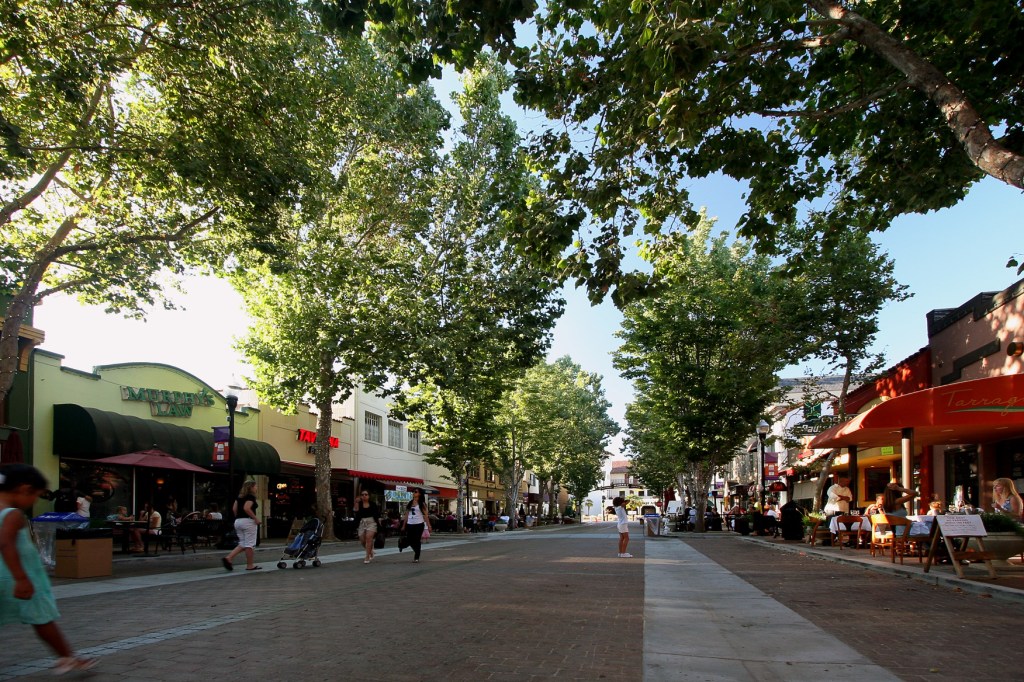
As a friend who recently visited me in Sunnyvale remarked as we waited for our table at the always-busy Madras Cafe, Sunnyvale feels so much like India! And I felt it too; what she was referring to was not only the very visible presence of Indian people all around town or the abundance of restaurants catering to various sub-regional cuisines from India. What felt different to me here was how relaxed everyone looked in grocery stores, restaurants and elsewhere, how utterly remade Sunnyvale is as a pan-Asian but mostly Indian space that even the smallest performances of fitting in feel unnecessary. In fact, shopping her reminded me of a point Purnima Mankekar’s Indian narrators made in her iconic essay on Indian grocery shopping in the San Francisco Bay Area (2010), that Indian stores in Sunnyvale and Milpitas as places where “white people look out of place” as compared to the ones in Berkeley.
The juxtaposition of the non-performances and the weight of being comfortably in place in a community like Sunnyvale only settles on the mind and body very slowly, like a faint but familiar smell from home. Words and demands often stumble out of my mouth at the grocery store, as if I am allowed and I will be completely understood. Immigrant life in America is steeped in language acrobatics, balancing being understood with becoming deliberately opaquely incomprehensible, using one accent for the ones from home, one for those who make you feel at home, and then the American accent for the Americans outside. The contrast of places like Sunnyvale, Fremont, Milpitas and other similar Northern California cities that have been transformed by immigrant presence is not just one of tangible and observable things, but sonic markers too, like Bolly 92.3FM.

Bolly 92.3FM is the default desiradio station that services the entire San Francisco Bay Area. As the name suggests, for the most part the station plays popular Bollywood songs from recently released movies and albums, but just as other stations do in India, Bolly92.3FM leverages its listener demographics at different times of the day to also play classics and hits from older Hindi films during late night slots. Interestingly, as the presenters repeat the station name and jingle time and again, they also remind you that you are listening to Bay Area’s Bollywood station owned by the Silicon Valley Asian media network. The name Bolly92.3FM is a play on the broad familiarity with Bollywood in the US even as Indian audiences globally have moved away from the older connotations of Bollywood as North Indian cinema with song, dance and people dressed in flashy clothes. Much like the hyper-authentic Indian restaurants that serve regional cuisines such as Andhra, Tamil, Gujarati, Rajasthani and Marathi food to their loyal and affording immigrant patrons, Bolly92.3FM has also configured its programming to cater to different regional and linguistic communities from India in the Bay Area. For instance, Saturday morning and afternoon slots are dedicated to Telugu programs—everything is in Telugu (language) from the hosts discussions to the songs being played as well as the actual topics being discussed—as if the station turns into a different station with the implicit acknowledgement of the substantial cultural presence and possibly the sonic and financial power of Telugu listeners among the wider Indian community here. There are similar slots dedicated to Gujarati language programming.
In addition to language and topical interests, listening to Bolly92.3FM has been instructive in getting a feel for communal desires, aspirations and anxieties through its advertisement. There are fellow desi real estate agents, tax planners, dentists, travel agencies and coaching centers, each signaling to why they are trustworthy. Some remind their audiences of their shared cultural background as key to them being able to understand their customers’ needs, others also indicate their familiarity with America: one realtor is the only Indian-origin person to feature in a top realtor list, another tax planner’s family has been in the US for three generations and thus he is well aware of the nitty-gritties of transnational estate planning. A known Indian-origin realtor in the area even sponsors his own radio show on the weekends where he takes questions from prospective home buyers and sellers. Before and beyond giving them financial advice, he often explains how fellow Indian immigrants think about financial opportunities, investments, how they might seek social validation from fellow Indians who might see their home and so on. He weaves in such exposition before talking dry financial facts about mortgages. The same tax planner and his co-host occasionally offer historical accounts of changing real estate trends, how certain places used to be affordable for Indian immigrant buyers and how new places are becoming of interest as vacation homes for more affluent Indian immigrants.

Hearing the tax planners and real estate agents plot these dynamic and speculative maps of South Asian financial, cultural and political futures week-after-week felt like witnessing what many historical texts on migration within the Bay Area have described as waves in the past. As I mentioned earlier, Sunnyvale is not the only ‘Little India’ in the Bay Area, let alone in California, but rather, is a more recent iconic place in the Indian and South Asian diaspora map where the younger and newer immigrants are finding homes. Fremont, Milpitas, and Hayward in the East Bay closer to Oakland, and San Jose in the South Bay, saw similar waves of Indian immigrant settlements in the past, many of whom now far more affluent than their younger counterparts. In my short time since moving here, I learned both from conversations with friends who grew up in the area as well as from communication scholar Anne Marie Todd’s work on the past and present of Santa Clara Valley, this region has not only seen waves of migration from settlers across the world but with each incoming wave and turn in occupational trends from farming to railroads to IT work. Multiple communities have remade cities in the Bay Area over the decades.
I also find advertisements as well as talk shows interesting because they offer a more proximate and concentrated triangulation of otherwise scattered, overheard communal talk – I’ve heard things about Indian immigrants and real estate, their aspirations for their children to get into Ivy league colleges. I have also been asked at the grocery store if I know people looking to get married; I’ve overheard aunties at the grocery store consulting each other about dealing with death, financial loss, planetary alignments and more. But it is through the radio that these private interests, anxieties and futures take more collective and articulate forms.
To speak, to be heard, and to be understood as intended are as important as visual representation to allow for feeling in place in the world and for feeling at home in the United States. Very simply put, in the American context, while Black and Brown vocal expression and volume or the stereotype of loudness have been historically stigmatized as a part of the larger racist depiction of ‘unruly’ bodies, various forms of Asian speech, languages and expression including loudness but also silence and the absence of vocality, have also been racialized against the backdrop of white socio-linguistic normativity. Specifically, Indian and South Asian immigrants have been repeatedly represented in popular American culture as muted characters whose interiority is either irrelevant to the plot or cannot be accessed. Think of Raj Koothrappali from the show The Big Bang Theory, an accomplished scientist at the prestigious Caltech university who loses his voice around women. In accounts of Indian tech workers in the US from the Y2K era, one finds multiple articles casting them as the back-office worker – good at laborious and boring work but not presentation material. Some of these stereotypes have changed and splintered as more South Asians technologists have gone on to become successful executives and leaders in US companies, but vocality as a form of publicity can be crucial to sonic forms of belonging.
When I arrived in the Bay Area, I was still trying to figure out how to form a community and how to immerse myself in the desi community here, somewhat selfishly to get a glimpse of how Indian presence is remaking the Valley, not only through IT work but also through cultural and political performances. But I also wanted to get to know people, be known by people around. Olakhita means “people known to us” in Gujarati, my mother tongue; in Hindi jaan-pehchaan means to be in each other’s knowing that gives you some claim and affiliation over others without deep intimacy, not quite acquaintances or neighbors like in the American context. Apart from the numerous Whatsapp and Facebook groups aimed at desifolks living in the same neighborhood or city, Bolly92.3FM acts as a beacon for Indians and South Asians spread across San Francisco, the East Bay and the South Bay areas, offering a medium for the various Indian associations and event organizers to reach out to thousands and invite them to Diwali, Dussehra and other festival celebrations as well as any major concerts by visiting Indian artists in the area.
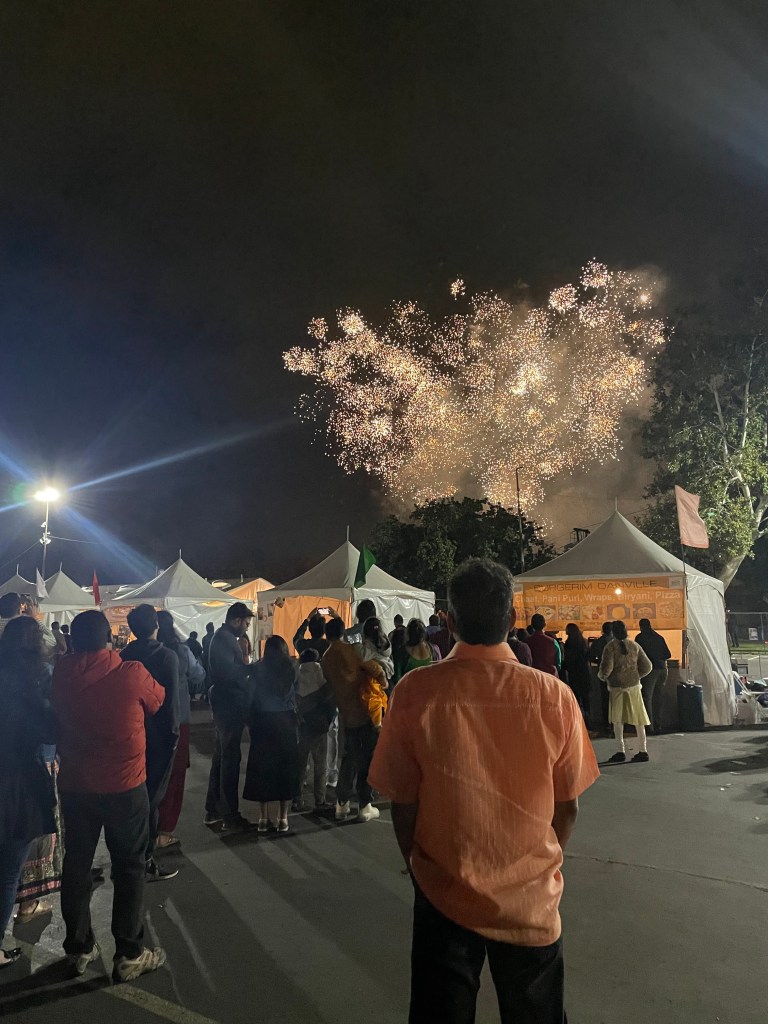
This is the far from the first or only time that a radio station has facilitated the forging of affective ties and social and material connections in diaspora. Rather this post recounts how active and passive listening to and through the station revealed over time how much South Asian presence has transformed the Bay Area. I attended the massive Diwali and Dussehra events advertised on 92.3, and once there, I could recognize so many of the organizers and sponsors’ names – some of them were the same tax planners and realtors that also run ads and sponsored segments on the station. One week in late September, an ad played on the radio, announcing that a famous hotel in downtown San Jose was now able to accommodate more than a thousand guests and offer a special entryway for the baraat procession (when the groom’s party of a few hundred comes dancing up to the wedding venue). The ad ended with the contact details of a South Asian representative of the hotel who could handle all queries related to Indian wedding arrangements! Bolly92.3FM mediates and shapes the collective desi identity through its programming and advertising, in turn also stitching, materializing and rendering visible a map of the Indian community spread across dozens of non-contiguous cities and neighborhoods in the Bay Area.

It bears noting, however, that the idea of Indianness or desi-ness (an imagined brotherhood among all the expats here) advanced through the radio programs, advertisements as well as the cultural celebrations, is very much a nationalistic and Hindu-dominant one. Although India is an ethnically, linguistically and culturally diverse country and not all people of Indian origin in the Bay Area are Hindu, the radio announcers never really celebrate or discuss Eid, Christmas, or Thanksgiving as events of possible interest. Just based on what is said and what is left unsaid, the dominant self-imagination of the Bay Area desi community as advanced through the radio station feels like it quietly aligns with the dominant religious and political imagination of India as Hindu, middle-class, post-religious and post-caste.
In the process of seeing this map render in my own imagination through regular listening, I also realized how this form of distant listening replicated the mode of jaan-pehchan (getting to know) for the itinerant immigrant-ethnographer. There is always the pre-fieldwork moment, the slightly promiscuous exploratory moment of getting to know and immersing oneself before one can articulate stakes and research questions. It is also often a period of deep uncertainty and ambivalence, since, as ethnographers, responsibility for and towards our field, communities, and interlocutors is always at the center of every project. We are always reminded not to be extractive and to think deeply about power relations even as we attempt to forge meaningful ties with those whom we want to observe and learn from and write about. Much like other visa-workers and international scholars in US academia, being a non-citizen ethnographer engenders multiple kinds of precarities—there is no straightforward or replicable guidebook on how to establish rapport, gain access, build trust and more with a community. More importantly, the itinerant-immigrant ethnographer’s relationships are also always interrupted, prone to arbitrary border restrictions and chronic deracination.
In the early days of digital ethnography, Kate Crawford powerfully argued to reframe acts of lurking (silently and passively hanging out in online communities) as forms of listening and by extension, listening as a concomitant and constitutive practice when we consider participation as speaking or having a voice. In the case of diasporic radio, as I realized, not only is the act of listening quite literal but it also affords and reinforces the vitality of different modes of agentic power and participation, those marked by ambivalence, yet-to-be gained legitimacy; forms of minor participation if you will. Via Crawford, listening and/as lurking also emerges as specifically racially inflected modes of agentic participation against the backdrop of media policy and the emphasis on free expression and speech as the ultimate realization of democratic power.
Among diasporic communities and further among itinerant immigrants within those communities, listening, overhearing and eavesdropping become the de facto modes of democratic and communitarian participation. Listening to the radio as a way of immersion is not a solution to these enduring dilemmas of ethical ethnography but to borrow from the analogy of Californian driving, listening to the radio, just like other forms of digital and analog lurking, allowed me an ‘on-ramp’ to gradually merge and embed myself in the larger South Asian diasporic community.
—
Featured Image: “Driving” by Flickr User AnnaNakami (CC BY-NC 2.0)
—
Noopur Raval is an interdisciplinary researcher interested in understanding global futures of work, the life and work decisions made by immigrant workers in tech companies, changing values and moral norms and projects of personhood especially in postcolonial settings. Noopur received a PhD in Informatics from University of California Irvine (UCI) in September 2020 and, through July 2022 was a postdoc researcher at the AI Now Institute at New York University. Noopur is currently a postdoctoral researcher at UC Santa Cruz – Silicon Valley Extension in the Computational Media department, working with Dr Norman Su. In Fall 2023, Noopur will join the Department of Information Studies at UCLA as an assistant professor.
—

REWIND! . . .If you liked this post, you may also dig:
“Gendered Soundscapes of India, an Introduction“–Monika Mehta and Praseeda Gopinath
The Queer Sound of the Dandiya Queen, Falguni Pathak–-Pavitra Sundar
“Out of Sync: Gendered Location Sound Work in Bollywood“—Priya Jaikumar
SO! LA: Sounding the California Story–Bridget Hoida
“Vous Ecoutez La Voix du Peuple”: The Kreyol Language Pirate Radio Stations of Flatbush, Brooklyn–David Goren
Listening (Loudly) to Spanish-language Radio–Dolores Inés Casillas
Share this:

A Day on the Dial in Cap Haïtien, Haiti

Radyo Ayisyen
Learning from other scholars’ work on Haitian radio was, and still is, one of the greatest pleasures in the process of writing Isles of Noise: Sonic Media in the Caribbean (UNC 2016). People living in or from Haiti widely acknowledged and almost took for granted radio’s outsized role in public and political life. Edwidge Danticat and Jonathan Demme also understood this and paid tribute in Claire of the Sea Light and The Agronomist respectively, but historians remained largely fixated, understandably, on pivotal moments in Haiti’s rich history. Radio is different. Not pivotal, but witnessing the pivotal. Less dramatic and more long lasting and adhering to the same format for days, years, decades. It speaks to people who wouldn’t read newspapers or books. It floods private and public space with the sounds of music, talking, ruling, dissenting, explaining, satirizing, creating, crying, testifying, lying. But it leaves few archival traces. This is why the work of the five scholars in this series is so important. They allow us to hear a little and honor the listeners who make the medium what it is.
Liveness, and company: Ian Coss’s finely tuned account of a “day in the life” of a radio station follows the programming rhythm of days and nights, from rollicking to quiet and back again. Radio is a predictable presence, an intimate friend who anticipates your needs even before you do. Coss draws from his years of listening to the listeners as he marks radio time and space in Cap Haïtien. Guest Editor– Alejandra Bronfman
——-
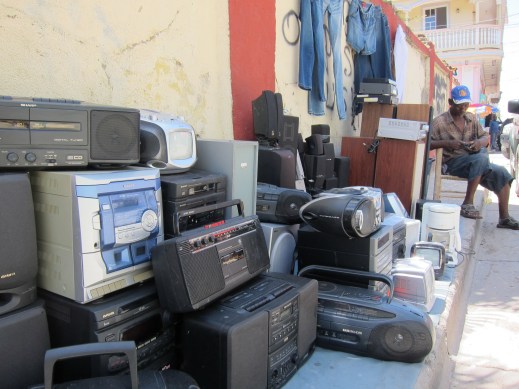
Fabrice Joseph is a mender, set up on a street corner in Cap Haïtien, Haiti’s second largest city. He shows me a red plastic toolbox filled with supplies — thread, wires, scraps of fabric—which he can use to fix a jammed zipper or stitch up a torn backpack strap. I stop because he’s cradling a radio set in his hands, tuned to the city’s most popular station: Radio Venus.
We meet on a quiet day; Fabrice has been sitting on the stoop for five hours already with no work. Another day he’s engrossed in assembling a large umbrella—the kind food vendors use for shade—but the radio is still on, now propped on a ledge just behind his head. He replaces the batteries almost weekly, because the radio is always on. In the morning Radio Venus plays news, Fabrice tells me, followed by music as the day heats up. Then in the afternoon he’ll hear sports or perhaps a religious program, before the station returns to music in the evening.
This arc Fabrice describes is designed to follow the arc of his day. In this post, I trace that link: between the rhythms of radio programming and the rhythms of daily life, to show how formatting choices create a heightened sense of ‘liveness’ on Haiti’s airwaves, with all content located in a specific moment: the present moment.
In a technical sense, terrestrial radio broadcasting has always been defined by real time or ‘live’ transmission (an dirèk in Creole), a characteristic that is often invoked in discussions of the medium’s capacity to create shared experiences or even ‘imagined communities.’ And yet where I live in the United States, the passage of time is barely discernible on most commercial stations. Where radio schedules once varied from hour to hour (often reflecting gendered and classed norms of listening), today market research has driven the rise of so-called “format stations” that target specific interest groups and demographics with an equally targeted form of programming: non-stop sports, news, top 40, easy listening, etc.
When I first visited Haiti in 2015, I was surprised to find a radio format unlike any I had grown up with, and not unlike those broadcast schedules of the 1920s and 1930s. While doing research in Cap Haïtien, I conducted a series of bandscans—systematic reviews of the entire radio dial—in order to identify the different types of programming heard on stations throughout the day there. I found the full range of talk and music-oriented shows you might expect, and yet of the 31 stations I picked up, only a handful carried the same type of programming all day. The vast majority carried every kind of program, including Fabrice’s favorite station, Radio Venus.
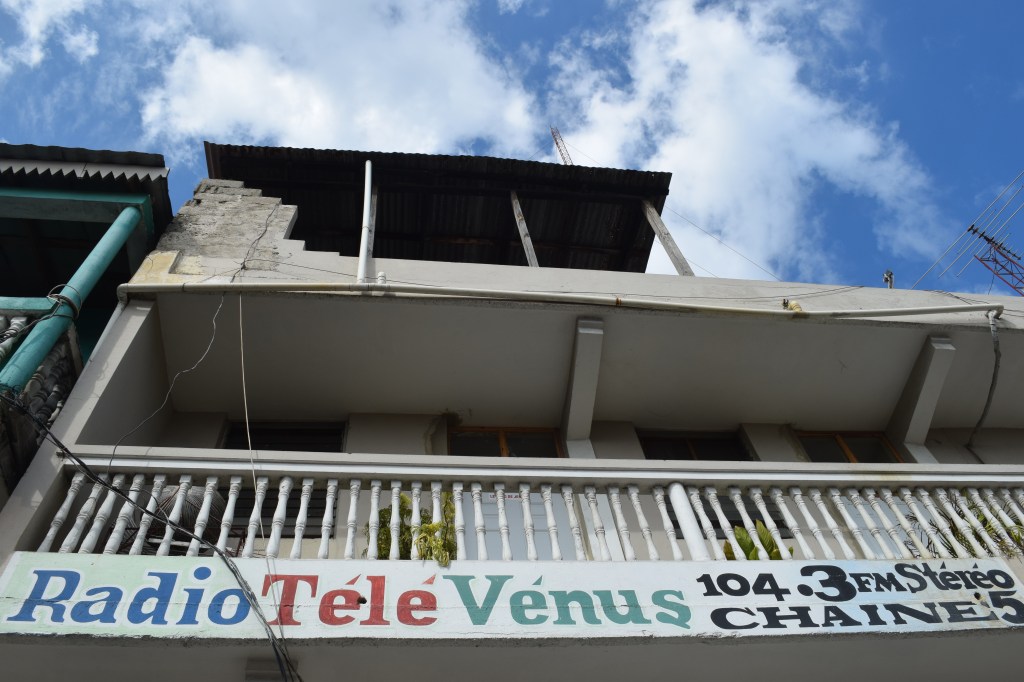
The Radio Venus studio sits on top of a three-story building, with a door leading straight out onto an open roof deck where the transmitter tower rises several more stories up in the air. That tower operates at 10 watts, just enough to relay the signal to a nearby mountain, where it’s then rebroadcast at roughly 450 watts, blanketing the country’s whole Northern Department. The person in charge of this whole system, as well as the overall flow of the day’s programs, is known as the opérateur. The station employs four operators—Molliere, Louis, Wilkonson and Simon—who work in shifts to cover the 24-hour schedule. This rotation provides stability as the hosts (or animateur) of different programs come and go—often showing up late, and sometimes not showing up at all. For long stretches of the day there is no host, so the operator just cues up a folder of songs in Windows Media Player, occasionally leaning over to trigger a station ID: a chesty voice that declares, “W’ap koute Radio Tele-Venus”—‘You are listening to Radio Tele-Venus.’
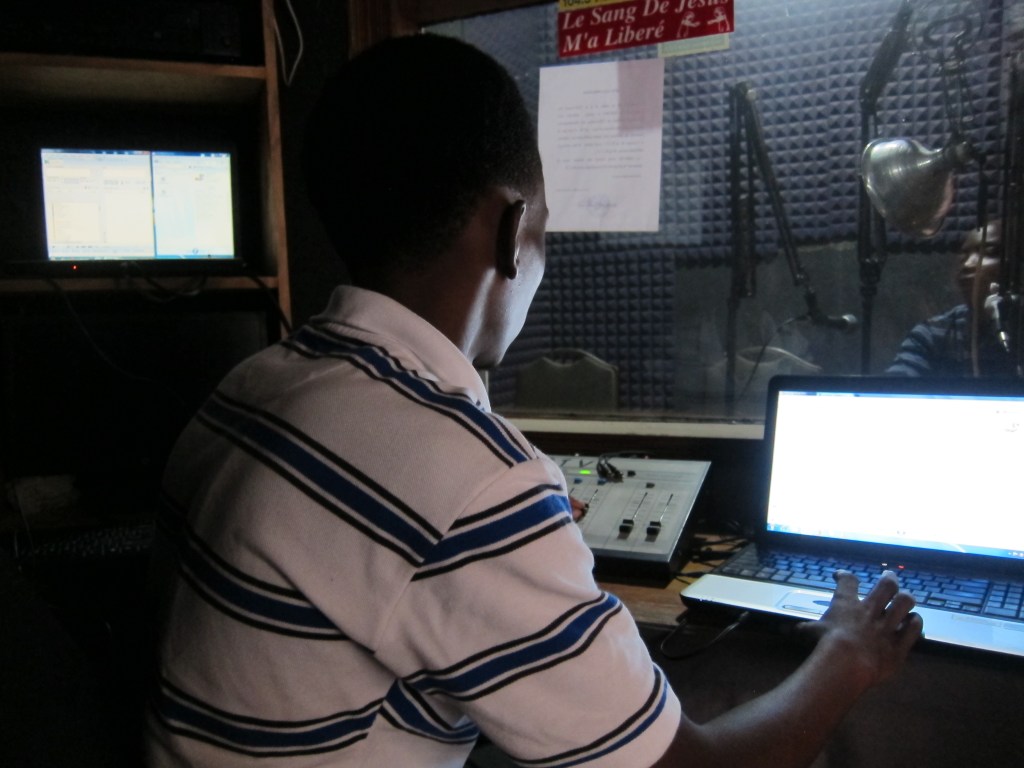
One day, while sitting behind the board of the cramped control room, Simon explains that the goal of the station’s format is to satisfy all of the listeners’ interests and to provide “stability” in their often unstable lives. That last descriptor, “estabilite,” strikes me as somewhat ironic, given that the station’s programming is constantly changing. But for Haitians like Fabrice, who listen all day while they work, the description fits: he never needs to touch the dial, and at the same time he knows exactly what he will hear. Indeed, most of the radio listeners I meet in Cap Haïtien praise the medium’s consistently variable nature; if they wanted to hear the same thing all day they could get a stereo that takes a kat memwa—a memory card—and load it up with their favorite mp3s. Radio should change with the hours of the day; that’s part of what makes it radio.
Many of the staff at Radio Venus describe the art of matching programming to the mood of the moment, in terms of ‘hotness’ (cho). For example, it’s important to have a lively host on the air between about 10am to noon, usually playing konpa music, so that the radio ‘heats up’ to give listeners more energy for their day. This shift takes place simultaneously across virtually every station on the dial, such that it’s literally audible on the street, from countless battery-powered radio sets. The timeliness of this ‘heating up’ is further emphasized by the host—at Venus, a local favorite named Don Lolo—who constantly reads the exact hour and minute off of a large analog clock on the studio wall. Lolo’s job is to make the music live in the moment; to make it ‘hot.’ By the same token, when I interview the overnight operator, Louis, he tells me that since many listeners keep the radio on all night, it’s important that he doesn’t play any music that’s ‘too hot,’ so as not to disturb their sleep. Everything in its right time.
The most dramatic shift in programming, however, begins on Friday evening. For the entire weekend, the station drops most of its talk-oriented shows and plays constant music—almost all of which is bootlegged recordings of live concerts. The idea is to convey the freewheeling mood of a night out on the town, even for those who won’t be at a bar or concert. To keep up this atmosphere, the station operators can choose from whole folders of “konpa live” tracks dating back decades—most of which run twelve to fifteen minutes long. Again, this programming convention of playing live recordings on weekends is ubiquitous across the dial, and indeed across Haiti. Turn on the radio on a Saturday night and you will be hard pressed to find any music that was recorded in a studio.

My first weekend at Radio Venus, I step out of the studio at dusk, and find the station’s signal is suddenly all around me—far more present than just a few hours earlier. Around the corner from the station, an electronics store has set up a row of folding chairs in the street, and is blasting Radio Venus for a small audience. At the end of the same block is a barbershop; there too the stereo is tuned to Venus, with one cabinet speaker set in its arched entryway.
At this hour, both the street and the shop are definitively male spaces—save for some market women packing goods and a mother overseeing her son’s haircut, those listening in public are men. A cell card vendor is perched on top of the stereo speaker itself; a man with two live chickens—their heads poking out of the bottom of plastic shopping bags—stops by and quickly exchanges some money with one of the barbers, who plays some air guitar as the next customer takes his seat. One of the other remaining barbers is perched sideways in his stool, feet in the air and a bottle of Barbancourt rum in one hand. The energy is loose, encouraged by the radio announcer.
Back at the station, the small studio is lit only by a single fluorescent bulb, whose harsh light spills through the glass pane into the neighboring control room. Don Lolo is on the air once again, but his style is different. No more telling the time or giving long monologues. Instead he sings along in a full-throated voice, occasionally adding personal shout-outs. We learn that Gerald is celebrating a birthday today, just as Claire and Alex are marking their anniversary. When his phone then rings, instead of picking it up Lolo silences the call and responds by radio: “Sorry, I can’t talk now!”
It’s late when Don Lolo wraps up his show and we head out of the studio, leaving Louis alone to cool the music back down for the overnight shift. The evening operator, Simon, offers to walk me home. At this hour, we can stroll down the middle of the street side by side, the city’s elaborate facades cast in silhouette by the occasional streetlight. As we head up the hill towards my place, Simon cocks his head and gestures across the street. I turn just in time to catch the station ID—“W’ap koute Radio Tele Venus”—coming out of a barbershop. The radio is still on.
Tune into a livestream of Radio Tele-Venus via Tune In: https://tunein.com/radio/Radio-Tele-Venus-1043-s181945/
—
Featured Image: “An electronics vendor in Cap Haïtien, Haiti” by Ian Coss
—
Ian Coss is an audio producer, composer and sound designer whose work spans the worlds of podcasting and performance. He has produced several critically acclaimed series with the Radiotopia network, including Ways of Hearing, The Great God of Depression, and Over the Road. His audio work has been reviewed by the New Yorker and the Guardian; featured on NPR, Al Jazeera and the BBC; and recognized with an Edward R. Murrow Award for ‘excellence in sound.’ Additionally, Ian has premiered live sound works at the Boston Museum of Science and Harvard University, and collaborated on immersive audio tours for the Isabella Stewart Gardner Museum, Richmond ICA, and other major art institutions. Ian holds a PhD in ethnomusicology from Boston University, where he conducted research on Haitian radio broadcasting and Indonesian shadow-puppetry. He continues this work as musical director for The Brothers Čampur, an international puppetry collaborative that has performed at major festivals in Indonesia, and at universities throughout the eastern United States. More on all these projects at iancoss.com.
—

REWIND! . . .If you liked this post, you may also dig:
Radio de Acción: Violent Circuits, Contentious Voices: Caribbean Radio Histories–Alejandra Bronfman
Radio Ambulante: A Radio that Listens –Carolina Guerrero
The Sweet Sounds of Havana: Space, Listening, and the Making of Sonic Citizenship–Vincent Andrisani
Share this:


Current Top Posts





April 2021

January 2020

November 2019

October 2019

August 2019

April 2014

November 2017

March 2015

December 2017

October 2015
 Sounding Out!
Recent Comments