
Hearing the Tenor of the Vendler/Dove Conversation: Race, Listening, and the “Noise” of Texts
In the beginning there were no words. In the beginning was the sound and they all knew what the sound sounded like. –Toni Morrison, Beloved
DOI: https://doi.org/10.59350/zssew-bpa12
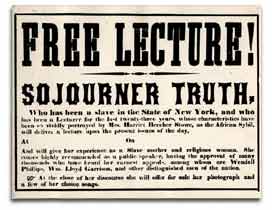
A conversation in my Black Feminist Theories class on the two versions of Sojourner Truth’s famous speech from the Ohio Women’s Convention—the one published in 1863 that renders her words in a black southern dialect or the 1851 version that does not—elicited the following story about listening. A black male student was student teaching/observing in a classroom — the teacher was white, the student teacher black. The exercise he observed involved transcribing speech and then reading it back. A black male student in the classroom spoke and the white teacher and black student teacher each transcribed the speech and read their transcriptions aloud. The white teacher’s transcription/recording was in dialect, the black student teacher’s was not. The student teacher maintained that what and how the white teacher heard the black student was not, in fact, either what or how the black student spoke.
Discussions like these have spurred me to meditate more deeply on sound. And now that I’ve really begun to consider it, texts have become much noisier places; the white spaces and black marks becoming places for reading and hearing. Thinking more deeply about sonic affinities and communities has helped me really begin to understand how sound shapes sight and sight shapes sound.
An example: Since reading Fred Moten’s In the Break, in particular “The Resistance of the Object,” it’s not only impossible for me to read the scene of Captain Anthony’s beating/rape of Aunt Hester in Frederick Douglass’s Narrative without hearing Abbey Lincoln’s hums, moans, and screams, it is not possible for me to read the entire text without populating it with sound, even as those sounds are, in my imagining of them, not always specific.
.
Perhaps it’s most accurate to say that I am aware that the world that the text references is a world filled with sounds peculiar to it, many of which may no longer be present in our contemporary world. At the same time, I try to bring at least some of those sounds—talking drums, field hollers, whips cracking, the sounds of chains, etc.—and approximations of sounds into the classroom when I teach Douglass’s Narrative and My Bondage and My Freedom (as well as when I teach other texts).
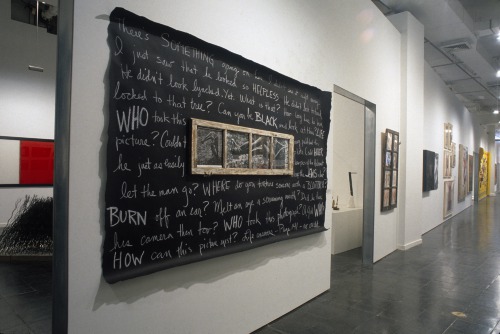
In “The Word and the Sound: Listening to the Sonic Colour-line in Frederick Douglass’s 1845 Narrative” (2011) Jennifer Stoever-Ackerman writes, “The emphasis Douglass places on divergent listening practices shows how they shape (and are shaped by) race, exposing and resisting the aural edge of the ostensibly visual culture of white supremacy, what I have termed the “sonic colour-line” (21). Stoever-Ackerman riffs on Elizabeth Alexander’s “Can you be BLACK and Look at This: Reading the Rodney King Video” (and Alexander riffs on Pat Ward Williams’s “Accused, Blowtorch, Padlock”) to ask, “Can you be WHITE and (really) LISTEN to this?” or alternatively, “Are you white because of HOW you listen to this?” (21).
.
In his review of Shane White and Graham White’s The Sounds of Slavery: Discovering African American History Through Songs, Sermons, and Speech (Beacon Press, 2005) in the July 2009 issue of the Journal of Urban History, Robert Desrochers contrasts the abolitionists who were attuned to how to make a white audience hear the sounds that surrounded and produced the (performances of the formerly) enslaved, to the “Virginia patriarch who failed to mention the singing of his slaves even once in a diary that ran to hundreds of manuscript pages” (754). Given these examples of the ways that many white ears had to be systematically attuned to hearing slavery’s sounds as well as the understanding that, “the very things that made slave sounds distinctive—chants, grunts, and groans; melismatic, repetitious, and improvisational lyric play; pitch and tonal inflections and cadences; timbral variations, polyrhythms, and heterophonic harmonies—struck whites mostly as strange, inappropriate, wrong” (754)—the answers to Stoever-Ackerman’s questions may be respectively “no” and “yes” (or several combinations of no and yes), particularly if we engage “whiteness” as an ideology and not simply (or not only) a “raced” description of those people constituted socially and legally as (presumably) white.

It was with these kinds of questions of sound and sonic whiteness on my mind (especially this question of who hears, who doesn’t hear, and then again what is and isn’t heard) that I read and was brought up short by Helen Vendler’s recent November 24, 2011 New York Review of Books review of Rita Dove’s The Penguin Anthology of 20th Century American Poetry. In this piece, Vendler takes Dove to task for what she considers the anthology’s over-inclusiveness (“No century in the evolution of poetry in English ever had 175 poets worth reading”), the “accessibility” of the poems (“short poems of rather restricted vocabulary”), and the appearance of a large number of black and other non-white poets in the latter part of the twentieth-century. In short, from Vendler’s perspective, Dove is choosing “sociology” and complaint over artistry; mixing the wheat and the chaff.
Vendler writes, “Rita Dove, a recent poet laureate (1993–1995), has decided, in her new anthology of poetry of the past century, to shift the balance, introducing more black poets and giving them significant amounts of space, in some cases more space than is given to better-known authors. These writers are included in some cases for their representative themes rather than their style. Dove is at pains to include angry outbursts as well as artistically ambitious meditations.”
And Vendler on Dove on Hart Crane: “sometimes one wonders whether Dove is being hasty. She speaks, for instance, of ‘the cacophony of urban life on Hart Crane’s bridge.’ But the bridge in his ‘Proem’ exhibits no noisy ‘cacophony’; its panorama is a silent one. The seagull flies over it; the madman noiselessly leaps from ‘the speechless caravan’ into the water; its cables breathe the North Atlantic; the traffic lights condense eternity as they skim the bridge’s curve, which resembles a ‘sigh of stars’; the speaker watches in silence under the shadow of the pier; and the bridge vaults the sea. The automatic—and not apt—association of an urban scene with noise has generated Dove’s ‘cacophony.’”
Why does Vendler insist on silence where Dove joins sight and sound? That Vendler imagines silence and takes Dove to task for attaching cacophony to the city scene in the bridge poem is a struggle over meaning, over epistemology and ontology. How is Vendler registering not only the poem but also the entire text differently? This isn’t the only instance of Vendler’s insistent sonic “whiteness” whereby and wherein the reading of the poem, the anthology, and the anthologizer herself are disciplined.
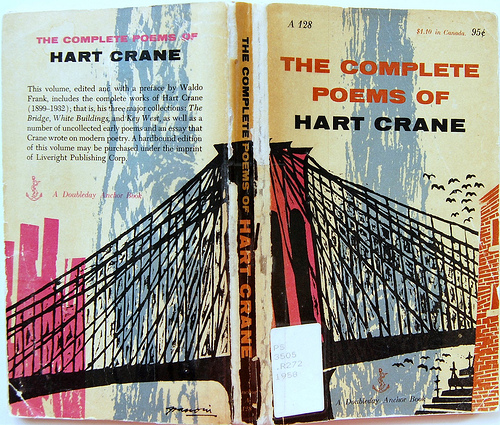
Speechlessness though, is not soundlessness, and it seems to me that Dove locates herself on the bridge (and in the soundscape of the contemporary written poem) such that she hears the water, the seagull, and the leap and curve and flap of gull and man. As Dove herself responded (also in the New York Review of Books), “A cursory sweep over just the section [Vendler] excerpted in my anthology yields a host of extraordinary sounds: what with trains whistling their “wail into distances,” chanting road gangs, papooses crying—even men crunching down on tobacco quid—my gasp of surprise at Vendler’s blunder can barely be heard.”
In Vendler’s remarks and Dove’s response we might read the kind of cultural dissonance that continues to both construct and give insight into how different communities of readers and listeners are formed and the ways they are and aren’t racialized. By the end of the review, Vendler wants to be heard by those whom she imagines as the anthology’s likely readers: she wants to turn to them and “say,” to “cry out,” that there are better poems than those included here. For the sounds that in this anthology that Vendler hears most often in the “minor” poems, in the “minority” poets, and the “minority” anthologizer, are simplicity, noise, and needless complaint. And Vendler and Dove have been here before – see Vendler on Dove and Delaney on Vendler and Dove.)
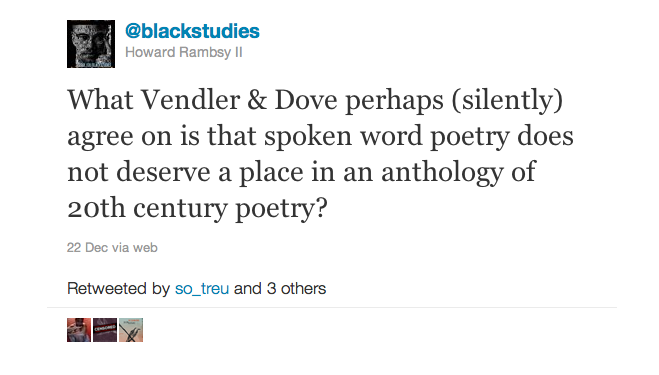
But despite the debate putting poetry front and center and enacting ways that it matters, Vendler’s critique and Dove’s response are each conservative, though in quite different ways. Neither Vendler nor Dove in the review, anthology, and defense of the anthology imagines the inclusion of spoken word, hip-hop (see Howard Rambsy II), and other forms of contemporary rhyme and verse that speak to a broad range of audiences across race, sex, and class. The inclusion of rap might further change the tenor of the conversation, opening up in important ways the debate over what counts as poetry, and expanding how black musical and poetic forms are heard and by whom.
—
Christina Sharpe is Associate Professor of English and American Studies at Tufts University where she also directs American Studies. Her book Monstrous Intimacies: Making Post-Slavery Subjects was published in 2010 by Duke University Press. Her current book project is Memory for Forgetting: Blackness, Whiteness, and Cultures of Surprise.
—
Share this:

Sounding the Motor City: Chrysler and Detroit’s Legacy
DOI: https://doi.org/10.59350/cbdh3-38c86
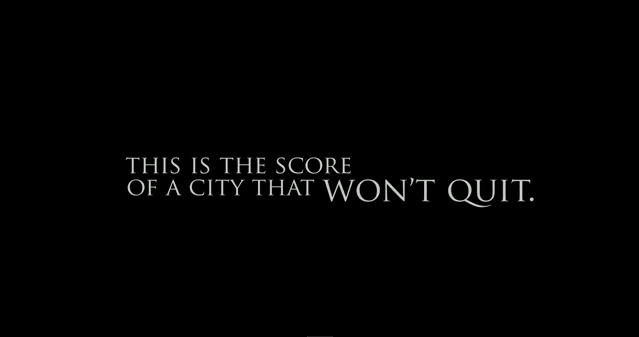
Last February, Chrysler premiered during the Super Bowl its “Imported From Detroit” campaign with a stunning 2-minute ad that showcased Detroit to the soundtrack of Eminem’s “Lose Yourself.” Helen Freund and David K. Li at The New York Post called Eminem the star of Super Bowl XLV’s ads. MyFOXDetroit.com mentioned how the people of Detroit showed their love for the ad on social media. Jeff Karoub and Mike Householder from The Associated Press said the ad “sent shivers of pride through the battered city.” Although the ads are, ultimately, about cars, they also sell us stories of the Motor City.
The commercial starts with scenes from a grey day in Detroit. We see streets, factories, and street signs. The voice-over helps weave a story of a working-class city: “What does this city know about luxury? What does a town that’s been to Hell and back know about the finer things in life?” From the vantage point of a Chrysler, we see shots of Detroit as it drives through the city and the suburbs. At the end, Eminem, a Detroit native, parks the Chrysler 200 in front of the Fox Theater and walks in to finda choir singing along to “Lose Yourself.” Ultimately, the video is a declaration of pride in American craftsmanship but also a statement of the strong will of an American city with working-class roots; this is emphasized when Eminem looks straight at the camera and states, “This is the motor city. And this is what we do.”
Although I tend to be critical of the messages advertising sends viewers, this commercial drives chills up my spine every time because it shows pride in an American city. However, what moved me to write this post was one of the most recent ads from the “Imported from Detroit” series. The commercial for the Chrysler 300 (2012 model) uses a sample of Bobby Blue Bland‘s “Ain’t No Love in the Heart of the City” (Dreamer, 1974) from Jay-Z’s 2001 hit “Heart of the City (Ain’t No Love)” (found on his album The Blueprint). The commercial starts with a panoramic view of Detroit, followed by the Chrysler 300 emerging from an underpass. The camera moves on to shots of different areas of Detroit as well as people on the street and street signs (for example, one of the signs we see is the sign for 8 Mile). Also, whereas most car commercials show cars without license plates, this ad proudly display the cars’ Michigan tags.
The music in both of these ads acts as a way of reminding us about Detroit (the first a song by a Detroit native, the second a song that makes us think about cities), but the music also calls into question the luxurious excess of the automobile. The ads try to draw attention away from the automobiles and toward the working-class community that keeps Chrysler running; they emphasize their ties to the Motor City. However, as Angie Schmitt points out in her blog post “The Hypocrisy of Chrysler’s ‘Imported from Detroit’ Campaign,” the ads betray the viewer:
Chrysler is selective about the Detroit it celebrates. Absent is the ruin that now accounts for a large share of the city. Invisible is the crushing poverty, constantly present in the urban landscape. The driver in the most recent installment, traveling out from the center of Detroit to its suburbs, is in control of his fate (thanks to his snappy ride) in a way few in the region really are.
Despite the defiant sentimentality of its ads, Chrysler, as well, is selective about its commitment to the city of Detroit.
Although the ads are visually stunning (but many of the ads produced by Wieden+Kennedy advertising company are–just look at their roster of clients and click on some of the brands), the ads also stage a conflict between race and class through the soundtrack. What is the message these commercials are trying to communicate through their music and their cars? On the one hand, they affirm the presence and reemergence of an American car company, one of the major car companies that was hit hard in the most recent U.S. recession. On the other hand, the ads use a discourse of class (also race) to sell a luxury product. The commercials want to connect Chrysler to Detroit’s working-class identity, and the soundtrack is supposed to act in service of that through the choices of artists and music.
A good example of this is the John Varvatos “Attitude” ad for Chrysler (less popular than the Eminem ad and the more recent Chrysler 300 ad).
Varvatos is a designer from Detroit, located in New York. The commercial shows us Varvatos at the Dope Jams record store in Brooklyn, on his way to his Manhattan studio. The voiceover tells us the key to his success is that he was “surrounded by the perfect combination of rock and roll and heavy industry.” The working-class theme is emphasized in this commercial, especially in the last line uttered by the narrator: “that’s what a blue collar attitude can do in a white collar world.” (It also creates a dichotomy where New York is the “white collar world” to Detroit’s “blue collar attitude.”) Unfortunately, the ads commodify class struggles and class values. The ads use working-class values to appeal to the consumer.
Music is not far removed from the automobile industry in Detroit. The Motor City not only exports cars, but is also an exporter of music. Suzanne Smith, in her book Dancing in the Street: Motown and the Cultural Politics of Detroit (2000), traces the development of Motown within the sociocultural context of Detroit in the 1960s. She explains how the automobile industry in Detroit benefited from African American labor, meanwhile excluding them from “controlling the means of production” (15). On the other hand, Smith also points out that Motown profited from the introduction of the transistor radio in 1953, for drivers could now listen to music in their cars. Motown execs were very aware of the new market that this would provide them. “Both the musical form and the audio fidelity of Motown hits such as ‘My Girl’ and ‘Shop Around’ were well suited and often produced with a car radio audience in mind” (123). The ads remind us how listening to music has become part of the experience of driving–and how that was not coincidental.
Ultimately, these ads remind us of how sound can act as a door into the social and cultural context surrounding the cars. However, I want to leave my readers with a thought: the ads are also about Detroit. If car ads require, in general, remarkably non-specific setting, Chrysler goes in the opposite direction and makes it all about the location. The ads, although problematic, remind us of the power and importance of place, whether in its Detroit ads or in its Portland, Oregon ad or its Los Angeles ad. If Jay-Z and Bobby Blue Bland sing “ain’t no love in the heart of the city,” these Chrysler ads show that the city has plenty of love to give.
–
Liana M. Silva is co-founder and Managing Editor of Sounding Out! She is also a PhD candidate at Binghamton University.
—
Share this:




Current Top Posts





April 2021

January 2020

November 2019

October 2019

August 2019

April 2014

November 2017

March 2015

December 2017

October 2015


Recent Comments