
Deejaying her Listening: Learning through Life Stories of Human Rights Violations

**Co-authored by Emmanuelle Sonntag and Bronwen Low
DOI: https://doi.org/10.59350/306p4-m0596
Are you listening?
Because sound specialist Julian Treasure argues, “We are losing our listening” due to the invention of multiple methods of recording and with the world being “so noisy . . . with this cacophony going on visually and auditorily, it’s just hard to listen, it’s tiring to listen.” In response, Treasure claims that we need to improve our conscious listening skills; he suggests teaching the skill of listening in school.
As co-directors of the “Education and Life Stories” working group of a large oral history project, we have been thinking a good deal about listening and pedagogy. The project is entitled “Life Stories of Montrealers Displaced by War, Genocide, and other Human Rights Violations,” shortened here as “Montreal Life Stories project.” From 2007 to 2012, a team of university and community-based researchers in the frame of the Canadian Community-University Research Alliances (CURA) Program recorded life story interviews with approximately 500 Montrealers who experienced mass violence and displacement. Members of the survivor communities (Tutsi, Haitian, Cambodian, and Holocaust) were key partners in both the research and the diffusion of the project, fundamentally shaping the project’s philosophy, activities and outcomes.
One of the Education Working Group’s principle accomplishments was developing an educational package called We Are Here, containing five Learning and Evaluation Situations (LES), the curricular units in the Quebec Education Program. The units are designed for “cycle two” secondary school, where the students are generally 14 to 16 years old. As of yet, these have not yet been piloted, but we plan to do so.
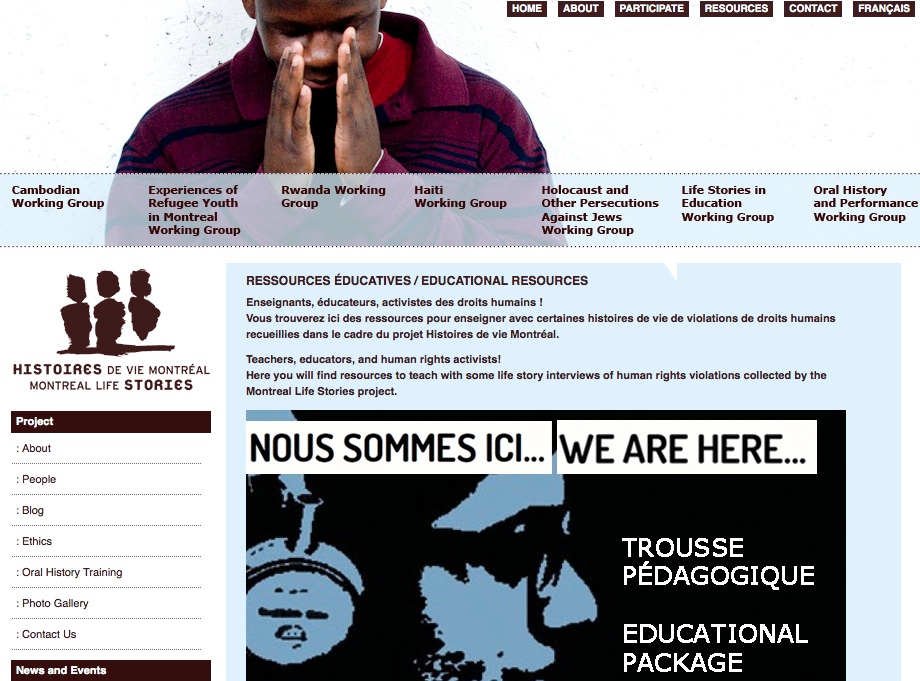
Our goal while designing “We Are Here” was to have teachers and students engage with the life stories of human rights violations, in order to foster a more inclusive cultural memory that would develop “le vivre-ensemble,” our capacity to live well together. Featuring the stories of immigrants and refugees to the province, the curriculum offers students a more complex understanding of human rights violations. First-person accounts bring world history and politics to life, helping us to understand the processes and human costs of violence and war, and expand our awareness of our fellow residents and citizens. At the same time, we recognized that the difficult stories of human rights violations make particular demands upon their listeners. We needed to consider how to ethically support students and teachers in engaging with the stories of people who have survived traumatic experience—while, importantly, respecting the interviewees themselves.
We sensed from the beginning that these goals and commitments would require us to develop our own “pedagogy of listening” to support teaching and learning from the life stories, and we foregrounded listening in all of the materials. For instance, each unit begins with the students listening to one or more project interviews, in the form of digital stories edited collaboratively by the interviewees and the editor. These digital stories tend to be under 10 minutes and bring together video, images, sound, and text (see for example, Bracha Rosenblum’s digital story). They are much more accessible than the original video interviews, which can be many hours long.
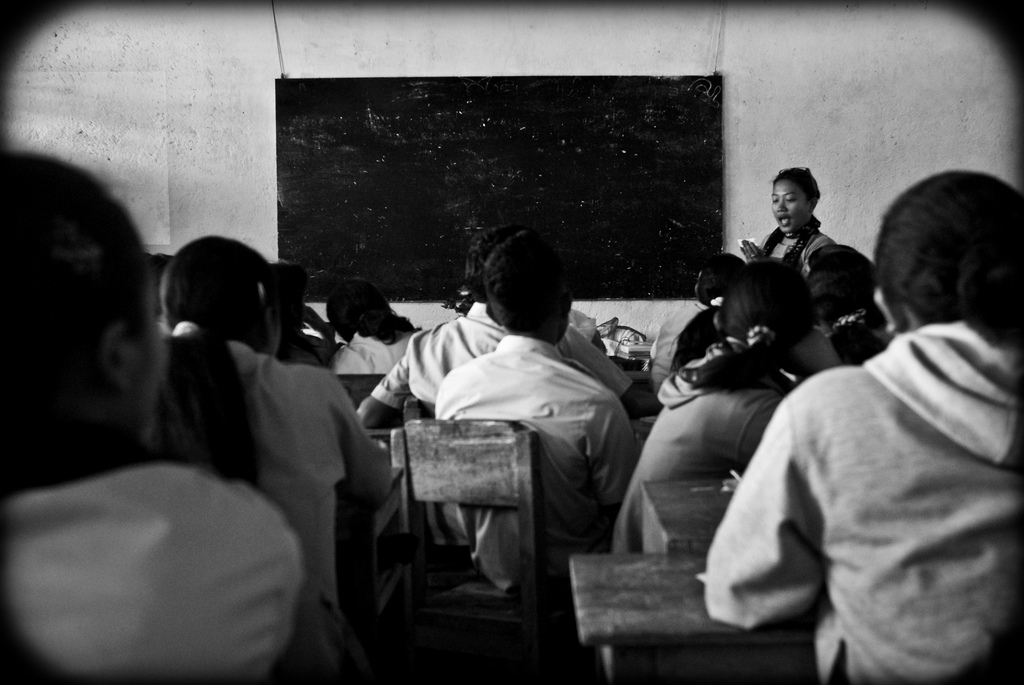
There is an irony in building a case for listening in schools. Students are commanded daily to “be quiet and listen to the teacher.” Despite the long history in educational theory of critiquing this model, the student-who-listens-in-silence versus the teacher-who-speaks-loudly is still regularly invoked in practice as an ideal relation. The demand for silence is in part a pragmatic response to the inherent noisiness of schools filled with people. At the same time, the listening imperative is also a key tool in the establishment of teacher authority and power.
We wanted to rethink the process of listening in our curricular design beyond these traditional power dynamics. Our pedagogy of listening draws on concepts of testimony, communities of memory, dialogue, and the principle of shared authority in oral history, which we describe in detail elsewhere (forthcoming in the Journal of Curriculum Studies). In this blog post, we explore our pedagogy’s indebtedness to philosopher and musicologist Peter Szendy’s work on listening and its potential in the public school classroom.
Listening begins with the desire to be signed and addressed
The address is a central notion in Peter Szendy’s Listen: A History of Our Ears. The early 2000s, as Szendy explains, saw the birth of the peer-to-peer file sharing service Napster (created by Shawn Fanning in 1999), where listeners exchanged and circulated music. Through the lens of file sharing, Szendy began reflecting on the rights of listeners and the nature of musical listening more generally. He argues that sharing shapes the listening act: while listening can be passive–I am listening to you, receiving what you are saying–we also offer up what we are listening to. Rather than envisioning listening as a two-way engagement, Szendy triangulates it, structuring listening around a listening subject, the sonorous object the subject is listening to, and the addressee (le destinataire) of the subject’s listening. In Szendy’s theory of address, as we listen to somebody or something, we also address our listening to an “other” (who might be another beside me, or in myself).
That students would address and engage with “an other” through their listening appeased, in part, our concerns about having students listen to difficult stories of mass violence. If listening is akin to a peer-to-peer sharing system, students were somehow not “alone” anymore in the experience; listening is a building of relation.
Closely related to the concept of listening as address is Szendy’s idea of signature, especially through the digitalization of sound where “listeners become authors” (136) naming, tagging, and classifying the files that they share with others. Szendy describes this process in terms of the singularity of listening:
It is more simply as a listener that I want to sign my listening: I would like to point out, to identify, and to share such-and-such sonorous event that no one besides me, I am certain of it, has ever heard as I have (3).
While all listening necessarily involves an appropriation of what has been listened to, we wanted to amplify the process of students “signing” or marking their listening, and so making it their own. We would deepen students’ engagement with the video interview and the “other” by having them actively edit, rework, even remix, and so adapt the original. We gave students the right to enter into the difficult stories from the survivors interviewed in the Montreal Life Stories project, responding as individuals and as members of a classroom community. While the dynamic of students listening to and making something in response to the life stories takes many forms in our curricular units (including timelines, maps, and audio-tours), we here share the unit which most explicitly embodies the remixing in Szendy’s notion of listening.
What a Story!
What a story!: Life stories and digital storytelling, is designed for senior students in the English Language Arts, and asks students to work in groups to create their own digital story version of a segment from one of the life story interviews.
In the preparation phase, the students listen to a 5 minute digital story of a Holocaust survivor living in Montreal that enables them to discover the multimedia elements and narrative structure of a digital story.
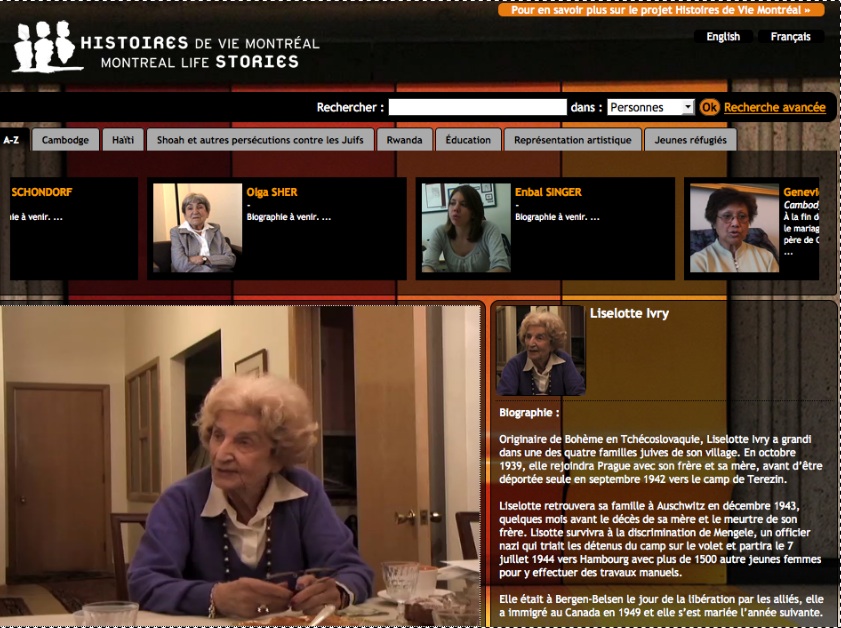
In the production phase, students approach their main task: producing a 5 minute digital story from a 34 minute life story interview with another Holocaust survivor. The phase begins with “deep listening” exercises where students work in groups to summarize the story and decide which parts of the larger interview they would like to keep in their edited versions. In doing this, they reflect on their experience as “listener“ vs. ”reader” and their responsibilities as listeners of difficult stories.
While the expression “deep listening” recalls the work of the composer Pauline Oliveros, in the Montreal Life Stories project the concept stems more directly from the notion of “shared authority,” a phrase coined by oral historian Michael Frisch (1990) to describe the process of co-creating an interview. The community-university model was collaborative at all levels, and researchers and the researched were partners in dialogue. In turn, we frequently used “deep listening” (as in the profound listening between interviewers and interviewees) as an expression during our working sessions. The concept also draws on the work of oral historian Martha Norkunas on interview techniques and deep listening exercices; her visit to the project shaped our curriculum design process, and students are encouraged to engage in dialogue and sharing, and to “Listen with close attention and deeply, in an empathetic and respectful manner.“(13). These appeared, to our eyes, to be consistent with Szendy’s notion of listening as address and signature.
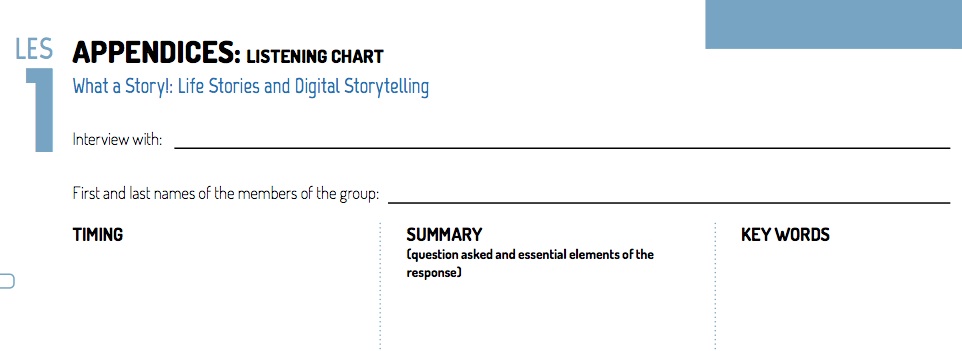
The production phase continues with the creation of the digital story, the editing and the montage. Students then reflect on the ethics of the process of cutting and reworking another’s story, exploring the way narratives can be modified, the meaning built into the digital story vs. the meaning of the interview, and the question of narrative form.
Peter Szendy chooses the deejay, or of the musical arranger, as a figure for the contemporary listener. Indeed, we imagined the students in groups, headphones on, in front of computers, slowing down the cadence, augmenting the sound, rewinding or fast-forwarding, cutting, pasting, annotating. We thought of them as highly skilled listeners, intervening in what they were listening to and interpreting their listening for the “other” ( in the manner of composition theory in which students are asked to write for real audiences for real purposes). As deejays of their listening!
Having students edit the life stories of others, especially stories of violence and war, brings with it risks of misinterpretation and manipulation. However, the unit asks students to think carefully about these risks, and unlike projects which use testimonies in the service of someone else’s argument, this editing assignment has students select from the larger interview in order to craft a narrative that respects the original. As Norkunas says, “When Michael Frisch coined his now famous phrase, “a shared authority,” he wrote of the shared responsibility of listener and narrator for creating the interview document, for interpreting it and for sharing the knowledge created.”(2) If editing and interpreting are critical to the process, adds Norkunas, “the first moment of creation takes place in the interview, in the act of listening.” Hence, the ethical issues raised by the editing assignment–and more generally by having students and teachers engage with personal stories of human rights violation–are addressed by considerable attention to the act of listening (13), and by the cultivation of trust, dialogue and sharing. In short, an attention to the “other.”
Rather than deciding that this content is too challenging for students or reproducing a passive listening dynamic in which students listen to the interviews in reverential silence, we work to support student engagement — as both an attention and response — with these stories as part of a community of listeners. And while listening to these stories can be difficult work, we hope that through our pedagogy of listening, students will gain a greater awareness of the lives of those Quebecois who are not often part of the national narrative, and grapple with some of the difficult knowledge of human pain and survival.
—
Bronwen Low is an Associate Professor in the Department of Integrated Studies in Education at McGill University. She researches the implications of popular culture for education, curriculum theory, and adolescent (multi)literacy practices. Areas of interest include hip-hop and spoken word culture; informal, arts-based and participatory education with youth; and community media and participatory video programs.
Emmanuelle Sonntag defines herself as a “knowledge organizer.” She offers consultancy services in communication, education, curriculum design, information management and knowledge mobilization while pursuing her PhD in Sociology on… Listening at Université du Québec à Montréal. She tweets on listening, sounds, stories and other noises @lvrdg.
—

REWIND! . . .If you liked this post, you may also dig:
Audio Culture Studies: Scaffolding a Sequence of Assignments–Jentery Sayers
The Sounds of Writing and Learning— Liana Silva
Listening to #Occupy in the Classroom–– Travers Scott
—
Share this:

Six Years in Nodar: Sound Art in a Rural Context
DOI: https://doi.org/10.59350/z3qpn-8pc02
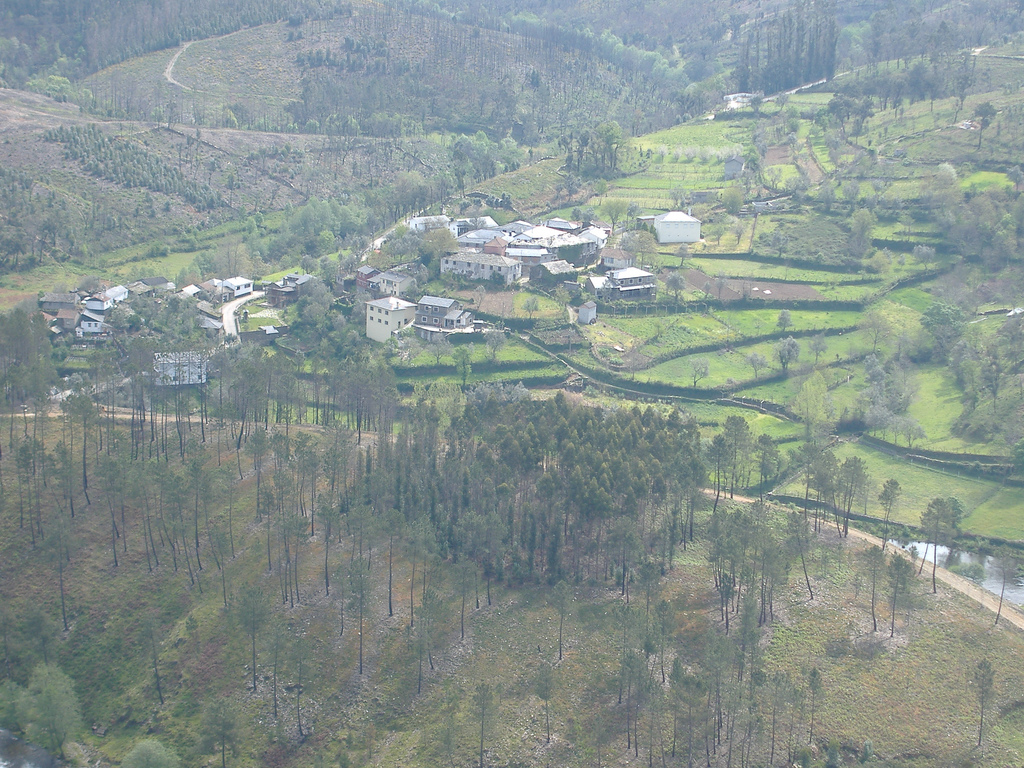
My family comes from a tiny village called Nodar in northern Portugal, part of the European Union-funded project “Tramontana” which focuses on preserving the immaterial heritage of mountain regions of southern Europe. In Nodar, centuries of isolation and self-sufficiency have created a unique blend of cultural expressions, ways of living, and inhabited landscapes. Like much of the Portuguese countryside, Nodar is undergoing a process of abandonment, which leaves rural communities with a weakened sense of identity. The agrarian paradigm, which has been central to the history and social fabric of rural communities, is arriving to an almost hopeless vanishing point, and the guardians of that memory are also disappearing. With this as formative part of my background, and considering my artistic interest in community-oriented projects, I felt almost a duty to direct much of my work to Nodar, a place that means so much to me and where I thought I could make a difference. In 2004 my brother Luis and I founded Binaural/Nodar, an arts collective based in the village and operating in the surrounding region of the Gralheira mountain range.
Since March 2006, the Nodar Rural Art Lab has invited both local and international artists who work in the areas of sound, video, and intermedia arts to address issues such as collective memory, identity, gender, age, life, death, geography, topography, music, sound heritage, landscape, vegetation, consumption and leisure dynamics, myths, traditions, crafts, agriculture, and shepherding. During their stay, the resident artists give public presentations in the region and are encouraged to establish interactions with the place and its inhabitants, geographic spaces, and social memory. Many of the artworks held in Nodar cross different artistic practices, often blending borders.
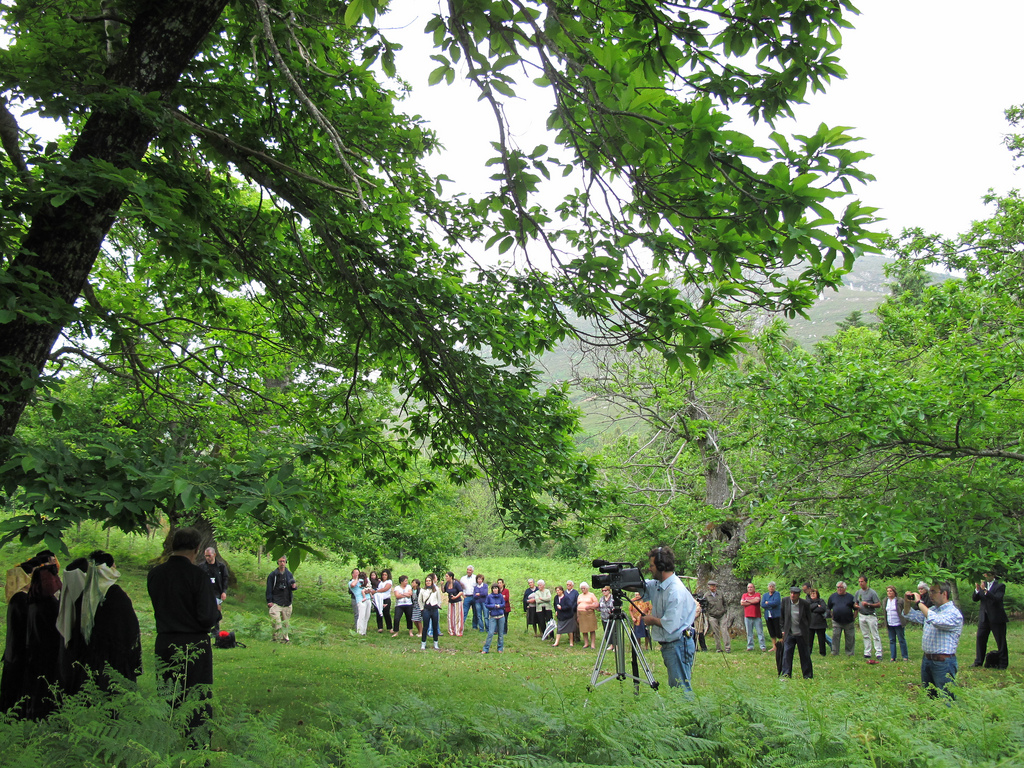
The decision to initiate an artist residency center in Nodar was motivated by my desire to deepen the investigation of exploratory artistic practices in close interaction with a specific rural context and its social and cultural possibilities. Throughout the year, the Nodar Rural Art Lab programs various residency modules in order to stimulate a collaborative environment between artists from different artistic fields and geographic origins. During the course of the residencies, several parallel activities are organized, such as conferences, lectures and educational activities, namely youth-oriented. At the end of each residency module, there is a public presentation organized in the village in which the art projects are presented and discussed by the artists and the organization.
The sonic dimension has a critical role in the model we have developed in Nodar, especially because it operates as a powerful metaphor for the intimate and personal discovery of a place. Artists have documented the area’s soundscapes and oral heritage in Nodar since 2006. There are three central lines of artistic interaction that converge here: Sound, Space and People:
SOUND (Interaction with the acoustic environment): Some sound artists, who work with the acoustic dimension in an experimental way, are part of the team that runs the Nodar Rural Art Lab. The Lab has always been active in the international theoretical and artistic domains of the so-called soundscapes, and it has hosted some of the most respected sound artists of today, who–using idiosyncratic techniques for sound capturing, editing and manipulation–have created works based on particular aspects of the local acoustic context.
One of our approaches is what we call “sound interventions,” where we use field recordings and performance in order to “activate the space” and establish a dialogical approach between what is activated and what just “is,” which can incorporate body, gesture, sound, object, space and voice in this process. An example of this approach was the “Revenant : Paiva” project, conceived in 2009 by Patrick McGinley, Marjia-Liisa Plats, Luís Costa and Tiago Carvalho, in which a series of performative actions were staged in a section of the river Paiva that crosses Nodar. Using materials found in-situ as instruments, in addition to the artists’ own voices, to generate sounds that interacted with the acoustic environment itself, all activity was purely acoustic, with no amplification. The resulting work was presented live with the artists and audience spread out across the space with no preferential “point of listening”, which created subtle overlaps between the artists’ work and the space.
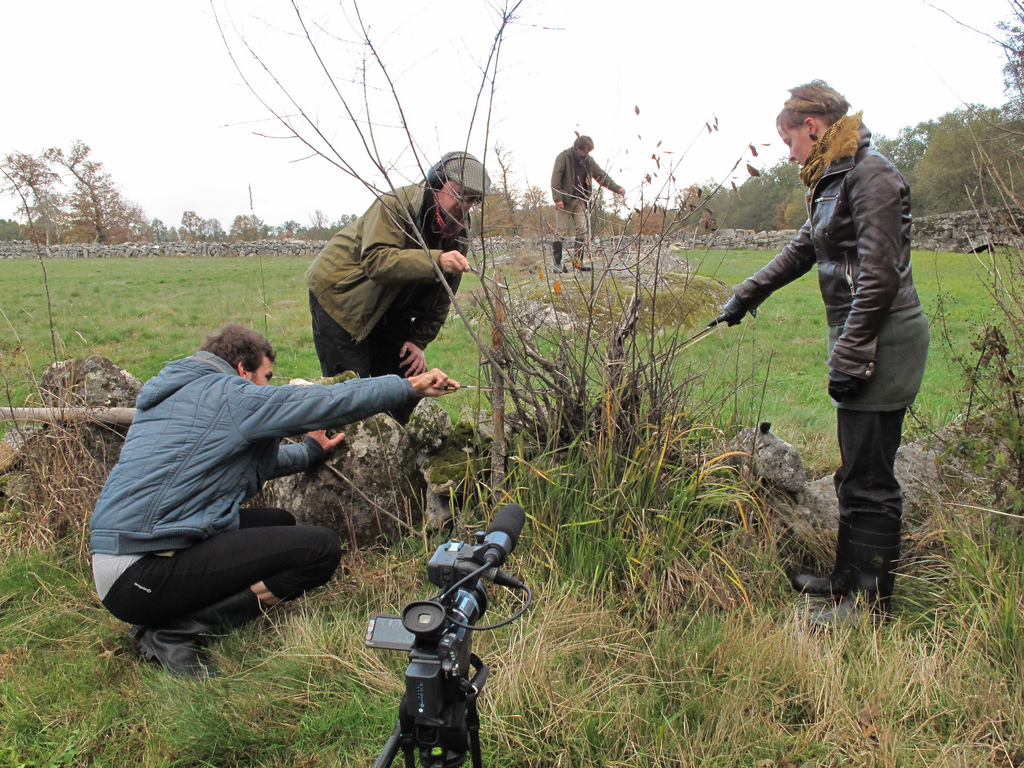
SPACE: Interaction with the geographic space. The landscape surrounding Nodar is beautiful and diverse; there are mountains, rivers, caves, slate stone architecture, terraced fields, and so much more. Moreover, we are witnessing an irreversible process of transformation of rural space. These two elements form fertile ground for the creation of works within nature, which either capture the dreamlike and timeless aspects of the landscape or question possible future uses for the same landscape.
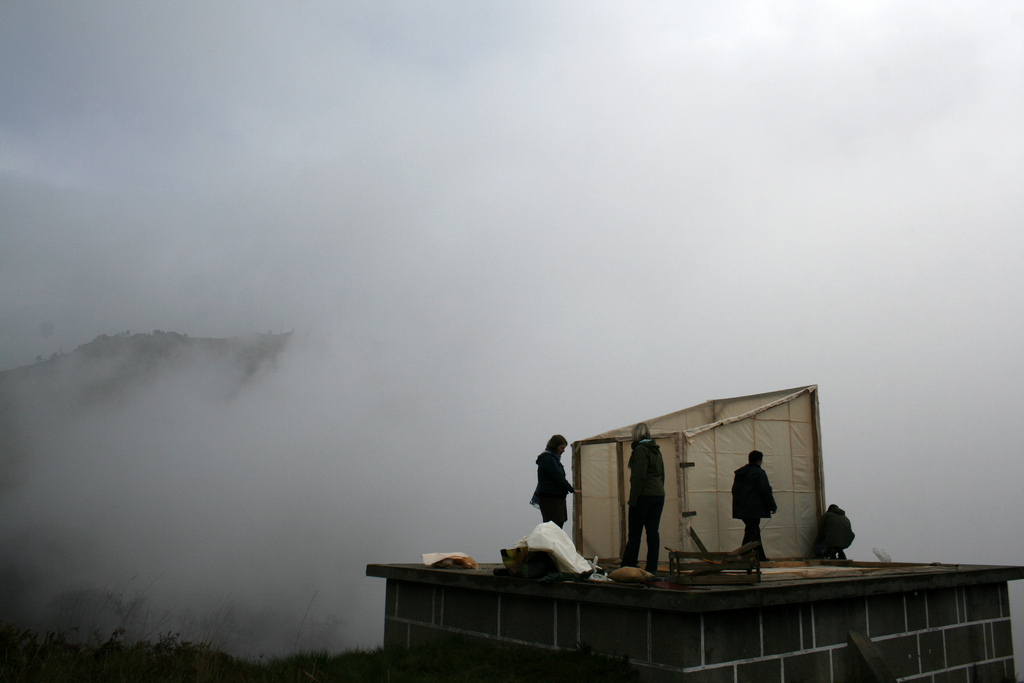
Of particular interest to us is the use of geography as a means for projecting sound in which specific variables of the territory, such as topography and meteorology, intersect with instrumental or subjective aspects of artistic creation, namely the position occupied in the space and the choice of sound recording and reproduction tools and techniques. A good example of this approach was Lisa Premke’s project “Aural Lookout,” developed in 2012, in which she built a canvas lookout on the top of a hill that allowed the visitors to be sheltered from the environment while listening to the nature sounds acoustically amplified, as if being inside a large drum.
PEOPLE: Interaction with local inhabitants. Since the beginning of our activities, we have been encouraging artists to interact, question and to some extent “provoke” local populations. As a result of these communication processes, various art projects have been developed reflecting and expressing aspects of the region’s collective memory and new habits and experiences.
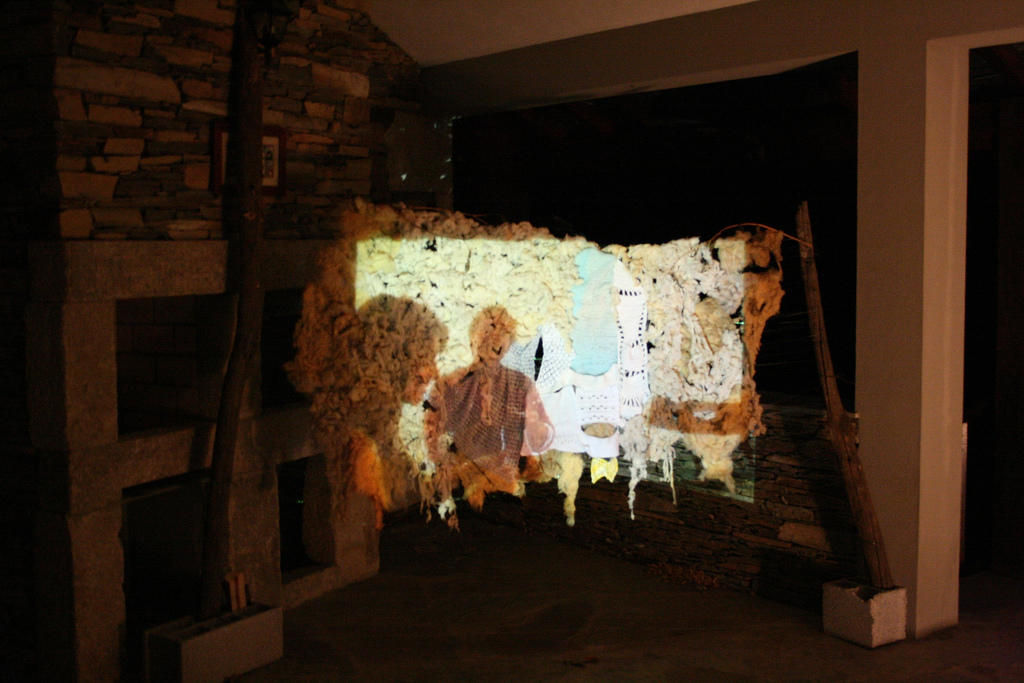
Working on the subject of the anthropological voice may involve direct conversation with the local communities based on topics proposed by the artists and related to everyday life and local memory, as well as it may focus on linguistic aspects such as accents, musicality of the voice, etc. Maile Colbert’s “Over the Eyes,” created in 2007, was a very successful example of this sort of “conversational” project, where she organized a knitting circle with the village women, recorded the conversations with them, their songs and stories and incorporated them into the sound design of a multimedia installation, along with field recordings of the area, and text on physiological, biological, and psychological aspects to memory creation and destruction in humans. The projection screen was composed of raw wool and the knitted cloths made during the circle, which created an interesting dialogue with the immaterial nature of the audiovisual element of the piece.
We have always emphasized a type of sound art that enhances the context within which a specific sound work is produced, escaping a purely acoustic, or “sound-in-itself” approach. We believe that this emphasis on subjectivity and context is necessary, because sound–and the practice of field recording in particular—sometimes carries a burden of “objectivity” because it stems from the documentation of reality. The subjectivity inherent to the sound recollection –for instance, the choice of the point of listening and of the technological means of sound capturing–is often not sufficient to alleviate this burden.
When we host sound artists in Nodar, we always try to convey the idea that the region’s landscape is fundamentally an “inhabited landscape.” Trying to avoid the human presence in order to get “wilder and more natural” recordings is purely illusory. The landscape is inhabited in several simultaneous ways: by the marks of historical occupation of the territory, by the existence of vital spaces for each inhabitant–often lying far beyond the boundaries of the villages–by the very presence of the artists and by the audiences of the art works’ final presentations.
In summary, there are several methodological, instrumental and aesthetic approaches that Binaural/Nodar is working to further in the area of sound art. These approaches are anything but sealed; intersections, complementarities, unions and differences exist, which make each work of art unique.
—
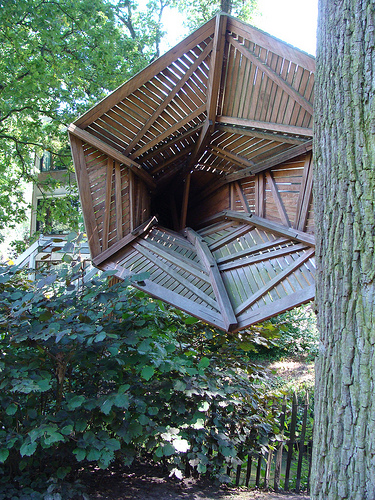
Featured Image: “Oor van Noach” by Flickr user ines saraiva under Creative Commons 2.0 License.
—
Rui Costa is a sound artist from Lisbon, Portugal. He is a founding member and artistic director of Binaural/Nodar, an arts organization founded in 2004 and dedicated to the promotion of context-specific and participatory art projects in rural communities of the Gralheira mountain range, northern Portugal. Rui has been performing and exhibiting his work since 1998 in festivals, galleries and museums across Portugal, Spain, Italy and the United States and has been collaborating regularly with the Italian vocal performer Manuela Barile and the American intermedia artist Maile Colbert. Rui Costa is also a regular speaker in conferences and gives workshops dedicated to sound art. For more from Binaural/Nodar, please check out the organization’s soundcloud, vimeo, and flickr.
—
Share this:




Current Top Posts





April 2021

January 2020

November 2019

October 2019

August 2019

April 2014

November 2017

March 2015

December 2017

October 2015


Recent Comments