
Listening to Modern Family’s Accent

**This piece is co-authored by Juan Sebastian Ferrada and Dolores Inés Casillas
DOI: https://doi.org/10.59350/kekr6-ptx85
Since debuting in 2009, American audiences have fallen in love with ABC’s Modern Family, a mockumentary comedy starring Ed O’Neill, Julie Bowen, and Colombian actress Sofía Vergara who plays the curvaceous, gorgeous, and ”accented” Gloria. Clearly a satirical comedy, the show presents three interrelated modern day versions of nuclear families. The patriarch Jay (O’Neill, formerly of Married With Children) marries Gloria, a much younger Latina who has an eleven-year-old son from her previous marriage (the wise-beyond-his-years Manny, played by Rico Rodriguez). The heterosexual suburban nuclear family is represented through Claire (Jay’s daughter, played by Bowen) and Phil (Ty Burrell) who have three children. The homosexual nuclear family is fashioned through the characters of Mitchell (Jay’s son, Jesse Tyler Ferguson), his partner Cameron (Eric Stonestreet) and their adoptive daughter, Lily, from Vietnam. The show follows the tried-and-true conventions of family sitcoms, complete with exaggerated portrayals of their characters and a feel good message delivered in 22 minutes. Our current fascination is Gloria—arguably the most popular character on the show (see her lucrative Pepsi deal here)—and the use of her “accent” to mark her Latina body. Visually audiences may be ogling over her curves, but it is her vocal body – her “accent,” tone, and staged grammatical blunders – that work to racialize her character as much as sexualize it.
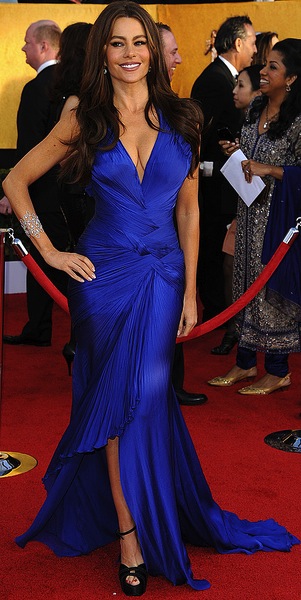
Vergara’s character Gloria hails from the same township of Barranquilla, Colombia as the actress herself. Despite her emerging star status in the U.S., Vergara is no stranger to Spanish-language television viewers. (Wilson Valentín-Escobar refers to such English-language media discoveries as “Columbus effects”). Vergara rose to fame through the immensely popular telenovela format and in recent years has gained popularity through various comedic roles type cast as the “sexy Latina.” Visually, the spitfire Latina is characterized by her red-painted lips, seductive clothing, curvaceous hips, long brunette hair, extravagant jewelry, and an inherent ability to dance. (See Priscilla Peña Ovalle’s fabulous SO! blog piece on Latinas, dance, and the “aural Otherness” of Rita Moreno). Vergara, in her personification of Gloria, embodies many of these attributes quite well. For instance, a natural blond, Vergara was forced to color her hair in order for American viewers to imagine her as an “appropriate” brown Latina.
In an equivalent vocal vein, Vergara showcases the required Spanish “accent.” Case in point, from the pilot episode:
Phil: Hi Gloria. How are you? Oh, what a beautiful dress.
Gloria: Ay, thank you Phil [Ph-eee-l].
Phil: Okay. [Proceeds to touch Gloria]
Claire: [Slaps Phil’s hand] No, honey. That’s how she says Phil. Not feel, Phil!
The communication mishap serves as the underlying funny because of Gloria’s accent and at the expense of Gloria’s body; her voice and her body are both subjected to gratuitous scrutiny. Phil, once again in episode 5 of season 1, does understand Gloria’s “accent” but seems to confuse the context. He greets Gloria upon arriving to his house to watch a football game:
Phil: Hey, for you! [Gives Gloria a bottle of wine] Nice to see you, Gloria. [Hugs Gloria]
Gloria: Two times today.
Phil: Okay. [Proceeds to hug her again]
Claire: Phil! She means we’ve seen them two times today.
In this case Phil is confused by Gloria’s inflection and repeatedly mistakes Gloria’s unintentional statements as personal invitations to her body. These acts sexualize and racialize Gloria as a desired “other” because of her apparent “accent.” Once again, repeated in this scene, Claire (Phil’s wife) is required to intervene or harness her husband’s sexual prowess by announcing what Gloria means, stripping Gloria of her voice to defend herself.

Perhaps most frustrating and audibly apparent feature of Gloria lies in her incessant grammatical errors scripted within her English-language lines. Yes, scripted. Vergara certainly has an audible “accent,” especially to Americans not accustomed to Latino-speak (although there are 35 million Latinos in the U.S.) or to those in denial that we all carry some sort of accent influenced by our social locations – class, race, and in this case, migration. But to Vergara’s own admission, she is bilingual and biliterate, which means the grammatical blunders that serve as punch lines or as a means of laughing at her, are largely owed to the script itself. Gloria’s grammar, like her “brown” hair, is an important false feature that helps make her a true Latina immigrant character.
Listeners have always struggled to make sense of one’s accent and speech style especially if the speaker’s body does not match stereotypical perceptions based on race and gender. A key study showed, for instance, that when participants were shown a recorded lecture by an Asian American woman voiced over with a white woman’s voice, they overwhelmingly insisted that the Asian American woman spoke with an Asian accent. A classic case of what sociolinguists refer to as “accent hallucination.” Listeners truly have a hard time believing what they hear or believe they hear.
In the case of comedian Margaret Cho, audiences laugh their heads off with her signature act – vocal reenactments of her immigrant Korean mother. Elaine Chun offers a brilliant analysis of Margaret Cho’s revoicings of her immigrant Korean mother (Chun refers to this as “Asian speech”). According to Chun, Cho’s comedic routines are not only incredibly funny but they offer a critique of racist mainstream ideologies precisely because Margaret Cho is read as an Asian American.
Which makes us wonder, how is Sofia Vergara read within a U.S. context and to non-Latino audiences? Ideally, folks would see her as a U.S. Latina role playing a recently arrived immigrant and offer viewers a critique of accented Latina spitfire. But alas, Vergara’s vocal performance of an immigrant Latina wrought with grammatical errors only helps her character Gloria become the quintessential racialized Other (or a true U.S. Latina).
—
D. Inés Casillas and Sebastian Ferrada
—
Share this:

New Wave Saved My Life*
*The title of this piece is inspired by the short story, “Minnie Riperton Saved My Life,” by the poet & playwright, Luis Alfaro.
DOI: https://doi.org/10.59350/p857y-r1676
(Shuffle)
I watch you breathe,
I cannot sleep,
I touch your hair,
I kiss your skin,
And hope the morning sun won’t wake you too soon.
For when you wake,
and look at me,
You never know,
you just might see,
Another boy who crept in your room…
Take your time…(that’s what you told me),
Take your time…
But I fell head first, and I just don’t know what to do—“Nothing Looks the Same in the Light,” Wham!
I was a teenager in the 80’s. I grew up in South East Los Angeles, Huntington Park, to be exact, H.P. for short—home of the Huntington Park Senior High Spartans and the local after game hangout, Spartan Burgers. In those years, almost everyone in my school was Mexican and most kids were either preppy or cholos or Florentine Gardens disco-types—almost no one was “alternative.” That is, until we caught our first glimpse of Boy George on Video One with Richard Blade – that MTV style video show that came before MTV. If you remember, or have YouTubed it recently, a key scene in the video for Culture Club’s “Do You Really Want to Hurt Me?” begins with Boy George stepping out of a swimming pool, fully clothed and dry (a lo-tech effect even by 80’s standards), wearing a flowing tunic, white-boy dreadlocks, and expertly applied makeup. I remember being instantly fascinated watching him dance to a reggae beat and hearing him sing so longingly about a mysterious “you.” I had never seen anyone who looked or sounded like that before, and I went from listening to my brothers’ heavy metal records, my mom’s cumbias, and my grandpa’s Beethovens to listening to Culture Club, Eurythmics, Wham!, and Bow Wow Wow almost overnight.
Soon after, I started noticing in my neighborhood sprinklings of pink, purple and green hair, spikey egg white mohawks, brown boys in skirts and makeup, and the girls from St. Mathias High wearing black chunky combat boots with their proper, pleated, Catholic school uniforms–my personal favorite look. And when I bought my very own first pair of 8-hole lace-up Doc Marten’s, I was forever transformed. I sensed that crossing fashion lines somehow meant crossing other lines too, although, I was perhaps I bit too young to really cross anything. As a questioning adolescent, I embraced the freedom that music, fashion, and expression represented. It’s strange to think about how such a global phenomenon took shape in my little eastside town. That time of 80’s new wave, the “Second British Invasion,” told me something about who I would become. I learned fearlessness from the bold and transgressive acts of fashion and wit my favorite gender bending pop stars regularly deployed on American network TV. And I learned to “tune in” to the sexually ambiguous language of songs like “Time Clock of the Heart” or “Nothing Looks the Same in the Light.” All of those blurred lines felt “normal” to me. And it meant later on that I didn’t have to have an identity crisis when I was coming out. And I really didn’t. I didn’t really think about “identity” in this way again until much later.
(Shuffle)
I’m only sad in a natural way
And I enjoy sometimes feeling this way
The gift you gave is desire
The match that started my fire—“The Paris Match,” The Style Council
As I copy and sometimes re-purchase 25-year old lost albums for my new e-music library, I’ve started to wonder about some of my musical choices. Why did I still like what I liked? How do I trace my musical habitus? Culture Club, George Michael, The Style Council – they’re all on my iPod right now. And I ask myself, is my musical taste really so wrapped up in what I perceived to be my pop idols’ alternative sexuality so long ago? In this post-gender, post-queer, post-race (rhetorically speaking), trans-border era, is there even such a thing as “alternative” anymore?
Because when I listen to those old songs now, part of me still “hears” the skillful crossing of gender lines in every ambiguously phrased lyric, like the Pet Shop Boys’ clever line, “Which do you choose, a hard of soft option?” And I recall vivid images of Annie Lennox at once crossing and keeping those lines in the video for “Who’s That Girl?” which ends with an impossibly queer kiss. (She queered the Lacanian mirror long before Black Swan!) I still sense how all of these wildly public expressions of queer desire, with all of its spectacle and taboo, flowed into my childhood home through the sturdy Zenith television set that brought us together to “listen” to music anew. And this kind of hearing has to do with a particular way of remembering my adolescence – the memory of how felt for the first time to hear those songs and see the images of Boy George winking his long painted lashes at the video camera, seriously putting pressure on the word “Boy”; or seeing George Michael dancing with Andrew Ridgley in the macho ditty “Wham Rap”, their two beautiful and stylish female band mates conspicuously superfluous in that dance. And also remembering how the combined effect put something like the question about boys on hold for me in a really powerful way. There were options out there, is what I understood, and that was all I needed to survive – to save my queer soul.
(Shuffle)
Don’t make me feel any colder
Time is like a clock in my heart
Touch we touch, was the heat too much?
I felt I lost you from the start
In time it could have been so much more
The time is precious I know
In time it could have been so much more
The time has nothing to show because
Time won’t give me time
And time makes lovers feel like they’ve got something real
But you and me we know they’ve got nothing but time–“Time Clock of the Heart,” Culture Club
But I also detect another kind of crossing, or rather, multiple crossings in those same songs. Somewhere between the funk inspired bass line of “Nothing Looks the Same in the Light” and the soulful oohs and ahs of Helen Terry’s backup vocals in “Time Clock of the Heart,” I sense this music also crossed a race and a class line, however precariously treaded. From the perspective of a young, working class Chicana, quickly interested in all things British and gay, it seemed to me that these young white British boys took up a mic and pen and left their own working class accents behind for the promise of America. Clearly raised on a diet of soul and R&B, their eventual collaborations with Luther Vandross, Stevie Wonder, and Mary J. Blige – American musical royalty – seemed only natural on the Grammy stage. And I wondered in my youthful, pop star fantasies, how did they feel when they learned they could sing like that? What did it mean to be queer and black at the same time? Musically speaking. What was the bigger transgression? Because the 80’s were deadly years for many of us, on both sides of the Atlantic, who were confronted with the authority of the lines drawn by Reagan, Thatcher, and AIDS. Maybe the transgression is to survive. And to remember.
Listening as an adult now to George Michael’s greatest hits collection Twenty Five, it is easy to see that there is no longer any doubt about his sexual orientation. In songs like “An Easier Affair,” he celebrates that he’s “dancing with the freaks now/I’m having so much fun/I do my dance with everyone.” So I wonder, when your pop idols sex lives stop being curiosities or taboo, what still fascinates? Even their notorious falls from grace, and their celebrated “come backs” didn’t really provoke the public imagination in the same way again. But I detect there are still clues in the music. In his brilliant cover of “Feeling Good,” George Michael pays humble homage to Nina Simone saying: “It’s a new day, it’s a new dawn, it’s a new life, it’s a new low/Oh we all know it’s too much to expect a man, a white man, to do it like Nina” (my emphasis). That simple musical gesture, a crossing of many sorts, tells me something about what she means to him. And I think that it has ever been and ever will be music that will save our collective souls… I was seventeen when I left HP for a much larger Los Angeles. In some ways I was too young to leave home and sometimes I thought that I didn’t survive some things that came my way. But I always had a song to guide me and show me something new–a different way. I know I’ll never fully rebuild my archive on something like iTunes. But as I contemplate my growing digital library, I really do believe that new wave saved my life.
(Shuffle)
Wanda Alarcon
Share this:




Current Top Posts





April 2021

January 2020

November 2019

October 2019

August 2019

April 2014

November 2017

March 2015

December 2017

October 2015


Recent Comments